
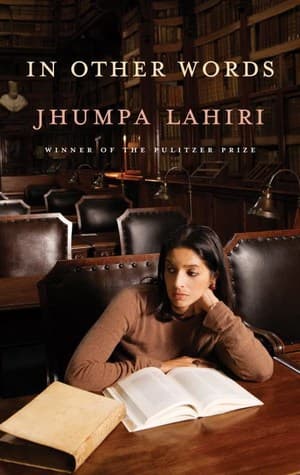
Core Idea
- Difficulty
- Medium
- Read it if
- You are a writer, a language learner, or anyone fascinated by the profound relationship between language, identity, and the creative process, and appreciate introspective, lyrical prose.
- Skip it if
- You prefer plot-driven narratives or practical guides to language learning, as this book is a reflective, internal journey rather than an instructional one.
Key Takeaways from In Other Words
The Allure of Linguistic Exile
Choosing a new language as a deliberate act of self-reinvention and artistic liberation.
Lahiri's Italian journey is not just about learning a skill; it is a deep, almost spiritual, search for a new identity. She purposely leaves the comfort and mastery of English, her first literary language, to accept the vulnerability and struggle of a foreign language. This act of language relocation is a necessary step for artistic growth, making her face the limits and possibilities of expression from a new view. It is a strong statement on how embracing discomfort can unlock hidden creative ability, suggesting that true new ideas often come from outside one's known skills.
“For me, writing in Italian is an act of courage, a leap into the unknown. It's a way of being reborn.”
In the book: Lahiri's decision to move to Rome with her family specifically to immerse herself in Italian, abandoning English as her primary language for reading and writing, even in her personal journal.
Try this: Identify an area of your life or work where you feel too comfortable or stagnant. Deliberately introduce a new, challenging element — a new tool, a different methodology, or even a completely unrelated skill — to disrupt your routine and foster new insights.
Related ideas: linguistic-exile, self-reinvention, creative-catalyst
The Writer's Vulnerability
Embracing imperfection and the struggle for expression as integral to the creative process.
Lahiri carefully details the frustration and humility that comes with learning to write in Italian. She is very aware of her language weaknesses, the words she cannot remember, the small details she misses. This constant state of being a 'beginner' is not a problem but a test, forcing her to simplify, to be more exact, and to find beauty in plainness. It challenges the idea of easy genius, instead showing the hard, often difficult, reality of artistic creation. Her journey shows that openness and the willingness to make mistakes are not weaknesses, but important parts of real artistic growth.
“To write in another language is to strip myself bare, to be a beginner again. It's to be constantly aware of what I cannot say, what I lack.”
In the book: Her detailed descriptions of struggling to find the right word, the grammatical errors she makes, and the constant feeling of being 'less articulate' than in English.
Try this: When undertaking a new creative endeavor, consciously allow yourself to produce imperfect drafts. View errors not as failures, but as data points guiding you towards improvement. Embrace the 'beginner's mind' and resist the urge for instant mastery.
Related ideas: creative-vulnerability, beginner-mindset, linguistic-struggle
The Intimacy of Language
How a language shapes perception and forges a unique, personal relationship with the world.
Lahiri shows language as more than a tool for talking; it is a close lens through which reality is seen and understood. Her growing connection with Italian changes how she sees Rome, its culture, and even her own inner world. Thinking and dreaming in Italian creates a new inner monologue, a 'secret garden' where her thoughts take on a different feel and rhythm. This idea highlights the deep, almost spiritual, connection one can form with a language, showing how it can become a part of one's identity and a unique way to self-discovery, far beyond just words and grammar.
“Italian is not just a language; it's a world, a way of seeing things. It has become a secret garden where I can wander.”
In the book: Her reflections on how Italian words carry different connotations than their English equivalents, and how this alters her understanding of concepts like 'loneliness' or 'belonging'.
Try this: Pay attention to the specific words you use in your daily internal monologue. How do they influence your mood or perception? Consider learning a few phrases in a new language and observe how they might subtly shift your perspective on everyday objects or feelings.
Related ideas: language-and-perception, cultural-immersion, self-discovery
The Shadow of the Mother Tongue
The persistent, complex relationship with one's original language, even in the pursuit of another.
Despite her deep immersion in Italian, Lahiri acknowledges the lasting presence of English, her first language. It is a 'shadow' that informs her new language efforts, sometimes offering comparison, sometimes resistance. This is not a rejection of English, but a recognition of its lasting mark on her identity and thought processes. The book suggests that one's original language is not easily forgotten; instead, it becomes a silent partner, a reference point against which the new language is constantly measured. This complex interaction shows the layered nature of identity, where new experiences do not erase the past but rather combine with it in unexpected ways.
“English, my mother tongue, is a shadow that follows me, a presence I cannot escape, even as I embrace Italian.”
In the book: The dual-language format of the book itself, where her Italian text is presented alongside its English translation, physically manifesting the constant dialogue between the two languages.
Try this: When learning something new, acknowledge the influence of your prior knowledge or habits. Instead of fighting them, try to understand how they might inform your new learning, identifying both helpful similarities and potential points of conflict.
Related ideas: mother-tongue, bilingualism, linguistic-identity
The Craft of Deliberate Practice
Mastery is a product of consistent, focused effort, not innate talent.
Lahiri's journey shows the power of deliberate practice. She does not wait for inspiration; she commits to daily writing in Italian, treating it as a strict discipline. This consistent, focused engagement, even when difficult or uninspired, is the true path to mastery. Her method shows that significant achievement in any field—whether language, art, or a professional skill—is rarely accidental. It is the result of showing up, doing the work, and keeping a persistent 'conversation' with the craft, slowly building skill through repetition and dedicated attention to detail.
“I write every day in Italian, even if it's just a few lines. It's a discipline, a constant conversation with the language.”
In the book: Her detailed account of filling journals with Italian prose, translating short stories, and actively seeking out Italian books to read, all as part of her daily routine.
Try this: Identify a skill you want to develop. Commit to a daily, focused practice session, even if it's brief. Track your progress and acknowledge the small improvements that accumulate over time, rather than waiting for a grand breakthrough.
Related ideas: deliberate-practice, mastery, discipline, consistent-effort
Finding a New Voice, Literally
The transformative experience of articulating oneself through a different linguistic medium.
Lahiri's exploration of Italian is not just about words; it is about finding a new 'voice.' She describes how her writing style in Italian differs from her English prose – it is more concise, perhaps less ornate, yet she feels a deep authenticity in it. This suggests that language is not just a way for existing thoughts, but actively shapes how those thoughts are formed and expressed. By shedding the stylistic habits of her first language, she uncovers a new part of her authorial self, proving that a change in medium can lead to a deeper, more refined understanding of one's own core message and artistic identity.
“In Italian, I am a different person, a different writer. My voice is thinner, more modest, but also perhaps more authentic.”
In the book: Her comparison of her English and Italian writing styles, noting the differences in sentence structure, word choice, and overall tone, and her feeling of being 'more herself' in the new language.
Try this: Experiment with expressing a familiar idea or story in a completely different format or medium (e.g., writing a poem instead of an essay, or drawing a concept instead of explaining it). Observe how the change in medium influences the message and your perception of it.
Related ideas: authorial-voice, linguistic-expression, authentic-self
The Power of Immersion
Full engagement in a new environment accelerates learning and deepens understanding.
Lahiri's decision to move her family to Rome shows the power of full immersion. By removing herself from the familiar comforts of English-speaking places, she forced herself into a 'trial by fire' where Italian became not just a subject of study, but the very air she breathed. This complete saturation, where every daily interaction, every sign, every thought had to be processed in Italian, proved to be the most effective way for true fluency and cultural fitting in. It highlights that deep learning often requires active, unavoidable engagement with the subject matter, pushing beyond casual encounters into a state of total commitment.
“Moving to Rome was a trial by fire, a sort of baptism. There was no turning back, no escape from Italian.”
In the book: Her account of only speaking Italian with her children and in daily errands, reading only Italian books, and refusing to revert to English even when frustrated.
Try this: When learning a new skill or subject, seek opportunities for deep immersion. This could mean dedicating a specific period solely to that pursuit, joining a community where it's the primary mode of communication, or creating an environment where you are constantly exposed to it.
Related ideas: immersion-learning, cultural-assimilation, accelerated-learning
The Endless Pursuit of Perfection
True mastery is a continuous journey, not a fixed destination.
Lahiri admits that despite her dedication, she will never achieve the effortless, intuitive fluency of a native Italian speaker. This acceptance of constant imperfection is not giving up; rather, it redefines the pursuit of mastery as an ongoing, changing process. The 'gap' between her and native fluency becomes the very space where her unique artistic work resides. It is a reminder that striving for an unattainable ideal can be a strong reason for continuous growth, and that the beauty often lies in the journey of constant refinement and the unique view gained from being an 'outsider' looking in, rather than in reaching a final goal.
“I will never be a native speaker. The distance will always be there, a small gap I can never fully close. But that gap is also where the work is.”
In the book: Her introspective reflections on the subtle linguistic nuances she still misses, the occasional grammatical errors she makes, and her self-awareness of her non-native accent.
Try this: In your own pursuits, shift focus from achieving a perfect 'end state' to embracing the continuous process of learning and improvement. Find value and unique insights in the ongoing effort, rather than solely in the outcome.
Related ideas: continuous-improvement, mastery-journey, perpetual-learning
Language as a Living Entity
Understanding language as an organic, evolving force, not a static set of rules.
Lahiri treats Italian not as a strict system to be memorized, but as a living thing with its own personality and moods. She speaks of its 'desires and moods,' showing that true fluency goes beyond grammar and words to an intuitive understanding of its spirit. This view encourages a more natural, less rigid way to learn languages and, indeed, any complex system. It suggests that deep engagement requires a willingness to feel and adapt to its inherent flow, rather than simply imposing external rules upon it. This creates a deeper, almost empathetic, connection to the subject.
“Italian, like any language, is a living thing. It breathes, it changes, it has its own desires and moods.”
In the book: Her descriptions of how certain Italian phrases 'feel' to her, or how the language itself seems to guide her writing in unexpected directions.
Try this: When learning or working with a complex system (e.g., a programming language, a musical instrument, a team dynamic), try to perceive it as having its own logic and flow. Instead of rigidly forcing your will, observe its natural tendencies and adapt your approach accordingly.
Related ideas: organic-learning, language-spirit, intuitive-understanding
In Other Words Quotes
“Living in a foreign country is like being a child again. You have to learn everything from scratch.”
“I want to be able to express myself, to feel truly myself, in another language. It's an almost childish desire, but it's also a profound one.”
“The feeling of being an outsider, of being between two worlds, is something I've always known. But in Italy, it's different.”
“To write in another language is to be a beginner again. To accept the awkwardness, the mistakes, the slowness.”
“A new language is a new life. It's a rebirth, a reinvention.”
“I am a writer who writes about language. I am a writer who writes in language. I am a writer who writes to understand language.”
“The greatest challenge is not to speak perfectly, but to speak truly.”
“Every word I learn is a small victory. Every sentence I construct is a small act of creation.”
“To surrender to a language, to let it take hold of you, is a brave act.”
“Silence is the space where language begins. It's where the desire for expression is born.”
“The book itself is an attempt to inhabit another language, to be inside it, to live within its walls.”
“I am learning that to write in another language is to reveal a different self, a self I did not know existed.”
“My relationship with Italian is a love story. A difficult, demanding, but ultimately rewarding one.”
“The page is a mirror. What I see there is not always what I expect.”
Quiz
10 questions on the main ideas. Each answer comes with a short explanation.
Question 1
What was the primary language Jhumpa Lahiri decided to immerse herself in, leading to the writing of 'In Other Words'?
- French
- Spanish
- Italian
- Latin
Show answer
C. Italian The book details Lahiri's deep immersion in Italian, a language she pursued with passion and obsession.
Question 2
Where did Jhumpa Lahiri and her family move in 2012 to achieve full immersion in her chosen language?
- Florence
- Venice
- Rome
- Milan
Show answer
C. Rome To achieve full immersion, Lahiri moved to Rome with her family in 2012, viewing it as 'a trial by fire, a sort of baptism.'
Question 3
What is 'In Other Words' primarily described as being at its heart?
- A historical account of Italian literature
- A travel guide to Rome
- A love story—of a writer for another language
- A critique of language education methods
Show answer
C. A love story—of a writer for another language The description explicitly states, 'In Other Words is at heart a love story—of a long and sometimes difficult courtship, and a passion that verges on obsession: that of a writer for another language.'
Question 4
What was Lahiri's initial experience with Italian that 'captivated and capsized' her?
- Reading an Italian novel
- A trip to Florence after college
- Meeting an Italian speaker
- Taking an Italian language class
Show answer
B. A trip to Florence after college Her initial captivation with Italian occurred during 'a trip to Florence after college.'
Question 5
How did Lahiri begin to write in Italian after moving to Rome?
- By immediately publishing short stories
- Initially in her journal, solely in Italian
- Translating her previous English works
- Collaborating with Italian co-authors
Show answer
B. Initially in her journal, solely in Italian In Rome, she 'began to read, and to write—initially in her journal—solely in Italian.'
Question 6
The book 'In Other Words' is presented in what specific format?
- Audiobook only
- Dual-language format
- Illustrated graphic novel
- Monolingual Italian
Show answer
B. Dual-language format The text explicitly states it is 'Presented in a dual-language format,' allowing readers to engage with both the Italian original and its English translation.
Question 7
The book investigates the process of learning to express oneself in another language and describes the journey of a writer seeking what?
- Financial independence
- A new publishing contract
- A new voice
- A permanent residence permit
Show answer
C. A new voice The book 'describes the journey of a writer seeking a new voice' through her linguistic immersion.
Question 8
The book is described as a 'startling act of self-reflection' and a provocative exploration of what two key themes?
- Politics and economics
- Belonging and reinvention
- History and geography
- Science and technology
Show answer
B. Belonging and reinvention The book is noted as 'a provocative exploration of belonging and reinvention,' reflecting the personal transformation Lahiri undergoes.
Question 9
The intensity and clarity of Lahiri's writing in 'In Other Words' is compared to which other author?
- Ernest Hemingway
- Virginia Woolf
- Vladimir Nabokov
- Gabriel García Márquez
Show answer
C. Vladimir Nabokov The text states the book is 'written with an intensity and clarity not seen since Nabokov,' drawing a specific literary comparison.
Question 10
Beyond linguistic immersion, what broader concept does 'In Other Words' explore, particularly in relation to the author's experience?
- The challenges of international diplomacy
- The economics of book publishing
- Exile, linguistic and otherwise
- The history of the Italian language
Show answer
C. Exile, linguistic and otherwise The description highlights that it is 'a book about exile, linguistic and otherwise,' indicating a deeper exploration of displacement and identity.
In Other Words FAQ
What is 'In Other Words' by Jhumpa Lahiri about?
'In Other Words' is a memoir by Jhumpa Lahiri that explores her profound journey of learning and immersing herself in the Italian language. It details her move to Rome with her family to achieve linguistic mastery and her experience of writing exclusively in Italian, delving into themes of identity, exile, and reinvention.
Does moving to a foreign country really help with language acquisition, as shown in the book?
Yes, 'In Other Words' strongly suggests that full immersion, like moving to a foreign country, can be incredibly effective for language acquisition. Lahiri describes her relocation to Rome as a 'trial by fire' that pushed her towards true mastery and a deeper understanding of Italian.
What is the 'dual-language format' of 'In Other Words'?
The dual-language format means the book presents Lahiri's original Italian text alongside its English translation. This allows readers to experience her journey of writing in Italian directly and observe the nuances of her expression in both languages.
How is 'In Other Words' different from other memoirs about language learning?
'In Other Words' stands out because it's not just about learning a language, but about a celebrated writer's profound struggle and eventual reinvention through another tongue. It's an autobiographical work written in the very language she's exploring, offering an intimate, intellectual, and intensely personal look at linguistic exile and creativity.
Who would enjoy reading 'In Other Words'?
Readers interested in memoirs, creativity, language learning journeys, and the works of Jhumpa Lahiri will find 'In Other Words' compelling. It also appeals to those fascinated by themes of identity, belonging, and the challenges of cultural and linguistic immersion.
What role does 'exile' play in Jhumpa Lahiri's 'In Other Words'?
Exile in 'In Other Words' refers to both a physical relocation and a linguistic displacement. Lahiri explores the feeling of being an outsider in a new language, the struggle to find her voice, and the profound sense of reinvention that comes with stepping away from her native tongue and established literary identity.
Is 'In Other Words' suitable for Italian language learners?
Yes, due to its dual-language format, 'In Other Words' can be an excellent resource for Italian language learners. It allows them to read authentic Italian prose by a masterful writer and immediately compare it with the English translation, aiding comprehension and vocabulary acquisition.
What motivated Jhumpa Lahiri to write 'In Other Words' in Italian?
Lahiri's motivation stemmed from her deep passion and obsession with Italian, which she felt she hadn't fully mastered. Writing the book solely in Italian was part of her immersive 'baptism' into the language, a way to fully commit to and embody her linguistic journey and find a new writerly voice.
About the author

Nilanjana Sudeshna "Jhumpa" Lahiri is a Bengali American author known for her short stories, novels, and essays in English and, more recently, in Italian.
Similar books
- The Writing Life
Annie Dillard
4.0 (13k) average on GoodreadsBiographyOffers a meditative look into the struggles and joys of the writing process and creative existence.
- Eat, Pray, Love
Elizabeth Gilbert
3.6 (1.5M) average on GoodreadsLifestyleA heartbroken writer leaves her conventional life for a year-long global search for pleasure in Italy, spiritual devotion in India, and unexpected love and balance in Bali.
- Wild: From Lost to Found on the Pacific Crest Trail
Cheryl Strayed
4.0 (615k) average on GoodreadsLifestyleAfter losing her mother and her marriage, a young woman impulsively hikes over a thousand miles of the Pacific Crest Trail alone, finding strength and healing in the unforgiving wilderness.
- Into Thin Air: A Personal Account of the Mount Everest Disaster
Jon Krakauer
4.2 (395k) average on GoodreadsLifestyleOn May 10, 1996, ambition and a sudden, violent storm turned Mount Everest into a deadly trap, leaving Jon Krakauer to tell the harrowing story of a disaster that took lives and shattered climbers' dreams.
- On The Road
Jack Kerouac
3.6 (349k) average on GoodreadsLifestyleDean Moriarty and Sal Paradise go on a wild, cross-country trip with jazz, drugs, and a desperate search for meaning on America's post-war roads.
- A Walk in the Woods: Rediscovering America on the Appalachian Trail
Bill Bryson
4.1 (346k) average on GoodreadsLifestyleBill Bryson humorously describes his ill-prepared yet insightful attempt to hike the Appalachian Trail, meeting unique characters and the raw beauty of the wilderness.





Enjoyed the summary?
A summary gives you the shape of the book. The book itself has the detail, the examples and the voice.
Find In Other Words on AmazonAs an Amazon Associate, BookBrief earns from qualifying purchases. How we're funded