
Core Idea
- Difficulty
- Medium
Key Takeaways from In the Garden of Beasts
The Peril of Gradualism
How incremental shifts in power and human rights can mask catastrophic future threats.
Larson shows how the Nazi regime gained power not through a sudden takeover, but by slowly eroding democratic norms and human rights. William Dodd, the American ambassador, arrived in Berlin in 1933, seeing a Germany still dealing with its post-WWI identity. However, the legal persecution of Jews, the suppression of dissent, and Hitler's consolidation of power happened gradually. Dodd's early reports, though increasingly worried, struggled to convey the full danger because each act, by itself, could be excused or ignored by an indifferent State Department. This gradual process is the book's main insight, showing how a society can be led into disaster step-by-step, making it hard for observers to understand the true path until it is too late.
“It was as if the German populace, in its yearning for order and national pride, willingly traded away fundamental freedoms, one small concession at a time.”
In the book: The book details the initial boycott of Jewish businesses in April 1933, followed by the Law for the Restoration of the Professional Civil Service, then the burning of books, and the establishment of concentration camps – each a distinct, yet connected, escalation.
Try this: Modern societies must be vigilant against incremental changes that erode democratic institutions or human rights. Any 'small' concession, if unchallenged, can pave the way for more significant abuses. Citizens and leaders should critically assess the long-term implications of seemingly minor policy shifts.
Ambassador Dodd's Unheeded Cassandra
The tragic failure of the U.S. State Department to recognize and act upon early warnings of Nazi brutality.
Larson details Ambassador Dodd's increasingly desperate efforts to warn Washington about the growing horrors in Nazi Germany. Dodd, a history professor, was perhaps uniquely able to recognize the historical patterns and likely direction of Hitler's regime. His reports described the systematic persecution of Jews, the violence of the SA, and the chilling words of Nazi leaders. Yet, the State Department, under Cordell Hull, often saw Dodd as an amateur, an idealist, or simply too alarmist. Their focus remained on maintaining trade relations and avoiding involvement, leading to a deep underestimation of the danger Hitler posed. This points to a problem in diplomatic systems: the tendency to prioritize established rules and economic interests over urgent moral warnings, especially when those warnings challenge existing beliefs.
“Dodd's warnings, often dismissed as the overreactions of an academic, fell on deaf ears in a State Department more concerned with economic stability and traditional diplomacy.”
In the book: Dodd's frequent, detailed telegrams to Washington, contrasted with the State Department's slow, often dismissive responses and their focus on minor diplomatic niceties while significant atrocities unfolded.
Try this: Leaders and policymakers must cultivate a culture that values diverse perspectives and challenges conventional wisdom, especially when confronted with uncomfortable truths from those on the front lines. Ignoring early warnings, even if seemingly 'unconventional,' can have catastrophic global consequences.
The Allure and Deception of Early Nazism
How the initial 'glamour' of the Third Reich captivated some, including Martha Dodd, before its true horror emerged.
One of the most compelling and disturbing parts of the book is the portrayal of Martha Dodd, Ambassador Dodd's daughter. Initially, Martha, a free-spirited socialite, is drawn to the energy of the 'New Germany.' She finds Nazi officials, particularly Rudolf Diels, charming and intelligent, and is attracted to the perceived national renewal. Larson shows how the regime skillfully presented an image of order, progress, and national pride, hiding its darker intentions. This period of 'enchantment' for Martha, and for many Germans and foreign observers, shows how easily a charismatic movement, even one based on dangerous ideas, can at first attract and blind people to its true nature. It is a strong reminder that evil does not always appear in an obvious, monstrous form but can first seem appealing and even progressive.
“For a brief, unsettling period, Berlin under Hitler presented a dazzling facade of renewed national pride, vibrant culture, and charismatic leaders, drawing in even skeptical observers.”
In the book: Martha Dodd's numerous affairs with high-ranking Nazi officials, her initial enthusiasm for the 'new' Germany, and her descriptions of the vibrant social scene in Berlin, all juxtaposed against the growing evidence of brutality.
Try this: Be wary of charismatic movements that promise radical solutions or national renewal, especially when they simultaneously suppress dissent or target minority groups. True progress rarely comes at the expense of fundamental human rights or freedoms. Critical thinking and skepticism are essential antidotes to such allure.
The 'Night of the Long Knives' as a Turning Point
The June 1934 purge solidified Hitler's power and revealed the regime's capacity for ruthless, internal violence.
Larson describes the 'Night of the Long Knives' in June 1934, when Hitler purged the SA leadership, including Ernst Röhm, and other political enemies. This event is a turning point for the Dodds, especially for Martha, who knew some of the victims. The brutality and speed of the killings, carried out without trial, shattered any remaining illusions about the 'legal' or 'orderly' nature of the Nazi regime. It showed Hitler's ruthlessness and his willingness to use extreme violence to consolidate power, even against his former allies. This event marked the clear shift from a regime using legal means to one openly embracing terror and extrajudicial murder, sending a clear, terrifying message to both internal and external observers.
“The slaughter of June 30th was a chilling declaration: Hitler would tolerate no rivals, no dissent, and no internal opposition. It was a clear signal of the regime's boundless capacity for murder.”
In the book: The detailed narrative of the purge, including the sudden arrests, executions, and the subsequent official justifications, which Dodd immediately recognized as a fabrication.
Try this: Understand that internal purges and the elimination of rivals, even within an authoritarian system, are often precursors to wider, more aggressive acts of violence. Such events reveal the true, unconstrained nature of a regime and should be taken as grave warnings.
The Bizarre Personalities of the Third Reich
Larson's character studies reveal the unsettling mix of banality, charm, and monstrousness among Nazi leaders.
Larson brings the key figures of the Nazi regime to life through the Dodds' interactions, showing them not as simple villains, but as complex, often contradictory individuals. Hermann Goering, with his love for opulent uniforms, pet lions, and country estates, appears almost comically grotesque, yet he was a ruthless architect of the regime. Joseph Goebbels, initially seen as charming and intelligent by Martha, quickly reveals his sinister ability for propaganda and manipulation. Even Rudolf Diels, the first Gestapo chief, shows surprising moments of decency towards Martha, complicating a simple 'evil' narrative. This nuanced portrayal is important, as it reminds us that monstrous acts are often committed by individuals who can also display 'normal' human traits, making their cruelty all the more chilling and harder to understand at first.
“Goering, with his bizarre costumes and love for animals, Goebbels, the charming intellectual capable of such venomous propaganda – the Nazis were a collection of unsettling contradictions.”
In the book: Martha's personal encounters with Goering, Goebbels, and Diels, including social invitations, conversations, and observations of their personal lives and public personas.
Try this: Be wary of judging individuals solely by their public image or initial charm. True character is revealed through actions, especially when power is involved. Understanding the human dimension of perpetrators can help in recognizing similar patterns in future conflicts.
The Burden of Moral Witness
Ambassador Dodd's personal struggle with the moral weight of witnessing atrocities while constrained by diplomatic protocol.
Larson highlights the immense personal and professional burden Ambassador Dodd carried. He was a man of principle, deeply disturbed by the persecution of Jews and the dismantling of democracy he witnessed daily. His internal conflict between his moral conscience and his diplomatic duties is clear. He understood the seriousness of the situation far better than his superiors in Washington, but his hands were often tied by bureaucracy, budget cuts, and a State Department unwilling to confront Germany. This struggle shows the ethical challenges faced by individuals in power who know about unfolding crises but lack the authority or support to act decisively. Dodd's story is a poignant example of the loneliness of the moral witness, especially when their warnings are ignored.
“He felt a profound moral obligation to speak out, yet his every diplomatic move was constrained by the cautious, often indifferent, dictates of Washington.”
In the book: Dodd's private diary entries, his increasingly urgent and frustrated communications with Washington, and his personal distress over the events he observed.
Try this: Individuals in positions of influence have a moral obligation to speak out against injustice, even when it is professionally inconvenient or personally risky. Supporting and listening to those who bear witness, especially from within authoritarian states, is crucial for international accountability.
The Cost of Isolationism and Indifference
America's reluctance to engage with European affairs contributed to its delayed recognition of the Nazi threat.
Larson demonstrates how American isolationist tendencies, still strong after WWI and worsened by the Great Depression, significantly hindered the U.S. response to Hitler. The State Department's main concerns were economic recovery and avoiding foreign entanglements, leading them to downplay Dodd's urgent warnings. This indifference, partly from a desire for neutrality and partly from a lack of understanding of the unique threat posed by Nazism, meant that crucial years were lost. The book suggests that a more involved American foreign policy, even in 1933-1934, might have altered history, or at least provided a clearer understanding of the impending catastrophe much sooner. This argument has limits, as direct intervention might have been politically impossible, but the cost of non-engagement is starkly clear.
“The prevailing American sentiment of isolationism, coupled with the Great Depression's demands, created a dangerous blind spot to the brewing storm in Europe.”
In the book: The State Department's consistent refusal to allocate sufficient funds or diplomatic support to Dodd, their dismissal of his concerns as 'alarmist,' and their prioritization of economic agreements with Germany.
Try this: Nations must balance domestic priorities with international responsibilities. Ignoring global threats, even those seemingly distant, can have devastating long-term consequences. Active engagement and diplomacy are essential to addressing rising authoritarianism.
The Personal Toll of Proximity to Evil
Living amidst the rise of Nazism profoundly impacted the Dodd family, transforming their perspectives and relationships.
Beyond the political narrative, Larson explores the deep personal toll that living in Hitler's Berlin took on the Dodd family. Martha, initially attracted by the glamour, eventually became a disillusioned observer, her relationships with Nazi officials ending in betrayal or horror. William Dodd himself aged visibly, his health deteriorating under the stress of his unheeded warnings and the constant exposure to brutality. Even his wife, Matilda, and son, William Jr., struggled with the moral ambiguities and dangers of their situation. The book shows how individuals, even those with initial optimism or detachment, can be irrevocably changed by prolonged proximity to systemic evil and violence, losing their innocence and facing profound moral dilemmas.
“The garden of beasts consumed them, transforming their initial naiveté into a profound and lasting horror.”
In the book: Martha's emotional journey from infatuation to revulsion, Dodd's physical decline and increasing despair, and the family's growing sense of isolation and danger in Berlin.
Try this: Recognize the psychological and emotional impact of living in or observing oppressive regimes. Empathy and support for those who have experienced such environments are crucial. It also highlights the importance of self-care and maintaining one's moral compass in challenging circumstances.
The Normalization of Atrocity
How everyday life continued in Berlin even as horrific events unfolded, creating a chilling sense of normalcy.
Larson repeatedly contrasts the brutal events of the Nazi regime with the seemingly mundane aspects of daily life in Berlin. The Dodds attend lavish parties, go to the opera, and enjoy social gatherings, even as reports of torture, murder, and the systematic persecution of Jews become undeniable. This chilling contrast shows how ordinary life can persist, even thrive, alongside unspeakable horrors. For many Germans and foreign residents, the desire for stability, the fear of reprisal, or simply the human capacity for denial allowed them to compartmentalize the escalating violence. This insight is crucial for understanding how societies can adapt to and even tolerate extreme forms of injustice, making it harder for external forces to intervene.
“Life in Berlin, for many, continued with its cafés, concerts, and social gatherings, even as the screams from concentration camps grew louder and the rights of citizens vanished.”
In the book: Descriptions of social events, diplomatic dinners, and Martha's romantic escapades occurring simultaneously with the SA's street violence, the establishment of Dachau, and the book burnings.
Try this: Be critically aware of how societies can normalize injustice. Do not allow the comforts of everyday life to blind you to the suffering of others or the erosion of fundamental rights. Actively seek out information beyond official narratives and challenge complacency.
Quiz
10 questions on the main ideas. Each answer comes with a short explanation.
Question 1
Who was the American ambassador to Hitler's Germany in 1933, as depicted in the book?
- William E. Dodd
- Rudolf Diels
- Joseph Goebbels
- Hermann Goring
Show answer
A. William E. Dodd William E. Dodd was appointed as America's first ambassador to Hitler's Germany in 1933.
Question 2
What year does the book primarily focus on as a turning point in history?
- 1930
- 1933
- 1936
- 1939
Show answer
B. 1933 The book highlights 1933 as a significant turning point in history related to Hitler's rise to power.
Question 3
Which member of the Dodd family became romantically involved with prominent figures in the Third Reich?
- William E. Dodd
- Dodd's wife
- Dodd's son
- Martha Dodd
Show answer
D. Martha Dodd Martha Dodd, the daughter of Ambassador Dodd, had several affairs with men in the Third Reich.
Question 4
Who was the first chief of the Gestapo that Martha Dodd had an affair with?
- Hermann Goring
- Joseph Goebbels
- Rudolf Diels
- Adolf Hitler
Show answer
C. Rudolf Diels Rudolf Diels, the first chief of the Gestapo, was one of Martha Dodd's romantic interests.
Question 5
What major concern did Ambassador Dodd repeatedly try to convey to the State Department?
- The economic prosperity of Germany
- The growing persecution of Jews
- The strength of the German military
- The popularity of the Nazi party
Show answer
B. The growing persecution of Jews Dodd's dispatches to the State Department increasingly focused on his alarm regarding the persecution of Jews in Germany.
Question 6
The book describes the atmosphere of the period as suffused with what?
- Optimism and innovation
- Economic hardship and unrest
- Tension and intrigue
- Cultural renaissance and freedom
Show answer
C. Tension and intrigue The narrative emphasizes the tense atmosphere of Berlin in 1933, filled with intrigue and growing unease.
Question 7
Which historical figure is described as 'expectedly charming—yet wholly sinister'?
- Hermann Goring
- Adolf Hitler
- Rudolf Diels
- Joseph Goebbels
Show answer
D. Joseph Goebbels Joseph Goebbels, the Nazi propaganda minister, is portrayed with this duality of charm and sinister intent.
Question 8
What event is mentioned as revealing Hitler's true character and ruthless ambition?
- The signing of the Munich Agreement
- A climactic spasm of violence and murder
- The Berlin Olympics
- The Reichstag fire
Show answer
B. A climactic spasm of violence and murder The book concludes that a significant outbreak of violence and murder in the latter part of the year exposed Hitler's true nature.
Question 9
The book suggests that the world did not recognize the grave threat posed by Hitler until what point?
- Until he consolidated full power in 1934
- Until the invasion of Poland
- Until Berlin and Europe were awash in blood and terror
- Until the Kristallnacht pogrom
Show answer
C. Until Berlin and Europe were awash in blood and terror The narrative posits that the full extent of Hitler's threat was tragically unrecognized until widespread violence and terror engulfed Europe.
Question 10
What was the primary characteristic of William E. Dodd before becoming ambassador?
- A seasoned diplomat
- A military strategist
- A mild-mannered professor
- A wealthy industrialist
Show answer
C. A mild-mannered professor William E. Dodd is described as a mild-mannered professor from Chicago before taking on the role of ambassador.
In the Garden of Beasts FAQ
What is "In the Garden of Beasts" about?
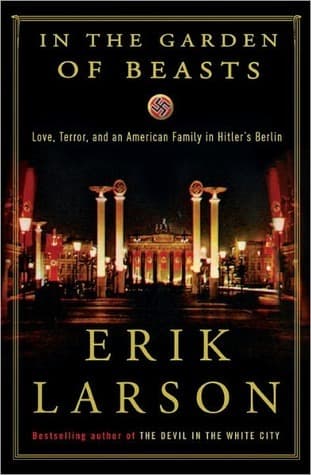
"In the Garden of Beasts" by Erik Larson tells the story of William E. Dodd, America's first ambassador to Nazi Germany in 1933. It chronicles his family's experiences in Berlin as they witness the rise of Hitler and the escalating persecution of Jews.
Who was William E. Dodd?
William E. Dodd was a mild-mannered history professor from Chicago who became the first American ambassador to Hitler's Germany in 1933. The book focuses on his experiences and observations during this tumultuous period.
What role did Martha Dodd play in the book?
Martha Dodd, William E. Dodd's daughter, is a central figure in the narrative. Initially captivated by the allure of Nazi Germany, she becomes involved with prominent figures of the Third Reich, including Rudolf Diels, the first chief of the Gestapo. Her experiences reflect the initial fascination and later disillusionment with the regime.
What historical events are covered in "In the Garden of Beasts"?
The book covers the critical year of 1933 in Berlin, detailing the early stages of Hitler's consolidation of power, the increasing persecution of Jews, the censorship of the press, and the drafting of new discriminatory laws. It captures the atmosphere as the world began to grasp the true nature of the Nazi regime.
What is the significance of the year 1933 in the book?
The year 1933 is depicted as a turning point in history, marking the beginning of Hitler's ascent to absolute power and the initial, yet alarming, signs of the atrocities that would follow. It's the year Dodd arrives and begins to witness the changes firsthand.
How does the book portray the atmosphere of Berlin in 1933?
Larson vividly portrays Berlin in 1933 as a city of both outward excitement and growing unease. It was a time of parties and pomp, but also of increasing political tension, intrigue, and the chilling reality of anti-Semitic policies taking root.
What is the book's perspective on the international community's awareness of Hitler's threat?
The book suggests that the international community, including the U.S. State Department, was largely indifferent or slow to recognize the grave threat posed by Hitler and the Nazi regime, even as evidence mounted.
Who are some notable figures from the Third Reich featured in the book?
Besides Hitler, the book features vivid portraits of other key Nazi figures, including Hermann Göring and Joseph Goebbels, offering insights into their personalities and roles during that era.
What does "In the Garden of Beasts" reveal about the complexity of the period?
The book highlights the surprising nuance and complexity of the era, showing how initial fascination and diplomatic engagement coexisted with growing alarm and the unfolding of horrific events.
Is "In the Garden of Beasts" a fictional story or non-fiction?
"In the Garden of Beasts" is a work of narrative non-fiction, meticulously researched and presented in a compelling, story-like manner.
About the author

Erik Larson is an American author known for his narrative non-fiction works that blend history with compelling storytelling. His notable books include "The Devil in the White City," which examines the 1893 Chicago World's Fair alongside a serial killer's activities, and "In the Garden of Beasts," focusing on an American family in Nazi Germany. Other significant titles include "Dead Wake," about the sinking of the Lusitania, and "Thunderstruck," which intertwines the stories of a murder and the invention of wireless communication.
Similar books
- The Rise and Fall of the Third Reich: A History of Nazi Germany
William L. Shirer
4.2 (101k) average on GoodreadsPoliticsWhile both books cover the rise of Nazi Germany, Shirer's work is a monumental, comprehensive historical account, offering a panoramic view of events, policies, and military campaigns. Larson's 'In the Garden of Beasts' is far more intimate and focused, providing a micro-history through the lens of a single American family's experience in Berlin. Shirer provides the 'what,' 'when,' and 'why' on a grand scale, while Larson offers the 'how it felt' and 'how it appeared' from a specific, personal vantage point during the early years.
- 1984
George Orwell
4.2 (3.1M) average on GoodreadsPoliticsIn a future where surveillance and thought control are absolute, a man's search for truth clashes with the Party, showing that hope can be a form of rebellion.
- Animal Farm
George Orwell
4.0 (2.7M) average on GoodreadsPoliticsA farm animals' rebellion against humans turns into a pig-led dictatorship, showing how power corrupts and revolutionary ideals are betrayed.
- Freakonomics: A Rogue Economist Explores the Hidden Side of Everything
Steven D. Levitt
4.0 (709k) average on GoodreadsBusinessThis book uses economic principles to reveal the surprising incentives behind everything from drug dealing and real estate to cheating teachers and the decline of crime.
- I Am Malala: The Story of the Girl Who Stood Up for Education and Was Shot by the Taliban
Malala Yousafzai
4.1 (419k) average on GoodreadsPoliticsA teenage girl from a Taliban-controlled valley refuses to give up her books, becoming a global voice for education even after an assassination attempt.
- Atlas Shrugged
Ayn Rand
3.7 (354k) average on GoodreadsPoliticsIn a dystopian America where innovators vanish, a brilliant heiress races to uncover the truth behind the disappearing industrialists and the enigmatic John Galt, who vows to stop the world's progress.





Enjoyed the summary?
A summary gives you the shape of the book. The book itself has the detail, the examples and the voice.
Find In the Garden of Beasts on AmazonAs an Amazon Associate, BookBrief earns from qualifying purchases. How we're funded