
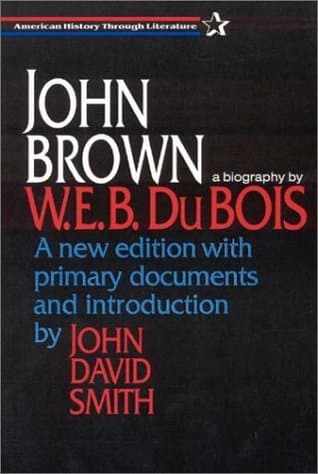
Core Idea
- Difficulty
- Medium
- Read it if
- You are interested in a deeply sympathetic, yet intellectually rigorous, historical defense of John Brown, particularly from an African American perspective. Essential for understanding the radical abolitionist movement and the lead-up to the Civil War, and for those who appreciate history told with a strong moral and political argument.
- Skip it if
- You prefer a neutral, dispassionate historical account without overt political argumentation, or if you are looking for a purely objective biography that doesn't champion its subject's controversial actions. Also, if you are uncomfortable with the justification of revolutionary violence in the pursuit of justice.
Key Takeaways from John Brown
The Righteous Rebel
John Brown's uncompromising moral stance against slavery defined his life and actions.
Du Bois shows John Brown not as a madman, but as a deeply religious and morally driven person who saw slavery as an evil that could not be tolerated. Brown's Calvinist upbringing gave him a strong sense of justice and a belief in direct action to correct wrongs. Unlike many abolitionists who favored political or persuasive methods, Brown believed that slavery was so violent and immoral it required a violent response. His firm conviction, even when widely condemned, came from a deep spiritual certainty that he was an instrument of God's will, meant to free the enslaved. This conviction, Du Bois argues, made him both terrifying to the South and inspiring to many who wanted an end to human bondage.
“The price of freedom is eternal vigilance, and the price of human liberty is the blood of the oppressor.”
In the book: Du Bois details Brown's early life and the profound influence of his father's abolitionist views and his own reading of the Bible, which led him to dedicate his life to fighting slavery. His vow at a young age to dedicate his life to ending slavery serves as a foundational example.
Try this: Reflect on personal moral convictions. When confronting systemic injustice, consider whether incremental change is sufficient or if more direct, disruptive action is morally imperative. Understand that deeply held moral beliefs can lead individuals to actions deemed radical by the status quo.
Related ideas: moral-imperative, abolitionism, righteous-violence
Kansas: A Dress Rehearsal for War
The violence in 'Bleeding Kansas' solidified Brown's belief in armed resistance.
Du Bois details the brutal events of 'Bleeding Kansas,' showing how this time was not just a land dispute but a smaller version of the larger national conflict over slavery. John Brown's direct involvement in the violence, especially the Pottawatomie Massacre, is presented not as an isolated act of barbarism but as a response to pro-slavery forces who had committed atrocities against abolitionist settlers. Du Bois argues that Brown's actions, though controversial, directly responded to the failure of legal and political means to protect free-state settlers and strengthened his belief that only force could counter the violence of slavery. Kansas was where Brown became an active military leader against the institution.
“The crimes of this guilty land will never be purged away, but with blood.”
In the book: The detailing of the Sack of Lawrence and the subsequent Pottawatomie Massacre, where Brown and his sons executed five pro-slavery settlers, is central. Du Bois frames this as a direct, albeit brutal, response to the terror inflicted by 'Border Ruffians.'
Try this: Examine how escalating violence in political disputes can radicalize individuals and groups. Consider the historical context that drives individuals to employ extreme measures when peaceful options are exhausted or proven ineffective. Understand the cyclical nature of violence and retaliation.
Related ideas: bleeding-kansas, border-ruffians, armed-resistance
Harpers Ferry: A Symbol, Not a Strategy
Brown's raid, though a tactical failure, served as a crucial catalyst for the Civil War.
Du Bois analyzes the Harpers Ferry raid, admitting its immediate failure as a military operation but highlighting its deep symbolic impact. Brown's plan to seize the federal arsenal, arm enslaved people, and establish a mountain stronghold was, in hindsight, flawed. However, Du Bois argues that its true meaning lies in its psychological effect: it terrified the South, confirming their deepest fears of abolitionist-instigated slave uprisings, and energized the North, showing the depth of moral conviction among some abolitionists. The raid, and Brown's subsequent trial and execution, exposed the irreconcilable differences between North and South, pushing the nation closer to civil war. It was less a practical attempt to end slavery and more a dramatic, sacrificial act meant to awaken the national conscience.
“His failure was not due to lack of foresight, but to the inherent difficulty of the task; a difficulty which only a God could surmount.”
In the book: The narrative covers the specifics of the raid, the lack of support from local enslaved populations, and Brown's capture by Robert E. Lee. Du Bois emphasizes the media frenzy and public discourse surrounding the event and Brown's trial.
Try this: Recognize that some actions, even if tactically unsuccessful, can have immense symbolic power and shift public opinion. Consider how perceived failures can become catalysts for larger movements. Understand the difference between strategic success and symbolic impact in social and political change.
Related ideas: harpers-ferry, catalyst, symbolic-action
Martyrdom and Mythmaking
Brown's execution transformed him into a martyr for the abolitionist cause and a villain for the South.
Du Bois thoroughly analyzes the aftermath of Harpers Ferry, focusing on how John Brown's trial and execution solidified his place in American history as a polarizing figure. For the North, especially radical abolitionists, his dignified conduct during the trial and his willingness to die for his cause elevated him to the status of a martyr. His last words and letters became powerful propaganda, inspiring songs and rallying cries. Conversely, the South demonized him as a terrorist and a symbol of Northern aggression, using his actions to justify secession and the defense of slavery. Du Bois argues that this dual perception was not accidental but a deliberate act of mythmaking by both sides, shaping the narrative leading up to the Civil War. Brown became more than a man; he became a symbol of the nation's irreconcilable divide.
“John Brown began to be transfigured from an outlaw into a saint. No longer a madman, but a martyr.”
In the book: Du Bois quotes extensively from Brown's courtroom speeches and final letters, demonstrating their impact. He also references the widespread public reaction, including newspaper editorials and the 'John Brown's Body' song.
Try this: Analyze how historical figures are framed and reframed through public discourse and political agendas. Understand the power of martyrdom in social movements and how narratives are constructed around controversial figures. Consider how different groups create their own heroes and villains.
Related ideas: martyrdom, mythmaking, propaganda, historical-narrative
A White Man for Black Freedom
Brown's unique dedication to Black liberation challenged racial norms of his era.
Du Bois, as a Black scholar, emphasizes a key aspect often overlooked: John Brown's deep and genuine commitment to the freedom and equality of Black people. Unlike many white abolitionists who focused on slavery's moral stain on white America or the abstract idea of freedom, Brown actively worked with and for Black communities. He saw enslaved people as human beings deserving of immediate liberation and full rights, not as passive victims. His willingness to sacrifice his own life and the lives of his sons for this cause, and his inclusion of Black men in his fighting force, set him apart from the paternalistic attitudes common even among some abolitionists. Du Bois argues that this deep, personal identification with the plight of the enslaved made Brown a truly unique figure in American history.
“He was the only white American who was willing to lay down his life for the freedom of the slave, not just for the principle, but for the actual freedom of the slave.”
In the book: Du Bois highlights Brown's specific actions, such as his work with the Underground Railroad, his establishment of a community for free Blacks in North Elba, New York, and his inclusion of Black men like Shields Green and Dangerfield Newby in his Harpers Ferry raiding party.
Try this: Evaluate the difference between abstract advocacy and direct, sacrificial action in social justice movements. Consider how allies can move beyond performative solidarity to genuine, risk-taking commitment. Reflect on historical examples of cross-racial solidarity and its limitations.
Related ideas: racial-equality, white-allyship, black-liberation
The Failure of Gradualism
Brown's radicalism was a response to the perceived inadequacy of incremental change.
Du Bois argues that John Brown's radical approach was not random but a direct result of the ongoing failure of gradual and political solutions to address slavery. For decades, abolitionists had petitioned, debated, and organized, yet slavery only seemed to strengthen, expanding into new territories and embedding itself further in the national economy and legal system. Brown, seeing this stagnation and the increasing violence against both enslaved people and free-state advocates, concluded that moral persuasion and political maneuvering were not enough. His actions, therefore, represent a strong rejection of gradualism, stating that only direct, forceful intervention could break the chains of bondage. He believed that the system was so corrupt it needed an absolute, revolutionary overthrow.
“The long, slow agony of gradual emancipation had given way to the swift, decisive stroke of the sword.”
In the book: Du Bois describes the various political compromises (e.g., Compromise of 1850, Kansas-Nebraska Act) that failed to resolve the slavery issue, often exacerbating it. He contrasts this with Brown's direct, violent interventions in Kansas and at Harpers Ferry.
Try this: Consider when incremental change is effective versus when revolutionary action becomes necessary in addressing deeply entrenched injustices. Evaluate the historical effectiveness of gradualism in achieving fundamental rights. Understand the frustration that can lead to radicalization when systemic change is resisted.
Related ideas: gradualism, radicalism, systemic-change, political-failure
History's Uncomfortable Truths
Du Bois challenges readers to confront the complexities of historical heroes and violence.
Beyond just telling events, Du Bois uses John Brown's story to force a critical re-evaluation of how history is written and who is considered a hero. He does not hide Brown's violence but places it within the greater violence of slavery itself. Du Bois challenges the common ideas of his time that dismissed Brown as insane, arguing that such labels avoid confronting the uncomfortable truth that sometimes, righteous ends might require violent means when all other options are exhausted. This book calls for intellectual honesty, urging readers to look beyond simple judgments and understand the motivations and historical forces that drive individuals to extreme actions. It reminds us that history is rarely simple, and heroes can be flawed, yet profoundly impactful.
“Men who make history are not always the men who write it.”
In the book: Du Bois's entire approach to the biography, which directly counters contemporary (and often racist) portrayals of Brown as a lunatic. He emphasizes Brown's sanity, intelligence, and moral consistency despite his violent acts.
Try this: Critically analyze historical narratives, especially those that simplify complex figures or events. Question the motivations behind historical interpretations. Be willing to confront uncomfortable truths about historical violence and its role in social change, even when it challenges conventional morality.
Related ideas: historical-revisionism, moral-complexity, historical-truth
The Legacy of Revolutionary Violence
Brown's actions sparked a debate about the legitimacy of revolutionary violence for justice.
Du Bois concludes by placing John Brown within a broader tradition of revolutionary figures who used violence to achieve liberation. He does not shy away from the ethical problems Brown's actions posed but argues that the context of slavery—an institution built on systemic violence and dehumanization—justified such extreme measures. Brown's legacy, therefore, is not just about ending slavery but about the lasting question of when, if ever, revolutionary violence is a legitimate tool for achieving justice and freedom. Du Bois suggests that for the oppressed, and for those who truly empathize with their plight, the 'peaceful' path is often not an option. Sometimes, only a direct confrontation of power, even a violent one, can break the chains of tyranny. This makes Brown a controversial but essential figure for understanding liberation struggles.
“The pathway to freedom is often drenched in blood.”
In the book: Du Bois draws parallels between Brown's fight and other historical struggles against oppression, implicitly suggesting a universal pattern where violence often precedes liberation when peaceful means are exhausted. He highlights the sheer brutality of slavery as the justification for Brown's methods.
Try this: Engage in critical discussions about the ethics of revolutionary violence in the context of extreme oppression. Consider the historical effectiveness and moral costs of violent versus non-violent resistance. Reflect on how power structures respond to different forms of protest and activism.
Related ideas: revolutionary-violence, liberation-struggle, ethical-dilemma, oppression
Prophet of the Coming Storm
Brown foresaw the inevitability of conflict, acting as a harbinger of the Civil War.
Du Bois presents John Brown as a prophetic figure, someone who, through his intense moral clarity and direct engagement with the brutal realities of slavery, understood America's true path better than many politicians and intellectuals of his time. While others hoped for peaceful resolution or compromise, Brown recognized that the fundamental problem of slavery in a nation supposedly dedicated to freedom could only be resolved through violent confrontation. His actions, therefore, were not random acts of madness but deliberate attempts to speed up what he saw as an inevitable clash. He was not just reacting to events but actively trying to shape the timing and nature of the coming storm, forcing the nation to face its deepest sin. He was a Cassandra, unheeded, yet ultimately proven right.
“He was a man who looked into the future and saw that blood was necessary.”
In the book: Du Bois repeatedly emphasizes Brown's unwavering conviction that only bloodshed could cleanse the nation of slavery, a conviction that proved tragically accurate with the outbreak of the Civil War just two years after Harpers Ferry.
Try this: Consider how individuals with deep moral insight might perceive future societal conflicts more clearly than the general populace. Reflect on the role of 'prophetic' figures in history who challenge prevailing complacency. Understand the concept of an 'inevitable' conflict when fundamental values are irreconcilable.
Related ideas: prophecy, civil-war-origins, inevitability-of-conflict
The Enduring Power of Conviction
Brown's unwavering belief in his cause highlights the force of individual conviction in history.
Throughout the biography, Du Bois emphasizes John Brown's extraordinary, almost terrifying, conviction. This was not a man swayed by public opinion, political convenience, or fear of personal consequence. His belief in slavery's absolute evil and his divine mission to end it was the foundation of his life. This firm conviction allowed him to endure hardship, face overwhelming odds, and ultimately sacrifice his life. Du Bois argues that while his methods were extreme, it was this deep, unshakeable faith in his moral purpose that made him a force of history. It shows that individual conviction, when held with such intensity, can deeply impact the course of nations, inspiring both awe and terror, and proving that one person's moral clarity can challenge the most entrenched injustices, even if it means becoming an outcast.
“He was a man of indomitable will, who believed with all his soul in the righteousness of his cause.”
In the book: Du Bois details Brown's lifelong dedication, his willingness to move his family repeatedly for the cause, his financial sacrifices, and his calm demeanor during his trial and execution, all stemming from his deep-seated conviction.
Try this: Reflect on the power of deeply held personal convictions in driving social change. Consider the personal sacrifices often required for truly transformative action. Evaluate the ethical boundaries of conviction when it leads to extreme measures. Understand the difference between obstinacy and principled commitment.
Related ideas: moral-conviction, individual-agency, personal-sacrifice, unwavering-resolve
John Brown Quotes
“The problem of the twentieth century is the problem of the color line.”
“John Brown was a man of God and a man of blood.”
“The cost of liberty is less than the price of repression.”
“He was a man whose career was a protest, an arraignment, and a prophecy.”
“The world was thinking wrong, and John Brown was thinking right.”
“The cause of freedom is not the cause of a race or a sect, a party or a class - it is the cause of humankind, the very birthright of humanity.”
“He did not believe in the right of property in man. He believed in the right of man to freedom.”
“The path of progress is paved with the bones of martyrs.”
“He was a man of indomitable will, of absolute belief, and of unflinching courage.”
“The world has not yet learned that it is impossible to kill a truth.”
“The South, with its cotton and its Negroes, was a world apart.”
“He was the first to strike a blow for the freedom of the slave, not by word, but by deed.”
“The death of John Brown was the beginning of the end of slavery.”
“There are times when the only thing to do is to fight.”
“He was a man who believed in the Golden Rule, and applied it to the Negro.”
Quiz
10 questions on the main ideas. Each answer comes with a short explanation.
Question 1
According to Du Bois, what was the primary motivation behind John Brown's actions against slavery?
- Desire for personal wealth and land in Kansas
- A deep-seated religious conviction and moral imperative to free the enslaved
- Political ambition to become a prominent leader in the abolitionist movement
- Revenge for personal losses suffered at the hands of pro-slavery forces
Show answer
B. A deep-seated religious conviction and moral imperative to free the enslaved Du Bois emphasizes Brown's profound religious conviction and his belief that God had called him to end slavery, making it a moral crusade rather than a political or personal vendetta.
Question 2
Which event, detailed by Du Bois, marked John Brown's violent entry into the national spotlight during the 'Bleeding Kansas' period?
- The Sacking of Lawrence
- The Pottawatomie Massacre
- The Battle of Black Jack
- The Osawatomie Raid
Show answer
B. The Pottawatomie Massacre Du Bois recounts the Pottawatomie Massacre as the turning point where Brown, in retaliation for attacks on free-staters, executed five pro-slavery settlers, cementing his image as a radical abolitionist.
Question 3
Du Bois argues that John Brown's raid on Harpers Ferry, despite its failure, was significant because it:
- Successfully armed a large number of enslaved people for rebellion.
- Forced the immediate abolition of slavery in Virginia.
- Exposed the deep divisions within the nation and accelerated the coming of the Civil War.
- Convinced Southern slaveholders to voluntarily emancipate their slaves.
Show answer
C. Exposed the deep divisions within the nation and accelerated the coming of the Civil War. Du Bois emphasizes that Harpers Ferry, though militarily unsuccessful, served as a catalyst, revealing the irreconcilable differences between North and South and pushing the nation closer to war.
Question 4
How does Du Bois challenge the prevailing historical narratives that often portrayed John Brown as a madman or a mere criminal?
- By ignoring any evidence of his mental instability.
- By presenting him as a rational, if extreme, agent of divine justice and a champion of human rights.
- By focusing solely on his early life and omitting his later radical actions.
- By arguing that his actions were primarily motivated by personal gain.
Show answer
B. By presenting him as a rational, if extreme, agent of divine justice and a champion of human rights. Du Bois consciously reclaims Brown's legacy, portraying him not as insane, but as a principled individual driven by a profound sense of justice and a clear-eyed understanding of the moral evil of slavery, willing to use force where other methods failed.
Question 5
Du Bois highlights John Brown's lineage, tracing his ancestry back to Puritan stock. What significance does Du Bois attach to this background?
- It explains Brown's inherited wealth and social standing.
- It underscores his deep-rooted commitment to religious principles and a militant sense of justice.
- It suggests a predisposition to agricultural pursuits.
- It explains his initial reluctance to engage in violent abolitionism.
Show answer
B. It underscores his deep-rooted commitment to religious principles and a militant sense of justice. Du Bois connects Brown's Puritan ancestry to a tradition of moral absolutism and a willingness to fight for righteous causes, framing his anti-slavery crusade as an extension of this heritage.
Question 6
Which specific aspect of John Brown's character does Du Bois particularly emphasize as crucial to understanding his unwavering commitment?
- His tactical genius in military engagements.
- His ability to sway public opinion through eloquent speeches.
- His profound and unshakeable conviction in his divine mission.
- His practical skills as a surveyor and land speculator.
Show answer
C. His profound and unshakeable conviction in his divine mission. Du Bois repeatedly stresses Brown's profound conviction in his divine calling to eradicate slavery, seeing it as the driving force behind his relentless and uncompromising actions.
Question 7
Du Bois criticizes abolitionists like William Lloyd Garrison for their reliance on 'moral suasion' alone. How does Du Bois contrast Brown's approach with this strategy?
- Brown also solely relied on moral suasion but through different channels.
- Brown believed that moral suasion had failed and that direct, forceful action was necessary to end slavery.
- Brown advocated for political compromise and gradual emancipation.
- Brown focused on legal challenges rather than public appeals.
Show answer
B. Brown believed that moral suasion had failed and that direct, forceful action was necessary to end slavery. Du Bois argues that Brown came to believe that decades of moral arguments had been insufficient to dismantle slavery and that only direct, physical intervention, even violence, could achieve the desired freedom for the enslaved.
Question 8
Du Bois dedicates significant attention to John Brown's interactions with Black Americans, both free and enslaved. What does Du Bois suggest about the nature of these relationships?
- Brown viewed them primarily as tools for his own political advancement.
- Brown saw them as equals and partners in the fight for freedom, earning their trust and respect.
- Brown largely avoided direct contact with Black communities.
- Black Americans were generally suspicious of Brown's motives and methods.
Show answer
B. Brown saw them as equals and partners in the fight for freedom, earning their trust and respect. Du Bois highlights Brown's genuine respect and collaboration with Black individuals, including Frederick Douglass and members of the local Black community, who saw him as a true ally in their struggle for liberation, a rare stance among white abolitionists of his time.
Question 9
In his analysis of John Brown's trial and execution, Du Bois argues that Brown's demeanor and words transformed him into what kind of figure?
- A repentant criminal seeking clemency.
- A political opportunist using the platform for self-promotion.
- A martyr whose sacrifice galvanized the anti-slavery cause.
- A disillusioned revolutionary admitting defeat.
Show answer
C. A martyr whose sacrifice galvanized the anti-slavery cause. Du Bois powerfully describes how Brown's dignified conduct and unwavering commitment to his cause during his trial and on the scaffold elevated him from a failed insurgent to a symbolic martyr, inspiring many in the North.
Question 10
Du Bois concludes his biography by reflecting on John Brown's place in history. What is the ultimate message Du Bois conveys about Brown's legacy, particularly in the context of American democracy?
- That Brown's actions were ultimately counterproductive and delayed emancipation.
- That Brown represents a necessary, albeit violent, force for justice when democratic processes fail to address fundamental human rights.
- That Brown's legacy is solely one of a misguided fanatic who should not be emulated.
- That Brown's primary contribution was to demonstrate the futility of armed rebellion.
Show answer
B. That Brown represents a necessary, albeit violent, force for justice when democratic processes fail to address fundamental human rights. Du Bois argues that Brown, by taking direct action, exposed the moral bankruptcy of a nation that tolerated slavery and demonstrated that sometimes, when legal and peaceful means fail, radical action is required to uphold the fundamental principles of justice and human freedom, even if it meant challenging the existing democratic order.
John Brown FAQ
What is the main argument of W.E.B. Du Bois's 'John Brown'?
Du Bois argues that John Brown was not a madman but a divinely inspired, righteous prophet and martyr whose actions, particularly at Harpers Ferry, were a necessary catalyst for the American Civil War and the abolition of slavery. He portrays Brown as a key figure in the struggle for Black liberation.
Does Du Bois's 'John Brown' present a sympathetic view of Brown's actions?
Yes, Du Bois presents an overwhelmingly sympathetic and admiring view of John Brown. He justifies Brown's use of violence as a legitimate response to the systemic violence of slavery and frames his radical abolitionism as heroic and morally imperative.
What is the significance of the Harpers Ferry raid in Du Bois's interpretation?
For Du Bois, the Harpers Ferry raid was a pivotal moment, not a failure. He sees it as a symbolic act of war against slavery that exposed the deep divisions in the nation and directly contributed to the outbreak of the Civil War, forcing the country to confront the moral evil of human bondage.
How does Du Bois's portrayal of John Brown differ from earlier historical accounts?
Du Bois's portrayal radically departs from earlier accounts that often depicted Brown as an insane fanatic or a misguided zealot. He elevates Brown to the status of a freedom fighter and a precursor to the Civil Rights Movement, emphasizing his anti-racist motivations rather than just his religious fervor.
What primary sources did W.E.B. Du Bois use for his biography of John Brown?
Du Bois conducted extensive research, utilizing a wide range of primary sources including court records, personal letters, contemporary newspaper accounts, interviews with surviving family members and associates of Brown, and other historical documents available at the time.
What is 'the problem of the color-line' as it relates to John Brown?
The 'problem of the color-line,' a core concept in Du Bois's work, refers to racial segregation and injustice. In 'John Brown,' Du Bois shows how Brown's life and actions were a direct confrontation with this problem, as Brown sought to dismantle the racial hierarchy that underpinned slavery.
Does 'John Brown' by Du Bois offer insights into the origins of the Civil War?
Absolutely. Du Bois argues that John Brown's radical abolitionism and the Harpers Ferry raid were not isolated incidents but crucial sparks that ignited the already simmering tensions between North and South, making the Civil War inevitable in the fight against slavery.
How does this book contribute to understanding American abolitionism?
The book offers a powerful and unique perspective on American abolitionism by highlighting the role of radical, direct action and the willingness to use force against an entrenched oppressive system. It underscores the diverse strategies employed by abolitionists, from moral suasion to armed rebellion.
About the author

W.E.B. Du Bois was an American sociologist, historian, and civil rights activist known for his influential writings on race and society. His notable works include "The Souls of Black Folk," which explores the African American experience, and "John Brown," a historical account of the abolitionist. Du Bois was a key figure in the early 20th-century struggle for civil rights and co-founded the NAACP.
Similar books
- The Souls of Black Folk
W.E.B. Du Bois
4.3 (36k) average on GoodreadsPoliticsProvides broader context on Du Bois's intellectual framework, his analysis of race in America, and his powerful prose style.
- 1984
George Orwell
4.2 (3.1M) average on GoodreadsPoliticsIn a future where surveillance and thought control are absolute, a man's search for truth clashes with the Party, showing that hope can be a form of rebellion.
- Animal Farm
George Orwell
4.0 (2.7M) average on GoodreadsPoliticsA farm animals' rebellion against humans turns into a pig-led dictatorship, showing how power corrupts and revolutionary ideals are betrayed.
- Freakonomics: A Rogue Economist Explores the Hidden Side of Everything
Steven D. Levitt
4.0 (709k) average on GoodreadsBusinessThis book uses economic principles to reveal the surprising incentives behind everything from drug dealing and real estate to cheating teachers and the decline of crime.
- I Am Malala: The Story of the Girl Who Stood Up for Education and Was Shot by the Taliban
Malala Yousafzai
4.1 (419k) average on GoodreadsPoliticsA teenage girl from a Taliban-controlled valley refuses to give up her books, becoming a global voice for education even after an assassination attempt.
- Atlas Shrugged
Ayn Rand
3.7 (354k) average on GoodreadsPoliticsIn a dystopian America where innovators vanish, a brilliant heiress races to uncover the truth behind the disappearing industrialists and the enigmatic John Galt, who vows to stop the world's progress.






Enjoyed the summary?
A summary gives you the shape of the book. The book itself has the detail, the examples and the voice.
Find John Brown on AmazonAs an Amazon Associate, BookBrief earns from qualifying purchases. How we're funded