
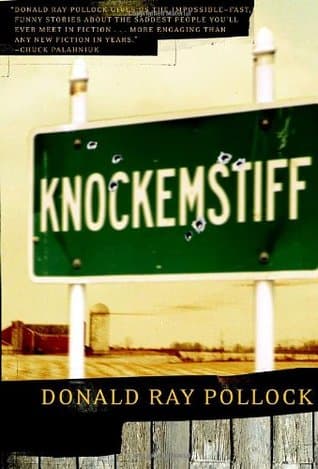
Synopsis
Covers the whole plot, including the ending.
- Difficulty
- Medium
- Pacing
- Moderate
- Mood
- Gritty, Dark, Bleak, Humorous (dark), Realistic
- Read it if
- You appreciate raw, unflinching portrayals of rural American life, dark humor, and stories with a strong sense of place and character.
- Skip it if
- You prefer optimistic narratives, find graphic content or bleak themes disturbing, or dislike regional dialect and explicit violence.
Knockemstiff Plot Summary
Covers the whole plot, including the ending.
The Winnebago
In 'The Winnebago,' young Jodie lives with his father, Frank, in a dilapidated Winnebago. Frank, a former bodybuilder, tries to relive his past through Jodie, injecting him with steroids and forcing him into intense training. Jodie, a sensitive and artistic boy, resents his father's pressure and the changes to his body. He often retreats into his own world, sketching and observing the strange characters of Knockemstiff. Frank's harsh discipline and emotional distance create a deep rift between them. Jodie wants a different life, always aware of his father's unfulfilled ambitions weighing on him in their isolated, rural existence.
Pills
Arvin Eugene, a young man in Knockemstiff, enters the local drug scene through his acquaintance with the manipulative Junior. Desperate for money to support his ailing mother and escape poverty, Arvin starts running pills for Junior. He quickly gets in over his head, witnessing violence and betrayal that force him to confront the brutal realities of the illegal trade. Arvin struggles with his conscience, torn between surviving and the moral compromises he must make, which leads him further into desperation and danger as he tries to outwit those around him.
The Fights
Frank, still obsessed with Jodie's physique and seeking new ways to fulfill his ambitions, forces Jodie into brutal, unregulated underground fights. Jodie, now muscular but unwilling, endures these violent encounters, often against older, more experienced fighters. Frank bets heavily on his son, treating him more as an investment than a child. The fights are a spectacle of violence and desperation. Jodie's victories bring fleeting pride to Frank but only deeper alienation and physical pain to Jodie. These events show the destructive nature of Frank's ambition and Jodie's passive resistance.
Lard
Lard, a mentally disturbed and isolated recluse in a remote part of Knockemstiff, spends his days watching the strange events in his community. He becomes fixated on siblings Billy and Susan, who are in an incestuous relationship. Lard, with his twisted sense of morality, decides he must intervene. His intervention is violent and horrifying, stemming from his warped understanding of right and wrong, and results in a tragic outcome for the siblings. This story explores the darkest parts of human behavior and the disturbing actions of those on the fringes of society, driven by their own inner demons.
The Animals
Arvin Eugene, increasingly disillusioned with the drug trade and the violence, retreats into the woods, seeking a temporary escape from his grim reality. There, he finds a group of men engaged in a cruel act of animal torture. The scene deeply disturbs Arvin, reflecting the senseless brutality he has witnessed among humans. This encounter reinforces his growing despair and the pervasive darkness that seems to engulf Knockemstiff. The incident shows how the environment dehumanizes its inhabitants, both human and animal, in their struggle for survival.
The Funeral
The funeral of a local resident, whose death is shrouded in Knockemstiff's blend of mystery and tragedy, brings together many of the town's recurring characters. Jodie, Arvin Eugene, and others attend, each carrying their own burdens and secrets. The event is less about mourning and more about the living, showing the complex and often dysfunctional relationships among community members. Conversations are terse, glances are loaded, and the underlying tensions and shared histories are clear. The funeral becomes a small example of Knockemstiff itself, a place where grief and grim humor mix.
The Drifter
A charismatic but dangerous drifter arrives in Knockemstiff, disrupting the community's fragile balance. He quickly befriends some susceptible residents, including a lonely woman named Evelyn, and begins to exploit their weaknesses. The drifter's presence creates an unsettling unpredictability, leading to small conflicts and heightened paranoia among the townspeople. His manipulative tactics and disregard for local customs eventually lead to a violent confrontation, further showing the precariousness of life in Knockemstiff and how susceptible its inhabitants are to outside influences in their isolated world.
The Confession
A character, deeply troubled by a past transgression, seeks to confess. This act of seeking redemption, however flawed, shows the lingering psychological toll of living in Knockemstiff. The confession might be to another character, a religious figure, or an internal monologue, but it reveals the character's struggle with guilt and the consequences of their choices. The scene explores themes of sin, repentance, and the difficulty of escaping one's past in a place where secrets are rarely kept and actions have lasting repercussions for both the individual and the community.
The Escape
Jodie, after years of his father's abuse and Knockemstiff's suffocating atmosphere, finally decides to leave. He plans his escape carefully, gathering his few resources and cutting ties with the past. His departure is risky; he fears his father's reaction and the unknown challenges of the outside world. This moment marks Jodie's desire for self-determination and his rejection of the life his father envisioned. His journey out of Knockemstiff is a symbolic step toward forging his own identity and seeking a future free from his upbringing, though the town's influence will always remain.
The Reckoning
Arvin Eugene's involvement in the drug trade comes to a violent end when he confronts Junior. The tensions that have built between them finally erupt, leading to a brutal struggle. This reckoning culminates Arvin's journey into the criminal underworld, forcing him to make life-or-death decisions. The outcome, whether Arvin wins or suffers further loss, marks a significant turning point in his life, solidifying his understanding of Knockemstiff's harsh realities and the irreversible consequences of his choices in the cutthroat world he inhabits.
The Return
Years later, Jodie, now an adult and having lived outside Knockemstiff, reflects on his origins. He may or may not return to the town, but its memory and his experiences there continue to shape him. This section explores the lasting impact of one's upbringing and the indelible mark a place like Knockemstiff leaves on its inhabitants. Jodie grapples with nostalgia, resentment, and a complex understanding of the people and events that defined his youth, acknowledging that while he may have left the town, a part of Knockemstiff will always remain with him, influencing his perspective.
Generations
The final stories often hint at the cyclical nature of life in Knockemstiff, showing how patterns of poverty, violence, and limited opportunity persist across generations. New characters, or the children of existing ones, begin to navigate the same challenging environment, facing similar struggles and making similar choices. This reinforces the idea that Knockemstiff is not just individual stories but a pervasive environment that shapes destinies. The ending leaves the reader with a sense of the town's enduring character, its capacity for both misery and a strange resilience, as the cycle of life continues in its unique, brutal way.
Principal Figures
Jodie
Protagonist
A sensitive, artistic boy forced into bodybuilding by his ambitious father.
Jodie is a quiet, introspective boy who possesses an artistic sensibility, often drawing in his notebook. He is physically transformed by his father Frank's relentless steroid injections and training, becoming a muscular but unwilling participant in Frank's vicarious dreams of glory. Jodie yearns for a life beyond the confines of Knockemstiff and his father's control, often feeling alienated and trapped. His internal world is rich, providing a stark contrast to the harsh realities of his external environment. He struggles with his identity, caught between his innate desires and his father's imposed will.
Relationships: Frank (Abusive, controlling father-son relationship); Arvin Eugene (Acquaintances, shared experience of hardship)
Frank
Antagonist/Supporting
Jodie's father, a failed bodybuilder who projects his unfulfilled ambitions onto his son.
Frank is a domineering and emotionally distant father, obsessed with bodybuilding and his own past, unfulfilled dreams. He is a man driven by a desperate need for recognition and validation, which he seeks to achieve through Jodie. Frank's methods are harsh and abusive, involving steroid injections and forced training, showing little regard for Jodie's well-being or desires. He embodies a certain kind of toxic masculinity and the destructive power of vicarious ambition, unable to escape his own failures and projecting them onto his son in a relentless, unforgiving manner.
Relationships: Jodie (Abusive, controlling father-son relationship)
Arvin Eugene
Protagonist
A young man entangled in the drug trade, trying to survive in Knockemstiff.
Arvin Eugene is a young man from a poverty-stricken background, driven by a desire to provide for his family and escape the bleakness of Knockemstiff. He becomes involved in the local drug scene, initially out of necessity, but quickly finds himself caught in a cycle of violence and moral compromise. Arvin is often conflicted, possessing a sense of right and wrong despite his circumstances, but is forced to make difficult, often brutal, choices to survive. He represents the struggle for dignity and survival in a world that offers few options, constantly battling external pressures and internal moral dilemmas.
Relationships: Junior (Antagonistic, drug-related associate); Jodie (Acquaintances, shared experience of hardship)
Lard
Supporting
A mentally disturbed recluse who acts on his warped sense of justice.
Lard is a deeply disturbed and isolated individual living on the fringes of Knockemstiff society. His mind operates on a twisted moral code, leading him to commit acts of extreme violence in the name of what he perceives as justice. He is a figure of both pity and terror, embodying the darker, more unsettling aspects of the town's inhabitants. Lard's actions are often unpredictable and horrific, driven by an internal logic that defies conventional understanding, making him a dangerous and tragic character who highlights the pervasive sense of decay and moral ambiguity in the community.
Relationships: Billy (Victim of Lard's violent intervention); Susan (Victim of Lard's violent intervention)
Junior
Antagonist
A manipulative and dangerous drug dealer in Knockemstiff.
Junior is a central figure in the local drug trade, characterized by his manipulative nature, ruthlessness, and capacity for violence. He preys on the desperation of others, including Arvin Eugene, drawing them into his illicit activities. Junior represents the pervasive corruption and danger that permeates Knockemstiff, acting as a constant threat to those who cross him or become entangled in his world. He is driven by greed and power, showing little empathy or remorse for the suffering he inflicts, making him a formidable and menacing presence in the lives of the protagonists.
Relationships: Arvin Eugene (Antagonistic, drug-related associate)
Evelyn
Supporting
A lonely woman seeking connection, often exploited by others.
Evelyn is a lonely and vulnerable woman in Knockemstiff, often seeking companionship and affection. Her emotional fragility makes her susceptible to manipulation, particularly by figures like the drifter. She represents the yearning for connection and escape from isolation that many residents feel, but also the dangers of misplaced trust in a community where kindness is rare and exploitation is common. Her experiences highlight the emotional toll of living in such a harsh environment, where genuine human connection is difficult to find and often comes at a high price.
Relationships: The Drifter (Exploitative romantic interest)
Billy
Mentioned/Supporting
A sibling involved in an incestuous relationship.
Billy is one half of the incestuous sibling pair, along with Susan, who becomes the focus of Lard's disturbing intervention. His character embodies the extreme dysfunction and moral decay that can exist in the hidden corners of Knockemstiff. While not deeply explored as an individual, his actions with Susan serve to highlight the raw, uncensored depravity that Pollock presents, challenging the reader's sensibilities and further illustrating the brokenness of the community's fabric. He is a tragic figure, a victim of circumstance and his own choices, leading to a violent end.
Relationships: Susan (Incestuous sibling relationship); Lard (Victim of Lard's violent intervention)
Susan
Mentioned/Supporting
A sibling involved in an incestuous relationship.
Susan is the other half of the incestuous sibling pair with Billy. Like her brother, her character is used to illustrate the extreme moral and social breakdown present in Knockemstiff. She is a figure of the town's hidden depravities, and her relationship with Billy serves as a shocking trigger for Lard's violent 'justice.' Her story, though brief, is a stark reminder of the dark underbelly of the community and the desperate, often destructive, ways in which people seek connection or comfort in a world devoid of conventional morality. She is a victim of both her circumstances and Lard's twisted sense of righteousness.
Relationships: Billy (Incestuous sibling relationship); Lard (Victim of Lard's violent intervention)
Themes & Insights
The Cycle of Poverty and Despair
Knockemstiff shows a community caught in a cycle of poverty, limited opportunities, and despair. Characters like Arvin Eugene deal drugs ('Pills') out of economic need. The dilapidated Winnebago where Jodie and Frank live ('The Winnebago') symbolizes their inability to escape their socio-economic circumstances. This theme appears in the characters' choices, their lack of prospects, and the general stagnation that fills the town, suggesting that the environment itself prevents any real progress or escape, continuing a grim legacy across generations ('Generations').
“There was a whole lot of evil in Knockemstiff, Ohio, and most of it was in the hearts of the people.”
Abuse of Power and Control
This theme is clearly shown through Frank's relationship with Jodie. Frank's constant steroid injections and forcing Jodie into bodybuilding and fighting ('The Winnebago', 'The Fights') show his desire to control and relive his own failed dreams through his son. Similarly, Junior's manipulation of Arvin Eugene in the drug trade ('Pills', 'The Reckoning') shows how those with power exploit the vulnerable. The theme highlights how unchecked control, whether familial or criminal, harms those subjected to it, taking away their agency and self-worth.
“He wanted me to be him, only better.”
Moral Ambiguity and Depravity
Knockemstiff is a place where traditional morality is often reversed or absent. The story of Lard intervening in Billy and Susan's incestuous relationship ('Lard') is a prime example, where a disturbed individual acts on a twisted sense of justice, leading to more violence. Characters like Arvin Eugene are forced into morally difficult situations ('Pills'), blurring the lines between victim and perpetrator. The pervasive violence, drug use, and sexual deviance are presented without judgment, forcing the reader to confront the raw aspects of human nature in extreme situations, where survival often matters more than conventional ethics.
“Sometimes it felt like the whole town was just waiting to fall apart.”
The Search for Escape and Identity
Many characters in Knockemstiff want to escape their grim realities and create their own identity. Jodie, stifled by his father's ambitions, dreams of a life beyond bodybuilding and the town ('The Escape'). Arvin Eugene's involvement in the drug trade, though dangerous, is also a desperate attempt to build a different future for himself and his family ('Pills'). Even temporary retreats into nature ('The Animals') symbolize a desire for purity and relief from the town's corruption. This theme shows the universal human desire for self-determination against huge odds, even if the escape is brief or ultimately unsuccessful, as seen in 'The Return'.
“I just wanted to be something other than what my father wanted me to be.”
Plot Devices & Literary Techniques
Linked Short Stories
Individual stories that feature recurring characters and a shared setting, building a larger narrative.
The novel is structured as a collection of linked short stories, each focusing on different characters or events within Knockemstiff. This device allows Pollock to explore the multifaceted nature of the town and its inhabitants from various perspectives, without adhering to a single linear plot. Recurring characters like Jodie and Arvin Eugene appear in multiple stories, allowing their individual arcs to develop gradually and their connections to the community to deepen. This structure creates a rich tapestry of interconnected lives, where the cumulative effect of the stories builds a comprehensive portrait of the town's pervasive despair and occasional moments of resilience.
Local Vernacular and Dialect
The use of authentic, regional language and speech patterns to enhance realism.
Pollock employs a distinct local vernacular and dialect throughout the stories, reflecting the speech patterns and cultural nuances of rural Southern Ohio. This device adds a powerful layer of authenticity and immersion to the narrative, making the characters and their dialogues feel incredibly real and grounded in their specific environment. The language is often raw, unpolished, and direct, mirroring the harsh realities of the characters' lives. It contributes significantly to the 'literature of place' aspect of the book, drawing the reader directly into the unique voice and atmosphere of Knockemstiff, making the prose feel both immediate and unflinching.
Foreshadowing through Atmosphere
The pervasive sense of dread and decay that hints at future violence and tragedy.
Throughout the collection, Pollock masterfully uses atmospheric details and character interactions to create a pervasive sense of dread and impending doom. The descriptions of the dilapidated landscape, the characters' grim circumstances, and their often violent or desperate actions subtly foreshadow the tragic events and violent confrontations that inevitably occur. For instance, the constant pressure Frank puts on Jodie or Arvin Eugene's deepening involvement in the drug trade inherently suggests a violent climax. This device keeps the reader on edge, anticipating the worst and reinforcing the idea that in Knockemstiff, violence and despair are not anomalies but ingrained aspects of life.
Symbolism of Animals
Animals are used to reflect the brutality and vulnerability present in the human world of Knockemstiff.
Animals in Knockemstiff often serve as powerful symbols, mirroring the brutality, suffering, and vulnerability experienced by the human characters. The scene where Arvin Eugene witnesses animal cruelty ('The Animals') directly reflects the senseless violence and dehumanization he experiences in the drug trade. Similarly, the descriptions of neglected or abused animals throughout the stories parallel the characters' own struggles against exploitation and their lack of agency. This device highlights the pervasive nature of suffering in the town, suggesting that both humans and animals are subject to the same harsh, unforgiving conditions, underscoring the raw, primal struggle for survival.
Knockemstiff Quotes
“There are a lot of good people in this world, but there are a whole lot of bad ones too, and the bad ones usually win.”
“The devil don't care if you're a good man or a bad one. He just wants your soul.”
“Some men are born to be good, some to be evil, and some just to get by.”
“In Knockemstiff, you lived and died and nobody cared. That was the way it was.”
“He knew that the past was never really past, not in a place like this.”
“God had long since packed his bags and left Knockemstiff, if he'd ever been there at all.”
“The only thing worse than living in Knockemstiff was trying to leave it.”
“Every family in Knockemstiff had its secrets, and most of them were ugly.”
“Some folks just got a bad seed in 'em, no matter how you try to raise 'em.”
“There wasn't much hope in Knockemstiff, but there was plenty of stubbornness.”
“The world was a cruel place, and Knockemstiff was just a small, concentrated dose of it.”
“He often thought that the only way to survive in Knockemstiff was to be as mean as the place itself.”
“The trees along the creek were so thick and dark they seemed to swallow the light.”
“Some sins just stick to a man, like mud to a boot, and you can't ever really wash 'em off.”
Quiz
10 questions on the plot and the characters. Each answer comes with a short explanation.
Question 1
Which specific Ohio town serves as the primary setting for Donald Ray Pollock's 'Knockemstiff'?
- Chillicothe
- Knockemstiff
- Piketon
- Jackson
Show answer
B. Knockemstiff The book's title itself, 'Knockemstiff,' refers to the real-life unincorporated community in Ohio where many of the stories are set.
Question 2
The stories in 'Knockemstiff' primarily span what time period?
- The Roaring Twenties to the Great Depression
- The mid-sixties to the late nineties
- Post-World War II to the early sixties
- The turn of the millennium to the present day
Show answer
B. The mid-sixties to the late nineties The book description states that the linked stories 'span a period from the mid-sixties to the late nineties,' covering several decades of the characters' lives.
Question 3
Which of the following literary figures is mentioned as an influence on Donald Ray Pollock's artistic style?
- Ernest Hemingway
- F. Scott Fitzgerald
- Flannery O'Connor
- John Steinbeck
Show answer
C. Flannery O'Connor The book description explicitly states that Pollock's artistic instinct was 'honed on the works of Flannery O'Connor and Harry Crews,' indicating a shared literary lineage.
Question 4
What common characteristic defines many of the recurring characters in 'Knockemstiff'?
- They are highly educated professionals seeking to escape their small town.
- They are wealthy entrepreneurs who exploit the town's resources.
- They are described as woebegone, baffled, and depraved, but resilient.
- They are devout churchgoers who uphold moral standards.
Show answer
C. They are described as woebegone, baffled, and depraved, but resilient. The description characterizes the recurring characters as 'woebegone, baffled and depraved but irresistibly, undeniably real,' highlighting their struggles and flaws.
Question 5
One story features a father who gives his son steroids. What is the father's motivation for this action?
- He wants his son to become a professional athlete and earn money for the family.
- He wants to vicariously relive his own past as a 'perpetual runner-up' bodybuilder.
- He believes steroids are necessary for his son's health and physical development.
- He is experimenting with illegal substances and using his son as a test subject.
Show answer
B. He wants to vicariously relive his own past as a 'perpetual runner-up' bodybuilder. The summary specifically mentions, 'A father pumps his son full of steroids so he can vicariously relive his days as a perpetual runner-up body builder,' indicating a personal, unfulfilled ambition.
Question 6
What is a key aspect of Pollock's narrative approach regarding his characters and their actions?
- He frequently offers moral judgments and condemnations of their behavior.
- He presents them with a stern intelligence and a bracing absence of value judgments.
- He romanticizes their struggles and portrays them as noble figures.
- He uses a highly formal and academic language to describe their lives.
Show answer
B. He presents them with a stern intelligence and a bracing absence of value judgments. The description highlights Pollock's objective and non-judgmental stance: 'Donald Ray Pollock presents his characters and the sordid goings-on with a stern intelligence, a bracing absence of value judgments.'
Question 7
The book is described as being 'rendered in the American vernacular.' What does this imply about the language used?
- It uses complex, academic vocabulary and sentence structures.
- It features formal, archaic language reminiscent of older literature.
- It employs the common, everyday speech patterns and vocabulary of the region.
- It is heavily reliant on metaphors and allegories, making it difficult to understand directly.
Show answer
C. It employs the common, everyday speech patterns and vocabulary of the region. 'American vernacular' refers to the common, everyday language spoken by people in a particular region. This suggests the dialogue and narration reflect the authentic speech of the characters' environment.
Question 8
In one of the stories, a psychotic rural recluse encounters two siblings committing incest. What is his immediate reaction?
- He immediately reports them to the authorities.
- He feels compelled to take action.
- He ignores the situation and walks away.
- He joins them in their act.
Show answer
B. He feels compelled to take action. The summary explicitly states, 'A psychotic rural recluse comes upon two siblings committing incest and feels compelled to take action,' indicating an intervention rather than indifference or participation.
Question 9
Which of the following best describes the overall tone and humor found in 'Knockemstiff'?
- Lighthearted and whimsical
- Satirical and overtly political
- Wry, dark, and bottom-dog
- Sentimental and nostalgic
Show answer
C. Wry, dark, and bottom-dog The description mentions 'a wry, dark sense of humor' and 'a refreshingly dark sense of bottom-dog humor,' indicating a grim yet humorous perspective on the struggles of the less fortunate.
Question 10
The book is referred to as 'a genuine entry into the literature of place.' What does this classification primarily emphasize?
- The universal applicability of its themes, regardless of setting.
- The focus on the unique cultural, social, and environmental characteristics of its specific setting.
- The extensive use of geographical maps and detailed descriptions of landmarks.
- The travelogue aspect, where characters journey through various locations.
Show answer
B. The focus on the unique cultural, social, and environmental characteristics of its specific setting. 'Literature of place' emphasizes how the specific environment, its culture, people, and history deeply influence the narrative and characters, making the setting itself a crucial element of the story.
Knockemstiff FAQ
What is the overarching setting and time period of 'Knockemstiff'?
'Knockemstiff' is set in the fictional, impoverished, and isolated town of Knockemstiff, Ohio. The linked short stories within the collection span a period from the mid-1960s to the late 1990s, capturing decades of hardship and resilience in this rural Midwestern community.
Who are some of the recurring characters, and what connects them?
Many characters, like the often-troubled family of Jasper and his son Bennie, or the various individuals navigating the town's dark underbelly, reappear throughout the collection. Their connections are often familial, circumstantial due to the small town, or through shared experiences of poverty, violence, and a desperate search for meaning.
What kind of tone and style does Donald Ray Pollock employ in 'Knockemstiff'?
Pollock uses a stark, unsparing, and often darkly humorous tone, employing the American vernacular to give authentic voice to his characters. His style is characterized by vivid, sometimes grotesque imagery and a unflinching portrayal of human depravity and resilience, reminiscent of Southern Gothic literature.
What is the significance of the town's name, 'Knockemstiff'?
The name 'Knockemstiff' itself evokes a sense of hardscrabble existence and potential violence, reflecting the harsh realities faced by its inhabitants. It's a place where life is tough, and individuals are often 'knocked' down, but also where a certain defiant resilience can be found.
How does the story 'Pills' connect to the broader themes of the book?
'Pills' introduces the desperation for escape and the destructive cycle of addiction prevalent in Knockemstiff, as characters seek solace or oblivion through substances. It highlights the pervasive sense of hopelessness and the various, often illicit, means people employ to cope with their grim realities.
In 'The Ohio River Valley Boys', what is the deeper implication of the father pumping his son Bennie full of steroids?
The father's actions are a tragic attempt to vicariously relive his own failed bodybuilding dreams through Bennie. This reveals a profound psychological projection and a destructive parental ambition, sacrificing his son's well-being for his own unfulfilled desires and a warped sense of legacy.
How does the recurring motif of animals, particularly dogs, function in the stories?
Animals often serve as mirrors or victims of the human condition in Knockemstiff, reflecting the brutality, neglect, and occasional loyalty found among the human characters. They can symbolize innocence corrupted or the raw, untamed aspects of the environment, often meeting tragic ends.
What is the underlying significance of the rural recluse's intervention in the incestuous encounter in one story?
The recluse's unexpected intervention suggests a complex moral code within even the most marginalized characters, indicating that certain transgressions, even in a depraved setting, can still provoke a primal sense of outrage or a twisted attempt at justice. It highlights the blurred lines of morality.
Are there any subtle connections between characters across different stories that might be missed on a first read?
Yes, characters might appear as minor figures in one story and central in another, or their past actions are referenced by different narrators, creating a tapestry of interconnected lives. For example, a character's notorious reputation or a past violent act might be mentioned by someone who wasn't directly involved but knew of the incident.
How does poverty psychologically impact the characters' decision-making and worldview?
Poverty profoundly limits choices, fostering a sense of desperation, nihilism, and a focus on immediate survival rather than long-term planning. It often leads characters to engage in illicit activities, make impulsive decisions, and internalize a belief that they are trapped, shaping a cynical and fatalistic worldview.
Discuss the psychological motivations behind the violence prevalent in Knockemstiff.
Violence often stems from deep-seated frustration, perceived slights, a lack of communication skills, and a brutalized upbringing. It can be a desperate assertion of power in a powerless existence, a response to fear, or a cyclical pattern inherited from previous generations, rather than purely malicious intent.
How do the characters cope with their isolation and lack of opportunities?
Characters cope through various means: escapism via drugs and alcohol, acts of petty crime, fleeting sexual encounters, or sometimes through a grim stoicism and a dark sense of humor. They often form dysfunctional bonds, finding solace in shared misery or perpetuating cycles of abuse.
What role does religion or faith (or its absence) play in the psychological landscape of Knockemstiff's residents?
Religion is often present but frequently appears as a superficial or hypocritical force, failing to provide genuine solace or moral guidance. For many, faith is either lost, twisted, or replaced by superstition and a grim acceptance of a godless, brutal reality, reflecting a profound spiritual emptiness.
To what extent is 'Knockemstiff' a critique of the 'American Dream'?
'Knockemstiff' serves as a harsh critique of the American Dream, portraying a segment of society where opportunities are nonexistent and the promise of upward mobility is a cruel joke. It shows how systemic neglect and poverty can shatter aspirations, leaving only desperation and struggle.
Is there any hope or redemption for the characters in 'Knockemstiff', or is it purely a portrait of despair?
While despair is pervasive, moments of resilience, dark humor, and even fleeting acts of kindness suggest a flicker of humanity. Redemption is rare and often ambiguous, but the characters' sheer endurance and continued struggle to exist, despite overwhelming odds, can be interpreted as a form of defiant hope.
How does Pollock manage to evoke empathy for characters who commit morally reprehensible acts?
Pollock achieves empathy by providing deep insight into the characters' backgrounds, their limited choices, and the psychological forces driving their actions. He presents their humanity alongside their depravity, allowing readers to understand, if not condone, their struggles without explicit judgment.
What is the book's stance on nature versus nurture regarding its characters' fates?
The book strongly suggests that nurture, particularly the harsh environment of Knockemstiff and the cycles of familial dysfunction, plays a dominant role in shaping characters' fates. While individual choices exist, they are severely constrained by circumstance, hinting at a deterministic view where environment often dictates destiny.
Does 'Knockemstiff' offer any commentary on the decline of rural America?
Yes, the book can be seen as a powerful commentary on the decline of rural America, particularly in the Rust Belt. It depicts communities left behind by economic shifts, struggling with joblessness, addiction, and a pervasive sense of forgottenness, highlighting the social decay in these neglected regions.
About the author

Donald Ray Pollock is an American author known for his gritty, darkly humorous fiction often set in the rural American South. His debut short story collection, "Knockemstiff," won the PEN/Bingham Prize for Debut Fiction. Pollock's first novel, "The Devil All the Time," was adapted into a film and cemented his reputation for visceral storytelling and unflinching portrayals of troubled characters.
Similar books
- The Devil All the Time
Donald Ray Pollock
4.1 (20k) average on GoodreadsThrillerShares the same author's signature style, setting, and dark thematic elements.
- Wise Blood
Flannery O'Connor
3.9 (26k) average on GoodreadsLiterary FictionFeatures grotesque characters, a Southern Gothic atmosphere, and explores themes of faith and depravity in a raw style.
- A Feast of Snakes
Harry Crews
4.0 (4k) average on GoodreadsFictionKnown for its unflinching look at poverty, violence, and the darker side of human nature in a rural setting.
- Winter's Bone
Daniel Woodrell
3.9 (29k) average on GoodreadsLiterary FictionWhile both books explore Appalachian poverty and the search for truth/survival, Pollock's Knockemstiff is more expansive in its character scope and interconnected narratives within a single town. Woodrell's characters often exhibit a stoic resilience and deep connection to the land, whereas Pollock's often lean into more overt desperation and moral decay.
- The Old Man and the Sea
Ernest Hemingway
3.8 (831k) average on GoodreadsLiterary FictionA Cuban fisherman's long struggle with a giant marlin becomes a story of endurance and dignity, now retold for young adults with illustrations, phonetic guides, and writing prompts in Traditional Chinese.
- One Hundred Years of Solitude
Gabriel García Márquez
4.1 (753k) average on GoodreadsLiterary FictionThrough the multi-generational story of the Buendía family, a mythical town deals with the repeating patterns of time, love, and solitude, as the extraordinary mixes with the ordinary.


Enjoyed the summary?
A summary gives you the shape of the book. The book itself has the detail, the examples and the voice.
Find Knockemstiff on AmazonAs an Amazon Associate, BookBrief earns from qualifying purchases. How we're funded