
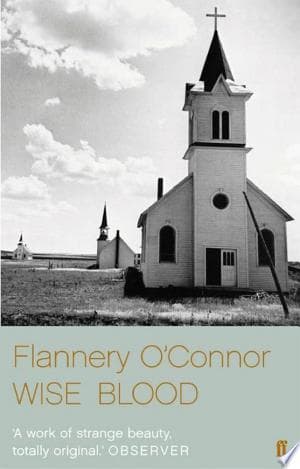
Synopsis
Covers the whole plot, including the ending.
- Difficulty
- Medium
- Pacing
- Moderate
- Mood
- Dark, Satirical, Disturbing, Philosophical
- Read it if
- You appreciate dark, satirical literary fiction with a strong Southern Gothic flavor and explore complex themes of faith, nihilism, and redemption.
- Skip it if
- You prefer straightforward narratives, are sensitive to grotesque imagery, or are uncomfortable with challenging religious themes.
Wise Blood Plot Summary
Covers the whole plot, including the ending.
The Return of Hazel Motes
Hazel Motes, a young man just out of the army, rides a train to Taulkinham, a fictional city in the Deep South. He is troubled by his strict, fundamentalist upbringing, especially his preacher grandfather. Despite his family's strong belief, Hazel decides to reject Christianity and start a new life free from it. On the train, he meets a saleswoman who tries to talk to him, but Hazel stays quiet and withdrawn, already showing the isolated, intense nature that will define his journey. He arrives in Taulkinham with a clear, though contradictory, goal: to preach a religion of no religion.
The Church Without Christ
When Hazel Motes arrives in Taulkinham, he immediately looks for a car, believing it necessary for his new ministry. He buys a rundown Essex, which becomes his main way to get around and a symbol of his unusual approach. He starts preaching his radical idea of 'The Church Without Christ,' saying there is no sin, no heaven, no hell, and no redemption. He argues that if there is no sin, there is no need for a savior. His sermons are delivered with fierce, almost violent conviction, often drawing small, curious, or mocking crowds, but he does not gain any true followers for his desolate philosophy.
Encountering Asa and Sabbath Lily Hawkes
Hazel Motes meets Asa Hawkes, a street preacher who claims to be blind for Christ. Asa preaches a more traditional, though equally strong, message of repentance and salvation. Hazel immediately distrusts Asa, seeing him as a fraud. Asa is with his fifteen-year-old daughter, Sabbath Lily Hawkes, a promiscuous and manipulative girl who quickly takes an interest in Hazel. Sabbath Lily is drawn to Hazel's intensity and strange faith. She starts following him, trying to get a reaction from him and inserting herself into his life, much to Hazel's annoyance and inner conflict.
The Blind Preacher's Deception
Hazel Motes, suspicious of Asa Hawkes's claims of blindness, follows him and watches him closely. He eventually finds out that Asa is not truly blind; he is only pretending to be to get sympathy and followers. This discovery further strengthens Hazel's resolve against traditional religion and his belief that all preachers are liars. The hypocrisy he sees in Asa reinforces his own anti-religious convictions, making him even more determined to preach his 'Church Without Christ' gospel. He believes he is at least honest in his rejection of God, even if his honesty is desperate and painful.
Enoch Emery and the New Jesus
Enoch Emery, an odd and socially awkward young man who works at the city zoo, becomes fascinated by Hazel Motes. Enoch believes he has 'wise blood' that guides him to important discoveries. He sees Hazel as an important figure and tries to befriend him, often following him and watching from a distance. Enoch begins his own strange search for spiritual fulfillment. This leads him to steal a shrunken mummy from the local museum, believing it to be a 'new Jesus.' He later puts on a gorilla suit and attacks someone, showing his own decline into primal, unreasoning faith.
The Betrayal of Sabbath Lily
Sabbath Lily Hawkes, still obsessed with Hazel Motes, takes a doll and wraps it in a newspaper, giving it to Hazel as their baby. She uses this made-up pregnancy to force Hazel into a relationship and get his attention, believing a child will bind them together. Hazel, however, sees through her trick immediately and is disgusted by her manipulation. He rejects her and the doll strongly, further isolating himself and deepening his distrust of human connection, especially one based on such a clear lie and a twisted use of religious imagery.
The Imposter and the Essex
A new character, Hoover Shoats, later known as Onnie Jay Holy, appears in Taulkinham, driving a similar car and copying Hazel Motes's 'Church Without Christ' message. This imposter, however, preaches it with a more commercial and less intense manner, making it seem like a mockery of Hazel's deeply felt, though twisted, beliefs. Hazel is furious at this imitation, seeing it as a gross misrepresentation of his unique and personal struggle. He confronts Onnie Jay Holy, and in a fit of desperate rage, Hazel runs him over with his Essex, killing him in a violent act that highlights his inner turmoil and the dangerous edge of his convictions.
The Destruction of the Essex
After killing Onnie Jay Holy, Hazel Motes is stopped by a patrolman. The officer, annoyed by Hazel's uncooperative attitude and strange preaching, impounds his car, the Essex, which has become a symbol of his identity and his ministry. Later, the patrolman, out of spite, pushes the Essex off an embankment, destroying it. This act is a deep blow to Hazel. The car was not just transportation; it was his pulpit, his refuge, and an extension of himself. Its destruction leaves him lost, stripped of his most tangible link to his chosen path and further isolating him from the world.
Blinding Himself
After his car is destroyed, Hazel Motes returns to his boarding house. In a shocking act of self-mutilation, he takes quicklime and blinds himself. This act is a twisted form of penance, an extreme expression of his belief in his own sinfulness and a desperate attempt to truly see, or perhaps to stop seeing, the world in its depravity and the hypocrisy he perceives. It is a final, clear rejection of the physical world and an embrace of an internal, spiritual darkness he believes is more honest than any light. This act solidifies his commitment to his unique path of suffering.
The Landlady's Discovery
After blinding himself, Hazel Motes continues to wander and live a life of extreme self-denial, often wrapping himself in barbed wire and putting rocks in his shoes. His landlady, Mrs. Flood, who initially finds his oddities disturbing but grows fascinated by him, observes his self-inflicted pain. One cold morning, Mrs. Flood finds Hazel Motes dead in a ditch. He died from exposure and his severe self-harm. His death is a grim, silent sign of his unwavering commitment to his chosen path, a path of deep spiritual struggle and physical deprivation that ultimately ended his life.
Wise Blood Characters
Hazel Motes
Protagonist
A discharged soldier who attempts to found 'The Church Without Christ'.
Hazel Motes is a young man from the rural South, profoundly shaped by a strict, fundamentalist upbringing. Driven by a fierce desire to escape the perceived hypocrisy and burden of religion, he embarks on a quest to preach a religion of no religion. He is intensely serious, isolated, and deeply conflicted, grappling with an inherited sense of sin and a desperate need for purity. His actions, though often violent and disturbing, stem from a profound, if misguided, spiritual longing. He seeks an absolute truth, even if that truth is a stark void.
Relationships: Asa Hawkes (rival preacher, object of suspicion and disdain); Sabbath Lily Hawkes (object of unwanted advances and manipulation); Enoch Emery (unwanted follower and source of bizarre interactions); Mrs. Flood (landlady, fascinated observer, and eventual caretaker)
Asa Hawkes
Antagonist/Supporting
A fraudulent blind preacher who preys on the religious sensibilities of others.
Asa Hawkes is a seemingly blind street preacher who preaches a traditional message of sin and redemption. He is a deceptive character, feigning blindness to gain sympathy and followers. Asa represents the hypocrisy and commercialization of religion that Hazel Motes so vehemently despises. Despite his claims of spiritual devotion, he is driven by worldly desires and uses religion as a means to an end. His presence serves as a constant irritant and a mirror to Hazel's own, albeit different, religious intensity.
Relationships: Hazel Motes (rival in preaching, object of Hazel's suspicion); Sabbath Lily Hawkes (his manipulative daughter, whom he uses to his advantage)
Sabbath Lily Hawkes
Supporting
Asa Hawkes's manipulative and promiscuous fifteen-year-old daughter.
Sabbath Lily Hawkes is the precocious and morally ambiguous daughter of Asa Hawkes. She is manipulative, sexually provocative, and seemingly devoid of genuine affection. She is drawn to Hazel Motes's intensity, seeing him as a potential source of excitement or escape. Her attempts to ensnare Hazel, particularly her fabricated pregnancy, highlight her own desperate need for connection and attention, albeit expressed in a twisted and dishonest manner. She embodies a kind of perverse innocence and moral decay, a product of her environment.
Relationships: Hazel Motes (object of her romantic and manipulative interest); Asa Hawkes (her father, whom she assists in his deceptions)
Enoch Emery
Supporting
A strange, socially awkward young man with 'wise blood' who becomes obsessed with Hazel.
Enoch Emery is a peculiar and isolated young man who works at the city zoo. He is guided by what he calls 'wise blood,' an instinctual, almost primal connection to certain events and people. Enoch is socially inept and longs for significance, often acting on bizarre impulses. His quest for a 'new Jesus' and his eventual transformation into a gorilla are symbolic of a raw, unreasoning, and almost pagan spirituality that parallels, and sometimes grotesquely mirrors, Hazel's own intense spiritual search. He represents a different kind of primitive religious impulse.
Relationships: Hazel Motes (figure of fascination and emulation)
Mrs. Flood
Supporting
Hazel Motes's landlady, who becomes increasingly fascinated by his self-mutilation.
Mrs. Flood is Hazel Motes's landlady, a pragmatic and initially detached woman who rents him a room. As Hazel's self-inflicted suffering escalates, Mrs. Flood becomes increasingly intrigued and even obsessed with him. She represents a secular curiosity about extreme religious devotion, initially repulsed but eventually drawn to the profound mystery of his suffering. Her attempts to care for him after he blinds himself are mixed with a desire to understand and perhaps even possess the meaning of his sacrifice, even if she can't fully grasp it.
Relationships: Hazel Motes (tenant, object of her growing fascination and morbid curiosity)
Onnie Jay Holy (Hoover Shoats)
Mentioned
An imposter who mimics Hazel Motes's 'Church Without Christ' for commercial gain.
Onnie Jay Holy, initially introduced as Hoover Shoats, is a charlatan who attempts to capitalize on Hazel Motes's unique brand of anti-religion. He drives a similar car and preaches a watered-down, commercialized version of 'The Church Without Christ,' lacking the intense conviction that drives Hazel. He represents the superficiality and exploitation that Hazel despises, and his presence ultimately provokes Hazel to a violent act, highlighting the profound difference between Hazel's tormented sincerity and Onnie Jay Holy's hollow imitation.
Relationships: Hazel Motes (imposter and eventual victim)
The Patrolman
Supporting
A local police officer who impounds and destroys Hazel's car.
The Patrolman is a minor character who interacts with Hazel Motes after he kills Onnie Jay Holy. He represents the indifferent and often arbitrary authority of the secular world. Annoyed by Hazel's strange behavior and lack of cooperation, he impounds Hazel's beloved Essex, later destroying it out of spite. His actions, though seemingly minor, have a profound impact on Hazel, stripping him of a crucial symbol of his identity and accelerating his descent into self-mortification. He is an instrument of fate, inadvertently pushing Hazel further down his chosen path.
Relationships: Hazel Motes (officer of the law, antagonist in the destruction of the Essex)
Wise Blood Themes
The Nature of Faith and Belief
O'Connor shows faith not as simple agreement with beliefs, but as an unavoidable human drive, often appearing in extreme, distorted ways. Hazel Motes's strong rejection of Christ is itself a kind of inverted faith, a desperate commitment to unbelief that mirrors the intensity of religious conviction. His self-blinding, for example, is a twisted act of spiritual self-denial, an attempt to 'see' through suffering. The novel suggests that the human need for meaning, even if it leads to nihilism or self-destruction, is inherently spiritual.
“'Where's one to go?' he asked, 'when he don't believe in nothing and nobody has any use for him?”
Hypocrisy and Deception
The novel has many characters who use religion for personal gain or to hide their true intentions. Asa Hawkes pretends to be blind for sympathy and money, and Sabbath Lily manipulates with false claims of pregnancy. Even Enoch Emery's 'wise blood' leads him to a grotesque 'new Jesus.' These deceptions highlight Hazel Motes's own fierce, though misguided, honesty. He despises the superficiality and fraud he sees in the world, pushing him to increasingly extreme and sincere acts of self-punishment to find an authentic truth, no matter how painful.
“'I'm a preacher,' he said, 'but I don't have nothing to preach. I'm a preacher and a good one, but I don't have a church, and I don't have Christ.”
Redemption Through Suffering
O'Connor often portrays grace as violent and unexpected, and 'Wise Blood' is a prime example. Hazel Motes's journey involves increasing self-harm—from wrapping himself in barbed wire to blinding himself. These acts of intense physical suffering, while seemingly self-destructive, can be seen as a twisted path to redemption or a search for spiritual purity. His suffering is not meaningless; it is a desperate, though extreme, attempt to atone for a perceived inherent sinfulness and to achieve a deep, internal vision beyond worldly sight.
“He knew that there was no way to avoid the eyes of God. The only way to avoid them was to be blind himself.”
Isolation and Alienation
Hazel Motes is very isolated throughout the novel, unable to connect meaningfully with others. His intense inner struggle and radical beliefs set him apart from the community. He rejects companionship, viewing others with suspicion or disdain. His attempts to preach his 'Church Without Christ' only alienate him further. Even characters like Enoch Emery and Sabbath Lily, who are drawn to him, fail to bridge his deep solitude. This isolation emphasizes the deeply personal and often lonely nature of spiritual struggle in O'Connor's world.
“He was not made for ordinary life, for the taste of coffee or the smell of bacon. He was made for a different kind of hunger.”
Plot Devices & Literary Techniques
The Essex Car
A dilapidated automobile that serves as Hazel Motes's mobile pulpit and symbol of his identity.
The Essex car is more than just transportation for Hazel Motes; it is his 'pulpit,' his sanctuary, and a physical manifestation of his 'Church Without Christ.' Its dilapidated state reflects the brokenness and desperation of Hazel's own spiritual quest. The car allows him to be constantly on the move, avoiding true attachment and symbolizing his rootless existence. Its eventual destruction by the patrolman is a pivotal moment, stripping Hazel of his outward identity and pushing him towards his ultimate act of self-mutilation, signaling the end of his external ministry and the beginning of his purely internal suffering.
Blindness (Literal and Figurative)
A recurring motif representing spiritual insight, deception, and the inability to truly see.
Blindness is a central motif. Asa Hawkes feigns literal blindness for deceptive purposes, while Hazel Motes's eventual self-blinding is an act of spiritual penance, a desperate attempt to gain inner sight by rejecting physical vision. Figuratively, many characters are blind to the truth: Mrs. Flood is blind to the depth of Hazel's suffering, and the townsfolk are blind to the true nature of faith. O'Connor uses this device to explore the idea that true spiritual perception often comes from an internal, rather than external, 'seeing,' and that literal sight can be a hindrance to understanding deeper truths.
Wise Blood
Enoch Emery's term for an instinctual, primal, and often grotesque spiritual intuition.
'Wise Blood' is Enoch Emery's unique concept, representing a raw, almost pagan intuition or instinct that guides him. It's an unreasoning, deeply felt connection to a hidden reality, often expressed through bizarre and unsettling actions, such as his obsession with the mummy and his transformation into a gorilla. This device highlights a different, more primal and less intellectualized form of spiritual seeking, contrasting with Hazel's tormented theological debates. It suggests that spiritual yearning can manifest in grotesque, irrational ways, operating beneath the surface of conscious thought and conventional religion.
The Shrunken Mummy
An object stolen by Enoch Emery that he believes to be a 'new Jesus'.
The shrunken mummy, stolen by Enoch Emery from the museum, functions as a grotesque parody of a religious relic and a twisted symbol of a 'new Jesus.' It represents the distortion and degradation of sacred objects within a secularized or misguided spiritual landscape. Enoch's attachment to it underscores his desperate search for a tangible, albeit bizarre, object of worship. This device highlights the human need to imbue objects with spiritual significance, even when those objects are profoundly unconventional or even unsettling, reflecting a yearning for the sacred in a world that often denies it.
Wise Blood Quotes
“No man is an island, entire of itself; every man is a piece of a continent, a part of the main.”
“Where you came from is gone, where you thought you were going to wasn't there, and where you are is no good unless you can get away from it.”
“The truth does not change according to our ability to stomach it.”
“He didn't believe in sin and he didn't believe in heaven and he didn't believe in hell, but he believed in the Law.”
“If there's no truth in the heart, there's none in the world.”
“He knew that the only way to avoid the light was to stay in the dark.”
“The soul is like a house, and the body is the walls and the roof.”
“He was a man who didn't want to be anything but himself, and he found that himself was a problem.”
“You can't be any poorer than dead.”
“He was going to be a new jesus, and he had already been crucified.”
“It was a place where there was no need to look for a sign, for every bush was aflame.”
“He had a head full of nothing but questions.”
“The eyes of the blind are not for seeing, but for looking.”
“He was going to preach a new church, the Church Without Christ, where the blind don't see and the lame don't walk and what's dead stays that way.”
Quiz
10 questions on the plot and the characters. Each answer comes with a short explanation.
Question 1
What is the name of the religion Hazel Motes attempts to found?
- The Church of the New Covenant
- The Church Without Christ
- The Holy Church of Truth
- The Temple of Modern Man
Show answer
B. The Church Without Christ Hazel Motes, in his rebellion against traditional religiosity, founds 'The Church Without Christ,' emphasizing his denial of redemption and a personal, bleak theology.
Question 2
Which physical disability does Asa Shadrack, the street preacher, claim to have?
- Deafness
- Limp
- Blindness
- Muteness
Show answer
C. Blindness Asa Shadrack, one of the first preachers Hazel encounters, claims to be a blind prophet, though his blindness is often questioned or implied to be feigned.
Question 3
What kind of vehicle does Hazel Motes purchase and live out of?
- A motorcycle
- A dilapidated truck
- A Ford car
- A horse and buggy
Show answer
C. A Ford car Hazel Motes buys a used car, a Ford, which he converts into his mobile home and pulpit for his anti-preaching.
Question 4
What is the name of Asa Hawkes's daughter, who forms a complex relationship with Hazel?
- Mary Grace
- Sabbath Lily
- Sarah Ruth
- Enoch Emery
Show answer
B. Sabbath Lily Sabbath Lily is Asa Hawkes's 'degenerate fifteen-year-old daughter' who becomes entangled with Hazel Motes, often manipulating him.
Question 5
What does Enoch Emery believe he has found in the museum that will grant him power?
- A ancient religious relic
- The new jesus
- A map to buried treasure
- A magical incantation
Show answer
B. The new jesus Enoch Emery steals a shrunken mummy from the museum, believing it to be 'the new jesus' and intending to present it to Hazel Motes.
Question 6
What is the ultimate fate of Hazel Motes's car?
- He sells it for a profit.
- It is repossessed by the dealer.
- It is pushed into a ditch by a police officer.
- He sets it on fire himself.
Show answer
C. It is pushed into a ditch by a police officer. After Hazel's preaching becomes too disturbing, a police officer pushes his car, his symbol of independence and pulpit, into a ditch, effectively destroying his mobile ministry.
Question 7
What extreme act of self-mutilation does Hazel Motes perform as an act of penance or devotion?
- He cuts off his own tongue.
- He blinds himself with lye.
- He severs his own hand.
- He burns his own feet.
Show answer
B. He blinds himself with lye. After his car is destroyed, Hazel Motes blinds himself with lye, a severe act of self-punishment and a distorted form of spiritual sacrifice, mirroring the 'blind' preachers he encounters.
Question 8
What is the primary thematic concern explored through Hazel Motes's relentless denial of Christ?
- The corrupting influence of power
- The inescapability of grace and the human need for redemption
- The futility of all religious belief
- The importance of individual freedom above all else
Show answer
B. The inescapability of grace and the human need for redemption Despite Hazel's fierce attempts to deny Christ and found a 'Church Without Christ,' his actions and suffering ultimately underscore O'Connor's theme that even in rebellion, humanity's innate need for grace and redemption is inescapable.
Question 9
How does Hazel Motes ultimately die?
- He is shot by a jealous rival.
- He starves to death in his rented room.
- He is found dead in a ditch after being struck by a car.
- He commits suicide by drowning.
Show answer
C. He is found dead in a ditch after being struck by a car. After blinding himself and continuing his penance, Hazel Motes is found dead in a ditch, having been struck by a car, a tragic and seemingly accidental end to his tormented life.
Question 10
What is the significance of the motif of 'blindness' in the novel, beyond literal physical blindness?
- It symbolizes the characters' inability to see the beauty in the world.
- It represents a spiritual or moral blindness to truth and grace, and the paradoxical insight sometimes found in physical darkness.
- It is a metaphor for the characters' lack of education and worldly knowledge.
- It highlights the oppressive nature of society on individual perception.
Show answer
B. It represents a spiritual or moral blindness to truth and grace, and the paradoxical insight sometimes found in physical darkness. Blindness, both literal (Asa Shadrack, Hazel's self-blinding) and figurative, is a central motif. It represents spiritual ignorance, the refusal to see God's truth, but also paradoxically, the potential for deeper, spiritual insight that can come through physical deprivation or suffering.
Wise Blood FAQ
What is the central premise of 'Wise Blood'?
The novel centers on Hazel Motes, a young veteran returning to the Deep South who is determined to deny Christ and establish his own religion, 'The Church Without Christ.' His quest is a vehement rejection of the religious hypocrisy and fervent belief he encounters, leading him down a path of self-mutilation and spiritual struggle.
Who is Hazel Motes and what motivates his actions?
Hazel Motes is a disillusioned young man, recently returned from the armed services, who feels a compulsive, almost predestined, need to preach against Christ. His motivations are complex, stemming from a childhood steeped in severe, fear-based religion, which he now rebels against by seeking absolute freedom from sin and redemption, even if it means denying their very existence.
Describe the relationship between Hazel Motes and Asa Hawkes.
Hazel is initially drawn to Asa Hawkes, a supposedly blind street preacher, believing Hawkes to be a fellow non-believer and kindred spirit. However, Hazel quickly sees through Hawkes's charade and views him as a hypocrite, intensifying his own resolve to preach a truly Christless religion, free of such deceit.
What role does Enoch Emery play in the narrative?
Enoch Emery is a peculiar, isolated young man who latches onto Hazel Motes, interpreting Hazel's actions through his own distorted understanding. He is obsessed with 'new jesus' figures and eventually steals a shrunken mummy, believing it to be a new prophet, ultimately transforming himself into a gorilla to terrorize the town.
How does the 'Church Without Christ' manifest itself in Hazel's life?
Hazel's 'Church Without Christ' is a doctrine of pure negation, asserting that there is no sin, no redemption, and no need for a savior. He preaches this from the hood of his rat-colored car, attempting to convince others, and ultimately himself, that he is free from the pervasive influence of Christ, even as his actions suggest a deeper, inescapable spiritual yearning.
What is the significance of Hazel Motes's car?
Hazel's rat-colored car is his most prized possession, symbolizing his independence, his mobile pulpit, and his attempt to escape his past and God's reach. When the car is destroyed by the patrolman, it represents a profound loss of his perceived autonomy and a turning point in his desperate spiritual journey.
What is the true nature of Asa Hawkes's blindness?
Asa Hawkes is not genuinely blind but fakes his affliction to elicit sympathy and donations for his street preaching. This deception is quickly perceived by Hazel Motes, who is disgusted by the hypocrisy and sees it as further proof of the falseness inherent in conventional religious displays.
How does the shrunken mummy acquired by Enoch Emery connect to the novel's themes?
The shrunken mummy, stolen by Enoch from a museum, is a grotesque and absurd symbol of a 'new jesus' figure for Enoch. It represents the human tendency to seek out and venerate false idols or distorted versions of spiritual truth, highlighting the novel's critique of misplaced faith and the grotesque aspects of human belief.
What is the significance of Hazel Motes blinding himself?
Hazel Motes blinds himself with quicklime after his car is destroyed, a drastic act of self-mutilation that signifies his final, desperate attempt to escape the 'wise blood' of Christ that he feels within him. It is an ironic act, as he metaphorically 'sees' more clearly in his physical blindness, accepting a form of spiritual truth he had long resisted.
Analyze Hazel Motes's internal conflict regarding sin and salvation.
Hazel Motes is consumed by a paradoxical internal conflict: he desperately wants to believe there is no sin and no need for salvation, yet he is constantly haunted by the pervasive presence of Christ and the concept of original sin. His rebellion is not a simple atheism but a passionate struggle against a spiritual reality he feels compelled to deny, indicating a deep-seated spiritual yearning masked by defiance.
How do the various characters' eccentricities reflect deeper psychological states?
The eccentricities of characters like Enoch Emery (obsessive, delusional), Asa Hawkes (deceptive, manipulative), and Sabbath Lily Hawkes (promiscuous, manipulative) reflect their profound spiritual and psychological brokenness. Their bizarre behaviors are external manifestations of internal voids, desperate attempts to find meaning, attention, or escape in a world they perceive as indifferent or hostile.
Discuss the psychological impact of Hazel's religious upbringing on his adult life.
Hazel's severe, fundamentalist religious upbringing instilled in him a profound fear of damnation and an inescapable sense of sin. In adulthood, this manifests as an intense, almost pathological, need to reject Christ, not out of true disbelief, but as an attempt to assert control over a spiritual burden he finds overwhelming and terrifying.
What does Hazel's final act of self-mutilation reveal about his psychological state?
Hazel's act of blinding himself is a culmination of his psychological torment. It reveals a broken man who, having failed to escape Christ through denial and outward rebellion, resorts to extreme self-punishment. This act, however, ironically leads him to a state of internal clarity, suggesting a desperate surrender to the very spiritual force he fought against.
Is Hazel Motes a true atheist or a deeply religious man in denial?
Hazel Motes is arguably a deeply religious man in denial, rather than a true atheist. His vehement, almost obsessive, rejection of Christ suggests an inescapable spiritual awareness. His 'Church Without Christ' is not an absence of belief, but a passionate, albeit inverted, form of faith, constantly defined by what it opposes, indicating an enduring spiritual struggle.
How does O'Connor use grotesque imagery to convey her spiritual themes?
O'Connor employs grotesque imagery—such as the shrunken mummy, Enoch's gorilla suit, and Hazel's self-blinding—to shock the reader and expose the spiritual distortions and moral decay within her characters. This 'Gothic' style serves to highlight the characters' desperate attempts to find truth, often through physically extreme or absurd means, emphasizing the spiritual violence inherent in their struggles.
What is the meaning of the title 'Wise Blood'?
The title 'Wise Blood' refers to an innate, instinctual, and perhaps ancestral, spiritual knowledge or pull towards Christ that Hazel Motes feels he possesses and cannot escape. Despite his intellectual and physical efforts to deny God, his 'wise blood' continually draws him back to a spiritual reality, suggesting that faith is not merely a choice but an inescapable part of human nature.
Does Hazel Motes achieve redemption by the end of the novel?
The question of Hazel's redemption is open to interpretation. While his final acts of self-mutilation and subsequent passive suffering are horrific, they can be seen as a form of inverted martyrdom or a grim acceptance of his spiritual burden. His physical blindness leads to a metaphorical spiritual sight, suggesting a painful, unconventional path to grace, characteristic of O'Connor's dark theology.
How does O'Connor critique modern society's approach to spirituality in 'Wise Blood'?
O'Connor critiques modern society's superficiality and intellectualized approach to spirituality through the various false prophets and distorted beliefs in the novel. She suggests that attempts to rationalize, deny, or commercialize faith lead to grotesque and empty forms of belief, highlighting the profound human need for authentic spiritual encounter, even if it is violent or unsettling.
About the author

Mary Flannery O'Connor was an American novelist, short story writer and essayist. She wrote two novels and 31 short stories, as well as a number of reviews and commentaries.
Similar books
- The violent bear it away
Flannery O'Connor
4.1 (10k) average on GoodreadsLiterary FictionAnother O'Connor novel dealing with spiritual struggle, prophecy, and the grotesque in the rural South.
- As I Lay Dying
William Faulkner
3.7 (137k) average on GoodreadsLiterary FictionFeatures a distinct Southern voice, dark humor, and a journey of a family confronting existential and physical challenges.
- The Old Man and the Sea
Ernest Hemingway
3.8 (831k) average on GoodreadsLiterary FictionA Cuban fisherman's long struggle with a giant marlin becomes a story of endurance and dignity, now retold for young adults with illustrations, phonetic guides, and writing prompts in Traditional Chinese.
- One Hundred Years of Solitude
Gabriel García Márquez
4.1 (753k) average on GoodreadsLiterary FictionThrough the multi-generational story of the Buendía family, a mythical town deals with the repeating patterns of time, love, and solitude, as the extraordinary mixes with the ordinary.
- The Goldfinch
Donna Tartt
3.9 (720k) average on GoodreadsLiterary FictionHaunted by a tragic explosion and clutching a stolen Dutch masterpiece, a young orphan navigates the opulent drawing rooms of New York and the gritty underbelly of the art world, desperately seeking connection and redemption amidst a life spiraling into crime and obsession.
- Little Fires Everywhere
Celeste Ng
4.1 (713k) average on GoodreadsLiterary FictionIn Shaker Heights, an artist and her daughter move in, and their free-spirited lives clash with a rule-bound matriarch, revealing hidden conflicts beneath a perfect surface.




Enjoyed the summary?
A summary gives you the shape of the book. The book itself has the detail, the examples and the voice.
Find Wise Blood on AmazonAs an Amazon Associate, BookBrief earns from qualifying purchases. How we're funded