
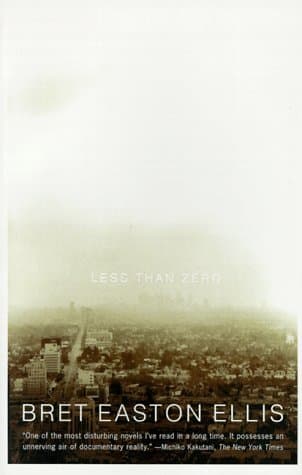
Synopsis
Covers the whole plot, including the ending.
- Difficulty
- Medium
- Pacing
- Slow
- Mood
- Bleak, Detached, Nihilistic, Disturbing, Atmospheric
- Read it if
- You are interested in a raw, unflinching portrayal of youth decadence and moral decay in 1980s Los Angeles.
- Skip it if
- You prefer stories with strong character arcs, clear resolutions, or a hopeful tone, or are sensitive to graphic depictions of drug use and exploitation.
Less Than Zero Plot Summary
Covers the whole plot, including the ending.
Return to Los Angeles
Clay, a college student, returns to Los Angeles for Christmas vacation. His ex-girlfriend, Blair, and friend, Trent, pick him up at the airport. He notices the superficial changes and the widespread boredom among his friends. He quickly falls back into his old routine, attending parties and meeting friends who live a life of drugs, sex, and apathy. This sets the tone for his disorienting holiday.
Reconnecting with Julian
Clay meets his childhood best friend, Julian, who is struggling. Julian admits he is addicted to heroin and has become a male prostitute to pay drug debts to a dealer named Rip. Clay is disturbed by Julian's physical decline and hopeless situation, but he cannot offer real help. This encounter shows Clay's passivity and the dysfunction in their social group, where even serious problems are met with indifference. Julian's struggles become a recurring, haunting part of Clay's vacation.
Parties and Superficiality
During his vacation, Clay attends many parties at mansions and clubs across Los Angeles. These gatherings involve excessive drug use (mainly cocaine), casual sex, and a widespread sense of boredom among attendees. Clay observes his friends engaging in these behaviors with a detached indifference. He notes the lack of real connection, even as people pursue fleeting pleasures. These scenes emphasize the nihilism and moral decay of their privileged lives, with Clay often feeling like an observer.
Attempted Reconciliation with Blair
Clay and Blair try to navigate their past relationship. They spend time together, often with friends, but their interactions lack intimacy and emotional connection. They have sex, but it feels mechanical. Blair wants something more meaningful, but Clay is emotionally distant. Their attempts at reconciliation fail because of their shared environment of apathy, drug use, and the unspoken understanding that neither can truly engage emotionally. Their relationship mirrors the larger emotional void in their lives.
Encounters with Rip
Clay has several disturbing encounters with Rip, Julian's drug dealer and pimp. Rip is a threatening figure who represents the predatory nature beneath the city's glamour. In one unsettling scene, Rip forces Julian to perform a sexual act in front of Clay, showing Julian's complete submission and Clay's horrified, paralyzed reaction. These interactions force Clay to confront the brutal realities of Julian's life and the dangers of their world. Rip represents the extreme consequences of their hedonistic lifestyle and the moral compromises made by those caught in it.
The Desert Trip
Clay, Blair, Trent, and others go to Palm Springs, hoping for a change of scenery. However, the desert offers no escape from their boredom. The trip quickly becomes more of the same: drug use, casual sex, and aimless conversations. Clay sees the same behavior patterns against a different background. The change in location only highlights the characters' internal emptiness, proving their problems are internal. The desert, often linked to spiritual quests, here symbolizes barrenness and a lack of real revelation.
Julian's Deterioration
As the vacation continues, Julian's heroin addiction and financial problems worsen. He becomes more desperate, making erratic decisions and further immersing himself in prostitution to meet Rip's demands. Clay sees Julian's physical and mental decline firsthand, feeling pity, disgust, and helplessness. Julian's pleas for help are mostly ignored or met with superficial sympathy, showing Clay and his friends' inability to intervene. Julian's downward spiral serves as a stark warning and a tragic contrast to the other characters' more 'controlled' nihilism.
Disquieting Observations
Clay's observations become more disturbing as he notices predatory behavior and moral decay among his friends. He sees younger girls exploited, hears casual discussions of sexual assault, and witnesses a general disregard for human dignity. These moments are often presented with a chilling detachment, reflecting Clay's own numbness, but they also signal growing unease within him. He recognizes the casual cruelty and normalization of exploitation in their world, solidifying his sense of alienation and his perception of the moral void. The line between consensual and exploitative behavior disappears.
A Glimmer of Self-Awareness
Despite his passivity, Clay has brief moments of self-awareness. He questions his role in the detached world he lives in and wonders about his future. He recognizes the hollowness of his relationships and the destructive nature of his environment. These moments are brief and rarely lead to action, but they suggest an internal struggle. He considers whether he can escape this lifestyle when he returns to college, or if it has shaped him permanently. This internal monologue provides a rare insight into Clay's character beyond his observational facade.
The Return East
At the end of his vacation, Clay prepares to return to college. His final interactions with Blair and Julian are as unresolved and emotionally detached as their first ones. He leaves Los Angeles with a sense of relief, but also with the unsettling knowledge that his experiences have left a lasting mark. The city, and its lifestyle, remains a haunting presence. As he boards the plane, he reflects on the 'less than zero' feeling—a pervasive emptiness that he carries with him, unsure if he has truly escaped or merely postponed his involvement.
Principal Figures
Clay
Protagonist
A college student returning home to a world of privilege and moral decay.
Clay is a seemingly passive and detached college student who returns to Los Angeles for Christmas break. He acts primarily as an observer, chronicling the hedonistic and morally bankrupt lifestyle of his wealthy friends. While he participates in some of the drug use and casual sex, he often feels a profound sense of alienation and disgust. He struggles with his own emotional numbness and an inability to connect authentically with others, including his ex-girlfriend Blair and his best friend Julian, whose downward spiral he witnesses with a chilling passivity. His internal monologue reveals a nascent, though often suppressed, awareness of the emptiness around him.
Relationships: Blair (Ex-girlfriend, attempts at rekindling a relationship marked by emotional distance.); Julian (Childhood best friend, whose drug addiction and prostitution Clay observes with helpless detachment.); Trent (Friend, part of the social circle, often facilitating parties and drug use.)
Blair
Supporting
Clay's ex-girlfriend, caught in the same cycle of ennui and superficiality.
Blair is Clay's ex-girlfriend, who picks him up from the airport and with whom he attempts to rekindle a relationship. She is beautiful, wealthy, and deeply entrenched in the same hedonistic lifestyle as Clay and their friends. While she occasionally expresses a desire for more meaning or emotional connection, she is ultimately as passive and emotionally numb as Clay. Her interactions with Clay are marked by a lack of genuine intimacy, and she often seems to be going through the motions, caught in the inertia of their privileged but empty existence. She represents the potential for connection that never fully materializes.
Relationships: Clay (Ex-boyfriend, attempts at rekindling a relationship marked by emotional distance.); Trent (Friend, part of the social circle.)
Julian
Supporting
Clay's childhood best friend, spiraling into heroin addiction and male prostitution.
Julian is Clay's childhood best friend, whose tragic descent into heroin addiction and male prostitution forms one of the novel's central emotional anchors. Once a vibrant and popular figure, Julian is now physically and mentally deteriorated, constantly seeking money to pay off his drug debts to Rip. He is vulnerable, exploited, and increasingly desperate, often pleading for help that Clay and their friends are unwilling or unable to provide. Julian embodies the extreme consequences of the nihilistic lifestyle, serving as a stark warning and a symbol of lost innocence and potential within their privileged but corrupt world.
Relationships: Clay (Childhood best friend, who observes Julian's deterioration.); Rip (Drug dealer and pimp, who exploits Julian's addiction and vulnerability.)
Rip
Antagonist
Julian's menacing drug dealer and pimp.
Rip is a menacing and predatory figure who serves as Julian's drug dealer and pimp. He is a dark embodiment of the seedy underbelly of Los Angeles, exploiting Julian's addiction and vulnerability with cold calculation. Rip is responsible for Julian's mounting debts and forces him into prostitution to pay them off. His presence introduces a tangible threat and a sense of genuine danger into Clay's otherwise detached observations. Rip represents the extreme moral depravity and the harsh realities that exist beneath the glamorous facade of wealth and privilege, highlighting the destructive consequences of unchecked hedonism.
Relationships: Julian (Exploits Julian as a drug dealer and pimp.); Clay (Causes Clay significant unease and fear through his actions towards Julian.)
Trent
Supporting
A friend in Clay's social circle, facilitating their hedonistic lifestyle.
Trent is one of Clay's friends and a prominent member of their social circle. He is frequently present at parties and gatherings, often facilitating drug use and casual encounters. Trent embodies the casual nihilism and superficiality of their group, participating in the hedonistic lifestyle without apparent introspection or consequence. He is generally amiable but lacks any deep emotional engagement, reflecting the pervasive apathy. His character helps to illustrate the widespread nature of the disaffection and moral emptiness among the wealthy youth in Los Angeles.
Relationships: Clay (Friend, part of the social circle.); Blair (Friend, part of the social circle.)
Muriel
Supporting
A young girl exploited within Clay's social circle.
Muriel is a very young girl, possibly underage, who is frequently seen at parties and is openly exploited by older men within Clay's social circle. Her presence highlights the dark and predatory nature lurking beneath the surface of their seemingly glamorous world. Clay observes her with a mixture of discomfort and passive acceptance, reflecting the moral decay and the normalization of exploitation. Muriel is a tragic figure, representing the extreme vulnerability of those drawn into this destructive environment and the complete lack of protection offered by the adults and older peers around her.
Relationships: Clay (Observed by Clay, who is disturbed by her exploitation.); Older men in the social circle (Exploited by them.)
Daniel
Mentioned
A friend from Clay's past, now heavily involved in the drug scene.
Daniel is a friend from Clay's past, now deeply enmeshed in the drug scene and exhibiting signs of severe addiction and mental deterioration. Clay observes Daniel's erratic behavior and physical decline, noting how far he has fallen. Daniel serves as another example of the destructive path many of their peers are on, further reinforcing the bleak outlook of their social environment. His presence underscores the pervasive nature of addiction and the lack of a future for many of these characters.
Relationships: Clay (Friend from the past, observed by Clay.)
Themes & Insights
Nihilism and Apathy
The novel shows widespread nihilism and apathy among its wealthy characters. They engage in excessive drug use, casual sex, and other hedonistic activities, not out of joy, but from boredom and a lack of meaning. Clay, as the main observer, embodies this detachment, often narrating events with a flat, emotionless tone. The characters rarely show genuine emotion, even in the face of tragedy like Julian's addiction. This theme appears in every party scene, every empty conversation, and especially in Clay's own struggle with feeling 'less than zero.'
“People are afraid to merge. They're afraid to have sex, they're afraid to get close to anybody.”
Moral Decay and Exploitation
Underneath the wealth and glamour, the novel reveals deep moral decay and exploitation. This is most clear through Julian's forced prostitution under Rip's control, but it also extends to the casual exploitation of younger girls like Muriel, and a general disregard for human dignity. Clay's observations show a world without ethics, where people are treated as disposable objects for pleasure or profit. Clay's and other characters' lack of intervention in the face of such acts highlights the widespread moral bankruptcy of their society.
“I really don't want to know what's going on. It's none of my business.”
Disconnection and Alienation
Despite being constantly surrounded by people, the characters in 'Less Than Zero' experience deep disconnection and alienation. Clay feels like an outsider even within his own social circle, observing rather than truly participating. Relationships, like his with Blair, lack genuine intimacy or emotional depth. The characters cannot form meaningful bonds, communicating mostly through superficial talk and shared drug use. This theme highlights the emptiness of their lives, where physical closeness does not mean emotional closeness, leaving everyone isolated.
“I felt myself getting lost in the crowd, just another face, and I didn't care.”
The Corrosive Nature of Privilege
The novel shows how immense wealth and privilege, without moral guidance, can lead to destructive outcomes. The characters have unlimited access to drugs, parties, and material comforts, but this only fuels their boredom and accelerates their self-destruction. Their parents are largely absent or indifferent, providing money but no emotional support. This theme suggests that privilege, in this context, is a curse, creating a void filled with addiction, exploitation, and a profound 'less than zero' feeling. Their wealth allows them to indulge every destructive impulse without immediate consequences.
“People are afraid to merge. They're afraid to have sex, they're afraid to get close to anybody.”
Plot Devices & Literary Techniques
First-Person Detached Narration
Clay's emotionless, observational point of view.
The entire novel is narrated from Clay's first-person perspective, characterized by a strikingly detached and emotionless tone. Clay reports events, conversations, and observations with minimal personal reflection or emotional reaction. This narrative style mirrors Clay's own apathy and alienation, making the reader experience the world through his numb gaze. It amplifies the sense of nihilism and moral decay by presenting horrific events as mundane, drawing the reader into the characters' desensitized reality and highlighting the profound lack of feeling that pervades their lives. The detachment itself becomes a powerful statement about the characters' inability to connect or care.
Repetitive Structure
The cyclical nature of parties, drugs, and aimless interactions.
The novel employs a highly repetitive structure, with Clay moving from one party to another, one drug-fueled encounter to the next, often with the same people and similar conversations. This cyclical pattern emphasizes the aimlessness and lack of progression in the characters' lives. It underscores their inability to break free from their destructive routines and highlights the pervasive boredom and lack of purpose. The repetition creates a claustrophobic atmosphere, trapping the reader within the characters' unchanging, self-destructive world, and reinforcing the idea that no real escape or redemption is possible within this cycle.
Unresolved Endings and Open Questions
Many plotlines and character fates are left ambiguous.
Many of the novel's plotlines, particularly concerning Julian's fate and Clay's own future, are left open-ended and unresolved. Clay's departure from Los Angeles offers no clear resolution or redemption; he simply leaves, carrying the weight of his experiences. This device reflects the pervasive nihilism and lack of hope within the narrative. It suggests that there are no easy answers or happy endings in this world, and that the cycle of destruction will likely continue. The ambiguity forces the reader to confront the unsettling reality that some problems have no solutions, and some characters are beyond saving, mirroring the 'less than zero' feeling.
Symbolism of Los Angeles
The city as a character reflecting glamour, decay, and emptiness.
Los Angeles itself functions as a major symbolic character in the novel. It is portrayed as a glittering, superficial landscape of wealth and glamour, but beneath this facade lies profound moral decay, emptiness, and exploitation. The city's sprawling, disconnected nature mirrors the characters' internal states. Iconic locations like the Beverly Center and the Whisky a Go Go become backdrops for moral rot. The constant sunshine and palm trees juxtaposed with the dark actions and despair create a stark contrast, emphasizing the illusory nature of their privileged existence and the pervasive corruption that defines their environment.
Less Than Zero Quotes
“I'm not a good person. I'm not a bad person. I'm just a person.”
“People are afraid to merge. They're afraid to have too much in common and they're afraid to have nothing in common.”
“There are no new feelings. Whatever it is, someone else has felt it before.”
“The city was a place of endless possibilities, but also endless despair.”
“I was starting to lose track of what was real and what wasn't.”
“Everybody's looking for something. Even if they don't know what it is.”
“It was like everyone was living in a movie, and I was just an extra.”
“The past was a place I couldn't go back to, and the future was a place I didn't want to go.”
“We were all so young and so lost, and we didn't even know it.”
“I kept waiting for something to happen, but nothing ever did.”
“Sometimes you just have to give up and let things happen.”
“The air was thick with unspoken words and unfulfilled desires.”
“It's not that I don't care. It's just that I don't know how to.”
“We're all just trying to get by, aren't we?”
Quiz
10 questions on the plot and the characters. Each answer comes with a short explanation.
Question 1
What is Clay's primary reason for returning to Los Angeles at the beginning of the novel?
- To start a new job
- For Christmas vacation from college
- To visit his ailing grandmother
- To attend a friend's wedding
Show answer
B. For Christmas vacation from college Clay returns to Los Angeles from his Eastern college for Christmas vacation, setting the stage for his re-entry into the city's decadent scene.
Question 2
Which of the following best describes Clay's emotional state throughout most of the novel?
- Excited and optimistic
- Indifferent and detached
- Angry and rebellious
- Joyful and carefree
Show answer
B. Indifferent and detached Clay's narrative voice is characterized by a profound sense of disaffection, passivity, and emotional detachment, mirroring the nihilism of his surroundings.
Question 3
What is Julian's primary struggle that Clay observes during his visit?
- A failing academic career
- An addiction to heroin and hustling to support it
- A strained relationship with his parents due to a new girlfriend
- Financial difficulties from a bad investment
Show answer
B. An addiction to heroin and hustling to support it Julian, Clay's best friend, is depicted as spiraling into heroin addiction and resorting to hustling, which deeply disturbs Clay.
Question 4
What is the name of Clay's girlfriend whom he attempts to reconnect with?
- Amanda
- Blair
- Chloe
- Tiffany
Show answer
B. Blair Clay attempts to renew feelings for his girlfriend, Blair, throughout his vacation.
Question 5
Which prominent Los Angeles restaurant is mentioned as a place where characters dine?
- The Ivy
- Chili's
- Spago
- Morton's
Show answer
C. Spago The novel explicitly states that characters 'dine at Spago,' highlighting the lavish lifestyle of the privileged youth.
Question 6
The novel's setting in the early 1980s is crucial. What type of car is frequently mentioned as being driven by the characters, symbolizing their wealth?
- Mercedes-Benz
- BMW
- Corvette
- Porsche
Show answer
D. Porsche The description states 'everyone drives Porches,' emphasizing the material wealth and status symbols of the characters.
Question 7
What overarching theme is most central to 'Less Than Zero'?
- The triumph of innocence over corruption
- The search for meaning in a nihilistic, morally bankrupt world
- The importance of family ties
- The pursuit of the American Dream
Show answer
B. The search for meaning in a nihilistic, morally bankrupt world The novel is described as a 'raw, powerful portrait of a lost generation... in a world shaped by casual nihilism, passivity, and too much money a place devoid of feeling or hope,' directly aligning with the theme of searching for meaning in a morally bankrupt world.
Question 8
Clay's journey through Los Angeles is characterized by a 'dizzying spiral of desperation.' Which of the following best describes the types of locations he frequents?
- Art galleries, libraries, and quiet cafes
- Glitzy mansions, seedy bars, and underground rock clubs
- Suburban homes, community centers, and school events
- Nature trails, meditation retreats, and yoga studios
Show answer
B. Glitzy mansions, seedy bars, and underground rock clubs The description explicitly states Clay's holiday takes him 'through the relentless parties in glitzy mansions, seedy bars, and underground rock clubs,' illustrating the dark and hedonistic landscape.
Question 9
The novel is classified as 'Literary Fiction, Thriller.' In what sense does 'Less Than Zero' incorporate elements of a thriller?
- Through a fast-paced detective plot to solve a murder mystery
- By building suspense and dread around the moral decay and dangerous situations Clay encounters
- With a dramatic car chase scene through the streets of L.A.
- By featuring a government conspiracy that Clay accidentally uncovers
Show answer
B. By building suspense and dread around the moral decay and dangerous situations Clay encounters While not a traditional action thriller, the 'thriller' aspect comes from the psychological suspense and growing dread as Clay witnesses and participates in increasingly disturbing and morally compromising situations, particularly concerning Julian's fate and the 'seamy world of L.A. after dark.'
Question 10
What does the phrase 'absolute moral entropy' in the description signify regarding the characters' environment?
- A strict adherence to moral codes and societal rules
- A state of complete moral decay and disorder, where values have disintegrated
- A philosophical debate about the nature of good and evil
- A society focused on improving ethical standards through education
Show answer
B. A state of complete moral decay and disorder, where values have disintegrated 'Moral entropy' refers to a gradual decline into disorder or chaos. In this context, 'absolute moral entropy' signifies a complete breakdown of ethical values and principles within the characters' world.
Less Than Zero FAQ
What is the central premise of 'Less Than Zero'?
The novel follows Clay, a college student returning to Los Angeles for Christmas break, where he is immediately immersed in the decadent, drug-fueled, and morally bankrupt lifestyle of his wealthy friends. He observes their destructive behaviors and struggles to reconnect with his past, particularly his ex-girlfriend Blair and his best friend Julian, who is spiraling into prostitution and heroin addiction.
Who is Clay, and what is his role in the narrative?
Clay is the protagonist and first-person narrator, an Eastern college student who returns to his affluent Los Angeles home. He acts primarily as an observer, coolly documenting the nihilistic hedonism around him, though he is also a participant in some of the illicit activities. His detached perspective highlights the emotional void experienced by his generation.
What happens to Julian, Clay's best friend?
Julian, Clay's former best friend, is depicted as being deeply entangled in drug addiction, specifically heroin, and has resorted to prostitution to support his habit. His downward spiral is one of the most tragic storylines, culminating in his being sold into sexual slavery by his pimp, Rip, and Clay's failed attempts to help him.
What is the nature of Clay's relationship with Blair?
Blair is Clay's ex-girlfriend, and he attempts to rekindle their relationship during his break. However, their interactions are marked by a profound emotional distance and a shared history of drug use and casual sex. Their attempts at intimacy are often interrupted by the pervasive apathy and the destructive environment they inhabit.
Where does the title 'Less Than Zero' come from?
The title is derived from Elvis Costello's song 'Less Than Zero,' which addresses themes of disillusionment and political apathy. In the context of the novel, it symbolizes the emotional and moral vacuum experienced by the characters, suggesting a state of being below zero in terms of feeling, hope, and purpose.
Are there any subtle hints about Clay's own past actions or complicity?
While Clay often presents himself as an observer, there are subtle hints throughout the novel that he is not entirely innocent. His detached narration occasionally reveals his past participation in the same destructive behaviors, including drug use and sexual encounters, suggesting a deeper complicity than he explicitly acknowledges. For instance, he refers to past actions with Julian and Blair without fully detailing them.
What is the significance of the recurring motif of television and movies?
Television and movies frequently appear in the background of scenes, often playing violent or mundane content that the characters ignore or barely register. This motif underscores their pervasive apathy and disconnection from reality, highlighting how media consumption has become a passive, meaningless ritual in their lives, mirroring their own emotional numbness.
How does the setting of early 1980s Los Angeles contribute to the novel's themes?
The early 1980s Los Angeles setting, with its emphasis on wealth, superficiality, and a burgeoning drug culture, perfectly encapsulates the novel's themes of moral decay and nihilism. The city's sprawling, disconnected landscape and its focus on appearance over substance mirror the characters' internal emptiness and their transient, meaningless existences.
Is there a specific moment that reveals the depth of Julian's exploitation?
The most harrowing moment revealing Julian's exploitation is when Clay discovers him being prostituted by Rip, and later when Julian is sold to a man in Palm Springs. This emphasizes the extreme vulnerability and dehumanization Julian experiences, highlighting the brutal reality of his addiction and the predatory nature of his environment.
How does Clay's detachment function as a psychological defense mechanism?
Clay's pervasive detachment serves as a psychological defense mechanism, allowing him to observe and participate in horrific events without fully processing their emotional impact. This emotional numbness protects him from the pain and despair of his environment, but also perpetuates his own sense of alienation and inability to connect authentically.
What psychological impact does the constant exposure to violence and depravity have on the characters?
The constant exposure to violence, drug abuse, and sexual depravity in their environment has desensitized the characters, leading to a profound emotional numbness and an inability to experience genuine empathy or joy. This psychological impact manifests as apathy, passivity, and a lack of moral compass, trapping them in a cycle of self-destruction.
How does the novel explore the psychology of addiction, particularly through Julian?
Through Julian, the novel vividly portrays the psychological grip of addiction, showing how it strips away dignity, agency, and self-worth. Julian's desperation, his willingness to engage in prostitution, and his inability to escape Rip's control illustrate the profound psychological and physical dependency that defines severe drug addiction.
What is the significance of Clay's recurring nightmares and fragmented memories?
Clay's recurring nightmares and fragmented memories, often involving disturbing or violent imagery, suggest a subconscious struggle with trauma and guilt. These fleeting glimpses into his inner turmoil contradict his outwardly cool demeanor, revealing the psychological toll of his experiences and hinting at repressed anxieties about his past actions or observations.
Is Clay a reliable narrator, or does his detachment distort the events?
Clay is largely considered an unreliable narrator due to his extreme detachment and passive observation. His emotional numbness and lack of introspection mean that his account may be filtered through a lens of apathy, potentially omitting details or downplaying his own involvement, thus distorting the full emotional and moral weight of the events.
Does the novel offer any hope for redemption or escape for its characters?
The novel offers very little, if any, hope for redemption. Clay's departure from Los Angeles at the end suggests a potential escape, but his lingering emotional numbness and the bleakness of the world he leaves behind imply that true redemption or a fundamental change in his psychological state is unlikely. The ending is ambiguous, leaving the reader with a sense of lingering despair.
What is the author's critique of wealth and privilege in 'Less Than Zero'?
Bret Easton Ellis critiques the corrosive effects of extreme wealth and privilege, depicting how limitless money, without moral guidance, leads to profound emptiness and destructive hedonism. The characters' affluence enables their drug use, casual sex, and apathy, suggesting that privilege can be a catalyst for moral decay rather than a source of fulfillment.
How does the novel challenge traditional notions of morality and consequence?
The novel challenges traditional morality by presenting a world where consequences are rarely felt or acknowledged by the characters. Their actions, no matter how depraved, often go unpunished, fostering a sense of moral relativism and nihilism. This lack of consequence underscores the profound moral entropy of their society.
What is the significance of the novel's episodic structure?
The novel's episodic, fragmented structure, characterized by short, disconnected scenes, mirrors the characters' own fractured existences and their inability to form meaningful connections or coherent narratives. It emphasizes their transient experiences and the lack of overarching purpose in their lives, contributing to the pervasive sense of apathy and disassociation.
About the author

Bret Easton Ellis is a provocative American novelist known for his unflinching explorations of consumerism, celebrity, and violence in contemporary culture. His most famous works include "Less Than Zero" and the controversial bestseller "American Psycho," which was adapted into a film. Ellis's writing is characterized by its sharp social commentary and often transgressive subject matter.
Similar books
- American Psycho
Bret Easton Ellis
3.8 (242k) average on GoodreadsThrillerShares Ellis's distinctive prose style, themes of moral decay, and graphic content within a wealthy, superficial setting.
- The Catcher in the Rye
J.D. Salinger
3.8 (2.7M) average on GoodreadsYoung AdultFeatures a disaffected young male protagonist struggling with alienation and the 'phoniness' of the adult world, though with a different tone and setting.
- The Old Man and the Sea
Ernest Hemingway
3.8 (831k) average on GoodreadsLiterary FictionA Cuban fisherman's long struggle with a giant marlin becomes a story of endurance and dignity, now retold for young adults with illustrations, phonetic guides, and writing prompts in Traditional Chinese.
- One Hundred Years of Solitude
Gabriel García Márquez
4.1 (753k) average on GoodreadsLiterary FictionThrough the multi-generational story of the Buendía family, a mythical town deals with the repeating patterns of time, love, and solitude, as the extraordinary mixes with the ordinary.
- The Goldfinch
Donna Tartt
3.9 (720k) average on GoodreadsLiterary FictionHaunted by a tragic explosion and clutching a stolen Dutch masterpiece, a young orphan navigates the opulent drawing rooms of New York and the gritty underbelly of the art world, desperately seeking connection and redemption amidst a life spiraling into crime and obsession.
- Little Fires Everywhere
Celeste Ng
4.1 (713k) average on GoodreadsLiterary FictionIn Shaker Heights, an artist and her daughter move in, and their free-spirited lives clash with a rule-bound matriarch, revealing hidden conflicts beneath a perfect surface.





Enjoyed the summary?
A summary gives you the shape of the book. The book itself has the detail, the examples and the voice.
Find Less Than Zero on AmazonAs an Amazon Associate, BookBrief earns from qualifying purchases. How we're funded