
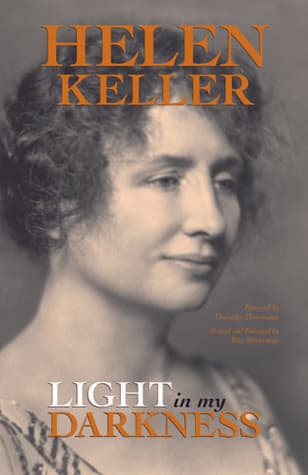
Core Idea
- Difficulty
- Medium
- Read it if
- You are seeking a unique perspective on spirituality, the nature of reality, and how to find profound meaning and connection beyond physical senses, especially if you appreciate introspective and philosophical memoirs.
- Skip it if
- You prefer a purely historical or factual biography, are uncomfortable with explicit spiritual or theological discussions, or are looking for a fast-paced narrative without deep philosophical reflection.
Key Takeaways from Light in my Darkness
A Guiding Light in the Darkness
Swedenborg's philosophy provided Helen Keller with intellectual and spiritual illumination, shaping her worldview from a young age.
Helen Keller's discovery of Emanuel Swedenborg's writings at fourteen was a spiritual awakening. It gave her a way to understand her unique life. In a world without typical sensory input, Swedenborg's descriptions of the spiritual realm, the connection of all things, and divine order gave Keller a rich inner world. This philosophy shaped her intellectual and emotional growth, offering a logic and beauty beyond her physical limits. Through Swedenborg, she found a language and reality more meaningful than the material world, helping her see a deeper purpose in her life.
“My first reading of Emanuel Swedenborg at age fourteen gave me truths that were to my faculties what light, color and music are to the eye and ear.”
In the book: Keller explicitly states that Swedenborg's teachings provided her faculties with what light, color, and music are to others, indicating its foundational impact from adolescence.
Try this: Explore philosophical or spiritual texts that resonate deeply with your personal experiences and challenges, allowing them to provide a new lens through which to interpret your life's journey and find profound meaning.
Related ideas: spiritual-awakening, philosophy-as-guide, inner-world
Sensory Deprivation, Spiritual Amplification
Keller argues that her lack of physical senses intensified her capacity for spiritual perception and inner understanding.
For Helen Keller, her lack of sight and hearing were not just disadvantages, but ways to achieve a heightened spiritual awareness. She believed that being 'cut off' from constant external stimuli sharpened her inner abilities, letting her see spiritual truths more clearly. This was not just about coping; it was about a unique advantage. While others might be distracted by the material world, Keller's internal focus became her main way of engaging, helping her connect more deeply with the spiritual dimensions Swedenborg described. Her experience challenges common ideas of perception, suggesting that true sight and hearing can come from within.
“The very darkness and silence that isolate me from the outer world have, in a sense, intensified my capacity for spiritual perception.”
In the book: Keller's direct assertion that her 'darkness and silence' intensified her spiritual perception, rather than hindering it.
Try this: Practice sensory deprivation exercises or mindful silence to reduce external distractions, allowing your inner thoughts and spiritual insights to come to the forefront. Journal about any insights gained during these periods.
Related ideas: sensory-perception, inner-sight, spiritual-intuition
The Universal Language of Love
Love, for Keller, is the ultimate spiritual force, transcending physical limitations and connecting all beings.
Helen Keller's view of the world, shaped by Swedenborgian thought, places love at the center of existence. She saw love not just as an emotion, but as a basic, divine energy that fills the universe, the very essence of God. For Keller, love was the universal language, accessible even without sight or sound, connecting her to humanity and to the divine. It was the force that broke down barriers, healed divisions, and gave meaning and purpose. This understanding of love helped her navigate a world that could have been isolating, instead finding connection and joy through service and empathy. Her life showed the power of love.
“Love is the light that illumines the darkness, the truth that conquers error, and the power that overcomes all obstacles.”
In the book: Keller's consistent emphasis throughout the book on love as the primary motivator, healer, and unifier, reflecting Swedenborg's concept of divine love and wisdom.
Try this: Actively seek opportunities to express and receive love in your daily life, recognizing it as a powerful force for connection and healing. Practice empathy and compassion in interactions, seeing them as direct expressions of universal love.
Related ideas: divine-love, interconnectedness, empathy
Heaven and Hell: States of Being
Keller adopts Swedenborg's view that heaven and hell are not physical places but internal spiritual states shaped by our choices.
A key part of Swedenborg's theology, and thus Keller's spiritual understanding, is the idea that heaven and hell are not places, but inner, spiritual states. Our choices, feelings, and thoughts in this life determine our inner world, which then extends into the afterlife. For Keller, this gave her a strong sense of personal responsibility. It meant that even with her physical limitations, she could create a 'heavenly' state of mind through love, service, and wisdom, or a 'hellish' one through selfishness. This view made the afterlife an immediate, ongoing spiritual journey rather than a distant judgment.
“Heaven and hell are not distant places beyond the stars, but states of the soul, conditions of the mind that we create for ourselves by our choices and actions.”
In the book: The book frequently references Swedenborg's 'Heaven and Hell' and its core tenet that our spiritual condition in this life dictates our eternal state, a concept Keller clearly embraces.
Try this: Reflect daily on your actions, thoughts, and intentions, recognizing how they contribute to your internal state of mind. Consciously choose to cultivate positive affections like kindness and gratitude to build a 'heavenly' inner world.
Related ideas: spiritual-states, personal-responsibility, afterlife-concept
The Spiritual World is Real
Keller firmly believed in the tangible reality of the spiritual world, perceiving it as more fundamental than the physical.
In 'Light in My Darkness,' Helen Keller states that the spiritual world is real, not an abstract idea or a distant future, but a present, more fundamental part of existence. Influenced by Swedenborg's detailed accounts of spiritual realms, Keller found a logic that resonated with her inner experience. For someone whose physical senses were largely absent, the idea of a spiritual reality, accessible through inner perception, was not just comforting but empowering. It provided a framework where her unique way of experiencing the world made sense, where her 'disabilities' were not important to her true, spiritual self. This belief shaped her optimism and her work for humanity.
“To me, the spiritual world is as real, as substantial, as the physical world, if not more so. It is the source from which all reality flows.”
In the book: Keller's consistent descriptions of angels, spirits, and the 'spiritual sun' throughout the book, drawing directly from Swedenborg's detailed visions and teachings.
Try this: Engage in practices that foster spiritual awareness, such as meditation, contemplative prayer, or nature walks, with the intention of perceiving a deeper, unseen reality beyond the purely physical.
Related ideas: spiritual-reality, esotericism, inner-perception
Service as Spiritual Practice
Keller's life of tireless service to others was a direct manifestation of her spiritual beliefs and a pathway to divine connection.
Helen Keller's life was marked by her dedication to service, a commitment she directly linked to her spiritual understanding. For Keller, influenced by Swedenborg's focus on 'uses' (purposeful service), helping others was not just a good deed but a divine command, a practical way to show love, and a direct path to spiritual growth. Her work for the disabled, promoting education, and inspiring millions showed her belief that true fulfillment and spiritual connection come from contributing to the well-being of humanity. This view changes altruism from a moral duty into an essential spiritual practice, important for one's own development.
“True happiness comes from giving, not from getting; from serving others, not from seeking self-gratification.”
In the book: Keller's entire biography, specifically her global advocacy for the blind and deaf, her fundraising efforts, and her prolific writing, all of which she attributes to her spiritual drive.
Try this: Identify an area of need in your community or within your personal sphere and commit to regular, selfless service. Reflect on how these acts of giving contribute to your own sense of purpose and spiritual well-being.
Related ideas: altruism, purposeful-living, spiritual-growth
The Power of Inner Light
Despite external darkness, Keller found an enduring source of light and optimism within her spiritual convictions.
Helen Keller's optimism, often surprising given her situation, came directly from her deep spiritual faith. She understood that while the physical world might be dark and silent, an internal 'light of God' was always there. This inner light, nurtured by Swedenborg's teachings, allowed her to see beauty, truth, and hope even in difficult situations. It was not naive positivity but a deep belief that the spiritual realm, full of divine love and wisdom, was always present and accessible. This 'inner light' helped her overcome her physical limits and become a source of hope for many, showing that true vision comes from within.
“Though I walk in darkness, I am not without light. For the light of God shines within me, and in that light, I see.”
In the book: Keller's consistent tone of hope and resilience throughout her writings, directly linking her ability to 'see' and find joy to her spiritual beliefs rather than her physical senses.
Try this: Cultivate daily practices that connect you to your inner source of strength and light, such as meditation, gratitude journaling, or reflecting on spiritual truths. Use these practices to maintain optimism during challenging times.
Related ideas: optimism, resilience, inner-strength
The Continuance of Life
Keller's belief in the immortality of the soul provided comfort and a sense of continuity beyond earthly existence.
For Helen Keller, death was not a frightening void but a natural shift, a 'door' to a higher form of existence. This belief, deeply rooted in Swedenborg's descriptions of the afterlife and the soul's immortality, gave her comfort and a sense of continuity. It meant that relationships were not ended by physical death but changed, and that spiritual growth from this life would continue in the next. This belief system allowed her to face mortality with peace and even anticipation, seeing it as an advancement rather than an end, further strengthening her optimistic view of life and its purpose.
“Death is not an end, but a door through which we pass into a larger, more glorious life. The soul, immortal, continues its journey.”
In the book: Keller's frequent references to the afterlife, the journey of the soul, and reunion with loved ones in the spiritual world, all consistent with Swedenborgian teachings on immortality.
Try this: Reflect on the concept of continuity of consciousness or soul. Consider how understanding death as a transition rather than an end might influence your perspective on life, loss, and purpose.
Related ideas: immortality, afterlife, spiritual-continuity
Interpreting the Divine through Analogy
Keller, like Swedenborg, used analogies from the natural world to grasp and articulate spiritual truths.
Given her unique sensory experience, Helen Keller valued Swedenborg's use of analogies, especially those connecting the natural and spiritual worlds. For Swedenborg, the physical world mirrors the spiritual, meaning earthly things can offer insight into divine truths. For Keller, this approach was very helpful. Lacking direct sensory input for abstract spiritual ideas, she could understand complex ideas like divine love and wisdom by relating them to the tangible experiences she had – the sun's warmth, a plant's growth, a sound's vibration. This method made the spiritual accessible and provided a concrete framework for her inner life, bridging her limited physical world and the boundless spiritual one.
“Just as the sun gives light and warmth to the natural world, so does the Lord give love and wisdom to the spiritual world.”
In the book: Keller frequently employs analogies, such as comparing the spiritual sun to divine love and wisdom, or the 'breathing' of the spirit, directly reflecting Swedenborg's doctrine of correspondences.
Try this: When grappling with complex or abstract concepts, seek out analogies from your own experiences or the natural world to make them more comprehensible and relatable. Use metaphors to deepen your understanding and communication.
Related ideas: correspondences, analogy, spiritual-understanding
A Life of Luminous Universe
Keller's final chapter encapsulates her belief in a universe permeated by divine light, accessible through spiritual perception.
The 'Epilogue: My Luminous Universe' summarizes Helen Keller's lifelong spiritual journey and her final worldview. It shows her strong belief that despite her physical 'darkness,' her inner world was bright, lit by the divine truths she learned from Swedenborg. Her universe was 'luminous' not because she could see physical light, but because she saw the constant light of God's love and wisdom. This final reflection confirms her message: true perception goes beyond physical senses, and a rich, meaningful life is possible when one connects with the spiritual parts of reality. It is a statement of overcoming hardship, based on a deeply considered and lived spirituality.
“My universe is not dark; it is luminous, filled with the light of God's love and wisdom, a light that shines eternally.”
In the book: The title and content of the final chapter, 'Epilogue: My Luminous Universe,' directly articulate her culminating perspective on a spiritually illuminated existence.
Try this: Cultivate a personal philosophy or spiritual framework that allows you to perceive beauty, meaning, and light even amidst life's challenges. Regularly reflect on how your beliefs shape your perception of the world.
Related ideas: luminous-life, divine-light, spiritual-triumph
Light in my Darkness Quotes
“The only thing worse than being blind is having sight but no vision.”
“What we have once enjoyed we can never lose. All that we love deeply becomes a part of us.”
“Self-pity is our worst enemy and if we yield to it, we can never do anything good in the world.”
“I long to accomplish a great and noble task, but it is my chief duty to accomplish small tasks as if they were great and noble.”
“When one door of happiness closes, another opens; but often we look so long at the closed door that we do not see the one which has been opened for us.”
“Faith is the strength by which a shattered world shall emerge into the light.”
“The best and most beautiful things in the world cannot be seen or even touched - they must be felt with the heart.”
“So much has been given to me that I have no time to ponder over that which has been denied.”
“Strike the evil at the root: doubt, distrust, and fear.”
“No pessimist ever discovered the secrets of the stars, or sailed to an uncharted land, or opened a new heaven to the human spirit.”
“I am only one, but still I am one. I cannot do everything, but still I can do something; and because I cannot do everything, I will not refuse to do the something that I can do.”
“Character cannot be developed in ease and quiet. Only through experience of trial and suffering can the soul be strengthened, ambition inspired, and success achieved.”
“The highest result of education is tolerance.”
“Life is either a daring adventure or nothing at all.”
Quiz
10 questions on the main ideas. Each answer comes with a short explanation.
Question 1
Which specific author's works did Helen Keller credit with providing truths that were 'to my faculties what light, color and music are to the eye and ear'?
- Ralph Waldo Emerson
- Henry David Thoreau
- Emanuel Swedenborg
- Walt Whitman
Show answer
C. Emanuel Swedenborg Helen Keller explicitly states that her first reading of Emanuel Swedenborg at age fourteen gave her truths that were 'to my faculties what light, color and and music are to the eye and ear,' highlighting his profound influence on her spiritual understanding.
Question 2
At what age did Helen Keller first encounter the works of Emanuel Swedenborg?
- Ten
- Twelve
- Fourteen
- Sixteen
Show answer
C. Fourteen The book description clearly states that Helen Keller's 'first reading of Emanuel Swedenborg at age fourteen' was a pivotal moment for her.
Question 3
What is the primary focus of 'Light in my Darkness' as described in the book's synopsis?
- A detailed account of her political activism
- Her journey to overcome physical limitations through scientific advancements
- Her mystical and spiritual autobiography, particularly her connection to Swedenborg's works
- A chronological history of her education
Show answer
C. Her mystical and spiritual autobiography, particularly her connection to Swedenborg's works The synopsis explicitly calls it her 'best-selling spiritual autobiography' and highlights how she 'reveals her mystical side' and explains 'how Swedenborg's works sustained her throughout her life.'
Question 4
Which of the following elements is a new addition to this specific edition of 'Light in my Darkness'?
- An introduction by Annie Sullivan
- A chapter titled 'My First Word'
- A foreword by Dorothy Herrmann and a chapter 'Epilogue: My Luminous Universe'
- Previously unpublished letters to her family
Show answer
C. A foreword by Dorothy Herrmann and a chapter 'Epilogue: My Luminous Universe' The book description states, 'This new edition includes a foreword by Dorothy Herrmann, author of the acclaimed Helen Keller: A Life, and a new chapter, 'Epilogue: My Luminous Universe.''
Question 5
How does Helen Keller describe the impact of Swedenborg's teachings on her life?
- They provided a structured framework for her academic studies.
- They offered practical solutions for navigating her physical challenges.
- They sustained her throughout her life, acting as a spiritual light and guide.
- They inspired her to pursue a career in religious leadership.
Show answer
C. They sustained her throughout her life, acting as a spiritual light and guide. The text explicitly states that she 'explains how Swedenborg's works sustained her throughout her life,' indicating their enduring spiritual support.
Question 6
Dorothy Herrmann contributed what to this new edition of 'Light in my Darkness'?
- The main body of the text
- An afterword
- A foreword
- The index
Show answer
C. A foreword The description notes, 'This new edition includes a foreword by Dorothy Herrmann, author of the acclaimed Helen Keller: A Life,' clarifying her contribution.
Question 7
Beyond being a celebrated figure, 'Light in my Darkness' presents Helen Keller in what less commonly known light?
- As a dedicated political activist for workers' rights.
- As a pioneer in early childhood education techniques.
- As a deeply spiritual and mystical individual profoundly influenced by Emanuel Swedenborg.
- As a world traveler documenting various cultures.
Show answer
C. As a deeply spiritual and mystical individual profoundly influenced by Emanuel Swedenborg. The synopsis emphasizes that Keller 'reveals her mystical side in this best-selling spiritual autobiography,' focusing on her less-explored spiritual depth and connection to Swedenborg.
Question 8
Considering the title 'Light in my Darkness' and the description of Swedenborg's works as 'light, color and music' to her faculties, what central metaphor is Keller likely exploring throughout the book?
- The contrast between physical and intellectual strength.
- The idea that spiritual understanding can illuminate and enrich a life devoid of sensory experience.
- The importance of natural light for mental well-being.
- The literal experience of seeing after a medical breakthrough.
Show answer
B. The idea that spiritual understanding can illuminate and enrich a life devoid of sensory experience. The metaphor of 'light' directly counters her physical 'darkness' (blindness and deafness), implying that Swedenborg's spiritual truths provided a profound internal illumination and sensory richness that compensated for her external sensory deprivation.
Question 9
How does the inclusion of a foreword by Dorothy Herrmann, author of 'Helen Keller: A Life,' enhance the new edition of 'Light in my Darkness'?
- It provides a fictionalized account of Keller's early life to increase reader engagement.
- It offers an external, scholarly perspective that contextualizes Keller's spiritual journey within her broader biography.
- It replaces Keller's original introduction, offering a more contemporary voice.
- It focuses solely on the theological debates surrounding Swedenborg's writings.
Show answer
B. It offers an external, scholarly perspective that contextualizes Keller's spiritual journey within her broader biography. Dorothy Herrmann is an acclaimed biographer of Helen Keller. Her foreword would likely provide valuable biographical context and scholarly insight, helping readers understand the significance of Keller's spiritual autobiography within the full scope of her life.
Question 10
The description highlights 'Light in my Darkness' as a 'spiritual autobiography.' How does this genre classification distinguish it from a typical biography of Helen Keller?
- A spiritual autobiography focuses primarily on her public achievements and political influence.
- It emphasizes her inner life, beliefs, and the development of her soul, rather than just factual events or external accomplishments.
- It means the book is entirely fictional and not based on real events.
- It only covers her childhood experiences and not her adult life.
Show answer
B. It emphasizes her inner life, beliefs, and the development of her soul, rather than just factual events or external accomplishments. A spiritual autobiography delves into the author's personal spiritual journey, insights, and the evolution of their beliefs, which aligns with the description of Keller revealing her 'mystical side' and how Swedenborg's works 'sustained her throughout her life.' This is distinct from a biography that might focus more broadly on factual life events, achievements, and external challenges.
Light in my Darkness FAQ
What is 'Light in my Darkness' about?
'Light in my Darkness' is Helen Keller's spiritual autobiography, where she shares how the writings of Emanuel Swedenborg profoundly influenced her life and provided her with enduring spiritual truths. It reveals a lesser-known mystical side of this iconic figure.
Who was Emanuel Swedenborg, and why was he important to Helen Keller?
Emanuel Swedenborg was an 18th-century Swedish scientist, philosopher, theologian, and mystic. Helen Keller encountered his works at age fourteen and found his spiritual insights to be as vital to her understanding as light and sound are to others, sustaining her throughout her life.
Does 'Light in my Darkness' offer insights into Helen Keller's experiences with deafness and blindness?
While the book is primarily a spiritual autobiography, Keller implicitly connects her profound inner life and spiritual understanding, shaped by Swedenborg's teachings, to her unique sensory experiences, offering a deeper dimension to her well-known struggles.
How does this book differ from other biographies of Helen Keller?
Unlike traditional biographies that focus on her public achievements and overcoming disabilities, 'Light in my Darkness' is a first-person account written by Keller herself, delving specifically into her spiritual journey and the profound influence of Emanuel Swedenborg, a topic often less emphasized elsewhere.
What kind of spiritual themes are explored in 'Light in my Darkness'?
The book explores themes of divine love, spiritual light, the nature of the soul, the afterlife, and the interconnectedness of the spiritual and natural worlds, all through the lens of Swedenborg's theological framework as interpreted and experienced by Helen Keller.
Is 'Light in my Darkness' suitable for readers unfamiliar with Swedenborg's philosophy?
Yes, while it discusses Swedenborg, Keller's personal narrative makes his complex ideas accessible through her own profound understanding and application. It serves as an excellent introduction to his influence through the eyes of a remarkable individual.
What is the significance of the 'Epilogue: My Luminous Universe' in this new edition?
The 'Epilogue: My Luminous Universe' is a new chapter that further illuminates Keller's later thoughts and expanded spiritual insights, providing readers with an even deeper understanding of her mystical worldview and how Swedenborg's teachings continued to evolve within her.
Does this book contain Helen Keller's own words and reflections?
Absolutely. 'Light in my Darkness' is entirely Helen Keller's own writing, offering her direct and deeply personal reflections on her spiritual life, her relationship with Swedenborg's teachings, and her unique perspective on existence.
About the author
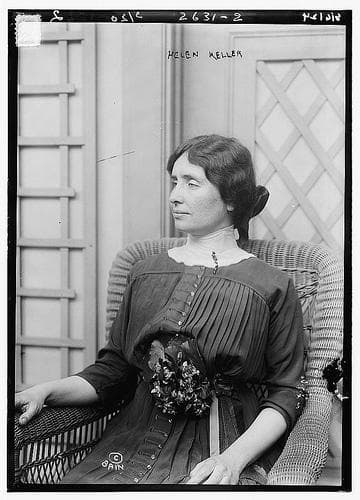
Helen Keller was an American author and activist known for her works on disability rights and personal experiences. Her notable books include "The Story of My Life," which chronicles her early years and challenges, and "Light in My Darkness," reflecting on her philosophy and beliefs. Keller's writings have had a significant impact on society's understanding of the deaf and blind communities.
Similar books
- The Story of My Life
Helen Keller
4.1 (132k) average on GoodreadsBiographyProvides the foundational biographical context for Keller's later spiritual reflections.
- Man's Search for Meaning
Viktor E. Frankl
4.4 (401k) average on GoodreadsBiographyExplores profound meaning and spiritual resilience in the face of extreme adversity.
- Miracles
C.S. Lewis
4.0 (15k) average on GoodreadsSpiritualityDiscusses the reality of the spiritual world and the divine's interaction with the physical, albeit from a different theological angle.
- The Diary of a Young Girl
Anne Frank
4.2 (2.7M) average on GoodreadsBiographyDuring the Nazi occupation, a teenage girl's diary, written from a secret annex, shares observations on humanity, hope, and the wait for freedom.
- Eat, Pray, Love
Elizabeth Gilbert
3.6 (1.5M) average on GoodreadsLifestyleA heartbroken writer leaves her conventional life for a year-long global search for pleasure in Italy, spiritual devotion in India, and unexpected love and balance in Bali.
- Night
Elie Wiesel
4.3 (970k) average on GoodreadsBiographyIn the darkness of Auschwitz and Buchenwald, a teenage Elie Wiesel faces the extermination of his family, the loss of his faith, and the lasting scars of humanity's deepest cruelty.





Enjoyed the summary?
A summary gives you the shape of the book. The book itself has the detail, the examples and the voice.
Find Light in my Darkness on AmazonAs an Amazon Associate, BookBrief earns from qualifying purchases. How we're funded