
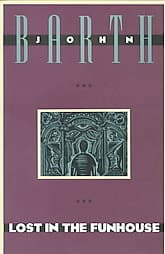
Synopsis
Covers the whole plot, including the ending.
- Difficulty
- Hard
- Pacing
- Variable
- Mood
- Intellectual, Challenging, Playful, Self-aware, Existential
- Read it if
- You enjoy experimental literary fiction, metafiction, and stories that deconstruct the act of storytelling.
- Skip it if
- You prefer traditional narratives with clear plots, character development, and a straightforward reading experience.
Lost in the Funhouse Plot Summary
Covers the whole plot, including the ending.
Frame-Tale
The collection opens with 'Frame-Tale,' a metafictional piece where the narrator directly addresses the reader about storytelling and the difficulty of beginning a tale. The narrator, presumably Barth, discusses the recursive structure of a frame-tale, where a story contains another story, which in turn contains another. He considers the infinite regress and self-reference in such structures, questioning the act of creating and consuming fiction. This piece sets the stage for the experimental and self-aware nature of the stories that follow, immediately establishing a dialogue between author, text, and reader about narrative conventions.
Night-Sea Journey
In 'Night-Sea Journey,' the narrator is a single sperm among millions, in a desperate race towards an unknown destination. This sperm, however, has a philosophical consciousness, questioning the meaning of its existence, the purpose of the journey, and the nature of the 'Goal' – the ovum. It considers the futility of individual effort within a vast, indifferent process and debates with a more optimistic companion. The journey is dangerous, with many brethren perishing, forcing the narrator to confront mortality and the overwhelming odds against success. This allegorical tale explores themes of identity, free will, and the search for meaning in a predetermined existence.
Ambrose His Mark
This story introduces Ambrose Mensch as a young boy in Ocean City, Maryland, during the early 20th century. Ambrose is sensitive and introspective, feeling alienated from his boisterous, conventional family, particularly his father, a successful hotelier. He grapples with his emerging sense of self, his intellectual curiosity, and his physical awkwardness. The narrative highlights his internal struggles with self-doubt and his desire for individuality, often contrasting his inner world with the external expectations placed upon him by his family and society. This piece lays the groundwork for Ambrose's recurring role as a character who embodies the author's anxieties about identity and storytelling.
Autobiography: A Self-Recorded Fiction
'Autobiography: A Self-Recorded Fiction' features a narrative that speaks directly to the reader, detailing its own birth and development as a fictional construct. The story describes its awareness of being written, its dependence on its author, and its inherent artificiality. It expresses a desire for genuine existence and laments its predetermined plot and characterizations. The narrative struggles with its identity as a fabricated entity, questioning its purpose and the meaning of its own existence within fiction. This piece is a commentary on the nature of storytelling, the relationship between author and text, and the boundaries between reality and fiction.
Lost in the Funhouse
The titular story follows a young Ambrose Mensch as he navigates a funhouse with his family and a girl named Magda. However, the narrator frequently breaks the fourth wall, directly addressing Ambrose as a character, discussing his motivations, his self-consciousness, and the mechanics of the story. Ambrose, aware of his fictionality, struggles with his identity and his predetermined path within the narrative. The funhouse itself becomes a metaphor for the labyrinthine nature of storytelling and the existential predicament of being a character in a fiction. He tries to impress Magda, but his self-awareness and the narrator's commentary constantly undermine his efforts, highlighting his awkwardness and the constructed nature of his experience.
Petition
'Petition' is a dialogue between Siamese twins, one male and one female, who are conjoined at the hip. They engage in a philosophical debate about their shared existence, their individual identities, and their conflicting desires. The male twin, who narrates, is more introspective and analytical, while the female twin is more pragmatic and sensual. They discuss how their physical bond affects their autonomy, sexuality, and the possibility of separation. Their conversation explores themes of duality, interdependence, and the struggle for selfhood within an inseparable union, using their unique condition as a metaphor for various forms of human connection and conflict.
Life-Story
In 'Life-Story,' an author tries to write his autobiography but finds himself constantly fictionalizing. He grapples with the inherent artificiality of memoir and the difficulty of presenting objective truth. The author, who resembles Barth, questions whether his life is merely a story he is telling, or if the act of telling it is shaping his reality. He becomes increasingly self-conscious of the narrative conventions he uses, leading to a metafictional exploration of the relationship between life and literature, and the impossibility of separating the two when one is a writer. The story highlights the paradox of trying to capture genuine experience through the artifice of language.
Glossolalia
'Glossolalia' presents a series of fragmented monologues from various unnamed, disembodied voices, like a Greek chorus. Each voice speaks in a distinct, often idiosyncratic style, offering philosophical musings, personal anecdotes, and existential questions. The voices discuss themes of communication, meaning, belief, and the nature of language. The piece is characterized by its stream-of-consciousness style and its exploration of the limits and possibilities of expression. It creates a cacophony of perspectives that collectively explore the human condition, without settling on any single truth, reflecting the fragmented and subjective nature of reality.
Menelaiad
'Menelaiad' is a complex, multi-layered story told from the perspective of Menelaus, the King of Sparta, after the Trojan War. He tries to recount his experiences, particularly his capture of Proteus and the prophecies he received, but the narrative is constantly interrupted and complicated by his own self-awareness of storytelling. The story features nested narratives, as Menelaus recounts what Proteus told him, what Helen told him, and so on, creating an infinitely regressing series of unreliable narrators. This piece is a display of narrative recursion, exploring themes of truth, memory, love, and the elusive nature of reality, all filtered through the lens of a weary, self-conscious storyteller.
Anonymiad
The final story, 'Anonymiad,' is narrated by a forgotten poet who has been shipwrecked on a desolate island. To preserve his legacy and his sanity, he carves his life story, his poems, and his philosophical reflections onto various objects—coconuts, seashells, turtle shells—and casts them into the sea, hoping they will be discovered. He recounts his past life, his artistic struggles, and his present isolation, all while contemplating the futility and necessity of art. The narrative is a meditation on the impulse to create, the desire for recognition, and the enduring power of storytelling against oblivion. It is a final, melancholic reflection on the themes of authorship and the search for meaning.
Lost in the Funhouse Characters
The Narrator (various)
Protagonist/Authorial Voice
The shifting, self-aware voice that guides and comments on the stories.
The narrator in 'Lost in the Funhouse' is not a single, consistent character but rather a fluid, often meta-fictional presence. This voice frequently breaks the fourth wall, discussing the act of storytelling, the nature of fiction, and the characters' roles. Sometimes it is overtly an authorial voice, at other times it embodies a character's internal monologue (like the sperm in 'Night-Sea Journey' or Menelaus), and sometimes it is the story itself (as in 'Autobiography'). This narrator is driven by an exploration of narrative conventions, questioning the boundaries between fiction and reality, and often expressing anxieties about the creative process and the meaning of existence.
Ambrose Mensch
Recurring Protagonist
A sensitive, self-conscious young man grappling with identity and the nature of his own story.
Ambrose Mensch appears in several stories, notably 'Ambrose His Mark' and 'Lost in the Funhouse.' He is depicted as an introspective, often awkward young man from Ocean City, Maryland, who feels alienated from his more conventional family. Ambrose is highly self-aware, particularly of his own fictionality, and struggles with self-doubt, intellectual curiosity, and his place in the world. He embodies the anxieties of the artist and the individual seeking authenticity within a predetermined or constructed reality. His experiences often mirror the author's own explorations of identity and the creative process.
Relationships: His family (Feels alienated and misunderstood by them.); Magda (Object of his youthful infatuation and self-conscious attempts to impress.)
The Sperm (Narrator of 'Night-Sea Journey')
Protagonist
A philosophical sperm questioning its purpose on a perilous journey.
This character is a single, remarkably self-aware sperm on a desperate journey towards the ovum. Unlike its millions of brethren, it possesses a profound philosophical bent, constantly questioning the meaning of its existence, the purpose of the 'Night-Sea Journey,' and the nature of the 'Goal.' It represents the human condition in miniature, grappling with themes of free will, predestination, mortality, and the search for meaning in a seemingly indifferent universe. Its internal monologues are filled with existential angst and intellectual debate.
Relationships: Other sperm (Fellow travelers, mostly unthinking, some serving as foils for his philosophical debates.)
The Story (Narrator of 'Autobiography')
Protagonist
A self-aware fictional narrative lamenting its own artificiality.
This is a unique 'character'—the story itself, which speaks directly to the reader about its own creation, its dependence on its author, and its inherent artificiality. It expresses a desire for genuine existence and laments its predetermined plot and characterizations. The story struggles with its identity as a fabricated entity, questioning its purpose and the meaning of its own existence within the confines of fiction. It is a profound meta-commentary on the nature of storytelling and the relationship between author and text.
Relationships: Its Author (Its creator and controller, a figure of both dependence and resentment.)
Menelaus
Protagonist
The King of Sparta, endlessly recounting his unreliable memories of the Trojan War.
Menelaus, from 'Menelaiad,' is a weary, post-Trojan War king, obsessed with recounting his experiences, particularly his encounter with Proteus. His character is defined by his struggle to tell a coherent story, constantly getting lost in nested narratives and questioning the truth of his own memories and the accounts of others. He embodies the unreliable narrator taken to an extreme, a figure haunted by the past and the elusive nature of truth. His attempts to communicate are convoluted and self-referential, reflecting a deep-seated anxiety about the very act of storytelling and the subjective nature of reality.
Relationships: Helen (His wife, whose story he attempts to recount, adding another layer of unreliability.); Proteus (The sea-god whose shifting forms and prophecies he struggles to accurately convey.)
The Conjoined Twins
Protagonists
Two inseparable individuals debating their shared identity and conflicting desires.
In 'Petition,' the conjoined twins (one male, one female) are a singular entity with two distinct consciousnesses. The male twin, who narrates, is more introspective and analytical, while the female twin is more pragmatic and sensual. Their shared physical bond forces them into a constant philosophical debate about identity, autonomy, sexuality, and the possibility of separation. They serve as a powerful metaphor for various forms of human interdependence, duality, and the struggle for individual selfhood within a shared existence. Their dialogue reveals the complexities of their unique predicament.
Relationships: Each other (Physically inseparable, intellectually and emotionally interdependent, yet often at odds.)
The Anonymiad
Protagonist
A shipwrecked poet carving his legacy onto objects, hoping for discovery.
The narrator of 'Anonymiad' is a forgotten poet, marooned on a desolate island. He is driven by an intense desire to create and to be remembered, meticulously carving his life story, poems, and philosophical musings onto various objects and casting them into the sea. He represents the artist's enduring impulse to create against the backdrop of oblivion, and the poignant hope for future recognition. His character embodies themes of isolation, artistic struggle, and the search for meaning and legacy in the face of inevitable anonymity.
Lost in the Funhouse Themes
Metafiction and Self-Conscious Narrative
Barth's collection is a work of metafiction, where the stories constantly draw attention to their own artificiality as fictional constructs. Narrators often address the reader directly, discuss narrative conventions, and question the act of storytelling. This is clear in 'Frame-Tale,' which discusses recursive structures, and 'Autobiography: A Self-Recorded Fiction,' where the story itself is the protagonist, lamenting its predetermined plot. In 'Lost in the Funhouse,' the narrator comments on Ambrose's character development and his awareness of being a fictional entity. This theme challenges traditional notions of realism and immerses the reader in the mechanics of fiction.
“For whom is the funhouse fun? Perhaps for the builder. Perhaps for the victim.”
The Nature of Identity and Selfhood
Many characters in the collection grapple with their identity, often in relation to their fictionality or unique circumstances. Ambrose Mensch, in 'Ambrose His Mark' and 'Lost in the Funhouse,' is self-conscious, struggling to define himself amidst family expectations and his awareness of being a character. The philosophical sperm in 'Night-Sea Journey' questions its individual purpose within a vast, collective endeavor. The conjoined twins in 'Petition' explore the boundaries of individual and shared identity. This theme highlights the constructed nature of self and the existential search for meaning in a world that often feels predetermined or artificial.
“I am a story, told or written. I am told by myself, but not written by myself. I am a fiction.”
The Elusiveness of Truth and Meaning
Barth explores the idea that objective truth is unattainable, especially through narrative. Stories like 'Menelaiad' show this, with Menelaus's endlessly nested and unreliable accounts of the Trojan War, where each retelling further obscures the original event. The fragmented voices in 'Glossolalia' offer multiple, often contradictory perspectives, preventing any single truth from emerging. This theme suggests that reality itself is subjective and constructed through language, and that meaning is often provisional or elusive, residing more in the process of questioning and interpretation than in definitive answers.
“What is the truth? I tell you, no man knows the truth. Each man tells his story, and the stories contradict. What then?”
The Act of Creation and Artistic Anxiety
The collection explores the anxieties and challenges in the creative process. The various authorial narrators, or characters who are writers (like the narrator in 'Life-Story' or the 'Anonymiad'), grapple with writer's block, the limitations of language, the burden of originality, and the desire for legacy. 'Life-Story' blurs the lines between life and fiction, as the author struggles to write his autobiography without fictionalizing it. This theme highlights the paradoxical nature of art: its artificiality as a construct versus its potential to convey truths about the human condition, and the artist's struggle for authenticity and meaning.
“To be what I am, I must be more than I am. To be me, I must be my story. But my story must be more than me.”
Plot Devices & Literary Techniques
Metafiction
Stories that self-consciously draw attention to their own status as fictional constructs.
Metafiction is the overarching plot device in 'Lost in the Funhouse.' It manifests through narrators who directly address the reader, discuss narrative conventions, and comment on the act of storytelling itself. This includes breaking the fourth wall, characters aware of their fictionality (Ambrose in 'Lost in the Funhouse'), and stories that are themselves the protagonists ('Autobiography: A Self-Recorded Fiction'). This device challenges traditional notions of realism, blurring the lines between author, text, and reader, and forcing an examination of the artificiality and construction of narrative.
Nested Narratives (Frame Story / Mise en Abyme)
Stories contained within other stories, creating layers of narrative.
Barth frequently employs nested narratives, or 'mise en abyme,' where a story contains another story, which in turn contains yet another. The most prominent example is 'Menelaiad,' where Menelaus recounts what Proteus told him, who in turn recounted other stories, leading to an infinite regress of unreliable accounts. 'Frame-Tale' explicitly discusses this structure. This device highlights the subjective and mediated nature of truth and memory, demonstrating how information is filtered and transformed through multiple tellings, making it impossible to reach an original, unadulterated truth.
Allegory and Parable
Stories that convey a deeper symbolic meaning beyond their literal plot.
Many of Barth's stories function as allegories or parables, using specific scenarios to explore universal philosophical or existential questions. 'Night-Sea Journey,' with its philosophical sperm, is a clear allegory for human existence, the search for meaning, and the journey of life. The funhouse itself in 'Lost in the Funhouse' serves as an allegory for the labyrinthine nature of storytelling and the complexities of identity. These devices allow Barth to tackle profound themes in a playful and intellectually stimulating manner, inviting readers to interpret the symbolic layers of meaning.
Stream of Consciousness
A narrative technique that mimics the continuous, unedited flow of a character's thoughts.
While not every story uses it exclusively, elements of stream of consciousness are present, particularly in the internal monologues of characters like the sperm in 'Night-Sea Journey' or the author in 'Life-Story.' The fragmented, philosophical musings of the voices in 'Glossolalia' also exhibit this device, reflecting the raw, unfiltered workings of the mind. This technique allows Barth to delve deep into the psychological and philosophical states of his characters, presenting their anxieties, questions, and self-awareness in a direct and immediate manner, often without conventional narrative transitions.
Lost in the Funhouse Quotes
“For whom is the funhouse fun? Perhaps for the funhouse itself.”
“The story you are about to read is a story about a story, which is to say, a story about itself.”
“To turn experience into language, language into print, print into a book, a book into a story, a story into a reader, a reader into a character, a character into a person, a person into a writer, a writer into God, God into the void, the void into everything.”
“Once upon a time there was a story that began, 'Once upon a time there was a story that began...' and so on.”
“Ambrose, you're a sensitive child. You feel things. That's why you're unhappy.”
“The author, in the privacy of his study, is at this moment wondering how to continue this story.”
“He wishes he had never been born. He wishes he were a character in a book, so he could be rewritten.”
“What does one do when faced with the fact that one's story is not one's own?”
“This is the story of a man who loved a woman who loved a man who loved a woman who loved a man...”
“The medium is the message, but the message is also the medium.”
“To be perfectly frank, I am tired of stories that begin with 'Once upon a time.'”
“The end of the story is the beginning of the next story, and the beginning of the story is the end of the last story.”
“What I want is to be free of all this, to be a simple, uncomplicated character in a simple, uncomplicated story.”
“The world is not a funhouse. It is a serious place, and we are serious people.”
“He was a character, and he knew it, and that was his tragedy.”
Quiz
10 questions on the plot and the characters. Each answer comes with a short explanation.
Question 1
In 'Lost in the Funhouse,' what is Ambrose's primary internal struggle as he navigates the funhouse?
- Fear of getting lost and never finding his family.
- Anxiety about his own fictionality and the author's control.
- Frustration with the funhouse's poor design and lack of clear exits.
- Jealousy towards his brother Peter's ease with girls.
Show answer
B. Anxiety about his own fictionality and the author's control. Ambrose's internal monologue frequently breaks the fourth wall, reflecting on his own existence as a character and the narrative choices being made by an unseen author, a key metafictional element of the story.
Question 2
Which of the following characters is NOT a focus in the story 'Life-Story'?
- The Author
- The Author's wife
- The Author's protagonist
- The Author's publisher
Show answer
D. The Author's publisher 'Life-Story' primarily deals with the Author, his fictional protagonist, and the Author's wife, exploring the blurring lines between their realities. The publisher is not a significant character.
Question 3
What unique structural element does the story 'Title' employ?
- It is written entirely in the form of stage directions.
- It consists solely of questions without answers.
- It is a story about the difficulty of beginning a story, with the text often commenting on its own creation.
- Each paragraph is a single, unpunctuated sentence.
Show answer
C. It is a story about the difficulty of beginning a story, with the text often commenting on its own creation. 'Title' is a metafictional piece that directly addresses the challenges of writing and the nature of fiction itself, often articulating the author's struggle to find a beginning, middle, and end.
Question 4
In 'Night-Sea Journey,' what is the narrator's ultimate goal?
- To reach the 'shore' and merge with the Beloved.
- To escape the 'sea' and find a new, independent existence.
- To lead other 'swimmers' to safety.
- To understand the meaning of the 'journey' itself.
Show answer
A. To reach the 'shore' and merge with the Beloved. The 'Night-Sea Journey' is an allegory for sperm's journey to the egg. The narrator, a 'swimmer,' strives to reach the 'shore' and unite with the 'Beloved' (the ovum), symbolizing conception.
Question 5
Which of the following best describes the overall tone of 'Lost in the Funhouse'?
- Sentimental and nostalgic.
- Humorous and intellectually playful.
- Melancholy and despairing.
- Angry and confrontational.
Show answer
B. Humorous and intellectually playful. Barth's collection is known for its experimental nature, often using humor, irony, and intellectual playfulness to explore the conventions and limitations of storytelling.
Question 6
In 'Anonymiad,' what is the protagonist's primary method of preserving his story and sanity after being shipwrecked?
- Carving his epic poem into the walls of his cave.
- Writing his narratives on parchment scrolls and sending them out in bottles.
- Reciting his tales aloud to imaginary companions.
- Building a monument to his experiences using found objects.
Show answer
B. Writing his narratives on parchment scrolls and sending them out in bottles. The nameless poet in 'Anonymiad' writes his epic poem and other stories on various materials and sends them into the sea in bottles, hoping they will be discovered and his voice preserved.
Question 7
The story 'Petition' is unique because it is presented as a letter from whom to whom?
- From a disgruntled reader to the author, complaining about the book.
- From a fictional character to his author, pleading for a different fate.
- From the author to his literary agent, discussing his next project.
- From one literary critic to another, debating the merits of metafiction.
Show answer
B. From a fictional character to his author, pleading for a different fate. 'Petition' is a direct address from a character within a story to his creator, begging for release from his predetermined narrative, highlighting the theme of authorial control and character agency.
Question 8
What is a prominent metafictional technique used throughout 'Lost in the Funhouse'?
- Extensive use of stream-of-consciousness narration.
- Characters directly addressing their own fictionality or the author.
- Narratives told entirely through epistolary form.
- Frequent shifts in narrative perspective between first and third person.
Show answer
B. Characters directly addressing their own fictionality or the author. Metafiction, where the narrative self-consciously draws attention to its status as an artifact, is a hallmark of Barth's style in this collection, often seen through characters acknowledging their own fictionality.
Question 9
The story 'Menelaiad' re-tells parts of the Odyssey from whose perspective, emphasizing the unreliability of memory and narrative?
- Odysseus, reflecting on his own tales.
- Helen, recounting her experiences at Troy.
- Menelaus, struggling to recall and retell his encounters.
- Proteus, changing forms as he speaks.
Show answer
C. Menelaus, struggling to recall and retell his encounters. 'Menelaiad' features Menelaus attempting to recount his journey and his encounter with Proteus, but the narrative becomes incredibly convoluted as he quotes others quoting others, demonstrating the recursive nature of storytelling and the slipperiness of truth.
Question 10
What is the significance of the 'funhouse' itself as a setting and metaphor in the title story and the collection as a whole?
- It represents the simple joys of childhood and innocence.
- It symbolizes the confusing, labyrinthine nature of modern society.
- It serves as a metaphor for the intricate, self-referential structure of fiction and the author's control.
- It is a literal place where characters repeatedly get lost and found.
Show answer
C. It serves as a metaphor for the intricate, self-referential structure of fiction and the author's control. The funhouse, with its mirrors, dead ends, and illusions, functions as a powerful metaphor for the narrative itself – a constructed, self-reflexive space where characters and readers can get 'lost' in the complexities of storytelling and meaning.
Lost in the Funhouse FAQ
What is the overarching premise of 'Lost in the Funhouse'?
'Lost in the Funhouse' is a collection of experimental short stories and prose pieces that often self-consciously examine the act of storytelling itself. Many pieces feature metafictional elements, breaking the fourth wall and discussing their own construction, while exploring themes of identity, love, and the challenges of creating art.
Who is Ambrose Mensch, and what is his significance across the collection?
Ambrose Mensch is a recurring character, often depicted as a sensitive, self-conscious young man grappling with existential anxieties, particularly in the titular story. He represents the author's alter ego or a character struggling with the very act of being a character in a story, his internal monologues often reflecting the book's metafictional concerns.
What makes the story 'Lost in the Funhouse' so unique in its presentation?
The story 'Lost in the Funhouse' is notable for its explicit metafiction, where the narrator frequently interrupts the narrative to comment on its own construction, discuss literary devices, and even provide instructions for how the story 'should' be read or performed. This self-reflexivity underscores Ambrose's feeling of being trapped within a predetermined narrative or his own consciousness.
How does 'Life-Story' exemplify the collection's experimental nature?
'Life-Story' is a prime example of metafiction, where the protagonist is a writer who realizes he is a character in his own story, which is being written as he lives it. This creates an infinite regress and a dizzying exploration of authorship, free will, and the boundaries between fiction and reality, leading to profound existential questions.
What is the significance of the epigraph 'For whom the funhouse bell tolls'?
This playful twist on John Donne's famous line 'For whom the bell tolls' immediately signals the collection's self-awareness and its engagement with literary tradition, even as it subverts it. It suggests a sense of existential dread or a reckoning, but filtered through the lens of a 'funhouse'—a place of distorted reality, amusement, and entrapment.
Are there connections between the seemingly disparate stories beyond recurring characters?
Beyond Ambrose, a pervasive theme is the exploration of language itself as a trap or a tool for both creation and destruction. Many stories feature characters struggling with communication, the limitations of narrative, and the overwhelming burden of self-consciousness, creating a cohesive thematic web even when plots differ.
What is the role of the 'frame-tale' in stories like 'Menelaiad'?
In 'Menelaiad,' the frame-tale structure, where stories are nested within other stories, becomes incredibly complex, mirroring the labyrinthine nature of memory, identity, and narrative itself. Menelaus struggles with the authenticity of his own experiences and the stories told about them, reflecting the collection's broader concern with the reliability of narrative.
How does the story 'Glossolalia' connect to the collection's themes?
'Glossolalia' explores the idea of speaking in tongues, a form of ecstatic utterance that is both deeply personal and often incomprehensible to others. This reflects the collection's fascination with the limits and excesses of language, the desire for genuine expression, and the inherent difficulty of communication, even within intimate relationships.
How does Ambrose's self-consciousness in 'Lost in the Funhouse' relate to adolescent psychology?
Ambrose's intense self-consciousness, his constant awareness of being observed and judged, and his struggle to articulate his feelings perfectly mirror common adolescent anxieties. His internal monologues about his appearance, his awkwardness with Magda, and his fear of inadequacy are deeply relatable to the psychological turmoil of youth.
What psychological impact does the metafictional style have on the reader?
The metafictional style forces the reader into a heightened state of awareness, constantly reminding them that they are reading a constructed text. This can create a sense of intellectual engagement, but also a feeling of alienation or frustration, as the emotional immediacy of the narrative is often deliberately disrupted by authorial intrusion.
How do characters like the narrator in 'Title' grapple with existential dread?
The narrator in 'Title' expresses profound existential dread through the very act of trying to write, feeling trapped by language and the burden of originality. The inability to create something new or meaningful, and the awareness of being a character in a story, leads to a paralyzing sense of futility and an overwhelming awareness of death and oblivion.
What is the psychological effect of the characters often being aware they are fictional?
When characters are aware of their fictionality, it creates a profound sense of anomie and existential crisis. They question their own agency, purpose, and reality, leading to feelings of entrapment, despair, or even rebellion against their creator, mirroring the human condition's search for meaning within a seemingly predetermined existence.
Is 'Lost in the Funhouse' ultimately a pessimistic or optimistic view of storytelling?
This is debatable. While the collection often highlights the limitations, artifices, and exhaustion of traditional storytelling, its very existence as a highly inventive work suggests an underlying optimism in the power of experimentation and renewal. It critiques, but also celebrates, the endless possibilities of narrative.
How does the collection challenge traditional notions of authorship?
Barth challenges authorship by making the author a character, questioning the author's control, and blurring the lines between creator and creation. Stories like 'Life-Story' and 'Title' explicitly debate the author's role, suggesting that the writer is as much a prisoner of language and narrative conventions as their characters are.
What is the significance of the recurring labyrinth or maze motif?
The labyrinth motif, most evident in the funhouse itself, symbolizes the intricate, confusing, and often disorienting nature of consciousness, identity, and narrative. It represents the feeling of being lost, trapped, and searching for an exit, mirroring the characters' and the reader's journey through complex literary structures.
Does the book suggest that love and connection are impossible given human self-consciousness?
The book frequently portrays characters struggling with genuine connection due to their overwhelming self-consciousness and the mediating filter of language. While moments of longing for connection exist, the constant internal monologue and awareness of performativity often impede authentic intimacy, leaving characters isolated despite their desires.
How might one interpret the 'tape-recorded' aspect of some stories?
The instruction to play certain stories on a tape recorder, particularly 'Autobiography: A Self-Recorded Fiction,' emphasizes the performative and constructed nature of narrative. It highlights the idea of a pre-recorded, linear experience, further blurring the lines between spoken word, written text, and the artificiality inherent in any 'story' of a life.
Is the collection primarily a critique of modernism or a step beyond it?
While it engages with and critiques some modernist preoccupations with subjectivity and literary innovation, 'Lost in the Funhouse' is generally seen as a seminal work of postmodernism. It moves beyond modernist self-absorption to actively deconstruct narrative, question its own existence, and play with form in a way that characterises postmodern literature.
About the author

John Simmons Barth is an American writer who is best known for his postmodern and metafictional fiction. His most highly regarded and influential works were published in the 1960s, and include The Sot-Weed Factor, a satirical retelling of Maryland's colonial history, and Lost in the Funhouse, a self-referential and experimental collection of short stories. Though Barth's work has been controversial among critics and readers, he was co-recipient of the National Book Award in 1973 for his novel Chimera with John Williams for Augustus. Despite Barth's influence on postmodern literature in America, his influence and publicity have decreased since his novels were published.
Similar books
- Ficciones
Jorge Luis Borges
4.4 (49k) average on GoodreadsFantasyBoth authors are masters of metafiction, exploring philosophical concepts through intricate, self-aware narratives.
- Pale Fire
Vladimir Nabokov
4.1 (43k) average on GoodreadsLiterary FictionFeatures a complex, unreliable narrative structure and a deep engagement with the nature of authorship and interpretation.
- The Old Man and the Sea
Ernest Hemingway
3.8 (831k) average on GoodreadsLiterary FictionA Cuban fisherman's long struggle with a giant marlin becomes a story of endurance and dignity, now retold for young adults with illustrations, phonetic guides, and writing prompts in Traditional Chinese.
- One Hundred Years of Solitude
Gabriel García Márquez
4.1 (753k) average on GoodreadsLiterary FictionThrough the multi-generational story of the Buendía family, a mythical town deals with the repeating patterns of time, love, and solitude, as the extraordinary mixes with the ordinary.
- The Goldfinch
Donna Tartt
3.9 (720k) average on GoodreadsLiterary FictionHaunted by a tragic explosion and clutching a stolen Dutch masterpiece, a young orphan navigates the opulent drawing rooms of New York and the gritty underbelly of the art world, desperately seeking connection and redemption amidst a life spiraling into crime and obsession.
- Little Fires Everywhere
Celeste Ng
4.1 (713k) average on GoodreadsLiterary FictionIn Shaker Heights, an artist and her daughter move in, and their free-spirited lives clash with a rule-bound matriarch, revealing hidden conflicts beneath a perfect surface.




Enjoyed the summary?
A summary gives you the shape of the book. The book itself has the detail, the examples and the voice.
Find Lost in the Funhouse on AmazonAs an Amazon Associate, BookBrief earns from qualifying purchases. How we're funded