
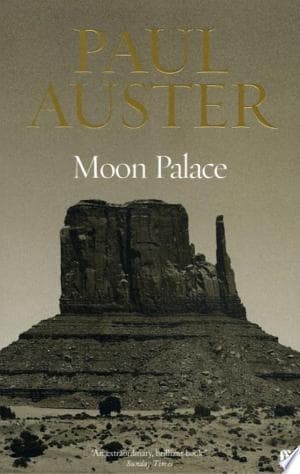
Synopsis
Covers the whole plot, including the ending.
- Difficulty
- Medium
- Pacing
- Moderate
- Mood
- Philosophical, Melancholy, Introspective, Mysterious, Coincidental
- Read it if
- You enjoy intricate, character-driven narratives with philosophical undertones, exploring themes of identity, fate, and the search for origins, set against a backdrop of historical events and vivid landscapes.
- Skip it if
- You prefer fast-paced thrillers or straightforward plots without extensive digressions and a strong emphasis on internal monologue and existential reflection.
Moon Palace Plot Summary
Covers the whole plot, including the ending.
Marco Stanley Fogg's Descent into Destitution
The novel begins in the summer of 1969, with Marco Stanley Fogg, a Columbia University student, telling about his quick slide into poverty. After getting a small amount of money from his eccentric Uncle Victor, his only living relative, Marco becomes absorbed in reading the 144 books left to him. He stops studying, runs out of money, and is kicked out of his apartment. With no other family or friends, Marco lives on the streets of New York, slowly starving and becoming unnoticed. He walks Central Park, searches for food, and succumbs to the city's indifference, his body and mind getting worse from homelessness and hunger. This time is his lowest point, a complete erasing of his former life.
Kitty Wu's Intervention and Marco's Recovery
Just as Marco is about to completely collapse, Kitty Wu, an old friend from college, and her roommate, Zimmer, find him. Kitty, shocked by how thin he is, takes him in, nurses him back to health, and gives him a safe place. While recovering, Marco falls in love with Kitty, who represents hope and stability in his troubled life. Zimmer, a former classmate and now a successful musician, offers Marco a job: reading to an elderly, blind, and eccentric man named Thomas Effing, who lives in a penthouse apartment and needs a live-in companion. This offer gives Marco a new purpose and a way out of his recent trouble, though he remains cautious of the world.
Life with Thomas Effing and His Peculiar Demands
Marco moves into Effing's luxurious apartment and starts his duties, which mainly involve reading aloud and writing down Effing's rambling memories. Effing, a demanding and grumpy old man, turns out to be a former landscape painter and adventurer with a life full of strange experiences and hidden secrets. He tells his life story in a non-linear, often contradictory way, speaking of his youth, his travels in the American West, and his interest in the moon. Marco becomes a confidant and a writer, carefully recording Effing's fragmented stories. He also finds Effing's unfinished main work, a series of paintings of the moon in different states, which Effing says must be destroyed after his death.
Effing's Past as Julian Barber and His Artistic Beginnings
Through Effing's stories, Marco learns that the old man's real name is Julian Barber, a promising young painter from a rich family. Julian, unhappy with high society and wanting a different life, faked his death by staging a disappearance at sea. He then took on the new identity of Thomas Effing and traveled west, looking for inspiration and escape. Marco carefully records these accounts, putting together the fragmented story of Julian's early life, his artistic goals, and why he made the radical decision to leave his former identity. This period of Effing's life shows youthful idealism and a rebellious spirit.
Effing's Western Adventures and the Moon Paintings
As Thomas Effing, Julian travels across the American West, meeting various people and seeing the rugged beauty of the land. He eventually finds himself in a remote desert, where he focuses on painting the moon. These paintings become his life's work, a single goal that consumes him. Marco learns about Effing's solitary life, his artistic struggles, and his connection to the moon. Effing describes his encounters with outlaws, prospectors, and hermits, creating a clear picture of a wild and untamed America. The moon, for Effing, becomes a symbol of mystery, solitude, and the vast unknown, a canvas for his artistic and personal questions.
Effing's Death and Marco's Inheritance
After several months, Thomas Effing dies peacefully in his sleep. In his will, he leaves Marco a lot of money, a collection of unique objects, and some instructions. Effing asks Marco to find a specific person and deliver a mysterious package. Marco is surprised by the amount of the inheritance and the trust Effing placed in him. Effing's death leaves Marco with a deep sense of loss, but also with a new purpose and a connection to a past he never knew. The instructions and the package start Marco's next journey, pulling him deeper into Effing's life.
Solomon Fogg and the Search for Effing's Son
Following Effing's instructions, Marco finds Solomon Fogg, an elderly, private man living in upstate New York. Solomon, a former friend and associate of Julian Barber (Effing), shares more details about Julian's past, including his marriage to a woman named Emily and the birth of their son. Solomon tells how Julian, after faking his death, left his family, leaving them poor. He also tells Marco about how Julian's disappearance affected Emily and their son. This meeting with Solomon gives Marco important missing pieces of Effing's life, connecting Effing's past as Julian Barber to his later life and hinting at a deeper, more personal connection to Marco.
The Revelation of Marco's Paternity
During his talks with Solomon Fogg, a surprising truth is revealed: Thomas Effing (Julian Barber) is Marco's biological grandfather. Solomon explains that Marco's mother, who died when he was young, was the daughter of Effing's son, Miles. Miles, in turn, was the son Julian Barber abandoned. This discovery deeply affects Marco, connecting him directly to the eccentric old man he cared for and the complex history he had been writing down. The search for Effing's son ends with the discovery of his own family line, changing his relationship with Effing's story from an outsider to a central figure within it. This discovery recontextualizes Marco's entire life.
The Story of Miles Fogg
Solomon Fogg then details the sad life of Miles Fogg, Marco's father and Effing's abandoned son. Miles grew up without a father, dealing with poverty and a deep feeling of being left alone. He became an inventor, focused on perpetual motion and a device he called the 'Moon Palace' – a perfect vision. Miles's life had a similar restless energy and a desire for something impossible to reach, mirroring parts of Julian Barber's own search. He eventually married and had Marco's mother, but his life was cut short by illness. Marco realizes how Effing's original abandonment affected later generations, a legacy of being rootless and longing.
Marco's Reflection and New Beginnings
With a full understanding of his family line, Marco thinks about the many coincidences and decisions that led him from homelessness to finding his family history. He sees similarities between Julian Barber's and Miles Fogg's lives and his own, especially their shared sense of wandering and a search for meaning. The novel ends with Marco, now financially stable and knowing his past, thinking about his future. He acknowledges life's repeating patterns, the connections between generations, and the lasting mystery of identity. He plans to travel westward, a symbolic retracing of his grandfather's steps, accepting his heritage while making his own way, with Kitty Wu by his side.
Moon Palace Characters
Marco Stanley Fogg
Protagonist
An orphaned Columbia student who descends into homelessness before uncovering his family's mysterious past.
Marco Stanley Fogg is an intelligent, introspective, and initially naive young man. Orphaned at a young age, he is emotionally adrift after the death of his Uncle Victor, his last living relative. His intellectual curiosity leads him to a period of intense reading that ultimately results in his homelessness. Marco is a natural quester, driven by a deep-seated need to understand his origins and place in the world. He is observant and empathetic, especially in his role as Effing's scribe, and develops a strong sense of responsibility. His journey is one of self-discovery, moving from passive observation to active engagement with his own history.
Relationships: Uncle Victor (eccentric adoptive uncle who raised him); Kitty Wu (girlfriend and rescuer); Thomas Effing (employer, then discovered to be his biological grandfather); Solomon Fogg (friend of Effing, who reveals Marco's paternity); Miles Fogg (biological father, whose story Marco uncovers)
Thomas Effing / Julian Barber
Supporting / Antagonist (in a historical sense)
Marco's blind, eccentric employer, revealed to be his wealthy, artistic grandfather who faked his own death.
Thomas Effing is a complex and contradictory character. Initially presented as a cantankerous, demanding old man, he is later revealed to be Julian Barber, a talented painter from a wealthy New York family who faked his death to escape his privileged life and pursue his artistic vision in the American West. Effing is driven by a profound need for freedom and self-expression, but also by a deep-seated loneliness and regret over his past actions, particularly his abandonment of his family. His obsession with the moon and his fragmented memoirs are central to the novel's plot, providing the mystery Marco must unravel. He is a man of grand gestures and profound artistic vision.
Relationships: Marco Stanley Fogg (employer of, then revealed to be biological grandfather); Solomon Fogg (long-time friend and confidant); Emily (abandoned wife); Miles Fogg (abandoned biological son)
Kitty Wu
Supporting
Marco's loyal friend and girlfriend who rescues him from destitution.
Kitty Wu is a compassionate, practical, and grounded young woman who provides Marco with stability and emotional support. She is an art student and later works as a dancer. Her unwavering loyalty and kindness are instrumental in Marco's survival and recovery from homelessness. She represents a connection to the present and a source of genuine affection for Marco, contrasting with the historical mysteries he uncovers. Kitty is a steadying force in Marco's often chaotic life, offering him a sense of belonging and a future. She is perceptive and understands Marco's intellectual and emotional needs.
Relationships: Marco Stanley Fogg (girlfriend and rescuer); Zimmer (roommate and friend)
Solomon Fogg
Supporting
An eccentric former friend of Julian Barber who holds the key to Marco's family history.
Solomon Fogg is a reclusive, elderly man living in upstate New York, who possesses a vast knowledge of Julian Barber's past. He is a pivotal character, serving as the primary source for Marco's understanding of his family history and the true identities of Effing and Miles Fogg. Solomon is a storyteller, carefully revealing the intricate details of the past, often with a philosophical bent. He carries the weight of shared history and secrets, having been a witness to the lives of both Julian Barber and Miles Fogg. His wisdom and memory are crucial to unraveling the novel's central mystery.
Relationships: Thomas Effing / Julian Barber (long-time friend and confidant); Marco Stanley Fogg (reveals his paternity to Marco)
Miles Fogg
Supporting / Mentioned
Marco's biological father, abandoned by Julian Barber, who became an inventor obsessed with the 'Moon Palace'.
Miles Fogg is Marco's biological father, whose life story is recounted through Solomon Fogg. He is the son Julian Barber abandoned, growing up in poverty and carrying the psychological scars of paternal absence. Miles is an inventor, driven by an idealistic vision of perpetual motion and a utopian device he calls the 'Moon Palace'. His life is a tragic testament to the long-lasting impact of Effing's choices. He represents a generational echo of restless searching and unfulfilled dreams, connecting Marco directly to a legacy of longing and intellectual pursuit. Though he never appears directly, his presence is deeply felt.
Relationships: Thomas Effing / Julian Barber (abandoned biological son); Marco Stanley Fogg (biological father)
Uncle Victor
Supporting / Mentioned
Marco's eccentric adoptive uncle and guardian, whose death precipitates Marco's crisis.
Uncle Victor is Marco's only living relative and guardian after his parents' deaths. An eccentric and reclusive man, he is a significant figure in Marco's early life, providing stability and fostering Marco's intellectual curiosity through the gift of his extensive library. His death marks the beginning of Marco's descent into destitution, as he leaves Marco with a small inheritance and a large collection of books, but no practical guidance. Victor's influence is primarily felt through his absence and the legacy of books he leaves behind, which ironically contribute to Marco's initial downfall.
Relationships: Marco Stanley Fogg (adoptive uncle and guardian)
Zimmer
Supporting
Kitty Wu's roommate and a successful musician who offers Marco a job.
Zimmer is Kitty Wu's roommate and an old acquaintance of Marco's from Columbia. He is a successful musician and a practical, if somewhat detached, individual. Zimmer plays a crucial role in Marco's recovery by offering him the job as Thomas Effing's reader and transcriber, thereby providing him with a means of survival and a new direction. He represents the possibility of re-entry into society for Marco, offering a pragmatic solution to his dire circumstances. Though not deeply involved in Marco's personal quest, his intervention is essential to the plot's progression.
Relationships: Kitty Wu (roommate and friend); Marco Stanley Fogg (former classmate; employer)
Emily
Mentioned
Julian Barber's abandoned wife and Miles Fogg's mother.
Emily is Julian Barber's wife, whom he abandons when he fakes his death and reinvents himself as Thomas Effing. Her story is relayed through Solomon Fogg, highlighting the devastating impact of Julian's actions. She represents the innocent victim of Julian's selfish pursuit of artistic freedom, left to raise their son, Miles, in poverty and without a husband. Her suffering underscores the moral complexities of Effing's grand artistic gesture and the far-reaching consequences of his abandonment.
Relationships: Thomas Effing / Julian Barber (abandoned wife); Miles Fogg (mother)
Moon Palace Themes
Identity and Self-Discovery
The novel explores how identity is flexible and created. Marco Stanley Fogg searches for his own origins and sense of self, which becomes connected to what he learns about his grandfather, Julian Barber, who intentionally changes his identity to become Thomas Effing. Effing's life shows the power of self-reinvention, while Marco's search is about uncovering the layers of his inherited identity. The story questions if identity is decided by family or made through individual experience and choice, suggesting a complex interaction between the two.
“What is a man but the sum of his memories? We are the stories we tell ourselves, the stories we are told by others.”
The Search for a Father Figure / Paternity
A main motivation for Marco is the lack of a father figure and the eventual discovery of his family line. His initial search for meaning after Uncle Victor's death leads him to Effing, who unknowingly becomes a father/grandfather figure. The later discovery that Effing is his biological grandfather, and the story of his actual father, Miles Fogg, provides the core emotional story. The novel examines the deep impact of not having a father and the desire for connection to one's family, showing how one generation's choices affect the next.
“I was looking for a father, of course, but I didn't know it then. I was looking for a beginning, for the place where I belonged.”
Coincidence and Fate
The plot of "Moon Palace" relies on many coincidences that guide Marco's journey, from Kitty Wu finding him on the street to the seemingly random job with Thomas Effing, and the eventual discovery of their family connection through Solomon Fogg. Auster uses these coincidences to explore destiny and the mysterious forces that shape human lives. The story suggests that while people make individual choices, there is also an overarching, almost cosmic, pattern that directs events, leading characters to their destined connections.
“Life is a series of accidents, but sometimes, if you're lucky, those accidents can lead to something beautiful.”
The American Dream and the Frontier
The novel touches on the romantic idea of the American frontier and the pursuit of freedom and self-creation. Julian Barber's decision to leave his identity and travel west to become Thomas Effing represents a version of the American Dream – the freedom to escape one's past and create a new life. His solitary quest to paint the moon in the vast American landscape brings to mind exploration and individualism. However, the novel also critiques this idea by showing the damage such pursuits can cause, especially the abandonment of family and the loneliness that can come with extreme individualism.
“The West was a blank slate, a place where a man could lose himself and find himself again, if he was brave enough.”
Art, Obsession, and Legacy
Art, especially painting and writing, is an important theme. Julian Barber's entire life as Thomas Effing is defined by his dedication to painting the moon, a project that consumes him and controls his existence. Marco, as a writer and transcriber, is an important part of preserving Effing's artistic and personal legacy. The novel explores the sacrifices artists make, the pursuit of an impossible ideal, and the lasting impact of creative works. It also highlights the idea that a person's life story, carefully recorded, can itself be a form of art and a way to achieve immortality.
“Every canvas was a moon, every stroke a journey into the unknown. He was painting not what he saw, but what he felt.”
Plot Devices & Literary Techniques
Non-Linear Narrative / Nested Stories
The story unfolds through Marco's present, Effing's dictated past, and Solomon's historical accounts.
The novel employs a complex non-linear structure, with Marco's present-day narrative serving as the framing device for the embedded stories of Thomas Effing (Julian Barber) and Miles Fogg. Effing's dictated memoirs, often rambling and out of sequence, force Marco (and the reader) to piece together his past. Later, Solomon Fogg provides another layer of historical detail, filling in gaps and ultimately revealing Marco's lineage. This structure mirrors the process of historical and personal discovery, where truths are uncovered in fragments and connections are made retrospectively, creating a sense of unfolding mystery and intricate causality.
The Moon as a Symbol
Represents mystery, solitude, human ambition, and the unattainable.
The moon is a pervasive and multifaceted symbol throughout the novel, appearing in the title, Effing's obsessive paintings, and Miles Fogg's utopian 'Moon Palace' invention. It represents the unknown, the mysterious, and the distant, reflecting the characters' quests for meaning and their often-solitary journeys. For Effing, it is an artistic muse and a symbol of his isolated existence; for Miles, it embodies an unattainable ideal of perfection. The moon also symbolizes the cyclical nature of life, the ebb and flow of fortune, and the constant human yearning for something beyond reach, mirroring the characters' restless spirits and their searches for ultimate truths.
The Orphan Archetype
Marco's status as an orphan drives his search for identity and belonging.
Marco Stanley Fogg's orphan status is not just a biographical detail but a foundational element of his character and the plot. Having lost both parents and then his Uncle Victor, Marco is literally unmoored, leading to his homelessness and subsequent quest for his origins. This archetype emphasizes his profound sense of displacement and his desperate need to connect with a family history and a place in the world. His journey is a classic orphan's tale, moving from vulnerability and isolation to the discovery of a lineage that grounds him, even if that lineage is complex and fraught with abandonment.
The Double / Alter Ego
Julian Barber's creation of Thomas Effing explores themes of identity and self-invention.
The most prominent example of the double is Julian Barber's deliberate creation of Thomas Effing as an alter ego. By faking his death and assuming a new identity, Julian explores the radical possibility of shedding one's past and reinventing oneself entirely. This device highlights questions of authenticity, the performative nature of identity, and the psychological impact of living a fabricated life. The novel suggests that while one can change names and circumstances, the core essence or karma of a person often remains, and the past inevitably catches up, as seen in Effing's eventual desire to record his true history.
Moon Palace Quotes
“The world is full of signs and wonders that come, and go, and if you don't stop to look around once in a while, you might miss them.”
“I was the sole inhabitant of my own moon, a world of silence and ice.”
“The past is a foreign country; they do things differently there.”
“We are all the heroes of our own stories, and the villains of others.”
“To lose everything is to find something else, something you never knew was there.”
“Books are the only place where the dead can speak to the living.”
“The moon is a mirror that reflects the light of the sun, and we are all mirrors of each other.”
“There is no such thing as an accident. Everything happens for a reason, even if we can't see it.”
“The city is a labyrinth, and we are all trying to find our way out.”
“Love is the only thing that makes the unbearable bearable.”
“We are all stories in the end, just make it a good one.”
“The desert is a place of emptiness, but also of possibility.”
“To be alive is to be in motion, to be constantly changing.”
“The past is not dead; it is not even past.”
Quiz
10 questions on the plot and the characters. Each answer comes with a short explanation.
Question 1
What tragic event leaves Marco Stanley Fogg orphaned at the beginning of the novel?
- His parents die in a car accident
- His mother dies in childbirth and his father is unknown
- His uncle Victor dies, leaving him alone in New York
- His entire family perishes in a house fire
Show answer
C. His uncle Victor dies, leaving him alone in New York Marco becomes an orphan when his uncle Victor, who raised him, dies suddenly. This event triggers Marco's descent into poverty and homelessness in New York City, setting his quest in motion.
Question 2
What unusual collection does Marco inherit from his uncle Victor that becomes central to the story?
- A collection of rare stamps
- 1,492 books that fill his apartment
- A collection of antique maps
- A portfolio of valuable stocks
Show answer
B. 1,492 books that fill his apartment Marco inherits 1,492 books from his uncle Victor. He gradually sells them off to survive when he becomes destitute, and this collection symbolizes both his inheritance and his gradual loss of security.
Question 3
What significant historical event serves as the backdrop for Marco's story?
- The Vietnam War
- The first moon landing in 1969
- The Great Depression
- World War II
Show answer
B. The first moon landing in 1969 The novel opens with the line 'It was the summer that men first walked on the moon,' referring to the Apollo 11 moon landing in 1969. This event parallels Marco's personal journey of exploration and discovery.
Question 4
Who is Thomas Effing, and how does Marco meet him?
- A wealthy art collector who hires Marco as a tutor
- A blind, elderly man who hires Marco as a companion to transcribe his memoirs
- A university professor who becomes Marco's mentor
- A homeless man Marco befriends in Central Park
Show answer
B. A blind, elderly man who hires Marco as a companion to transcribe his memoirs Thomas Effing is a blind, reclusive old man who hires Marco to transcribe his life story. This relationship provides Marco with income and exposes him to Effing's mysterious past, which becomes crucial to the plot.
Question 5
What crucial discovery does Marco make about his own origins through Thomas Effing's story?
- That Effing is actually his biological grandfather
- That Effing murdered Marco's father
- That Effing stole a fortune that rightfully belongs to Marco
- That Effing was Marco's uncle Victor's business partner
Show answer
A. That Effing is actually his biological grandfather Through transcribing Effing's memoirs, Marco learns that Effing is actually Julian Barber, his grandfather. This revelation connects Marco to a family history he never knew, involving art, betrayal, and the American West.
Question 6
What symbolic role does the American West play in Marco's journey?
- It represents a place of final rest and burial for his family
- It serves as a literal and metaphorical frontier for exploration and self-discovery
- It is where Marco goes to escape legal troubles
- It symbolizes industrial progress and modernity
Show answer
B. It serves as a literal and metaphorical frontier for exploration and self-discovery The American West, particularly Utah's desert landscapes, represents a frontier where Marco physically and metaphorically explores his identity, heritage, and the 'moon palace' of the title, tying his personal quest to larger American myths.
Question 7
How does the character of Kitty Wu influence Marco's life?
- She is Marco's college sweetheart who helps him financially
- She is a Chinese-American woman who becomes Marco's lover and provides emotional stability
- She is a social worker who rescues Marco from homelessness
- She is Effing's nurse who reveals secrets about his past
Show answer
B. She is a Chinese-American woman who becomes Marco's lover and provides emotional stability Kitty Wu is a Chinese-American pianist who becomes Marco's lover. Their relationship offers Marco love and stability amidst his chaotic quest, representing a grounding force compared to his search for elusive origins.
Question 8
What is the significance of the 'Moon Palace' referenced in the title?
- It is a Chinese restaurant where Marco and Kitty frequently dine
- It is a nickname for the apartment Marco inherits from his uncle
- It refers to NASA's lunar module from the 1969 moon landing
- It is a metaphor for the American government's secrecy
Show answer
A. It is a Chinese restaurant where Marco and Kitty frequently dine The 'Moon Palace' is a Chinese restaurant where Marco and Kitty eat. The title symbolizes the novel's themes of coincidence, mystery, and the interplay between the mundane and the cosmic, connecting Marco's personal story to larger lunar imagery.
Question 9
What unlikely coincidence reveals the connection between Marco's story and that of Solomon Barber?
- Marco finds Barber's diary in one of his inherited books
- Barber turns out to be a professor at Marco's university, and they meet by chance
- Kitty Wu is revealed to be Barber's long-lost daughter
- Barber contacts Marco after reading about him in a newspaper
Show answer
B. Barber turns out to be a professor at Marco's university, and they meet by chance Solomon Barber, who is revealed to be Marco's father, is a professor at Columbia University where Marco is a student. They meet by chance, one of the novel's many coincidences that Auster uses to weave together the generational narrative.
Question 10
How does Paul Auster use the motif of blindness in the novel?
- As a literal condition affecting key characters and a metaphor for ignorance and insight
- Primarily as a plot device to make characters more vulnerable
- To criticize society's neglect of disabled people
- As a reference to classical mythology only
Show answer
A. As a literal condition affecting key characters and a metaphor for ignorance and insight Blindness appears literally (Thomas Effing is blind) and metaphorically throughout the novel. It represents characters' inability to see truths about themselves and others, while also suggesting that insight can come from non-visual means, echoing themes of fate and perception.
Moon Palace FAQ
What is 'Moon Palace' about?
'Moon Palace' follows Marco Stanley Fogg, an orphaned young man in 1960s America, as he embarks on a quest to uncover his origins and identity. The narrative spans three generations, moving from Manhattan to the American West, intertwining his search for his unknown father with historical events like the moon landing. Through unlikely coincidences and tragedies, Marco's journey explores themes of fate, love, and self-discovery against the backdrop of mid-20th century America.
Why should I read 'Moon Palace'?
You should read 'Moon Palace' for its mesmerizing blend of suspense, lyrical prose, and philosophical depth, as it masterfully weaves personal quests with historical milestones like the moon landing. Auster's novel offers rich character development, unexpected plot twists, and explores universal themes of identity, fate, and the search for meaning, making it both intellectually stimulating and emotionally resonant.
What is the background/setting of 'Moon Palace'?
The novel is set primarily in 1960s America, with key locations including the canyons of Manhattan and the cruelly beautiful landscape of the American West. It spans three generations, from the early 20th century to the first lunar landings in 1969, using these settings to mirror Marco's internal journey and the era's cultural shifts.
What are the most memorable quotes?
Memorable quotes include the opening lines: 'It was the summer that men first walked on the moon. I was very young back then, but did not believe there would ever be a future. I wanted to live dangerously...', which set the tone for Marco's quest. Another is Marco's reflection on fate: 'We are all connected in ways we cannot see,' highlighting the novel's themes of coincidence and destiny.
What writing style does Paul Auster use?
Paul Auster employs a lyrical and erudite writing style in 'Moon Palace', blending suspense with philosophical musings. His prose is characterized by vivid descriptions, such as the 'cruelly beautiful landscape of the American West', and a narrative that flows effortlessly, using unlikely coincidences and marvellous flights of language to engage readers in Marco's introspective journey.
What minor details add significant meaning?
Minor details like Marco's obsession with the moon and lunar imagery subtly reinforce themes of exploration and the unknown, mirroring his quest for identity. The recurring motif of 'canyons' in Manhattan symbolizes the depths of his past, while small coincidences, such as chance encounters, underscore the novel's exploration of fate and interconnectedness.
What are some subtle foreshadowing moments?
Early references to the moon landing foreshadow Marco's own journey into the unknown, hinting at the novel's climax where personal and historical discoveries converge. Marco's initial disbelief in a 'future' subtly foreshadows his transformative quest, and minor tragedies early in the story hint at the wrenching losses he will face, shaping his path.
What unexpected character connections exist?
Unexpected connections include the revelation of Marco's unknown father, whose identity is intertwined with figures from earlier generations, creating a web of relationships that spans the novel's three-generation timeline. These connections often emerge through unlikely coincidences, such as chance meetings in the American West, that tie characters' fates together in surprising ways.
What are unspoken character motivations?
Marco's unspoken motivation is a deep-seated fear of emptiness and a desire to fill the void left by his orphaned past, driving his dangerous pursuits. Other characters, like his father figure, may harbor hidden guilt or unresolved legacies that influence their actions, adding layers to their interactions without explicit dialogue.
What psychological complexities do characters exhibit?
Marco exhibits psychological complexity through his oscillation between despair and hope, as seen in his initial disbelief in a future contrasted with his relentless quest. Characters often grapple with identity crises, repressed memories, and the weight of familial secrets, manifesting in behaviors that range from self-destructive to redemptive.
What are the major emotional turning points?
Major emotional turning points include Marco's realization of his orphaned state, which sparks his quest; tragic losses that force him to confront mortality; and climactic discoveries about his father, which bring both closure and new questions. The moon landing serves as a symbolic turning point, merging personal and historical epiphanies.
How do relationship dynamics evolve?
Relationship dynamics evolve from Marco's initial isolation as an orphan to complex bonds with mentors, lovers, and familial figures. These relationships shift through trust, betrayal, and reconciliation, mirroring his growth from a questing youth to someone who understands interconnectedness, as seen in his evolving connection with his unknown father.
Which parts remain ambiguous or open-ended?
Ambiguities include the exact nature of Marco's father's past and the full extent of the coincidences that shape the plot, leaving room for interpretation about fate versus chance. The novel's ending, while resolving some quests, leaves questions about Marco's future and the ongoing impact of his discoveries, inviting readers to ponder the elusiveness of origins.
What are controversial scenes or decisions?
Controversial scenes may include Marco's risky, self-destructive behaviors early on, which some readers might see as reckless rather than heroic. Decisions involving familial revelations and the handling of tragedies could spark debate over characters' moral choices and the novel's portrayal of destiny versus free will.
'Moon Palace' ending explained: how it ends & what it means
The ending sees Marco achieving a partial understanding of his origins, with revelations about his father and his own place in the generational saga, set against the backdrop of the moon landing. It suggests that while some mysteries are solved, the quest for identity is ongoing, emphasizing themes of connection and the perpetual search for meaning in a vast, uncertain world.
About the author

Paul Benjamin Auster is an American writer and film director. His notable works include The New York Trilogy (1987), Moon Palace (1989), The Music of Chance (1990), The Book of Illusions (2002), The Brooklyn Follies (2005), Invisible (2009), Sunset Park (2010), Winter Journal (2012), and 4 3 2 1 (2017). His books have been translated into more than forty languages.
Similar books
- The New York Trilogy
Paul Auster
3.9 (62k) average on GoodreadsMysteryShares Auster's signature style of existential mystery, interconnected narratives, and philosophical inquiry into identity and coincidence.
- Invisible Cities
Italo Calvino
4.1 (62k) average on GoodreadsFantasyFeatures lyrical prose and a contemplative exploration of memory, place, and storytelling, though with less plot-driven narrative.
- A Heartbreaking Work of Staggering Genius
Dave Eggers
3.7 (171k) average on GoodreadsLiterary FictionExplores themes of orphanhood and the search for identity with a blend of humor and pathos, though with a different narrative style.
- The Crying of Lot 49
Thomas Pynchon
3.7 (71k) average on GoodreadsLiterary FictionBoth Moon Palace and The Crying of Lot 49 share a postmodern sensibility, featuring protagonists who embark on a quest for meaning within a labyrinthine and often absurd reality. Pynchon's novel, like Auster's, uses an intricate web of symbols and coincidences to explore themes of paranoia, conspiracy, and the elusive nature of truth. However, Pynchon's prose is often more overtly experimental and fragmented, while Auster maintains a more traditional narrative voice despite his postmodern tricks.
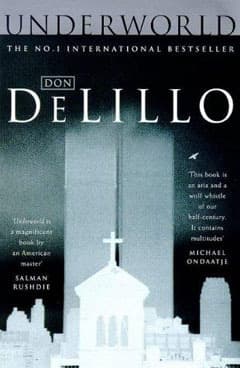
- Underworld
Don DeLillo
4.1 (2k) average on GoodreadsFantasyMoon Palace and DeLillo's Underworld both tackle broad themes of American history and identity, tracing personal narratives against significant historical backdrops. While Auster focuses on individual quests for meaning, DeLillo's epic novel provides a panoramic view of late 20th-century America, connecting diverse characters and events through a sprawling, non-linear narrative. DeLillo often employs a more detached, journalistic tone, whereas Auster's narration is deeply embedded in the subjective experience of his protagonist.
- Nineteen Eighty-Four
George Orwell
4.2 (5.5M) average on GoodreadsFictionWinston Smith dreams of truth and rebellion in a world where Big Brother watches all, but he confronts the terrifying power of a regime that controls not just actions, but thoughts.


Enjoyed the summary?
A summary gives you the shape of the book. The book itself has the detail, the examples and the voice.
Find Moon Palace on AmazonAs an Amazon Associate, BookBrief earns from qualifying purchases. How we're funded