

Synopsis
Covers the whole plot, including the ending.
- Difficulty
- Medium
- Pacing
- Moderate
- Mood
- Epic, thoughtful, politically charged, hopeful, speculative
Moving Mars Plot Summary
Covers the whole plot, including the ending.
The Binding Multiple and Early Life
Casseia Majumdar grows up on Mars, a member of a large, interconnected family unit. Her early life mixes traditional Martian values with a growing dissatisfaction about Earth's colonial rule. She is intelligent and observant, benefiting from Mars's advanced education, though it is still seen as worse than Earth's best. Casseia forms close bonds with her family, especially her bond-brother Charles and cousin Daniel, who will be important later. The story shows Mars's political situation: Earth corporations control resources and technology, fueling a desire for independence among younger Martians.
University and the Seeds of Revolution
Casseia attends university on Earth, a privilege that broadens her perspective but also shows her the power imbalance between the planets. She excels in physics and starts a relationship with Hwan, a bright Earth student. On Earth, Casseia meets various political and intellectual groups, some openly supporting Martian independence. She sees firsthand how many Earth authorities dismiss Mars and its people, strengthening her own feelings of Martian identity and the need for self-determination. Her experiences on Earth, both academic and personal, prepare her for future political struggles.
Return to Mars and Political Awakening
Returning to Mars, Casseia finds the political situation tense. The desire for independence has grown, fueled by Earth's continued limits on advanced technology and education for Martians. Casseia, now a respected physicist, gets more involved in the independence movement, first through discussions and then through direct political action. She reunites with Charles and Daniel, both committed to Mars's future. Her relationship with Hwan continues, bridging the planets but also creating personal problems as political tensions rise. Casseia's scientific skills start to play a role in the movement's strategy.
The Rise of Martian Autonomy
The Martian independence movement gains speed through political action and technological progress. Martians develop their own advanced technologies, bypassing Earth's restrictions and showing their self-sufficiency. Casseia's scientific knowledge helps with projects that improve Martian capabilities. The political fight grows, with Earth trying to regain control through economic and diplomatic pressure. However, Martians, united by a shared vision of freedom, resist. Casseia, Charles, and Daniel become important figures, handling the complex politics and arguing for Martian rights on a global stage. The first steps toward true autonomy happen, changing the conflict.
The Discovery of the 'Quantum Entanglement' Technology
Casseia and other Martian scientists make a discovery: a way to use quantum entanglement for practical purposes, far beyond anything known on Earth. This technology, first meant for communication and computing, quickly shows potential for more radical uses, like energy generation and matter manipulation. The discovery is kept secret because its strategic implications are huge. It offers a way to balance Earth's military and economic power. Martian leaders discuss the ethical problems and dangers of such powerful technology, but most agree it is necessary for independence. This discovery changes the balance of power.
The Ultimatum and Escalation
News of Mars's technological advances, especially rumors of quantum entanglement, reaches Earth. Fearing a loss of control and the threat this new technology poses, Earth's governments issue an ultimatum: Mars must give up its advanced technologies and accept tighter Earth oversight, or face severe consequences. Martian leaders defiantly refuse. Political tensions rise sharply, pushing both sides to the edge of open conflict. Casseia, Charles, and Daniel lead the Martian response, planning strategies to defend their planet's new autonomy. War becomes very real, and the Martians prepare for the final confrontation.
The Great Departure: Moving Mars
Facing Earth's military strength, Martian leaders, guided by Casseia's scientific knowledge and strategy, make a bold decision: to move Mars out of Earth's orbit. Using the perfected quantum entanglement technology, they begin displacing the entire planet, making it disappear from Earth's detection and pursuit. This huge undertaking is full of danger and ethical questions, as it affects every living thing on Mars. The event shows Martian ingenuity and determination, a desperate but brilliant move for ultimate freedom. The act itself is a global spectacle, terrifying and amazing to Earth, and a moment of triumphant defiance for Mars.
Life Beyond Earth's Grasp
After successfully moving Mars to a new, secret location in deep space, Martians begin building a fully independent civilization. This new existence brings both opportunities and challenges. They are free from Earth's control but must now deal with the vastness of space and the task of self-governance without outside support. Casseia helps adapt the quantum entanglement technology for long-term planetary survival and exploration. The story explores the social, political, and philosophical results of this liberation. Martians grapple with their new identity, their relationship with the now distant Earth, and humanity's future.
Reaching Out and Reconciliation
Years after the Great Departure, Mars, now a thriving independent society, decides to contact Earth again. Casseia, a wise and respected leader, is central to these efforts. The goal is not to return to the old colonial relationship, but to form a new alliance based on mutual respect and shared humanity. The quantum entanglement technology, once a tool of defiance, is now offered for cooperation and advancement for both planets. Reconciliation is difficult, marked by lingering resentment and mistrust from Earth. However, Casseia's diplomatic skills and the clear benefits of Martian technology slowly bridge the divide, hinting at a future where humanity might again be united, though fundamentally changed.
The Future of Humanity
In the final sections, Casseia thinks about Mars's long journey to freedom and its impact on both Martian and Earth society. She considers freedom, identity, and humanity's destiny as it expands beyond its home. Quantum entanglement technology keeps evolving, opening possibilities for interstellar travel and communication, suggesting a future where humanity is not confined to one solar system. Casseia's personal relationships, especially with Hwan and Daniel, find a new balance amid these larger developments. The story ends with hope and a vision of humanity transformed, having overcome its divisions to embrace a boundless future in the cosmos, led by Mars's bold spirit.
Principal Figures
Casseia Majumdar
Protagonist
A brilliant Martian physicist and leader of the independence movement.
Casseia is the central figure, an intelligent and insightful woman from a powerful Martian Binding Multiple. She is a gifted physicist, whose scientific acumen proves crucial to Mars's technological breakthroughs. Initially a diligent student, she evolves into a shrewd political strategist and diplomat, driven by a deep love for Mars and a belief in its right to self-determination. Her journey is one of intellectual discovery, personal sacrifice, and profound leadership, as she navigates complex relationships and guides her people towards an unimaginable future. She embodies the spirit of Martian ingenuity and resilience.
Relationships: Charles (Bond-brother, political ally); Daniel (Cousin, love interest, political ally); Hwan (Earth love interest, scientific collaborator)
Daniel
Supporting
Casseia's cousin and a key political figure.
Daniel is Casseia's cousin and a significant presence in her life, becoming her confidante, occasional love interest, and a crucial ally in the independence movement. He is charismatic, politically astute, and deeply committed to Martian freedom. While Casseia often provides the scientific and strategic brilliance, Daniel is adept at the practicalities of political organization and public relations. His relationship with Casseia is complex, marked by shared ideals and deep affection, providing a strong personal anchor for her during tumultuous times. He represents the passionate, activist side of the Martian revolution.
Relationships: Casseia Majumdar (Cousin, love interest, political ally)
Charles
Supporting
Casseia's bond-brother and a pillar of the Majumdar Multiple.
Charles is Casseia's bond-brother, representing the traditional yet evolving structure of the Martian Binding Multiples. He is a steady, reliable presence in Casseia's life, offering familial support and practical advice. Charles is also deeply invested in the future of Mars and plays a significant role in the political and economic aspects of the independence movement. He often acts as a grounding force for Casseia, reminding her of their family's heritage and the collective well-being of their people. His character highlights the importance of family and community in Martian society.
Relationships: Casseia Majumdar (Bond-brother, political ally)
Hwan
Supporting
Casseia's Earth love interest and scientific collaborator.
Hwan is a brilliant Earth physicist whom Casseia meets and falls in love with during her studies on Earth. He represents the potential for connection and understanding between Earth and Mars, despite the growing political divide. Hwan is intellectually curious and open-minded, eventually collaborating with Casseia on some of her groundbreaking research. His relationship with Casseia is a personal bridge between the two worlds, fraught with the challenges of loyalty and distance. He struggles with his allegiance but ultimately supports Casseia and the Martians, embodying a hope for future reconciliation.
Relationships: Casseia Majumdar (Love interest, scientific collaborator)
The Binding Multiple
Supporting
The extended family unit central to Martian society.
The Binding Multiple is not a single character but a collective entity, representing the intricate, multi-generational family structures that are fundamental to Martian culture. Casseia's own Majumdar Multiple provides her with a strong sense of identity, belonging, and a network of support. These multiples are economic, social, and political units, fostering loyalty and collective action. They provide a contrast to Earth's more individualistic societies and demonstrate the strength of Martian communal bonds in the face of external threats. The decisions and well-being of the Multiple often weigh heavily on Casseia.
Relationships: Casseia Majumdar (Family, source of identity and support)
Earth Government/Corporations
Antagonist
The colonial power controlling Mars.
This collective entity represents the primary antagonist in the narrative. It encompasses the various political bodies, corporate interests, and military forces of Earth that seek to maintain control over Mars and its resources. They are characterized by a sense of entitlement, a dismissive attitude towards Martian autonomy, and a willingness to use economic and military coercion to assert their dominance. Their actions, driven by a desire for power and resources, are the direct catalyst for the Martian independence movement. While not a single character, their collective policies and decisions drive much of the conflict.
Relationships: Mars (collective) (Colonial overlord, antagonist)
Themes & Insights
Colonialism and Liberation
The main theme is the struggle of a colonized people (Martians) to break free from a dominant power (Earth). It covers economic exploitation, cultural disrespect, and political suppression inherent in colonial relationships, and the deep desire for self-determination. The Martians' journey from subservience to independence, ending with moving their planet, is an allegory for decolonization and how far people will go for freedom. It shows the psychological and social costs of both colonial rule and revolution.
“We were a colony, a resource, a distant experiment. But we were also human, and we had grown up. It was time for us to leave the nest, even if the nest tried to hold us by force.”
Identity and Belonging
This theme looks at how a unique Martian identity forms over generations, separate from Earth origins. It explores the creation of a collective consciousness rooted in shared experiences, unique social structures (like the Binding Multiples), and the challenges of life on a frontier world. Casseia's personal journey reflects this, as she balances her connections to both Earth and Mars, ultimately choosing loyalty to her home planet. Moving Mars is the ultimate statement of this distinct identity and their right to define themselves and their future, separate from Earth's influence.
“Our roots were in Earth, yes, but our branches, our leaves, our very fruit, were Martian. We were a new species of humanity, forged in the red dust.”
The Ethics and Power of Technology
The novel examines the dual nature of advanced technology: its potential for both freedom and destruction. Quantum entanglement technology is first a tool for communication and research, then a strategic weapon for independence, and finally a way to relocate a planet. The ethical questions around its development and use, including potential misuse and its impact on humanity's future, are central. The theme asks who controls such power, for what reasons, and the responsibility that comes with capabilities that can reshape existence. It shows technology as a mirror reflecting humanity's deepest desires and fears.
“The power we held was immense, terrifying. It could grant us freedom, or it could unravel the very fabric of our reality. The choice was always ours, and the consequences, eternal.”
Love and Loyalty Across Divides
This theme explores personal relationships during political and planetary conflict. Casseia's love for Hwan, an Earthling, creates a personal divide that mirrors the larger conflict between the planets. Her strong bonds with her family, especially Daniel and Charles, show the strength of Martian communal loyalty. The story examines how love can cross boundaries, but also how political loyalties can strain or redefine personal connections. It suggests that even in extreme divisions, the human capacity for connection, understanding, and reconciliation can endure, offering hope for a unified future.
“Even as our worlds pulled apart, our hearts found ways to bridge the chasm. Love, it seemed, obeyed no planetary laws.”
Plot Devices & Literary Techniques
Quantum Entanglement Technology
A fictional scientific breakthrough enabling planetary relocation.
This is the primary scientific plot device, a highly advanced form of quantum entanglement manipulation that allows for instantaneous communication, energy generation, and, most dramatically, the physical relocation of an entire planet. It serves as both the ultimate weapon of defiance against Earth and the means by which Martians achieve absolute independence. The device drives the plot's major turning point, moving it from political struggle to a grand, audacious act of planetary engineering. It also raises profound ethical and philosophical questions about humanity's power over its environment and destiny.
The Binding Multiple
Martian extended family units as social and political structures.
The Binding Multiple is a unique social construct on Mars, representing the multi-generational, interconnected family units that form the bedrock of Martian society. This device shapes character relationships, provides a strong sense of cultural identity for Martians, and influences their collective decision-making. It contrasts sharply with Earth's more individualistic societies, highlighting the communal strength and loyalty that enables the Martian independence movement. The Multiple provides Casseia with both support and obligations, making her personal journey intricately tied to her family's fate and the collective will of her people.
The 'Great Departure'
The physical relocation of Mars from Earth's solar system.
This event is the ultimate manifestation of Martian independence and serves as the novel's climactic plot device. It is a literal and metaphorical separation from Earth, signifying the Martians' complete liberation. The Great Departure is a moment of immense tension, scientific marvel, and profound consequence, altering the course of human history. It forces both Martians and Earthlings to redefine their identities and relationship, and sets the stage for the novel's exploration of post-colonial existence and the future of humanity in the cosmos. It's an unprecedented act that irrevocably changes the narrative landscape.
Quiz
10 questions on the plot and the characters. Each answer comes with a short explanation.
Question 1
What is the primary conflict in 'Moving Mars'?
- A war between different Martian factions.
- A struggle for independence by Mars from Earth's corporate control.
- An environmental disaster threatening the Martian colony.
- A philosophical debate about the nature of consciousness.
Show answer
B. A struggle for independence by Mars from Earth's corporate control. The text explicitly states that 'Mars is a colonial world, governed by corporate interests on Earth' and describes a 'planetary liberation movement' and the desire of Martians for independence.
Question 2
Who is the main protagonist through whose eyes the story is told?
- A corporate executive from Earth.
- A revolutionary leader.
- Casseia Majumdar.
- An engineer developing new Martian technology.
Show answer
C. Casseia Majumdar. The text clearly states: 'Told through the eyes of an extraordinary character, Casseia Majumdar...'
Question 3
What is the main reason the young Martians have little loyalty to Earth?
- They have never visited Earth.
- Earth's corporate interests restrict their access to education and new inventions.
- They are genetically engineered to dislike Earth.
- A recent war between Earth and Mars has created animosity.
Show answer
B. Earth's corporate interests restrict their access to education and new inventions. The summary mentions that Martians are 'held back by their lack of access to the best education, and the desire of the Earthly powers to keep the best new inventions for themselves,' which fuels their disloyalty.
Question 4
The political struggle for Martian independence is described as:
- A swift and violent uprising.
- A gradual process spanning decades.
- A series of diplomatic negotiations.
- An internal Martian civil war.
Show answer
B. A gradual process spanning decades. The text states the revolution 'begins slowly, but will grow in power over decades of political struggle until it becomes irresistible.'
Question 5
What is a 'Binding Multiple' in the context of the story?
- A type of Martian spacecraft.
- A political organization on Mars.
- A family or social structure on Mars.
- A corporate entity from Earth.
Show answer
C. A family or social structure on Mars. Casseia Majumdar is described as 'a daughter of one of Mars' oldest, most conservative Binding Multiples,' implying it's a social or familial structure.
Question 6
The story is set within which genre(s)?
- Romance and Thriller.
- Mystery and Historical Fiction.
- Politics, Fantasy, and Science Fiction.
- Western and Adventure.
Show answer
C. Politics, Fantasy, and Science Fiction. The provided text explicitly lists the genres as 'Politics, Fantasy, Science Fiction.'
Question 7
What aspect of the story is described as 'audacious scientific speculation'?
- The political system of Earth.
- The social structures of Martian families.
- The process of colonizing and potentially moving Mars.
- The development of advanced Martian weaponry.
Show answer
C. The process of colonizing and potentially moving Mars. The text states the book embellishes 'an audacious scientific speculation,' which in the context of the book's title and theme, refers to the concept of moving Mars or the science behind large-scale planetary engineering.
Question 8
The description of Mars in the book emphasizes:
- Its barren and inhospitable nature, making survival impossible.
- Its advanced, pre-existing Martian civilization.
- The challenges and realities of human colonization.
- Its primary role as a tourist destination for Earth's elite.
Show answer
C. The challenges and realities of human colonization. The text focuses on Mars as a 'colonial world' with 'citizens of Mars' who are 'hardworking,' highlighting the human effort and challenges involved in establishing a society there.
Question 9
What does the phrase 'grand historical sweep' suggest about the narrative scope of 'Moving Mars'?
- The story focuses intensely on a single, pivotal moment.
- The narrative covers a significant period of time, likely encompassing generations and major societal changes.
- The story is limited to the personal experiences of the protagonist without broader context.
- The focus is on detailed descriptions of historical events on Earth.
Show answer
B. The narrative covers a significant period of time, likely encompassing generations and major societal changes. 'Grand historical sweep' implies a broad and extensive coverage of events over a long period, often dealing with the rise and fall of civilizations or significant societal transformations, which aligns with the description of a decades-long liberation movement.
Question 10
The description 'lovingly painted details' implies that Greg Bear's writing style in 'Moving Mars' is:
- Minimalist and sparse, focusing only on plot.
- Characterized by rich, immersive, and detailed world-building.
- Primarily dialogue-driven with little descriptive content.
- Focused on abstract philosophical concepts rather than concrete descriptions.
Show answer
B. Characterized by rich, immersive, and detailed world-building. 'Lovingly painted details' suggests a meticulous and rich approach to describing the setting, characters, and atmosphere, creating an immersive experience for the reader.
Moving Mars FAQ
What is the main plot of Moving Mars?
Moving Mars chronicles the human struggle for independence on a colonized Mars, where citizens are oppressed by Earth's corporate interests. The story follows a growing liberation movement over decades, focusing on the desire for self-governance and access to resources.
Who is the protagonist of Moving Mars?
The story is told through the eyes of Casseia Majumdar, who comes from one of Mars' oldest and most traditional families. Her perspective offers a unique insight into the Martian society and the unfolding revolution.
What is the setting of Moving Mars?
The novel is set on Mars, depicted as a colonial world governed by Earth's corporate powers. It explores the lives of the second and third generations born on Mars who have little allegiance to Earth.
What are the main themes in Moving Mars?
Key themes include planetary liberation, human courage and love, the conflict between colonial powers and their subjects, the pursuit of education and technological advancement, and the yearning for independence.
Is Moving Mars a science fiction novel?
Yes, Moving Mars is a science fiction novel that blends elements of politics and fantasy. It features audacious scientific speculation about the colonization of Mars.
What is the political situation on Mars in the book?
Mars is a colonial world controlled by Earthly corporations, which limits the resources and opportunities for its citizens. This political oppression fuels a decades-long movement for Martian independence.
How does Moving Mars portray the relationship between Earth and Mars?
The book portrays a strained relationship where Earth exploits Mars for its resources and suppresses its development. The Martian-born population increasingly resents this control, leading to calls for independence.
What does 'Binding Multiples' refer to in Moving Mars?
Binding Multiples appear to be a form of social or familial structure on Mars, possibly related to traditional or conservative aspects of Martian society, as Casseia Majumdar comes from one of the oldest.
Is Moving Mars part of a series?
While Moving Mars is part of a larger saga concerning planetary liberation, it is often considered a standalone novel within that context, focusing on the specific events and characters of the Martian revolution.
What kind of scientific speculation is present in Moving Mars?
The novel features audacious scientific speculation related to the human colonization of Mars, exploring the challenges and possibilities of establishing a thriving society on another planet.
About the author

Greg Bear is an American author known for his contributions to science fiction. His notable works include "Eon," a tale of time travel and alternate realities, "Blood Music," which explores themes of biotechnology and consciousness, and "Moving Mars," a story about political and social change on Mars. Bear's writing often delves into complex scientific concepts and their implications for humanity.
Similar books
- Red Mars
Kim Stanley Robinson
3.9 (67k) average on GoodreadsFantasyWhile both "Moving Mars" and "Red Mars" explore the colonization and political struggles of Mars, Bear's novel delves deeper into the philosophical implications of advanced technology and consciousness, particularly with the introduction of 'phages' and quantum nonlocality. Robinson's series focuses more on the ecological transformation of Mars (terraforming) and the sociological development of its inhabitants, with political conflicts stemming more from ideological differences and resource control. Bear's approach is more internal and conceptual, while Robinson's is more external and environmental.
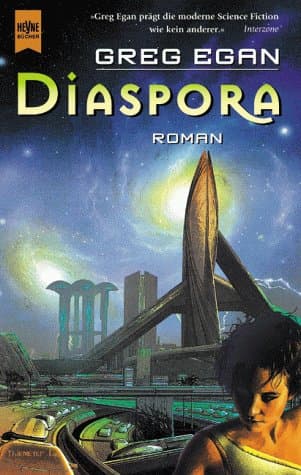
- Diaspora
Greg Egan
4.1 (7k) average on GoodreadsScience FictionBoth Bear's "Moving Mars" and Egan's "Diaspora" are exemplary works of hard science fiction that explore post-human evolution and the nature of consciousness. However, Egan's novel takes the concept of disembodied consciousness and digital existence to a much more extreme and abstract level, with characters existing purely as software entities in vast computer networks or even exploring other universes. Bear, while introducing 'phages' and quantum entanglement, retains a stronger connection to biological humanity and the physical world of Mars, making the philosophical questions more directly tied to human experience and political power structures. Egan's work is arguably more rigorous and less anthropocentric in its scientific and philosophical extrapolation.
- 1984
George Orwell
4.2 (3.1M) average on GoodreadsPoliticsIn a future where surveillance and thought control are absolute, a man's search for truth clashes with the Party, showing that hope can be a form of rebellion.
- Animal Farm
George Orwell
4.0 (2.7M) average on GoodreadsPoliticsA farm animals' rebellion against humans turns into a pig-led dictatorship, showing how power corrupts and revolutionary ideals are betrayed.
- Freakonomics: A Rogue Economist Explores the Hidden Side of Everything
Steven D. Levitt
4.0 (709k) average on GoodreadsBusinessThis book uses economic principles to reveal the surprising incentives behind everything from drug dealing and real estate to cheating teachers and the decline of crime.
- I Am Malala: The Story of the Girl Who Stood Up for Education and Was Shot by the Taliban
Malala Yousafzai
4.1 (419k) average on GoodreadsPoliticsA teenage girl from a Taliban-controlled valley refuses to give up her books, becoming a global voice for education even after an assassination attempt.





Enjoyed the summary?
A summary gives you the shape of the book. The book itself has the detail, the examples and the voice.
Find Moving Mars on AmazonAs an Amazon Associate, BookBrief earns from qualifying purchases. How we're funded