
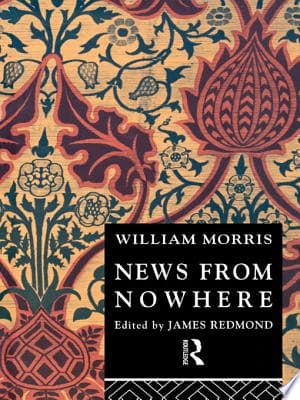
Core Idea
- Difficulty
- Medium
- Read it if
- You are interested in socialist utopian ideals, critiques of industrial society, or an imaginative vision of an alternative future focused on art, craft, and communal living.
- Skip it if
- You prefer fast-paced narratives, strictly realistic political blueprints, or are uninterested in historical socialist thought presented as a pastoral idyll.
Key Takeaways from News from Nowhere
Abolition of Private Property
The core of Nowhere's utopia is the communal ownership of all means of production and land.
Morris imagines a society where private property, especially in land and capital, is gone. This is not just redistribution; it is a basic change in how resources are seen and managed. In Nowhere, everything is shared, which ends class divisions, poverty, and the constant chase for profit. Without the pressure of rent, wages, and market competition, people can do work that they find satisfying and that helps the community. This shared ownership creates cooperation and mutual aid, replacing the competitive individualism Morris saw as harmful in his own time. Their economy is built on need and desire, not on accumulation.
“The great change came, and it was seen that, as long as there was property, the power of property would be used to prevent the working-class from rising above the position of wage-earners.”
In the book: The entire narrative hinges on the protagonist, William Guest, observing a society where houses are open, goods are freely shared, and no money or exchange system exists. The elder Hammond explains how the 'Great Change' abolished property and the market.
Try this: While a complete abolition of private property is a radical societal overhaul, individuals can apply the spirit by prioritizing sharing resources, participating in cooperative ventures, and advocating for policies that reduce wealth inequality and promote common good over private accumulation.
Related ideas: communalism, socialism, utopian-socialism, anti-capitalism
Work as Joyful Creation
Labor in Nowhere is transformed from a burden into a source of pleasure and artistic expression.
One striking part of Morris's utopia is the new definition of work. Unlike the alienated, repetitive, and often exploitative labor of industrial capitalism, work in Nowhere is voluntary, creative, and fulfilling. People choose tasks based on their skills and desires, finding satisfaction in helping the community and making beautiful, useful things. There is no force, no wage system, and no split between mental and manual labor. This change elevates craftsmanship and artistry, making every act of production a source of joy. The lack of drudgery lets people develop their full potential and contribute meaningfully, blurring the lines between work and leisure, necessity and art.
“Indeed, if I were to say what is the great motive-power of our lives, I should say it was the love of the earth and the hope of the future which we have, and the pleasure of work, which is the token of these two things.”
In the book: Guest observes people eagerly engaging in various tasks, from building and farming to weaving and metalwork, all done with a sense of pride and enjoyment. The hay-making scene is particularly illustrative, with everyone participating joyfully.
Try this: Reflect on how to infuse more joy and purpose into your own work. Seek opportunities for creative expression, contribute to projects you genuinely believe in, and advocate for workplaces that prioritize employee well-being and meaningful contributions over mere productivity metrics. Embrace skill development beyond economic gain.
Related ideas: craftsmanship, meaningful-work, anti-alienation, art-and-labor
Decentralized, Self-Governing Communities
Nowhere operates without a centralized government, relying on direct democracy and communal consensus.
Morris proposes a society without the usual state: no parliament, police, prisons, or formal laws. Instead, governance happens locally through direct democratic assemblies and informal agreement. Disputes are settled through open talk and mutual understanding, focusing on restorative justice and communal harmony rather than punishment. This radical decentralization lets individuals and small communities manage their own affairs, creating a strong sense of shared responsibility and involvement. The absence of forceful authority shows Morris's anarchist leanings, suggesting that people, when free from oppressive structures, naturally cooperate and self-organize.
“We are very well off as to matters of government, for we have none at all, if you mean any authority which can force an individual against his will.”
In the book: Guest learns that 'matters of government' are handled by informal 'folk-motes' or assemblies, where everyone participates in decision-making. Disputes are rare and settled by public opinion and common sense, as exemplified by the lack of courts or legal systems.
Try this: Engage more actively in local community decision-making. Support and participate in cooperative models, neighborhood councils, and direct democratic initiatives. Advocate for restorative justice practices in your community and challenge hierarchical power structures.
Related ideas: anarchism, direct-democracy, localism, communal-governance, consensus-building
Integration with Nature
The utopian society lives in harmony with the environment, blurring the lines between town and country.
Morris's vision is very ecological, showing a world where human settlements blend into nature. Industrial pollution and urban decay are gone, replaced by lush gardens, clean rivers, and restored forests. Towns are beautiful and practical, more like large villages than sprawling cities. This respect for nature extends to their way of life: food is grown locally, technology is used carefully to lessen environmental impact, and seasons guide much of their activity. This harmony reflects Morris's criticism of industrialization's harm to the environment and his belief that a beautiful, healthy natural world is vital for people to thrive.
“The earth was beautified rather than deformed by the dwellings of men, and the towns were but beautiful gardens.”
In the book: Guest's journey up the Thames reveals a transformed landscape: clean water, abundant wildlife, and beautiful, simple buildings nestled amidst greenery. London itself is described as a 'great garden,' with fields and orchards replacing crowded streets.
Try this: Cultivate a deeper connection with nature. Support local food systems, reduce your environmental footprint, and advocate for urban planning that prioritizes green spaces and sustainable development. Spend time outdoors and appreciate natural beauty.
Related ideas: ecotopia, environmentalism, sustainable-living, agrarianism, urban-gardening
Education for Life and Creativity
Learning in Nowhere is informal, experiential, and focused on practical skills and artistic development.
The education system in Nowhere is very different from standard schooling. Children do not attend formal institutions, memorize facts, or take competitive exams. Instead, they learn through direct experience, play, observation, and mentorship from adults. Education is lifelong and self-directed, focusing on practical skills, artistic talents, and a deep understanding of nature. This approach encourages curiosity, creativity, and a love of learning for its own sake, not for career advancement. The goal is to raise well-rounded, capable individuals who can contribute meaningfully to their community and find joy in their efforts, embodying Morris's belief that true education prepares one for a rich and engaged life.
“We have learned to live, and not to waste our lives in learning how to live.”
In the book: Guest observes children learning by doing, helping with tasks, and exploring their surroundings. Old Hammond explains that they have no schools in the traditional sense, but rather a fluid process of acquiring knowledge and skills as needed and desired.
Try this: Embrace lifelong learning and prioritize experiential education for yourself and others. Seek out opportunities to learn new practical skills, engage in creative pursuits, and mentor younger generations informally. Question the emphasis on standardized testing and formal credentials.
Related ideas: experiential-learning, unschooling, lifelong-learning, holistic-education, apprenticeship
Beauty as a Moral Imperative
Aesthetics are central to life, with all objects and environments crafted for beauty and utility.
For Morris, beauty is not a luxury but a basic need for a fulfilling life. In Nowhere, every object, from a simple cup to a grand building, is made with care and an eye for beauty. This dedication to beauty extends to the environment itself, with towns and landscapes designed to be pleasing and harmonious. This directly criticizes the ugliness and poor mass production of industrial society. The people of Nowhere enjoy creating and living among beautiful things, which lifts their spirits and builds dignity and respect for their surroundings. It shows that a truly good society must also be a beautiful one.
“Indeed, if I were to sum up our life, I should say that we have a craving for beauty, and a passion for making things beautiful.”
In the book: Guest is constantly struck by the beauty of everything he encounters: the clothing, the architecture, the furniture, and the natural scenery, all crafted with an evident love of art and quality.
Try this: Prioritize beauty and craftsmanship in your own life and surroundings. Choose well-made, aesthetically pleasing objects, even if it means owning fewer things. Support artisans and craftspeople. Advocate for urban planning and architecture that emphasizes beauty and human scale.
Related ideas: arts-and-crafts-movement, aesthetics, design-philosophy, craftsmanship, anti-mass-production
Rejection of Artificial Scarcity
With abundance and communal sharing, the notion of scarcity and competition vanishes.
Morris's utopia works on a principle of abundance, not endless resources, but a smart organization of society to meet everyone's needs without creating artificial scarcity. By ending private property and the market, the forces behind competitive acquisition and hoarding are removed. Goods are made for use, not for profit, and are available to all. This removes the fear of poverty and the need for greed, fostering generosity and mutual support. The idea of 'value' changes from money to an object's usefulness and beauty, and the effort and joy in its creation, showing a deep rethinking of economic principles.
“The people of this time had no fear of scarcity, and so no need to hoard; they had no fear of poverty, and so no need for greed.”
In the book: Guest observes that people simply take what they need from communal stores or receive goods from those who produce them, without any exchange of money or haggling. Food and clothing are plentiful and freely shared.
Try this: Challenge the consumerist mindset and recognize how artificial scarcity drives desire. Practice generosity and sharing within your own community. Advocate for economic systems that prioritize meeting basic needs for all over profit maximization.
Related ideas: post-scarcity, gift-economy, anti-consumerism, economic-equality, resource-sharing
Equality in Gender Relations
Women and men are equal partners in society, free from traditional gender roles and expectations.
While not as detailed as his economic or environmental ideas, Morris's Nowhere shows a notable change in gender dynamics for its time. Women are shown as strong, independent, and active in all parts of life, from physical labor to intellectual pursuits. There is no hint of domestic confinement or male dominance; relationships are based on mutual respect and attraction, with people free to choose partners without economic or social pressure. The absence of private property removes the need for marriage as an economic institution, allowing for more fluid and genuine connections. This reflects a progressive, though somewhat understated, idea of gender equality, where both men and women contribute equally to and benefit from the communal society.
“We live in a world where there is no longer any need for women to be dependent on men, nor for men to be masters of women.”
In the book: Guest encounters strong, capable female characters like Clara and Ellen, who participate in hay-making, boat navigation, and intellectual discussions, clearly on equal footing with men. The absence of marriage laws and the focus on free love also suggest gender freedom.
Try this: Actively challenge gender stereotypes and promote equality in your personal and professional life. Support policies and cultural shifts that empower women and dismantle patriarchal structures. Advocate for relationships based on mutual respect and autonomy.
Related ideas: gender-equality, feminist-utopia, free-love, post-patriarchy, social-equality
The Importance of Historical Memory
Understanding the past is crucial for appreciating the present and preventing regression.
Despite living in an seemingly perfect present, the people of Nowhere know their history well, especially the past struggles and injustices that led to their current utopian state. Older figures like Hammond act as living libraries, telling stories of the 'Great Change' and the hardships of the 'Epoch of Rest' (industrial capitalism). This historical memory is not a burden but a vital tool for understanding their current freedom and ensuring they do not repeat past mistakes. It provides context for their values and strengthens their commitment to communal living and joyful labor. Morris suggests that a true utopia must acknowledge and learn from the past, rather than just erasing it.
“The past is not dead, it is not even past; it is a part of the present, and will be a part of the future.”
In the book: The character of Old Hammond, the ancient historian, is central to the narrative, providing detailed accounts of the 'bad old times' and the 'Great Change' to William Guest, explaining how their society came to be.
Try this: Study history, especially the history of social movements and economic systems, to understand the roots of current challenges and successes. Engage in intergenerational dialogue to preserve collective memory. Use historical context to inform contemporary activism and decision-making.
Related ideas: historical-consciousness, collective-memory, social-history, utopian-theory, revolution
Revolution as a Necessary Catalyst
The transition to utopia was not peaceful but necessitated a violent social upheaval.
Morris, a dedicated socialist, clearly shows the 'Great Change'—the shift from capitalist society to Nowhere—as a time of much social unrest and armed conflict. While details are somewhat vague, it is clear that the ruling classes did not willingly give up their power and property. The working class had to fight for their freedom. This recognition of revolutionary struggle is vital; it roots the utopian vision in a realistic understanding of power dynamics and resistance to fundamental social change. It suggests that a truly transformative society often needs a forceful break from oppressive structures, rather than gradual reform, highlighting Morris's radical political beliefs.
“The people had to fight for their freedom, and they fought well, and they won.”
In the book: Old Hammond's detailed historical account of the 'Great Change' explicitly mentions strikes, riots, battles, and the eventual triumph of the organized workers against the state and capitalist forces.
Try this: Understand that significant social change often faces strong opposition and may require sustained, collective action and even radical disruption. Support movements advocating for systemic change, and be prepared for resistance when challenging entrenched power structures. Study the history of successful social revolutions.
Related ideas: social-revolution, class-struggle, socialism, utopian-politics, radical-change
News from Nowhere Quotes
“Well, I have seen a many a thing, and I have heard a many a thing, and I have read a many a thing; but never did I hear nor see nor read of a happier folk than these.”
“Indeed, if I were to say what is the great end of art, I should say it is to give pleasure. And if I were to say what is the great end of pleasure, I should say it is to give a sense of creation.”
“For the great mass of the people... had nothing to lose but their chains, and they knew it.”
“The true secret of happiness lies in taking a genuine interest in all the details of daily life.”
“The spirit of the new days, of the days to come, was already abroad.”
“We are very shy of using force, and indeed of any kind of compulsion.”
“All work which is not a pleasure is a pain, and all work which is a pain is a crime.”
“Indeed, I have often thought that the amount of dirt, and indeed of squalor, which you call civilization, is one of its most peculiar features.”
“For we are very fond of the earth, and we think that it is the most beautiful thing that we know.”
“The great mass of the people had nothing to lose but their chains, and they knew it. And they determined to lose them.”
“For us, all life is an art, and all art is a pleasure.”
“I say that the only way to get rid of a bad system is to put a better one in its place.”
“And indeed, I thought that the very air was sweeter than any I had ever breathed.”
“Do you know, I think one of the greatest pleasures of life is to be able to make things with your own hands?”
Quiz
10 questions on the main ideas. Each answer comes with a short explanation.
Question 1
What is the primary mode of transportation that William Guest observes and utilizes during his journey in the future?
- Steam trains
- Horse-drawn carriages
- Small, oar-powered boats on the Thames
- Automobiles
Show answer
C. Small, oar-powered boats on the Thames William Guest frequently travels by small, oar-powered boats on the Thames, reflecting the simpler, more communal, and less industrialized nature of the future society depicted in 'News from Nowhere.'
Question 2
What has happened to the Houses of Parliament in the future society as described by William Guest's guides?
- They have been converted into a grand public library.
- They serve as the main communal dining hall for London.
- They are used as a dung-market, symbolizing the obsolescence of parliamentary politics.
- They house a museum dedicated to the 'Epoch of Transition.'
Show answer
C. They are used as a dung-market, symbolizing the obsolescence of parliamentary politics. The Houses of Parliament are described as being used as a dung-market, a stark symbol of how the future society has abandoned the political structures of the past, viewing them as useless and even contemptible.
Question 3
Which character serves as William Guest's primary guide and companion for much of his journey up the Thames?
- Old Hammond
- Clara
- Dick
- Ellen
Show answer
C. Dick Dick is the young, cheerful boatman who accompanies William Guest on much of his journey up the Thames, introducing him to various aspects of the future society.
Question 4
According to Old Hammond, what has fundamentally changed about the nature of work in the future society?
- Most work is now automated by advanced machinery.
- Work is now considered a form of pleasurable art and a social duty, not a burden.
- People work fewer hours but are paid significantly more.
- Specialized guilds now control all forms of labor.
Show answer
B. Work is now considered a form of pleasurable art and a social duty, not a burden. Old Hammond explains that work is no longer seen as a curse or a means to an end, but as a pleasurable activity, an outlet for creative energy, and a contribution to the common good, driven by the joy of making and doing.
Question 5
What is the 'Great Change' or 'Change Over' that Old Hammond recounts as the historical event leading to the current society?
- A gradual shift driven by technological innovation.
- A series of peaceful legislative reforms.
- A period of intense class conflict and revolutionary struggle.
- A global environmental catastrophe that forced societal restructuring.
Show answer
C. A period of intense class conflict and revolutionary struggle. The 'Great Change' was a period of revolutionary class struggle, including violent conflict, which ultimately led to the overthrow of the old capitalist system and the establishment of the new communal society.
Question 6
How do the inhabitants of Nowhere typically handle disputes or minor disagreements?
- They are resolved through formal legal proceedings and judges.
- They are usually settled through public debate and consensus, with no need for formal laws.
- A council of elders makes final decisions on all conflicts.
- They are often ignored, as people are generally too content to argue.
Show answer
B. They are usually settled through public debate and consensus, with no need for formal laws. The society in 'News from Nowhere' has no formal legal system or prisons. Disputes are rare and are generally resolved through reasoned discussion and communal agreement, reflecting a fundamental shift in human nature and social organization.
Question 7
What is the role of money and private property in the society William Guest encounters?
- Money is still used, but its value is tied to communal labor.
- Private property is limited to personal items, but money is abolished.
- Both money and private property (beyond personal use) have been abolished.
- Money is exchanged for goods, but services are freely given.
Show answer
C. Both money and private property (beyond personal use) have been abolished. In the future society, both money and the concept of private property (beyond what one personally uses or makes) are entirely obsolete. Goods are produced for use and shared freely, reflecting a communist ideal.
Question 8
How does the future society view the concept of education and learning?
- Children attend highly structured schools focused on vocational training.
- Learning is largely informal, self-directed, and integrated with daily life and craft.
- Education is primarily conducted through advanced digital interfaces.
- Specialized scholars impart knowledge in dedicated academies.
Show answer
B. Learning is largely informal, self-directed, and integrated with daily life and craft. Education in Nowhere is organic and natural. Children learn through play, observation, hands-on experience, and by engaging with adults in their daily activities, rather than in formal, institutionalized settings.
Question 9
What is the ultimate fate of William Guest at the end of the novel?
- He decides to remain in the future society permanently.
- He is recognized as a historical figure and becomes a revered elder.
- He slowly fades from the future, returning to his own time, unsure if it was a dream or vision.
- He leads a small group of people to establish a similar society in his own time.
Show answer
C. He slowly fades from the future, returning to his own time, unsure if it was a dream or vision. William Guest's journey ends with him gradually becoming invisible and unheard by the people of the future, eventually finding himself back in his own time, leaving the reader to ponder the reality of his experience.
Question 10
Which specific architectural feature or building style is prominently discussed as having been restored or re-embraced in the future society?
- Victorian Gothic Revival
- Classical Roman and Greek temples
- Medieval and early modern craftsmanship, reflecting beauty and utility.
- Minimalist, utilitarian concrete structures.
Show answer
C. Medieval and early modern craftsmanship, reflecting beauty and utility. Morris, through his characters, expresses a clear preference for the architectural styles and craftsmanship of the medieval and early modern periods, which he saw as embodying beauty, utility, and joy in labor, in contrast to the mass-produced ugliness of his own industrial era.
News from Nowhere FAQ
What is 'News from Nowhere' about?
'News from Nowhere' is a utopian novel by William Morris, published in 1890. It tells the story of William Guest, who falls asleep in late 19th-century London and wakes up to find himself in a future socialist society, exploring its customs, values, and daily life.
Does the utopian society in 'News from Nowhere' work?
Within the narrative of 'News from Nowhere,' the depicted utopian society is presented as highly successful and harmonious. It functions without money, government, prisons, or class distinctions, relying instead on communal cooperation and the joy of labor.
What is 'utopian socialism' as depicted in the book?
Utopian socialism in 'News from Nowhere' envisions a society where private property is abolished, labor is joyful and creative, and resources are shared for the common good. It emphasizes community, craftsmanship, and a deep connection to nature, contrasting sharply with industrial capitalism.
How is 'News from Nowhere' different from other utopian novels like 'Looking Backward'?
'News from Nowhere' explicitly critiques the industrial, state-socialist vision presented in Edward Bellamy's 'Looking Backward.' Morris's utopia emphasizes decentralized, agrarian communities, artisanal labor, and aesthetic beauty, rather than Bellamy's highly organized, industrial, and somewhat militaristic future.
Is 'News from Nowhere' still relevant today?
Yes, 'News from Nowhere' remains highly relevant for its critiques of capitalism, industrialism, and environmental degradation, as well as its exploration of alternative ways of living. It offers a powerful vision of a society based on cooperation, meaningful work, and ecological harmony.
What role does art and craftsmanship play in the society of 'News from Nowhere'?
Art and craftsmanship are central to the utopian society, where all labor is seen as an artistic endeavor. People take joy in creating beautiful and useful objects, blurring the lines between work and leisure, and rejecting the alienation of industrial production.
How does the book address gender roles in its future society?
The book presents a society with largely egalitarian gender roles, where women and men participate equally in all aspects of life, from agriculture to intellectual pursuits. Traditional gender divisions are largely dissolved, though some critics note lingering conventionalities in certain depictions.
Where can I read 'News from Nowhere'?
'News from Nowhere' is a classic work that is widely available in various editions, both print and digital. It is also in the public domain, meaning free versions can be found online through projects like Project Gutenberg.
About the author

William Morris was a British textile designer, poet, artist, fantasy writer, and socialist activist associated with the British Arts and Crafts Movement. He was a major contributor to the revival of traditional British textile arts and methods of production. His literary contributions helped to establish the modern fantasy genre, while he helped win acceptance of socialism in fin de siècle Great Britain.
Similar books
- Ecotopia
Ernest Callenbach
3.6 (4k) average on GoodreadsPoliticsA later utopian novel depicting an ecological, decentralized society in the Pacific Northwest.
- Walden Two
B.F. Skinner
3.5 (6k) average on GoodreadsPsychologyExplores a behaviorist-designed utopian community, focusing on social engineering for an ideal society.
- The Diary of a Young Girl
Anne Frank
4.2 (2.7M) average on GoodreadsBiographyDuring the Nazi occupation, a teenage girl's diary, written from a secret annex, shares observations on humanity, hope, and the wait for freedom.
- Twisted 1. Twisted love
Ana Huang
3.7 (1.7M) average on GoodreadsA quiet billionaire with a difficult past finds his guarded heart opening to the woman he must protect, but their growing passion uncovers dangerous secrets and a shared, traumatic history.
- Eat, Pray, Love
Elizabeth Gilbert
3.6 (1.5M) average on GoodreadsLifestyleA heartbroken writer leaves her conventional life for a year-long global search for pleasure in Italy, spiritual devotion in India, and unexpected love and balance in Bali.
- Night
Elie Wiesel
4.3 (970k) average on GoodreadsBiographyIn the darkness of Auschwitz and Buchenwald, a teenage Elie Wiesel faces the extermination of his family, the loss of his faith, and the lasting scars of humanity's deepest cruelty.




Enjoyed the summary?
A summary gives you the shape of the book. The book itself has the detail, the examples and the voice.
Find News from Nowhere on AmazonAs an Amazon Associate, BookBrief earns from qualifying purchases. How we're funded