
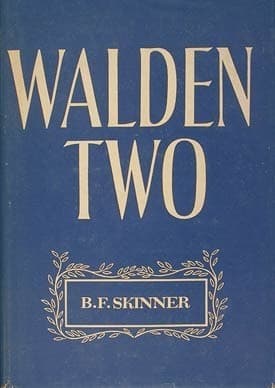
Synopsis
Covers the whole plot, including the ending.
- Difficulty
- Medium
- Read it if
- You are interested in experimental social structures, the practical application of behavioral psychology, or philosophical debates surrounding free will versus determinism and the ethics of social engineering for collective well-being.
- Skip it if
- You prefer character-driven narratives, are averse to didactic philosophical discussions within fiction, or find the concept of a controlled, planned society deeply unsettling or authoritarian.
Walden Two Quotes
“The one fact that all of us have to face is that we are going to die.”
“Walden Two is a community in which a way of life has been designed. We have had to discover the laws which govern human behavior and then put those laws into practice.”
“That's the only difference between us and the people who are not going to leave.”
“The world is suffering from a bad case of the wrong people in the right places.”
“It's the only way to get rid of the great men—to get rid of the need for them.”
“We are not interested in the freedom to make choices, but in the freedom from having to make choices.”
“The good life is not something to be earned, but something to be designed.”
“We can't have a science of human behavior if we don't admit that behavior is determined.”
“A man is free when he can do what he wants to do.”
“The only way to create a better world is to create better people.”
“We are applying a science of behavior to the design of a culture.”
“We have chosen the good life, not the life of freedom.”
“It's not enough to be right; you have to be effective.”
“There are no heroes in Walden Two. There are only managers and planners.”
“What is the good life? It is health, a minimum of unpleasant labor, and a chance to make the best use of one's talents.”
Quiz
10 questions on the plot and the characters. Each answer comes with a short explanation.
Question 1
Which character is the primary antagonist, representing traditional academic and societal views in opposition to Walden Two's principles?
- Steve
- Professor Burris
- Professor Castle
- Frazier
Show answer
C. Professor Castle Professor Castle is the most vocal and persistent critic of Walden Two, constantly challenging Frazier's arguments and the community's practices from a philosophical and moral standpoint.
Question 2
What is the primary mechanism used in Walden Two to ensure desirable behavior and social harmony?
- Strict laws and punishments
- Genetic engineering
- Behavioral engineering through positive reinforcement
- Religious indoctrination
Show answer
C. Behavioral engineering through positive reinforcement Walden Two explicitly rejects punitive measures and instead relies on a carefully designed system of positive reinforcement, or behavioral engineering, to shape the behavior of its citizens from childhood.
Question 3
Which of the following is NOT a core principle of the Walden Two economic system?
- Labor credits for work performed
- A fixed income for all members regardless of work
- Equal access to goods and services
- Rotation of undesirable jobs
Show answer
B. A fixed income for all members regardless of work Walden Two's economic system is based on labor credits, where members earn credits for work performed, with more credits given for less desirable jobs. There is no fixed income for all; rather, work is distributed and compensated via a credit system.
Question 4
According to Frazier, what is the ultimate goal of Walden Two's social engineering?
- To eliminate all forms of individual freedom
- To create a society free from war and poverty, with happy, productive citizens
- To establish a global empire based on scientific principles
- To prove the superiority of a single scientific dictator
Show answer
B. To create a society free from war and poverty, with happy, productive citizens Frazier consistently argues that the goal is to create a better life for all members, free from common societal ills, by scientifically designing a culture that fosters happiness, health, and productivity.
Question 5
How does Walden Two address the raising of children, differing significantly from traditional nuclear family structures?
- Children are raised exclusively by their biological parents within individual homes.
- Children are raised communally by trained specialists, with limited parental involvement.
- Children are sent to boarding schools outside the community from an early age.
- Children are given complete freedom to educate themselves from a young age.
Show answer
B. Children are raised communally by trained specialists, with limited parental involvement. Walden Two implements a communal child-rearing system where children are cared for and educated by specialists in nurseries and schools, allowing for consistent behavioral conditioning and freeing parents for other community tasks.
Question 6
What is the primary criticism Professor Castle levels against Walden Two's approach to human behavior?
- It is economically unsustainable.
- It denies human freedom and dignity by manipulating behavior.
- It relies too heavily on religious dogma.
- It is not technologically advanced enough.
Show answer
B. It denies human freedom and dignity by manipulating behavior. Castle's central argument is that Walden Two's behavioral engineering, despite its positive outcomes, strips individuals of their fundamental freedom and dignity, reducing them to predictable machines.
Question 7
Frazier argues that the concept of 'freedom' as understood in traditional society is often an illusion. What does he suggest is a more accurate understanding of human behavior?
- Behavior is solely determined by innate genetic predispositions.
- Behavior is primarily a product of environmental contingencies and conditioning.
- Behavior is entirely random and unpredictable.
- Behavior is controlled by supernatural forces.
Show answer
B. Behavior is primarily a product of environmental contingencies and conditioning. Frazier, reflecting Skinner's behaviorist views, asserts that what people perceive as 'free will' is actually behavior shaped by environmental factors, and that by controlling these factors, one can predictably influence behavior.
Question 8
How does Walden Two manage governance and decision-making, particularly regarding the role of the 'Planners'?
- Through direct democracy where all members vote on every issue.
- A council of rotating, elected representatives makes all decisions.
- A small group of scientifically trained Planners make decisions based on data, without direct democratic input.
- Decisions are made by a single charismatic leader.
Show answer
C. A small group of scientifically trained Planners make decisions based on data, without direct democratic input. Walden Two is managed by a small, expert group of 'Planners' who make decisions based on scientific principles and observation, rather than popular vote or a single dictatorial figure. This aspect is often a point of contention for critics.
Question 9
Which of the following best describes the novel's resolution regarding Professor Burris's ultimate decision?
- He decides to return to his old life, rejecting Walden Two completely.
- He convinces Frazier to abandon his experiment and dismantle Walden Two.
- He chooses to stay and join Walden Two, embracing its principles.
- He leaves to establish his own similar community elsewhere.
Show answer
C. He chooses to stay and join Walden Two, embracing its principles. After much internal debate and observation, Professor Burris, the narrator, ultimately decides to remain in Walden Two, signifying his acceptance and belief in its system, even as Professor Castle departs.
Question 10
Frazier frequently challenges the visitors to articulate a viable alternative to Walden Two's system that can solve societal problems effectively. This reflects Skinner's broader argument about what?
- The inherent superiority of democracy.
- The need for a scientific approach to cultural design as opposed to traditional, often unexamined, practices.
- The impossibility of any utopian society.
- The importance of individual artistic expression above all else.
Show answer
B. The need for a scientific approach to cultural design as opposed to traditional, often unexamined, practices. Frazier's challenge underscores Skinner's core argument that societal problems persist because traditional methods of governance and social organization are not scientifically designed. He posits that a scientific technology of human behavior is necessary for true progress.
Walden Two FAQ
What is Walden Two about?
Walden Two is a fictional novel by B.F. Skinner that describes a utopian community in the United States where societal problems are solved through a scientific application of behavioral psychology. It explores the principles of operant conditioning to design a harmonious and productive society.
Does the behavioral engineering described in Walden Two actually work in practice?
The effectiveness of the behavioral engineering described in Walden Two is a subject of much debate. While operant conditioning principles are scientifically validated in various contexts, the large-scale, comprehensive application to an entire society as depicted in the book remains a theoretical and controversial concept, with ethical and practical challenges.
What is 'operant conditioning' as it applies to Walden Two?
Operant conditioning, central to Walden Two, is a learning process where behavior is modified by its consequences. In the novel, it's applied through a system of positive reinforcement and aversion therapy to shape citizens' actions, values, and happiness, eliminating conflict and promoting collective well-being.
How is Walden Two different from other utopian novels like 'Brave New World'?
Walden Two differs from 'Brave New World' primarily in its tone and methods. While both depict controlled societies, Skinner's vision is presented as a positive, scientifically engineered utopia focused on happiness and efficiency through reinforcement, whereas Huxley's portrays a dystopian future achieved through genetic engineering and conditioning that stifles individuality and freedom, often with a critical lens.
Is Walden Two a critique or an endorsement of behaviorism?
Walden Two is widely considered an endorsement and an illustrative outline of B.F. Skinner's behaviorist theories, particularly operant conditioning, applied to social engineering. Skinner himself viewed it as a thought experiment demonstrating how a society could be improved through scientific management of human behavior, though it sparked significant critical discussion.
What is the role of the 'Planners' in Walden Two?
The Planners in Walden Two are the intellectual and administrative elite responsible for designing and maintaining the community's social and behavioral engineering. They use psychological principles to create the environment, rules, and reinforcement schedules that guide the citizens' lives, ensuring the smooth functioning and happiness of the society.
Does Walden Two advocate for a loss of individual freedom?
Critics argue that Walden Two implicitly advocates for a loss of traditional individual freedom by shaping behavior through conditioning, even if the inhabitants perceive themselves as free and happy. Proponents, however, suggest that true freedom is achieved by being free from societal ills and making choices that lead to collective well-being, guided by scientific principles.
Are there real-world communities inspired by Walden Two?
Yes, several real-world intentional communities have been directly inspired by the concepts presented in Walden Two, most notably the Twin Oaks Community in Virginia, founded in 1967. These communities attempt to implement some of Skinner's principles of communal living, shared resources, and behavioral design, though often with modifications.
About the author

B.F. Skinner was a renowned American psychologist, behaviorist, and philosopher. His seminal works, including "Walden Two" and "Beyond Freedom and Dignity," explored his theories of operant conditioning and radical behaviorism. Skinner's influential ideas significantly impacted psychology, education, and social engineering, proposing a society structured around principles of behavioral control.
Similar books
- Brave New World
Aldous Huxley
4.0 (1.4M) average on GoodreadsFantasyExplores a technologically advanced, controlled society, though with a more dystopian lens on conditioning and happiness.
- 1984
George Orwell
4.2 (3.1M) average on GoodreadsPoliticsExamines a totalitarian society with extensive social control, contrasting Skinner's benevolent control with Orwell's oppressive one.
- Island
Aldous Huxley
3.8 (6k) average on GoodreadsThrillerPresents another utopian vision, focusing on psychological freedom and ecological harmony, often seen as a counterpoint to Walden Two.
- The Perks of Being a Wallflower
Stephen Chbosky
4.2 (1.3M) average on GoodreadsPsychologyThrough letters, a shy high school freshman learns to navigate first love, trauma, and self-discovery, stepping off the sidelines and into life.
- Eleanor Oliphant Is Completely Fine
Gail Honeyman
4.3 (708k) average on GoodreadsLiterary FictionA lonely woman's structured life changes when an IT guy and an elderly man help her learn to open her heart.
- One Flew Over the Cuckoo's Nest
Ken Kesey
4.2 (631k) average on GoodreadsPsychologyIn a mind-bending asylum, the boisterous Randle McMurphy wages a defiant war against the tyrannical Nurse Ratched, inspiring his fellow inmates, including the seemingly catatonic Chief Bromden, to reclaim their lost humanity.






Enjoyed the summary?
A summary gives you the shape of the book. The book itself has the detail, the examples and the voice.
Find Walden Two on AmazonAs an Amazon Associate, BookBrief earns from qualifying purchases. How we're funded