
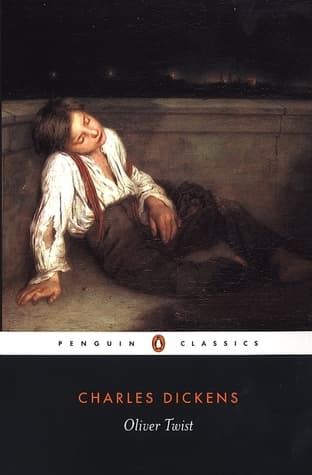
Synopsis
Covers the whole plot, including the ending.
- Difficulty
- Medium
- Pacing
- Moderate
- Mood
- Dark, Melancholy, Hopeful, Suspenseful
- Read it if
- You enjoy classic Victorian literature, stories about social injustice, and tales of good triumphing over evil, with a vivid portrayal of London's historical underbelly.
- Skip it if
- You prefer fast-paced modern thrillers, dislike detailed social commentary, or are sensitive to descriptions of poverty and violence.
Oliver Twist Plot Summary
Covers the whole plot, including the ending.
A Life Begins in Misery
Oliver Twist is born in a workhouse in a nameless English town; his mother dies after his birth. She is unknown, leaving Oliver an orphan without identity. He spends his first nine years with Mrs. Mann at a baby-farm, where children suffer from neglect and abuse. At nine, Oliver moves to the parish workhouse, run by Mr. Bumble. Conditions are bad there, with little food and harsh treatment. One evening, hungry, Oliver asks for 'more.' This request shocks the workhouse board and leads to him being offered as an apprentice.
Escaping Oppression
After asking for more food, Oliver is apprenticed to Mr. Sowerberry, an undertaker. He is treated slightly better than at the workhouse but still endures taunts from Noah Claypole, another charity boy, and neglect from Mrs. Sowerberry. Noah insults Oliver's dead mother, making Oliver angry. This leads to Mr. Bumble severely beating him. Unable to stand the abuse and insults about his mother, Oliver decides to run away. He walks for days towards London, hoping for a better life.
Lured into London's Underbelly
After a difficult walk, Oliver arrives in London, tired and hungry. He meets Jack Dawkins, the Artful Dodger, who seems friendly and offers him a free place to stay. Dodger takes Oliver to the dirty home of Fagin, an old criminal who leads a gang of young pickpockets. Oliver, innocent, does not know what Fagin's 'business' is. He is welcomed, fed, and housed, thinking he has found a safe place, unaware he is in a thieves' den and being prepared for crime.
A Brush with the Law and Unexpected Kindness
Oliver soon goes with the Artful Dodger and Charley Bates on a 'job.' He watches them pickpocket an old gentleman's handkerchief. When the victim, Mr. Brownlow, realizes he has been robbed, Oliver, surprised and innocent, runs away. He is mistakenly chased and arrested. In court, a bookseller who saw the real crime steps in, clearing Oliver's name. Mr. Brownlow, seeing Oliver's innocence and illness, feels sorry for him. He takes Oliver to his home, giving him a comfortable bed, food, and real kindness—something Oliver has never known. This offers Oliver a chance at a respectable life.
Recaptured by the Criminal World
Oliver's short time of happiness at Mr. Brownlow's house ends suddenly. Fagin, worried Oliver might expose his gang, asks Bill Sikes to recapture the boy. Oliver is ambushed by Nancy, Sikes's mistress, and Sikes himself while running an errand for Mr. Brownlow. They force him back to Fagin's den. Despite Nancy's brief sympathy for Oliver, Sikes and Fagin make her help. Oliver is again imprisoned, his hopes for a good life gone, and he faces Fagin's bad influence, being prepared for more serious crimes.
The Failed Burglary and a New Sanctuary
Fagin and Sikes plan to use Oliver in a burglary of a country house. Sikes needs a small boy to fit through a window and forces Oliver to help. During the break-in, Oliver, scared of committing a crime, tries to warn the people inside. A servant shoots him, and Sikes and Toby Crackit leave him for dead in a ditch. Wounded and confused, Oliver stumbles to the house they tried to rob. The owners, kind Mrs. Maylie and her adopted niece Rose, feel sorry for the injured boy. They nurse him back to health, believe his story, and offer him a safe, loving home, giving him the family affection he has always wanted.
Monks's Sinister Schemes Revealed
While Oliver lives peacefully with the Maylies, a bad man named Monks appears, secretly working with Fagin. Monks wants to ruin Oliver's reputation and keep him a criminal. It is slowly revealed that Monks benefits from Oliver's downfall, as Oliver's good character would threaten Monks's inheritance. Monks, whose real name is Edward Leeford, is Oliver's half-brother. He plans to destroy any proof of Oliver's true parents. He specifically looks for a locket and ring that belonged to Oliver's mother, which would prove Oliver's identity and claim to money.
Nancy's Courage and Tragic Demise
Nancy, despite her criminal life and loyalty to Bill Sikes, feels deep sympathy for Oliver. She overhears Fagin and Monks's plan to harm Oliver and secretly contacts Rose Maylie, telling her about Monks's scheme and Oliver's true parents. She arranges a secret meeting on London Bridge with Rose and Mr. Brownlow to share information. However, Fagin, suspicious of Nancy, has the Artful Dodger spy on her. Dodger tells Fagin what he saw, and Fagin tells Bill Sikes. Angry at what he sees as betrayal, Sikes brutally murders Nancy in a drunken rage. This shocking act shows his extreme violence and the bad nature of their criminal world.
Justice and Revelations
Nancy's murder shocks London's criminal world and the public. People are outraged, and a large search for Bill Sikes begins. The information Nancy gave Rose and Mr. Brownlow proves very helpful. Mr. Brownlow confronts Monks, making him confess the truth about Oliver's past. Monks reveals that Oliver is his half-brother, the legitimate son of their father, Edwin Leeford, and Agnes Fleming. Monks had tried to hide Oliver's birth and inheritance by making him a criminal. The locket and ring, thought lost, are found, confirming Oliver's identity and his claim to a large fortune.
The Downfall of the Criminals
Justice comes for the criminals. Bill Sikes, hunted by police and an angry crowd, accidentally hangs himself while escaping across a rooftop. His dog, Bull's-eye, howls below. Fagin is arrested, tried, and sentenced to death for his many crimes. He dies in fear and despair in Newgate Prison. With the criminal group gone, Oliver's future is safe. Mr. Brownlow formally adopts him and becomes his loving guardian. Rose Maylie is revealed to be Oliver's aunt, his mother's sister, further strengthening his family ties. Oliver finally finds the loving home, family, and respect he has always wanted, leaving his difficult past behind.
Oliver Twist Characters
Oliver Twist
Protagonist
An orphaned boy who endures immense suffering but retains his innate goodness.
Oliver is an innocent and pure-hearted orphan, born into the abject poverty of a workhouse. Despite being subjected to relentless abuse, starvation, and exposure to the criminal underworld, he consistently demonstrates an inherent goodness, honesty, and resilience. He is often portrayed as passive, reacting to the circumstances around him, yet his unyielding spirit and moral compass serve as a contrast to the depravity he encounters. His journey is one of survival and a quest for identity and belonging.
Relationships: Mr. Bumble (antagonistic, represents oppressive authority); Fagin (antagonistic, attempted corruption); Bill Sikes (antagonistic, violent abductor); Artful Dodger (initial misguided friendship, later complicit in his abduction); Nancy (sympathetic, protector); Mr. Brownlow (benevolent guardian, rescuer); Rose Maylie (kind aunt, protector); Monks (antagonistic half-brother)
Fagin
Antagonist
An elderly, cunning, and manipulative master thief who preys on orphaned boys.
Fagin is a notoriously sinister and grotesque character, the leader of a gang of juvenile pickpockets and criminals. He is depicted as avaricious, cowardly, and utterly without moral scruples, using flattery and deception to control his young charges, whom he grooms for a life of crime. He hoards wealth and lives in squalor, embodying the corrupting influence of the criminal underworld. His Jewish identity, though controversial, is often highlighted in Dickens's descriptions, emphasizing his 'hooked nose' and 'shrivelled' appearance.
Relationships: Oliver Twist (attempted corruption, captor); Artful Dodger (loyal apprentice, accomplice); Charley Bates (apprentice, accomplice); Bill Sikes (criminal associate, co-conspirator); Nancy (subordinate, later object of suspicion and betrayal); Monks (conspirator)
Mr. Brownlow
Supporting
A benevolent and wealthy gentleman who becomes Oliver's guardian and benefactor.
Mr. Brownlow is a kind, intelligent, and compassionate elderly gentleman who first encounters Oliver when he is mistakenly accused of pickpocketing. Struck by Oliver's innocent appearance and illness, he takes the boy into his home, offering him the first genuine kindness and stability Oliver has ever known. He is persistent in his belief in Oliver's goodness and actively works to uncover the truth about Oliver's past, eventually becoming his adoptive father. He represents the forces of good and justice in the novel.
Relationships: Oliver Twist (guardian, adoptive father); Rose Maylie (confidante, co-investigator); Monks (interrogator, antagonist)
Bill Sikes
Antagonist
A brutal, violent, and unfeeling housebreaker and murderer.
Bill Sikes is one of Dickens's most terrifying villains, a professional housebreaker and murderer. He is characterized by his immense physical strength, his savage temper, and his utter lack of conscience or empathy. He is a heavy drinker and frequently abuses his dog, Bull's-eye, and his mistress, Nancy. His presence instills fear in everyone around him, and he represents the extreme brutality and moral decay within the criminal underworld. His actions, particularly Nancy's murder, drive much of the plot's climax.
Relationships: Nancy (abusive partner, victim); Fagin (criminal associate); Oliver Twist (abductor, accomplice in burglary)
Nancy
Supporting
A young woman forced into a life of crime, who shows compassion and courage.
Nancy is a complex and tragic character, a young woman who has been drawn into Fagin's gang and is Bill Sikes's mistress. Despite her life as a prostitute and criminal, she possesses a deep sense of compassion and loyalty, particularly towards Oliver. She is torn between her love for Sikes and her growing horror at the crimes she witnesses and participates in. Her decision to risk her life to help Oliver, driven by her innate goodness, ultimately leads to her brutal murder, making her a martyr for the forces of good.
Relationships: Bill Sikes (abusive partner); Oliver Twist (sympathetic protector); Fagin (subordinate, later betrayed); Rose Maylie (confidante, ally)
The Artful Dodger (Jack Dawkins)
Supporting
A cunning and charismatic young pickpocket, Fagin's most skilled apprentice.
The Artful Dodger is a lively and street-smart boy, Fagin's most successful and favored apprentice. He is known for his skill as a pickpocket, his confident swagger, and his distinctive style of dress. He serves as Oliver's initial guide into Fagin's world, presenting a facade of friendliness while subtly drawing Oliver into their criminal activities. Despite his criminal nature, he often displays a certain charm and quick wit. He represents the corrupting influence of London's streets on its youth.
Relationships: Fagin (apprentice, accomplice); Oliver Twist (initial guide, later accomplice in his abduction); Charley Bates (fellow apprentice)
Rose Maylie
Supporting
A kind, beautiful, and virtuous young woman who becomes Oliver's aunt.
Rose Maylie is the adopted niece of Mrs. Maylie and a paragon of virtue, beauty, and kindness. She embodies purity and compassion, contrasting sharply with the harshness Oliver has experienced. She nurses Oliver back to health after the failed burglary and becomes a loving, maternal figure to him. Her own mysterious past, particularly her parentage, is intertwined with Oliver's, and she is eventually revealed to be Oliver's biological aunt, his mother's younger sister. She is a symbol of hope and redemption.
Relationships: Oliver Twist (protector, later aunt); Mrs. Maylie (adoptive aunt, guardian); Harry Maylie (suitor); Nancy (confidante, recipient of crucial information)
Monks (Edward Leeford)
Antagonist
Oliver's malevolent half-brother, driven by greed to destroy Oliver's inheritance.
Monks, whose true name is Edward Leeford, is Oliver's older half-brother and a central antagonist. He is a dark, brooding, and sickly man consumed by a desire to deprive Oliver of his rightful inheritance. He conspires with Fagin to corrupt Oliver and ensure his ruin, believing that if Oliver remains a criminal, he will lose his claim to his father's estate. Monks embodies a deep-seated malice and jealousy, fueled by a troubled past and a corrupt mother. He is eventually forced to confess his schemes.
Relationships: Oliver Twist (antagonistic half-brother); Fagin (conspirator); Mr. Brownlow (interrogated, exposed); Mrs. Leeford (mother)
Mr. Bumble
Supporting
The pompous and self-important beadle of the workhouse, representing bureaucratic cruelty.
Mr. Bumble is the parish beadle, a corpulent and self-important official who presides over the workhouse where Oliver is born and raised. He is a symbol of the cruel and hypocritical Poor Law system, often delivering pompous pronouncements about charity while actively participating in the mistreatment and starvation of the paupers under his care. He believes himself to be a man of great authority and wisdom, but is ultimately revealed as a petty, cowardly, and morally bankrupt individual, whose hypocrisy eventually leads to his own downfall.
Relationships: Oliver Twist (oppressor); Mrs. Corney (later Mrs. Bumble) (romantic interest, later abusive wife); Monks (unwitting accomplice in revealing Oliver's past)
Oliver Twist Themes
Social Injustice and Poverty
Dickens uses 'Oliver Twist' to show the harshness of poverty and the failures of the Victorian Poor Law. The workhouse, run by hypocritical officials like Mr. Bumble, is shown as a place of hunger, abuse, and moral decline, not charity. The novel shows how system problems push children into crime, as with Fagin's gang, and how the rich often ignore or do not care about the poor. Oliver's path from the workhouse to the criminal world and then to a loving home shows how social class can be arbitrary and highlights the need for kindness.
“Please, sir, I want some more.”
Good vs. Evil and Innate Purity
A main theme is the constant fight between good and bad, especially inside people. Oliver Twist, despite being born poor and exposed to bad things in Fagin's den, keeps his natural goodness and moral purity. This contrasts sharply with characters like Fagin, Bill Sikes, and Monks, who represent pure evil. The novel suggests that while outside events can shape people, an inner moral sense can resist even the worst influences. Characters like Mr. Brownlow and Rose Maylie show the power of kindness and forgiveness against widespread evil.
“The boy is a child of the devil. He has the gallows written on his face.”
Identity and Belonging
Oliver's search for who he is and where he belongs drives much of the story. Born without a name and an orphan, he spends his early life as an anonymous 'pauper.' His journey to London and his meetings with Mr. Brownlow and the Maylies are all about finding a place where he is loved and accepted. The discovery of his true parents and his connection to the respectable Leeford and Fleming families gives him a real identity and a rightful place in society, fulfilling his wish for family and removing the shame of his birth.
“He was a child of the workhouse; a pauper; an orphan; that was a hard name.”
Hypocrisy and Class Divisions
Dickens strongly criticizes the hypocrisy in Victorian society, especially among those in power. Mr. Bumble and the workhouse board, who talk about morality and charity, are shown to be cruel and self-serving. The novel also shows the strict class divisions, where a person's birth decides their future, and moving up in society is almost impossible without unusual events. The big difference between the dirty slums and the comfort of Mr. Brownlow's home highlights the large gap between the rich and the poor, and the moral failures of those who keep such inequalities.
“The law is a ass—a idiot.”
The Corrupting Influence of the City
London, especially its dirty parts, represents corruption and moral decay. When Oliver arrives, he is immediately pulled into Fagin's criminal group, showing how the city can trap and corrupt innocent people. The dark alleys, pubs, and thieves' dens represent a moral wilderness where violence and bad behavior thrive. While the city offers chances, it also has great dangers, especially for the vulnerable and orphans, pulling them into crime and despair.
“The streets were filled with people, and the noise and bustle were immense.”
Plot Devices & Literary Techniques
Coincidence and Deus ex Machina
Unlikely encounters and timely interventions drive key plot developments.
Dickens frequently employs coincidence to advance the plot and bring characters together. Examples include Oliver mistakenly being arrested by Mr. Brownlow, the very man who turns out to be his future guardian; Oliver stumbling upon the Maylie household during the burglary, which leads to his rescue; and Nancy overhearing Monks's plot. While sometimes criticized as a 'deus ex machina,' these coincidences serve to highlight the forces of fate and providence at play, ensuring that Oliver's inherent goodness is ultimately rewarded and his true identity revealed, allowing for a resolution that might otherwise be impossible.
Symbolism of Names
Character names often reflect their nature or role in the story.
Dickens skillfully uses character names to symbolize their traits or circumstances. 'Oliver Twist' itself suggests a twisted, unfortunate fate. 'Mr. Bumble' evokes a bumbling, self-important, and ineffectual authority figure. 'Fagin' is a name associated with deceit and manipulation. 'Sikes' sounds harsh and violent, reflecting his brutal character. These names are not merely labels but contribute to the reader's understanding and perception of the characters, reinforcing their roles within the narrative and Dickens's social commentary.
Melodrama
Exaggerated emotions, clear moral distinctions, and dramatic events to evoke strong reader response.
The novel heavily utilizes melodrama, characterized by heightened emotions, clearly defined good and evil characters, and sensational events. Oliver's repeated escapes from danger, the dramatic rescue by Mr. Brownlow, Nancy's courageous sacrifice, and Sikes's violent end are all melodramatic elements. This style was popular in Victorian literature and theatre, allowing Dickens to create suspense, evoke strong empathy for Oliver, and emphasize the moral lessons he wished to convey about social injustice and the triumph of virtue over vice. It ensures a clear emotional impact on the reader.
Foil Characters
Characters that highlight the qualities of another through contrast.
Dickens uses various foil characters to emphasize Oliver's unique purity. The Artful Dodger and Charley Bates, for instance, serve as foils to Oliver. They are also orphaned boys from similar backgrounds, but they readily embrace a life of crime, highlighting Oliver's unwavering innocence and resistance to corruption. Similarly, the benevolent Mr. Brownlow and Rose Maylie act as foils to the cruel Fagin and Sikes, showcasing the stark contrast between compassion and depravity, and providing a moral framework against which Oliver's journey is measured.
Oliver Twist Quotes
“Please, sir, I want some more.”
“Some people are nobody's enemies but their own.”
“It is because I think so much of warm and sensitive hearts, that I would spare them from being wounded.”
“Dignity, and even holiness too, sometimes, are more questions of coat and waistcoat than some people imagine.”
“There is a passion for hunting something deeply implanted in the human breast.”
“It is a world of disappointment: often to the hopes we most cherish, and hopes that do our nature the greatest honour.”
“The sun—the bright sun, that brings back, not light alone, but new life, and hope, and freshness to man—burst upon the crowded city in clear and radiant glory.”
“Men who look on nature, and their fellow-men, and cry that all is dark and gloomy, are in the right; but the sombre colours are reflections from their own jaundiced eyes and hearts.”
“We need be careful how we deal with those about us, when every death carries to some small circle of survivors, thoughts of so much omitted, and so little done.”
“It is a melancholy truth that even great men have their poor relations.”
“The memories which peaceful country scenes call up, are not of this world, nor of its thoughts and hopes.”
“There are books of which the backs and covers are by far the best parts.”
“Let it be enough to say, that the old lady was, for the time being, thoroughly tired of being a widow, and had set her heart on being a married woman.”
“The boy had no friends to care for, or to care for him.”
Quiz
10 questions on the plot and the characters. Each answer comes with a short explanation.
Question 1
What is the name of the pompous beadle who oversees the workhouse where Oliver Twist begins his life?
- Mr. Brownlow
- Mr. Bumble
- Bill Sikes
- Fagin
Show answer
B. Mr. Bumble Mr. Bumble is the beadle who runs the workhouse where Oliver is born and raised. He represents the cruel and hypocritical authority figures Dickens criticizes in the novel.
Question 2
Which character first lures Oliver into Fagin's den of thieves in London?
- Nancy
- Bill Sikes
- The Artful Dodger
- Monks
Show answer
C. The Artful Dodger The Artful Dodger (Jack Dawkins) meets Oliver when he arrives in London and brings him to Fagin's hideout, introducing him to a life of crime.
Question 3
What is the name of Bill Sikes's vicious dog in the novel?
- Bull's Eye
- Fang
- Grip
- Snarler
Show answer
A. Bull's Eye Bull's Eye is Bill Sikes's dog, known for its fierce loyalty and viciousness, mirroring Sikes's own brutal nature.
Question 4
Why does Nancy risk her life to help Oliver escape from Fagin's gang?
- She is paid by Mr. Brownlow to betray the gang
- She feels maternal pity for Oliver and wants to save him from a life of crime
- She hopes to marry Oliver when he grows up
- She is secretly Oliver's long-lost aunt
Show answer
B. She feels maternal pity for Oliver and wants to save him from a life of crime Nancy, despite being a prostitute and member of the criminal gang, shows compassion and moral conscience by helping Oliver because she pities him and wants to give him a chance at a better life.
Question 5
How was 'Oliver Twist' originally published before being released as a complete book?
- As a weekly newspaper column
- In serialisation in Bentley's Miscellany
- As a stage play performed in London
- In a single volume published by Penguin
Show answer
B. In serialisation in Bentley's Miscellany The novel was first published in monthly installments in 'Bentley's Miscellany' from 1837 to 1839, which was common for Dickens's works and influenced their episodic structure.
Question 6
What critical societal issue does Dickens primarily attack through Oliver's experiences in the workhouse?
- The corruption of the legal system
- The cruelty and inadequacy of the Poor Law system
- The dangers of industrialization
- The inequality in education access
Show answer
B. The cruelty and inadequacy of the Poor Law system Dickens criticizes the Poor Law Amendment Act of 1834, which established workhouses with harsh conditions to deter the poor from seeking aid, highlighting societal indifference to poverty.
Question 7
Which character is revealed to be Oliver's half-brother and seeks to deprive him of his inheritance?
- Monks
- The Artful Dodger
- Noah Claypole
- Mr. Bumble
Show answer
A. Monks Monks (Edward Leeford) is Oliver's older half-brother who conspires with Fagin to ruin Oliver's reputation and claim their father's inheritance for himself.
Question 8
What literary genres does 'Oliver Twist' combine, according to the book description?
- Science Fiction and Romance
- Gothic Romance, the Newgate Novel, and popular melodrama
- Historical Nonfiction and Satire
- Fantasy and Adventure
Show answer
B. Gothic Romance, the Newgate Novel, and popular melodrama The description notes that Dickens blended Gothic Romance (with its dark, mysterious elements), the Newgate Novel (focusing on crime), and melodrama (exaggerated emotions and plot) to create a new kind of fiction.
Question 9
In the Penguin Classics edition described, what unique feature helps readers understand the context of Victorian criminal slang used in the novel?
- A map of contemporary London
- A glossary of Victorian thieves' slang
- A chronology of Dickens's life
- All of George Cruikshank's original illustrations
Show answer
B. A glossary of Victorian thieves' slang This edition includes a glossary specifically for the thieves' slang that Dickens incorporated to add authenticity to the criminal underworld depictions, aiding modern readers.
Question 10
How does the fate of Bill Sikes ultimately reflect the novel's themes of justice and morality?
- He is arrested and sentenced to life in prison, showing legal justice
- He escapes to America and lives freely, illustrating societal failure
- He is killed by his own dog Bull's Eye while trying to flee, symbolizing poetic justice
- He accidentally hangs himself while trying to escape a mob, representing moral retribution
Show answer
D. He accidentally hangs himself while trying to escape a mob, representing moral retribution Sikes dies by accidentally hanging himself with a rope as he flees from a mob seeking vengeance for Nancy's murder. This violent end serves as a form of moral retribution, aligning with Dickens's theme that evil actions lead to deserved consequences.
Oliver Twist FAQ
What is 'Oliver Twist' about?
'Oliver Twist' follows the journey of an orphan boy from his birth in a workhouse through his exploitation by criminals like Fagin and Bill Sikes in London's underworld. The story exposes the brutal conditions of Victorian England's poor laws while tracing Oliver's quest for identity and belonging, ultimately revealing his true aristocratic heritage through the locket his mother left.
Why should I read 'Oliver Twist'?
You should read 'Oliver Twist' for its powerful social critique of Victorian England's treatment of the poor and its unforgettable characters like the Artful Dodger and Fagin. Dickens combines gripping melodrama with sharp satire, creating a foundational work that influenced both social reform and the development of the novel as an art form.
What is the background/setting of 'Oliver Twist'?
The novel is set in 1830s London, primarily in the impoverished parishes and criminal underworld areas like Saffron Hill and Whitechapel. Dickens draws from the New Poor Law of 1834, workhouse conditions, and the real criminal networks of the time to create a vivid portrait of urban poverty and institutional cruelty.
What are the most memorable quotes from 'Oliver Twist'?
Key quotes include Oliver's famous plea 'Please, sir, I want some more' when asking for additional gruel in the workhouse, and Fagin's ominous description of the criminal life as 'the game.' Nancy's declaration 'I have promised for your sake, not mine' to Rose Maylie highlights her tragic loyalty.
What writing style does Dickens use in 'Oliver Twist'?
Dickens employs a blend of Gothic Romance elements, Newgate Novel conventions, and popular melodrama, using vivid caricature for characters like Mr. Bumble and dramatic irony in plot twists. His serialized publication in Bentley's Miscellany influenced the episodic structure with cliffhangers and detailed social commentary.
What minor details add significant meaning to 'Oliver Twist'?
The locket and ring Oliver's mother Agnes left become crucial plot devices that eventually prove his lineage. Bull's Eye, Bill Sikes' dog, serves as both a symbol of Sikes' brutality and a haunting presence that leads to his capture after Nancy's murder.
What are some subtle foreshadowing moments in 'Oliver Twist'?
Early references to Oliver's 'good breeding' and gentle nature hint at his upper-class origins. Fagin's careful teaching of pickpocketing techniques foreshadows the elaborate criminal schemes, while Nancy's protective behavior toward Oliver subtly predicts her ultimate sacrifice.
What unexpected character connections exist in 'Oliver Twist'?
Monks is revealed to be Oliver's half-brother, secretly working with Fagin to ruin Oliver's inheritance. Mr. Brownlow turns out to be an old friend of Oliver's father, while Nancy's relationship with Rose Maylie creates an unlikely bridge between the criminal underworld and respectable society.
What are unspoken character motivations in 'Oliver Twist'?
Fagin's manipulation of young thieves stems from both greed and a deep-seated fear of poverty and the gallows. Nancy remains with the abusive Bill Sikes due to complex loyalty and limited options as a woman in Victorian society, while Monks' hatred of Oliver is driven by jealousy over their father's will.
What psychological complexities do characters exhibit in 'Oliver Twist'?
Nancy embodies moral conflict, committing crimes while protecting Oliver and ultimately sacrificing herself. Fagin shows both paternal care for his 'boys' and ruthless exploitation, while Oliver maintains innate goodness despite constant exposure to corruption, challenging contemporary ideas about inherited criminality.
What are the major emotional turning points in 'Oliver Twist'?
Oliver's request for more food marks his first rebellion against authority. His kidnapping back to Fagin's den after finding safety with Mr. Brownlow creates despair, while Nancy's decision to reveal Oliver's whereabouts to Rose Maylie and her subsequent murder by Sikes form the novel's tragic climax.
How do relationship dynamics evolve in 'Oliver Twist'?
Oliver's relationship with the Artful Dodger shifts from initial mentorship to divergent paths as Oliver rejects crime. Nancy's maternal protection of Oliver contrasts with her abusive relationship with Sikes, while Mr. Brownlow transforms from suspicious benefactor to determined protector who uncovers Oliver's true identity.
Which parts of 'Oliver Twist' remain ambiguous or open-ended?
The fate of characters like the Artful Dodger after his transportation to Australia is left unresolved. Dickens doesn't fully explore whether Oliver's inherent goodness triumphs because of nature or nurture, and the novel's conclusion leaves questions about how much Victorian society actually reformed after such exposures.
What are controversial scenes or decisions in 'Oliver Twist'?
Nancy's brutal murder by Sikes was considered shockingly violent for Victorian readers. Dickens' portrayal of Fagin has been criticized as anti-Semitic, particularly in the original serialization where he repeatedly refers to him as 'the Jew.' The novel's sentimentalized ending for Oliver contrasts sharply with the grim realities depicted earlier.
'Oliver Twist' ending explained: how it ends & what it means
The ending reveals Oliver's true identity as the son of wealthy parents, with Monks confessing to destroying evidence of Oliver's inheritance. Fagin is executed, Sikes dies accidentally while fleeing, and Oliver is adopted by Mr. Brownlow. This conclusion reinforces Dickens' theme that environment rather than birth determines morality, while offering a fantasy of social mobility through revealed aristocracy.
What Victorian thieves' slang appears in 'Oliver Twist' and what does it reveal?
Terms like 'kinchin' (child), 'flash' (criminal savvy), and 'plant' (scheme) appear throughout, particularly in Fagin's dialogues. This authentic slang, documented in the Penguin edition's glossary, adds realism to the criminal underworld portrayal and emphasizes the subculture's separation from respectable society.
How does the serialized publication affect 'Oliver Twist's structure?
The original Bentley's Miscellany serialization created cliffhangers like Oliver's shooting during the Chertsey burglary and episodic revelations about his parentage. This format allowed Dickens to respond to reader reactions, possibly influencing Nancy's expanded role and the novel's increasingly complex plot twists.
About the author

Charles John Huffam Dickens was an English writer and social critic who created some of the world's best-known fictional characters and is regarded by many as the greatest novelist of the Victorian era. His works enjoyed unprecedented popularity during his lifetime and, by the 20th century, critics and scholars had recognised him as a literary genius. His novels and short stories are widely read today.
Similar books
- Les Misérables
Victor Hugo
4.2 (683k) average on GoodreadsHistorical FictionBoth are epic tales of social injustice, crime, and redemption in 19th-century cities.
- Great Expectations
Charles Dickens
3.8 (652k) average on GoodreadsHistorical FictionAnother Dickensian classic exploring themes of social class, ambition, and identity through an orphan's journey.
- Jane Eyre
Charlotte Brontë
4.1 (1.6M) average on GoodreadsHistorical FictionFeatures an orphaned protagonist overcoming adversity and societal challenges to find her place.
- To Kill a Mockingbird
Harper Lee
4.3 (4.5M) average on GoodreadsHistorical FictionIn the 1930s Jim Crow South, Harper Lee writes about racial injustice, moral growth, and the quiet courage of a lawyer father, Atticus Finch, as seen through his young daughter's eyes.
- The Great Gatsby
F. Scott Fitzgerald
3.9 (3.8M) average on GoodreadsHistorical FictionIn the opulent Roaring Twenties, a mysterious millionaire's lavish parties hide his desperate, tragic pursuit of a lost love, exposing the emptiness within the American Dream.
- Pride and Prejudice
Jane Austen
4.3 (3M) average on GoodreadsHistorical FictionIn a society focused on status and money, Elizabeth Bennet navigates love and pride, challenging Mr. Darcy and social expectations to find true affection.



Enjoyed the summary?
A summary gives you the shape of the book. The book itself has the detail, the examples and the voice.
Find Oliver Twist on AmazonAs an Amazon Associate, BookBrief earns from qualifying purchases. How we're funded