

Core Idea
- Difficulty
- Hard
- Read it if
- You are interested in a foundational critique of Western morality, the psychological origins of ethical concepts, or want to understand Nietzsche's core arguments on power, ressentiment, and the revaluation of values.
- Skip it if
- You prefer straightforward, prescriptive moral philosophy, are easily offended by controversial and confrontational arguments against traditional ethics, or are looking for a light, easy read.
Key Takeaways from On the Genealogy of Morals
The Master-Slave Morality Divide
Morality's origins are rooted in power dynamics, not universal truths.
Nietzsche says morality is not a divine or objective construct but a historical product of two opposing views: 'master morality' and 'slave morality.' Master morality, from the dominant class, values strength, pride, nobility, and self-affirmation. Good is what is strong and powerful; bad is what is weak and contemptible. Slave morality comes from the oppressed. Unable to challenge their masters directly, they invent a new moral framework. This framework revalues the masters' values, making their 'good' 'evil' and their own suffering, humility, and compassion 'good.' This inversion is a psychological act of revenge, a reinterpretation of reality to make their suffering bearable and to subtly undermine their oppressors. This basic difference shapes all moral development.
“The noble type of man experiences *itself* as determining value; it has no need of approval; it judges 'what is harmful to me is harmful in itself'...”
In the book: Nietzsche's historical analysis of ancient Greek and Roman societies, where the noble warrior class defined 'good' based on their own attributes (strength, courage), and contrasts it with the later emergence of priestly castes and their revaluation of suffering and humility.
Try this: When evaluating moral claims or societal values, question their origins. Ask: Who benefits from this moral code? Whose interests does it serve? Is it a product of strength or a response to weakness? This helps uncover hidden power dynamics behind seemingly objective ethics.
Related ideas: master-morality, slave-morality, ressentiment
Ressentiment: The Birth of Moral Values
The deep-seated resentment of the weak fuels the invention of 'good' and 'evil.'
Nietzsche says ressentiment is the psychological force behind slave morality. Ressentiment is an internalized bitterness that arises in those powerless to act on their aggression or desire for revenge. Instead of direct action, the ressentiment-filled individual reinterprets reality, inventing a moral system where their oppressors are 'evil' and their own suffering and weakness are 'good' (e.g., humility, patience, compassion). This inversion is 'imaginary revenge,' giving psychological relief and a sense of moral superiority. This idea helps explain how seemingly positive moral values can come from negative psychological states, challenging traditional ideas of moral purity.
“The revolt of the slaves in morals begins when *ressentiment* itself becomes creative and gives birth to values: the *ressentiment* of natures that are denied the true reaction, that of action, and compensate themselves with an imaginary revenge.”
In the book: The priestly caste's revaluation of values, where their own weakness and suffering are elevated to virtues, while the strength and pride of the noble warriors are condemned as sin. Nietzsche sees this as a profound act of psychological warfare, culminating in the Judaeo-Christian ethical framework.
Try this: Be wary of moral pronouncements that seem to glorify suffering, self-denial, or the condemnation of strength. Examine if such values might be rooted in a hidden *ressentiment* rather than genuine benevolence. Recognize that not all 'virtues' are born of strength or affirmation; some are born of weakness and reactive negation.
Related ideas: ressentiment, slave-morality, psychological-inversion
The Ascetic Ideal: A Will to Power Against Life
The pursuit of self-denial and suffering is a disguised will to power, often directed against life itself.
Nietzsche examines the 'ascetic ideal.' He says it is not a selfless pursuit of higher truth but a form of the will to power, turned inward and against life. The ascetic priest, philosopher, or scientist tries to control themselves, their desires, and the natural world through denial, suffering, and suppressing instincts. This self-inflicted cruelty gives a sense of meaning and power, especially for the weak or suffering, offering an escape from meaninglessness. It is a 'will to nothingness' that gives life meaning by denying it, channeling energy into spiritual or intellectual pursuits that often devalue the earthly and the sensual. This ideal, for Nietzsche, has deeply shaped Western thought and morality.
“The ascetic ideal springs from the protective instinct of a degenerating life which tries to maintain itself by every means and with every help, and which fights against everything which is strong and healthy.”
In the book: Nietzsche examines the figures of the ascetic priest, the philosopher (e.g., Kant, Schopenhauer), and even the scientist, showing how their pursuit of 'truth' or 'virtue' often involves a profound self-denial, a detachment from the body, and a suspicion of instinctual life. The Christian ideal of purity and suffering is a prime example.
Try this: Question the motivations behind extreme self-denial or the glorification of suffering. Is it truly for a 'higher' purpose, or is it a hidden attempt to exert control, escape pain, or find meaning in a way that ultimately diminishes life? Be wary of ideologies that demand the suppression of natural human instincts.
Related ideas: ascetic-ideal, will-to-power, nihilism, self-denial
Punishment: From Compensation to Guilt
The meaning of punishment evolved from debt repayment to moral condemnation, creating a 'bad conscience.'
Nietzsche traces the history of punishment, showing how its meaning has changed. Initially, punishment was a practical transaction: a debtor compensated a creditor for damage, a tit-for-tat exchange in contractual relationships. The 'debtor' paid with their body, freedom, or life. This was a non-moral calculation. However, with slave morality and the ascetic ideal, punishment gained moral condemnation. 'Guilt' emerged, shifting from a material debt to an internal, spiritual burden. This internalization of guilt, often by religion, created the 'bad conscience' – a deep self-torture and self-contempt Nietzsche sees as one of humanity's most harmful inventions. The state, through law, further solidified this moralized punishment.
“The feeling of guilt, of personal obligation, has, as we shall see, grown up by far the most from the oldest and most primitive relation between persons, that of buyer and seller, creditor and debtor.”
In the book: Nietzsche explores ancient legal systems where penalties were often direct equivalents or forms of compensation. He contrasts this with the later Christian emphasis on sin, eternal damnation, and the internalization of guilt, which led to a profound psychological torment for individuals.
Try this: When considering justice and punishment, differentiate between practical restitution and moral retribution. Question whether the primary goal is to compensate for harm or to inflict suffering and shame. Recognize how the concept of 'guilt' can be a powerful, often destructive, tool of social control.
Related ideas: punishment, guilt, bad-conscience, debt
The 'Bad Conscience': Internalized Cruelty
Humanity's instincts, denied outward expression, turn inward, creating self-torture.
The 'bad conscience' is Nietzsche's account of humanity's self-inflicted cruelty. When aggressive instincts – once freely expressed in master cultures – were 'domesticated' by society, they did not disappear. Instead, they were repressed and turned inward. This internalization created a new kind of suffering: man became his own torturer. The individual, unable to use their natural drives, began to judge, punish, and condemn themselves. This self-directed aggression formed the 'soul' and conscience, leading to guilt, shame, and unworthiness. The bad conscience, then, is not moral progress but a deep psychological wound, a symptom of humanity's separation from its animal vitality and a result of societal limits.
“All instincts that do not discharge themselves outwardly *turn inward* – this is what I call the *internalization* of man: thus it was that man first developed what was later called his 'soul.'”
In the book: Nietzsche describes the shift from a 'free man' who could act on his impulses to the 'tamed man' living within societal constraints. The examples of religious asceticism, self-flagellation, and the constant self-scrutiny encouraged by Christian morality illustrate the 'bad conscience' in action.
Try this: Reflect on sources of self-criticism, guilt, or shame. Are these genuinely constructive, or are they manifestations of internalized aggression? Seek healthy outlets for natural drives and instincts rather than allowing them to fester and turn inward. Challenge societal norms that promote excessive self-denial or guilt.
Related ideas: bad-conscience, internalization, instincts, self-torture
The Priest as the Advocate of the Sick
The ascetic priest offers solace and meaning to the suffering, but often at the cost of genuine healing and vitality.
Nietzsche presents the ascetic priest as a key figure in the genealogy of morals. The priest is a 'shepherd' to the sick and suffering, providing meaning, comfort, and a way to endure pain. For those with a bad conscience, the priest offers a diagnosis (sin, guilt) and a cure (ascetic practices, faith, self-denial). While seemingly kind, Nietzsche argues this 'cure' often makes the illness worse. It channels suffering into a 'will to nothingness' instead of promoting health or affirmation of life. The priest's power comes from organizing and directing the ressentiment of the weak. This gives them purpose and moral superiority, strengthening slave morality and further separating humanity from its instincts. The priest, though often suffering himself, is a master of psychological manipulation.
“The ascetic ideal has been precisely the great educator in the grand style: it was the great tamer of animals, for man was still an animal.”
In the book: The historical role of religious leaders in providing explanations for suffering, instituting rituals of penance, and promoting virtues like humility and obedience. Nietzsche sees these as strategies to manage and channel the suffering of the masses, giving it a 'meaning' that ultimately serves the ascetic ideal.
Try this: Be critical of leaders or ideologies that offer solace by demanding self-denial, guilt, or the rejection of the physical world. Question whether the proposed 'solution' truly empowers or merely rechannels suffering. Seek those who affirm life and foster strength, rather than those who glorify weakness and despair.
Related ideas: ascetic-priest, will-to-nothingness, suffering, meaning
Truth as a Will to Power, Not Absolute
Even the pursuit of truth, including science, is a manifestation of the ascetic ideal and a will to power.
Nietzsche extends his critique to the pursuit of truth. He argues that even science and philosophy, seemingly free from moralizing, are not neutral. The 'will to truth' is another form of the ascetic ideal – a deep drive to uncover, control, and impose order on reality. This often comes at the expense of life's ambiguity, chaos, and joy. The scientist's pursuit of objective facts, the philosopher's quest for absolute knowledge, are seen as forms of self-denial. They prefer sterile certainty over a messy existence. This 'will to truth' is a will to power aiming to understand and master the world. But it often carries the ascetic's suspicion of instinct, emotion, and the body, preferring abstract reason and 'objective' facts. So, even our intellectual pursuits have moral origins.
“This whole ascetic ideal, this serious, this passionate seriousness, has its greatest enemy in laughter, in levity, in the dance, in mockery, in childishness...”
In the book: Nietzsche links the 'unconditional will to truth' to the ascetic ideal, suggesting that the drive to find absolute truth often stems from a desire to escape the uncertainties and suffering of life. He critiques the 'objectivity' of science as a form of self-denial, a refusal to acknowledge the subjective, interpretive nature of all knowledge.
Try this: Approach claims of absolute truth, whether scientific or philosophical, with healthy skepticism. Recognize that all interpretations, including your own, are shaped by underlying values and perspectives. Embrace ambiguity and the inherent limitations of knowledge, rather than seeking solace in rigid certainties.
Related ideas: will-to-truth, ascetic-ideal, objectivity, interpretation
The Problem of the 'Last Man' and Nihilism
The triumph of slave morality and the ascetic ideal leads to a comfortable, meaningless existence.
While not explicitly detailed as 'the last man' in Genealogy, the book's ideas point to the danger of a future where slave morality and the ascetic ideal have fully won. This leads to a society of 'last men' – individuals who prioritize comfort, safety, equality, and superficial happiness above all else. They avoid suffering, risk, and challenges, resulting in a diminished, complacent existence without creativity, passion, or higher goals. This state, for Nietzsche, is passive nihilism: life is so without meaning that people invent trivial pleasures and busywork to fill the void. The 'last man' represents humanity's ultimate domestication, a victory of the weak over the strong, and a threat to future human greatness or self-overcoming. It is a world where everyone is equal, but equally mediocre.
“The earth has become small, and on it hops the last man, who makes everything small. His race is as ineradicable as the flea; the last man lives longest.”
In the book: The pervasive influence of 'herd' morality, democratic ideals, and the pursuit of comfort and security over struggle and self-overcoming. While not using the 'last man' term explicitly in Genealogy, the text lays the groundwork for this concept by showing how the ascetic ideal drains life of its vitality.
Try this: Resist the temptation of complacency and superficial comfort. Actively seek challenges, embrace struggle, and strive for self-overcoming rather than settling for a life of minimal effort and pre-packaged happiness. Question societal values that prioritize safety and equality above all else, especially when they seem to stifle individual excellence or vital drives.
Related ideas: last-man, nihilism, herd-morality, mediocrity
Beyond Good and Evil: The Call for Revaluation
Nietzsche challenges us to move beyond conventional morality and create new values.
The Genealogy is not just a critique; it is an invitation to a revaluation of all values. By showing the historical and psychological origins of our moral concepts, Nietzsche clears the way for something new. He challenges us to move 'beyond good and evil,' to move past the reactive slave morality and the life-denying ascetic ideal. This does not mean abandoning all values. Instead, it means creating new ones that come from strength, affirmation, and a love for life. It is a call for individuals to become 'philosophers of the future' – to critically examine inherited moral frameworks, to embrace their instincts and creativity, and to forge a path of self-overcoming and self-creation. This is the ultimate goal: to cultivate a morality that enhances life, rather than diminishes it.
“We, however, want to become those we are – human beings who are new, unique, incomparable, who give themselves laws, who create themselves!”
In the book: The entire work serves as evidence for the need for revaluation, by systematically dismantling the foundations of existing morality. While the 'how' is more in *Thus Spoke Zarathustra*, *Genealogy* provides the critical 'why.'
Try this: Engage in constant self-interrogation of your own moral beliefs and values. Are they truly yours, or have they been inherited? Do they affirm life and foster growth, or do they restrict and diminish? Dare to create your own values, taking responsibility for the choices that shape your life and contribute to a stronger, more vibrant existence.
Related ideas: revaluation-of-values, beyond-good-and-evil, self-overcoming, creation-of-values
On the Genealogy of Morals Quotes
“To see others suffer does one good, to make others suffer even more: this is a hard saying but an ancient, mighty, human, all-too-human principle.”
“The slave revolt in morality begins when ressentiment itself becomes creative and gives birth to values.”
“All instincts that do not discharge themselves outwardly turn inward—this is what I call the internalization of man.”
“Bad conscience is an illness, there is no doubt about that, but an illness as pregnancy is an illness.”
“The ascetic ideal springs from the protective instinct of a degenerating life.”
“Man would rather will nothingness than not will.”
“The concept of guilt and punishment, the entire 'moral world-order,' was invented to stand security for the creditor against the debtor.”
“The noble type of man experiences itself as determining values; it does not need approval; it judges, 'what is harmful to me is harmful in itself.'”
“The priestly mode of valuation can branch off from the knightly-aristocratic and then develop into its opposite.”
“The feeling of guilt, of personal obligation, had its origin, as we saw, in the oldest and most primitive personal relationship, that between buyer and seller, creditor and debtor.”
“The ascetic priest is the incarnate wish for being otherwise, being elsewhere.”
“The slave's eye is not favorable to the virtues of the powerful: he is skeptical and suspicious, subtly, of all the 'good' that is honored there.”
“Punishment is supposed to possess the value of awakening the feeling of guilt in the guilty person.”
“The will to power interprets—it is a question of interpretation when an organ is formed.”
Quiz
10 questions on the main ideas. Each answer comes with a short explanation.
Question 1
According to Nietzsche in 'On the Genealogy of Morals,' what is the primary historical function of Judeo-Christian morality?
- To promote universal love and spiritual enlightenment
- To domesticate the animal vitality of earlier cultures through conditioning
- To establish scientific truths about human nature
- To create a foundation for democratic political systems
Show answer
B. To domesticate the animal vitality of earlier cultures through conditioning Nietzsche argues that Judeo-Christian morality, with values like compassion and equality, emerged from a brutal process of conditioning aimed at taming the primal, vital instincts of earlier aristocratic cultures. This is central to his critique of morality as a history of cruelty.
Question 2
In the 'Genealogy,' what does Nietzsche claim about the origins of the concepts of 'good' and 'evil'?
- They were discovered through rational philosophical inquiry
- They evolved from biological instincts for survival
- They originated from a 'slave revolt' in morality by the weak against the strong
- They were divinely revealed in religious scriptures
Show answer
C. They originated from a 'slave revolt' in morality by the weak against the strong Nietzsche traces 'good' and 'evil' to a 'slave revolt' where the weak (e.g., priests, oppressed groups) inverted the aristocratic values of 'good' and 'bad,' labeling their oppressors as 'evil' and themselves as 'good' out of resentment. This is a key part of his genealogical method.
Question 3
What is Nietzsche's view on the claims to absolute truth by religion and science, as discussed in the book?
- He fully supports science as the only path to truth, while rejecting religion
- He argues that both have no claim to absolute truth and questions their presuppositions
- He believes religion offers absolute truth, but science is flawed
- He dismisses both as irrelevant to ethical discussions
Show answer
B. He argues that both have no claim to absolute truth and questions their presuppositions Nietzsche critiques both religion and science for asserting absolute truths, showing that they are human constructs shaped by historical and psychological forces. He even turns this skepticism on his own arguments, emphasizing the provisional nature of all interpretations.
Question 4
According to Nietzsche, what role does 'ressentiment' play in the development of morality?
- It inspires creative artistic expressions in society
- It fuels the slave revolt in morality by allowing the weak to morally condemn the strong
- It promotes self-improvement and personal growth
- It leads to scientific advancements through critical thinking
Show answer
B. It fuels the slave revolt in morality by allowing the weak to morally condemn the strong 'Ressentiment' is a key concept in Nietzsche's genealogy: it's the repressed resentment and hatred felt by the weak toward the strong, which they channel into creating moral values like 'evil' to devalue their oppressors. This psychological mechanism drives the inversion of values.
Question 5
In the 'Genealogy,' how does Nietzsche characterize the 'ascetic ideal'?
- As a path to physical health and longevity
- As a means for the weak to gain power by denying life and devaluing the body
- As a purely religious practice with no psychological implications
- As a scientific method for understanding human behavior
Show answer
B. As a means for the weak to gain power by denying life and devaluing the body Nietzsche analyzes the ascetic ideal (e.g., in priests, philosophers) as a strategy where life turns against itself: by denying bodily instincts and worldly pleasures, the weak exert power and give meaning to their suffering, but at the cost of vitality.
Question 6
What is the primary methodological approach Nietzsche uses in 'On the Genealogy of Morals'?
- Experimental science with empirical data
- Genealogy, which traces the historical and psychological origins of moral concepts
- Logical deduction from first principles
- Statistical analysis of cultural trends
Show answer
B. Genealogy, which traces the historical and psychological origins of moral concepts Nietzsche employs genealogy as a method to uncover the contingent, often violent, origins of moral values, rather than treating them as timeless truths. This involves historical and psychological analysis to show how values like justice emerged from power dynamics.
Question 7
How does Nietzsche's 'Genealogy' challenge the liberal tradition's values, according to the book's description?
- By arguing that liberal values are inherently irrational and should be abandoned
- By exposing values like equality and justice as products of a brutal conditioning process
- By proving that liberal values are scientifically verifiable
- By showing they originated in ancient Greek philosophy
Show answer
B. By exposing values like equality and justice as products of a brutal conditioning process Nietzsche's genealogy reveals that liberal values such as compassion, equality, and justice are not natural or noble but arose from historical processes of domestication and cruelty, designed to suppress more primal, aristocratic instincts.
Question 8
In what way does Nietzsche turn his arguments against themselves in the 'Genealogy'?
- By admitting that all his claims are fictional and should be ignored
- By questioning the very presuppositions of his own genealogical method and interpretations
- By retracting his critique of religion in later chapters
- By advocating for a return to traditional moral values
Show answer
B. By questioning the very presuppositions of his own genealogical method and interpretations Nietzsche practices self-reflexivity by applying his skeptical critique to his own work, acknowledging that his genealogical interpretations are also contingent and shaped by his perspectives, thus avoiding dogmatism and emphasizing the complexity of truth.
Question 9
What practical implication does Nietzsche's genealogy have for contemporary ethics, as suggested in the book's description?
- It provides a clear blueprint for creating new moral systems
- It raises disquieting issues about the violence inherent in ethical systems and interpretations
- It offers solutions for achieving world peace through moral reform
- It confirms the superiority of modern democratic values
Show answer
B. It raises disquieting issues about the violence inherent in ethical systems and interpretations By exposing the violent origins and conditioning behind moral values, Nietzsche's work challenges contemporary readers to critically examine the foundations of their ethical beliefs, rather than accepting them as inherently good or true.
Question 10
According to Nietzsche, what is the relationship between 'bad conscience' and the internalization of instincts?
- Bad conscience arises when instincts are freely expressed without restraint
- Bad conscience results from the turning inward of aggressive instincts due to social constraints
- Bad conscience is a natural feeling unrelated to social factors
- Bad conscience is eliminated through religious forgiveness
Show answer
B. Bad conscience results from the turning inward of aggressive instincts due to social constraints Nietzsche argues that with the rise of civilization, humans' aggressive instincts were suppressed by social norms and turned inward, creating 'bad conscience'—a sense of guilt and self-punishment. This internalization is key to understanding the psychology behind moral development.
On the Genealogy of Morals FAQ
What is 'On the Genealogy of Morals' about?
It's Nietzsche's 1887 philosophical work that traces the history of ethics, arguing that Judeo-Christian and liberal values like compassion and justice emerged from a brutal process of social conditioning designed to suppress humanity's primal vitality. The book challenges moral certainties by exposing the violent origins of ethical systems.
What is Nietzsche's concept of 'slave morality'?
Slave morality is Nietzsche's term for the value system created by oppressed groups (like early Christians) who labeled their masters' traits as 'evil' while calling their own weakness 'good.' This inverted traditional power-based morality and became dominant in Western culture through religion.
How does Nietzsche's view of morality differ from traditional ethics?
Traditional ethics sees morality as universal and divine, while Nietzsche argues it's a historical product of power struggles and psychological conditioning. He rejects absolute moral truths, showing how values serve specific human interests rather than eternal principles.
Does Nietzsche believe morality is inherently violent?
Yes, Nietzsche argues that all morality originates in violence—either physical domination (master morality) or psychological revenge (slave morality). Even seemingly peaceful values like equality emerge from historical cruelty and the suppression of natural instincts.
How is 'On the Genealogy of Morals' different from Kant's moral philosophy?
Kant bases morality on universal reason and duty, while Nietzsche sees it as historically contingent and rooted in psychological drives. Where Kant seeks objective moral laws, Nietzsche exposes how moral concepts serve hidden power agendas and change over time.
What practical insights does Nietzsche offer for modern life?
Nietzsche encourages questioning inherited moral assumptions and recognizing how values shape behavior. By understanding morality's violent origins, individuals can consciously reevaluate their beliefs rather than accepting them uncritically from tradition.
Does Nietzsche's critique of morality apply to science and religion equally?
Yes, Nietzsche argues both science and religion falsely claim absolute truth. Science inherits religion's moralizing tendencies by presenting itself as objectively neutral, while both systems mask their underlying will to power and historical conditioning.
What is 'ressentiment' and why is it important?
Ressentiment is the repressed resentment and vengefulness of powerless groups that fuels slave morality. It's crucial because Nietzsche identifies it as the psychological engine behind Christian ethics, transforming weakness into moral virtue through spiritualized revenge.
How does Nietzsche's approach work for understanding contemporary politics?
Nietzsche's genealogy reveals how political values like equality and justice have historical origins in power struggles. This helps analyze modern ideologies by tracing their psychological roots rather than taking their moral claims at face value.
What is the 'will to power' in relation to morality?
The will to power is humanity's fundamental drive to dominate and create values. Nietzsche shows how morality channels this drive—either openly (in master morality) or covertly through guilt and ressentiment (in slave morality).
About the author
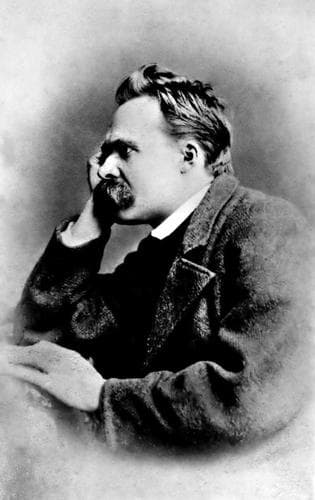
Friedrich Nietzsche was a German philosopher active in the late 19th century, known for his critiques of traditional moral values and religion. His notable works include "Thus Spoke Zarathustra," "Beyond Good and Evil," and "On the Genealogy of Morals," which explore themes of individualism, power, and the nature of existence. Nietzsche's writings have had a profound influence on modern philosophy and literature.
Similar books
- Beyond Good and Evil
Friedrich Nietzsche
4.0 (67k) average on GoodreadsPsychologyExpands on many themes introduced here, further developing Nietzsche's critique of morality and call for new values.
- Thus Spoke Zarathustra
Friedrich Nietzsche
4.0 (111k) average on GoodreadsPsychologyPresents Nietzsche's philosophical ideas, including the Übermensch and eternal recurrence, in a more poetic and allegorical style.
- Utilitarianism
John Stuart Mill
3.7 (19k) average on GoodreadsPoliticsMill attempts to establish a rational, universal moral principle based on maximizing happiness. Nietzsche, in stark contrast, deconstructs the very notion of universal morality, revealing its contingent, historical, and often irrational origins rooted in power dynamics and psychological states like ressentiment. Mill's project is constructive and aims to build a coherent ethical system; Nietzsche's is 'destructive' (in a positive sense), aiming to unmask and re-evaluate existing values rather than to provide a new universal ethic.
- Groundwork of the Metaphysics of Morals
Immanuel Kant
3.8 (17k) average on GoodreadsPhilosophyKant sought to derive moral laws from pure reason, independent of empirical conditions, resulting in the categorical imperative as a universal and immutable moral command. Nietzsche, conversely, argues that morality is deeply embedded in human psychology, history, and physiological conditions, making Kant's universal, rational morality an illusion – a product of the ascetic ideal and a will to 'truth' as a specific form of the will to power. While Kant searches for the unchanging foundations of duty, Nietzsche excavates the mutable, all-too-human origins of our sense of duty and moral obligation.
- The Perks of Being a Wallflower
Stephen Chbosky
4.2 (1.3M) average on GoodreadsPsychologyThrough letters, a shy high school freshman learns to navigate first love, trauma, and self-discovery, stepping off the sidelines and into life.
- Eleanor Oliphant Is Completely Fine
Gail Honeyman
4.3 (708k) average on GoodreadsLiterary FictionA lonely woman's structured life changes when an IT guy and an elderly man help her learn to open her heart.




Enjoyed the summary?
A summary gives you the shape of the book. The book itself has the detail, the examples and the voice.
Find On the Genealogy of Morals on AmazonAs an Amazon Associate, BookBrief earns from qualifying purchases. How we're funded