
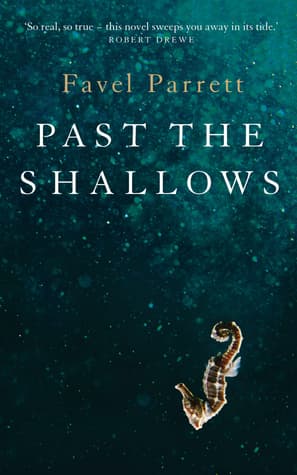
Synopsis
Covers the whole plot, including the ending.
- Difficulty
- Medium
- Pacing
- Moderate
- Mood
- Bleak, Atmospheric, Tragic, Poignant, Intense
- Read it if
- You appreciate raw, emotionally intense literary fiction exploring themes of family, trauma, nature, and the loss of innocence, set against a stark, beautiful backdrop.
- Skip it if
- You prefer light-hearted stories or are sensitive to themes of child abuse, violence, and profound sadness.
Past the Shallows Plot Summary
Covers the whole plot, including the ending.
The Brothers' Precarious Existence
The book starts by introducing brothers Miles and Harry, who live a difficult life on the rugged Tasmanian coast with their father, an abalone fisherman. Miles, the middle brother, often works on his father's boat, enduring long, dangerous days and his father's unpredictable temper. Harry, the youngest, is especially vulnerable, often left alone or with their grandfather, and experiences much of his father's anger. Joe, the oldest brother, has left home, seeking a life away from their abusive father. The boys' mother died years ago, and her memory, particularly a special abalone shell, comforts Harry. Their lives center around the ocean, fishing dangers, and constant tension at home.
Harry's Isolation and Connection to Nature
Harry, a sensitive and observant child, often feels alone. He spends his days exploring the beach, collecting abalone shells, and watching sea life. His dog, Jake, is his constant friend and gives him unconditional love. Harry feels a deep connection to nature, showing empathy for ocean and land creatures, especially a shark pup he finds and tries to care for. This sensitivity contrasts with his harsh home life and the practical, often brutal, reality of his father's fishing business. His grandfather, George, offers some stability and kindness, providing a short break from the fear at home.
Miles's Burdens and Loyalties
Miles is caught between his father's demands and his loyalty to Harry. He is a skilled and hardworking boy, forced to do the hard and dangerous work of abalone diving, often without proper gear or safety. He feels responsible for Harry, constantly trying to protect him from their father's anger and neglect. Miles's childhood is taken by the need to earn money for the family and survive daily struggles. He dreams of a life beyond the fishing boat and his father's presence, but feels stuck by his circumstances and his love for his younger brother. His experiences on the boat, seeing the ocean's harshness and the abalone industry, also shape his strong and resilient nature.
Joe's Return and Attempts at Intervention
Joe, the oldest brother, returns home after trying to make his own way. His return brings a brief moment of hope and changes the family dynamic. He sees the neglect and abuse Harry and Miles face, and is disturbed by his father's increasing violence and drinking. Joe tries to intervene, confronting his father about how he treats the boys, but his efforts are met with resistance and more aggression. His presence, while comforting to Harry and Miles, also shows the deep family problems and the father's unwillingness to change. Joe's own past traumas, especially related to their mother's death, are hinted at, adding to the family's complex history.
The Father's Deepening Despair and Violence
The father's drinking and temper get much worse. His drinking becomes more frequent, and his outbursts more violent, often aimed at Harry. He struggles with his work and a devastating secret, which he tries to forget with alcohol. The boys live in constant fear, trying to be unseen when he is home. The house becomes a place of terror. The father's actions come from deep pain and guilt, though the boys do not know the real reason. His cruelty, especially toward Harry, becomes increasingly unbearable, pointing to a tragic ending.
Harry's Fear and the Shark Pup
Harry's innocent nature appears when he finds a small shark pup on the beach. He tries to care for it, bringing it home in a bucket, hoping to keep it alive. This act of kindness and his bond with the creature contrast with the cruelty he experiences. The shark pup, a symbol of vulnerability and the wild ocean, reflects Harry's own fragile position. His father, in a drunken rage, finds the shark and kills it, further traumatizing Harry and showing the father's increasing violence and disregard for Harry's feelings. This event shows a major increase in the father's destructive behavior.
The Truth of the Mother's Death
Through broken memories and the father's drunken talks, the truth about the mother's death slowly appears. She died in a car accident, and the father was driving drunk. This secret has caused his guilt, alcoholism, and rage. The mother's death also involved another child, a baby girl, who was in the car and also died. This revelation is the main reason for the father's suffering and explains his self-destructive behavior and his inability to cope with the boys, especially Harry, who looks like their mother. This past trauma explains the dark cloud over the family.
Harry's Final Moments and the Father's Desperation
In a terrible scene, Harry is left alone with his very drunk and angry father. The father's grief and guilt over the mother and baby's death consume him. In a moment of uncontrolled despair and anger, he accidentally or deliberately causes Harry's death. The details are somewhat unclear, but it is clear the father's actions lead to Harry drowning in the bathtub. This event is the tragic end of the father's long abuse and his inability to deal with his past. The scene is short but devastating, marking the ultimate failure to protect Harry.
Miles Discovers the Tragedy
Miles comes home to find the awful scene. Harry is dead, and his father is drunk and despairing, seemingly unable to understand what he has done. The discovery shatters Miles, who is overwhelmed with grief and shock. The immediate aftermath is a blur of confusion and horror. Miles's already harsh world completely collapses with the loss of his younger brother. The father's actions have permanently destroyed what little family remained, leaving Miles to deal with immense loss and the devastating truth of his family's history.
Aftermath and Miles's Future
Afterward, the police are involved, and the father is taken away. Joe returns, and the brothers are left to process their grief and the brutal reality of their father's actions. Miles is taken in by his grandfather, George, who offers him a stable and loving environment. The novel ends with Miles starting to heal, finding comfort in the ocean in a new way, and beginning to make a path for himself. While the trauma of Harry's death and their father's legacy will always be a part of him, there is a sense of cautious hope for Miles's future, free from the immediate threat of his father's violence, but forever changed by his losses.
Past the Shallows Characters
Miles Curren
Protagonist
Middle brother, forced into abalone fishing, protective of Harry
Miles is a hardworking and resilient young boy, thrust into the adult world of abalone fishing at a tender age. He is stoic and responsible, often taking on the role of protector for his younger brother, Harry, against their father's abuse. Miles finds a deep connection to the ocean, understanding its rhythms and dangers, but also yearns for a life beyond the boat. He struggles with the moral compromises of his father's profession and his own complicity in it, while simultaneously trying to maintain a sense of innocence and hope for the future. His inner turmoil is often expressed through his observations of nature.
Relationships: Harry Curren (Younger brother, Miles is fiercely protective of him.); Joe Curren (Older brother, a source of occasional support and longing for Miles.); Dad (Curren) (Abusive father, Miles fears him but is also dependent on him.); George (Grandfather) (Kind and supportive grandfather, offers Miles refuge.)
Harry Curren
Protagonist/Victim
Youngest brother, sensitive and vulnerable, deeply connected to nature
Harry is the most vulnerable and innocent of the brothers, a sensitive child who finds solace in the natural world and his dog, Jake. He collects treasures from the beach, like abalone shells, and possesses a profound empathy for animals. Harry's innocence makes him particularly susceptible to his father's escalating abuse and neglect, and he lives in a constant state of fear. His memories of his deceased mother are vivid and comforting, offering a glimpse of a love he no longer experiences. His small size and trusting nature make his eventual fate all the more tragic, highlighting the devastating impact of domestic violence.
Relationships: Miles Curren (Middle brother, his primary protector and comfort.); Joe Curren (Older brother, a distant but longed-for figure of safety.); Dad (Curren) (Abusive father, the source of his greatest fear and ultimately his demise.); Jake (His loyal dog and constant companion.)
Dad (Curren)
Antagonist
Abusive abalone fisherman, consumed by guilt and alcoholism
The unnamed father is a bitter, violent, and alcoholic abalone fisherman. He is haunted by the secret of his wife's and baby's death, for which he is responsible. This immense guilt and grief manifest as extreme rage and neglect towards his sons, particularly Harry. He projects his internal torment onto his family, creating a terrifying and abusive home environment. Despite his cruelty, there are brief, fleeting moments that hint at the complex, broken man beneath the anger, suggesting his actions stem from profound self-loathing rather than pure malice. His character embodies the destructive power of unaddressed trauma and addiction.
Relationships: Miles Curren (Son, whom he forces to work and often abuses.); Harry Curren (Son, the primary target of his escalating abuse and neglect.); Joe Curren (Eldest son, with whom he has a strained and confrontational relationship.); Mum (deceased) (Deceased wife, whose death is the source of his profound guilt.)
Joe Curren
Supporting
Eldest brother, escaped home but returns to confront the family's issues
Joe is the eldest of the three brothers, having left home to escape their father's abuse. He represents a fleeting hope for the younger boys, a glimpse of a different life. When he returns, he is deeply disturbed by the deterioration of his brothers' lives and attempts to intervene, confronting his father. Joe carries his own scars from their upbringing but demonstrates a capacity for empathy and protection, particularly towards Harry and Miles. His presence, though temporary, highlights the stark contrast between their father's cruelty and the possibility of familial love and support.
Relationships: Miles Curren (Younger brother, he feels a responsibility towards him.); Harry Curren (Youngest brother, whom he tries to protect.); Dad (Curren) (Abusive father, with whom he has a confrontational relationship.); George (Grandfather) (Grandfather, a figure of stability.)
George (Grandfather)
Supporting
Kind and stable grandfather, a refuge for the boys
George is the boys' grandfather, a kind and gentle man who lives nearby. He provides the only consistent source of warmth, stability, and unconditional love in the boys' lives, particularly for Harry. His house is a sanctuary from their father's violence, offering food, comfort, and a sense of normalcy. He is aware of the father's abusive behavior but seems powerless to directly intervene beyond offering the boys refuge. After Harry's death, he becomes Miles's guardian, offering him a chance at a safer future.
Relationships: Miles Curren (Grandson, whom he cares for.); Harry Curren (Grandson, whom he dotes on.); Dad (Curren) (Son-in-law, with whom he has a strained relationship due to his abuse.)
Jake
Supporting
Harry's loyal dog and constant companion
Jake is Harry's faithful dog, a constant presence and source of comfort in Harry's lonely and frightening life. He offers Harry unconditional love and companionship, often being the only living creature Harry can fully trust. Jake's loyalty and simple affection highlight Harry's innocence and vulnerability. The dog's presence further emphasizes the neglect Harry suffers from his father, as Jake often fills the emotional void. His role is primarily symbolic, representing Harry's pure heart and the simple joys denied to him.
Relationships: Harry Curren (His owner and best friend.)
Mum (deceased)
Mentioned
The boys' deceased mother, whose memory haunts the family
The boys' mother is a significant presence despite being deceased. Her memory is cherished by Harry, particularly through an abalone shell she once gave him, representing love and a happier past. Her death, revealed to be due to their father's drunk driving, is the central trauma that fuels his guilt, alcoholism, and abuse. She is the 'ghost' that haunts the family, her absence creating a void that none of them can fill, and her tragic end dictating the dark trajectory of their lives. Her memory symbolizes lost innocence and the weight of an unacknowledged past.
Relationships: Dad (Curren) (Deceased wife, whose death he caused.); Miles Curren (Deceased mother, a vague but loving memory.); Harry Curren (Deceased mother, a cherished memory.)
Stewart
Supporting
Fellow abalone diver and friend of the father
Stewart is another abalone diver who sometimes works with the boys' father. He represents the broader, often harsh, community of the abalone industry. While not overtly abusive, he is complicit in the father's neglect by not intervening in the boys' welfare. He is a pragmatic character, focused on the work, and his interactions provide glimpses into the dangerous and demanding nature of their livelihood. He is an observer, rather than an active participant, in the family's internal drama, highlighting the isolation of the boys' suffering.
Relationships: Dad (Curren) (Work colleague and friend.); Miles Curren (Employer/colleague on the boat.)
Past the Shallows Themes
Loss of Innocence and Childhood
The novel shows how Miles and Harry lose their childhood too soon. Miles is forced into dangerous adult work on his father's abalone boat, giving up his education and safety for survival. Harry, though younger, loses the security and care every child needs, living in constant fear and neglect. Their experiences show how poverty, abuse, and trauma can take away a child's right to a carefree upbringing, replacing it with responsibility, fear, and a desperate struggle to survive. Harry's death is the tragic end of this theme.
“Miles knew the feel of the boat, the thrum of the engine, the roll of the sea. He knew it in his bones. He was just a boy, but he was already old.”
The Destructive Power of Guilt and Trauma
The father shows how unaddressed guilt and trauma can destroy a person and an entire family. His responsibility for his wife and baby's death consumes him, leading to drinking and increasing violence. His inability to deal with this past trauma creates a cycle of abuse that traps his sons. The novel suggests that the father's cruelty comes from his own deep pain and self-hatred, making him a complex figure who is both a victim and a perpetrator. This shows the lasting and damaging effects of past tragedies on present lives.
“The dad had a darkness in him, thick and heavy like the abalone shells at the bottom of the sea.”
The Redemptive and Destructive Power of Nature
The ocean and the Tasmanian landscape are a source of income and danger, and a place of comfort and escape for the boys. For Miles, the ocean is a harsh workplace, but also a place where he feels a strong connection and a sense of purpose. For Harry, the beach and its creatures offer safety from his terrifying home life, a place for innocent exploration and wonder. However, nature is also uncaring and harsh, reflecting the difficult realities of their lives. The ocean both gives and takes away, showing the unpredictable and often cruel nature of their existence.
“The ocean was always there. It was the only thing that was always there, and it was always changing.”
Family Bonds and Loyalty
Despite the severe family problems and abuse, the strong bond between the brothers — especially Miles's fierce protection of Harry — is a central theme. Miles constantly tries to shield Harry from their father's anger, and Joe, though he left, returns to confront the situation. These relationships offer moments of tenderness and hope amid the darkness, showing the human need for connection and love even in the hardest situations. The brothers' loyalty to each other shows their resilience and their shared struggle against a common oppressor.
“Miles would always look out for Harry. That's what brothers did.”
Memory and the Past
The past, especially the death of the boys' mother and baby sister, is a constant and unavoidable force in the novel. It always affects the present, shaping the father's destructive behavior and the boys' understanding of their world. Harry holds onto small memories of his mother, while Miles deals with the unspoken traumas of their family. The gradual reveal of the truth about the mother's death explains the family's problems, showing how unaddressed past events can cast a long and devastating shadow over future generations.
“Some things were just there, deep inside you, like the cold in the ocean.”
Plot Devices & Literary Techniques
Foreshadowing
Hints of impending tragedy and past trauma woven throughout the narrative
Foreshadowing is skillfully used to build tension and hint at the tragic events to come. The father's escalating violence, Harry's vulnerability, and recurring imagery of drowning and danger (e.g., the shark pup, rough seas) all subtly prepare the reader for the climax. The father's vague, drunken references to the past and the mother's death also foreshadow the eventual revelation of his guilt. This technique creates a pervasive sense of dread and inevitability, making the eventual tragedy feel both shocking and tragically logical.
Symbolism of the Ocean and Abalone
The sea represents both life, livelihood, and overwhelming danger; abalone symbolizes both sustenance and hidden depths/secrets
The ocean is a powerful, multifaceted symbol. It provides the family's livelihood through abalone fishing, yet it is also a source of constant danger, reflecting the unpredictability and harshness of their lives. It represents both freedom and entrapment for Miles. Abalone shells, particularly the one Harry cherishes, symbolize precious memories, beauty, and the hidden depths of the past. The act of diving for abalone mirrors the characters' own struggles to 'dive deep' into their traumatic past and confront the hidden truths, often at great risk.
Limited Omniscient Point of View
Alternating perspectives between Miles and Harry, creating intimacy and suspense
The novel primarily uses a limited omniscient point of view, alternating between the perspectives of Miles and Harry. This allows the reader to intimately experience the world through their eyes, feeling their fear, hope, and confusion. By withholding the father's full perspective until crucial moments, the narrative builds suspense around the family's dark past and the source of his rage. This dual perspective emphasizes the boys' shared trauma while also highlighting their individual ways of coping with their harsh reality, making their experiences more immediate and impactful.
Sensory Imagery
Vivid descriptions appealing to sight, sound, smell, and touch to immerse the reader in the setting and characters' experiences
Parrett employs rich sensory imagery to create a visceral and immersive reading experience. Descriptions of the cold, salty air, the 'thrum' of the boat engine, the 'smell of fish and blood and diesel,' and the visual details of the rugged Tasmanian coastline bring the setting to life. This imagery not only grounds the story in its specific geographical context but also conveys the characters' physical and emotional states, making their struggles and their connection to nature deeply felt by the reader. The tactile nature of the descriptions enhances the authenticity of the boys' harsh existence.
The Abalone Shell
A tangible link to the past, memory, and lost maternal love
The abalone shell that Harry treasures is a potent symbol throughout the novel. It was given to him by his mother, making it a tangible link to her memory and the love she once provided. For Harry, it represents a lost innocence and a cherished connection to a happier past, a stark contrast to his present reality. The shell also symbolizes the beauty and fragility found within the harsh environment, much like Harry's own delicate nature. Its presence underscores the theme of memory and the lingering impact of past happiness amidst present sorrow.
Past the Shallows Quotes
“Joe knew that when they were all out in the boat, with the sun on their faces and the sea all around, that was when they were the most like a family.”
“The ocean was always there. It was always watching.”
“He just wanted to be a boy. Not a brother, or a son, or a worker. Just a boy.”
“It was the sort of house that had given up on itself. The sort of house that had seen too much.”
“The past was like the ocean, always there, always moving, always pulling you back.”
“Sometimes you just had to be quiet and let the world do what it was going to do.”
“He thought about how some things just got broken, and you couldn't put them back together.”
“The wind was a whisper, a warning, a promise.”
“It was a good place to hide, the sea. A good place to be lost.”
“He knew that some secrets were too big to keep, and some were too big to tell.”
“The darkness was like a blanket, heavy and suffocating.”
“The world was a harsh place, but sometimes, just sometimes, there was a kindness in it.”
“He wished he could just make everything okay, like you could glue a broken plate back together.”
“The smell of salt and fish and something else, something old and sad.”
Quiz
10 questions on the plot and the characters. Each answer comes with a short explanation.
Question 1
Which three brothers are the central characters in 'Past the Shallows'?
- Tom, Harry, and Miles
- Joe, Harry, and Liam
- Joe, Harry, and Miles
- Sam, Miles, and Joe
Show answer
C. Joe, Harry, and Miles The book centers on the lives of the three brothers: Joe, Harry, and Miles, as they navigate their difficult home life and the challenges of the Tasmanian coast.
Question 2
What is the primary occupation of the brothers' father?
- Deep-sea fishing
- Abalone fisherman
- Lobster trapping
- Whaling
Show answer
B. Abalone fisherman Their father makes a living as an abalone fisherman, a dangerous and demanding job that often takes him out onto the unpredictable ocean.
Question 3
Which of the brothers is described as the most vulnerable and bears the brunt of their father's anger?
- Joe
- Miles
- Harry
- All of them equally
Show answer
C. Harry Harry, the youngest brother, is specifically highlighted as the most vulnerable and the one who frequently suffers from their father's volatile temper.
Question 4
What kind of secret is their father harboring that is described as 'devastating'?
- A secret gambling addiction
- A past crime he committed
- A hidden family debt
- A devastating secret related to their mother/family past
Show answer
D. A devastating secret related to their mother/family past The father's 'devastating secret' is a central mystery and source of his bitterness, which is later revealed to be connected to the death of their mother and another family tragedy.
Question 5
Where is the setting for 'Past the Shallows'?
- The northern coast of New Zealand
- The south-east coast of Tasmania
- The west coast of mainland Australia
- A remote island off the coast of Queensland
Show answer
B. The south-east coast of Tasmania The story is set on the rugged and unpredictable south-east coast of Tasmania, a location that plays a significant role in the brothers' lives and their father's work.
Question 6
How do Harry and Miles typically try to cope with their father's bad moods?
- By confronting him directly
- By leaving the house until he calms down
- By trying to stay as invisible as possible
- By seeking help from their older brother Joe
Show answer
C. By trying to stay as invisible as possible The younger brothers, Harry and Miles, try to make themselves scarce and invisible to avoid their father's anger and the 'dark cloud' of his mood.
Question 7
What is a prominent theme explored in the relationship between the ocean and the characters?
- The ocean as a source of endless joy and freedom
- The ocean as a symbol of peace and tranquility
- The ocean as a metaphor for life's unpredictable dangers and a source of livelihood/destruction
- The ocean as a barrier separating them from the rest of the world
Show answer
C. The ocean as a metaphor for life's unpredictable dangers and a source of livelihood/destruction The ocean is central to the story, providing their livelihood but also representing unpredictable danger, hardship, and ultimately, a force that both sustains and threatens life, mirroring the turbulent home environment.
Question 8
Why is Joe, unlike Harry and Miles, not always forced to live under the 'dark cloud' of his father's mood?
- He has a better relationship with his father than his brothers.
- He is old enough to leave home and seek independence.
- He spends most of his time at school or with friends.
- He lives with other relatives for part of the year.
Show answer
B. He is old enough to leave home and seek independence. The text states that 'Unlike Joe, Harry and Miles are too young to leave home,' implying Joe is older and has more freedom or opportunities to escape the immediate domestic tension.
Question 9
The father's character is described as a 'hard man' and 'bitter drinker.' How do these traits contribute to the overall atmosphere of the novel?
- They create a sense of lightheartedness and optimism.
- They establish a tense, oppressive, and unpredictable home environment.
- They suggest a stable and reliable father figure.
- They primarily serve to highlight the beauty of the Tasmanian landscape.
Show answer
B. They establish a tense, oppressive, and unpredictable home environment. The father's harshness and drinking habits are direct causes of the 'dark cloud' mentioned, creating an atmosphere of fear, unpredictability, and oppression for the younger brothers within their home.
Question 10
The title 'Past the Shallows' likely refers to what in the context of the book's themes?
- The physical depth of the ocean where abalone are found.
- Moving beyond superficial understanding to deeper, more dangerous truths or experiences.
- A specific location on the Tasmanian coast where the family often fishes.
- The limited opportunities available to the characters.
Show answer
B. Moving beyond superficial understanding to deeper, more dangerous truths or experiences. The title 'Past the Shallows' metaphorically suggests venturing beyond safe, known territories—both literally into the deeper, more dangerous ocean and figuratively into the profound, often painful truths and experiences of the characters' lives.
Past the Shallows FAQ
What is "Past the Shallows" about?
"Past the Shallows" is a poignant story about three brothers, Joe, Miles, and Harry, living a harsh life on the rugged south-east coast of Tasmania with their abusive, alcoholic abalone fisherman father. It explores themes of loss, brotherly love, the destructive power of secrets, and the unforgiving nature of both the ocean and human relationships, all while hinting at a dark family past.
Why should I read "Past the Shallows"?
You should read "Past the Shallows" for its raw emotional depth, beautiful prose that captures the wild Tasmanian landscape, and its unflinching portrayal of childhood resilience amidst trauma. It's a powerful and heartbreaking exploration of family secrets and the unbreakable bonds between brothers, leaving a lasting impact long after the final page.
What is the background/setting of "Past the Shallows"?
The story is set on the remote and wild south-east coast of Tasmania, specifically around a fishing community where the ocean dictates life and death. The isolated, often brutal natural environment mirrors the harshness of the brothers' home life, with the sea serving as both a source of livelihood and a constant threat.
What are the most memorable quotes?
While specific quotes aren't provided in the summary, the book is known for its evocative descriptions of the ocean and the boys' internal struggles. Readers often remember lines that highlight the beauty and danger of the sea, or the quiet strength of the brothers' bond against their father's cruelty.
What writing style does the author use?
Favel Parrett employs a sparse, lyrical, and evocative writing style, often using vivid imagery to describe the Tasmanian landscape and the internal worlds of the characters. Her prose is deceptively simple yet carries significant emotional weight, often shifting perspectives to convey the experiences of Joe, Miles, and Harry.
What minor details add significant meaning?
The recurring motif of the abalone shells, particularly the prized 'pearl' shells, symbolizes both the beauty and the danger of their father's profession, and the fleeting value of their harsh life. Harry's constant search for treasures on the beach reflects his innocence and his desperate need for something good in his life.
What are some subtle foreshadowing moments?
The father's extreme reactions to Harry, combined with his bitter drinking and the 'devastating secret,' subtly foreshadow the revelation of Harry's true parentage and the dark circumstances surrounding the mother's death. The frequent descriptions of the ocean's unpredictability also hint at a tragic event to come.
What unexpected character connections exist?
The most significant unexpected connection is revealed through the 'devastating secret': Harry is not the biological son of the abusive father. This revelation connects Harry directly to the mother's past and the circumstances of her death, fundamentally altering the family dynamic and the father's motivations.
What are unspoken character motivations?
The father's unspoken motivation for his cruelty, especially towards Harry, is rooted in the guilt and anger associated with the secret surrounding Harry's true parentage and the mother's death. Miles's unspoken motivation is a deep-seated desire to protect Harry, even at his own expense, driven by his love and the absence of a responsible adult.
What psychological complexities do characters exhibit?
The father exhibits severe psychological damage, manifesting as alcoholism, violence, and a profound inability to cope with his past. Miles displays a complex mix of childhood innocence and premature maturity, burdened by the responsibility of caring for Harry while grappling with fear and resentment towards his father.
What are the major emotional turning points?
A major emotional turning point is when Joe leaves home, forcing Miles to shoulder more responsibility and intensifying his fear for Harry. The ultimate turning point is the tragic revelation of the secret and the subsequent events that lead to Harry's fate, irrevocably altering the lives of Miles and Joe.
How do relationship dynamics evolve?
The relationship between the brothers, initially defined by their shared vulnerability and Miles's protective instincts, evolves as Joe gains independence and Miles is left to bear the brunt of the father's abuse. The father's relationship with Harry, seemingly just cruel, is later revealed to be deeply twisted by the secret of Harry's parentage and the mother's death.
Which parts remain ambiguous or open-ended?
The full extent of the mother's relationship with the other man and the exact circumstances leading to her death and Harry's birth are hinted at rather than explicitly detailed, leaving some aspects open to reader interpretation regarding the father's precise role and level of culpability beyond his abuse.
What are controversial scenes or decisions?
The most controversial aspect is the father's sustained physical and emotional abuse of Harry, leading to his ultimate fate. Readers often debate the father's capacity for redemption and the choices made by Joe and Miles given their limited options in such a harsh environment.
"Past the Shallows" ending explained: how it ends & what it means
The book culminates in a tragic climax where Harry is lost at sea, a direct consequence of the father's neglect and the dangerous secret. It's revealed that Harry was not the father's biological son, and the father's bitterness stemmed from this and the mother's death. The ending signifies the ultimate destruction wrought by hidden trauma and abuse, but also the enduring, albeit heartbroken, bond between Joe and Miles who must now navigate life without Harry and confront their past.
Similar books
- The Road
Cormac McCarthy
4.0 (716k) average on GoodreadsScience FictionExplores a desolate landscape and a father-son relationship under extreme duress, with a focus on survival and the fragility of innocence.
- Breath
Tim Winton
3.9 (17k) average on GoodreadsLiterary FictionFeatures a strong sense of place (Australian coast), coming-of-age themes, and the allure and danger of the ocean.
- A Little Life
Hanya Yanagihara
4.3 (212k) average on GoodreadsLiterary FictionDelves into deep psychological trauma and the lasting impact of childhood abuse, though with a different setting and scope.
- The Light Between Oceans
M.L. Stedman
4.0 (397k) average on GoodreadsHistorical FictionBoth 'Past the Shallows' and 'The Light Between Oceans' are set in isolated Australian coastal environments and explore themes of grief, moral dilemmas, and the profound impact of the ocean on human lives. However, Parrett's novel focuses more intensely on childhood trauma and the immediate, brutal realities of a dysfunctional family, whereas Stedman's explores the complexities of choice, adoption, and long-term consequences of a single life-altering decision, often with a more romanticized, albeit tragic, lens. Parrett's prose is starker and more visceral, while Stedman's is more expansive and reflective.
- Jasper Jones
Craig Silvey
4.1 (26k) average on GoodreadsHistorical FictionWhile both novels are Australian and feature young protagonists navigating difficult circumstances, 'Jasper Jones' by Craig Silvey is more of a coming-of-age mystery with a strong emphasis on racial prejudice and social injustice within a small town. 'Past the Shallows' is a more internal and domestic tragedy, focusing on the immediate family unit and the cycle of abuse. Silvey's narrative often balances its dark themes with moments of humor and a sense of community, offering more hope and resolution than Parrett's starker, more fatalistic tale. Parrett's work is arguably more focused on the psychological impact of trauma, while Silvey's uses the mystery genre to explore broader societal issues.
- The Old Man and the Sea
Ernest Hemingway
3.8 (831k) average on GoodreadsLiterary FictionA Cuban fisherman's long struggle with a giant marlin becomes a story of endurance and dignity, now retold for young adults with illustrations, phonetic guides, and writing prompts in Traditional Chinese.



Enjoyed the summary?
A summary gives you the shape of the book. The book itself has the detail, the examples and the voice.
Find Past the Shallows on AmazonAs an Amazon Associate, BookBrief earns from qualifying purchases. How we're funded