
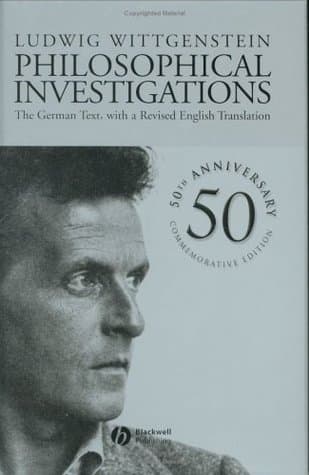
Core Idea
- Difficulty
- Hard
- Read it if
- You are a student or scholar of philosophy, linguistics, or cognitive science interested in a foundational critique of traditional theories of meaning, mind, and language, and are prepared for a challenging, non-linear exploration of these concepts.
- Skip it if
- You are looking for a straightforward, systematic presentation of philosophical doctrines, a light introduction to philosophy, or a book offering definitive answers to traditional metaphysical questions.
Key Takeaways from Philosophical Investigations
Meaning is Use
Words derive their meaning from their context and how they are used, not from a fixed, internal essence.
Wittgenstein challenged the idea that words are labels for pre-existing objects or ideas. Instead, he argued that a word's meaning is determined by its 'use in the language.' To understand a word, one must observe how it functions within a specific linguistic context, how it is used in various 'language-games.' Searching for an intrinsic, universal meaning for a word often leads to confusion. Meaning is dynamic, context-dependent, and socially constructed through shared practices. This concept reframes many traditional philosophical problems as misunderstandings about how language works.
“For a large class of cases—though not for all—in which we employ the word 'meaning' it can be explained thus: the meaning of a word is its use in the language.”
In the book: Wittgenstein's famous example of the word 'game.' He shows that there is no single, essential property shared by all activities we call 'games' (board games, card games, Olympic games, etc.). Instead, they form a 'family resemblance,' and the meaning of 'game' is derived from its diverse uses.
Try this: When encountering philosophical or conceptual difficulties, stop searching for an essential definition. Instead, ask: 'How is this word (or concept) actually used in different contexts?' Examine its practical application rather than its abstract essence to resolve confusion.
Related ideas: language-games, family-resemblance, use-theory-of-meaning
Language-Games
Language is not a monolithic structure but a collection of diverse, rule-governed activities, each with its own context and purpose.
Wittgenstein introduces 'language-games' to show that language is not one system but many distinct, rule-governed activities. Just as there are different types of games, there are different ways we use language: giving orders, describing an object, reporting an event, forming and testing a hypothesis, greeting, praying. Each language-game has its own rules, context, and purpose. Understanding a word or sentence means understanding which language-game it belongs to. Trying to understand a statement from one language-game (e.g., a prayer) using the rules of another (e.g., scientific description) leads to misunderstanding and philosophical confusion.
“I shall also call the whole, consisting of language and the actions into which it is woven, the 'language-game.'”
In the book: The 'builders' language-game (PI §2) where builders use simple commands ('Slab!', 'Pillar!') and responses ('Block!') to communicate. This simple scenario highlights how meaning is tied to specific actions and context, demonstrating a complete, albeit primitive, language-game.
Try this: To resolve misunderstandings or philosophical impasses, identify the specific 'language-game' being played. Are you trying to apply the rules of scientific verification to a moral judgment, or the rules of a personal confession to a legal testimony? Recognize that different contexts demand different linguistic rules and expectations.
Related ideas: meaning-as-use, form-of-life, rules-of-language
Private Language Argument
A language whose words refer only to an individual's private sensations, inaccessible to others, is impossible.
This is one of Wittgenstein's most famous arguments. He says a 'private language' — one where words refer only to one's own private feelings, and whose meaning is known only to oneself — is impossible. For a word to have meaning, it must be possible to apply it correctly or incorrectly, and this needs public rules for its use. If I alone decide what my private sensation 'S' means, there is no difference between thinking I am using 'S' correctly and actually using it correctly; 'correctness' disappears. Meaning is public and tied to shared language practices and observable behavior. This has implications for understanding consciousness, sensation, and subjective experience.
“An 'inner process' stands in need of outward criteria.”
In the book: The 'beetle in a box' analogy (PI §293). Imagine everyone has a box with a 'beetle' inside, but no one can look into anyone else's box. People talk about their 'beetle.' The word 'beetle' could not refer to any specific thing, as whatever is in the box 'cancels out' if it has no public criteria. The word's meaning, if any, must derive from its public use, not from the private contents.
Try this: Be wary of philosophical claims that rely on purely private, incommunicable experiences as the sole basis for meaning. If you cannot articulate or demonstrate the criteria for using a term, it likely lacks coherent meaning. Seek public, shareable criteria for understanding subjective experiences.
Related ideas: meaning-as-use, public-criteria, sensation
Philosophical Problems as Grammatical Illusions
Many philosophical problems arise from misunderstanding the 'grammar' of our language, leading us to misuse words.
Wittgenstein believed that philosophical problems are often not real empirical problems or deep mysteries, but 'grammatical' ones. They appear when we misapply the rules of one language-game to another, or when we are 'bewitched' by the surface grammar of our language, leading us to ask meaningless questions or search for non-existent things. For example, treating 'mind' as a substance like 'body' (because both are nouns) leads to the mind-body problem. His therapeutic approach aimed to dissolve these problems by showing how language is misused, rather than solving them with grand theories. The goal is to gain 'perspicuous representation' of our language use.
“Philosophy is a battle against the bewitchment of our intelligence by means of language.”
In the book: The persistent philosophical questions about 'what is time?' or 'what is a number?' Wittgenstein suggests these questions arise when we treat 'time' or 'number' as if they were objects that could be pointed to, rather than understanding their complex, diverse uses within different language-games. The confusion lies in the expectation of a singular, underlying essence.
Try this: When confronted with a perplexing philosophical question, instead of seeking a profound answer, try to analyze the language being used. Ask: 'How are these words actually used in everyday life?' 'Am I being misled by the superficial similarity of grammatical forms?' This often reveals the problem to be a linguistic misunderstanding, not a deep existential puzzle.
Related ideas: therapeutic-philosophy, language-games, bewitchment-of-intelligence
Forms of Life
Language is deeply interwoven with our shared human activities, customs, and ways of living.
The concept of 'forms of life' shows how language is part of our shared human practices and natural history. Language is not an abstract system; it is an integral part of how we live, act, and interact. Our language practices are rooted in our shared biological and cultural 'form of life' — our common human nature, our shared reactions, customs, and institutions. Understanding a language-game means understanding the 'form of life' in which it is played. This suggests that certain basic agreements and ways of seeing the world are not matters of proof, but simply 'given' as the foundation of our language and social existence. It highlights that our most basic beliefs and actions have no deeper foundation.
“It is what is called a 'form of life.'”
In the book: Our shared human reactions to pain (crying, wincing), joy (smiling, laughing), or fear (flinching). These are not learned behaviors in the same way as calculus; they are natural expressions that form the basis for how we learn and use words like 'pain,' 'joy,' or 'fear.' This shared human biology and culture constitute a 'form of life' that grounds our language.
Try this: When faced with radical disagreement or a breakdown in communication, consider if the participants are operating from fundamentally different 'forms of life'—different bedrock assumptions, customs, or ways of being in the world. Recognize that some foundational agreements are not subject to rational proof but are simply the shared ground upon which communication is built.
Related ideas: language-games, agreement-in-form-of-life, bedrock
Criteria vs. Symptoms
We use 'criteria' as public, constitutive evidence for applying a concept, distinct from mere 'symptoms' which are empirical correlations.
Wittgenstein distinguishes between 'criteria' and 'symptoms' in how we apply concepts, especially to mental states. A criterion for something (e.g., pain) is a public, observable behavior (wincing, crying out) that is conceptually tied to the sensation. It is not just evidence that pain might be present; it is part of what makes up our understanding and use of the word 'pain.' Symptoms, on the other hand, are empirical correlations (e.g., a specific brain activation pattern with pain). While symptoms can be found through science, criteria are part of our language-games and allow us to learn and use the word 'pain.' This distinction helps clarify how we know about other minds and avoids solipsism.
“The language-game is rather this: when a certain sensation occurs, I use this expression.”
In the book: Consider how a child learns the word 'pain.' They don't learn it by observing their own private sensation and then labeling it. They learn it in contexts where adults react to their wincing, crying, and holding an injured limb, saying 'Are you in pain?' The outward behavior *is* the primary criterion for pain in learning and communication, not just a symptom.
Try this: When analyzing concepts, especially those related to mental states, differentiate between what constitutes the concept (its criteria) and what merely correlates with it (its symptoms). This can help avoid confusion and clarify what we truly mean when we attribute certain states to ourselves or others. Focus on the public, learnable aspects of a concept.
Related ideas: private-language, public-criteria, mental-states
The Impossibility of Ostensive Definition without Context
Pointing to an object alone cannot establish the meaning of a word; it requires a pre-existing understanding of a language-game.
Wittgenstein critiques the idea that words can be defined purely by pointing (ostensive definition). If I point to a red apple and say 'red,' how do you know if I mean the color, the shape, the fruit itself, or the action of pointing? Without a shared background, a 'form of life,' and an understanding of the language-game, pointing is unclear. It requires that the learner already grasp the kind of thing being defined (e.g., that we are talking about colors, not shapes). This shows that language learning is not just about associating words with objects, but about integrating words into complex social practices and shared understandings. Meaning is never purely referential; it is always contextual and social.
“One cannot ostensively define a word without presupposing a certain amount of training in the use of language.”
In the book: Imagine pointing to a green leaf and saying 'green.' A child might interpret this as the name of the leaf, the specific shade of green, the action of pointing, or even the texture. The act of pointing itself is insufficient without the surrounding 'language-game' that clarifies *what* is being pointed out.
Try this: When teaching or explaining complex concepts, don't rely solely on examples or pointing. Ensure that the listener understands the underlying 'language-game' or context in which the concept is being used. Clarify the category or function of the concept before providing specific instances.
Related ideas: meaning-as-use, language-games, form-of-life
Following a Rule
Following a rule is not a private, mental act but a public, social practice that requires agreement in action.
Wittgenstein explores 'rule-following,' arguing against the idea that following a rule is a purely internal, mental process. If following a rule were only private, then any action could be called 'following the rule' in one's own mind, making the concept of a rule meaningless. Instead, he says that following a rule is a public practice, part of a 'form of life.' It requires 'agreement in form of life' and 'agreement in judgments' among a community. This means correct rule-following is not decided by an individual's private interpretation, but by the shared, observable ways a community applies and responds to the rule. This has implications for logic, mathematics, and the foundations of knowledge.
“To obey a rule, to make a report, to give an order, to play a game of chess, are customs (uses, institutions).”
In the book: His discussion of a student learning to continue a numerical series (e.g., adding 2: 2, 4, 6, 8...). At some point, the student might deviate, and we correct them not because we have access to their private mental state, but because their public actions do not align with our shared, communal understanding of 'adding 2.' The correctness is a matter of shared practice, not private insight.
Try this: When establishing rules or expectations, ensure they are publicly observable and understood, rather than relying on private interpretations. Recognize that effective rule-following depends on a community's shared practices and agreement, not just individual mental assent. Foster clear, communal understanding of what 'following the rule' entails.
Related ideas: private-language, form-of-life, agreement-in-judgments
Meaning is not Mental Imagery
Understanding a word is not about having a specific mental image or feeling associated with it.
Wittgenstein challenges the idea that when we understand a word, we conjure up a corresponding mental image or feeling. He argues that such mental things are neither necessary nor enough for meaning. One can understand 'justice' without a specific image, and one can have an image (e.g., a blindfolded woman with scales) without truly grasping the complex use of the word 'justice.' Meaning is not in these internal states, but in the practical ability to use the word correctly within a language-game. This critique undermines psychological accounts of meaning that reduce understanding to inner mental events and reinforces the public, behavioral nature of language ability.
“When I think in language, there aren't 'meanings' going through my mind in addition to the verbal expressions: the language is itself the vehicle of thought.”
In the book: Consider the word 'now.' Can one form a stable, consistent mental image for 'now'? Or 'but'? Or 'if'? The inability to form such an image does not impede our understanding or use of these words. Conversely, one might have an image of a red square when hearing 'square,' but still not understand its mathematical properties or uses.
Try this: Don't confuse understanding with having a particular mental image or feeling. If you're struggling to grasp a concept, stop trying to 'picture it' internally and instead focus on how the word is used in different contexts and what actions it enables or describes. Meaning is in the doing, not the seeing.
Related ideas: meaning-as-use, private-language, language-games
Philosophy as Therapy, Not Doctrine
The aim of philosophy is to clarify linguistic confusions, not to construct grand theories or discover ultimate truths.
Wittgenstein saw philosophy as a therapeutic activity, a 'battle against the bewitchment of our intelligence by means of language.' Its purpose is not to build systematic theories about the world or to uncover hidden truths, but to dissolve the intellectual confusions that arise from misusing or misunderstanding our language. Philosophical problems are like illnesses of the intellect. The philosopher's role is to provide a 'perspicuous representation' of our language-games, showing how our words actually work, thereby easing the perplexity. This means there are no 'philosophical propositions' in the traditional sense; rather, philosophy is an activity of clarification, leading to intellectual peace where problems simply vanish.
“The philosopher's treatment of a question is like the treatment of an illness.”
In the book: His repeated use of examples to demonstrate how traditional philosophical questions (e.g., 'What is knowledge?', 'What is the self?') can be shown to be ill-formed or based on linguistic misunderstandings, rather than answering them directly. He seeks to show the fly 'the way out of the fly-bottle,' not to redesign the bottle.
Try this: Approach philosophical or conceptual difficulties with a critical eye towards the language being used. Instead of immediately seeking an answer, question the question itself: 'What assumptions are embedded in this question?' 'Am I misusing a word here?' Seek clarity and understanding of language's function, rather than definitive answers to potentially misleading questions.
Related ideas: grammatical-illusions, language-games, perspicuous-representation
Philosophical Investigations Quotes
“The limits of my language mean the limits of my world.”
“Meaning is use.”
“Don't think, but look!”
“An 'inner process' stands in need of outward criteria.”
“To imagine a language means to imagine a form of life.”
“The picture held us captive. And we could not get outside it, for it lay in our language and language seemed to repeat it to us inexorably.”
“What is your aim in philosophy? To show the fly the way out of the fly-bottle.”
“If a lion could talk, we could not understand him.”
“The confusions which occupy us arise when language is like an engine idling, not when it is doing work.”
“We are like savages, primitive people, who hear the expressions of civilized men, and interpret them wrongly.”
“My aim is: to teach you to pass from a piece of disguised nonsense to something that is undisguised nonsense.”
“Philosophical problems arise when language goes on holiday.”
“The game of language is not everywhere regulated by rules; but there are also cases where we should say: 'This is just how we do it.'”
“Understanding a sentence means understanding a language.”
“To obey a rule is a practice.”
Quiz
10 questions on the main ideas. Each answer comes with a short explanation.
Question 1
Which of the following best describes Wittgenstein's concept of 'language-games' in the 'Philosophical Investigations'?
- A formal system of rules that dictates the correct use of all language.
- The idea that language functions are diverse and embedded in forms of life, much like games with varying rules and purposes.
- A philosophical method for constructing ideal languages free from ambiguity.
- A hypothesis about the evolutionary origins of human language.
Show answer
B. The idea that language functions are diverse and embedded in forms of life, much like games with varying rules and purposes. Wittgenstein introduces 'language-games' to illustrate the diverse and context-dependent ways language is used, rejecting the idea of a single, overarching logic for all language. He compares different uses of language to different games, each with its own rules and purposes, embedded in specific 'forms of life'.
Question 2
What is Wittgenstein's primary criticism of the Augustinian picture of language acquisition, as discussed in the opening sections of the 'Philosophical Investigations'?
- It fails to account for the role of grammar in language learning.
- It assumes that all words function primarily as names for objects, neglecting the diverse uses of language.
- It overemphasizes the importance of ostensive definition in learning abstract concepts.
- It does not adequately explain how children learn to form sentences.
Show answer
B. It assumes that all words function primarily as names for objects, neglecting the diverse uses of language. Wittgenstein criticizes the Augustinian picture for presenting a simplistic view where language learning primarily involves associating words with objects (naming). He argues that this model overlooks the vast array of functions words perform beyond merely naming, such as commanding, questioning, greeting, etc.
Question 3
Wittgenstein famously states, 'The meaning of a word is its use in the language.' What does this proposition imply about how we should understand linguistic meaning?
- Meaning is an intrinsic property of words, discoverable through introspection.
- Meaning is determined by the observable public practices and contexts in which a word is employed.
- Meaning is primarily a mental image or idea associated with a word.
- Meaning is established by a universal, underlying logical structure of language.
Show answer
B. Meaning is determined by the observable public practices and contexts in which a word is employed. This central tenet of the 'Philosophical Investigations' shifts the focus of meaning away from mental states or abstract entities towards the practical, public, and contextual ways words are used within specific language-games and forms of life.
Question 4
In the discussion of 'private language' (PI §§243-315), what is Wittgenstein's main argument against the possibility of a language intelligible to only one person?
- Such a language would be too complex for a single individual to master.
- There would be no public criteria or rules to distinguish correct from incorrect use of its terms, making it impossible to establish meaning.
- It would lack the necessary grammatical structure to form coherent propositions.
- The sounds produced in a private language could not be replicated by others.
Show answer
B. There would be no public criteria or rules to distinguish correct from incorrect use of its terms, making it impossible to establish meaning. Wittgenstein argues that for a word to have meaning, there must be public criteria for its correct application. In a private language, the speaker would have no independent standard to judge if they are using a term consistently, thus undermining the very concept of meaning and rule-following.
Question 5
How does Wittgenstein address the concept of 'understanding' in the 'Philosophical Investigations'?
- Understanding is primarily a distinct mental process or feeling that accompanies language use.
- Understanding is demonstrated by the ability to use a word, follow a rule, or apply a concept correctly in practice.
- Understanding refers to the complete and exhaustive knowledge of all possible contexts for a word's use.
- Understanding is a private, ineffable experience that cannot be publicly verified.
Show answer
B. Understanding is demonstrated by the ability to use a word, follow a rule, or apply a concept correctly in practice. Wittgenstein challenges the idea that understanding is a specific mental state. Instead, he argues that understanding is manifested in our practical abilities – our capacity to apply a rule, continue a series, or use a word appropriately within a language-game. It's about 'knowing how' rather than just 'knowing that'.
Question 6
What role do 'family resemblances' play in Wittgenstein's account of concepts?
- They provide a strict definition for all members of a concept, sharing a single common essence.
- They explain how concepts are formed through a network of overlapping and criss-crossing similarities, without a single defining feature.
- They suggest that all concepts are ultimately reducible to a set of elementary logical propositions.
- They illustrate the historical development of concepts from simpler, primitive forms.
Show answer
B. They explain how concepts are formed through a network of overlapping and criss-crossing similarities, without a single defining feature. Wittgenstein uses the analogy of 'family resemblances' to argue against the idea that all instances of a concept (like 'game') must share a single, essential defining characteristic. Instead, he suggests they are connected by a complex network of overlapping similarities, much like members of a family.
Question 7
Wittgenstein's method in the 'Philosophical Investigations' is often described as 'therapeutic'. What does this imply about the aim of his philosophical inquiry?
- To provide definitive answers to all traditional philosophical problems.
- To develop a comprehensive theory of mind and language.
- To dissolve philosophical problems by showing that they arise from misunderstandings of language and its use.
- To construct a new, more precise philosophical language.
Show answer
C. To dissolve philosophical problems by showing that they arise from misunderstandings of language and its use. Wittgenstein aimed to 'show the fly the way out of the fly-bottle.' He believed that many philosophical problems are not substantive but rather arise from our being 'bewitched by language.' His method seeks to clarify our understanding of language use, thereby dissolving, rather than solving, these philosophical confusions.
Question 8
Consider Wittgenstein's example of the builder's language-game (PI §2). What does this simple scenario primarily illustrate?
- The inherent ambiguity of all natural languages.
- How language functions are embedded in specific, practical activities and forms of life.
- The necessity of having mental representations for every word used.
- The universal grammar underlying all human communication.
Show answer
B. How language functions are embedded in specific, practical activities and forms of life. The builder's language-game (where 'Slab!', 'Pillar!', 'Block!', 'Beam!' are used as commands) is a foundational example demonstrating how the meaning of words is tied to their use within a specific context of action and interaction, a 'form of life.' It challenges the idea that words primarily name objects.
Question 9
Wittgenstein states, 'If a lion could talk, we could not understand him.' What is the most profound implication of this statement in the context of the 'Philosophical Investigations'?
- Animals lack the vocal apparatus for human speech.
- Understanding language requires sharing a common 'form of life' and the associated practices, not just knowing vocabulary.
- Lions' thoughts are inherently too complex for humans to grasp.
- The grammar of lion language would be fundamentally different from human grammar.
Show answer
B. Understanding language requires sharing a common 'form of life' and the associated practices, not just knowing vocabulary. This enigmatic statement highlights that understanding is not merely about translating words but about sharing a background of common actions, reactions, and ways of living – a 'form of life.' A talking lion, despite using human words, would operate from a completely different set of instincts, reactions, and purposes, making genuine understanding impossible.
Question 10
According to Wittgenstein, what is the role of 'rules' in language and human activity?
- Rules are always explicitly stated and consciously followed in every instance of language use.
- Rules are not fixed, but are interpreted and applied within a community, and our 'following a rule' is a practice, not a mere mental act.
- Rules are mental blueprints that pre-exist and dictate all possible linguistic behaviors.
- Rules are ultimately arbitrary and have no real bearing on how language is actually used.
Show answer
B. Rules are not fixed, but are interpreted and applied within a community, and our 'following a rule' is a practice, not a mere mental act. Wittgenstein delves deep into the concept of 'rule-following,' arguing against the idea that rules are mental states or abstract entities. He emphasizes that following a rule is a public, communal practice, a 'custom, usage, or institution.' Our agreement in judgments and actions constitutes the 'bedrock' of rule-following, not an interpretation of a rule.
Philosophical Investigations FAQ
What is the main idea of Wittgenstein's Philosophical Investigations?
The book critiques the idea that language works by referring to objects and instead proposes that the meaning of words lies in their use within specific 'language-games' or forms of life. It emphasizes the social and contextual nature of meaning, moving away from a purely representational view of language.
What are 'language-games' in Philosophical Investigations?
Language-games are simple, often hypothetical, scenarios that illustrate how language functions within particular contexts and activities. Wittgenstein uses them to show that meaning is not fixed but is determined by the rules and practices of a given 'game' or social interaction, akin to how pieces move in chess.
Does the Philosophical Investigations offer a new theory of mind?
While not a direct theory of mind in a traditional psychological sense, the book profoundly impacts how we think about mental states, sensations, and private experience. Wittgenstein argues against the notion of private language and suggests that our understanding of minds is rooted in shared public criteria and linguistic practices, rather than introspective access to an inner realm.
How does Philosophical Investigations differ from earlier analytic philosophy?
It marks a significant departure from Wittgenstein's own earlier work, *Tractatus Logico-Philosophicus*, and much of early analytic philosophy, by rejecting the idea of an ideal logical language that perfectly mirrors reality. Instead, it focuses on the messy, ordinary uses of language and the diverse ways meaning is created in everyday life.
What is the 'private language argument' in the book?
The private language argument challenges the possibility of a language whose words refer to sensations or private experiences that only the speaker can understand. Wittgenstein argues that for a word to have meaning, there must be public criteria for its correct use, making a truly private language impossible and undermining certain forms of solipsism.
Is Philosophical Investigations difficult to read for beginners in philosophy?
Yes, it is often considered challenging due to its aphoristic style, lack of a linear argument, and its method of posing questions and exploring examples rather than stating direct conclusions. Readers often benefit from secondary literature and careful re-reading to grasp its nuanced arguments.
How does Wittgenstein's work relate to psychology?
Philosophical Investigations influenced psychology by questioning foundational assumptions about introspection, inner states, and the nature of mental concepts. It suggests that psychological concepts like 'pain' or 'understanding' are not defined by private internal experiences but by the public criteria and behavioral contexts in which they are used, impacting fields like philosophical psychology and behaviorism.
What is 'meaning as use'?
'Meaning as use' is a central tenet of the book, asserting that the meaning of a word is not an entity it refers to, nor a mental image, but rather the way it is employed within a particular linguistic context or 'language-game'. Understanding a word means knowing how to use it correctly in various situations, much like knowing the rules of a game.
About the author
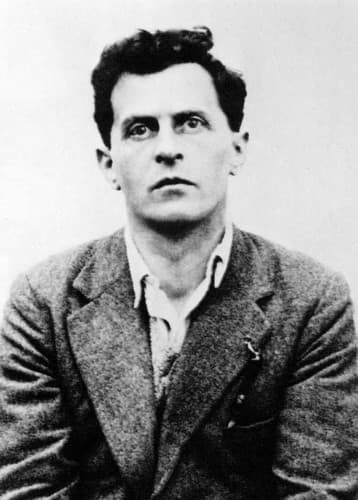
Ludwig Wittgenstein was an Austrian philosopher active in the early to mid-20th century, primarily known for his work in the philosophy of language and mind. His notable work, "Philosophical Investigations," explores the nature of meaning and understanding in language, significantly influencing contemporary philosophy.
Similar books
- The Perks of Being a Wallflower
Stephen Chbosky
4.2 (1.3M) average on GoodreadsPsychologyThrough letters, a shy high school freshman learns to navigate first love, trauma, and self-discovery, stepping off the sidelines and into life.
- Eleanor Oliphant Is Completely Fine
Gail Honeyman
4.3 (708k) average on GoodreadsLiterary FictionA lonely woman's structured life changes when an IT guy and an elderly man help her learn to open her heart.
- One Flew Over the Cuckoo's Nest
Ken Kesey
4.2 (631k) average on GoodreadsPsychologyIn a mind-bending asylum, the boisterous Randle McMurphy wages a defiant war against the tyrannical Nurse Ratched, inspiring his fellow inmates, including the seemingly catatonic Chief Bromden, to reclaim their lost humanity.
- The Bell Jar
Sylvia Plath
4.0 (591k) average on GoodreadsPsychologyIn the suffocating grip of 1950s expectations, a brilliant young woman's descent into mental illness is painted with such vivid, internal clarity that her 'insanity' feels terrifyingly rational and inevitable.
- The Subtle Art of Not Giving a F*ck: A Counterintuitive Approach to Living a Good Life
Mark Manson
3.9 (530k) average on GoodreadsBusinessEmbrace your flaws and stomach life's lemons, because true happiness isn't about relentless positivity, but about choosing what truly matters to give a f*ck about.
- Sapiens: A Brief History of Humankind
Yuval Noah Harari
4.4 (502k) average on GoodreadsPsychologySapiens tells the story of Homo sapiens, showing how our ability to create shared fictions helped us go from an ordinary ape to the planet's main species, changing Earth and our future.






Enjoyed the summary?
A summary gives you the shape of the book. The book itself has the detail, the examples and the voice.
Find Philosophical Investigations on AmazonAs an Amazon Associate, BookBrief earns from qualifying purchases. How we're funded