
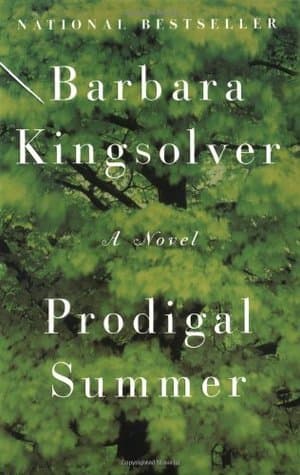
Synopsis
Covers the whole plot, including the ending.
- Difficulty
- Medium
- Pacing
- Moderate
- Mood
- Atmospheric, Reflective, Thought-provoking, Earthy
- Read it if
- You enjoy rich, character-driven literary fiction with strong environmental themes, set in a vividly described natural landscape, and appreciate stories that explore the intersection of human lives and the natural world.
- Skip it if
- You prefer fast-paced plots, high-stakes thrillers, or stories without explicit environmental or philosophical undertones.
Prodigal Summer Plot Summary
Covers the whole plot, including the ending.
Deanna's Solitude Interrupted
Deanna Wolfe, a wildlife biologist, lives alone in a cabin on Zebulon Mountain in Appalachia. She spends her summer watching a den of coyotes, new to the area. She studies their behavior and diet, seeing their importance in the ecosystem. Her quiet time ends when Eddie Bondo, a young hunter, appears on her land. Eddie, at first seen as an intruder, says he is hunting turkey. He is interested in Deanna's work and independent life. Their first meetings show suspicion and different views on nature and human involvement. Deanna protects her privacy and scientific distance.
Lusa's Unexpected Widowhood and Farm Stewardship
Lusa Maluf Landowski, an entomologist from the city, becomes a widow after her husband, Cole Landowski, dies in a logging accident. She is left to manage his tobacco farm, a world she barely knows, with her two young children, Codi and Lark. Cole's family, especially his sisters, push her to sell the farm and move back to the city, thinking she cannot run it. Lusa, however, feels a strong connection to the land and Cole's past. She learns about farming, dealing with tobacco growing, money problems, and local expectations. She wants to keep the farm for her children and honor Cole's memory.
Hatchet and Garnett's Feud Over Fruit Trees
Near Lusa's farm, two older neighbors, Garnett Walker and Nannie Rawley (called Hatchet), have a long, often difficult, friendship. Their main problem this summer is Garnett's old apple trees, which are sick with disease and insects. Garnett, a religious man and traditional farmer, uses pesticides. He blames the 'fallen' world. Hatchet, an environmentalist and 'pagan,' supports organic methods and ecological balance. She sees the trees as part of a bigger system. Their talks, often heated, cover faith, science, nature, and community.
Deanna and Eddie's Growing Connection
Despite her first resistance, Deanna is drawn to Eddie Bondo's constant presence and real interest. He helps her with tasks around her cabin and shows a surprising understanding of nature, though from a hunter's view. Deanna shares her scientific knowledge of coyotes and the ecosystem. Their talks and time in the wild lead to a close physical and emotional relationship. Deanna, who has kept her personal life separate from her science, finds her strict limits challenged by Eddie's energy and directness. This makes her face her own desires and weaknesses.
Lusa's Struggle for Independence and Understanding
Lusa struggles to understand tobacco farming and the local market. She talks to farm agents, reads books, and asks neighbors, including Hatchet and Garnett, for advice. Her in-laws, especially Cole's sisters, keep pushing her to sell, making her doubt herself. Lusa finds Cole secretly planted chestnut trees, a sign of his hope for the future and a possible new crop. This discovery makes her more determined to keep the farm and try sustainable options, despite the many problems and her ongoing sadness for Cole.
Hatchet and Garnett's Shared History and Future
As summer goes on, Hatchet and Garnett's arguments continue, but their hidden affection and shared past become clearer. They remember their youth, changes in the valley, and their lives. Hatchet keeps pushing for natural pest control and tells Garnett to think about his orchard's long-term health. Garnett, though unwilling, starts to see some sense in Hatchet's ideas as his trees get worse. Their interactions show the conflict between old farming ways and new environmental awareness, and the strong ties of community.
Deanna's Revelation and Eddie's Departure
Deanna learns that Eddie Bondo is not just a casual hunter. He is a professional coyote hunter, hired by local farmers to kill the very animals she studies. This news breaks her trust and makes her rethink their whole relationship. The conflict between their basic views on nature — saving it versus controlling it — cannot be solved. Despite the pain, Deanna confronts Eddie, and he leaves. This experience leaves Deanna heartbroken but also more dedicated to her work and her understanding of nature's complex, often harsh, balance.
Lusa's New Vision for the Farm
Inspired by Cole's hidden chestnut trees and new knowledge, Lusa decides to change the farm from tobacco. She imagines a future with sustainable farming, perhaps growing chestnuts or other native crops. This decision puts her against Cole's family, who see it as a foolish risk. But it strengthens her commitment to the land and her children's future. She starts the hard work of removing tobacco plants and preparing the soil for new projects, showing she is embracing a new life and identity as a farmer.
Hatchet and Garnett's Reconciliation and Legacy
After much discussion, Garnett, influenced by Hatchet's constant arguments and his own observations of his dying trees, agrees to try Hatchet's organic methods. He lets her bring in good insects and ecological management for his orchard. This is a big change for Garnett, showing he is open to a more complete view of nature. Their making up strengthens their bond and ensures the orchard's future health, a shared legacy. This shows that cooperation and change are possible even in old age.
The Interconnected Web of Life
As summer ends, Deanna, though alone again, finds new purpose in her coyote research. She understands that even loss is part of nature's cycle. Lusa, having dealt with grief and uncertainty, feels connected to her farm. She takes on her role as a protector of the land and a provider for her children. Hatchet and Garnett, having overcome their different ideas, continue their shared work on the orchard. This shows that human relationships, like ecosystems, need balance and respect. The three stories come together in their themes, showing how human lives and the natural world in the Appalachian mountains depend on each other.
Principal Figures
Deanna Wolfe
Protagonist
Reclusive wildlife biologist studying coyotes on Zebulon Mountain.
Deanna is a fiercely independent and intelligent wildlife biologist who has chosen a life of scientific observation and solitude. She is deeply committed to her work studying coyotes and understanding the complex dynamics of the Appalachian ecosystem. Her past experiences, including a difficult relationship with her father, have led her to guard her emotions and prioritize intellectual pursuits over personal connections. She initially views the natural world with scientific detachment but her experiences, particularly with Eddie Bondo, challenge her to confront her own humanity and place within that ecosystem. She is a symbol of scientific inquiry and environmental dedication.
Relationships: Eddie Bondo (lover, intellectual sparring partner, ultimately a source of disillusionment); Her Father (strained, influential on her reclusive nature)
Lusa Maluf Landowski
Protagonist
City-bred entomologist who inherits a tobacco farm after her husband's death.
Lusa is an intelligent and bookish entomologist from a city background who finds herself unexpectedly widowed and marooned on her late husband Cole's tobacco farm. Initially overwhelmed and out of her element, she is pressured by her in-laws to sell the farm. However, Lusa develops a deep, spiritual connection to the land and Cole's legacy. She is driven by a desire to honor her husband and provide a stable future for her children, Codi and Lark. She embarks on a journey of self-discovery, learning about farming, local ecology, and her own resilience, ultimately choosing a path of sustainable agriculture.
Relationships: Cole Landowski (late husband, his memory and legacy drive her); Codi and Lark Landowski (her young children, her motivation for the farm); Cole's Sisters (antagonistic, pressure her to sell the farm); Hatchet (Nannie Rawley) (mentor, source of ecological wisdom)
Nannie Rawley (Hatchet)
Supporting
Elderly, opinionated organic farmer and environmentalist.
Nannie Rawley, affectionately known as Hatchet, is an elderly, sharp-witted woman who lives on a small farm near Garnett Walker. She is a staunch advocate for organic farming, ecological balance, and a more 'pagan' or nature-centric worldview, often clashing with Garnett's traditional Christian views. She is deeply knowledgeable about plants, insects, and natural cycles, and her philosophy emphasizes the interconnectedness of all life. Hatchet serves as a mentor figure for Lusa and a foil for Garnett, pushing him to reconsider his agricultural practices and beliefs. She represents indigenous wisdom and environmental consciousness.
Relationships: Garnett Walker (long-time neighbor, sparring partner, and friend); Lusa Maluf Landowski (mentor, shares ecological knowledge)
Garnett Walker
Supporting
Elderly, traditional farmer and devout Christian.
Garnett Walker is an elderly, traditional farmer and a devout Christian who lives next to Hatchet. He believes in conventional farming methods, including the use of pesticides, and interprets natural phenomena through a lens of Christian theology, often attributing problems to 'the Fall.' He is stubborn and set in his ways but possesses a deep love for his land and his community. His ongoing debates with Hatchet are central to the novel's exploration of conflicting worldviews regarding nature and faith. Despite their disagreements, he and Hatchet share a profound, enduring friendship and mutual respect.
Relationships: Nannie Rawley (Hatchet) (long-time neighbor, sparring partner, and friend)
Eddie Bondo
Supporting
Young, charismatic coyote hunter who challenges Deanna's solitude.
Eddie Bondo is a young, charismatic, and seemingly free-spirited hunter who encounters Deanna Wolfe. He is intelligent and observant, capable of charming Deanna and initially bridging the gap between their differing perspectives on nature. However, his true profession as a professional coyote hunter reveals a fundamental conflict with Deanna's conservationist ethics. Eddie represents the human impulse to control and exploit nature, even while appreciating its beauty. His presence forces Deanna to confront her own vulnerabilities and the complex, often contradictory, relationship humans have with the wild.
Relationships: Deanna Wolfe (lover, intellectual sparring partner, ultimately a source of disillusionment)
Cole Landowski
Mentioned
Lusa's deceased husband, whose legacy influences her choices.
Cole is Lusa's late husband, whose sudden death in a logging accident sets much of Lusa's story in motion. Though deceased, his presence is strongly felt through Lusa's memories, his family's expectations, and especially through his farm. He was a man deeply connected to the land, who harbored dreams of sustainable agriculture, evidenced by his secret planting of chestnut trees. His legacy inspires Lusa to stay on the farm and pursue a more ecological path, representing a bridge between traditional farming and a more environmentally conscious future.
Relationships: Lusa Maluf Landowski (wife, his memory is her motivation); Codi and Lark Landowski (his children)
Codi Landowski
Supporting
Lusa's young daughter, who is curious about the farm and nature.
Codi is Lusa's young daughter. She is observant and curious, often asking questions about the natural world around the farm. Her presence, along with her younger brother Lark, grounds Lusa's decisions and provides a tangible reason for her to fight for the farm's future. Codi represents the next generation who will inherit the land and the consequences of current environmental choices. Her innocence and wonder often highlight the beauty and harshness of rural life.
Relationships: Lusa Maluf Landowski (mother); Lark Landowski (brother)
Lark Landowski
Supporting
Lusa's young son.
Lark is Lusa's young son and Codi's younger brother. Still a baby, he is less developed as a character than Codi, but his vulnerability reinforces Lusa's maternal drive to create a secure and healthy environment on the farm. He represents the future and the need for a sustainable world for generations to come. His innocence is a powerful motivator for Lusa to make difficult choices for the farm's longevity.
Relationships: Lusa Maluf Landowski (mother); Codi Landowski (sister)
Cole's Sisters (e.g., Betty and Carol)
Supporting
Lusa's overbearing in-laws who want her to sell the farm.
Cole's sisters are traditional, often judgmental, women who represent the conservative forces within the local community. They believe Lusa, as a city girl, is incapable of running the farm and constantly pressure her to sell it and return to her urban life. Their interference creates significant external conflict for Lusa, highlighting the challenges of integrating into a new culture and asserting independence. They embody a narrow-minded perspective that struggles to accept change or unconventional choices.
Relationships: Lusa Maluf Landowski (antagonistic, in-laws)
Themes & Insights
Interconnectedness of Nature and Humanity
Kingsolver shows how all life, human and non-human, is connected. Deanna's coyote studies show the predators' important role in the ecosystem. Lusa's journey shows her reliance on the soil, weather, and insects. Hatchet and Garnett's talks about organic farming versus pesticides show how human choices affect the environment. The book argues that understanding and respecting these connections are key for survival and well-being. It says that people are not separate from nature but a part of its balance.
“What happens to the land, happens to us. We are one. We are the land.”
Stewardship and Sustainability
The idea of being a good land steward is central, especially through Lusa's efforts to manage her farm and Hatchet's support for organic methods. Lusa's choice to switch from tobacco to chestnuts shows a move toward sustainable practices that respect the land instead of using it up. Deanna's scientific work also supports protecting natural places. The book compares old, often harmful, farming ways with a more thoughtful, long-term approach to living with the environment. It supports a future where people care for nature instead of conquering it.
“The land is not yours, it's borrowed. You're just passing through.”
Conflict of Science, Faith, and Tradition
The book looks at the conflict between different ways of seeing the world. Deanna represents science and protecting nature. Garnett represents traditional Christian faith and standard farming, often seeing natural problems as God's judgment. Hatchet offers a different, nature-based spirituality and organic knowledge. These views clash in talks about pesticides, coyotes, and human duty. The book suggests that even if these views seem opposite, they can be combined and people can learn from each other, as seen when Garnett becomes open to Hatchet's methods.
“God gave us dominion over the beasts of the field. He didn't say make friends with them.”
Love and Connection in Isolation
Despite the isolation some characters feel, the book explores different kinds of love and connection. Deanna's unexpected romance with Eddie Bondo, Lusa's lasting love for Cole and her children, and the deep, often difficult, friendship between Hatchet and Garnett all show people's need for company. These relationships, whether short or long, help the characters deal with their problems and understand themselves better. Love for the land itself also strongly connects the characters to their environment and to each other.
“Loneliness was a kind of hunger, and it had been a long time since she'd eaten.”
Adaptation and Resilience
Each character faces big challenges that require them to change. Lusa must adjust to being a widow and to farm life, learning new skills and taking on a new identity. Deanna must adjust to her broken solitude and the emotional impact of her relationship with Eddie. Hatchet and Garnett, despite their age, must change their old views to find common ground for the orchard's future. The coyotes themselves show change, having moved into new territory. The book celebrates how both people and nature can survive, change, and find new ways to thrive when things are difficult.
“Sometimes you have to let go of what you think you are, to become what you will be.”
Plot Devices & Literary Techniques
Interwoven Narratives
Three distinct storylines that parallel and converge thematically.
The novel employs three seemingly separate narratives – Deanna's, Lusa's, and Hatchet/Garnett's – which are initially distinct but are geographically proximate and thematically linked. This structure allows Kingsolver to explore different facets of human interaction with nature across varying life stages and perspectives. While the characters rarely physically interact, their stories echo and reinforce the novel's central themes, creating a rich, multi-layered tapestry of life in Appalachia. This device emphasizes the interconnectedness of individuals within a shared ecosystem, even when they are unaware of each other.
Symbolism of Coyotes
Representing adaptation, wildness, and ecological balance.
The coyotes that Deanna studies are a powerful symbol throughout the novel. As new arrivals to the Appalachian ecosystem, they represent adaptation, resilience, and the ever-changing nature of the wild. They challenge established notions of predator control and force humans to reconsider their place in the food chain. For Deanna, they embody her scientific pursuit and the wild spirit she both admires and struggles to understand. Their presence also highlights the conflict between conservation and human intervention, as they are both studied by Deanna and hunted by Eddie.
Symbolism of the Chestnut Trees
Representing hope, legacy, and ecological restoration.
Cole Landowski's secret planting of American chestnut trees on his farm is a potent symbol of hope, foresight, and ecological restoration. The American chestnut was decimated by blight in the early 20th century, making Cole's efforts to reintroduce them a long-term, visionary act. For Lusa, discovering these trees provides a tangible connection to her late husband's dreams and inspires her to transition the farm towards sustainable agriculture. They symbolize a commitment to a healthier future for the land and the possibility of recovering what was lost through mindful stewardship.
Nature as Character/Setting
The Appalachian environment is an active force and integral to character development.
The natural environment of the Appalachian mountains is far more than just a backdrop; it functions as a central character in the novel. The flora, fauna, weather patterns, and ecological processes actively shape the characters' lives, decisions, and worldviews. Deanna's work is entirely dictated by it, Lusa's struggle is with it, and Hatchet and Garnett's debates are about it. Kingsolver uses vivid, detailed descriptions of the natural world to immerse the reader and reinforce the theme of interconnectedness, demonstrating how human identity and fate are inextricably linked to the land.
Prodigal Summer Quotes
“Solitude is a human presumption. Every quiet step is thunder to beetle life underfoot, a tug of impalpable thread on the web pulling mate to mate and predator to prey, a beginning or an end.”
“What on earth would she do with a man? She had a life. She had a job. She had a dog.”
“The very least you can do in your life is to figure out what you hope for. And the most you can do is live inside that hope.”
“Everything you're sure is right can be wrong in another place.”
“There is no point in saving a world that has no soul.”
“Love is not a transaction. It's a leap of faith.”
“The forest was a place of such intricate beauty it seemed impossible that it could be so without design.”
“You can't save everything, but you can save something.”
“A weed is just a plant growing where you don't want it to.”
“The body remembers what the mind forgets.”
“In nature, nothing is perfect and everything is perfect.”
“We are all just passing through, borrowing the land from our children.”
“Sometimes the hardest thing and the right thing are the same.”
“The coyote's howl is not a lament; it is a declaration of territory.”
Quiz
10 questions on the plot and the characters. Each answer comes with a short explanation.
Question 1
What is Deanna Wolfe's profession in 'Prodigal Summer'?
- A farmer
- A wildlife biologist
- A schoolteacher
- A hunter
Show answer
B. A wildlife biologist Deanna Wolfe is a reclusive wildlife biologist who lives in an isolated mountain cabin, studying coyotes that have migrated into the Appalachian region.
Question 2
What animal species is Deanna Wolfe particularly focused on observing in the novel?
- Black bears
- White-tailed deer
- Coyotes
- Wild turkeys
Show answer
C. Coyotes Deanna watches a den of coyotes that have recently migrated into the southern Appalachian mountains, which becomes central to her story and the novel's ecological themes.
Question 3
How does Lusa Maluf Landowski come to live on the farm in Appalachia?
- She inherits it from a distant relative
- She buys it as an investment
- She marries a farmer and moves there
- She wins it in a contest
Show answer
C. She marries a farmer and moves there Lusa is a bookish city girl who becomes a farmer's wife after marrying Cole Widener. After his unexpected death, she finds herself 'marooned' on the farm and must decide whether to stay connected to the land.
Question 4
What disrupts Deanna Wolfe's solitary life in her mountain cabin?
- A forest fire
- The arrival of a young hunter
- A family emergency
- A government inspection
Show answer
B. The arrival of a young hunter Deanna's isolated existence is interrupted when a young hunter named Eddie Bondo invades her private spaces, leading to a complex relationship that challenges her self-assured solitude.
Question 5
What is a primary point of contention between the elderly feuding neighbors, Garnett Walker and Nannie Rawley?
- Property boundaries
- Family inheritance
- The use of pesticides
- Political affiliations
Show answer
C. The use of pesticides Garnett and Nannie frequently argue about God, pesticides, and their differing approaches to farming. Garnett uses chemical pesticides while Nannie practices organic methods, reflecting the novel's themes of ecology and human intervention in nature.
Question 6
What significant life event forces Lusa to reconsider her future on the farm?
- A drought that ruins the crops
- The death of her husband
- A falling out with her in-laws
- A tempting job offer back in the city
Show answer
B. The death of her husband After her husband Cole's sudden death, Lusa must decide whether to leave the farm or develop her own attachment to the land and community, which becomes a central struggle in her storyline.
Question 7
Which of the following best describes how the three main storylines in 'Prodigal Summer' are connected?
- The characters are all related by blood
- They all work for the same conservation organization
- They inhabit the same Appalachian region and their lives intersect thematically
- They are connected through a series of letters
Show answer
C. They inhabit the same Appalachian region and their lives intersect thematically The three stories—Deanna's, Lusa's, and the elderly neighbors'—are set in the same southern Appalachian region over one summer. While they don't all interact directly, their lives are woven together through shared themes of ecology, love, and human connection to nature.
Question 8
What does the title 'Prodigal Summer' metaphorically refer to in the context of the novel?
- A summer of economic hardship
- A season of abundant wildlife and returning migrants
- A period of religious revival
- A time of technological innovation
Show answer
B. A season of abundant wildlife and returning migrants The title plays on the biblical parable of the prodigal son, suggesting a season of return and abundance—particularly referring to the coyotes migrating back to the region and the characters' own returns to connection with nature and each other.
Question 9
How does Eddie Bondo's presence challenge Deanna's scientific perspective?
- He questions her data collection methods
- He represents a hunting ethos that conflicts with her conservation values
- He proves her coyote research theories wrong
- He convinces her to leave her research for city life
Show answer
B. He represents a hunting ethos that conflicts with her conservation values As a hunter, Eddie represents human intervention that often conflicts with Deanna's conservationist approach. Their relationship forces her to confront the complexities of human-nature interactions beyond pure scientific observation.
Question 10
What broader ecological theme is explored through the parallel stories of human relationships and natural phenomena in the novel?
- The inevitability of climate change
- The interconnectedness of all living things
- The superiority of human intelligence over nature
- The economic benefits of industrial farming
Show answer
B. The interconnectedness of all living things Kingsolver weaves together human dramas with natural events (like coyote migration, plant pollination, and seasonal changes) to illustrate how human lives are deeply interconnected with ecological systems—a central theme throughout the novel.
Prodigal Summer FAQ
What is 'Prodigal Summer' about?
'Prodigal Summer' follows three interconnected stories set in southern Appalachia during one humid summer. Deanna Wolfe, a wildlife biologist, monitors coyotes while confronting her solitude when a hunter enters her life; Lusa Maluf Landowski, a city-bred widow, struggles to maintain her farm and find belonging; and elderly neighbors Garnett Walker and Nannie Rawley feud over farming methods while secretly depending on each other.
Why should I read 'Prodigal Summer'?
The novel offers a rich exploration of human relationships intertwined with ecological themes, blending compelling character dramas with insights into nature's interconnectedness. Kingsolver's lyrical prose and deep empathy for both her characters and the Appalachian landscape create a immersive reading experience that balances intellectual depth with emotional resonance.
What is the background/setting of 'Prodigal Summer'?
The story unfolds in the forested mountains and struggling small farms of southern Appalachia during a single humid summer. This rural setting becomes a character itself, with its coyote migrations, tobacco farms, apple orchards, and intricate ecosystems shaping the characters' lives and conflicts.
What are the most memorable quotes?
Key quotes include Deanna's ecological insight: 'Everything alive is connected to every other by fine, invisible threads,' and Garnett's reflection on change: 'The very least you can do in your life is to figure out what you hope for. The most you can do is live inside that hope.' These capture the novel's themes of interconnection and personal transformation.
What writing style does Barbara Kingsolver use?
Kingsolver employs lyrical, descriptive prose that vividly brings the Appalachian setting to life while weaving scientific concepts about ecology seamlessly into the narrative. Her style balances multiple perspectives through alternating chapters, creating a polyphonic story that mirrors the biological interconnectedness the novel explores.
What minor details add significant meaning?
The monarch butterflies Lusa studies symbolize transformation and migration, mirroring her own journey. Garnett's heirloom apple trees represent tradition versus innovation in farming. The coyotes' predation patterns that Deanna documents metaphorically reflect human territorial behaviors and the novel's themes of balance.
What are some subtle foreshadowing moments?
Early mentions of Lusa's knowledge of moths foreshadow her eventual economic salvation through rare moth specimens. Deanna's initial resistance to Eddie Bondo hints at their inevitable attraction through shared predator-prey observations. Nannie's persistent offers of zucchini to Garnett subtly foreshadow their growing interdependence.
What unexpected character connections exist?
Though living miles apart, all characters are connected through the land: Deanna's coyotes eventually wander near Lusa's farm, while Garnett and Nannie's feud impacts both women's lives. Lusa discovers her late husband's family secretly admired her city background, and Eddie Bondo's hunting ultimately serves Deanna's research in unexpected ways.
What are unspoken character motivations?
Deanna's fierce protection of the coyotes masks her fear of human intimacy. Lusa's determination to farm stems from wanting to honor her husband's memory while proving herself to his skeptical family. Garnett's pesticide advocacy conceals his grief over his wife's death and resistance to change, while Nannie's organic farming represents her rebellion against traditional gender roles.
What psychological complexities do characters exhibit?
Deanna embodies the tension between scientific detachment and emotional engagement, struggling to maintain objectivity about the coyotes while falling for Eddie. Lusa grapples with imposter syndrome as an outsider in Appalachian culture while discovering inner resilience. Garnett and Nannie's feud masks deep affection and mutual dependence developed through years of lonely adjacency.
What are the major emotional turning points?
Deanna's decision not to report Eddie's coyote killing marks her acceptance of nature's complexity. Lusa discovering the valuable moths in her barn represents her economic and emotional salvation. Garnett finally accepting Nannie's help with his apples symbolizes his surrender to interdependence. Each character's relationship to the land fundamentally shifts through these moments.
How do relationship dynamics evolve?
Deanna and Eddie move from adversarial hunter-biologist to lovers who fundamentally disagree but deeply understand each other. Lusa transforms from resented outsider to respected family matriarch through her farming innovations. Garnett and Nannie's decades-long feud gradually reveals itself as their primary human connection, evolving into cautious friendship and unacknowledged dependence.
Which parts remain ambiguous or open-ended?
The novel leaves Deanna and Eddie's future relationship uncertain—whether their philosophical differences about hunting are reconcilable. Lusa's long-term success with her farm remains open, as does whether Garnett will fully embrace organic methods. The coyotes' ultimate impact on the ecosystem is presented as an ongoing question rather than resolved conclusion.
What are controversial scenes or decisions?
Eddie's coyote killing creates moral tension between conservation and traditional hunting rights. Lusa's decision to sell the family tobacco allotment against tradition divides the community. Garnett's pesticide use versus Nannie's organic methods debate environmental ethics. Deanna's sexual relationship with Eddie despite their professional conflict raises questions about objectivity versus passion.
'Prodigal Summer' ending explained: how it ends & what it means
The novel concludes with all characters finding new equilibrium: Deanna accepts Eddie's departure while continuing her work, Lusa secures her farm's future through moth specimens, and Garnett and Nannie reach tentative harmony. The ending suggests that human relationships, like ecosystems, require constant negotiation and that 'prodigal' means both wasteful and abundantly returning—like the summer's relentless fertility.
What ecological themes are woven through the human stories?
Kingsolver parallels human relationships with ecological systems: Deanna's coyote research mirrors human territorial behavior, Lusa's farming innovations demonstrate adaptation like species evolution, and Garnett and Nannie's feud reflects predator-prey dynamics. The novel argues that human communities function as ecosystems requiring balance between competition and cooperation.
How does the Appalachian setting function as more than backdrop?
The mountains and farms actively shape the plot: the coyote migration drives Deanna's story, the poor farmland forces Lusa's innovation, and the isolated landscape intensifies Garnett and Nannie's dependence. The setting becomes a testing ground for characters' relationships with nature and each other, with the humid summer accelerating both biological and emotional processes.
What role does grief play in character development?
Lusa's widowhood forces her to reinvent herself, Garnett's mourning manifests as resistance to change, and Deanna's isolation stems from past relationship losses. Each character's grief initially separates them from community but ultimately drives them toward new connections—with the land, animals, and each other—demonstrating Kingsolver's theme of regeneration through loss.
About the author

Barbara Kingsolver is a Pulitzer Prize winning American novelist, essayist and poet. She was raised in rural Kentucky and lived briefly in the Congo in her early childhood. Kingsolver earned degrees in biology at DePauw University and the University of Arizona and worked as a freelance writer before she began writing novels. Her widely known works include The Poisonwood Bible, the tale of a missionary family in the Congo, and Animal, Vegetable, Miracle, a non-fiction account of her family's attempts to eat locally.
Similar books
- Flight Behavior
Barbara Kingsolver
3.8 (83k) average on GoodreadsLiterary FictionExplores environmental themes and human connection in Appalachia with a focus on scientific observation and personal struggle.
- Where the Crawdads Sing
Delia Owens
4.5 (975k) average on GoodreadsHistorical FictionFeatures a strong sense of place in a natural setting, with a focus on a solitary woman's connection to nature and human relationships.
- The Overstory
Richard Powers
4.1 (73k) average on GoodreadsLiterary FictionInterweaves multiple human stories with a profound exploration of trees, nature, and environmental activism.
- The Old Man and the Sea
Ernest Hemingway
3.8 (831k) average on GoodreadsLiterary FictionA Cuban fisherman's long struggle with a giant marlin becomes a story of endurance and dignity, now retold for young adults with illustrations, phonetic guides, and writing prompts in Traditional Chinese.
- One Hundred Years of Solitude
Gabriel García Márquez
4.1 (753k) average on GoodreadsLiterary FictionThrough the multi-generational story of the Buendía family, a mythical town deals with the repeating patterns of time, love, and solitude, as the extraordinary mixes with the ordinary.
- The Goldfinch
Donna Tartt
3.9 (720k) average on GoodreadsLiterary FictionHaunted by a tragic explosion and clutching a stolen Dutch masterpiece, a young orphan navigates the opulent drawing rooms of New York and the gritty underbelly of the art world, desperately seeking connection and redemption amidst a life spiraling into crime and obsession.





Enjoyed the summary?
A summary gives you the shape of the book. The book itself has the detail, the examples and the voice.
Find Prodigal Summer on AmazonAs an Amazon Associate, BookBrief earns from qualifying purchases. How we're funded