
Core Idea
- Difficulty
- Medium
- Read it if
- You are interested in a raw, unflinching exploration of a young Black woman's journey through mental health struggles, toxic relationships, and the search for self-acceptance in contemporary London, with a focus on intersectional identity.
- Skip it if
- You prefer books with a light tone, avoid narratives with explicit sexual content and detailed descriptions of trauma, or are not prepared for a protagonist who makes many difficult and at times frustrating choices.
Key Takeaways from Queenie
The Peril of Seeking Validation Externally
Queenie's tumultuous journey highlights the dangers of defining self-worth through others, especially in relationships.
Queenie's story shows the effects of seeking external validation, particularly from romantic partners. After her breakup with Tom, she has a series of ill-advised sexual encounters, each one lowering her self-esteem. These encounters, often with unavailable or exploitative men, temporarily ease her pain but ultimately deepen her sense of worthlessness. Her desperate need to feel desired and seen by men, even at the cost of her own well-being, shows a disconnect from her intrinsic value. This constant search for approval from others, rather than self-love, leaves her vulnerable and continues a cycle of disappointment and self-sabotage. The book argues that true self-worth must come from within, not from how others perceive or treat you.
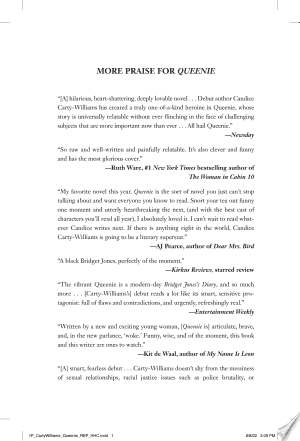
“What are you doing? Why are you doing it? Who do you want to be?”
In the book: Queenie's repeated engagements with 'hazardous men' post-breakup, such as the married man or the 'casual' encounters where she feels used, are central to this theme. Each interaction, rather than providing comfort, leaves her feeling more isolated and less worthy.
Try this: Cultivate a strong internal locus of control for self-worth. Practice mindfulness to identify when you're seeking external validation. Engage in activities that genuinely make you feel good about yourself, independent of others' opinions. Prioritize self-care and set firm boundaries in relationships to protect your emotional well-being.
Related ideas: self-worth, external-validation, self-sabotage, emotional-dependency
Navigating Intersectional Identity
Queenie grapples with the complexities of being a Black British woman, feeling 'othered' in both professional and personal spheres.
Queenie's experience is shaped by her identity as a Jamaican British woman in London. At her workplace, a national newspaper, she feels pressure to conform to white, middle-class norms, leading to feelings of inadequacy and invisibility. Her colleagues' microaggressions and lack of understanding about her culture show the reach of systemic racism, even in seemingly progressive environments. This sense of 'otherness' extends to her personal life, where she struggles to find full acceptance. The novel explores the psychological cost of navigating spaces where one's identity is questioned or overlooked, forcing Queenie to internalize societal biases and struggle with belonging. It comments on the challenges faced by women of color in contemporary society.
“straddling two cultures and slotting neatly into neither.”
In the book: Queenie's interactions with her white colleagues at the newspaper, where she feels she has to work harder to prove herself or explain her cultural references. Her internal monologues about feeling 'too Black' for some spaces and 'not Black enough' for others.
Try this: For individuals, seek out and build communities that affirm your full identity. For organizations, actively promote diversity and inclusion, ensuring cultural competency training and creating safe spaces for employees from marginalized backgrounds. Challenge microaggressions and advocate for equitable representation.
Related ideas: intersectionality, cultural-identity, microaggressions, systemic-racism, belonging
The Power of Female Friendship
Queenie's 'Corgis' offer a vital, albeit sometimes challenging, support system through her darkest moments.
Among Queenie's tumultuous romantic life and professional struggles, her female friends, the 'Corgis,' become a lifeline. These women, despite their own struggles and occasional disagreements with Queenie's choices, provide emotional support, tough love, and a sense of belonging. They are her sounding board, her cheerleaders, and her moral compass, often telling her difficult truths. Their collective strength and loyalty show the importance of platonic female relationships in modern life. They remind Queenie of her worth, even when she forgets it, and their presence keeps her from completely spiraling, showing the healing power of genuine sisterhood.
“A must-read novel about sex, selfhood, and the best friendships that get us through it all.”
In the book: The regular group chats and meetups with her friends, who offer advice, comfort, and sometimes direct criticism about her poor choices, but always with underlying love and support. Their intervention when Queenie is at her lowest point.
Try this: Actively nurture and invest in your close female friendships. Be a supportive and honest friend, offering both empathy and constructive feedback when needed. Prioritize quality time and open communication with your chosen 'sisters' to build a strong, resilient support network.
Related ideas: female-friendship, support-system, sisterhood, emotional-support, platonic-love
The Unseen Scars of Trauma
Queenie's childhood trauma subtly influences her adult patterns of seeking unhealthy relationships and avoiding intimacy.
While not directly stated as the only cause, Queenie's difficult childhood, especially the absence of a stable father and a complex relationship with her mother, affects her adult behavior. Her constant search for validation from men, her difficulty forming healthy attachments, and her willingness to accept less than she deserves can be traced to these early experiences. The novel suggests that unresolved childhood trauma appears in various ways, often leading to self-destructive patterns and a fear of intimacy. Queenie's inability to confront these underlying issues initially keeps her from breaking free from her cycle of poor choices, showing how past wounds can dictate present actions until acknowledged and healed. The book implies the importance of addressing foundational emotional pain for genuine healing and growth.
“I am hooked.”
In the book: Queenie's flashbacks and internal reflections on her childhood, particularly her strained relationship with her mother and the recurring theme of abandonment, which are subtly linked to her adult relationship patterns and her struggle with self-worth.
Try this: Engage in self-reflection or therapy to identify and process past traumas. Recognize how childhood experiences might be influencing current behaviors and relationship patterns. Develop healthier coping mechanisms and seek secure attachment in relationships by building trust and open communication.
Related ideas: childhood-trauma, attachment-theory, self-destructive-patterns, intimacy-issues, emotional-healing
The Burden of Being a 'Strong Black Woman'
Queenie struggles under the societal expectation to be resilient, often suppressing her vulnerability and pain.
Queenie shows the unspoken pressure many Black women face to be strong and resilient, often at the expense of their emotional well-being. She internalizes the idea that she must always appear capable and independent, even when she is falling apart. This societal expectation prevents her from openly expressing vulnerability, seeking help, or acknowledging her pain, leading to unaddressed emotional turmoil. Her attempts to 'handle it all' on her own, especially her messy romantic life, worsen her struggles. The novel critiques this harmful trope, revealing how it isolates women and prevents them from getting the support they need. It calls for acknowledging the full humanity of Black women, allowing them space for fragility and healing without judgment.
“Her search for love and found something very different in its place.”
In the book: Queenie's reluctance to fully confide in her family or even some friends about the depth of her struggles, often putting on a brave face. Her internal battles with loneliness and despair, which she tries to hide from the outside world.
Try this: Challenge the 'strong Black woman' narrative by normalizing vulnerability and seeking support. Encourage open dialogue about mental health within communities of color. Practice self-compassion and allow yourself to lean on others when needed, recognizing that asking for help is a sign of strength, not weakness.
Related ideas: strong-black-woman-trope, vulnerability, mental-health-stigma, emotional-resilience, self-compassion
The Complexities of Modern Dating Culture
Queenie's experiences highlight the often-toxic landscape of casual sex and the search for meaningful connection.
The novel looks at the confusing and often damaging realities of modern dating, particularly casual sex and its impact on emotional well-being. Queenie's post-breakup entry into non-committal sexual encounters, driven by a desire for connection and validation, consistently leaves her feeling empty and used. The men she meets are often emotionally unavailable, disrespectful, or exploitative, reflecting a cultural trend where intimacy is sacrificed for fleeting physical gratification. This exploration critiques a dating landscape that can be harsh for women, especially women of color, who navigate additional layers of fetishization and prejudice. It shows the difficulty of finding authentic connection in an environment of superficial interactions, and the toll it takes on self-esteem and mental health.
“Queenie seeks comfort in all the wrong places…including several hazardous men.”
In the book: The detailed descriptions of Queenie's various sexual encounters, none of which provide her with the emotional fulfillment she craves, and often leave her feeling worse about herself. The casual dismissiveness of many of the men she dates.
Try this: Prioritize your emotional well-being over fleeting physical gratification in dating. Be clear about your intentions and boundaries. Seek partners who respect you and are capable of genuine emotional connection. Don't be afraid to disengage from relationships that consistently leave you feeling devalued.
Related ideas: modern-dating, casual-sex, emotional-availability, sexual-exploitation, intimacy-struggles
The Importance of Self-Advocacy and Boundaries
Queenie's journey is a slow, painful awakening to the necessity of standing up for herself and setting limits.
A significant part of Queenie's growth involves learning to advocate for herself and set healthy boundaries, a skill she lacks at the start of the novel. Her inability to say 'no' to undesirable sexual encounters, to challenge disrespectful treatment at work, or to demand better from her partners consistently puts her in vulnerable situations. Her initial passivity and people-pleasing tendencies are gradually replaced by an understanding that her well-being depends on her ability to assert her needs and protect her space. This evolution, though slow, highlights the role of self-advocacy in building self-respect and fostering healthier relationships. The book argues that true empowerment comes from defining your own limits and ensuring they are respected.
“all of the questions today’s woman must face in a world trying to answer them for her.”
In the book: Queenie's initial inability to articulate her needs or discomfort in sexual situations, leading to feelings of regret and shame. Her eventual, albeit hesitant, steps towards confronting her editor or calling out disrespectful behavior from dates.
Try this: Practice setting clear boundaries in all areas of your life – personal, professional, and romantic. Learn to say 'no' without guilt. Develop assertive communication skills to advocate for your needs and desires. Recognize that protecting your boundaries is a form of self-care.
Related ideas: self-advocacy, boundaries, assertiveness, self-respect, people-pleasing
Therapy as a Path to Healing
Queenie's eventual engagement with therapy proves crucial for confronting her past and building a healthier future.
One of the most impactful developments in Queenie's story is her decision to seek therapy. Initially resistant, her sessions become a safe space where she can unpack childhood traumas, understand self-destructive patterns, and begin healing. Her therapist provides a non-judgmental mirror, helping her connect past experiences and present behaviors. This portrayal of therapy is important, destigmatizing mental health support and showing its transformative power. It underscores that professional guidance can be essential in navigating emotional challenges, providing tools and insights that self-reflection alone cannot always achieve. Queenie's progress in therapy shows the value of investing in mental health and seeking expert assistance when faced with overwhelming challenges.
“A book that sneaks up on you.”
In the book: The detailed scenes of Queenie's therapy sessions, where she slowly begins to open up about her family history, her relationships, and her feelings of inadequacy, leading to moments of clarity and emotional breakthroughs.
Try this: Consider seeking professional therapy if you are struggling with unresolved trauma, self-destructive patterns, or mental health challenges. Research therapists who align with your needs and cultural background. Approach therapy with an open mind and commit to the process, understanding that healing is a journey, not a quick fix.
Related ideas: therapy, mental-health, trauma-recovery, self-discovery, healing-journey, destigmatize-therapy
The Slow Road to Self-Acceptance
Queenie's narrative culminates in a hard-won, yet incomplete, understanding and acceptance of herself.
Queenie's journey is not one of sudden transformation, but a realistic depiction of the gradual process of self-acceptance. By the end of the novel, she hasn't solved all her problems or found perfect love, but she has made strides in understanding who she is, what she deserves, and what she needs to do to protect her well-being. Her growth is marked by a willingness to be honest with herself, to set boundaries, and to prioritize her mental and emotional health. This nuanced ending avoids simplistic resolutions, offering a hopeful, yet realistic, portrayal of personal development. It suggests that self-acceptance is an ongoing practice, a continuous commitment to valuing oneself despite imperfections and past mistakes, and that true strength is in embracing the journey of becoming.
“A remarkably relatable exploration of what it means to be a modern woman searching for meaning in today’s world.”
In the book: The ending of the book, which shows Queenie making healthier choices, engaging in therapy, and beginning to repair relationships, but without presenting a 'happily ever after.' Her internal monologues reflect a more mature and self-aware perspective.
Try this: Embrace the journey of self-acceptance, recognizing it's a continuous process. Practice self-compassion and forgive yourself for past mistakes. Celebrate small victories in your personal growth. Focus on progress, not perfection, in your quest for self-understanding and well-being.
Related ideas: self-acceptance, personal-growth, self-compassion, emotional-maturity, healing-process
Queenie Quotes
“My therapist says I have an avoidant attachment style. I say, I just don't like people.”
“Sometimes you just need to feel sorry for yourself for a bit. And that’s okay. Just don’t stay there.”
“It’s funny how you can spend so much time with someone, sharing so much, and still feel completely alone.”
“Being a black woman in this world means you’re always fighting for something. Your voice, your space, your humanity.”
“I’m not a stereotype. I’m a person. With feelings. And a job. And a cat.”
“You can’t pour from an empty cup. And my cup was not just empty, it had a hole in the bottom.”
“Why do men always think they’re doing you a favour by being with you?”
“My body is not a public service announcement. It’s my body.”
“Grief is a funny thing. It comes in waves, and sometimes you drown, and sometimes you just float.”
“Maybe I don’t need a man to fix me. Maybe I need to fix myself.”
“The thing about being strong is that people expect you to be strong all the time.”
“There’s a difference between being alone and being lonely.”
“My vagina is not a revolving door.”
“It’s hard to love yourself when the world keeps telling you you’re not enough.”
Quiz
10 questions on the main ideas. Each answer comes with a short explanation.
Question 1
What is Queenie Jenkins' primary profession at the beginning of the novel?
- A freelance journalist
- A teacher
- A staff writer at a national newspaper
- A social media manager
Show answer
C. A staff writer at a national newspaper Queenie works at a national newspaper, where she often feels out of place compared to her white middle-class colleagues.
Question 2
Queenie frequently compares herself to her white middle-class peers at work. What specific type of publication does she work for?
- A fashion magazine
- A national newspaper
- A local community paper
- An online news blog
Show answer
B. A national newspaper The synopsis explicitly states Queenie 'works at a national newspaper'.
Question 3
What is the primary cultural background of Queenie Jenkins, as described in the book's synopsis?
- Nigerian British
- Ghanaian British
- Jamaican British
- Barbadian British
Show answer
C. Jamaican British Queenie is described as a 'twenty-five-year-old Jamaican British woman living in London'.
Question 4
After her messy breakup, Queenie 'seeks comfort in all the wrong places.' What is a key characteristic of the men she dates, according to the synopsis?
- They are all long-term, committed partners.
- They are 'hazardous men who do a good job of occupying brain space and a bad job of affirming self-worth.'
- They consistently help her navigate her career challenges.
- They are exclusively from her own cultural background.
Show answer
B. They are 'hazardous men who do a good job of occupying brain space and a bad job of affirming self-worth.' The synopsis states she finds 'several hazardous men who do a good job of occupying brain space and a bad job of affirming self-worth.'
Question 5
Queenie is described as 'straddling two cultures and slotting neatly into neither.' This central theme relates to her identity as a Jamaican British woman in London. What is a core struggle she faces due to this?
- Choosing between London and Jamaica as her permanent home.
- Feeling a sense of belonging in neither her cultural heritage nor the dominant British society.
- Deciding which cultural traditions to uphold during holidays.
- Balancing two different languages in her daily life.
Show answer
B. Feeling a sense of belonging in neither her cultural heritage nor the dominant British society. The phrase 'straddling two cultures and slotting neatly into neither' directly points to her struggle with identity and belonging, a common experience for those navigating dual cultural identities.
Question 6
Roxane Gay's quote describes 'Queenie' as 'A book that sneaks up on you...I am hooked.' What does this suggest about the novel's narrative style or impact?
- It has a slow, uneventful plot that eventually picks up pace.
- Its depth and emotional resonance might not be immediately apparent but grow on the reader over time.
- It features unexpected plot twists and turns throughout the story.
- The book is deceptively short but packed with content.
Show answer
B. Its depth and emotional resonance might not be immediately apparent but grow on the reader over time. The phrase 'sneaks up on you' implies a gradual realization of its power or impact, suggesting its depth and resonance become more apparent as one reads.
Question 7
What is the age of Queenie Jenkins at the beginning of the novel?
- Twenty-two
- Twenty-five
- Thirty
- Twenty-eight
Show answer
B. Twenty-five The synopsis clearly states Queenie Jenkins is a 'twenty-five-year-old Jamaican British woman'.
Question 8
The synopsis mentions Queenie 'careens from one questionable decision to another.' This pattern of behavior is a significant aspect of her journey. What is the ultimate goal she is trying to achieve through her self-reflection, as indicated by the questions she asks herself?
- To secure a promotion at her newspaper job.
- To reconcile with her long-term white boyfriend.
- To find self-understanding, define her identity, and determine her desired future self.
- To completely abandon her Jamaican heritage and assimilate into British culture.
Show answer
C. To find self-understanding, define her identity, and determine her desired future self. Queenie asks herself, 'What are you doing? Why are you doing it? Who do you want to be?' These questions are central to her journey of self-discovery and defining her identity.
Question 9
Candace Bushnell describes 'Queenie' as 'a must-read novel about sex, selfhood, and the best friendships that get us through it all.' Considering this, what role do friendships likely play in Queenie's 'careening from one questionable decision to another'?
- Her friends are consistently detrimental, leading her to make worse choices.
- Her friendships likely provide crucial support, advice, and a sense of belonging amidst her struggles, acting as a grounding force.
- Her friends are largely absent from her life, leaving her isolated.
- Her friendships are primarily superficial and focused on social outings, offering little emotional depth.
Show answer
B. Her friendships likely provide crucial support, advice, and a sense of belonging amidst her struggles, acting as a grounding force. Bushnell's quote highlights 'the best friendships that get us through it all,' suggesting that despite Queenie's personal struggles, her friendships are a vital source of support and resilience.
Question 10
The novel explores 'what it means to be a modern woman searching for meaning in today’s world.' Given Queenie's experiences, what is a practical implication for readers dealing with similar identity and relationship challenges?
- To always prioritize career advancement over personal well-being.
- To avoid introspection and simply accept societal expectations.
- To critically examine personal choices, seek self-affirmation, and navigate complex cultural and relational landscapes to define one's own path.
- To rely solely on romantic partners for a sense of self-worth and direction.
Show answer
C. To critically examine personal choices, seek self-affirmation, and navigate complex cultural and relational landscapes to define one's own path. The core of Queenie's journey is asking 'Who do you want to be?' and navigating 'a world trying to answer them for her.' This points to the practical need for self-reflection, self-affirmation, and active decision-making in defining one's identity against external pressures.
Queenie FAQ
What is the book 'Queenie' about?
'Queenie' follows Queenie Jenkins, a twenty-five-year-old Jamaican British woman in London navigating cultural identity, workplace dynamics, and a messy breakup. She embarks on a journey of self-discovery, making questionable decisions in her search for love and self-worth.
Does 'Queenie' address themes of identity and race?
Yes, 'Queenie' deeply explores themes of identity, particularly what it means to be a Black woman in contemporary London, straddling two cultures and often feeling like an outsider. It also touches on racial dynamics within the workplace and personal relationships.
Is 'Queenie' a romantic comedy?
While 'Queenie' has witty humor and deals with relationships, it's more accurately described as a disarmingly honest and often poignant exploration of selfhood and mental health rather than a straightforward romantic comedy. It delves into the complexities of modern dating and personal struggles.
How is 'Queenie' different from 'Bridget Jones's Diary'?
While both feature a single woman navigating life and relationships in London, 'Queenie' offers a distinct perspective through the lens of a Jamaican British woman, deeply exploring racial identity, cultural clashes, and the specific challenges faced by Black women, which 'Bridget Jones's Diary' does not address.
Does Queenie find love by the end of the book?
The book's primary focus is Queenie's journey of self-discovery and learning to value herself, rather than solely finding romantic love. Her relationships with various men are catalysts for her personal growth, leading to a deeper understanding of her own needs and desires.
What kind of mental health issues does Queenie face?
Queenie grapples with anxiety, low self-esteem, and the emotional toll of past traumas and unhealthy relationships. The book honestly portrays her struggles to cope and her eventual path towards seeking help and healing.
Is the book 'Queenie' suitable for young adults?
'Queenie' contains mature themes, including explicit sexual content, mental health struggles, and discussions of racism and trauma. While it offers valuable insights, it is generally recommended for adult readers.
What is the significance of Queenie's friendships?
Queenie's friendships, particularly with her close-knit group of female friends, are a vital source of support, humor, and tough love throughout her journey. They provide a grounding force and a sense of belonging when other aspects of her life are in turmoil.
Where can I watch the 'Queenie' TV series?
The 'Queenie' TV series is a Hulu Original Series. You can stream it on the Hulu platform.
About the author

Candice Carty-Williams is a British author celebrated for her debut novel, "Queenie." This critically acclaimed work explores themes of race, relationships, and identity through a contemporary lens. Carty-Williams has been recognized for her sharp wit and authentic voice in contemporary fiction.
Similar books
- Americanah
Chimamanda Ngozi Adichie
4.3 (264k) average on GoodreadsLiterary FictionExplores themes of race, identity, and relationships for a young Nigerian woman navigating different cultures.
- Such a Fun Age
Kiley Reid
3.9 (171k) average on GoodreadsLiterary FictionDeals with racial dynamics, class, and the complexities of modern relationships and identity through a young Black woman's experiences.
- The Diary of a Young Girl
Anne Frank
4.2 (2.7M) average on GoodreadsBiographyDuring the Nazi occupation, a teenage girl's diary, written from a secret annex, shares observations on humanity, hope, and the wait for freedom.
- Twisted 1. Twisted love
Ana Huang
3.7 (1.7M) average on GoodreadsA quiet billionaire with a difficult past finds his guarded heart opening to the woman he must protect, but their growing passion uncovers dangerous secrets and a shared, traumatic history.
- Eat, Pray, Love
Elizabeth Gilbert
3.6 (1.5M) average on GoodreadsLifestyleA heartbroken writer leaves her conventional life for a year-long global search for pleasure in Italy, spiritual devotion in India, and unexpected love and balance in Bali.
- Night
Elie Wiesel
4.3 (970k) average on GoodreadsBiographyIn the darkness of Auschwitz and Buchenwald, a teenage Elie Wiesel faces the extermination of his family, the loss of his faith, and the lasting scars of humanity's deepest cruelty.






Enjoyed the summary?
A summary gives you the shape of the book. The book itself has the detail, the examples and the voice.
Find Queenie on AmazonAs an Amazon Associate, BookBrief earns from qualifying purchases. How we're funded