
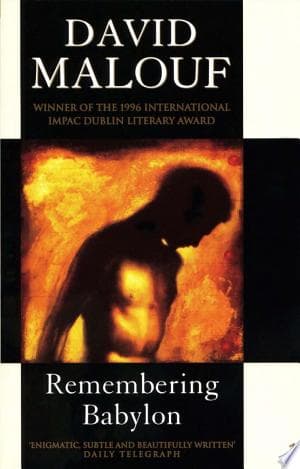
Synopsis
Covers the whole plot, including the ending.
- Difficulty
- Medium
- Pacing
- Slow
- Mood
- Atmospheric, Reflective, Melancholy, Thought-provoking
- Read it if
- You appreciate beautifully crafted prose, deep psychological exploration of cultural clash, and historical fiction set in early colonial Australia.
- Skip it if
- You prefer fast-paced plots, clear-cut resolutions, or lighthearted narratives.
Remembering Babylon Plot Summary
Covers the whole plot, including the ending.
The Arrival of Gemmy Fairley
In mid-19th century Queensland, Australia, three young girls—Janet McIvor, Lachlan Behan, and their cousin Ellen—play near their isolated farm. They see a figure approaching and realize he is a white man, but his appearance and mannerisms are Aboriginal. This is Gemmy Fairley, abandoned as a child and raised by an Aboriginal tribe. His sudden appearance at the McIvor fence causes immediate alarm and confusion among the children and, later, the adult settlers. Gemmy's hesitant, almost animalistic speech and his mix of European features with Aboriginal customs create unease and curiosity in the small community.
Gemmy's Integration into the McIvor Household
The McIvors, particularly Jock McIvor, decide to take Gemmy in, offering him shelter and trying to re-integrate him into European society. Other settlers react in various ways. Some, like Mrs. McIvor, are kind but cautious, while others, like the prejudiced Mr. Frazer, see Gemmy with suspicion and fear, viewing him as a potential spy or a sign of Aboriginal violence. Gemmy struggles with the change, finding settler customs strange and their language hard to understand. He often returns to his Aboriginal ways of thinking and observing. He is a constant reminder of the 'other' world beyond the fence, making settlers question their own identity and uncertain hold on the land.
The Settlers' Fear and Prejudice
Gemmy's inability to fully shed his Aboriginal identity, along with his occasional use of their language or sudden trips into the bush, feeds the white settlers' existing fears and prejudices. They are constantly nervous, believing Aboriginal people are a threat to their lives and livelihoods. Mr. Frazer, a particularly outspoken and fearful settler, leads the community's distrust of Gemmy, often stirring others with his words. The settlers' fear is not just of Aboriginal people, but of the vast, unknown Australian wilderness itself, which Gemmy represents. His presence forces them to face how fragile their transplanted European culture is in this foreign land.
Lachlan's Sympathy and Understanding
Among the children, Lachlan Behan, Janet's cousin, forms a special bond with Gemmy. Unlike the adults, who often see Gemmy as a threat or a mystery, Lachlan observes him with a child's open curiosity and a developing understanding. He tries to learn from Gemmy, watching his interactions with nature and his unique view of the world. Lachlan's innocence allows him to see past the cultural barriers that blind the adults, offering a glimpse of possible harmony between the two worlds. His empathy contrasts sharply with the growing hostility of many adults, showing the missed chances for real connection.
The Arrival of Mr. Hearn and the Church's Influence
The arrival of Mr. Hearn, a zealous clergyman, further complicates the community's relationship with Gemmy. Hearn sees Gemmy as a 'lost soul' needing Christian salvation and tries to educate and 'civilize' him, viewing the Aboriginal way of life as pagan and inferior. While Hearn's intentions are good, his efforts are misguided and reinforce the colonial mindset that aims to erase Indigenous culture. He tries to teach Gemmy English and Christian doctrine, but Gemmy struggles to understand concepts so foreign to his upbringing, further highlighting the divide between the two cultures and the limits of forced assimilation.
The Incident with the Spear
A key event happens when Gemmy is seen with a spear, an object he likely got from his Aboriginal family or made himself. This sight, combined with the settlers' fear of Aboriginal violence, is misinterpreted as a direct threat. Despite Gemmy's likely innocent intentions—perhaps he was just carrying it, or it was part of his past life—the settlers, especially Mr. Frazer, use it as proof of his 'savagery' and a sign he cannot be trusted. This event solidifies the community's decision to ostracize Gemmy and reinforces their belief that he is an outsider, fundamentally different and dangerous.
Gemmy's Retreat and the Community's Response
After the spear incident and the increasing hostility, Gemmy begins to withdraw further into himself and physically distance himself from the McIvor household and the wider settlement. He spends more time in the surrounding bush, finding comfort in the natural world that feels more familiar than the confined European existence. The settlers, seeing his withdrawal, interpret it as more proof of his untrustworthiness and his loyalty to the Aboriginal people. This cycle of fear and misunderstanding pushes Gemmy further away, making any real reconciliation or integration impossible. His isolation becomes a tragic symbol of the broader conflict.
The Search for Gemmy
Gemmy eventually disappears completely from the settlement. A search party is organized, but its motivations are complex. For some, like the McIvors, there is genuine concern for his well-being. For others, particularly Mr. Frazer, the search is driven by a desire to ensure he is no longer a threat, or perhaps to capture him. The search itself shows the settlers' limited understanding of the bush and their reliance on Gemmy's knowledge of it, even as they fear him. The futility of their search emphasizes the vastness of the land and Gemmy's unique connection to it, a connection they cannot replicate or understand.
The Enduring Mystery of Gemmy
Gemmy is never definitively found by the settlers. His disappearance remains a mystery, a haunting presence that stays in the community's memory. His story becomes a legend, whispered among the children and a source of continued unease for the adults. The uncertainty of his fate reflects the broader unresolved tensions between white settlers and the Indigenous population, and the lasting difficulty of bridging cultural divides. Gemmy's memory is a constant reminder of the 'otherness' of the land and the people who truly belong to it, challenging the settlers' sense of ownership and belonging.
The Settlers' Legacy and the Land
In the novel's close, Malouf considers the long-term impact of the settlers on the land and their own identities. Despite their efforts to impose European order, the Australian bush keeps its wildness and ancient spirit. The settlers, even generations later, remain somewhat foreign to the land, never fully understanding it as Gemmy did. The story of Gemmy Fairley becomes a founding myth for the region, a tale that captures the initial clash of cultures, the fear, the misunderstanding, and the deep, almost spiritual connection to the land that some, like Gemmy, had. The land remembers, and its memory goes beyond the settlers' temporary claims.
Principal Figures
Gemmy Fairley
Protagonist
A white boy raised by Aboriginal people, caught between two worlds.
Gemmy Fairley is the central figure, a young white man who was shipwrecked as a child and subsequently adopted and raised by an Aboriginal tribe. He embodies the liminal space between European and Indigenous cultures, speaking a broken English mixed with Aboriginal languages and possessing a deep intuitive understanding of the Australian bush. He is gentle, observant, and largely innocent, yet his 'otherness' makes him a figure of both fascination and profound fear for the white settlers. His inability to fully assimilate or articulate his experiences highlights the chasm between the two cultures.
Relationships: McIvor Family (Shelters him, attempts to civilize him with mixed compassion and wariness.); Lachlan Behan (Forms a unique, empathetic bond based on mutual curiosity.); Mr. Frazer (Object of Frazer's intense fear, prejudice, and suspicion.); Aboriginal Tribe (His adoptive family, to whom he retains a deep, instinctive connection.)
Jock McIvor
Supporting
A pragmatic and compassionate Scottish settler who takes Gemmy in.
Jock McIvor is a Scottish settler, a farmer who, despite his own fears and cultural biases, possesses a degree of pragmatism and compassion. He is the one who decides to take Gemmy in, driven by a sense of duty and perhaps a flicker of curiosity. He represents the more moderate, yet still fundamentally colonial, perspective among the settlers. While he tries to help Gemmy, he struggles to truly understand him, often seeing him through the lens of European civility. His actions are well-intentioned but ultimately insufficient to bridge the cultural divide.
Relationships: Gemmy Fairley (His reluctant benefactor, attempts to re-integrate Gemmy into society.); Mrs. McIvor (His wife, shares the burden and worry of Gemmy's presence.); Mr. Frazer (Contrasting figure, Jock is more measured than Frazer's outright hostility.)
Mrs. McIvor
Supporting
Jock's wife, who views Gemmy with a mixture of pity and trepidation.
Mrs. McIvor is Jock's wife, a practical and devout woman who embodies the domestic anxieties of the frontier. While she initially feels pity for Gemmy and tries to care for him, her underlying fear of the unknown and the perceived threat of the Aboriginal world steadily grows. She is concerned for the safety of her children and the stability of her home, reflecting the vulnerability of the settlers. Her compassion is overshadowed by a deep-seated cultural fear, making her unable to truly embrace Gemmy.
Relationships: Gemmy Fairley (Cares for him out of duty and pity, but also fears him.); Jock McIvor (His wife, shares the responsibilities and anxieties of their life.)
Janet McIvor
Supporting
One of the children who first encounters Gemmy, observant and thoughtful.
Janet is one of the McIvor children, an observant and somewhat introspective girl. She is among the first to see Gemmy and, like her cousin Lachlan, is initially more curious than fearful. She represents the younger generation's potential for a less prejudiced view, though she is also influenced by the adults' anxieties. Her perspective offers a window into the initial wonder and subsequent unease that Gemmy evokes in the community, as she grapples with understanding his alien nature.
Relationships: Gemmy Fairley (Witnesses his arrival and gradual alienation, remembers him in adulthood.); Lachlan Behan (Her cousin, shares the experience of encountering Gemmy.)
Lachlan Behan
Supporting
Janet's cousin, who develops a unique, empathetic connection with Gemmy.
Lachlan Behan is Janet's cousin and perhaps the most open-minded of the children. He is drawn to Gemmy's connection with nature and tries to understand him on a deeper, almost intuitive level. Lachlan represents a fleeting possibility of genuine cross-cultural understanding, unburdened by adult prejudices. He observes Gemmy's movements and listens to his broken speech with a child's unfiltered curiosity, seeing a different kind of knowledge in Gemmy than the adults do. His empathy is a stark contrast to the growing fear of the community.
Relationships: Gemmy Fairley (Forms the closest empathetic bond among the children, trying to understand his world.); Janet McIvor (His cousin, shares the early experiences of Gemmy's arrival.)
Mr. Frazer
Antagonist
A prejudiced and fearful settler who embodies the community's hostility towards Gemmy.
Mr. Frazer is a fervent and fearful Scottish settler who quickly becomes the primary antagonist. He embodies the deep-seated prejudices and anxieties of the white community regarding the Aboriginal people and the 'wildness' of Australia. Frazer views Gemmy as an inherently dangerous 'savage' and a spy, constantly inciting fear and suspicion among the other settlers. He is rigid in his beliefs, unable to see beyond his own cultural framework, and his rhetoric actively contributes to Gemmy's isolation and eventual expulsion. He represents the destructive power of fear and ignorance.
Relationships: Gemmy Fairley (His primary target of suspicion, fear, and hostility.); Jock McIvor (Opposes McIvor's more moderate approach, advocating for Gemmy's removal.)
Mr. Hearn
Supporting
A zealous clergyman who attempts to 'civilize' Gemmy through Christian teaching.
Mr. Hearn is a newly arrived clergyman, driven by a sincere but culturally insensitive desire to convert and 'civilize' Gemmy. He represents the colonial imposition of religion and European values, viewing Aboriginal culture as primitive and in need of salvation. While his intentions might be good, his approach is dismissive of Gemmy's existing identity and knowledge. He struggles to communicate with Gemmy, highlighting the limitations of imposing one cultural framework onto another, and ultimately contributes to Gemmy's alienation by reinforcing his 'otherness'.
Relationships: Gemmy Fairley (Attempts to teach and convert him, but fails to understand his perspective.)
The Aboriginal Tribe
Mentioned/Supporting
Gemmy's adoptive family, representing the original inhabitants of the land.
The Aboriginal tribe is Gemmy's adoptive family, though they remain largely unseen and are primarily represented through Gemmy's memories, language, and mannerisms. They symbolize the deep, ancient connection to the land and a way of life that is fundamentally different from the European settlers. They are a constant, unspoken presence, the 'other' world just beyond the fence, and the source of the settlers' greatest fears. Their wisdom and understanding of the land stand in stark contrast to the settlers' struggle to adapt.
Relationships: Gemmy Fairley (His true family, who raised him and to whom he feels an instinctive bond.); White Settlers (Feared and misunderstood, their presence is a source of anxiety for the settlers.)
Themes & Insights
Cultural Clash and Misunderstanding
The novel explores the inevitable and often tragic clash between European colonial culture and Indigenous Australian culture. Gemmy Fairley, a white man raised by Aboriginal people, embodies this conflict. His inability to explain his past in a way settlers can understand, and their inability to grasp his Indigenous worldview, leads to misunderstanding and fear. Settlers see his natural ease in the bush and his 'otherness' as a threat, not a different way of being, as shown when an innocent act with a spear is seen as aggression. This theme highlights the destructive results of cultural arrogance and a lack of empathy.
“What they were afraid of was the unknown element in him, the one that had been there for sixteen years, that had left its mark on him and changed him.”
Fear of the Unknown and the Wilderness
The 'bush' and its native inhabitants create deep fear for the white settlers. They constantly try to impose order and familiarity on a foreign landscape. Gemmy, with his strong connection to the wilderness, becomes a living symbol of their anxieties. The settlers' fear is not just of physical danger but of the psychological threat to their European identity and sense of belonging. Mr. Frazer's intense prejudice is largely driven by this fear, seeing Gemmy as a symbol of the untamed, 'savage' forces that threaten their uncertain existence. The vastness and mystery of the Australian landscape constantly challenge their sense of control.
“That was what they feared. That everything out there might not be as they thought it was.”
Identity and Belonging
Gemmy's struggle to define himself is central to the novel. He is white by birth but Aboriginal by upbringing, belonging fully to neither world. His fragmented language reflects his fragmented identity. The settlers also struggle with their identity, trying to transplant European culture onto an ancient land where they are ultimately outsiders. They try to establish belonging through ownership and imposing their ways, but the land itself resists. The novel questions what it means to belong to a place and how identity is shaped by both heritage and environment. Gemmy's final return to the bush suggests where his true belonging is, even if it means isolation.
“He was a white man. But they would not have him. He was a black man. But he was not one of them.”
The Power of Language and Silence
Language is a recurring element, showing the barriers between cultures. Gemmy's broken English and his use of gestures and a few Aboriginal words symbolize the deep difficulty of communication across cultural divides. Settlers struggle to understand him, leading to misinterpretations and increasing fear. Conversely, Gemmy often finds silence more expressive than words, a trait of his Aboriginal upbringing. The novel suggests that true understanding needs more than just shared words; it requires a shared framework of meaning, which is missing. The settlers' inability to 'read' Gemmy's silence adds to their alienation from him.
“He spoke a language that was no language at all, or a language that had been forgotten. It was a language of the air, of the light, of the leaves.”
Memory and History
The novel explores how history is made and remembered, especially in a colonial setting. The settlers try to create a new history, but the land holds an older, deeper memory, seen in Gemmy and the Aboriginal people. Gemmy's fragmented memories of his early European life and his rich, tactile memories of his Aboriginal upbringing contrast with the settlers' desire to forget the 'savagery' of the past and impose a linear, European story. The story of Gemmy Fairley becomes a founding myth for the settlement, a memory that continues to shape their understanding of their place in Australia, showing the lasting mark of the past on the present.
“The land itself, they discovered, had a memory. And it was a memory that did not include them.”
Plot Devices & Literary Techniques
The Liminal Character (Gemmy Fairley)
A character existing between two distinct cultures, symbolizing their clash.
Gemmy Fairley serves as a powerful liminal character, literally existing on the boundary between the European settlement and the Aboriginal wilderness. His appearance, speech, and mannerisms are a blend of both worlds, making him a walking embodiment of the cultural clash. This device forces the settlers to confront their own definitions of humanity and belonging, as Gemmy challenges their preconceived notions of 'civilized' and 'savage'. His presence highlights the impossibility of easy integration and the tragic consequences of cultural intolerance, as he is ultimately rejected by both worlds.
The Fence
A physical and symbolic barrier separating two worlds.
The fence at the edge of the McIvor property is a potent symbol. Physically, it marks the boundary between the cultivated, 'civilized' land of the settlers and the wild, untamed bush, the domain of the Aboriginal people. Symbolically, it represents the rigid cultural and psychological barriers that prevent understanding and coexistence. Gemmy's initial appearance at the fence, and his later retreats back across it, underscore his position between two worlds. The fence also signifies the settlers' attempt to impose order and ownership on a land that resists such clear divisions, and their desperate need to keep the 'other' out.
Animal Imagery
Comparisons of Gemmy to animals, highlighting his perceived 'otherness'.
Throughout the novel, Gemmy is frequently described using animalistic imagery – his gait, his watchful eyes, his 'animal' sounds. This device serves to emphasize the settlers' perception of him as 'other' and 'savage,' reinforcing their dehumanizing prejudices. It reflects their inability to see him as a fully human being within their own cultural framework. While intended to highlight his 'primitiveness,' it also subtly suggests his deep, intuitive connection to the natural world, a connection the settlers lack, hinting at a different kind of wisdom and belonging that they cannot comprehend.
Fragmented Language
Gemmy's broken speech, symbolizing cultural and communicative barriers.
Gemmy's fragmented and often incomprehensible speech is a crucial plot device. It immediately establishes him as an outsider and highlights the profound communication breakdown between the two cultures. His inability to fully articulate his past or his experiences in a coherent European narrative frustrates the settlers and fuels their suspicion. This linguistic barrier is a metaphor for the deeper cultural chasm, showing that even with shared words, genuine understanding is impossible without a shared context. It underscores the novel's theme of the limitations of language in bridging vast cultural divides.
Remembering Babylon Quotes
“He had been set down, as it were, in the midst of a populous and thriving place, but a place that was not quite real to him, a place that he had no part in.”
“He had come to understand that he did not belong, that he was an outsider, a wild boy, a thing of the bush.”
“The world he had known, the world of the blackfella, was gone, swallowed up by the white man's world.”
“They were all, in their different ways, exiles from a world they had left behind, and still, in their dreams, returned to.”
“It was the landscape that had made them, shaped them, given them their peculiar cast of mind.”
“They had come to this place with their own gods, their own fears, their own certainties, and the land had begun to work on them.”
“He was a wild man, a man of the bush, and they were, after all, settlers, civilised folk.”
“What was it they feared? Not the blackfella, not the wild white man, but something in themselves, something that the land brought out.”
“The silence of the bush was not an empty silence, but a silence full of presences, of eyes watching, of ears listening.”
“They had come to establish a new order, but the old order of the land, of its original inhabitants, kept asserting itself.”
“He was a bridge, a living link, between two worlds that refused to acknowledge each other.”
“Memory was a kind of haunting, a persistent echo of what had been, and what might have been.”
“They lived on the edge of a great emptiness, a vast, indifferent continent that stretched away into myth and dream.”
“It was a story that had no ending, only a continuing unfolding of events, of lives lived and forgotten, of a land that remained.”
Quiz
10 questions on the plot and the characters. Each answer comes with a short explanation.
Question 1
What is Gemmy Fairley's background before he is found by the MacIvors?
- He was born to Aboriginal parents and raised in the bush.
- He was a British orphan who was abandoned by his family after arriving in Australia.
- He was a convict who escaped from a penal colony.
- He was a sailor who was shipwrecked on the Australian coast.
Show answer
B. He was a British orphan who was abandoned by his family after arriving in Australia. Gemmy Fairley was a British orphan who was abandoned and subsequently raised by Aboriginal people after his arrival in Australia as a child.
Question 2
Which family initially takes Gemmy Fairley in after he emerges from the bush?
- The Frazer family
- The McIvor family
- The Dalgarno family
- The Fairley family
Show answer
B. The McIvor family Lachlan Beattie and Janet McIvor are the ones who first encounter Gemmy and whose family takes him in.
Question 3
What is the primary reaction of most of the white settlers to Gemmy's presence?
- Immediate acceptance and curiosity.
- Suspicion, fear, and a sense of unease.
- Indifference, as he is seen as harmless.
- Admiration for his survival skills.
Show answer
B. Suspicion, fear, and a sense of unease. The settlers, especially those beyond the immediate family, view Gemmy with deep suspicion and fear, seeing him as an unsettling 'other' and a potential threat.
Question 4
What specific physical characteristic of Gemmy is often noted by the settlers and contributes to their discomfort?
- His exceptionally tall stature.
- His heavily tattooed body.
- His 'squinting' eyes and the way he looks at things.
- His missing fingers.
Show answer
C. His 'squinting' eyes and the way he looks at things. Gemmy's unique way of seeing and his 'squinting' gaze are frequently mentioned, making him seem both childlike and alien to the settlers.
Question 5
How does Malouf portray the landscape of Australia in the novel, particularly from the perspective of the early settlers?
- As a bountiful and welcoming paradise.
- As a harsh, alien, and potentially hostile environment.
- As an ordinary, unremarkable agricultural land.
- As a romantic wilderness to be explored.
Show answer
B. As a harsh, alien, and potentially hostile environment. The novel emphasizes the settlers' terror and alienation in the face of the vast, unfamiliar, and often unforgiving Australian bush.
Question 6
What role does the character of Mr. Frazer, the schoolmaster, play in the community's perception of Gemmy?
- He is Gemmy's strongest advocate and defender.
- He attempts to educate Gemmy and integrate him into settler society.
- He articulates and rationalizes the settlers' fear and suspicion of Gemmy, viewing him as a 'missing link'.
- He is indifferent to Gemmy, focusing only on his teaching duties.
Show answer
C. He articulates and rationalizes the settlers' fear and suspicion of Gemmy, viewing him as a 'missing link'. Mr. Frazer, though educated, represents the intellectual justification for the settlers' fear, classifying Gemmy as something less than fully human and a threat to their ordered world.
Question 7
What is the significance of the title 'Remembering Babylon'?
- It refers to the settlers' longing for their homeland, England, which they liken to the biblical city of Babylon.
- It alludes to the biblical story of the Tower of Babel, symbolizing the breakdown of communication and mutual understanding between the two cultures.
- It is a direct reference to a specific historical event involving the city of Babylon that influenced the colonization of Australia.
- It signifies the settlers' desire to build a new, perfect society in Australia, reminiscent of the ancient glory of Babylon.
Show answer
B. It alludes to the biblical story of the Tower of Babel, symbolizing the breakdown of communication and mutual understanding between the two cultures. The title evokes the Tower of Babel, symbolizing the profound linguistic and cultural misunderstandings and the failure to build a common ground between the white settlers and the Aboriginal people, with Gemmy caught in between.
Question 8
How does Janet McIvor's relationship with Gemmy evolve throughout the novel?
- She remains consistently fearful of him, mirroring the general community.
- She initially fears him but later develops a unique understanding and empathy for his 'otherness'.
- She attempts to force him to abandon his Aboriginal ways entirely.
- She uses him as a source of information about the Aboriginal people.
Show answer
B. She initially fears him but later develops a unique understanding and empathy for his 'otherness'. Janet, along with Lachlan, is one of the few who tries to understand Gemmy beyond the settlers' prejudices, developing a deep, albeit complex, connection based on empathy for his unique position.
Question 9
What event ultimately leads to Gemmy's final departure from the white settlement?
- He is offered a job by another settler family further inland.
- He is accused of stealing and is driven out by the community.
- The death of Mr. Frazer, which removes his only protector.
- The increasing hostility and threat from the settlers, culminating in an act of violence against him.
Show answer
D. The increasing hostility and threat from the settlers, culminating in an act of violence against him. Gemmy is eventually shot by a settler, driven by fear and prejudice, which forces him to retreat permanently back into the bush, unable to bridge the gap between the two worlds.
Question 10
What literary device is prominently used by Malouf to convey the settlers' internal struggles and perception of the new land?
- Extensive use of direct dialogue to reveal character motivations.
- A highly descriptive, poetic prose style that often blurs the line between objective reality and subjective experience.
- Frequent shifts in narrative perspective among many different characters.
- Heavy reliance on historical documents and factual accounts.
Show answer
B. A highly descriptive, poetic prose style that often blurs the line between objective reality and subjective experience. Malouf's writing is renowned for its lyrical and poetic quality, which deeply explores the psychological landscape of his characters and their sensory experience of the world, especially the unsettling Australian environment.
Remembering Babylon FAQ
What is the central premise of 'Remembering Babylon'?
The novel centers on Gemmy Fairley, a young Englishman shipwrecked and raised by Aboriginal people, who suddenly reappears among a small community of British settlers in colonial Queensland. His presence forces the settlers to confront their fears of the unknown Australian landscape and its Indigenous inhabitants, challenging their established worldview and sense of identity.
Who are the central characters in the story, besides Gemmy?
The MacIvor family, particularly Lachlan and Janet, play a significant role as they are the first to encounter Gemmy and offer him shelter. Other key figures include Jock McIvor, Janet's father, who embodies a more rigid colonial perspective, and the local clergyman, Mr. Frazer, who attempts to understand Gemmy through a theological lens.
What kind of conflict drives the narrative?
The primary conflict stems from the cultural clash and profound misunderstanding between the British settlers and the Aboriginal world, personified by Gemmy. The settlers struggle with fear and suspicion towards Gemmy's 'otherness' and his deep connection to the land, while Gemmy himself grapples with his lost identity and the inability to fully communicate his experiences.
How does the Australian landscape function as a character in the novel?
The Australian bush is portrayed as a powerful, alien, and often terrifying entity that both fascinates and threatens the settlers. It symbolizes the untamed, the unknown, and the ancient, constantly reminding the British of their tenuous hold on the land and their precarious position as invaders, shaping their fears and perceptions.
What is the significance of the title 'Remembering Babylon'?
The title evokes a sense of exile and longing, referencing the biblical Psalm 137, 'By the rivers of Babylon, there we sat down, yea, we wept, when we remembered Zion.' It suggests the settlers' profound sense of displacement and their yearning for the familiar European world, contrasting with the alien Australian landscape they inhabit, which becomes their own 'Babylon'.
What subtle details reveal the settlers' deep-seated fear of the unknown?
The settlers' fear is subtly revealed through their constant vigilance, their reliance on fences and domesticated animals to create a semblance of order, and their immediate suspicion of anything that deviates from their European norms. Their misinterpretation of Gemmy's gestures and silences, often projecting menace onto him, underscores their profound anxiety about the 'other' and the wildness of the continent.
Are there any symbolic objects or recurring motifs that highlight the cultural divide?
The fence is a powerful recurring motif, symbolizing the settlers' attempt to impose order, define boundaries, and exclude the 'wild' world, including Indigenous peoples. Gemmy's clothing, or lack thereof, and his initial inability to communicate with English words also serve as stark symbols of the cultural chasm he bridges, yet struggles to reconcile.
How does the novel subtly critique the concept of 'civilization'?
Malouf critiques 'civilization' by showing how the settlers' rigid adherence to European customs and beliefs prevents them from understanding or adapting to their new environment. Their 'civilized' fears and prejudices lead to cruelty and exclusion, suggesting that their definition of civilization is narrow and destructive, especially when confronted with the natural world and different ways of being.
What role does language play in shaping the characters' understanding and misunderstanding?
Language is central to the novel, highlighting both connection and alienation. Gemmy's fragmented English and his unique way of perceiving the world through Aboriginal concepts create a profound communication barrier. The settlers' inability to grasp his meaning, and their dismissal of his 'different' speech, underscores their limited perspective and their refusal to truly engage with his experience.
How does Gemmy Fairley's liminal existence impact his psychological state?
Gemmy's liminality, being caught between two cultures, creates a profound psychological burden. He experiences a deep sense of dislocation, struggling with a fragmented identity where neither world fully accepts or understands him. This leads to profound loneliness and an internal conflict as he tries to reconcile his Aboriginal upbringing with his rediscovered European heritage.
What psychological fears do the British settlers collectively exhibit?
The settlers collectively exhibit a profound fear of the unknown, xenophobia, and a deep-seated anxiety about losing their European identity in the vast, alien landscape. They are terrified of 'going native' and of the perceived savagery of the Aboriginal people, projecting their own anxieties onto Gemmy and the bush itself.
How do characters like Lachlan and Janet MacIvor psychologically cope with Gemmy's presence?
Lachlan and Janet initially show compassion, but their psychological responses diverge. Lachlan struggles with a sense of responsibility and a desire to understand, yet is ultimately limited by his cultural framework. Janet, particularly, experiences a complex mix of fear, curiosity, and a nascent empathy that challenges her ingrained prejudices, leading to internal conflict and a questioning of her own world.
How does the novel explore the concept of identity, particularly through Gemmy?
The novel profoundly explores identity as fluid and culturally constructed. Gemmy embodies this, having lost his original English identity and adopted an Aboriginal one, only to be forced back into a European context. His struggle highlights how identity is shaped by language, environment, and social acceptance, and the pain of having a fragmented sense of self.
Is the novel ultimately optimistic or pessimistic about cultural reconciliation?
The novel leans towards a pessimistic view of large-scale cultural reconciliation in the colonial context. While individual moments of empathy occur, the prevailing fear and prejudice among the settlers ultimately lead to Gemmy's ostracization and departure. It suggests that the chasm between the two worlds was too vast and the colonial mindset too entrenched for genuine integration at that time.
How does Malouf use poetic language to convey the novel's themes?
Malouf's poetic language, characterized by vivid imagery, lyrical descriptions, and sensory details, allows him to evoke the beauty and terror of the Australian landscape, and the inner lives of his characters. This intensity helps to convey the profound spiritual and psychological dimensions of the cultural clash, making abstract themes palpable and emotionally resonant for the reader.
What is the significance of Gemmy's eventual disappearance?
Gemmy's disappearance signifies his ultimate rejection of the European world and his return to the only environment where he truly feels a sense of belonging, even if it remains unseen by the settlers. It underscores the novel's tragic conclusion, suggesting that for someone caught between two irreconcilable worlds, disappearance might be the only form of peace or resolution.
Can the novel be read as an allegory for Australia's colonial history?
Yes, 'Remembering Babylon' can certainly be read as an allegory for Australia's colonial history. Gemmy represents the Indigenous presence and the land's ancient spirit, while the settlers embody the invading European culture, their fears, and their destructive impact. The novel explores themes of dispossession, cultural clash, and the lasting scars of colonization on both the land and its people.
What philosophical questions does the novel raise about humanity's relationship with nature?
The novel raises profound questions about humanity's relationship with nature, contrasting the European desire to conquer and tame with the Aboriginal understanding of living in harmony with the land. It challenges the anthropocentric view, suggesting that humans are part of nature, not separate from it, and that a failure to respect this connection leads to both spiritual and environmental degradation.
About the author

David George Joseph Malouf AO is an Australian poet, novelist, short story writer, playwright and librettist. Elected a Fellow of the Royal Society of Literature in 2008, Malouf has lectured at both the University of Queensland and the University of Sydney. He also delivered the 1998 Boyer Lectures.
Similar books
- The Secret River
Kate Grenville
3.8 (18k) average on GoodreadsLiterary FictionExplores the harsh realities of Australian colonial settlement and the conflict with Indigenous people.
- An Imaginary Life
David Malouf
3.9 (2k) average on GoodreadsLiterary FictionShares Malouf's poetic language, themes of identity, and connection to the natural world.
- Cloudstreet
Tim Winton
4.0 (20k) average on GoodreadsLiterary FictionOffers a deep dive into Australian identity and the landscape, with rich, evocative language.
- The Old Man and the Sea
Ernest Hemingway
3.8 (831k) average on GoodreadsLiterary FictionA Cuban fisherman's long struggle with a giant marlin becomes a story of endurance and dignity, now retold for young adults with illustrations, phonetic guides, and writing prompts in Traditional Chinese.
- One Hundred Years of Solitude
Gabriel García Márquez
4.1 (753k) average on GoodreadsLiterary FictionThrough the multi-generational story of the Buendía family, a mythical town deals with the repeating patterns of time, love, and solitude, as the extraordinary mixes with the ordinary.
- The Goldfinch
Donna Tartt
3.9 (720k) average on GoodreadsLiterary FictionHaunted by a tragic explosion and clutching a stolen Dutch masterpiece, a young orphan navigates the opulent drawing rooms of New York and the gritty underbelly of the art world, desperately seeking connection and redemption amidst a life spiraling into crime and obsession.





Enjoyed the summary?
A summary gives you the shape of the book. The book itself has the detail, the examples and the voice.
Find Remembering Babylon on AmazonAs an Amazon Associate, BookBrief earns from qualifying purchases. How we're funded