
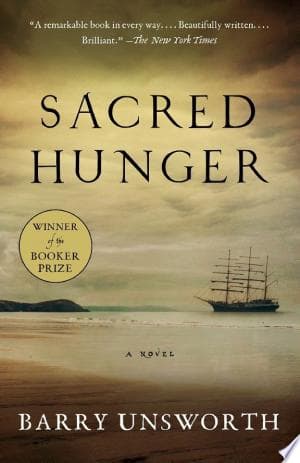
Synopsis
Covers the whole plot, including the ending.
- Difficulty
- Medium
- Pacing
- Moderate
- Mood
- Dark, Thought-provoking, Intense, Reflective
- Read it if
- You want a deeply researched, morally complex historical novel that unflinchingly examines the horrors of the 18th-century slave trade and explores themes of freedom, greed, and human nature.
- Skip it if
- You prefer light-hearted historical fiction or are sensitive to graphic descriptions of violence, suffering, and the dehumanizing aspects of slavery.
Sacred Hunger Plot Summary
Covers the whole plot, including the ending.
The Ill-Fated Venture of the 'Liverpool Merchant'
In 1752, William Kemp, a Liverpool merchant facing financial ruin, invests his entire fortune in fitting out a slave ship, the 'Liverpool Merchant'. His son, Erasmus Kemp, an ambitious young man, sees this venture as his only way to wealth, hoping it will allow him to marry Miss Melicent Bell. Erasmus pressures his father to make the ship seaworthy, despite its age and poor condition. Dr. Matthew Paris, William Kemp's nephew, a physician outcast for his progressive views and personal tragedy, agrees to serve as the ship's surgeon. He seeks to escape his past and find purpose beyond the corrupt society he dislikes. Captain Thurston, known for his brutality and efficiency, commands the ship.
The Middle Passage: Disease and Brutality
The 'Liverpool Merchant' sails to the West African coast, where Captain Thurston and his crew acquire enslaved people. Matthew Paris is horrified by the conditions and inhumanity he sees, both in the slave factories on shore and later on the ship. During the difficult Middle Passage, disease, especially ophthalmia, spreads among the captives below deck. Captain Thurston, fearing an epidemic that would destroy his 'cargo', orders the sick slaves thrown overboard. Matthew strongly protests this decision, leading to a direct conflict between the two men. Thurston's cruelty extends to his crew, as he maintains order through fear and severe punishment.
Mutiny and Shipwreck
The captain's decision to throw sick slaves overboard, along with his general brutality towards both slaves and crew, fuels growing resentment. Matthew Paris, seeing the suffering and the captain's increasing madness, sympathizes more and more with the enslaved. A severe storm hits the ship, further destabilizing the already tense situation. During the chaos, a coordinated mutiny erupts. The enslaved people, helped by some of the crew tired of Thurston's tyranny, rise up. In the violence that follows, Captain Thurston is killed, and the ship is badly damaged, eventually running aground off the coast of Spanish Florida. Many lives are lost in the shipwreck.
The Maroon Community
Against all odds, a group of survivors, including former slaves and mutinous crew members, reach the Florida shore. Led by Matthew Paris, who uses his medical knowledge and moral compass to guide them, and assisted by resourceful individuals like the African leader Kwamena, they decide to form a new, independent community. They go deep into the wilderness, establishing a hidden settlement away from European eyes. Here, they try to create a society based on shared labor, mutual respect, and a rejection of the hierarchical systems they left behind. They learn to hunt, farm, and build, aiming for a utopian existence, though tensions and challenges arise from their diverse backgrounds.
Erasmus Kemp's Relentless Pursuit
News of the 'Liverpool Merchant's' disappearance eventually reaches Liverpool. William Kemp is devastated, but Erasmus, driven by ambition and the perceived loss of his inheritance, refuses to accept the ship's total loss. He is obsessed with recovering the 'cargo' and the financial investment, seeing it as his only way to secure his future with Miss Bell. Erasmus begins a relentless quest to track down the missing ship and its survivors. He travels to various ports, questioning sailors and gathering information, his determination becoming fanatical. His pursuit becomes a consuming vendetta, fueled by greed and a strong sense of entitlement.
Life in the Settlement
Life in the Florida settlement is hard. While they achieve some self-sufficiency, the community faces many difficulties. They deal with the harsh environment, the constant threat of discovery by Spanish or British forces, and internal disputes from cultural differences and past problems. Matthew Paris acts as a mediator and healer, trying to keep peace and enforce a fair system of justice for all. Kwamena, with his leadership and survival knowledge, becomes an essential figure. Despite the hardships, they build homes, cultivate crops, and establish a working society, blending African and European customs.
Erasmus Closes In
Years pass, but Erasmus Kemp's resolve remains strong. His pursuit of the 'Liverpool Merchant' becomes legendary, showing his tenacity and ruthlessness. He develops a network of informants and tirelessly follows every lead, no matter how small. His quest takes him across the Atlantic and through the Caribbean. Eventually, through sheer persistence and luck, he finds fragmented clues and rumors that suggest a group of survivors, including former slaves, might have established a hidden community in Florida. This discovery reignites his desire for retribution and wealth, and he begins to gather a party to track them down.
The Expedition of Vengeance
Armed with his information, Erasmus organizes a well-equipped expedition to Florida, hiring mercenaries and experienced woodsmen. His main goal is to reclaim the 'cargo' – the surviving slaves – and punish those responsible for the mutiny and the loss of his father's ship. He is driven by a cold desire for financial recovery and a deep need for revenge, especially against Matthew Paris, whom he blames for the ship's downfall. The journey into the Florida wilderness is arduous and dangerous, but Erasmus's focus pushes his men forward, overcoming natural obstacles and the threat of hostile natives.
Discovery and Confrontation
After a long and difficult trek, Erasmus's expedition finally finds the hidden settlement. The peaceful life of the maroon community is shattered by the arrival of the heavily armed outsiders. A tense standoff leads to a violent confrontation. The community, led by Matthew Paris and Kwamena, fights to defend their freedom and their way of life against Erasmus's forces. The battle is fierce, marked by desperation on both sides. Lives are lost, and the fragile utopia they had painstakingly built is threatened with total destruction, forcing Matthew and his people to make desperate choices to preserve their liberty.
The Aftermath
The confrontation ends with many casualties on both sides. Erasmus Kemp, though perhaps not fully achieving his desired revenge or financial recovery, is forever changed by the experience, his obsession leading him to a hollow victory. Matthew Paris, deeply scarred by the violence, must deal with the broken remains of his utopian dream and the difficult task of leading his people to an uncertain future. The novel concludes by reflecting on the lasting impact of greed, exploitation, and the human cost of the slave trade, leaving the ultimate fate of the maroon community unclear but their fight for freedom clear.
Sacred Hunger Characters
Dr. Matthew Paris
Protagonist
A compassionate physician seeking redemption and a new societal model.
Matthew Paris is a principled and intelligent physician, ostracized from polite society due to a scandal and his progressive views. Haunted by the loss of his wife and child, he seeks a purpose beyond the corrupt British Empire. He possesses a strong moral compass and a deep empathy for suffering, which puts him at odds with the brutal realities of the slave trade. On the 'Liverpool Merchant', he witnesses the horrors firsthand and eventually becomes a leader in the maroon community, striving to create a more just and humane society. He is driven by a desire for a world free from exploitation and cruelty.
Relationships: William Kemp (Uncle; employer on the ship); Erasmus Kemp (Cousin; antagonist); Kwamena (Ally and co-leader in the maroon community)
Erasmus Kemp
Antagonist
A ruthless and avaricious merchant driven by ambition and a sense of entitlement.
Erasmus Kemp is William Kemp's ambitious and cold-hearted son, a man consumed by the desire for wealth and social standing. He views people, particularly enslaved Africans, as commodities and investments. His primary motivation is to secure a fortune that will allow him to marry into the aristocracy. When the 'Liverpool Merchant' is lost, his ambition transforms into a relentless, decades-long obsession to recover his perceived losses and exact vengeance. He embodies the destructive forces of European capitalism and the dehumanizing nature of the slave trade, demonstrating a profound lack of empathy and a calculating, predatory mindset.
Relationships: William Kemp (Father; his financial venture is Erasmus's hope); Matthew Paris (Cousin; target of his vengeance); Miss Melicent Bell (Object of his social ambition)
William Kemp
Supporting
A desperate merchant whose last gamble on a slave ship leads to his ruin.
William Kemp is an aging Liverpool merchant whose business is failing. He is a man of his time, deeply entrenched in the mercantile system, yet he possesses a certain weariness and perhaps a flicker of conscience that his son lacks. He makes the fateful decision to invest everything in the 'Liverpool Merchant' as a last resort to save his family from destitution, largely pressured by Erasmus's relentless ambition. His financial ruin and the loss of the ship ultimately break him, representing the personal cost of the speculative and morally compromised world of the slave trade.
Relationships: Erasmus Kemp (Son; his ambition drives William's last venture); Matthew Paris (Nephew; whom he employs as ship's surgeon)
Captain Thurston
Supporting
The brutal and unhinged captain of the 'Liverpool Merchant'.
Captain Thurston is the embodiment of the cruelty and dehumanization inherent in the slave trade. He is a ruthless and efficient commander, driven by a desire to deliver his 'cargo' intact, regardless of the human cost. His methods are sadistic, employing extreme violence and fear to maintain control over both the enslaved people and his own crew. He is a man teetering on the edge of madness, his brutality escalating throughout the voyage until it precipitates the mutiny. He represents the institutionalized savagery of the Middle Passage.
Relationships: Matthew Paris (Antagonistic; Matthew opposes his cruelty); His Crew (Rules through fear and violence)
Kwamena
Supporting
A powerful and resourceful African leader who becomes a key figure in the maroon community.
Kwamena is an enslaved African man, a leader among his people, who is forcibly taken aboard the 'Liverpool Merchant'. He is intelligent, resilient, and possesses deep knowledge of survival and community. He plays a crucial role in the mutiny and later becomes a vital co-leader with Matthew Paris in establishing and sustaining the maroon settlement in Florida. He represents the strength, dignity, and cultural richness of the enslaved people, and his collaboration with Matthew symbolizes the potential for a new, more equitable society built on mutual respect.
Relationships: Matthew Paris (Ally and co-leader); Other enslaved people (Leader and protector)
Miss Melicent Bell
Mentioned
The aristocratic woman Erasmus Kemp desires to marry for social advancement.
Miss Melicent Bell is a figure representing the social aspirations of Erasmus Kemp. She is from a higher social class, and Erasmus's obsession with her drives his relentless pursuit of wealth. She is largely a symbolic character, embodying the societal pressures and class distinctions that fuel the avarice of men like Erasmus. Her presence in the narrative highlights the social climbing motivation behind the economic ventures of the time, including the slave trade, suggesting that the pursuit of status often overshadowed moral considerations.
Relationships: Erasmus Kemp (Object of his marital ambition)
Billy
Supporting
A young, impressionable cabin boy on the 'Liverpool Merchant'.
Billy is a young cabin boy on the 'Liverpool Merchant', initially eager for adventure and a life at sea. He is exposed to the brutal realities of the slave trade and the captain's cruelty, which deeply affects his innocence. He is one of the few crew members who develops a bond with Matthew Paris, looking up to him as a figure of kindness and reason. His experiences on the ship and in the maroon community represent the corrupting influence of the slave trade on young, vulnerable individuals, but also the potential for empathy and change.
Relationships: Matthew Paris (Mentee; looks up to Matthew); Captain Thurston (Subject to his authority and cruelty)
The Bosun
Supporting
A brutal and loyal subordinate to Captain Thurston.
The Bosun is Captain Thurston's right-hand man, a cruel and unthinking enforcer of the captain's will. He embodies the subservience to authority and the willingness to inflict violence that was common among certain members of a slave ship's crew. He carries out Thurston's orders without question, participating in the brutalization of both the enslaved people and disobedient crew members. He represents the complicity of individuals in maintaining a system of oppression, highlighting how power structures can corrupt even those who are not at the very top.
Relationships: Captain Thurston (Loyal subordinate and enforcer)
Sacred Hunger Themes
The Corrupting Nature of Greed and Capitalism
The novel shows how the relentless pursuit of wealth, especially through the slave trade, corrupts individuals and society. William Kemp's desperate gamble, Erasmus Kemp's obsession, and Captain Thurston's brutal efficiency are all driven by money. This theme is clear in Erasmus's decades-long hunt for the 'Liverpool Merchant' and its 'cargo', showing how monetary value is placed above human life. The story suggests that this 'hunger' for profit distorts moral judgment and causes suffering, revealing the dark side of early global capitalism.
“'It was the sacred hunger, the hunger for gold, that drove men to such deeds.'”
The Dehumanization and Resilience of the Enslaved
Unsworth vividly portrays the dehumanization in the slave trade, from the brutal captures to the conditions of the Middle Passage. Enslaved Africans are treated as 'cargo' and 'commodities', their humanity denied. However, the novel also shows their resilience, resistance, and ability to form communities. Kwamena's leadership, the mutiny, and the creation of the maroon settlement highlight the strength and spirit of those subjected to such cruelty. Their struggle to maintain identity and build a new society is a testament to the human will.
“'They were not cargo. They were people, and they wanted to live.'”
The Search for Utopia and Its Fragility
A main theme is the attempt to create a utopian society in the Florida wilderness, free from the hierarchical systems of the British Empire. Matthew Paris and the survivors, both former slaves and crew, try to build a community based on equality, shared labor, and mutual respect. This ideal, however, faces constant challenges from internal tensions due to diverse backgrounds and past problems, as well as the external threat of discovery. The confrontation with Erasmus's forces highlights the fragility of such ideals in a world driven by greed and revenge, questioning if true utopia is possible.
“'We can make a new world here, if we only have the will.'”
Moral Compromise and Redemption
The novel explores the moral compromises characters make when faced with the realities of the slave trade. William Kemp's desperate venture, the crew's involvement, and even Matthew Paris's initial decision to serve on a slave ship represent different forms of giving in morally. However, Matthew's journey also offers a path to redemption. By actively resisting Captain Thurston's cruelty, helping the mutiny, and dedicating himself to the maroon community, he tries to make up for his initial involvement and live by his principles. His story suggests that even in the darkest circumstances, individuals can choose to fight for justice and make amends.
“'There was no innocence to be found on such a voyage, only degrees of complicity.'”
Plot Devices & Literary Techniques
The 'Liverpool Merchant' as a Microcosm
The slave ship functions as a self-contained representation of the entire slave economy and its inherent brutality.
The 'Liverpool Merchant' is more than just a setting; it's a symbolic microcosm of the entire slave trade and the oppressive British Empire. Its cramped, disease-ridden decks reflect the systemic dehumanization and suffering. The power dynamics between Captain Thurston, the crew, and the enslaved people mirror the broader societal hierarchy of the era. The ship becomes a crucible where moral boundaries are tested and broken, forcing characters to confront the true nature of their world. Its eventual destruction and the subsequent formation of the maroon community symbolize a violent rejection of that established order.
Parallel Journeys
The contrasting and intertwined odysseys of Matthew Paris and Erasmus Kemp drive the narrative.
The novel employs parallel journeys for Matthew Paris and Erasmus Kemp. Matthew's journey is one of moral awakening, escape from societal corruption, and the difficult pursuit of a utopian ideal. Erasmus's journey, conversely, is a relentless, decades-long descent into obsessive greed and vengeance, driven by a desire to reclaim lost wealth. These two contrasting paths, one towards liberation and community, the other towards retribution and material gain, create narrative tension and highlight the central thematic conflicts of the book. Their eventual collision forms the climax, representing the clash of opposing moral and economic ideologies.
The Wilderness as a Transformative Space
The Florida wilderness provides a testing ground for new societal models and personal transformation.
The uncharted wilderness of Spanish Florida serves as a crucial plot device. It is a space removed from the 'civilized' world, allowing the survivors of the 'Liverpool Merchant' to shed the constraints and hierarchies of European society. Here, they are forced to adapt, cooperate, and forge a new social contract. The wilderness tests their resilience, their ability to live in harmony with nature, and their capacity for self-governance. It is both a sanctuary and a harsh environment, enabling the creation of their maroon community while simultaneously exposing its vulnerabilities to external threats.
The Letter/Journal
Matthew Paris's writings provide an intimate, reflective, and often critical perspective on events.
Though not explicitly a full journal, Matthew Paris's role as a physician and an educated observer allows for moments of internal reflection and critical commentary, often framed as letters or mental notes. These provide a more intimate and philosophical insight into the horrors of the slave trade and the challenges of building a new society. His observations serve to articulate the novel's themes of moral compromise, human suffering, and the search for justice, offering a counterpoint to the more action-driven narrative and deepening the reader's understanding of the moral landscape.
Sacred Hunger Quotes
“The soul can survive the body. The mind, too, can survive the body. But the heart... the heart always breaks.”
“There are some things you can never forgive yourself for, no matter how much you try to make amends.”
“To be free is not merely to cast off one's chains, but to live in a way that respects and enhances the freedom of others.”
“Memory is a cruel master, a relentless reminder of what was and what can never be again.”
“The sea, she takes everything in the end. Everything.”
“You can try to escape your past, but it always catches up with you, in the quietest moments, in the darkest corners of your mind.”
“There is a hunger in us all, a sacred hunger, for something more than what this world offers.”
“Justice is a luxury few can afford, and even fewer receive.”
“Hope is a dangerous thing, a flickering candle in a storm, but without it, there is only darkness.”
“The line between savagery and civilization is often thinner than we care to admit.”
“A man can lose everything but his dignity, and if he loses that, he has lost himself entirely.”
“The silence of the innocent is often more deafening than the cries of the guilty.”
“History is written by the victors, but the truth is whispered in the hearts of the vanquished.”
“Love, even in its most twisted forms, can still bind us, still drive us to impossible acts.”
Quiz
10 questions on the plot and the characters. Each answer comes with a short explanation.
Question 1
Which character is a merchant who pins his last chance on a slave ship in 'Sacred Hunger'?
- Matthew Kemp
- William Kemp
- Erasmus Kemp
- Thurston Kemp
Show answer
B. William Kemp The novel explicitly states that William Kemp is the merchant 'pinning his last chance to a slave ship'.
Question 2
What event directly precedes the mutiny on the slave ship?
- A storm severely damages the ship.
- The crew discovers a hidden treasure.
- Disease spreads among the slaves and the captain takes drastic action.
- The ship runs aground on a sandbar.
Show answer
C. Disease spreads among the slaves and the captain takes drastic action. The plot summary indicates that 'disease spreads among the slaves and the captain's drastic response provokes a mutiny'.
Question 3
What is the primary motivation for William Kemp's son to seek a fortune?
- To fund a scientific expedition.
- To pay off gambling debts.
- To pursue an upper-class woman he loves.
- To establish a new trading company.
Show answer
C. To pursue an upper-class woman he loves. The summary states that William Kemp's son 'needs a fortune because he is in love with an upper-class woman'.
Question 4
Where do the mutineers and slaves establish their secret, utopian society?
- The Caribbean islands
- The wilderness of Florida
- A remote African village
- An uninhabited island in the Pacific
Show answer
B. The wilderness of Florida The text clearly states that 'the sailors and the slaves set up a secret, utopian society in the wilderness of Florida'.
Question 5
What role does William Kemp's nephew serve on the slave ship?
- First Mate
- Navigator
- Cook
- Doctor
Show answer
D. Doctor The summary specifies that William Kemp's nephew 'sails on the ship as its doctor'.
Question 6
Which of the following is NOT explicitly mentioned as a central theme or exploration in 'Sacred Hunger'?
- Power
- Domination
- Romantic love's triumph over class barriers
- Greed in the British Empire
Show answer
C. Romantic love's triumph over class barriers While William Kemp's son is motivated by love for an upper-class woman, the novel's overarching themes are described as 'power, domination, and greed', not the triumph of romantic love.
Question 7
What is the historical context for the novel's setting?
- The early 17th century during the peak of piracy.
- The late 19th century during the Scramble for Africa.
- The eighteenth century, as the British Empire expanded its slave trade.
- The Roman Empire's expansion into Britannia.
Show answer
C. The eighteenth century, as the British Empire expanded its slave trade. The introduction states the novel is 'set in the eighteenth century, a stunning, engrossing exploration of power, domination, and greed in the British Empire as it entered fully into the slave trade'.
Question 8
What is the nephew's personal motivation for sailing on the ship as its doctor?
- To gain experience for a prestigious medical career.
- He has lost all he has loved.
- To escape political persecution.
- To study tropical diseases firsthand.
Show answer
B. He has lost all he has loved. The summary provides the specific detail that the nephew sails 'because he has lost all he has loved'.
Question 9
Who is described as 'single-minded' and seeking 'vengeance' against the utopian society?
- The captain of the slave ship
- The merchant, William Kemp
- The young Kemp (William's son)
- A rival merchant
Show answer
C. The young Kemp (William's son) The text states that the utopian society awaits 'the vengeance of the single-minded, young Kemp', referring to William's son.
Question 10
The title 'Sacred Hunger' most likely refers to which overarching concept within the novel's themes?
- The spiritual yearning for freedom among the enslaved.
- The insatiable and almost religiously driven desire for wealth and power, particularly through exploitative means like the slave trade.
- The longing for a utopian society, seen as a divine aspiration.
- The literal hunger experienced by the slaves during the voyage.
Show answer
B. The insatiable and almost religiously driven desire for wealth and power, particularly through exploitative means like the slave trade. Given the novel's exploration of 'power, domination, and greed in the British Empire as it entered fully into the slave trade', 'Sacred Hunger' strongly implies a deep, almost worshipped, desire for wealth and control, even if achieved through morally reprehensible means.
Sacred Hunger FAQ
What is the central conflict that drives the plot of "Sacred Hunger"?
The central conflict arises from the mutiny aboard the slave ship, the 'Liverpool Merchant,' where the crew and enslaved Africans unite against the brutal conditions and the captain's actions. This leads to them establishing a utopian society in Florida, which is then threatened by the relentless pursuit of Erasmus Kemp, who seeks to reclaim his family's lost fortune and exact revenge.
Who are the primary protagonists and antagonists in the initial part of the novel?
Initially, William Kemp, the merchant, and his son Erasmus are driven by the ambition to profit from the slave trade. Matthew Paris, William's nephew and the ship's doctor, serves as a moral observer and eventually a key figure in the mutiny. Captain Thurso, with his harsh discipline, acts as an antagonist to both the crew and the enslaved people, leading to the ship's downfall.
What role does the 'Liverpool Merchant' play in the story, beyond being a setting?
The 'Liverpool Merchant' is more than just a setting; it symbolizes the brutality and moral corruption inherent in the slave trade. Its voyage is a microcosm of imperial exploitation, and its eventual mutiny represents a rebellion against the established order, a pivotal moment that reshapes the lives of all on board and sets the stage for the novel's philosophical explorations.
How does the novel portray the establishment and challenges of the utopian society in Florida?
The novel portrays the utopian society in Florida, founded by Matthew Paris and the mutineers, as an attempt to create a just and egalitarian community free from the hierarchies of the British Empire. They cultivate the land, share resources, and try to live in harmony, but they constantly face internal disagreements, the harsh realities of the wilderness, and the looming threat of discovery and retribution.
What motivates Erasmus Kemp's relentless pursuit of the mutineers?
Erasmus Kemp is driven by a powerful combination of financial ruin and personal vengeance. The loss of the 'Liverpool Merchant' and its cargo devastates his family's fortune, jeopardizing his chance to marry Lydia and secure his social standing. He views the mutiny as a personal affront and is consumed by a desire to recover his losses and punish those responsible.
What is the significance of the title, "Sacred Hunger"?
The title "Sacred Hunger" is a complex metaphor. It refers to the insatiable greed and desire for wealth that drove the slave trade and the British Empire's expansion, often justified by religious or moral pretenses. It also alludes to the deeper human desires for freedom, justice, and dignity, which are 'sacred' in their own right, contrasting with the destructive 'hunger' for profit.
Are there any subtle foreshadowing elements regarding Captain Thurso's character or actions?
Captain Thurso's character is subtly foreshadowed by his rigid adherence to discipline, his detached view of the enslaved people as mere cargo, and his prior reputation as a stern commander. His drastic decision to throw sick slaves overboard, which ignites the mutiny, is a culmination of his unyielding and dehumanizing approach, hinted at by his lack of empathy throughout the voyage.
How do the different characters' views on 'civilization' and 'savagery' evolve throughout the novel?
The novel challenges conventional notions of 'civilization' and 'savagery.' Initially, the British consider themselves civilized and the Africans savage. However, the brutality of the slave trade and Erasmus Kemp's vengeful pursuit reveal the savagery within the 'civilized' world. Conversely, the mutineers' attempt to build a just society in the wilderness suggests that true civilization lies in humane conduct, regardless of setting or race.
What is the psychological impact of the slave trade on the characters involved, both enslavers and enslaved?
The slave trade profoundly dehumanizes all involved. For the enslaved, it inflicts unimaginable trauma and loss of identity. For the enslavers like Captain Thurso, it fosters cruelty and moral callousness. Even characters like Matthew Paris, initially appalled, are forced to confront the depths of human depravity and their own complicity, leading to deep psychological scars and moral reckoning.
How does Matthew Paris's personal tragedy influence his actions and moral compass on the ship and in the settlement?
Matthew Paris's profound grief over the loss of his family leaves him emotionally detached and cynical, initially viewing his role as doctor with a weary resignation. However, witnessing the horrors of the slave ship and the suffering of others reawakens his compassion and sense of justice, spurring him to lead the mutiny and strive for a more humane society in the Florida settlement, seeking a form of redemption.
Analyze Erasmus Kemp's psychological transformation throughout his pursuit of the mutineers.
Erasmus Kemp undergoes a psychological descent into obsession and ruthlessness. Initially motivated by financial need and social ambition, his relentless pursuit transforms him into a single-minded avenger. He sheds any pretense of morality, becoming increasingly isolated and brutal, driven by a pathological need for retribution that consumes his humanity and ultimately leaves him a hollow figure.
How does the novel explore the concept of freedom, both personal and collective?
The novel explores freedom on multiple levels. It highlights the brutal denial of freedom for the enslaved Africans. For the mutineers, freedom is gained through rebellion but is constantly threatened by external forces and internal struggles. Matthew Paris's journey explores personal freedom from societal expectations and the freedom to define one's own moral code, even in the face of profound adversity.
What moral ambiguities does the novel present regarding the actions of the mutineers?
While the mutineers' initial rebellion against tyranny is justifiable, their subsequent actions involve moral ambiguities. They seize property, kill their former oppressors, and establish their society on land that may not be theirs, raising questions about the legitimacy of their newfound freedom and whether their 'utopia' can truly escape the cycle of violence and appropriation inherent in their origins.
Does the novel offer a definitive conclusion about the possibility of true utopia?
The novel suggests that true utopia is an elusive and perhaps unattainable ideal. While the Florida settlement strives for equality and justice, it is constantly challenged by human nature, internal conflicts, and external threats. The eventual confrontation with Erasmus Kemp demonstrates that the dream of a perfect society is fragile and often vulnerable to the forces of greed and vengeance from the world it sought to escape.
How does the ending of the novel, particularly the final confrontation, reflect the book's overarching themes?
The final confrontation between Erasmus Kemp and the settlement encapsulates the novel's core themes: the clash between rapacious greed and the yearning for freedom, the cyclical nature of violence, and the fragility of human ideals. It highlights that the 'sacred hunger' for wealth and power often triumphs over attempts at justice, leaving a lasting impact on all involved and questioning the true cost of 'progress' and 'civilization.'
What is the significance of the physical setting, from the ship to the Florida wilderness?
The physical settings are deeply symbolic. The 'Liverpool Merchant' represents a floating hell and a symbol of imperial exploitation. The vast, untamed Florida wilderness, conversely, offers a space for reinvention and the forging of a new society, yet it also presents its own challenges and dangers. These contrasting environments highlight humanity's capacity for both destruction and creation.
How does the novel address the themes of justice and retribution?
The novel grapples with justice and retribution through various lenses. The mutiny can be seen as a form of justice against the brutal slave trade. However, Erasmus Kemp's relentless pursuit is driven by a desire for retribution, demonstrating how personal vengeance can overshadow any notion of fairness. The book ultimately questions whether true justice can ever be achieved when deeply rooted systems of power and greed are at play.
What role do the enslaved African characters play in shaping the narrative, beyond being victims?
The enslaved African characters are not merely passive victims; they are active agents in shaping the narrative. Their suffering is a catalyst for the mutiny, and their resilience, knowledge of the land, and contributions to the new settlement are crucial for its survival. Characters like Jemmy and others demonstrate agency, leadership, and a steadfast desire for freedom that profoundly influences Matthew Paris and the other mutineers.
About the author

Barry Unsworth FRSL was an English writer known for his historical fiction. He published 17 novels, and was shortlisted for the Booker Prize three times, winning once for the 1992 novel Sacred Hunger.
Similar books
- Roots: The Saga of an American Family
Alex Haley
4.4 (146k) average on GoodreadsHistorical FictionA seminal work detailing the brutal realities of the slave trade and the resilience of those enslaved.
- Wolf Hall
Hilary Mantel
3.9 (166k) average on GoodreadsLiterary FictionPrize-winning historical fiction known for its immersive detail, moral ambiguity, and deep character psychology.
- Beloved
Toni Morrison
3.9 (325k) average on GoodreadsLiterary FictionMorrison's Beloved explores the psychological scars and aftermath of slavery through a more symbolic and poetic lens, often delving into magical realism. Unsworth's novel, in contrast, adopts a more direct, historically grounded, and almost documentary-like approach to depicting the historical events and their consequences.
- The Old Man and the Sea
Ernest Hemingway
3.8 (831k) average on GoodreadsLiterary FictionA Cuban fisherman's long struggle with a giant marlin becomes a story of endurance and dignity, now retold for young adults with illustrations, phonetic guides, and writing prompts in Traditional Chinese.
- One Hundred Years of Solitude
Gabriel García Márquez
4.1 (753k) average on GoodreadsLiterary FictionThrough the multi-generational story of the Buendía family, a mythical town deals with the repeating patterns of time, love, and solitude, as the extraordinary mixes with the ordinary.
- The Goldfinch
Donna Tartt
3.9 (720k) average on GoodreadsLiterary FictionHaunted by a tragic explosion and clutching a stolen Dutch masterpiece, a young orphan navigates the opulent drawing rooms of New York and the gritty underbelly of the art world, desperately seeking connection and redemption amidst a life spiraling into crime and obsession.






Enjoyed the summary?
A summary gives you the shape of the book. The book itself has the detail, the examples and the voice.
Find Sacred Hunger on AmazonAs an Amazon Associate, BookBrief earns from qualifying purchases. How we're funded