
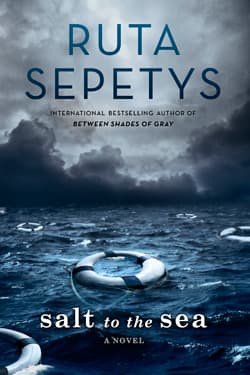
Synopsis
Covers the whole plot, including the ending.
- Difficulty
- Medium
- Pacing
- Moderate
- Mood
- Somber, Hopeful, Suspenseful, Heartbreaking
- Read it if
- You enjoy historical fiction based on lesser-known but significant events, especially stories of survival and human connection during wartime.
- Skip it if
- You prefer lighthearted reads or are sensitive to detailed depictions of war tragedies and high death tolls.
Salt to the Sea Plot Summary
Covers the whole plot, including the ending.
The Convergence of Strangers
The story begins with four separate narratives in January 1945. Joana Vilkas, a Lithuanian nursing student, flees the Soviet advance, feeling guilty about leaving her cousin and family. Florian Beck, a young Prussian art restorer, deserts the German army. He carries a secret satchel of amber art from Königsberg, determined to protect it from Nazi seizure. Emilia Staszewska, a pregnant 15-year-old Polish girl, is alone and scared, trying to reach the German port of Gotenhafen (Gdynia). Alfred Frick, a pompous German sailor on the Wilhelm Gustloff, is shown through his self-important letters. He believes he is important despite his low rank. These different paths start to come together as they all head toward the Baltic coast, hoping to escape the Eastern Front and find safety.
A Shared Journey and Growing Bonds
Joana meets Florian after he saves her group from a Russian soldier. Despite initial distrust, especially from Joana who thinks Florian is a deserter, they form a tense alliance. Their group grows to include a blind shoemaker, an old woman named Eva, and the 'shoe poet' boy. Emilia, weak and alone, eventually finds them. Her advanced pregnancy is a constant worry. As they travel through the harsh East Prussian winter, facing starvation, frostbite, and the constant danger of Soviet soldiers, their shared vulnerability makes them rely on each other. Florian, at first withdrawn, starts to feel responsible for the group, especially Emilia.
Secrets and Suspicions Unveiled
As the journey continues, the characters' pasts start to appear. Joana deals with the memory of her cousin, Lina, and the ethical problems she faced in her nursing work. Florian, a master forger and restorer, carries the secret of the amber art. He believes he protects German heritage from Hitler's rule. He is also haunted by his sister's death and the forced labor he endured. Emilia's silence and fear hint at a trauma she experienced from Soviet soldiers, which is the reason for her pregnancy. The group learns to handle these unspoken burdens. Moments of shared humanity break through the fear and suspicion. Florian's art skills help them get supplies.
Arrival at Gotenhafen and the Gustloff
After a difficult journey with close calls with Soviet soldiers and the constant threat of starvation and exposure, the group finally reaches the bombed port city of Gotenhafen. The Wilhelm Gustloff, a large former cruise liner now used for Operation Hannibal, is their last hope for survival. The port is chaotic, with thousands of desperate refugees trying to get passage. Joana uses her nursing credentials to get passage for her group, while Florian uses his cleverness. They board the Gustloff, a ship designed for 1,800 but now packed with over 10,000 people, mostly women, children, and wounded soldiers. Alfred, meanwhile, continues to boast in his letters about his 'important' role on the ship.
Life Aboard the Overcrowded Ship
Life aboard the Wilhelm Gustloff is a small picture of the war's destruction. The ship is dangerously overcrowded, with refugees packed into every available space. Sanitation is poor, food is scarce, and the air is thick with worry. Despite the grim reality, small hopes appear. Joana, using her nursing skills, helps care for the sick and injured. Florian, though still guarded, feels drawn to Joana and increasingly protects Emilia. A tentative romance starts between Joana and Florian. Emilia, close to labor, gets comfort and care from Joana. Alfred, unaware of the real suffering around him, continues his self-important duties, patrolling the decks and fantasizing about his superior rank.
Emilia's Delivery and a New Life Amidst Despair
As the Wilhelm Gustloff sails the icy Baltic Sea, Emilia goes into labor. With Joana's help and Florian's support, she gives birth to a baby girl, whom she names Halina. The birth of a new life on the crowded, tense ship is a strong moment of hope and vulnerability. It strengthens the bond between Joana, Florian, and Emilia, making their alliance a makeshift family. Florian feels a deep connection to the baby, seeing her as a symbol of innocence and a reason to fight for survival. This event briefly overshadows the journey's danger and the constant fear of U-boat attacks.
The Torpedo Strikes
On the night of January 30, 1945, the unthinkable happens. The Wilhelm Gustloff, sailing through the dark, icy waters of the Baltic Sea, is hit by three torpedoes from a Soviet submarine. The impact is catastrophic, throwing the ship into immediate chaos. Lights fail, the ship lists violently, and panic breaks out among the thousands of trapped passengers. Alfred, at first unaware, is thrown into the horrifying reality. Joana, Florian, Emilia, and baby Halina, along with their companions, are thrust into a desperate fight for survival. They fight against the crowd, the freezing water, and the rapidly sinking vessel.
A Desperate Struggle for Survival
Amidst the loud screams and the rapidly tilting decks, the group tries to get to the lifeboats. The sheer number of people, the icy conditions, and the lack of organization make escape very difficult. Many lifeboats are frozen to their davits or cannot be launched. Joana, Florian, and Emilia, with Halina, struggle to stay together. Florian's strength and quick thinking are important. They face horrors: people crushed in the stampede, others freezing to death in the water, and the overwhelming feeling of impending doom. Alfred, in his panic, focuses only on his own survival, showing his true cowardice.
Loss and Sacrifice in the Icy Waters
As the Wilhelm Gustloff sinks into the icy Baltic, the refugees are thrown into the freezing water. Many die from hypothermia or are crushed by debris. The blind shoemaker and the 'shoe poet' boy are lost in the chaos. Old Eva, in a selfless act, sacrifices herself to save baby Halina by wrapping her in her own shawl before dying from the cold. Florian, despite his own injuries and the weight of his amber satchel, desperately tries to keep Joana, Emilia, and Halina alive. Joana uses her nursing instincts to care for the injured in the water. The scale of the tragedy becomes clear, with thousands freezing or drowning around them.
Rescue and Lingering Scars
After hours in the freezing water, clinging to debris, Joana, Florian, Emilia, and baby Halina are among the few rescued by a German torpedo boat. They are brought to safety, but the experience leaves them deeply scarred. Florian finally tells Joana the truth about his amber satchel. Emilia confesses the full horror of her past and Halina's father's identity. While they have survived the physical ordeal, the psychological wounds of the sinking, the loss of their companions, and the broader trauma of the war will stay with them. The story ends with the survivors dealing with their grief and an uncertain future, forever linked by the shared tragedy of the Wilhelm Gustloff.
Principal Figures
Joana Vilkas
Protagonist
A Lithuanian nursing student haunted by guilt, seeking survival and redemption.
Joana is a compassionate and resourceful Lithuanian nursing student fleeing the Soviet advance. She carries immense guilt for having to abandon her cousin and family, and for the difficult ethical choices she made as a nurse during the war. Despite her inner turmoil, she consistently puts the needs of others before her own, using her medical skills to help her fellow refugees. She is initially wary of Florian but comes to trust and fall in love with him. Her journey is one of resilience and finding purpose in helping others, even amidst overwhelming despair.
Relationships: Florian Beck (Love interest and fellow survivor); Emilia Staszewska (Protective friend and caregiver); Lina (Cousin she feels guilty for leaving behind)
Florian Beck
Protagonist
A secretive Prussian art restorer deserting the German army, protecting stolen art and newfound companions.
Florian is a young, skilled Prussian art restorer who deserts the German army, carrying a satchel of priceless amber art he believes he is protecting from Nazi destruction. He is intelligent, resourceful, and initially very guarded, haunted by his past and the loss of his sister. Despite his secretive nature, he possesses a strong moral compass and a surprising capacity for protectiveness, especially towards Emilia and Joana. His artistic skills and knowledge prove invaluable during their escape. He seeks to reclaim his identity and atone for past complicity.
Relationships: Joana Vilkas (Love interest and fellow survivor); Emilia Staszewska (Protective friend, almost like a brother); Dr. Lange (Former mentor and target of his deception)
Emilia Staszewska
Protagonist
A pregnant 15-year-old Polish girl, traumatized and seeking safety.
Emilia is a young, pregnant Polish girl, only 15, who is deeply traumatized and vulnerable. She is quiet, fearful, and initially distrustful, having suffered unspeakable horrors at the hands of Soviet soldiers. Her pregnancy is a constant source of fear and shame, and she carries the secret of her baby's paternity. Despite her fragility, she possesses an inner resilience and a fierce maternal instinct that emerges after the birth of her daughter, Halina. She represents the innocent victims of war and the hope for new life amidst devastation.
Relationships: Joana Vilkas (Caregiver and friend); Florian Beck (Protector and friend); Halina (Her newborn daughter)
Alfred Frick
Antagonist/Supporting
A delusional German sailor on the Gustloff, obsessed with his own perceived importance.
Alfred is a German sailor aboard the Wilhelm Gustloff, though his actual rank and duties are insignificant. He is characterized by his pompous, self-aggrandizing letters to a fictional girlfriend, Anni, which reveal his profound delusions of grandeur, prejudice, and cowardice. He constantly exaggerates his importance and status, viewing himself as a hero while in reality he is a petty, cruel, and self-absorbed individual. He represents the ignorance and self-deception that was pervasive in parts of Nazi society, and his narrative provides a stark contrast to the genuine suffering of the other refugees.
Relationships: Anni (Fictional girlfriend to whom he writes letters)
The Shoe Poet (Klaus)
Supporting
A young, observant boy who collects shoes and shares poignant observations.
The Shoe Poet is a young boy in Joana's group who is observant and sensitive. He has a unique habit of collecting shoes, seeing them as symbols of the people who wore them and the stories they carry. He often shares profound, poetic observations about life, war, and humanity, despite his young age. He represents the lost innocence of children in wartime and the ability to find beauty and meaning even in the darkest circumstances. He forms a bond with the other refugees, particularly Joana, and his presence adds a touch of poignant innocence to their grim journey.
Relationships: Joana Vilkas (Caretaker and friend); The Blind Shoemaker (Friend and fellow traveler)
The Blind Shoemaker
Supporting
An elderly, wise blind man who offers comfort and guidance to the group.
The Blind Shoemaker is an elderly man in Joana's group who, despite his blindness, possesses profound wisdom and a calming presence. He often offers insightful comments and comfort to the other refugees. His disability forces the group to slow down, but his spirit and resilience are invaluable. He is a symbol of endurance and the human spirit's ability to find light even in darkness. He forms a particularly strong bond with the Shoe Poet, acting as a mentor figure.
Relationships: The Shoe Poet (Friend and companion); Joana Vilkas (Caregiver and friend)
Eva
Supporting
An old woman who eventually sacrifices herself to save baby Halina.
Eva is an elderly woman in Joana's group. She is initially depicted as somewhat frail and quiet, but her character grows in significance during the sinking of the Gustloff. In a moment of profound self-sacrifice, she uses her last strength to wrap baby Halina in her shawl, ensuring the infant's survival at the cost of her own life. She embodies the selfless acts of heroism that occurred amidst the tragedy, demonstrating the enduring human capacity for love and protection even in the face of death.
Relationships: Emilia Staszewska (Fellow refugee, saving her baby); Halina (The baby she saves)
Dr. Lange
Mentioned
Florian's former mentor, a Nazi who exploited his artistic talents.
Dr. Lange is Florian's former mentor and a key figure in the Nazi regime's art appropriation efforts. He exploited Florian's artistic talents for his own gain and to further the Nazi agenda of stealing and re-cataloging European art. Florian's desertion and his mission to protect the amber art are partly a rebellion against Dr. Lange and everything he represents. Lange symbolizes the corrupting influence of power and ideology on art and individuals.
Relationships: Florian Beck (Former mentor and exploiter)
Halina
Supporting
Emilia's newborn daughter, a symbol of hope and new beginnings.
Halina is Emilia's newborn daughter, born aboard the Wilhelm Gustloff just before its tragic sinking. Her birth is a powerful symbol of hope and the continuation of life amidst the horrors of war. She is the innocent focal point for the group's protective instincts, particularly Florian's. Her survival, against incredible odds, underscores the novel's themes of resilience and the preciousness of new life. She represents the future that the survivors are fighting for.
Relationships: Emilia Staszewska (Her mother); Joana Vilkas (Caregiver); Florian Beck (Protector)
Themes & Insights
Survival and Resilience
A main theme is the will to survive against great odds. Joana, Florian, Emilia, and their companions endure freezing temperatures, starvation, constant threats of violence, and the sinking of the Gustloff. Their resilience shows in their continued movement, resourcefulness, and refusal to give up, even with great loss. Emilia giving birth on the ship and the group's effort to protect the baby, seeing her as a reason to keep going, shows this theme.
“'Sometimes, when you least expect it, you find hope from a most unexpected place.'”
The Trauma of War and Loss of Innocence
The novel clearly shows the damaging psychological and physical effects of war, especially on civilians and children. Emilia's rape and pregnancy, the Shoe Poet's observations, and the constant fear and loss for all characters show the widespread trauma. The large number of deaths during the Gustloff sinking shows how war destroys without care. The characters face horrors, losing any innocence they had before their journeys began.
“'War is chaos. It's a tornado. So you're just trying to find some place to stand.'”
Identity and Belonging
Each main character struggles with their identity in wartime. Joana deals with her guilt and her role as a healer. Florian questions his loyalty and his purpose as an artist. Emilia seeks safety and a place for herself and her unborn child. They are all refugees, without homes and often without national identities, looking for a new place to belong. Their journey together makes them redefine who they are, not by their pasts or nationalities, but by their shared humanity and connections to each other, forming a new, makeshift family.
“'I had been defined by my family, my country, my choice of study. Now, I was a refugee. A nothing.'”
The Power of Human Connection and Compassion
Despite the harsh circumstances, the novel emphasizes the strength of human connection, empathy, and compassion. The bonds between Joana, Florian, Emilia, and the other refugees are important for their survival. Acts of kindness, sharing resources, and mutual protection provide light amid the darkness. Joana's nursing instincts, Florian's protectiveness, and Eva's sacrifice for baby Halina all show how humanity can continue even in extreme hardship, countering the inhumanity of war.
“'There is a time for everything. A time for hope and a time for despair. A time for living and a time for dying. A time for love and a time for hate. A time for war and a time for peace. A time for remembering and a time for forgetting.'”
Truth and Deception
The theme of truth and deception appears in the stories. Florian carries the secret of the amber art and his desertion. Emilia hides the traumatic truth of her pregnancy. Alfred lives in a self-made fantasy of importance, deceiving himself and his fictional correspondent. The characters must decide which truths to reveal and to whom, often for their own protection or to stay sane. The novel explores different forms of truth—historical, personal, and emotional—and how war shapes and hides them.
“'Shame is a hunter. It stalks us through life, whispering that we don't deserve what we've been given.'”
Plot Devices & Literary Techniques
Multiple First-Person Perspectives
Four distinct voices narrate the story, offering varied insights and building suspense.
The novel is structured with four alternating first-person narrators: Joana, Florian, Emilia, and Alfred. This allows the reader to experience the events from different emotional and ideological viewpoints, creating a rich, multifaceted understanding of the historical context and the characters' individual struggles. The short, alternating chapters build suspense and highlight the subjective nature of truth and experience during wartime. This technique also allows Sepetys to cover a broad spectrum of refugee experiences, from the compassionate to the delusional.
The Amber Satchel
A symbolic treasure representing stolen heritage, artistic passion, and Florian's burden.
Florian's satchel, filled with stolen amber art pieces, serves as a powerful symbol. Initially, it represents his past as an art restorer, his connection to beauty, and his rebellion against Nazi appropriation. As the journey progresses, it becomes a physical and metaphorical burden, weighing him down but also giving him a sense of purpose beyond mere survival. The amber itself, a fossilized resin, symbolizes preserved history and the enduring beauty that can be found even in the face of destruction, contrasting with the fleeting nature of human life.
Alfred's Letters
An epistolary narrative providing a stark, delusional counterpoint to the other characters' reality.
Alfred's sections are presented as letters he writes to a fictional girlfriend, Anni. This epistolary device provides a unique, often darkly humorous, and ultimately tragic contrast to the harsh realities faced by the other protagonists. His self-aggrandizing tone, prejudiced views, and complete disconnect from the suffering around him highlight the delusion and moral decay that could exist even amidst immense human tragedy. His narrative serves as a foil, emphasizing the authenticity and gravity of the other characters' experiences and the true scale of the Gustloff disaster.
The Wilhelm Gustloff
A historical vessel transformed into a symbol of both hope and catastrophic loss.
The Wilhelm Gustloff is not just the setting for the climax but a powerful symbol throughout the book. Initially, it represents salvation, a massive ship offering a chance to escape the advancing Red Army and reach safety. However, its transformation from a luxury liner to an overcrowded refugee transport, and its eventual sinking, makes it a symbol of the war's destructive power, the false promises of safety, and the unprecedented scale of human loss. It embodies the hidden histories and forgotten tragedies of World War II.
Salt to the Sea Quotes
“Guilt is a hunter.”
“Fate is a hunter.”
“Shame is a hunter.”
“War is catastrophe. It breaks families in irretrievable pieces.”
“I had escaped the wolf, but in the forest I had become one.”
“The dead are only dead if they are forgotten.”
“Hope is a pocket of possibility.”
“We all have secrets. Some are just heavier than others.”
“The heart is an arrow. It demands aim to land true.”
“In the end, we all become stories.”
“Sometimes it is the dream that saves us.”
“Courage is a weapon we must wield ourselves.”
“The sea can be a cruel mother.”
“We were all refugees of our own pasts.”
Quiz
10 questions on the plot and the characters. Each answer comes with a short explanation.
Question 1
What is the primary historical event that serves as the climax of 'Salt to the Sea'?
- The sinking of the Titanic in 1912
- The bombing of Dresden in 1945
- The sinking of the Wilhelm Gustloff in 1945
- The evacuation of Dunkirk in 1940
Show answer
C. The sinking of the Wilhelm Gustloff in 1945 The novel culminates with the sinking of the German cruise liner Wilhelm Gustloff on January 30, 1945, which is considered the deadliest maritime disaster in history with over 9,000 casualties.
Question 2
Which character is a Lithuanian nurse fleeing with a group of refugees?
- Emilia
- Joana
- Florian
- Albert
Show answer
B. Joana Joana is a Lithuanian nurse who uses her medical skills to help refugees during their escape, carrying guilt over leaving her family behind.
Question 3
What secret is Florian carrying that makes him a target for the Nazis?
- He is a Jewish spy
- He has stolen a valuable amber swan
- He is a deserter from the Red Army
- He is smuggling classified documents
Show answer
B. He has stolen a valuable amber swan Florian, a Prussian restoration artist, has stolen an amber swan containing a key Nazi secret, which puts him in danger as he flees.
Question 4
Why is Emilia, the Polish girl, particularly vulnerable during her journey?
- She is blind and relies on others for guidance
- She is a young girl traveling alone without papers
- She is pregnant and traumatized by a past assault
- She is wanted for stealing food from soldiers
Show answer
C. She is pregnant and traumatized by a past assault Emilia is eight months pregnant after being assaulted by Russian soldiers, making her physically and emotionally vulnerable as she pretends to be a German to survive.
Question 5
What role does Albert, the fourth narrator, play on the Wilhelm Gustloff?
- He is the ship's captain
- He is a low-ranking Nazi assigned to record the ship's events
- He is a Soviet spy sabotaging the ship
- He is a doctor treating refugees
Show answer
B. He is a low-ranking Nazi assigned to record the ship's events Albert is a Nazi peon with delusions of grandeur who is tasked with keeping the ship's log, providing a perspective from within the Gustloff's crew.
Question 6
How does the novel structure its narrative to tell the story of the disaster?
- Through a single omniscient narrator
- Through alternating first-person perspectives of four characters
- Through a series of letters between characters
- Through historical documents and flashbacks
Show answer
B. Through alternating first-person perspectives of four characters The story is told through the alternating first-person voices of Joana, Florian, Emilia, and Albert, weaving together their individual journeys toward the Gustloff.
Question 7
What major theme is highlighted through the characters' diverse backgrounds and shared plight?
- The glory of war and national pride
- The importance of historical accuracy in fiction
- The universal suffering of refugees during war
- The technological advances in maritime safety
Show answer
C. The universal suffering of refugees during war Despite their different nationalities and circumstances, the characters represent the collective trauma of refugees fleeing conflict, emphasizing war's human cost beyond borders.
Question 8
What historical detail about the Wilhelm Gustloff's sinking does the novel accurately portray?
- It was sunk by a British submarine in the Atlantic
- It was carrying exactly 1,800 passengers as intended
- It was attacked by a Soviet submarine in the Baltic Sea
- It sank due to a mechanical failure in calm waters
Show answer
C. It was attacked by a Soviet submarine in the Baltic Sea The novel stays true to history: the Gustloff was torpedoed by the Soviet submarine S-13 in the Baltic Sea on January 30, 1945, while overcrowded with refugees.
Question 9
Which character's subplot involves a moral dilemma related to their past actions?
- Joana's guilt over abandoning her family
- Florian's theft of the amber swan and his father's involvement with the Nazis
- Emilia's decision to keep her pregnancy a secret
- Albert's desire for promotion on the ship
Show answer
B. Florian's theft of the amber swan and his father's involvement with the Nazis Florian grapples with the ethics of his theft and his father's Nazi ties, which drive his quest for redemption and escape.
Question 10
In what way does the novel's title 'Salt to the Sea' metaphorically relate to its content?
- It refers to the seasoning used on ship rations
- It symbolizes the tears shed by the characters
- It represents the preservation of forgotten histories
- It describes the taste of the Baltic Sea water
Show answer
C. It represents the preservation of forgotten histories The title evokes how salt preserves food, paralleling the novel's mission to preserve the memory of the Wilhelm Gustloff tragedy, which had been largely overlooked in history.
Salt to the Sea FAQ
What is 'Salt to the Sea' about?
'Salt to the Sea' follows four young refugees—Joana, Florian, Emilia, and Albert—as they flee the advancing Red Army during World War II, converging on the ill-fated German ship Wilhelm Gustloff. Through their alternating perspectives, the novel depicts their harrowing journeys, personal secrets, and the historical maritime disaster where over 9,000 people died when the ship was torpedoed in January 1945.
Why should I read 'Salt to the Sea'?
You should read 'Salt to the Sea' to learn about the little-known Wilhelm Gustloff disaster, the deadliest maritime tragedy in history, through emotionally gripping fictional characters. Ruta Sepetys masterfully blends historical accuracy with compelling narratives of survival, guilt, and hope, making the human cost of war vividly accessible to readers.
What is the background/setting of 'Salt to the Sea'?
The novel is set in East Prussia in January 1945 during the final months of World War II, as Russian forces advance westward. The characters traverse frozen landscapes and refugee camps, culminating on the overcrowded German cruise liner Wilhelm Gustloff in the Baltic Sea, which becomes the site of a catastrophic sinking.
What are the most memorable quotes?
Notable quotes include Florian's reflection, 'Guilt is a hunter,' and Joana's observation, 'War had bled color from everything, leaving nothing but a storm of gray.' These lines encapsulate the novel's themes of moral ambiguity and the desolation of conflict, resonating deeply with the characters' struggles.
What writing style does the author use?
Ruta Sepetys employs a first-person, present-tense narrative with alternating chapters from Joana, Florian, Emilia, and Albert. This style creates immediacy and intimacy, allowing readers to experience each character's distinct voice, fears, and secrets as they unfold against the backdrop of historical events.
What minor details add significant meaning?
Small details like the amber swan Florian carries—a stolen artifact tied to his past—and Emilia's pink hat, which symbolizes her lost innocence and Polish identity, carry deep emotional weight. These objects become motifs of memory and survival, subtly enriching the characters' journeys.
What are some subtle foreshadowing moments?
Early references to the 'salt to the sea' phrase hint at the maritime disaster, while characters' anxieties about overcrowding and cold foreshadow the Wilhelm Gustloff's sinking. Emilia's recurring nightmares and Joana's nursing instincts subtly prepare readers for the tragedy ahead.
What unexpected character connections exist?
Florian and Emilia share a hidden link through the Amber Room treasure, as Florian's stolen artifact connects to Emilia's past. Additionally, Albert's delusional writings about heroism ironically contrast with the refugees' real bravery, creating a thematic connection between perception and reality.
What are unspoken character motivations?
Florian is driven by guilt over betraying his father and a desire for redemption, while Joana harbors unresolved grief from abandoning her family. Emilia's fierce protection of her unborn child masks trauma from assault, and Albert's obsession with recognition stems from deep-seated insecurity.
What psychological complexities do characters exhibit?
Joana balances compassion with survivor's guilt, Florian grapples with moral ambiguity as a thief and fugitive, Emilia displays resilience masking profound trauma, and Albert's narcissism reveals a fragile psyche desperate for validation. These complexities highlight how war distorts identity and morality.
What are the major emotional turning points?
Key moments include Emilia revealing her pregnancy and rape, Florian confessing his theft and past to Joana, and the group's bonding during the escape. The climax occurs during the Wilhelm Gustloff's sinking, where sacrifices and losses force characters to confront their deepest fears and connections.
How do relationship dynamics evolve?
Initially distrustful, Joana and Florian develop a tentative romance built on shared secrets. Emilia forms a maternal bond with the group, especially Joana, who becomes a protector. Albert's isolation contrasts with the refugees' growing camaraderie, emphasizing themes of unity versus alienation.
Which parts remain ambiguous or open-ended?
The fates of some characters after the sinking are left uncertain, such as the full impact on survivors' futures. Additionally, the moral implications of Florian's theft and the ultimate whereabouts of the Amber Room treasure are not fully resolved, inviting reader interpretation.
What are controversial scenes or decisions?
Florian's decision to steal the Amber Room artifact and his initial selfishness spark debate about survival ethics. Emilia's silence about her rape and pregnancy raises questions about trauma representation, while Albert's Nazi affiliations and delusions provoke discussions on complicity and denial.
'Salt to the Sea' ending explained: how it ends & what it means
The novel ends with the Wilhelm Gustloff sinking, resulting in massive loss of life, including Emilia's death after giving birth. Joana, Florian, and the baby survive, symbolizing hope amid tragedy. The ending underscores the historical erasure of the disaster while honoring individual stories of resilience and memory.
About the author

Ruta Sepetys is an author known for her historical fiction that often explores themes of identity and resilience. Her notable works include "Between Shades of Gray," which delves into the experiences of Lithuanian deportees during World War II, "Salt to the Sea," centered on the tragedy of the Wilhelm Gustloff sinking, and "The Fountains of Silence," which examines post-war Spain.
Similar books
- Between Shades of Gray
Ruta Sepetys
4.4 (164k) average on GoodreadsHistorical FictionExplores a lesser-known WWII atrocity through the eyes of young protagonists, focusing on survival and human resilience.
- The Nightingale
Kristin Hannah
4.6 (698k) average on GoodreadsHistorical FictionFeatures strong female characters navigating the brutal realities of WWII, emphasizing sacrifice and survival.
- All the Light We Cannot See
Anthony Doerr
4.3 (1M) average on GoodreadsHistorical FictionInterweaves the stories of young people on opposing sides of WWII, set against a backdrop of historical events and their personal struggles.
- The Book Thief
Markus Zusak
4.4 (1.8M) average on GoodreadsHistorical FictionWhile both explore WWII from a young person's perspective, Zusak's novel focuses on the Holocaust and life in Nazi Germany. Sepetys' Salt to the Sea shifts the geographical and political lens to the plight of East Prussian and Baltic refugees fleeing the Soviet advance, offering a different, underrepresented facet of the war.
- To Kill a Mockingbird
Harper Lee
4.3 (4.5M) average on GoodreadsHistorical FictionIn the 1930s Jim Crow South, Harper Lee writes about racial injustice, moral growth, and the quiet courage of a lawyer father, Atticus Finch, as seen through his young daughter's eyes.
- The Great Gatsby
F. Scott Fitzgerald
3.9 (3.8M) average on GoodreadsHistorical FictionIn the opulent Roaring Twenties, a mysterious millionaire's lavish parties hide his desperate, tragic pursuit of a lost love, exposing the emptiness within the American Dream.





Enjoyed the summary?
A summary gives you the shape of the book. The book itself has the detail, the examples and the voice.
Find Salt to the Sea on AmazonAs an Amazon Associate, BookBrief earns from qualifying purchases. How we're funded