
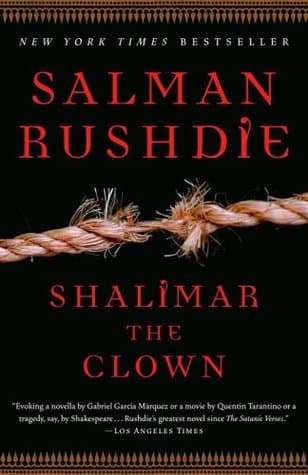
Synopsis
Covers the whole plot, including the ending.
- Difficulty
- Hard
- Pacing
- Variable
- Mood
- Epic, Tragic, Reflective, Intense, Lyrical
- Read it if
- You enjoy sweeping, multi-generational sagas with intricate plots, lyrical prose, and a deep exploration of post-colonial themes, identity, and the impact of political violence on personal lives.
- Skip it if
- You prefer linear narratives, lighthearted stories, or are put off by graphic violence and complex, often non-chronological storytelling.
Shalimar the Clown Plot Summary
Covers the whole plot, including the ending.
The Assassination of Max Ophuls
The novel opens in Santa Monica, California, with the assassination of Maximilian Ophuls, a former U.S. ambassador to India and current counterterrorism chief. His killer is Shalimar the Clown, his Kashmiri Muslim driver, who had worked for Ophuls for several months. Shalimar, a mysterious figure, corners Ophuls in his home and kills him in front of Ophuls' daughter, India. Shalimar escapes, leaving India and the authorities to deal with the shocking act. This event sets up the investigation and the unraveling of the history connecting the victim and his assassin, hinting at a vendetta rooted in past betrayals and geopolitical trouble.
India's Grief and Investigation
India Ophuls, an artist and Max's daughter, is devastated by her father's murder. She is the only witness and a central figure afterward, dealing with grief and the revelation of her father's secret life. The assassination draws significant media attention because of Max's role. As the investigation unfolds, India starts to piece together her father's past and Shalimar's true identity, who is first known only as a driver. Her journey leads her to confront truths about her father and the relationships that led to his death, especially the connection to Kashmir.
Kashmir: The Valley of Shalimar
The story goes back decades to the Kashmiri village of Pachigam in the 1960s, a time when the region was called 'paradise.' Here, we meet a younger Shalimar, whose real name is Noman Sher Noman, a tightrope walker and clown. He is in love with Boonyi Kaul, a local dancer. Their love story is central to the early Kashmiri chapters, showing a culture where Hindu and Muslim communities live peacefully. Their romance blossoms against traditional village life, with festivals, performances, and the joys of a close community, contrasting sharply with the future violence and betrayal.
Max Ophuls' Arrival in Kashmir
Maximilian Ophuls arrives in Kashmir as an American diplomat, tasked with observing the region's politics. He is charismatic and ambitious, captivated by Kashmir. During his stay, he meets Boonyi Kaul, the dancer, and becomes infatuated with her. His presence begins to subtly, then dramatically, unravel Pachigam's peace. Max represents an outside force, bringing global politics and Western influence that will shatter local harmony and start the tragic events leading to his assassination decades later.
Boonyi's Betrayal and Departure
Lured by Max Ophuls' charm, wealth, and promises of a glamorous life, Boonyi Kaul decides to leave Shalimar and her home in Pachigam. She becomes Ophuls' mistress, abandoning her traditional life and the man she was to marry. This betrayal is a moment that shatters Shalimar's world and starts his path of vengeance. Boonyi's departure symbolizes the corruption of innocence and the destructive power of ambition and outside influences on a traditional society. Her choice, driven by a desire for a different future, ultimately leads to a tragic end for herself and those she leaves behind.
Shalimar's Transformation and Vow of Vengeance
Boonyi's leaving devastates Shalimar (Noman Sher Noman). The clown is consumed by grief and rage. He vows revenge against Max Ophuls and Boonyi. This emotional wound, with Kashmir's growing political instability, pushes him towards militancy. He joins a local resistance group, training and adopting a new, hardened identity. His change from a symbol of joy to a skilled killer is central to his story, showing how personal betrayal can mix with broader political conflicts to cause extreme actions. His quest for vengeance becomes his only purpose.
Boonyi's Life with Ophuls and Its Decline
Boonyi's life with Max Ophuls is exciting at first but quickly sours. Max's interest fades, and she finds herself abandoned in London, pregnant with his child (India). Her dream of a glamorous life turns into loneliness and regret. She tries to return to Kashmir, but the village, especially Shalimar's family, rejects her for her betrayal. Isolated and shamed, Boonyi falls into poverty and despair, eventually becoming a prostitute. Her tragic path shows the destructive results of her choices and the harsh realities faced by women who defy norms in traditional communities, leading to her death.
Max Ophuls' Rise to Power
While Boonyi suffers, Max Ophuls' career flourishes. He moves from India to France, then England, and back to the United States, rising in the diplomatic corps. He becomes a significant figure in international relations, known for his intellect and strategy, eventually becoming America's counterterrorism chief. His personal life, however, remains complicated, with many affairs and a distant relationship with his family. Max is a powerful, often morally compromised Western figure, whose actions, though seemingly separate from his past, plant the seeds of his future destruction.
Shalimar's Journey to America
Driven by his vow of vengeance, Shalimar (Noman Sher Noman) begins a long journey, changing from a Kashmiri militant into a global operative. He travels through various countries, honing his skills, adopting different identities, and patiently tracking Max Ophuls. His journey shows his determination. He eventually goes to America, where he gets a job as Ophuls' driver. This infiltration is the result of years of planning and the final step in his act of retribution, bringing him face-to-face with his target.
India Discovers the Truth
Through her investigation, fueled by grief and a desire for understanding, India Ophuls gradually uncovers the full story behind her father's assassination. She learns about Boonyi Kaul, her mother, and her tragic past in Kashmir, and the betrayal that started Shalimar's quest for revenge. The revelation that she is the daughter of the man who ruined Shalimar's life and the woman who betrayed him is a shock. This understanding forces India to re-evaluate her father's legacy and her own identity, placing her between victim and avenger, and between two conflicting stories of love and loss.
The Intertwined Destinies
As the story moves between past and present, Kashmir, France, England, and America, the connections between the characters are fully revealed. Max Ophuls' ambition and disregard for others, Boonyi's longing for a different life and heartbreak, Shalimar's change from lover to avenger, and India's role as the product of this history are all linked. The novel details how choices, geopolitical events, and cultural clashes combine to create a chain reaction, ending in the violent present and showing the cyclical nature of vengeance.
The Legacy of Violence
The novel ends by highlighting the lasting legacy of violence and the cycle of revenge. Shalimar, having finished his mission, disappears, leaving India to deal with the disturbing truths she has found. The story suggests that the wounds from betrayal and conflict, both personal and political, are deep and last long, echoing across generations and places. The violence that took over Kashmir and the lives of its characters is not easily resolved, implying that retribution may continue, leaving a bitter taste and a warning about unchecked ambition and unresolved grievances.
Principal Figures
Maximilian Ophuls
Antagonist/Protagonist
A charismatic and ambitious American diplomat, later counterterrorism chief.
Max Ophuls is a complex, morally ambiguous character. He is a brilliant and successful diplomat, rising to become America's counterterrorism chief, a 'maker of the modern world.' He is charming, intelligent, and driven by ambition, but also deeply self-centered and capable of profound casual cruelty. His affair with Boonyi Kaul, and his subsequent abandonment of her, demonstrates his objectification of others and his lack of responsibility. He embodies the Western gaze and the impact of external powers on vulnerable regions like Kashmir, unknowingly sowing the seeds of his own destruction through his past actions.
Relationships: Boonyi Kaul (mistress, father of India); India Ophuls (illegitimate daughter); Shalimar the Clown (assassin, victim of his betrayal)
Shalimar the Clown (Noman Sher Noman)
Protagonist/Antagonist
A Kashmiri tightrope walker transformed into a vengeful militant.
Noman Sher Noman, known as Shalimar, begins as an innocent, skilled tightrope walker and clown in the idyllic village of Pachigam. He is deeply in love with Boonyi Kaul and embodies the simple, harmonious life of pre-conflict Kashmir. Boonyi's betrayal and abandonment by Max Ophuls shatters his world, transforming him into a hardened, highly trained militant consumed by a singular quest for vengeance. He is patient, resourceful, and utterly determined, spending decades tracking and ultimately assassinating Ophuls. Shalimar represents the devastating impact of personal betrayal intertwining with political conflict, and the enduring power of a vow of revenge.
Relationships: Boonyi Kaul (childhood sweetheart, betrayed lover); Maximilian Ophuls (target of his vengeance); India Ophuls (daughter of his betrayers)
Boonyi Kaul
Supporting/Tragic Figure
A beautiful Kashmiri dancer whose ambition leads to betrayal and tragedy.
Boonyi Kaul is a vibrant and beautiful dancer from Pachigam, deeply in love with Shalimar. She is ambitious and yearns for a life beyond her village, making her susceptible to Max Ophuls' charm and promises of glamour. Her decision to leave Shalimar and become Ophuls' mistress is the central act of betrayal that ignites the novel's tragic chain of events. Her subsequent abandonment and descent into poverty, shame, and prostitution highlight the harsh consequences faced by women who transgress societal norms, particularly in traditional cultures. Boonyi represents lost innocence and the destructive power of ambition and external seduction.
Relationships: Shalimar the Clown (childhood sweetheart, betrayed him); Maximilian Ophuls (lover, father of her child, ultimately abandoned her); India Ophuls (daughter)
India Ophuls
Protagonist
Max Ophuls' illegitimate daughter, an artist who uncovers her family's dark past.
India Ophuls is an artist living in Santa Monica, the illegitimate daughter of Max Ophuls and Boonyi Kaul. She is a strong, independent woman, initially unaware of the complex and tragic history that defines her parentage. Witnessing her father's assassination by Shalimar forces her to confront uncomfortable truths about her family and her own identity. Her journey of discovery drives much of the present-day narrative, as she pieces together the story of her parents' betrayal and Shalimar's vengeance. India represents the innocent offspring caught in the crossfire of past conflicts, struggling to reconcile her heritage with her contemporary life.
Relationships: Maximilian Ophuls (father); Boonyi Kaul (mother); Shalimar the Clown (her father's assassin, her mother's betrayed lover)
Pyarelal Kaul
Supporting
Boonyi's father and the sarangi player of Pachigam.
Pyarelal Kaul is Boonyi's father, a respected sarangi player in Pachigam. He represents the traditional, artistic, and peaceful aspect of Kashmiri culture. He is initially supportive of Boonyi's relationship with Shalimar, but is deeply shamed and heartbroken by her decision to leave with Max Ophuls. His character embodies the profound sense of loss and cultural degradation experienced by Kashmir as it descends into conflict. He struggles to cope with his daughter's betrayal and its impact on his family and community, ultimately becoming a symbol of the suffering endured by ordinary Kashmiris.
Relationships: Boonyi Kaul (daughter); Shalimar the Clown (potential son-in-law)
Abdullah Noman
Supporting
Shalimar's father, a respected tightrope walker and elder of Pachigam.
Abdullah Noman is Shalimar's father and a master tightrope walker, passing his skills down to his son. He is a man of honor and tradition, proud of his family's heritage as performers. His character represents the resilience and cultural identity of the Kashmiri people. He is deeply affected by Boonyi's betrayal and his son's subsequent transformation, but he maintains a sense of dignity and adherence to community values. Abdullah serves as a link to the historical practices and wisdom of Pachigam, providing context for Shalimar's early life and the traditions he abandoned.
Relationships: Shalimar the Clown (father); Boonyi Kaul (potential daughter-in-law)
General Kachhwaha
Supporting
A high-ranking Indian military officer involved in the Kashmir conflict.
General Kachhwaha is a powerful figure in the Indian military, representing the state's authority and its often brutal response to the insurgency in Kashmir. He is a pragmatic and ruthless leader, focused on maintaining control, even at the cost of civilian lives and human rights. His character highlights the geopolitical complexities and the violent realities of the Kashmir conflict, providing a contrasting perspective to the personal stories of the villagers. He embodies the broader forces of state power and military might that contribute to the region's suffering and the radicalization of individuals like Shalimar.
Relationships: Maximilian Ophuls (diplomatic contact)
Maharaja of Kashmir
Mentioned/Historical Figure
The last ruler of the princely state of Kashmir.
The Maharaja of Kashmir, Hari Singh, is a historical figure whose decisions regarding the accession of Kashmir to India are crucial to the region's political fate. While not a direct character in the present narrative, his actions and the subsequent conflict form the backdrop against which the personal dramas unfold. He represents the historical context of Kashmir's disputed status and the legacy of political decisions that continue to fuel violence and discord. His presence, though often indirect, underscores the deep historical roots of the conflict that shapes the characters' lives.
Themes & Insights
The Corrupting Power of Betrayal
Betrayal starts the novel's tragic events. Boonyi's leaving Shalimar for Max Ophuls is a personal betrayal that shatters Shalimar's innocence and turns him into a vengeful militant. Max Ophuls' seduction and abandonment of Boonyi is another betrayal, showing his moral flaws. These personal betrayals echo the political betrayals and broken promises that affect Kashmir, turning a paradise into a war zone. The theme shows how one act of betrayal can have devastating, far-reaching consequences, leading to cycles of violence and retribution across decades and continents.
“A man's life can be ruined by a woman's choice, and a country's destiny by a politician's whim.”
The Loss of Paradise and Innocence
The novel shows Kashmir as a 'paradise' in its early chapters, a place of beauty and harmony between communities. This image contrasts with its later descent into conflict. The loss of innocence is seen in Shalimar's change from a joyful clown to a killer, and Boonyi's fall from a hopeful dancer to an outcast. The theme explores how outside forces—ambition, politics, and personal desires—can corrupt and destroy a pure state, both geographically and spiritually, leaving only violence and regret.
“Kashmir was the most beautiful place on earth, until it became the most dangerous.”
The Intertwined Nature of Personal and Political Conflict
The novel weaves individual dramas with broader geopolitical conflicts. Shalimar's quest for vengeance against Max Ophuls is tied to the insurgency in Kashmir. His change into a militant is not only a response to Boonyi's betrayal but also a result of the political instability and violence in his homeland. Max Ophuls' diplomatic career, which brings him to Kashmir, directly contributes to the personal tragedies. This theme emphasizes that personal choices have political effects and that political turmoil deeply impacts individual lives, showing how large and small conflicts are connected.
“Every personal story is, in a way, a political story, and every political story contains a million personal ones.”
The Enduring Cycle of Vengeance
Vengeance drives the narrative, fueling Shalimar's decades-long pursuit of Max Ophuls. His determination to get retribution for Boonyi's betrayal and her tragic fate powers the main plot. The novel explores the destructive nature of this cycle, showing how violence creates more violence, and how past wounds continue to affect the present. Even after Shalimar achieves his goal, the lingering questions and the impact on India suggest that the cycle of retribution may not truly end, highlighting the difficulty of breaking free from past grievances and the pursuit of 'justice.'
“Vengeance is a dish best served cold, but it can freeze the heart in the serving.”
Identity and Belonging in a Displaced World
Many characters struggle with identity and belonging. Boonyi is displaced from her village and traditional life, an outcast in both the Western world and her home. Shalimar takes on multiple identities during his journey of vengeance, losing his original self. India, as a mixed-race, illegitimate daughter, deals with her heritage and the conflicting stories of her parents. The theme reflects the displacement of Kashmiris and the loss of cultural identity in a region torn by conflict. It questions what it means to belong when one's home and past are shattered.
“To lose your homeland is to lose a part of yourself, perhaps the most important part.”
Plot Devices & Literary Techniques
Non-linear Narrative Structure
The story jumps between different time periods and locations.
The novel employs a complex non-linear narrative, frequently shifting between the present-day assassination of Max Ophuls in California and the past events in Kashmir, France, and England. This structure allows Rushdie to gradually reveal the intricate connections between characters and events, building suspense and providing a comprehensive historical context for the central conflict. It mimics the fragmented nature of memory and history, forcing the reader to piece together the narrative, much like India Ophuls herself, ultimately revealing how past actions inevitably lead to present consequences.
The Unreliable Narrator / Multiple Perspectives
The story is told through various viewpoints, some implicitly biased or incomplete.
While the primary narrative voice is omniscient, the story subtly incorporates elements of unreliable narration and shifts in perspective, particularly when recounting historical events or characters' motivations. This allows for a multifaceted understanding of the characters and their actions, preventing a simplistic 'good vs. evil' interpretation. The reader is often presented with different versions of events or character interpretations, reflecting the subjective nature of memory and the complexities of human motivation, especially in a conflict-ridden environment where truth itself becomes a casualty.
Symbolism of Kashmir as 'Paradise Lost'
Kashmir represents an idealized state corrupted by external forces and conflict.
Kashmir functions as a powerful symbol throughout the novel. Initially depicted as a 'paradise on Earth,' a place of natural beauty, cultural harmony, and innocent love (between Shalimar and Boonyi), it gradually transforms into a symbol of paradise lost. Its descent into violence, militancy, and despair mirrors the corruption of innocence and the destruction of harmonious relationships among the characters. The physical and political degradation of Kashmir serves as a poignant metaphor for the broader themes of betrayal, loss, and the devastating impact of external interference on an otherwise idyllic land.
The Clown/Performer Motif
Characters associated with performance and disguise.
The motif of the clown and other performers (tightrope walkers, dancers) is central to the novel. Shalimar, literally a clown and tightrope walker, embodies a duality: the joyful entertainer and the deadly avenger. His transformation highlights the idea that appearances can be deceiving and that individuals can adopt new 'roles' out of necessity or vengeance. Boonyi, as a dancer, also performs. This motif underscores themes of illusion, transformation, and the masks people wear, both literally and figuratively, to survive or achieve their goals, blurring the lines between identity and performance.
Shalimar the Clown Quotes
“What is the opposite of a miracle? An India.”
“The past is a foreign country; they do things differently there.”
“Terrorism is the war of the poor, and war is the terrorism of the rich.”
“Everywhere was the same, the everywhere of the everywhere, the nowhere of the nowhere.”
“Love, it turns out, is not a victory but a surrender.”
“To be born again, you must first die.”
“History, like love, is mostly a matter of telling stories.”
“The greatest trick the devil ever pulled was convincing the world he didn't exist. The second greatest was convincing the world that Kashmir was a paradise.”
“Memory is a kind of country, and you have to have a map to find your way around it.”
“When you lose everything, you gain the freedom to do anything.”
“The world is full of ghosts, and if you don't believe in them, they'll just have to believe in you.”
“The truth is a moving target, and sometimes it hits you when you least expect it.”
“Every act of love is also an act of faith.”
“The mirror of history is broken, and everyone sees a different reflection.”
Quiz
10 questions on the plot and the characters. Each answer comes with a short explanation.
Question 1
What is the name of America's counterterrorism chief and India's father?
- Shalimar
- Maximilian Ophuls
- Boonyi Kaul
- Noman Sher Noman
Show answer
B. Maximilian Ophuls Maximilian Ophuls is established early in the novel as America's counterterrorism chief and the father of India.
Question 2
What is the primary motive for Shalimar the Clown to murder Maximilian Ophuls?
- Political disagreement over counterterrorism policies.
- Revenge for Maximilian's affair with Shalimar's wife, Boonyi Kaul.
- A desire to start a new terrorist organization.
- To steal classified government documents.
Show answer
B. Revenge for Maximilian's affair with Shalimar's wife, Boonyi Kaul. Shalimar's primary motivation for killing Maximilian Ophuls is revenge for Maximilian's affair with Boonyi, which led to her abandonment and subsequent tragic fate.
Question 3
In which region of the world do Shalimar and Boonyi originate?
- France
- England
- Kashmir
- California
Show answer
C. Kashmir Shalimar and Boonyi both come from the village of Pachigam in Kashmir, a region central to the novel's themes of love, betrayal, and conflict.
Question 4
What is Boonyi Kaul's talent that initially draws Maximilian Ophuls' attention?
- Her skill as a political negotiator.
- Her exceptional dancing.
- Her prowess in martial arts.
- Her ability to speak multiple languages.
Show answer
B. Her exceptional dancing. Boonyi Kaul is renowned for her beautiful dancing, a talent that captures Maximilian Ophuls' attention during his diplomatic visit to Kashmir.
Question 5
What role does Firdaus Noman play in Shalimar's life after he is ostracized from Pachigam?
- He becomes Shalimar's new dance partner.
- He trains Shalimar in various forms of combat and guerrilla warfare.
- He helps Shalimar reconcile with Boonyi.
- He offers Shalimar a job in his restaurant.
Show answer
B. He trains Shalimar in various forms of combat and guerrilla warfare. After being cast out of Pachigam, Shalimar is taken in by Firdaus Noman, who transforms him from a clown and lover into a highly skilled warrior and assassin, training him in various combat techniques.
Question 6
Who is India in relation to Maximilian Ophuls and Boonyi Kaul?
- Maximilian's niece and Boonyi's sister.
- Maximilian's adopted daughter and Boonyi's friend.
- Their illegitimate daughter.
- Maximilian's wife and Boonyi's rival.
Show answer
C. Their illegitimate daughter. India is the illegitimate daughter of Maximilian Ophuls and Boonyi Kaul, a key revelation that connects the main characters and fuels much of the narrative's emotional conflict.
Question 7
What significant historical event in Kashmir serves as a backdrop for much of Shalimar's radicalization?
- The construction of a new hydroelectric dam.
- The rise of separatist movements and the ensuing conflict.
- A devastating earthquake.
- A period of unprecedented economic prosperity.
Show answer
B. The rise of separatist movements and the ensuing conflict. The escalating conflict in Kashmir, particularly the rise of militancy and the Indian government's response, is a crucial historical backdrop that shapes Shalimar's journey from a peaceful villager to a vengeful killer.
Question 8
What is the ultimate fate of Boonyi Kaul after she is abandoned by Maximilian Ophuls and ostracized from her village?
- She becomes a successful dancer in Mumbai.
- She lives a quiet life in another village.
- She is taken in by militants and eventually killed.
- She reunites with Shalimar and lives happily.
Show answer
C. She is taken in by militants and eventually killed. After her abandonment and ostracism, Boonyi falls into a tragic spiral, eventually becoming involved with militants and meeting a violent end, a fate that deeply impacts Shalimar.
Question 9
The novel explores the theme of 'love, gained and lost, uncommonly beautiful and mortally dangerous.' How does Shalimar's love for Boonyi exemplify this theme?
- Their love remains pure and untainted throughout the novel.
- His initial deep love transforms into a destructive, murderous rage after her betrayal and fate.
- Their love is primarily a political alliance.
- Their love is a minor subplot with little impact on the main narrative.
Show answer
B. His initial deep love transforms into a destructive, murderous rage after her betrayal and fate. Shalimar's initial profound love for Boonyi is tragically corrupted by her betrayal with Maximilian, transforming his love into a dangerous, all-consuming desire for revenge that drives the entire plot.
Question 10
What is the significance of the character Shalimar being referred to as 'the clown'?
- It refers to his profession as a circus performer in California.
- It highlights his original, peaceful role as an entertainer and acrobat in his village before his transformation.
- It's a sarcastic nickname given to him by Maximilian Ophuls.
- It symbolizes his inability to take anything seriously.
Show answer
B. It highlights his original, peaceful role as an entertainer and acrobat in his village before his transformation. The appellation 'the clown' refers to Shalimar's original life as a skilled acrobat and performer in Pachigam, contrasting sharply with his later identity as a trained killer and emphasizing the profound loss of his innocent past.
Shalimar the Clown FAQ
Who is Maximilian Ophuls and what is his significance in the story?
Maximilian Ophuls is a prominent American counterterrorism chief, a former ambassador, and a key figure in shaping modern geopolitical strategies. He is also India Ophuls' biological father and the target of Shalimar the clown's revenge, making him the catalyst for many of the novel's central conflicts and explorations of power and betrayal.
Who is Shalimar the clown and what drives his actions?
Shalimar the clown, whose real name is Noman Sher Noman, is a Kashmiri Muslim driver who becomes Maximilian Ophuls' assassin. His actions are driven by a profound desire for revenge against Max, who seduced and impregnated his wife, Boonyi Kaul, leading to her exile and the eventual destruction of their idyllic village life in Pachigam.
What is the role of India Ophuls in the narrative?
India Ophuls is Maximilian Ophuls' illegitimate daughter, conceived during his affair with Boonyi Kaul in Kashmir. She serves as a focal point for the unfolding tragedy, inheriting the complexities of her parents' past and grappling with the revelation of her true parentage and the violent legacy of her family.
How does the setting of Kashmir influence the story?
Kashmir is depicted as a once-paradisiacal valley, embodying innocence and cultural richness, but it becomes a symbol of lost purity and the devastating impact of political conflict and external interference. The transformation of Pachigam from an idyllic village to a battleground directly reflects the broader geopolitical struggles and personal betrayals that drive the plot.
What is the central conflict or theme explored in 'Shalimar the Clown'?
The novel primarily explores themes of betrayal, revenge, the destruction of innocence, and the devastating consequences of colonialism and political extremism on individuals and communities. It delves into how personal transgressions intertwine with larger historical and geopolitical forces, leading to inevitable tragedy and the corruption of love.
What is the significance of the 'clown' moniker for Shalimar?
The 'clown' moniker is ironic and tragic. Noman Sher Noman was a renowned tightrope walker and performer in his youth, embodying joy and spectacle. After Boonyi's betrayal and exile, he adopts the name 'Shalimar the clown' as a disguise and a bitter reminder of his lost past, transforming his performance art into a deadly skill for revenge.
How does the legend of 'Shalimar the Clown' (the actual historical figure) connect to Noman Sher Noman?
The novel alludes to a historical Kashmiri entertainer named Shalimar, known for his acrobatic feats and cunning. Noman Sher Noman adopts this persona, not just as a disguise, but as a way to channel a legendary figure of both entertainment and underlying menace, reflecting his own transformation from a beloved performer to a calculated assassin.
What is the role of Boonyi Kaul beyond being a love interest and victim?
Boonyi Kaul is more than just a victim; she represents the allure of the outside world and the tragic consequences of seeking personal freedom and ambition beyond traditional boundaries. Her journey from the innocent dancer of Pachigam to Max's mistress and then a forgotten exile highlights the destructive power of societal judgment and personal choices in a world shaped by patriarchal norms.
Are there any subtle connections between Max's counterterrorism work and his personal life?
Yes, Max's professional life as a counterterrorism expert, dealing with global conflicts and 'bad guys,' subtly mirrors his personal betrayal of Boonyi and Shalimar. His detached, strategic approach to international relations is reflected in his casual disregard for personal loyalties, suggesting a continuum between his public and private moral failings.
How does the novel explore the psychology of revenge through Shalimar?
Shalimar's psychology of revenge is depicted as a consuming, lifelong mission, meticulously planned and executed. It transforms him from a lover and performer into a skilled killer, demonstrating how profound personal betrayal can warp an individual's identity and morality, justifying extreme violence in pursuit of perceived justice.
What psychological impact does the revelation of her parentage have on India Ophuls?
The revelation of her parentage shatters India's sense of self and identity, forcing her to confront a violent and complex legacy. She experiences profound shock and disorientation, grappling with the fact that her father was murdered by her biological mother's husband, and that her existence is rooted in a devastating betrayal.
How does Boonyi's psychological state evolve after her affair and exile?
Boonyi's psychological state deteriorates significantly after her affair and subsequent exile. She experiences profound guilt, shame, and a sense of displacement, leading to a life of regret and eventual mental instability. Her initial ambition gives way to a deep melancholy and a longing for the lost innocence of Pachigam.
What is the psychological cost of Max's seemingly detached and powerful persona?
Max's detached and powerful persona, while projecting strength and control, comes at the psychological cost of emotional emptiness and a lack of genuine connection. His inability to truly love or commit, and his casual betrayal of others, suggests a deep-seated narcissism and a moral void that ultimately leads to his downfall.
Is Shalimar's revenge justified within the moral framework of the novel?
The novel presents Shalimar's revenge as a complex and morally ambiguous act. While the reader can understand the profound betrayal and loss that fuels his actions, his transformation into a cold-blooded killer and the collateral damage he inflicts question the ultimate justification of his violence, leaving the reader to ponder the cyclical nature of retribution.
How does the novel critique American foreign policy and interventionism?
The novel critiques American foreign policy through Maximilian Ophuls, a symbol of American power and intervention. His personal betrayals parallel the broader political interventions that destabilize regions like Kashmir, suggesting that the pursuit of power and self-interest, whether personal or national, often leads to chaos and suffering for those caught in its wake.
What is the symbolic significance of the migration of the villagers from Pachigam?
The migration of the villagers from Pachigam symbolizes the forced displacement and loss of identity experienced by many communities affected by geopolitical conflicts and extremism. It represents the destruction of traditional ways of life and the scattering of people, mirroring the broader theme of paradise lost and the human cost of political turmoil.
Does the novel offer any hope for reconciliation or healing?
The novel offers a glimmer of potential for reconciliation and healing through India Ophuls, who, despite her tragic origins, strives to understand her past and forge her own path. While the immediate aftermath is bleak, her journey represents the possibility of breaking cycles of violence and seeking truth, even if true reconciliation remains elusive for the older generation.
How does Rushdie use magical realism or mythological elements in this realistic narrative?
Rushdie subtly weaves elements of magical realism and mythological storytelling, particularly through the legends and folklore of Kashmir, such as tales of princesses and demons. These elements enrich the narrative by providing a deeper, symbolic context for the characters' experiences, blurring the lines between historical reality and timeless myth, and emphasizing the epic scope of human drama.
About the author

Sir Ahmed Salman Rushdie is an Indian-born British-American novelist. His work often combines magic realism with historical fiction and primarily deals with connections, disruptions, and migrations between Eastern and Western civilizations, typically set on the Indian subcontinent. Rushdie's second novel, Midnight's Children (1981), won the Booker Prize in 1981 and was deemed to be "the best novel of all winners" on two occasions, marking the 25th and the 40th anniversary of the prize.
Similar books
- The Ministry of Utmost Happiness
Arundhati Roy
3.5 (28k) average on GoodreadsLiterary FictionExplores complex political and social issues in India and Kashmir through a multi-faceted, character-driven plot.
- The God of Small Things
Arundhati Roy
3.9 (244k) average on GoodreadsLiterary FictionBoth Shalimar the Clown and Roy's The God of Small Things (1997) explore the devastating impact of political and social upheaval on individual lives and relationships within India. However, Roy's novel is more tightly focused on the micro-level of a single family's tragedy in Kerala, using a more intimate and lyrical prose style. Rushdie's canvas is far broader, encompassing international politics and historical trauma across multiple continents, and his narrative is more overtly political and satirical. While Roy often delves into the quiet despair and unspoken rules of caste and class, Rushdie confronts explicit violence and the grand narratives of nation-building and destruction.
- The Old Man and the Sea
Ernest Hemingway
3.8 (831k) average on GoodreadsLiterary FictionA Cuban fisherman's long struggle with a giant marlin becomes a story of endurance and dignity, now retold for young adults with illustrations, phonetic guides, and writing prompts in Traditional Chinese.
- One Hundred Years of Solitude
Gabriel García Márquez
4.1 (753k) average on GoodreadsLiterary FictionThrough the multi-generational story of the Buendía family, a mythical town deals with the repeating patterns of time, love, and solitude, as the extraordinary mixes with the ordinary.
- The Goldfinch
Donna Tartt
3.9 (720k) average on GoodreadsLiterary FictionHaunted by a tragic explosion and clutching a stolen Dutch masterpiece, a young orphan navigates the opulent drawing rooms of New York and the gritty underbelly of the art world, desperately seeking connection and redemption amidst a life spiraling into crime and obsession.
- Little Fires Everywhere
Celeste Ng
4.1 (713k) average on GoodreadsLiterary FictionIn Shaker Heights, an artist and her daughter move in, and their free-spirited lives clash with a rule-bound matriarch, revealing hidden conflicts beneath a perfect surface.




Enjoyed the summary?
A summary gives you the shape of the book. The book itself has the detail, the examples and the voice.
Find Shalimar the Clown on AmazonAs an Amazon Associate, BookBrief earns from qualifying purchases. How we're funded