
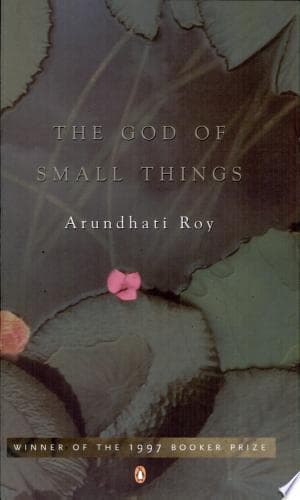
Synopsis
Covers the whole plot, including the ending.
- Difficulty
- Medium
- Pacing
- Slow
- Mood
- Atmospheric, Melancholy, Poignant, Reflective, Tragic
- Read it if
- You appreciate beautifully written, lyrical prose, complex family sagas, and deep explorations of social injustice and forbidden love in a specific cultural context.
- Skip it if
- You prefer fast-paced plots, straightforward narratives, or lighthearted stories, as this book is emotionally heavy and requires patience.
The God of Small Things Plot Summary
Covers the whole plot, including the ending.
Ayemenem in the Present
The novel begins in 1993, with Rahel returning to Ayemenem, Kerala, after a long time away, mostly spent in America. She finds the once lively Ipe family home, now called the History House, run down and overgrown. Her twin brother, Estha, has become quiet and withdrawn, a state called 'Esthapanized,' and has recently returned from Australia. Their reunion is silent, marked by a shared, unspoken sadness that fills the air. The story immediately shows how past tragedies still affect the adult twins, hinting at the devastating events that shaped their lives and separated them. The oppressive heat and the decaying beauty of Ayemenem reflect the emotional state of its residents.
The Arrival of Sophie Mol
The story moves back to 1969, describing the anticipated arrival of Sophie Mol, the nine-year-old daughter of Chacko, Rahel and Estha's uncle, and his English ex-wife, Margaret Kochamma. Sophie's arrival from England is a big event for the Ipe family. Ammu, Rahel and Estha's mother, sees it with a mix of hope and worry, knowing it will be a temporary change. For the seven-year-old twins, Sophie's presence is a source of great excitement and novelty. They are fascinated by her Englishness and the gifts she brings. This time represents a brief moment of childhood innocence and happiness, contrasting sharply with the somber present-day story and hinting at the tragedy to come.
The Love Laws and Velutha
Ammu, feeling trapped and unloved after her divorce, finds comfort and passion in a secret affair with Velutha, a skilled carpenter working for the Ipe family's pickle factory. Velutha is a Paravan, an 'Untouchable' in Kerala's deeply rooted caste system. Their relationship breaks the 'Love Laws' – unwritten rules that dictate 'who should be loved, and how. And how much.' The twins, Rahel and Estha, like Velutha, who treats them kindly and with respect. This forbidden love is a central conflict, showing the oppressive social structures and the severe consequences for those who defy them, especially women and lower-caste individuals. The affair is kept very secret, but its discovery is unavoidable and disastrous.
The Discovery of the Affair
Baby Kochamma, Ammu's grand-aunt, driven by her own hidden desires and a deep prejudice against Velutha because of his caste, discovers Ammu and Velutha's forbidden relationship. Her discovery comes from a mix of moral outrage and a desire to keep the family's social standing. She manipulates events and people, especially Mammachi, to make sure the relationship is exposed and punished. This revelation shatters the fragile peace in the Ipe household and sparks a furious reaction from Chacko, Ammu's brother. The family's anger is not just about the affair itself, but the serious violation of the caste system, which they, as Syrian Christians, strictly follow. Baby Kochamma's actions are central, directly leading to Velutha's tragic downfall and the ruin of Ammu and her children.
The Betrayal and the Police
After the discovery, Chacko locks Ammu in her room, forbidding her from seeing her children. The family, especially Baby Kochamma, fearing the social fallout of the affair, decides to frame Velutha for the attempted rape of Ammu and the kidnapping of the children. They invent a false story, using the local police's deep-seated prejudices against 'Untouchables.' Inspector Thomas Mathew, a corrupt and caste-biased officer, readily accepts their made-up account. Velutha, unaware of the family's plans, is brutally beaten by the police, despite his innocence. This act of grave injustice shows the systemic oppression and how easily power is abused against the vulnerable in society.
Sophie Mol's Drowning
Amidst the chaos and tension after Ammu's punishment, the twins, Rahel and Estha, along with Sophie Mol, decide to run away in their uncle's country boat. They are trying to escape the unhappiness at home and perhaps find Velutha, whom they believe is innocent. During their journey across the river, their boat capsizes in a storm. Sophie Mol, who cannot swim, drowns. This accidental death is a devastating blow, not only to Margaret Kochamma and Chacko but to the entire family. It starts a series of horrific events, becoming the tragic point around which the children's lives are broken and the family's secrets are further hidden. The storm itself can be seen as mirroring the internal turmoil and impending disaster.
The Children's Lie
After Sophie Mol's drowning, the traumatized children are found and brought back. Baby Kochamma, seeing a chance to get rid of Velutha for good and protect their reputation, manipulates Rahel and Estha. She forces them to lie to the police, making them testify that Velutha was responsible for Sophie Mol's death and that he tried to harm them. The children, scared and confused, and under great pressure, confirm her made-up story. This forced betrayal by the children seals Velutha's fate and is a serious violation of their innocence. It leaves them with a heavy burden of guilt and complicity, scarring them for life and contributing to their later silence and emotional withdrawal.
Velutha's Death
Based on the children's forced testimony and the family's false accusations, police brutally beat Velutha in the lockup. Despite his innocence and the complete lack of evidence, the police, driven by caste prejudice and a desire to please the influential Ipe family, inflict a merciless beating. Velutha dies from his injuries, a tragic victim of a corrupt justice system and deep social discrimination. The truth of his innocence is never publicly acknowledged, and his death remains a dark secret within the Ipe family.
The Aftermath and Separation
Following Sophie Mol's death and Velutha's murder, the Ipe family completely falls apart. Ammu is unfairly blamed for everything. Chacko, using his authority, banishes her from the house, denying her access to her children and leaving her with nothing. Estha, due to a complicated reason involving his father's new wife and his perceived 'unsuitability,' is 'Returned' to his estranged father, Baba, in Calcutta, effectively separating him from Rahel and Ammu. This forced separation is a deep trauma for the twins, breaking their strong bond and leaving them isolated. Ammu eventually dies alone, years later, a broken woman. The family house becomes a tomb of unspoken grief and faded memories.
Rahel's Wanderings
After the terrible events of 1969, Rahel lives a fragmented and unsettled life. She is eventually expelled from school for various minor misbehaviors, reflecting her deep trauma and inability to fit in. She drifts through different cities and countries, including Delhi and New York, pursuing various artistic and architectural projects, but never truly settling. Her relationships are brief and unfulfilling, marked by a pervasive sense of detachment and an inability to form deep connections. She carries the weight of the past, the guilt of her childhood lie, and the deep loss of her mother, brother, and Velutha. Her return to Ayemenem in 1993 shows a desperate attempt to confront her past and perhaps find some resolution or understanding.
Estha's Silence
Estha, after being 'Returned' to his father in Calcutta, lives a life defined by his deep silence. The trauma of Sophie Mol's death, Velutha's murder, the forced lie, and his separation from Ammu and Rahel make him almost completely mute. He is withdrawn, obsessive, and carries a clear sense of grief and guilt. He returns to Ayemenem after his father's death, living with Mammachi and Baby Kochamma, who largely ignore his emotional state. His 'Esthapanized' condition is a direct result of the psychological wounds from his childhood, showing the devastating impact of the 'Love Laws' and the family's betrayal. His silence is a powerful symbol of the unaddressed pain and injustice that fills the Ipe family's history.
The Reunion and Shared Grief
In 1993, Rahel and Estha reunite in Ayemenem. Their reunion is not joyous but one of a shared, unspoken burden. They communicate through glances, gestures, and a deep understanding born of shared trauma. Estha's silence is not a barrier but a language they both understand. They revisit the places of their childhood, the river, the History House, the pickle factory, each location heavy with memories. Their connection is the only remaining thread from their shattered past. They are two halves of a whole, forever bound by the tragedy that consumed their family. Their reunion shows the lasting power of their twinship and the lingering shadow of the past.
The Cycle of the Love Laws
The novel ends with Rahel and Estha, now adults, having an incestuous encounter. This deeply forbidden act is presented not as one of passion, but of deep comfort, a desperate attempt to reclaim what was lost and to find connection in their isolated lives. It is another violation of the 'Love Laws,' reflecting and intensifying the forbidden love between Ammu and Velutha. Their intimacy is a tragic consequence of their shared trauma and their inability to form healthy relationships in the outside world. It signifies the cyclical nature of the 'Love Laws' – those who break them are doomed, and those who suffer under them are driven to further transgression, continuing a cycle of pain and forbidden desire.
The God of Small Things Characters
Ammu Ipe
Protagonist
The defiant and passionate mother of Rahel and Estha, trapped by societal expectations.
Ammu is a beautiful, spirited, and ultimately tragic figure. Born into the Syrian Christian Ipe family, she feels stifled by the restrictive expectations placed upon women. Her unhappy marriage and subsequent divorce leave her ostracized and economically dependent. She is fiercely protective of her children, Rahel and Estha, but also prone to fits of temper. Her love for Velutha, an 'Untouchable' Paravan, is a desperate act of rebellion against the 'Love Laws' and a search for genuine connection and passion. She is a victim of both the rigid caste system and the patriarchal society that punishes her for daring to love outside its boundaries.
Relationships: Rahel (Daughter, deeply loved but often subjected to Ammu's frustrations.); Estha (Son, deeply loved but also subjected to Ammu's frustrations.); Velutha (Lover, a forbidden and passionate relationship that leads to their downfall.); Chacko (Brother, a complex relationship marked by a power imbalance and Chacko's eventual rejection.); Baby Kochamma (Grand-aunt, Baby Kochamma resents Ammu and actively works to destroy her.)
Rahel Ipe
Protagonist
One of the fraternal twins, a sensitive and observant child who becomes a rootless adult.
Rahel is one of the novel's central protagonists, a sensitive and imaginative child who shares an almost telepathic bond with her twin brother, Estha. She is observant and often feels things deeply, though she struggles to articulate them. The trauma of 1969 – Sophie Mol's death, Velutha's murder, and the separation from her family – leaves her deeply scarred. As an adult, she is rootless and detached, drifting through life without a clear purpose or lasting connections. Her return to Ayemenem in 1993 is a pilgrimage to confront the ghosts of her past and to reconnect with her estranged brother.
Relationships: Estha (Twin brother, shares an unbreakable, almost telepathic bond and profound shared trauma.); Ammu (Mother, a complex relationship of love, frustration, and eventual profound loss.); Velutha (Friend and protector in childhood, a figure of kindness and tragedy.); Sophie Mol (Cousin, initially a source of excitement, her death is a pivotal traumatic event.)
Estha Ipe
Protagonist
The other fraternal twin, traumatized into near-silence by childhood events.
Estha is Rahel's fraternal twin brother, equally sensitive but more prone to internalizing his pain. He is particularly affected by the trauma of his childhood, especially the molestation by the Orangedrink Lemonade man, Sophie Mol's death, Velutha's murder, and the forced lie against Velutha. His most defining characteristic as an adult is his 'Esthapanized' state – a profound, almost complete silence, a coping mechanism for the unbearable weight of his past. He is meticulous, obsessive, and carries a palpable sense of grief and guilt. His silence is a powerful symbol of the unaddressed pain and injustice that destroyed his family.
Relationships: Rahel (Twin brother, shares an unbreakable, almost telepathic bond and profound shared trauma.); Ammu (Mother, a complex relationship of love, frustration, and eventual profound loss.); Velutha (Friend and protector in childhood, a figure of kindness and tragedy.); Sophie Mol (Cousin, her death is a pivotal traumatic event, for which he feels immense guilt.)
Velutha
Supporting/Tragic Hero
A skilled Paravan carpenter whose forbidden love for Ammu leads to his destruction.
Velutha is a young, intelligent, and skilled carpenter who works for the Ipe family's pickle factory. He is a Paravan, an 'Untouchable,' making his relationship with Ammu a profound transgression of the 'Love Laws.' He is kind and gentle, particularly with the children, Rahel and Estha, who adore him. Despite his lower caste, he possesses a dignity and quiet strength that contrasts sharply with the hypocrisy of the upper-caste characters. His love for Ammu is genuine and passionate, but it ultimately seals his fate. He becomes a tragic victim of the rigid caste system, social prejudice, and the corrupt justice system, wrongly accused and brutally murdered.
Relationships: Ammu (Lover, a forbidden and passionate relationship that leads to their downfall.); Rahel (Friend and mentor, a figure of kindness and respect.); Estha (Friend and mentor, a figure of kindness and respect.)
Baby Kochamma
Antagonist
Ammu's manipulative and prejudiced grand-aunt, the architect of much suffering.
Baby Kochamma is Ammu's grand-aunt and a deeply unpleasant character. She is a former nun, driven by a combination of repressed desires, snobbery, and a fierce adherence to the caste system. She harbors a deep resentment towards Ammu and a profound prejudice against Velutha. Her actions are consistently malicious and self-serving. She manipulates events and people, particularly the children, to ensure Velutha's destruction and to maintain the family's social standing. She is the primary catalyst for many of the novel's tragedies, acting as the embodiment of the oppressive 'Love Laws' and the hypocrisy of the upper class.
Relationships: Ammu (Niece, Baby Kochamma despises Ammu and actively seeks her downfall.); Velutha (A Paravan she despises and falsely accuses.); Rahel (Great-niece, she manipulates Rahel into lying to the police.); Estha (Great-nephew, she manipulates Estha into lying to the police.)
Chacko Ipe
Supporting
Ammu's intellectual but self-absorbed brother, who inherits the family pickle factory.
Chacko is Ammu's older brother, educated at Oxford, and the patriarch of the Ipe family after Pappachi's death. He is intelligent and well-read but also self-absorbed and often oblivious to the emotional needs of those around him. He loves his daughter, Sophie Mol, deeply, but his relationship with Ammu is strained, marked by his patriarchal authority and the double standards he applies to her. He inherits the pickle factory and tries to run it, but his emotional detachment often prevents him from truly understanding his family's struggles. His grief over Sophie Mol's death is profound, but it also hardens his heart against Ammu.
Relationships: Ammu (Sister, a strained relationship marked by Chacko's patriarchal authority and eventual rejection.); Sophie Mol (Daughter, deeply loved and mourned.); Margaret Kochamma (Ex-wife, maintains a cordial relationship for Sophie's sake.); Mammachi (Mother, a loving but somewhat overbearing relationship.)
Mammachi
Supporting
The matriarch of the Ipe family, blind to her husband's cruelty and the injustices around her.
Mammachi is the elderly matriarch of the Ipe family, Ammu and Chacko's mother. She is depicted as a kind, gentle woman who, despite her good intentions, is often naive or willfully blind to the harsh realities and injustices within her own family and society. She endures her husband Pappachi's cruelty in silence. She loves her children and grandchildren but is easily influenced by Baby Kochamma and the prevailing social norms, particularly regarding caste. Her inability to stand up for Ammu or Velutha, despite her affection for them, contributes to their tragic fates. She runs the pickle factory, but her decisions are often swayed by others.
Relationships: Pappachi (Husband, endured his cruelty in silence.); Chacko (Son, she dotes on him.); Ammu (Daughter, she loves her but is unable to protect her.); Baby Kochamma (Sister-in-law, she is easily influenced by her.); Rahel (Granddaughter, she loves her but is distant.)
Sophie Mol
Supporting
The English cousin whose accidental death serves as a catalyst for the family's unraveling.
Sophie Mol is Chacko's nine-year-old daughter, who comes to Ayemenem from England for a visit. Her arrival is initially a source of excitement and novelty for Rahel and Estha. She is presented as a sweet, somewhat reserved English girl, a contrast to the Indian twins. Her accidental drowning in the river is the central tragic event of the novel, a catalyst that unleashes the family's darkest prejudices and ultimately leads to Velutha's murder and the permanent fracturing of the Ipe family. Her death is not just a personal tragedy but a pivotal moment that exposes the deep-seated flaws and injustices within the community.
Relationships: Chacko (Father, deeply loved and mourned by him.); Margaret Kochamma (Mother, deeply loved and mourned by her.); Rahel (Cousin, initially a playmate.); Estha (Cousin, initially a playmate.)
Pappachi
Mentioned/Supporting
The cruel and abusive patriarch of the Ipe family, whose legacy of bitterness permeates.
Pappachi (Shri B. Ipe) is Ammu and Chacko's deceased father, a retired Imperial Entomologist. He is presented through flashbacks and memories as a deeply unpleasant and abusive man. He was a disappointed and frustrated individual, taking out his bitterness on his wife, Mammachi, by regularly beating her. His unfulfilled ambitions and rigid adherence to social status contribute to the oppressive atmosphere within the Ipe household. Although dead by the time the main events of 1969 unfold, his legacy of cruelty and his rigid worldview continue to influence the family's actions and decisions, particularly their adherence to caste distinctions.
Relationships: Mammachi (Wife, whom he regularly abused.); Ammu (Daughter, he was critical and dismissive of her.); Chacko (Son, he favored Chacko over Ammu.)
Inspector Thomas Mathew
Supporting
A corrupt and prejudiced police officer who ensures Velutha's unjust death.
Inspector Thomas Mathew is the local police officer who handles the case of Sophie Mol's death and the accusations against Velutha. He is depicted as a corrupt, cynical, and deeply caste-biased individual. He readily accepts the Ipe family's fabricated story against Velutha, not out of conviction, but out of a desire to maintain social order and appease the influential upper-caste family. He is responsible for Velutha's brutal beating and subsequent death, a symbol of the pervasive injustice and abuse of power against the lower castes. He represents the systemic corruption that allows the 'Love Laws' to be enforced with deadly consequences.
Relationships: Baby Kochamma (Manipulated by her to frame Velutha.); Velutha (Responsible for his unjust beating and death.)
The God of Small Things Themes
The Love Laws and Social Transgression
The main theme is the 'Love Laws,' unspoken rules dictating 'who should be loved, and how. And how much.' The novel carefully details the devastating consequences of breaking these laws, especially through the forbidden love between Ammu, an upper-caste woman, and Velutha, an 'Untouchable' Paravan. Their relationship challenges the rigid caste system and the deep social hierarchy of Kerala in the 1960s. The severe punishment they receive – Velutha's brutal murder and Ammu's exclusion – illustrates how brutally these societal norms are enforced. The 'Love Laws' go beyond caste to gender roles and family expectations, affecting Ammu's divorce and the twins' later separation.
“It was just a way of knowing what should and shouldn't be. And what should and shouldn't be loved. The Love Laws. The laws that lay down who should be loved, and how. And how much.”
Loss of Innocence and Trauma
The novel clearly shows the irreversible loss of innocence experienced by Rahel and Estha. The catastrophic events of 1969 – the discovery of Ammu and Velutha's affair, Sophie Mol's drowning, Velutha's murder, and the children's coerced lie – shatter their childhood. This trauma shows up in their adult lives: Estha's deep silence and Rahel's unsettled, detached existence. The story constantly shifts between the lively, innocent past and the desolate, grief-stricken present, emphasizing how these childhood traumas permanently scar the twins, preventing them from forming healthy relationships or finding peace. Their inability to speak about the past shows the depth of their psychological wounds.
“They had learned that the world had to be kept outside. That inside, things were different.”
Caste System and Injustice
The oppressive and discriminatory nature of the Indian caste system is a constant theme. Velutha, as a Paravan (formerly 'Untouchable'), faces systemic prejudice and violence. His love for Ammu, an upper-caste Syrian Christian, is seen as an unforgivable offense. The novel shows how easily the powerful Ipe family can manipulate the police and the justice system to frame and murder Velutha, simply because of his caste. The caste system dictates not only social interactions but also determines one's worth and right to exist, leading to great injustices and the brutal suppression of those who dare to defy its boundaries. The 'Love Laws' are closely tied to the caste system.
“Small things, God of Small Things. The things that are too small to be seen, to be heard, to be felt. The things that don't matter. But they do.”
Memory, Time, and History
The narrative structure itself highlights memory and time. The story unfolds in a non-linear way, constantly shifting between 1969 and 1993. This mirrors the fractured and cyclical nature of memory. The past is not distant but a living presence that constantly shapes the present. The dilapidated 'History House' physically shows this. The characters are haunted by their memories, unable to escape the past's influence. The novel suggests that history, both personal and collective, is not a straight line but a complex web of interconnected events, where 'things can change in a day,' but their effects last a lifetime. The twins' shared memories are their only true connection.
“The past was like a an old house, full of cobwebs and dust, but also full of the echoes of lives lived.”
The Power of Storytelling and Silence
The novel explores how stories are told, hidden, and manipulated. Baby Kochamma's false story against Velutha is a prime example of how powerful individuals can twist truth for their own ends. Conversely, Estha's deep silence shows the unspeakable trauma he carries. The narrative itself weaves a complex, fragmented story, suggesting that some truths can only be conveyed indirectly, through the 'God of Small Things.' The novel gives voice to those who were silenced by society – Ammu, Velutha, and the children – allowing their untold stories to finally emerge. This highlights the importance of acknowledging forgotten histories and injustices.
“She had told him that he was the most beautiful man she had ever seen. And that she loved him. He had told her that he loved her too. And that he would always love her. And that was all they had said to each other. Everything else was unspoken.”
Plot Devices & Literary Techniques
Non-linear Narrative
The story jumps back and forth between 1969 and 1993.
The novel employs a non-linear narrative, constantly shifting between the pivotal year of 1969, when the tragic events unfold, and 1993, when the adult twins, Rahel and Estha, reunite. This device creates a sense of suspense and foreshadowing, gradually revealing the full scope of the tragedy and its lasting impact. It mirrors the fragmented nature of memory and trauma, showing how the past is not a distinct entity but a living presence that continues to shape the present. The reader pieces together the story alongside the characters, experiencing their grief and confusion.
Foreshadowing
Hints and clues throughout the narrative allude to future tragedies.
Roy masterfully uses foreshadowing to build tension and deepen the sense of impending doom. Early descriptions of the dilapidated Ayemenem house in 1993, Estha's profound silence, and Rahel's detachment all hint at a devastating past. Phrases like 'the day Sophie Mol died' are introduced early, making the reader aware of a future tragedy before its details are revealed. This technique creates a pervasive atmosphere of melancholy and inevitability, emphasizing that the characters are already living with the consequences of events yet to be fully disclosed.
Symbolism
Objects, places, and characters represent deeper meanings.
The novel is rich in symbolism. The 'History House' symbolizes the decaying grandeur of the Ipe family and the weight of their past. The river represents both life and death, connection and separation. The pickle factory, initially a source of family income, becomes a symbol of their decline. The 'Love Laws' themselves are a powerful symbol of societal oppression. Even the 'God of Small Things' represents the overlooked details and the marginalized individuals whose lives are profoundly affected by larger forces. These symbols enrich the narrative, adding layers of meaning and emotional resonance to the story.
Stream of Consciousness
Narrative technique that captures the flow of characters' thoughts and feelings.
While not exclusively a stream of consciousness novel, Roy frequently employs elements of this technique, particularly when delving into the minds of Rahel and Estha as children. The narrative often blurs the lines between observation, memory, and internal thought, reflecting the twins' unique, often non-verbal way of perceiving the world. This allows the reader to experience their emotional states and fragmented understanding of events, deepening the empathy for their trauma and illustrating how their childhood innocence is gradually eroded by the overwhelming circumstances around them.
The God of Small Things Quotes
“They all made the same mistake. They decided that they would never do what they had been told they must do.”
“It was a time when the world was changing, but not in Kottayam. In Kottayam, the world was still fixed.”
“And the God of Small Things. He knew what Love was (God's Love, a parent's, a lover's, a friend's), but He didn't know what Small Things were. He only knew what God's things were.”
“Each of them knew that what had happened could not be undone. And that the world would never be the same.”
“That's how it was with now. It was always there. It was always coming. It was always on its way.”
“She was a woman who had grown up in a house where the sound of breaking glass was as common as the sound of birdsong.”
“Little events, ordinary things, it was just a question of not noticing them.”
“The secret of the Big Things was that they were only Small Things that had been allowed to fester.”
“How many things had to happen to you before you realised that you were a prisoner?”
“It didn't matter what she did. It didn't matter what she said. The moment she opened her mouth, the moment she took a breath, she was wrong.”
“He knew that the world was changing. He knew that the old ways were crumbling. But he didn't know that the dust from the crumbling would settle on him.”
“And the God of Loss. He knew that things, once lost, could never be found again.”
“She was learning that love could be a terrible thing. It could be a beautiful thing, but it could also be a terrible thing.”
“History was like a old house at night. With all the lights out. And you were trying to find your way around in the dark.”
Quiz
10 questions on the plot and the characters. Each answer comes with a short explanation.
Question 1
What is the name of the pickle factory owned by Baby Kochamma's family?
- Paradise Pickles
- Best Pickles
- Paradise Pickles & Preserves
- Acha's Pickles
Show answer
C. Paradise Pickles & Preserves The pickle factory is specifically named 'Paradise Pickles & Preserves', a detail that reflects the family's business and social standing.
Question 2
What is Ammu's relationship to Estha and Rahel?
- She is their aunt.
- She is their mother.
- She is their grandmother.
- She is their nanny.
Show answer
B. She is their mother. Ammu Ipe is the mother of the fraternal twins, Estha and Rahel, whose lives and experiences are central to the novel's narrative.
Question 3
Which historical event is explicitly mentioned as impacting the political climate in Kerala during the novel's timeline?
- The Indian Independence Movement
- The Emergency in India (1975-1977)
- The Partition of India
- The Quit India Movement
Show answer
B. The Emergency in India (1975-1977) The novel frequently references The Emergency in India, particularly through Estha's experiences in Calcutta and the political unrest in Kerala, highlighting its impact on individual lives and freedoms.
Question 4
What 'Small Thing' does the title refer to, according to the novel's themes?
- The insignificant details of daily life
- The unwritten rules and social conventions that govern behavior and relationships
- The children's innocent understanding of the world
- The small acts of kindness between characters
Show answer
B. The unwritten rules and social conventions that govern behavior and relationships The 'God of Small Things' refers to the intricate, often unwritten, social and cultural rules, taboos, and expectations that dictate how love can be expressed, who can love whom, and the devastating consequences when these 'small things' are transgressed.
Question 5
What is the primary reason for Sophie Mol's visit to Ayemenem?
- To visit her grandparents for the summer holidays.
- To attend a family wedding.
- To escape political unrest in England.
- To celebrate her birthday with her cousins.
Show answer
A. To visit her grandparents for the summer holidays. Sophie Mol, Chacko's daughter, visits Ayemenem from England with her mother Margaret for her Christmas holidays, a visit that precipitates many of the novel's tragic events.
Question 6
What is Velutha's caste, which plays a crucial role in his forbidden relationship with Ammu?
- Nair
- Syrian Christian
- Paravan
- Brahmin
Show answer
C. Paravan Velutha is a Paravan (Untouchable), a caste considered far below Ammu's Syrian Christian background. This caste difference is the central reason their love is forbidden and ultimately leads to tragic consequences.
Question 7
What happens to Estha permanently after the events surrounding Sophie Mol's death and Velutha's murder?
- He moves to America and never returns.
- He becomes a successful businessman.
- He stops speaking and becomes largely silent.
- He joins a communist political movement.
Show answer
C. He stops speaking and becomes largely silent. After the traumatic events, particularly his 're-return' to Ayemenem, Estha mostly stops speaking, a profound psychological impact that defines his adult character.
Question 8
What is the significance of the 'love laws' in the novel?
- They are official legal statutes governing marriage.
- They represent the unspoken, rigid social rules dictating who should be loved, and how, and how much.
- They are the personal moral codes of the Ipe family members.
- They are the rules for expressing affection within the family.
Show answer
B. They represent the unspoken, rigid social rules dictating who should be loved, and how, and how much. The 'Love Laws' are a metaphorical concept in the novel, representing the deeply entrenched, often unwritten, social and caste rules that dictate permissible relationships and the severe consequences for those who dare to transgress them.
Question 9
Which character is responsible for the 'Orangedrink Lemondrink' man incident?
- Baby Kochamma
- Mammachi
- Estha
- Chacko
Show answer
C. Estha Estha is molested by the 'Orangedrink Lemondrink' man at a movie theater, a traumatic event that contributes to his later withdrawal and silence.
Question 10
How does the novel primarily use its non-linear narrative structure?
- To build suspense for a single climactic event.
- To reflect the fragmented nature of memory and to reveal the tragic outcome early, then explore how it came to be.
- To present different characters' perspectives on the same events in chronological order.
- To create a sense of mystery around who the narrator is.
Show answer
B. To reflect the fragmented nature of memory and to reveal the tragic outcome early, then explore how it came to be. The novel's non-linear structure, jumping between past and present, serves to mimic the way memory works, to foreshadow tragic events, and to reveal the devastating consequences before detailing the events themselves, deepening the reader's understanding of the 'how' and 'why'.
The God of Small Things FAQ
What is the central premise of 'The God of Small Things'?
The novel explores the tragic story of the Ipe family in Ayemenem, Kerala, particularly focusing on the fraternal twins Rahel and Estha. It delves into the events of 1969 that irrevocably alter their lives and the lives of their mother Ammu, grand-aunt Baby Kochamma, and uncle Chacko, ultimately revealing the devastating consequences of societal rules and forbidden love.
Who are the main protagonists and what is their relationship?
The main protagonists are Rahel and Estha, fraternal twins who share a profound, almost telepathic bond. They are the children of Ammu and divorcée Baba, and their childhood experiences, particularly the tragic events surrounding their mother's relationship with Velutha, form the core of the narrative.
What is the significance of the 'Love Laws' mentioned in the book?
The 'Love Laws' refer to the unspoken but rigidly enforced societal rules that dictate 'who should be loved, and how. And how much.' These laws are central to the tragedy, particularly in prohibiting the relationship between the upper-caste Ammu and the 'untouchable' Velutha, leading to devastating consequences for all involved.
When and where does the story primarily take place?
The story primarily takes place in Ayemenem, Kerala, India, across two main timelines: 1969, when the pivotal tragic events unfold, and 1993, when a grown-up Rahel returns to Ayemenem and reunites with Estha, reflecting on their past and the enduring impact of the trauma.
Who is Velutha and what is his role in the tragedy?
Velutha is an 'untouchable' Paravan worker at the Ipe family's pickle factory, and a skilled carpenter. He is the forbidden lover of Ammu, and their relationship, deemed transgressive by society and particularly by Baby Kochamma, ultimately leads to his brutal murder and the subsequent destruction of the Ipe family.
What is the significance of Sophie Mol's death?
Sophie Mol's death is the catalyst for the unraveling of the Ipe family and the subsequent tragedy, particularly Velutha's fate. Her accidental drowning, initially misrepresented by Baby Kochamma to frame Velutha, directly leads to the police brutality against him and the permanent separation of the twins.
How does the narrative structure, with its non-linear timeline, contribute to the story?
The non-linear narrative, constantly shifting between 1969 and 1993, mirrors the fragmented memory and trauma experienced by Rahel and Estha. It gradually reveals details, building suspense and allowing the reader to piece together the full horror of the past, emphasizing how the past continues to haunt the present.
What is the implied fate of Estha after he is 'Sent Back'?
After being 'Sent Back' to his father Baba in Assam, Estha endures years of sexual abuse from Baba, which is hinted at through his silence and withdrawn nature. This trauma further isolates him and contributes to his permanent muteness and profound psychological damage upon his return to Ayemenem.
How does Baby Kochamma's unrequited love for Father Mulligan manifest and influence her actions?
Baby Kochamma's lifelong, unrequited love for Father Mulligan, a visiting Irish monk, fuels her bitterness, jealousy, and desire for control. Her frustrated desires lead her to maliciously orchestrate Velutha's downfall and manipulate the events surrounding Sophie Mol's death, projecting her own unfulfilled passions onto others.
Discuss the psychological impact of trauma and loss on Rahel and Estha.
Rahel and Estha suffer profound psychological damage from the events of 1969, including the loss of their mother, the persecution of Velutha, and their forced separation. Estha becomes selectively mute and withdrawn, while Rahel struggles with a sense of displacement and an inability to form lasting connections, both exhibiting symptoms of unresolved grief and PTSD.
Analyze Ammu's character and her defiance against societal norms.
Ammu is a fiercely independent woman trapped by the patriarchal society and her failed marriage. Her defiance against the 'Love Laws' by pursuing a relationship with Velutha is an act of desperate self-assertion and a search for genuine affection, despite knowing the severe repercussions. She embodies both strength and tragic vulnerability.
How does the novel explore the theme of childhood innocence lost?
The novel vividly portrays the vibrant, imaginative world of Rahel and Estha's childhood, which is brutally shattered by the adult world's rigid rules and cruelties. Their innocence is irrevocably lost through exposure to violence, injustice, and the devastating consequences of forbidden love, forcing them into a premature and traumatic understanding of the world.
What statement does the book make about the Indian caste system and social hierarchy?
The book powerfully critiques the oppressive and dehumanizing nature of the Indian caste system, particularly through the character of Velutha. It exposes how deep-seated prejudices and 'Love Laws' perpetuate injustice, violence, and prevent genuine human connection across social divides, ultimately destroying lives and families.
Is the ending, specifically the reunion and intimacy between Rahel and Estha, meant to be seen as redemptive or further tragic?
The ending is often debated, but it leans towards being a further tragic consequence of their trauma and isolation rather than pure redemption. Their incestuous intimacy, born from profound loneliness and a desperate attempt to reclaim their lost bond, highlights the extent of their brokenness and the impossibility of true healing within their circumstances.
How does nature and the landscape of Kerala function as a character or symbolic element in the novel?
The lush, vibrant, and often overwhelming landscape of Kerala, with its rivers, monsoon rains, and dense vegetation, acts as a powerful symbolic backdrop. It mirrors the characters' internal turmoil, providing both beauty and a sense of impending doom, reflecting the wild, untamed passions and the destructive forces at play in their lives.
What is the significance of the title, 'The God of Small Things'?
The title refers to Velutha, who is perceived by the children and Ammu as someone who understands and cares for the 'small things' – the intricate details of life, nature, and human connection, often overlooked by the powerful. It symbolizes the marginalized, the vulnerable, and the beauty found in defiance against grand, oppressive systems.
How does the novel explore the theme of communism and political disillusionment in Kerala?
The novel touches upon the rise and eventual disillusionment with communism in Kerala through characters like Chacko and Velutha. While communism initially offered hope for equality, it ultimately failed to dismantle deeply entrenched caste prejudices, as evidenced by the party's betrayal of Velutha, highlighting the gap between political ideals and social realities.
What role do the 'Orangedrink Lemondrink man' and Margaret Kochamma play in the twins' trauma?
The 'Orangedrink Lemondrink man' sexually abuses Estha, contributing significantly to his later silence and psychological withdrawal. Margaret Kochamma, Chacko's English ex-wife, and her daughter Sophie Mol's visit are the direct catalysts for the events that lead to Velutha's death and the family's destruction, though she is an unwitting participant in the larger tragedy.
About the author

Suzanna Arundhati Roy is an Indian author best known for her novel The God of Small Things (1997), which won the Booker Prize for Fiction in 1997 and became the best-selling book by a non-expatriate Indian author. She is also a political activist involved in human rights and environmental causes.
Similar books
- Pachinko
Min Jin Lee
4.3 (208k) average on GoodreadsLiterary FictionMulti-generational family saga dealing with discrimination and resilience in a specific cultural setting.
- Homegoing
Yaa Gyasi
4.4 (175k) average on GoodreadsLiterary FictionExplores the generational impact of historical trauma and family separation with a lyrical style.
- The Namesake
Jhumpa Lahiri
4.0 (234k) average on GoodreadsLiterary FictionLahiri's novel explores identity and cultural displacement for Indian immigrants in America with a more conventional narrative and understated prose. Roy's work is deeply rooted in historical and social injustices within India, using personal tragedy to illuminate broader societal ills with a more visceral and emotionally raw style.
- The Old Man and the Sea
Ernest Hemingway
3.8 (831k) average on GoodreadsLiterary FictionA Cuban fisherman's long struggle with a giant marlin becomes a story of endurance and dignity, now retold for young adults with illustrations, phonetic guides, and writing prompts in Traditional Chinese.
- One Hundred Years of Solitude
Gabriel García Márquez
4.1 (753k) average on GoodreadsLiterary FictionThrough the multi-generational story of the Buendía family, a mythical town deals with the repeating patterns of time, love, and solitude, as the extraordinary mixes with the ordinary.
- The Goldfinch
Donna Tartt
3.9 (720k) average on GoodreadsLiterary FictionHaunted by a tragic explosion and clutching a stolen Dutch masterpiece, a young orphan navigates the opulent drawing rooms of New York and the gritty underbelly of the art world, desperately seeking connection and redemption amidst a life spiraling into crime and obsession.





Enjoyed the summary?
A summary gives you the shape of the book. The book itself has the detail, the examples and the voice.
Find The God of Small Things on AmazonAs an Amazon Associate, BookBrief earns from qualifying purchases. How we're funded