
Synopsis
Covers the whole plot, including the ending.
- Difficulty
- Medium
- Pacing
- Variable
- Mood
- Whimsical, Philosophical, Provocative, Humorous, Surreal
- Read it if
- You enjoy whimsical, philosophical, and sexually charged literary fiction with a strong dose of magical realism and social commentary.
- Skip it if
- You prefer straightforward narratives, dislike surrealism, or are easily offended by irreverent takes on religion and sexuality.
Skinny Legs and All Plot Summary
Covers the whole plot, including the ending.
Ellen Cherry and Boomer Petway's Journey to New York
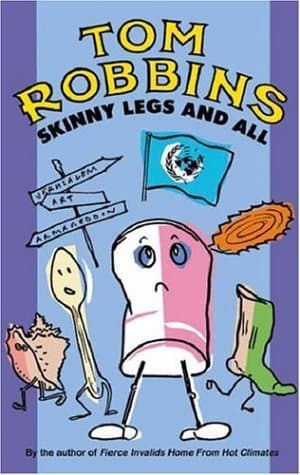
The novel begins with Ellen Cherry Charles, a young waitress from Seattle, and her husband, Boomer Petway, a welder, driving across America in a converted school bus called 'The Road Hog.' They are going to New York City, where Ellen hopes to start her art career. Boomer, who at first doubts Ellen's art goals, made a sculpture for her. It is a large, rotating scene of the Last Supper, but with a difference. Instead of the usual figures, Boomer's version has inanimate objects: a can of beans, a conch shell, a dessert spoon, a dirty sock, and a condom. These objects later become alive and talk. Their trip includes philosophical thoughts and growing tension between Ellen's art ambition and Boomer's practical, but odd, view.
Arrival in New York and the Art World
In New York, Ellen and Boomer have trouble settling in. They get a showing for Boomer's Last Supper sculpture at The Chicken Skin, a SoHo gallery. The gallery owner, Salome, a flamboyant and mysterious person, immediately likes the sculpture's originality. Ellen tries to make her own art, often feeling overshadowed by Boomer's accidental talent. The New York art scene is chaotic and often pretentious, full of critics, collectors, and performance artists drawn to Boomer's unusual work. The objects in the Last Supper sculpture start to show signs of being alive, watching and commenting on the human world, though Ellen first thinks this is her artistic vision.
The Sentient Objects and Their Debates
The inanimate objects in Boomer's Last Supper—the can of beans (Can o' Beans), the conch shell (Conch), the dessert spoon (Spoon), the dirty sock (Dirty Sock), and the condom (Rubber)—become fully alive and talk. They have discussions about reality, God, life's meaning, and the human condition. Each object has a distinct personality: Can o' Beans is an atheist and a materialist, Spoon is a mystic and a romantic, Dirty Sock is a cynical pragmatist, Conch is a historian and storyteller, and Rubber is a hedonist. Their conversations, which humans do not hear at first, comment on the events happening around them, offering unique views on human foolishness, love, and spiritual longing.
Ellen's Artistic Struggle and Boomer's Revelation
While Boomer's Last Supper gets more attention, Ellen struggles to find her own artistic voice. She constantly fights self-doubt and the pressure to fit into the art world's expectations. She tries different art projects, but none feel truly authentic. Meanwhile, Boomer becomes more interested in the spiritual ideas in his accidental masterpiece. He starts to research ancient religions and myths, especially those from the Middle East. His journey changes unexpectedly when he meets Wiggs Dannyboy, a mysterious old man who knows ancient secrets and hints at a lost goddess in Palestine. Boomer's search for spiritual understanding starts to differ from Ellen's art goals.
The Rise of Wiggs Dannyboy and the Search for the Goddess
Wiggs Dannyboy, a mysterious person with deep knowledge of history and mysticism, becomes a key mentor for Boomer. He tells Boomer the legend of a forgotten goddess of Palestine. Her essence is scattered, and finding her again is important for bringing balance to the world. Wiggs believes the goddess's spirit lives in various 'sacred shanks' (legs) of women around the world. Boomer, at first doubtful, is slowly convinced by Wiggs's stories and the strange coincidences he experiences. This search for the goddess becomes Boomer's main focus, leading him away from the art world and into a deeper, spiritual journey, which at first confuses and frustrates Ellen.
Salome's Influence and the Art World's Obsession
Salome, the owner of The Chicken Skin gallery, skillfully uses the New York art world's interest in Boomer's Last Supper. She organizes events, creates excitement, and makes sure the sculpture becomes a sensation. The sentient objects in the tableau continue their philosophical discussions. They offer sharp and often humorous comments on the absurdity of human ambition, the changing nature of fame, and the superficiality of the art scene. They note the irony of their inanimate forms causing such human drama. Salome, with her own mysterious past and reasons, becomes a central figure in the human story. Her actions often influence Ellen and Boomer's paths.
Ellen's Journey of Self-Discovery
As Boomer goes deeper into his spiritual quest, Ellen starts her own self-discovery. She questions her first art goals and her relationship with Boomer. She realizes her art needs to come from true passion, not from wanting outside approval or needing to compete with Boomer. She begins to explore different ways to express herself, moving away from traditional painting and performance art. Her interactions with various eccentric people in New York, and the philosophical thoughts of the sentient objects (which she still sees as her own imaginative creations), help her understand her identity and what she truly wants from life and art.
Boomer's Pilgrimage to Palestine
Guided by Wiggs Dannyboy and his clues, Boomer eventually travels to Palestine. He believes this ancient land holds the key to finding the goddess. He thinks a 'sacred shank' (leg) in Jerusalem is an important part of the goddess's scattered essence. His journey is an adventure, spiritual thought, and unexpected meetings. He navigates the complex political and religious Middle East, searching for the specific woman whose leg holds the divine spark. This trip is a turning point for Boomer, solidifying his change from a simple welder to a seeker of ancient truths.
The Revelation of the Goddess and the Dance
In Palestine, Boomer finally meets the woman whose leg is believed to be the goddess's 'sacred shank.' This woman, a dancer, performs an ecstatic dance that ends with the goddess appearing. The revelation is not a single, still image, but a dynamic, unifying force that goes beyond traditional religious images. It is a celebration of the feminine, the earthly, and the sacred together. This event starts a cosmic dance, involving humans and the sentient objects from Boomer's Last Supper. They, through their philosophical journey, have also arrived at this moment. The dance shows the integration of spirit and matter, the sacred and the everyday, and how everything connects.
The Aftermath and New Beginnings
After the goddess's revelation and the cosmic dance, Ellen and Boomer find themselves on new, separate paths. Boomer, having finished his spiritual quest, is deeply changed, understanding the world more. Ellen, having lost her art insecurities, finds her true artistic calling in a unique form of performance art. This art includes parts of her past and her new understanding of beauty and spirituality. Their relationship, though changed, is stronger because of their individual journeys. The sentient objects, having finished their role as philosophical commentators, find their own endings. Some return to being inanimate, others continue their metaphysical existence. The novel ends with a sense of renewal and the lasting mystery and magic of existence.
Principal Figures
Ellen Cherry Charles
Protagonist
A young waitress from Seattle, aspiring artist, and seeker of authenticity.
Ellen Cherry is a complex and evolving protagonist. Initially driven by a desire for artistic recognition in New York, she struggles with self-doubt, the commercialism of the art world, and her relationship with her eccentric husband, Boomer. She is intelligent, sensitive, and possesses a unique perspective on life, often filtering her experiences through an artistic lens. Her journey is one of self-discovery, moving beyond external validation to find her own authentic voice and purpose. She initially perceives the sentient objects' conversations as her own internal monologue or artistic inspiration.
Relationships: Boomer Petway (Husband, artistic collaborator, spiritual counterpoint); Salome (Gallery owner, mentor/manipulator); Can o' Beans (Perceived artistic creation, philosophical voice)
Boomer Petway
Protagonist/Supporting
A redneck welder turned accidental artist and spiritual seeker.
Boomer is Ellen's husband, a rough-around-the-edges, good-hearted redneck welder with an unexpected knack for creating profound, if accidental, art. His 'Last Supper' sculpture, initially a whimsical project, becomes a catalyst for his own spiritual awakening. He is less concerned with artistic fame than with understanding the deeper meanings behind his creation. Guided by Wiggs Dannyboy, he embarks on a quest to find a lost goddess, demonstrating a surprising capacity for spiritual devotion and an openness to the mystical. He is pragmatic yet capable of deep wonder.
Relationships: Ellen Cherry Charles (Wife, artistic partner, emotional anchor); Wiggs Dannyboy (Spiritual guide, mentor); Salome (Gallery owner, business associate)
Salome
Supporting
The enigmatic and manipulative owner of The Chicken Skin gallery.
Salome is a powerful and mysterious figure in the New York art world. She owns The Chicken Skin gallery and is instrumental in promoting Boomer's Last Supper sculpture. She is shrewd, perceptive, and has a keen eye for what will capture the public's imagination. Her past is hinted at being complex and perhaps even ancient, suggesting a deeper, almost mythical connection to the themes of the book. She serves as both a facilitator and a manipulator, pushing Ellen and Boomer into the spotlight while pursuing her own enigmatic agenda.
Relationships: Ellen Cherry Charles (Artist/gallery owner relationship, mentor figure); Boomer Petway (Artist/gallery owner relationship)
Wiggs Dannyboy
Supporting
A mysterious old man who guides Boomer on his spiritual quest.
Wiggs Dannyboy is an ancient, wise, and somewhat cryptic figure who enters Boomer's life to steer him towards his spiritual destiny. He possesses an immense knowledge of ancient history, mythology, and forgotten goddesses, particularly the goddess of Palestine. He speaks in riddles and parables, slowly revealing the significance of the 'sacred shanks' and the need for the goddess's return. He acts as a spiritual mentor and catalyst for Boomer's journey, embodying the mystical and the profound.
Relationships: Boomer Petway (Spiritual guide, mentor)
Can o' Beans
Supporting
A sentient can of beans, the cynical atheist of the Last Supper tableau.
Can o' Beans is one of the sentient inanimate objects in Boomer's Last Supper sculpture. He is the materialist, the atheist, and the most cynical of the group, constantly challenging the spiritual and mystical interpretations offered by the other objects. He represents logic, skepticism, and the scientific worldview, often providing a grounded, albeit sarcastic, counterpoint to the more esoteric discussions. Despite his cynicism, he is a keen observer of human folly and contributes significantly to the philosophical debates.
Relationships: Spoon (Philosophical adversary, debater); Conch (Philosophical debater); Dirty Sock (Philosophical debater)
Spoon
Supporting
A sentient dessert spoon, the mystic and romantic of the Last Supper tableau.
Spoon is another of the sentient objects, embodying mysticism, romance, and a belief in the spiritual dimensions of existence. She often counters Can o' Beans's materialism with poetic insights and a deep appreciation for beauty, love, and the unseen forces of the universe. She represents intuition, art, and the search for transcendent meaning. Her perspective is often lyrical and she yearns for connection and understanding beyond the purely physical.
Relationships: Can o' Beans (Philosophical adversary, debater); Conch (Philosophical debater); Dirty Sock (Philosophical debater)
Conch
Supporting
A sentient conch shell, the historian and storyteller of the Last Supper tableau.
Conch, a sentient conch shell, is the historian and storyteller among the objects. He possesses a vast memory of ancient times, myths, and legends, often weaving elaborate narratives that provide context for the philosophical debates. He represents tradition, memory, and the cyclical nature of history. His voice adds a layer of depth and timelessness to the discussions, connecting the present events to a rich tapestry of human and cosmic history.
Relationships: Can o' Beans (Philosophical debater); Spoon (Philosophical debater); Dirty Sock (Philosophical debater)
Dirty Sock
Supporting
A sentient dirty sock, the cynical pragmatist of the Last Supper tableau.
Dirty Sock is the cynical pragmatist of the sentient objects. He is often concerned with the mundane, the physical, and the less glamorous aspects of existence. He represents the gritty reality of life, often cutting through the philosophical abstractions with a dose of harsh truth or earthy humor. His perspective is grounded and unpretentious, providing a relatable, if sometimes crude, viewpoint on the human condition.
Relationships: Can o' Beans (Philosophical debater); Spoon (Philosophical debater); Conch (Philosophical debater)
Rubber (Condom)
Supporting
A sentient condom, the hedonist and symbol of pleasure.
Rubber, the sentient condom, represents hedonism, pleasure, and the sensual aspects of life. He is often focused on the immediate gratification of desires and the celebration of physical intimacy. While sometimes seen as superficial by the other objects, he offers a vital perspective on the importance of joy, connection, and the life force itself. He counters the more intellectual or spiritual discussions with a reminder of the body's pleasures and the simple act of living.
Relationships: Can o' Beans (Philosophical debater); Spoon (Philosophical debater); Conch (Philosophical debater)
Themes & Insights
Identity and Self-Discovery
The novel explores self-discovery through Ellen Cherry's art struggles and Boomer Petway's spiritual quest. Ellen works to find her real artistic voice amid the commercialism and pretense of the New York art world. She learns that true art comes from within. Boomer, at first a simple welder, becomes a seeker of ancient truths, finding a spiritual side he did not know he had. Their individual paths, though different, lead them to a deeper understanding of themselves and their purpose. The sentient objects also deal with their 'identities' as philosophical commentators.
“What is art if not an attempt to make sense of the world, to find meaning where there is none, to impose order on chaos?”
Spirituality vs. Materialism
A main theme is the discussion between spiritual belief and materialistic doubt. This is mostly shown by the sentient objects in Boomer's Last Supper. Can o' Beans strongly argues for a purely material view, while Spoon supports mysticism and the unseen. Conch offers historical and mythical views, linking the two. This theme also shows in Boomer's change from a practical welder to a spiritual traveler looking for a lost goddess. This contrasts with the often superficial and commercially driven New York art scene. The book suggests that both material and spiritual realities hold valid truths.
“A bean can is a bean can is a bean can. There is no 'spirit' in it, nor in anything else.”
The Nature of Art and Creativity
Tom Robbins examines the art world and the act of creation. The novel questions what 'art' is, showing how critical praise and commercial success can be arbitrary. Boomer's accidental masterpiece, the Last Supper tableau, becomes popular, while Ellen struggles to be taken seriously. The sentient objects, first seen as just parts of art, become the real commentators on its meaning. The book suggests that art can come from unexpected places. Its true value is not its commercial worth, but its ability to make people think, inspire wonder, and show deeper truths about existence.
“Art, like love, is a leap into the unknown, a willingness to be ridiculous.”
The Sacred Feminine and Reclaiming the Goddess
The search for the lost goddess of Palestine is an important theme. It emphasizes the importance of the sacred feminine. The novel suggests that suppressing the goddess figure has caused imbalance in the world, and finding her again is important for harmony. The 'sacred shanks' (legs) of women symbolize this scattered divine essence, connecting the physical and the spiritual. This theme celebrates female power, sensuality, and intuition as vital forces. It contrasts with patriarchal religious stories and supports a more complete understanding of divinity.
“The goddess is not a statue. She is a dance. She is in the blood and bone of every woman.”
Love, Sex, and Connection
The novel explores different parts of love and human connection, from Ellen and Boomer's unusual marriage to Spoon's longing for intimacy. Sex is shown as a powerful, often sacred, force, linked to both pleasure and spiritual enlightenment, as shown by Rubber. The connection between people, whether romantic, artistic, or philosophical, is portrayed as essential for growth and understanding. The book explores the complexities of relationships, showing how shared experiences and individual journeys can strengthen bonds, even if they change unexpectedly.
“Love is not a thing to be found. It is a thing to be created.”
Plot Devices & Literary Techniques
Sentient Inanimate Objects
A literary device using everyday objects as philosophical commentators.
The most prominent plot device is the sentience of the inanimate objects in Boomer's Last Supper tableau: a can of beans, a conch shell, a dessert spoon, a dirty sock, and a condom. These objects not only observe the human drama but engage in profound philosophical debates, offering a meta-commentary on themes of existence, spirituality, art, and human nature. Their distinct personalities and arguments serve to deconstruct human pretension and provide diverse perspectives, often with humor and biting wit, making abstract concepts accessible and entertaining. They are initially perceived as Ellen's artistic creations, blurring the line between reality and imagination.
The Last Supper Tableau
A symbolic art piece that acts as a central catalyst and metaphor.
Boomer's 'Last Supper' sculpture, featuring inanimate objects instead of biblical figures, is more than just a piece of art; it's a central catalyst for the entire plot. It draws Ellen and Boomer to New York, becomes a sensation in the art world, and, most importantly, houses the sentient objects that drive much of the philosophical discourse. It serves as a powerful metaphor for the intersection of the sacred and the profane, the ordinary and the extraordinary, and the unexpected places where profound meaning can be found. Its unconventional nature challenges traditional religious and artistic interpretations.
The Quest Motif
Boomer's journey to find the lost goddess of Palestine.
The narrative employs a classic quest motif, specifically Boomer Petway's search for the lost goddess of Palestine. Guided by Wiggs Dannyboy, Boomer embarks on a physical and spiritual pilgrimage that takes him from New York to the Middle East. This quest provides the underlying structure for Boomer's character arc and allows the novel to explore themes of spirituality, ancient myths, and the sacred feminine. The 'sacred shanks' (legs) serve as the tangible, yet symbolic, objectives of his journey, leading to a profound revelation rather than a simple discovery.
Magical Realism
Integration of fantastical elements into a realistic setting.
The novel seamlessly blends realistic settings and character struggles with elements of the fantastical, characteristic of magical realism. The most obvious example is the sentience and philosophical debates of the inanimate objects. Other elements include the mysterious, possibly ancient, nature of Salome and Wiggs Dannyboy, and the literal manifestation of the goddess through a dance. These magical elements are presented without extensive explanation, treated as part of the world's fabric, which allows the novel to explore profound themes in a whimsical and thought-provoking manner without losing its grounding in human experience.
Philosophical Dialogue
Extensive use of dialogue to explore complex philosophical ideas.
Much of the novel's thematic depth is conveyed through extensive philosophical dialogue, primarily among the sentient inanimate objects. Their debates cover a wide range of topics, including the existence of God, the nature of reality, the meaning of life, and the human condition. This device allows Robbins to present multiple viewpoints on complex issues in an engaging and often humorous way, without resorting to didacticism. The dialogue serves not only to advance the themes but also to develop the distinct personalities of the objects themselves, making them compelling characters in their own right.
Skinny Legs and All Quotes
“The only difference between a rut and a grave is their dimensions.”
“There are two kinds of people in this world: those who are always looking for something, and those who are always looking for someone.”
“It's never too late to have a happy childhood.”
“There are no solutions, only trade-offs.”
“The longest journey is the journey inward.”
“We are not our bodies. We are the stories we tell ourselves about our bodies.”
“Art is a way of understanding the world. It is not an escape from it.”
“Most people don't know what they want, but they know what they don't want.”
“The past is a ghost, the future a dream, and all we ever have is now.”
“There's a fine line between fishing and standing on the shore like an idiot.”
“The only way to get rid of a temptation is to yield to it.”
“Life is not a journey to the grave with the intention of arriving safely in a pretty and well preserved body, but rather to skid in broadside, thoroughly used up, totally worn out, and loudly proclaiming 'Wow! What a ride!'”
“Everything is pregnant with its own opposite.”
“Only when we are brave enough to explore the darkness will we discover the infinite power of our light.”
Quiz
10 questions on the plot and the characters. Each answer comes with a short explanation.
Question 1
What is the primary occupation of Ellen Cherry Charles at the beginning of the novel?
- Art gallery owner
- Dancer
- Waitress
- Welder
Show answer
C. Waitress Ellen Cherry Charles starts her journey as a waitress in New York City, which is where she encounters much of the novel's initial cast of characters and situations.
Question 2
Which inanimate objects frequently engage in philosophical discussions and observations in the novel?
- A coffee cup and a newspaper
- A bean can and a dessert spoon
- A paintbrush and a canvas
- A truck tire and a wrench
Show answer
B. A bean can and a dessert spoon The novel is known for its whimsical anthropomorphism, particularly with a bean can (Can o' Beans) and a dessert spoon (Spoon) who offer unique philosophical perspectives.
Question 3
What is the name of the redneck welder who plays a significant role in discovering a lost god?
- Boomer Charles
- Buddy Charles
- Bobo Charles
- Buster Charles
Show answer
B. Buddy Charles Buddy Charles is Ellen Cherry's husband, a welder from Seattle, who travels across the country and becomes involved in the search for the lost god of Palestine.
Question 4
Which historical/mythological figure is central to the 'lost god of Palestine' storyline?
- Baal
- Ishtar
- Yahweh
- Salome
Show answer
D. Salome The 'lost god of Palestine' refers to the goddess Salome, whose story and significance are explored throughout the novel, particularly through Buddy's journey.
Question 5
What kind of artistic expression does Ellen Cherry initially pursue and exhibit in New York?
- Abstract painting
- Performance art involving food and nudity
- Sculptures made from found objects
- Photography of urban decay
Show answer
B. Performance art involving food and nudity Ellen Cherry's art takes a provocative turn, involving 'Nude Descending a Staircase' reenactments using food and her own body, challenging conventional art norms.
Question 6
What is the significance of the phrase 'Skinny Legs and All' within the novel's thematic context?
- It refers to a specific dance move Ellen Cherry perfects.
- It symbolizes the rejection of superficial beauty standards and embraces raw, natural existence.
- It is a secret code used by the characters searching for Salome.
- It describes the appearance of the 'lost god' once found.
Show answer
B. It symbolizes the rejection of superficial beauty standards and embraces raw, natural existence. The phrase 'Skinny Legs and All' embodies a theme of embracing imperfection and naturalness, particularly in the context of Salome's story and the rejection of idealized, sanitized forms.
Question 7
Which famous work of art is repeatedly referenced and reinterpreted by Ellen Cherry in her performances?
- Salvador Dalí's 'The Persistence of Memory'
- Marcel Duchamp's 'Nude Descending a Staircase, No. 2'
- Leonardo da Vinci's 'Mona Lisa'
- Vincent van Gogh's 'The Starry Night'
Show answer
B. Marcel Duchamp's 'Nude Descending a Staircase, No. 2' Ellen Cherry's performance art is directly inspired by Duchamp's iconic painting, 'Nude Descending a Staircase, No. 2,' which she brings to life in a literal and provocative way.
Question 8
How does the novel ultimately connect the seemingly disparate storylines of Ellen Cherry's art world endeavors and Buddy's spiritual quest?
- They both end up in the same art gallery in Paris, by coincidence.
- Their individual journeys converge on the theme of seeking truth and challenging conventional perceptions, often through the figure of Salome.
- Ellen Cherry creates an art piece depicting Buddy's discoveries, bringing them together.
- The inanimate objects (bean can and spoon) reveal the connection to them.
Show answer
B. Their individual journeys converge on the theme of seeking truth and challenging conventional perceptions, often through the figure of Salome. The novel intricately weaves these plots together through shared themes of challenging societal norms, embracing the physical and spiritual, and the re-evaluation of historical and mythological figures like Salome, who represents a potent blend of art, sensuality, and spiritual power.
Question 9
What is the primary philosophical argument or concept put forth by the character 'Can o' Beans'?
- The importance of individual freedom above all else.
- The inherent meaninglessness of human existence.
- The idea that 'everything is connected' and the universe is a unified, dancing whole.
- The superiority of rational thought over emotion.
Show answer
C. The idea that 'everything is connected' and the universe is a unified, dancing whole. Can o' Beans often expounds on the interconnectedness of all things, viewing the universe as a grand, cosmic dance where every element, no matter how small or seemingly insignificant, plays a vital role.
Question 10
The novel often uses paradox and humor to explore serious themes. Which of the following best describes its approach to spirituality and religion?
- It advocates for a return to traditional, organized religious practices.
- It satirizes all forms of belief, suggesting they are inherently absurd.
- It redefines spirituality by embracing the sensual, the physical, and the often-ignored feminine aspects of divinity, challenging patriarchal religious narratives.
- It promotes a purely atheistic worldview, rejecting any notion of the divine.
Show answer
C. It redefines spirituality by embracing the sensual, the physical, and the often-ignored feminine aspects of divinity, challenging patriarchal religious narratives. Tom Robbins's work, especially in 'Skinny Legs and All,' often subverts conventional religious narratives. It seeks a more holistic, embodied spirituality that integrates the sensual and the sacred, particularly through the re-emergence of the goddess figure Salome, challenging traditional, often patriarchal, understandings of divinity.
Skinny Legs and All FAQ
What is "Skinny Legs and All" about?
"Skinny Legs and All" is a sprawling, philosophical, and comedic novel that follows a young waitress named Ellen Cherry Charles who moves to New York with her husband, Boomer Petway, a welder. Their journey intertwines with sentient inanimate objects like a can of beans, a spoon, and a dirty sock, as they navigate the art world, ancient prophecies, and the rediscovery of a forgotten goddess.
Why should I read "Skinny Legs and All"?
You should read "Skinny Legs and All" for its unique blend of irreverent humor, profound philosophical insights, and whimsical storytelling. Tom Robbins's distinctive prose, rich with metaphor and playful alliteration, creates a world where the mundane becomes magical, challenging readers to reconsider their perceptions of reality, art, and spirituality.
What is the background/setting of "Skinny Legs and All"?
The novel primarily takes place in two contrasting settings: the gritty, vibrant art scene of New York City in the late 20th century, and the ancient, mystical desert landscapes of the Middle East. These settings converge as the characters, particularly Ellen Cherry and Boomer, find themselves entangled in an unfolding prophecy involving biblical figures and forgotten deities.
What are the most memorable quotes?
Some memorable quotes include the bean can's philosophical musings like, "In the land of the blind, the one-eyed man is a hallucination." Another is "It's never too late to have a happy childhood," reflecting the novel's theme of reclaiming joy. Robbins's prose is full of such gems that invite contemplation and laughter.
What writing style does the author use?
Tom Robbins employs a highly distinctive, verbose, and alliterative writing style characterized by elaborate metaphors, playful puns, and frequent digressions into philosophical and historical anecdotes. His prose is rich, often poetic, and demands active engagement from the reader, blending slapstick comedy with deep spiritual inquiry.
What minor details add significant meaning?
The specific brand names and origins of the inanimate objects—such as the Jerusalem Slim bean can and the spoon named Stella—are not arbitrary. They subtly link to the ancient prophecies and the novel's overarching themes of consumerism, spirituality, and the hidden life within seemingly ordinary things, suggesting a deeper consciousness in the world.
What are some subtle foreshadowing moments?
Early on, Boomer's seemingly random interest in welding, particularly his creation of a 'Last Supper' sculpture, subtly foreshadows his eventual role in the unfolding biblical prophecy and the revelation of the goddess Ishtar. The recurring motif of the 'skinny legs' itself, initially a joke, foreshadows the sacred dance of the seven veils and the goddess's re-emergence.
What unexpected character connections exist?
One unexpected connection is between the modern-day characters and historical/mythological figures. For example, Ellen Cherry is subtly linked to Salome, and Boomer to John the Baptist, through a reinterpretation of their biblical narrative. The inanimate objects also form their own philosophical collective, unexpectedly influencing human events.
What are unspoken character motivations?
Ellen Cherry's unspoken motivation is a deep-seated yearning for authentic artistic expression and spiritual fulfillment beyond the superficiality of the New York art scene. Boomer, despite his redneck exterior, secretly yearns for a sense of purpose and a deeper understanding of the world, which drives his unwitting involvement in the ancient prophecy.
What psychological complexities do characters exhibit?
Ellen Cherry grapples with imposter syndrome and the pressure to conform to artistic trends, while simultaneously searching for genuine meaning. Boomer struggles with his identity as a 'simple' man confronted with profound spiritual experiences, leading to a complex interplay of skepticism and burgeoning faith.
What are the major emotional turning points?
A major emotional turning point for Ellen Cherry is her decision to abandon conventional art and embrace her own unique, often misunderstood, artistic vision. For Boomer, it's his realization and acceptance of his role in the prophecy, culminating in his willingness to participate in the sacred dance, which marks a profound shift from cynicism to spiritual openness.
How do relationship dynamics evolve?
The relationship between Ellen Cherry and Boomer evolves from a somewhat conventional, though quirky, marriage into a partnership deeply intertwined with their individual spiritual awakenings. Their initial disconnect over art and ambition transforms as they both come to understand and support each other's unique paths, ultimately finding a deeper connection through shared mystical experiences.
Which parts remain ambiguous or open-ended?
The ultimate 'truth' behind the sentience of the inanimate objects and the exact nature of the goddess Ishtar's re-emergence remains somewhat ambiguous. Robbins leaves it to the reader to decide whether these events are literal occurrences, profound metaphors, or manifestations of collective consciousness, blurring the lines between reality and myth.
What are controversial scenes or decisions?
The novel's reinterpretation of biblical figures, particularly the portrayal of Salome and John the Baptist, and the explicit sexual nature of the sacred dance of the seven veils, can be controversial. Robbins challenges traditional religious narratives and societal norms regarding spirituality and sensuality, often with a provocative and irreverent tone.
"Skinny Legs and All" ending explained: how it ends & what it means
The novel concludes with Boomer performing the dance of the seven veils, which culminates in the symbolic re-emergence of the goddess Ishtar, representing the return of the sacred feminine and a rebalancing of spiritual energies in the world. This act helps Ellen Cherry achieve artistic and spiritual liberation. The ending suggests a hopeful, albeit chaotic, future where ancient wisdom and modern life intertwine, emphasizing the importance of embracing both the sacred and the profane.
About the author

Tom Robbins is an American author known for his distinctive style and imaginative storytelling. His notable works include "Still Life with Woodpecker," "Jitterbug Perfume," "Even Cowgirls Get the Blues," "Skinny Legs and All," "Another Roadside Attraction," and "Half Asleep in Frog Pajamas," which often blend humor and philosophical themes in a fictional context.
Similar books
- Jitterbug Perfume
Tom Robbins
4.2 (69k) average on GoodreadsFantasyShares Robbins' signature blend of magical realism, philosophy, and quirky characters.
- A Confederacy of Dunces
John Kennedy Toole
3.9 (231k) average on GoodreadsLiterary FictionFeatures eccentric characters and a satirical look at society with a unique narrative voice.
- One Hundred Years of Solitude
Gabriel García Márquez
4.1 (753k) average on GoodreadsLiterary FictionExhibits elements of magical realism, grand scope, and a unique narrative style.
- The Old Man and the Sea
Ernest Hemingway
3.8 (831k) average on GoodreadsLiterary FictionA Cuban fisherman's long struggle with a giant marlin becomes a story of endurance and dignity, now retold for young adults with illustrations, phonetic guides, and writing prompts in Traditional Chinese.
- The Goldfinch
Donna Tartt
3.9 (720k) average on GoodreadsLiterary FictionHaunted by a tragic explosion and clutching a stolen Dutch masterpiece, a young orphan navigates the opulent drawing rooms of New York and the gritty underbelly of the art world, desperately seeking connection and redemption amidst a life spiraling into crime and obsession.
- Little Fires Everywhere
Celeste Ng
4.1 (713k) average on GoodreadsLiterary FictionIn Shaker Heights, an artist and her daughter move in, and their free-spirited lives clash with a rule-bound matriarch, revealing hidden conflicts beneath a perfect surface.




Enjoyed the summary?
A summary gives you the shape of the book. The book itself has the detail, the examples and the voice.
Find Skinny Legs and All on AmazonAs an Amazon Associate, BookBrief earns from qualifying purchases. How we're funded