
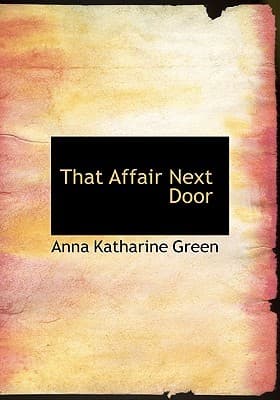
Synopsis
Covers the whole plot, including the ending.
- Difficulty
- Medium
- Pacing
- Moderate
- Mood
- Intricate, Suspenseful, Victorian
- Read it if
- You enjoy classic, intricate Victorian mysteries with a strong amateur female detective and a focus on detailed evidence analysis.
- Skip it if
- You prefer fast-paced, action-oriented thrillers or find older prose styles difficult to engage with.
That Affair Next Door Plot Summary
Covers the whole plot, including the ending.
The Discovery of the Body
Miss Amelia Butterworth, a spinster living quietly in New York City, is bothered by odd events in the vacant house next door. One evening, she sees a light and hears a struggle, then silence. Curious and feeling responsible, she investigates the next morning. Using a key from the former owner, she enters the house and finds a young woman's lifeless body in the library, elegantly dressed on a bearskin rug. The scene is oddly peaceful, but a crime has clearly happened, pulling Amelia into a mystery beyond her usual life.
Initial Investigation and Identification
Amelia immediately calls the police, and Inspector Gryce, a well-known detective, takes over. The victim is identified as Anna Katharine Van Burnam, a beautiful woman of high social standing, recently returned from Europe. Initial checks show no clear signs of struggle or forced entry, puzzling investigators. Gryce, while respecting Amelia's observations, first dismisses some of her more imaginative ideas. The discovery of a small, distinctively embroidered handkerchief near the body becomes an important early clue, suggesting a close connection to the victim or killer.
The Missing Emeralds and a Suspect
Further investigation shows that a valuable emerald necklace belonging to Anna Katharine is missing, suggesting robbery as a motive. Police learn Anna expected a visitor the night she died. Suspicion soon falls on Philip Van Burnam, Anna's cousin, known for financial problems and a dispute with Anna over inheritance. Philip is questioned, and his evasive answers and distress make Inspector Gryce suspicious. Amelia, however, finds Philip's behavior too obviously guilty, suggesting a more complex situation.
The Introduction of Dora Van Burnam
Dora Van Burnam, Anna Katharine's younger sister, returns from a trip to find her sister murdered. Dora's reaction is unusual; she shows a strange mix of grief and detachment, and her testimony seems contradictory. She claims to know nothing of Anna's recent activities or visitors, which Amelia finds unlikely given their close relationship. Dora's beauty and delicate appearance first gain sympathy, but her inconsistent statements and odd possessiveness over her sister's belongings begin to concern both Amelia and Inspector Gryce, adding another layer to the case.
A Secret Rendezvous and a Mysterious Man
Amelia, using her observation and logic, finds that Anna Katharine had been writing to a mysterious man and planning a secret meeting. She finds a coded message and a small, distinct flower often linked to romance. This information suggests a lover's quarrel or betrayal as a possible motive, shifting focus from Philip's financial troubles. The identity of this unknown man becomes a central question, leading Amelia to investigate Anna's social circle and past relationships, often ahead of the official police inquiry.
The Role of Mrs. Fairbrother
Mrs. Fairbrother, Anna Katharine's long-time companion and housekeeper, first seems distressed and unhelpful. However, through careful questioning by Amelia and Inspector Gryce, she slowly reveals details about Anna's secretive behavior, anxieties, and relationships. Mrs. Fairbrother is very loyal to Anna, and her reluctance to speak comes from wanting to protect Anna's reputation, even after death. Her fragmented memories and hints at a past secret provide key insights into Anna's character and the complex relationships around her.
The Clue of the Embroidered Handkerchief
The embroidered handkerchief, found near Anna Katharine's body, is a key clue. Its unique stitching and monogram are traced to a specific maker and then to a woman who gave it as a gift. This investigation connects the handkerchief to Arthur Van Burnam, another cousin, who had been estranged from the family. This discovery introduces a new suspect and a potential motive related to a forgotten family dispute or a hidden romance, further complicating the case and challenging earlier ideas about the killer.
Dora's Confession and a Twisted Love
Under intense scrutiny and growing evidence, Dora Van Burnam finally confesses to Anna Katharine's murder. Her motive is a twisted form of love and jealousy. Dora had a deep, obsessive affection for her sister, almost possessiveness. She believed Anna was about to leave her for a secret lover, and in a fit of rage, she confronted Anna, leading to the fatal struggle. The missing emeralds were a false lead, planted by Dora to mislead the police, and her erratic behavior showed her guilt and distress.
Unraveling the Truth of the Emeralds
With Dora's confession, the mystery of the missing emeralds is also solved. Dora admits she did not steal them for money, but to further implicate Philip Van Burnam, whom she disliked and saw as a rival for Anna's affection and inheritance. She had hidden the emeralds, planning for them to be found later, thus solidifying Philip's guilt in the eyes of the police. This revelation fully clears Philip, who had been under suspicion, and shows Dora's cunning and manipulative nature beneath her fragile appearance.
The Aftermath and Justice
After her confession, Dora Van Burnam is arrested and charged with her sister Anna Katharine's murder. The evidence, carefully gathered by Inspector Gryce and cleverly interpreted by Miss Amelia Butterworth, leaves no doubt of her guilt. The community is shocked by the reveal, as Dora had seemed a fragile, innocent victim. The case closes, bringing resolution to the affair next door. Miss Butterworth, having played a key role in solving the mystery, returns to her quiet life, changed by her experience in crime and detection, leaving Inspector Gryce with new respect for her amateur sleuthing.
Principal Figures
Miss Amelia Butterworth
Protagonist
A curious and astute spinster who becomes an amateur detective.
Amelia Butterworth is a middle-aged spinster living in New York City. She possesses a keen intellect, an insatiable curiosity, and a sharp observational eye, often noticing details that escape professional detectives. Though initially a reluctant participant, her strong sense of justice and her fascination with human nature compel her to involve herself deeply in the investigation. She is methodical in her approach, often meticulously cataloging her thoughts and findings, and is unafraid to challenge the assumptions of others, including Inspector Gryce. Her independent wealth allows her the freedom to pursue her investigations without constraint.
Relationships: Inspector Gryce (professional collaboration, initially skeptical but evolving into respect); Anna Katharine Van Burnam (the victim, whose murder Amelia is driven to solve)
Inspector Gryce
Supporting
A seasoned and methodical police detective.
Inspector Gryce is a prominent and highly respected detective from the New York City police force. He is known for his methodical approach, his reliance on concrete evidence, and his often-skeptical view of amateur interference. While initially dismissive of Miss Butterworth's more speculative theories, he comes to appreciate her insights and unique perspective. Gryce is persistent and thorough, leading the official investigation with a professional demeanor, even when faced with perplexing clues and contradictory testimonies. He represents the established authority and the pragmatic side of crime-solving.
Relationships: Miss Amelia Butterworth (professional collaboration, initially skeptical but evolving into respect); Anna Katharine Van Burnam (the victim he is tasked with finding justice for)
Anna Katharine Van Burnam
Victim
The beautiful and enigmatic woman whose murder drives the plot.
Anna Katharine Van Burnam is the victim whose murder is at the heart of the story. She is portrayed as a beautiful, wealthy, and somewhat mysterious young woman who has recently returned from Europe. Her life, prior to her death, is gradually revealed through the investigation, showing her to be a woman with secrets, including a secret lover and complex relationships with her family members. Her character is largely constructed through the memories and testimonies of others, painting a picture of a woman who was both admired and, ultimately, tragically misunderstood.
Relationships: Dora Van Burnam (sister, with a deeply troubled and obsessive bond); Philip Van Burnam (cousin, with whom she had a contentious relationship over inheritance); Mrs. Fairbrother (loyal companion/housekeeper)
Dora Van Burnam
Antagonist
Anna Katharine's younger sister, whose fragile appearance hides a dark secret.
Dora Van Burnam is Anna Katharine's younger sister, initially appearing as a fragile and grief-stricken figure. Her behavior, however, is often inconsistent and peculiar, raising suspicions. Beneath her delicate exterior lies a deeply possessive and obsessive personality, particularly concerning her sister. Her actions are driven by a twisted form of love and jealousy, leading her to commit a heinous crime and then attempt to manipulate the investigation to frame another. Dora's character embodies the psychological complexities and hidden darkness that can exist within seemingly innocent individuals.
Relationships: Anna Katharine Van Burnam (sister, for whom she held an obsessive and ultimately deadly affection); Philip Van Burnam (cousin, whom she attempted to frame for the murder)
Philip Van Burnam
Supporting
Anna's cousin and an early suspect due to financial troubles.
Philip Van Burnam is Anna Katharine's cousin, who quickly becomes a prime suspect in the murder investigation. He is known to have financial difficulties and a strained relationship with Anna over a family inheritance. His evasive demeanor and apparent distress during questioning make him seem guilty, further solidifying initial suspicions. However, his guilt is largely circumstantial and based on appearances, serving as a red herring to distract from the true perpetrator. He is ultimately exonerated when the real killer is revealed.
Relationships: Anna Katharine Van Burnam (cousin, with whom he had financial disputes); Dora Van Burnam (cousin, who attempted to frame him)
Mrs. Fairbrother
Supporting
Anna Katharine's loyal but secretive companion.
Mrs. Fairbrother is Anna Katharine's long-time companion and housekeeper. She is deeply loyal to Anna, even after her death, and initially reluctant to reveal anything that might tarnish Anna's reputation or expose family secrets. Her testimony is often fragmented and cryptic, requiring careful interpretation by Amelia and Gryce. Despite her initial reticence, she provides crucial pieces of information that help to unravel the complex web of relationships and events leading up to the murder, serving as a vital link to Anna's past and secret life.
Relationships: Anna Katharine Van Burnam (employer and close companion, deeply loyal)
Arthur Van Burnam
Mentioned
Another cousin, connected by a key piece of evidence.
Arthur Van Burnam is a cousin of Anna Katharine, who is introduced into the narrative through the discovery of the embroidered handkerchief. He is estranged from the main branch of the family and his connection to the victim initially raises questions about a possible secret affair or a long-standing family feud as a motive. While he is not a central character, his brief appearance and the clue associated with him serve to broaden the scope of the investigation and introduce additional possibilities, further complicating the perceived simplicity of the crime.
Relationships: Anna Katharine Van Burnam (estranged cousin, briefly considered a suspect)
Themes & Insights
The Dangers of Obsessive Love
This theme appears most strongly through Dora Van Burnam's character. Her 'love' for her sister, Anna Katharine, goes beyond healthy sibling affection and becomes an obsessive possessiveness. Dora cannot stand the idea of Anna finding happiness or companionship outside their bond, especially with a secret lover. This intense jealousy drives her to murder, believing she is stopping Anna from leaving or betraying their bond. The story shows how such unchecked emotions can turn affection into a destructive force, leading to tragedy and deceit, as seen in Dora's attempts to frame Philip.
“Love, when it turns to hate, is the most terrible passion on earth.”
Appearance vs. Reality
The novel explores the difference between how people and situations appear and the complex, often darker, realities beneath. Dora Van Burnam, for example, appears as a fragile, grieving sister, gaining sympathy, while secretly being the calculating murderer. Philip Van Burnam, with his financial problems and evasive behavior, appears guilty, but is innocent. Even the seemingly 'vacant' house next door holds a grim secret. Miss Butterworth's role is to uncover these illusions, showing that truth is often hidden behind carefully built facades, making the investigation a constant fight against misdirection and false impressions.
“Things are not always what they seem, especially in a house where a crime has been committed.”
The Role of the Amateur Detective
This theme is central to the novel, showing Miss Amelia Butterworth's important role in solving the crime. While Inspector Gryce represents the methodical, evidence-based approach of professional law enforcement, Amelia's strength is in her intuitive insights, her keen observation of human behavior, and her ability to notice subtle details that professionals might miss due to their procedures. Her amateur status allows her freedom of inquiry and a willingness to consider unconventional theories that often prove more useful. The story argues for the unique perspective and often crucial role an intelligent amateur can play in solving complex mysteries, bridging formal investigation and human intuition.
“The professional eye sees what it expects to see; the amateur, sometimes, sees what is truly there.”
The Power of Circumstantial Evidence
Throughout the investigation, circumstantial evidence plays a significant, though often misleading, role. Philip Van Burnam's financial problems, his dispute with Anna, and his suspicious behavior all point to his guilt, building a strong circumstantial case against him. The missing emeralds further support this idea. However, as the story unfolds, it becomes clear that while circumstantial evidence can create a compelling narrative, it can also be manufactured or misinterpreted, leading to wrong conclusions. The novel shows how seemingly damning coincidences can be explained or deliberately set up, emphasizing the need for concrete proof and a deeper understanding of motives.
“Circumstances, like shadows, can deceive the most discerning eye.”
Plot Devices & Literary Techniques
The Red Herring
A misleading clue or character designed to distract from the true culprit.
The novel employs several red herrings to misdirect both the characters and the reader. Philip Van Burnam, with his financial troubles and suspicious demeanor, is the primary red herring, carefully positioned to appear guilty of Anna Katharine's murder. The missing emeralds also serve as a red herring, suggesting robbery as a motive when the true motive is far more personal and psychological. These diversions create suspense and challenge the reader's assumptions, making the eventual reveal of Dora Van Burnam as the killer more surprising and impactful.
The Unreliable Narrator (Limited Perspective)
The story is primarily told through the perspective of a character with limited knowledge.
While not strictly an unreliable narrator in the sense of intentionally deceiving, the story is largely filtered through Miss Amelia Butterworth's limited but astute perspective. She only knows what she observes, deduces, or is told, and her interpretations, while often correct, are subject to her own biases and lack of complete information. This device allows the author to gradually reveal information alongside Amelia, creating a sense of shared discovery and surprise for the reader as Amelia pieces together the puzzle, often ahead of the official police investigation, but not omnisciently.
The Locked-Room Mystery Element
A crime committed in circumstances where the perpetrator's entry or exit seems impossible.
The initial discovery of Anna Katharine's body in the house next door presents elements of a locked-room mystery. There are no obvious signs of forced entry, and the house appears to have been vacant, making the presence of a body and the subsequent escape of a killer perplexing. This element immediately heightens the mystery and challenges the investigators to look beyond conventional explanations, pushing them to consider more intricate scenarios or hidden means of access, thereby adding to the intellectual challenge of the puzzle.
Symbolic Objects/Clues
Everyday objects imbued with special significance to advance the plot.
Specific objects in the novel are not merely props but crucial pieces of evidence that carry symbolic weight. The embroidered handkerchief, with its unique stitching and origins, is a prime example, linking an unexpected character to the crime scene. The missing emerald necklace, initially believed to be the motive for robbery, later reveals Dora's manipulative intent to frame Philip. These objects serve as tangible clues that, once their true significance is deciphered, unlock deeper layers of the mystery and provide concrete paths for the investigation.
That Affair Next Door Quotes
“It is not always the obvious which is the true, and the first impression is often the most misleading.”
“A woman's intuition, if not always logical, is sometimes strangely accurate.”
“The truth, like murder, will out, if only given time and a persistent hand to uncover it.”
“It is a strange thing how little we truly know of those who live next door.”
“Suspicion is a poison, and it taints everything it touches.”
“Every secret has its price, and some prices are paid in blood.”
“The human heart is a labyrinth, and often hides its darkest corners even from itself.”
“To truly understand a crime, one must first understand the victim.”
“Silence can be more eloquent than any words, especially when it conceals a lie.”
“The most dangerous lies are those we tell ourselves.”
“Justice is not merely finding the guilty, but understanding the intricate web of circumstances that led to the crime.”
“Even in the closest relationships, there are always unplumbed depths.”
“It is a peculiar burden, that of knowing too much, and yet not enough.”
“The past is never truly dead; it merely sleeps, waiting for an opportunity to awaken and demand its due.”
Quiz
10 questions on the plot and the characters. Each answer comes with a short explanation.
Question 1
What is the initial discovery that sets the mystery in motion in 'That Affair Next Door'?
- A valuable painting stolen from Mrs. Van Burnam's house.
- The body of a young woman found in the locked library of Mrs. Van Burnam's house.
- A fire breaking out in the attic of the house next door.
- A strange letter delivered to Mrs. Van Burnam's address.
Show answer
B. The body of a young woman found in the locked library of Mrs. Van Burnam's house. The mystery begins with the shocking discovery of a young woman's body in Mrs. Van Burnam's locked library, raising immediate questions about how she got there and who she is.
Question 2
Who is the primary detective tasked with investigating the crime in 'That Affair Next Door'?
- Inspector Lestrade
- Hercule Poirot
- Detective Gryce
- Sherlock Holmes
Show answer
C. Detective Gryce Detective Gryce is the shrewd and meticulous investigator who takes on the challenging case of the locked-room mystery.
Question 3
What is the name of the young woman whose body is found in Mrs. Van Burnam's library?
- Eleanor Hammond
- Anna Katherine
- Miss Amelia Butterworth
- Miss Leavenworth
Show answer
D. Miss Leavenworth The victim found in the library is identified as Miss Leavenworth, a key detail that drives much of the initial investigation into her background and connections.
Question 4
What unique challenge does the locked library present to the investigators?
- The room is filled with poisonous gas, making entry dangerous.
- The only window is barred from the inside, and the door is locked from the inside with the key missing.
- The room is entirely soundproof, preventing any screams from being heard.
- A complex booby trap is set up at the entrance.
Show answer
B. The only window is barred from the inside, and the door is locked from the inside with the key missing. The locked-room aspect of the mystery is a central puzzle: the door is locked from the inside, and the window is barred, implying no one could have entered or exited after the crime.
Question 5
What is the relationship between Mrs. Van Burnam and the victim, Miss Leavenworth?
- They are sisters who had a long-standing feud.
- Miss Leavenworth was a distant relative who had recently come to stay with Mrs. Van Burnam.
- Mrs. Van Burnam was Miss Leavenworth's former employer.
- They were complete strangers who met by chance that evening.
Show answer
B. Miss Leavenworth was a distant relative who had recently come to stay with Mrs. Van Burnam. Miss Leavenworth was a distant relative whom Mrs. Van Burnam had invited to stay with her, making her presence in the house explainable, but her death all the more mysterious.
Question 6
What significant piece of evidence is initially overlooked or misinterpreted, leading to early confusion in the case?
- A coded message hidden in a book on the library shelf.
- A faint scent of a specific perfume that is not Miss Leavenworth's.
- The true identity of the victim, which is initially mistaken.
- A hidden compartment in the library desk.
Show answer
C. The true identity of the victim, which is initially mistaken. A crucial misstep in the early investigation involves the initial misidentification of the victim, leading to a significant delay and confusion in understanding the motive and perpetrator.
Question 7
What is a recurring theme in Anna Katharine Green's work, exemplified in 'That Affair Next Door'?
- The struggle for women's suffrage.
- The corruption of political systems.
- The meticulous unraveling of circumstantial evidence with mathematical precision.
- The psychological impact of war on individuals.
Show answer
C. The meticulous unraveling of circumstantial evidence with mathematical precision. Green is known for her 'mathematical precision' in dissecting motivations and evidence, a hallmark of her style that is clearly evident in the complex plot of 'That Affair Next Door'.
Question 8
How does the 'affair next door' element contribute to the complexity of the mystery?
- The killer escapes through a secret tunnel connecting the two houses.
- The residents of the house next door are initially prime suspects, and their activities provide crucial alibis and motives.
- The house next door is a decoy, distracting from the real crime scene.
- The victim was attempting to purchase the house next door, leading to a property dispute.
Show answer
B. The residents of the house next door are initially prime suspects, and their activities provide crucial alibis and motives. The proximity of the neighboring house and its occupants' interactions with Mrs. Van Burnam and Miss Leavenworth introduce a complex web of potential motives, alibis, and observations that are vital to solving the case.
Question 9
What is the ultimate fate of the perpetrator as described in the book's summary?
- They flee the country and are never caught.
- They commit suicide before being apprehended.
- They are punished in a most fitting fashion.
- They are acquitted due to lack of evidence.
Show answer
C. They are punished in a most fitting fashion. As stated in the book's description, the mystery ultimately unravels, and 'the perpetrator is punished in a most fitting fashion,' indicating a resolution where justice is served.
Question 10
Which of the following best describes the role of 'human motivations' in the novel, according to the provided text?
- They are secondary to the physical evidence and often ignored by the detective.
- They are straightforward and easily discernible, simplifying the investigation.
- They are intertwined with circumstantial evidence and meticulously explained by Green.
- They primarily revolve around financial gain and power struggles.
Show answer
C. They are intertwined with circumstantial evidence and meticulously explained by Green. The summary states that the novel is 'a fascinating study in human motivations intertwined with bits and pieces of circumstantial evidence' and that Green 'calls up and explains each motivation' with precision, highlighting their central and complex role.
That Affair Next Door FAQ
What is the central mystery in 'That Affair Next Door'?
The central mystery revolves around the murder of Miss Amelia Butterworth, a seemingly ordinary spinster, found dead in her New York City home. The initial investigation is complicated by the fact that her death appears to be a suicide, yet several inconsistencies and the discovery of a hidden will suggest foul play.
Who is Amelia Butterworth and what role does she play in the story?
Amelia Butterworth is the titular 'affair next door' and the amateur detective who takes an interest in the murder of Miss Amelia Butterworth. She is a sharp-witted, observant, and somewhat meddlesome spinster who lives next door to the victim and uses her keen intellect to assist the official police investigation, often noticing details others overlook.
Who is the primary police investigator assigned to the case?
The primary police investigator is Detective Gryce, a seasoned and methodical officer from the New York City police force. He initially approaches the case with a focus on logical deduction and traditional police work, though he eventually comes to appreciate and rely on Miss Butterworth's unique insights.
What is the significance of the 'hidden will' in the investigation?
The hidden will is a crucial piece of evidence, as it reveals that the deceased Miss Amelia Butterworth had left her fortune to a distant relative, a young woman named Katherine. This discovery immediately introduces a strong motive for murder, shifting the investigation from a potential suicide to a clear case of foul play and inheritance.
How does the setting of late 19th-century New York City influence the narrative?
The late 19th-century New York City setting provides a backdrop of evolving social norms and burgeoning urban life, with its gaslit streets, brownstone houses, and the specific limitations and methods of police work of the era. This influences the availability of evidence, communication, and the societal expectations placed on characters like Miss Butterworth.
What is the significance of the 'rose' found near the victim?
The rose found near the victim is a subtle but important clue, initially dismissed as incidental. It later becomes a key detail, linking a specific character to the scene and providing insight into the emotional state or intentions of the person who left it there, suggesting a personal connection rather than a random act.
How do the seemingly insignificant details about the victim's daily routine become crucial?
Details about the victim's daily routine, such as her habit of keeping certain windows closed or her precise arrangements of household items, become crucial because they highlight discrepancies at the crime scene. These deviations from her known patterns are often the first indicators to Miss Butterworth that something is amiss, challenging the initial assumption of suicide.
What is the role of the secretive neighbor, Mr. Orton, and his connection to the case?
Mr. Orton is a mysterious neighbor whose reclusive behavior and vague answers initially make him a person of interest. His connection to the case is not immediately clear, but his hidden activities and past relationships eventually reveal a complex web of deceit and ulterior motives that directly impact the victim and the inheritance.
How does Miss Butterworth's 'gossipy' nature aid her in solving the case?
Miss Butterworth's 'gossipy' nature, while sometimes perceived as a social flaw, is actually a strength in her detective work. Her extensive knowledge of neighborhood happenings, social connections, and personal histories allows her to gather information and make connections that a formal police investigation might overlook, providing crucial context to the evidence.
What psychological motivations drive the perpetrator of the crime?
The perpetrator is primarily driven by a combination of greed and desperation, fueled by the desire to secure a significant inheritance that they believe is rightfully theirs or that they desperately need. This motivation is intertwined with a cunning and manipulative psychological profile, allowing them to construct an elaborate facade to divert suspicion.
How does Anna Katharine Green explore the psychology of circumstantial evidence?
Green meticulously explores the psychology of circumstantial evidence by presenting numerous seemingly disconnected facts that, individually, offer little insight. She then demonstrates how the human mind, particularly Miss Butterworth's, can connect these disparate pieces, revealing the underlying narrative and motivations, often highlighting how initial interpretations can be misleading.
What is the psychological impact of the 'affair next door' on Miss Butterworth?
The 'affair next door' profoundly impacts Miss Butterworth by providing an intellectual challenge that invigorates her otherwise quiet life, drawing her into a world of intrigue and danger. It sharpens her observational skills and forces her to confront the darker aspects of human nature, ultimately solidifying her role as an amateur detective.
To what extent can 'That Affair Next Door' be seen as a critique of societal expectations for women in the late 19th century?
'That Affair Next Door' can be interpreted as a subtle critique of societal expectations for women, particularly spinsters, in the late 19th century. Miss Butterworth, by engaging in intellectual pursuits and actively participating in a murder investigation, defies the passive roles often assigned to women of her age and status, showcasing her intelligence and agency.
Is the ending of the novel satisfying, given the perpetrator's fate?
The ending is generally considered satisfying as the perpetrator is brought to justice in a manner fitting their crime, aligning with Green's promise of mathematical precision in unraveling the mystery. The resolution provides a sense of closure and reinforces the idea that even the most cunning deceptions can be exposed through careful deduction.
How does the novel challenge or uphold traditional detective fiction tropes of its time?
The novel challenges traditional detective fiction tropes by featuring an amateur female detective, Miss Butterworth, who often outwits the professional male investigator, Detective Gryce, in her observations. However, it upholds tropes by relying on a clear-cut perpetrator, a logical unraveling of clues, and a satisfying resolution where justice is served.
What is the significance of the initial misdirection regarding suicide in the plot?
The initial misdirection regarding suicide is crucial because it highlights the ease with which appearances can deceive and the danger of premature conclusions. It sets up the core challenge for Miss Butterworth and Detective Gryce to look beyond the obvious, forcing them to meticulously examine every detail to uncover the truth of murder.
How does the novel explore themes of family loyalty versus personal gain?
The novel deeply explores themes of family loyalty versus personal gain through the actions of various characters connected to the victim's will. It exposes how the promise of inheritance can corrupt familial bonds, leading individuals to betray trust and even commit heinous acts in pursuit of wealth, contrasting with characters who maintain their integrity.
About the author

Anna Katharine Green was a pioneering American mystery novelist, often credited with popularizing the genre. Her debut novel, "That Affair Next Door" (1890), introduced the recurring detective Ebenezer Gryce and established her signature blend of intricate plotting and complex characters. She was a prolific writer, publishing over 30 novels and numerous short stories, leaving a significant legacy in early detective fiction.
Similar books
- The Moonstone
Wilkie Collins
3.9 (79k) average on GoodreadsHistorical FictionA classic Victorian mystery involving a stolen jewel, multiple suspects, and a detailed, unfolding investigation.
- A Study in Scarlet
Arthur Conan Doyle
4.2 (324k) average on GoodreadsHistorical FictionA foundational detective story with a methodical investigator (Sherlock Holmes) and a focus on evidence and deduction.
- To Kill a Mockingbird
Harper Lee
4.3 (4.5M) average on GoodreadsHistorical FictionIn the 1930s Jim Crow South, Harper Lee writes about racial injustice, moral growth, and the quiet courage of a lawyer father, Atticus Finch, as seen through his young daughter's eyes.
- The Great Gatsby
F. Scott Fitzgerald
3.9 (3.8M) average on GoodreadsHistorical FictionIn the opulent Roaring Twenties, a mysterious millionaire's lavish parties hide his desperate, tragic pursuit of a lost love, exposing the emptiness within the American Dream.
- Pride and Prejudice
Jane Austen
4.3 (3M) average on GoodreadsHistorical FictionIn a society focused on status and money, Elizabeth Bennet navigates love and pride, challenging Mr. Darcy and social expectations to find true affection.
- Angels & Demons
Dan Brown
3.9 (2.7M) average on GoodreadsThrillerA Harvard symbologist races through Rome's ancient sites, deciphering cryptic clues to unmask the Illuminati and stop a vengeful plot to destroy the Vatican with a stolen antimatter weapon.





Enjoyed the summary?
A summary gives you the shape of the book. The book itself has the detail, the examples and the voice.
Find That Affair Next Door on AmazonAs an Amazon Associate, BookBrief earns from qualifying purchases. How we're funded