
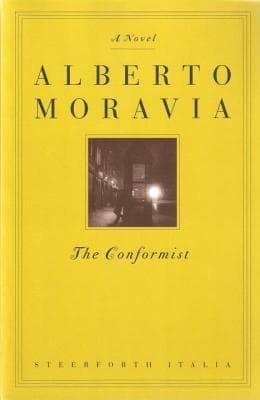
Synopsis
Covers the whole plot, including the ending.
- Difficulty
- Medium
- Pacing
- Moderate
- Mood
- Dark, Introspective, Psychological, Bleak, Atmospheric
- Read it if
- You are fascinated by the psychological underpinnings of political conformity, explore moral ambiguity, and enjoy character-driven literary fiction set against a tumultuous historical backdrop.
- Skip it if
- You prefer fast-paced thrillers, clear-cut heroes and villains, or shy away from introspective, somewhat bleak explorations of human nature.
The Conformist Plot Summary
Covers the whole plot, including the ending.
Marcello's Childhood and the Seeds of Conformity
The novel begins with Marcello Clerici getting ready to kill his former philosophy professor, Luca Quadri, in Paris. Flashbacks show Marcello's childhood. We learn about his troubled aristocratic family: a mother with mental health issues, a pleasure-seeking father, and general neglect. A key event happens when, as a boy, Marcello shoots a chauffeur, Lino, who had tried to molest him. This event, with his hidden homosexuality and a strong feeling of being 'different,' makes Marcello want to conform and appear 'normal.' He thinks that by following social rules and joining a strong institution, he can escape his past and his perceived abnormalities.
Engagement to Giulia and the Quest for a 'Normal' Life
As a young man, Marcello gets engaged to Giulia, a woman he sees as a typical Italian woman. He does not love her deeply but sees their marriage as a step towards a 'normal' middle-class life. Giulia is attractive, somewhat naive, and from a respectable family, all things that fit Marcello's wish for an outwardly perfect life. He carefully plans their future, imagining a usual home and family, believing that these outer signs will give him the acceptance and normalcy he wants, hiding his inner trouble and past events.
Joining the Fascist Secret Police
Marcello's wish to belong and have a clear social identity leads him to join the Fascist secret police (OVRA). He sees the Fascist Party as the best institution for conformity, offering order, belonging, and clear rules. His work for the government makes him feel part of something bigger and lets out his hidden aggression, all while looking respectable. He gets his first important mission: to go to Paris as if on a honeymoon and kill his former anti-Fascist philosophy professor, Luca Quadri, showing his full loyalty to the state.
The Honeymoon to Paris and the Encounter with Quadri
Marcello and Giulia go on their honeymoon to Paris. Marcello's main goal is to meet Professor Quadri, who lives in exile with his wife, Anna. Marcello struggles with the two-faced nature of his mission, acting like a newlywed tourist while quietly gathering information on Quadri. He meets Quadri, and their talks bring up old intellectual debates and hidden memories in Marcello. Quadri, though anti-Fascist, has some fondness for his former student, not knowing Marcello's real plans or the dark mission he is doing for the government.
Marcello's Fascination with Anna Quadri
While with the Quadris, Marcello becomes very interested in Anna, Professor Quadri's beautiful and mysterious wife. Her charm and unusual appeal upset Marcello's carefully built conformist image. He feels drawn to her in a way he never was to Giulia, feeling a strong, almost uncontrolled desire that challenges his commitment to 'normalcy' and his mission. This unexpected attraction adds a big emotional problem, threatening to ruin his plans and show his inner conflicts.
Anna and Giulia's Unexpected Connection
To Marcello's surprise, Anna and Giulia become friends. Anna, sensing Giulia's innocence and perhaps her husband's underlying issues, likes her. Giulia, in turn, is charmed by Anna's worldly sophistication. This growing friendship between the two women creates an unexpected problem for Marcello. He has to deal with the increasingly complex social situation, trying to keep his cover and advance his mission while also managing his wife's innocent affection for his target's wife and his own conflicted feelings for Anna.
Anna's Revelation and Marcello's Internal Conflict
In a tense meeting, Anna tries to attract Marcello. She openly says she likes him, recognizing his hidden complexities and perhaps his hidden homosexuality. This direct challenge to her desire, and his own hidden desires for her (and perhaps for men), causes Marcello deep inner conflict. He is torn between his mission, his carefully built conformist identity, and the raw emotions Anna brings out. Her bold offer makes him face parts of himself he has tried to hide, making him question the basis of his 'normal' life.
The Decision to Proceed with the Assassination
Despite his growing emotional involvement and the unsettling things Anna revealed, Marcello decides to go ahead with the assassination. His deep need for conformity and his loyalty to the Fascist government are stronger than his personal feelings or moral doubts. He tells himself that this act of violence is needed to secure his place in the 'normal' world he so desperately wants. He tells his Fascist contacts about the Quadris' travel plans, setting up the attack.
The Ambush and Its Aftermath
As the Quadris drive through the French countryside, their car is attacked by Fascist agents. Professor Quadri is killed. Anna, whom Marcello was attracted to, is also killed in the attack, even though Marcello's orders were only for Quadri. Marcello sees the violent aftermath, a scene that disturbs him deeply. The reality of his actions, and Anna's unexpected death, break his calm emotional state, leaving him with a feeling of emptiness and moral unease, despite finishing his mission.
Return to Rome and a Hollow Victory
Marcello returns to Rome with Giulia, having completed his mission. He expects to feel a sense of success and belonging, but instead, he feels only emptiness. His 'normal' life with Giulia, the usual job, and his position in the Fascist Party now feel empty. The assassination, far from bringing him peace, has only made his inner void deeper. He is haunted by the violence and the faces of those he betrayed, especially Anna, and his conformist image starts to break under his unaddressed psychological problems.
The Fall of Fascism and Marcello's Unmasking
Years later, as World War II ends, the Fascist government falls. Marcello is walking through Rome with his wife and child when he meets a former Fascist acquaintance. This meeting, during the public celebration of freedom, leads to an unexpected revelation. Marcello publicly speaks against the Fascist Party and, while drunk, admits to being involved in the murder of Lino, the chauffeur, as a boy. This public revealing takes away his last bits of conformity, showing the raw, unaddressed traumas and moral compromises that have defined his life.
A Final, Disillusioned Glimpse
The last scene shows Marcello alone, without his Fascist identity and his carefully built image. The fall of the government that gave him purpose, with his public confession, leaves him exposed and weak. He is no longer the 'conformist' he tried to be; the idea of normalcy has shattered. The novel ends with Marcello facing the deep emptiness of a life built on hiding things and false appearances. His search for belonging has led him to be completely disillusioned and alone.
The Conformist Characters
Marcello Clerici
Protagonist
A man obsessed with conformity to escape his traumatic past and perceived deviance.
Marcello Clerici is a complex, deeply repressed individual driven by an overwhelming desire for 'normalcy' and conformity. Haunted by a traumatic childhood incident (shooting a chauffeur who molested him) and his own repressed homosexuality, he seeks to erase his 'difference' by aligning himself with powerful, conventional institutions. He marries Giulia, a woman he doesn't love, purely for her conventionality and joins the Fascist secret police, seeing it as the ultimate expression of societal order. His intellectualism is constantly at odds with his emotional repression, leading to a profound internal conflict. He believes that by committing acts of violence for the state, he can finally belong.
Relationships: Giulia (Wife, chosen for her conventionality, not love); Professor Quadri (Former mentor, target for assassination); Anna Quadri (Wife of Quadri, object of Marcello's complicated attraction); Lino (Chauffeur, attempted molester, victim of Marcello's childhood shooting)
Giulia
Supporting
Marcello's conventional wife, a symbol of the normalcy he craves.
Giulia is Marcello's fiancée and later wife, a pretty, naive, and conventionally minded young woman from a respectable middle-class family. She represents everything Marcello believes he needs to achieve a 'normal' life: a traditional wife, a stable home, and an unblemished social image. She genuinely loves Marcello, though she is largely unaware of his complex inner life, his repressed past, or his secret work. Her innocence and simple desires serve as a stark contrast to Marcello's internal turmoil, making her a symbol of the ordinary world he desperately tries to inhabit.
Relationships: Marcello Clerici (Husband, whom she loves but doesn't fully understand); Anna Quadri (Friend, whom she admires and is briefly drawn to)
Professor Luca Quadri
Supporting
Marcello's former philosophy professor and a prominent anti-Fascist intellectual in exile.
Professor Quadri is Marcello's former philosophy professor, an intelligent and principled anti-Fascist intellectual living in exile in Paris. He represents the intellectual freedom and moral integrity that Marcello, in his quest for conformity, has abandoned. Quadri maintains a certain affection for Marcello, seeing him as a promising former student, and is unaware of Marcello's true mission. His discussions with Marcello about philosophy and politics serve to highlight Marcello's internal conflict and the intellectual sacrifices he has made for the Fascist regime. He is ultimately the target of Marcello's assassination plot.
Relationships: Marcello Clerici (Former student and eventual assassin); Anna Quadri (Wife, whom he deeply loves and respects)
Anna Quadri
Supporting
Professor Quadri's alluring and unconventional wife, who challenges Marcello's repressed desires.
Anna Quadri is Professor Quadri's beautiful, sophisticated, and enigmatic wife. She is intelligent, worldly, and possesses a magnetic allure that deeply unsettles Marcello. Anna represents a freedom and unconventionality that both fascinates and repels Marcello, challenging his carefully constructed conformist persona. She is perceptive, quickly sensing Marcello's hidden complexities and repressed desires, even attempting to seduce him. Her presence forces Marcello to confront his own sexuality and the artificiality of his 'normal' life, becoming an unexpected catalyst for his internal turmoil.
Relationships: Professor Quadri (Husband, whom she deeply loves); Marcello Clerici (Object of mutual, complicated attraction); Giulia (Friend, whom she finds charming and naive)
Manganiello
Supporting
A Fascist agent, Marcello's contact and accomplice.
Manganiello is a blunt, pragmatic, and ruthless Fascist agent who serves as Marcello's contact and accomplice in the assassination plot. He embodies the brutal efficiency and lack of moral introspection characteristic of the regime. Unlike Marcello, Manganiello has no intellectual or psychological conflicts about his actions; he simply follows orders. He is the practical arm of the Fascist state, a stark contrast to Marcello's internal struggles, highlighting the difference between blind obedience and tormented conformity.
Relationships: Marcello Clerici (Colleague in the secret police)
Lino
Mentioned
The chauffeur from Marcello's childhood, a figure of his repressed trauma.
Lino is the chauffeur from Marcello's childhood who attempts to sexually molest him. Marcello, as a boy, shoots Lino during this encounter. Lino's character is not developed in the present narrative but exists as a pivotal figure in Marcello's past, representing the traumatic origin of his deep-seated psychological issues, his repressed homosexuality, and his subsequent obsession with conformity. The memory of Lino and the act of violence against him haunt Marcello throughout his life.
Relationships: Marcello Clerici (Childhood victim/assailant)
Colonel
Supporting
Marcello's superior in the Fascist secret police.
The Colonel is Marcello's superior in the Fascist secret police, representing the bureaucratic and ideological head of the organization. He is the one who assigns Marcello the mission to assassinate Professor Quadri. The Colonel embodies the detached, calculating nature of the Fascist state, prioritizing political loyalty and efficiency above all else. He is the figure who grants Marcello the 'permission' to commit violence in the name of conformity, further cementing Marcello's commitment to the regime.
Relationships: Marcello Clerici (Superior officer)
Marcello's Mother
Mentioned
Marcello's mentally unstable aristocratic mother.
Marcello's mother is portrayed as an unstable, aristocratic woman, often seen in a state of mental disarray or engaging in frivolous activities. Her neglect and emotional unavailability contribute significantly to Marcello's traumatic childhood and his subsequent psychological development. She represents the dysfunctional family environment from which Marcello desperately tries to escape by seeking external order and conformity.
Relationships: Marcello Clerici (Neglectful mother)
The Conformist Themes
Conformity vs. Individuality
This is the main theme of the novel, shown through Marcello Clerici's strong wish to appear 'normal.' Because of his past events and hidden desires (especially his hidden homosexuality), Marcello believes that by strictly following social rules, marrying a conventional woman like Giulia, and joining a powerful, authoritarian institution like the Fascist Party, he can erase his 'difference.' However, his attempts to conform only hide his true self, leading to an empty life and inner trouble, especially when he meets Anna Quadri's unusual appeal. The novel argues that true individuality cannot be hidden without big psychological cost.
“What he wanted was to be like everyone else, to be 'normal,' to have a 'normal' life.”
Repression and Trauma
The novel looks at the psychological effects of childhood events and hiding feelings. Marcello's shooting of the chauffeur, Lino, after an attempted molestation, is the main event that shapes his whole life. This event, with his troubled family and hidden homosexuality, makes him build a complex image of conformity. He hides his true feelings, desires, and memories, believing that only by doing so can he be accepted. However, these hidden parts constantly come out, especially when he talks to Anna, showing that hiding feelings is a weak and eventually harmful way to cope.
“He sought in the Fascist Party not so much an ideology as a cure, a remedy for his own abnormality.”
The Psychology of Fascism
Moravia connects the rise of Italian Fascism to the psychological needs of people like Marcello. For Marcello, Fascism is not mainly an idea but a strong institution that offers order, belonging, and a clear identity, a 'cure' for his personal feeling of being abnormal. The government's focus on conformity, obedience, and stopping disagreement matches Marcello's own inner struggles. The novel suggests that Fascism grows by appealing to a shared desire to belong and by letting out hidden aggression, allowing people to do bad things under the guise of loyalty and normalcy.
“Fascism was for him, above all, the possibility of being like everyone else.”
Appearance vs. Reality
This theme is central to Marcello's character and the wider comment on Fascist Italy. Marcello builds an elaborate appearance of normalcy – a conventional marriage, a respectable job, outward adherence to social rules – to hide his inner trouble, hidden desires, and past events. The Fascist government itself also relies heavily on appearances, showing an image of order and strength while often doing brutal and corrupt things behind the scenes. The novel always shows the difference between what characters (and the state) show to the world and their true, often darker, realities, ending with these illusions breaking.
“He had always lived in a kind of double life, one external and visible, the other internal and hidden.”
Sexuality and Desire
Marcello's hidden homosexuality and his conflicting desires are an important underlying element throughout the novel. His attempted molestation by Lino as a child, and his violent reaction, deeply harms him, making him fear and hide his own sexual identity. His marriage to Giulia is a clear effort to establish a 'normal' heterosexual life. However, his strong, unsettling attraction to Anna Quadri, and Anna's own understanding of his hidden desires, make him face the complexities of his sexuality, challenging the strict limits he has placed on himself.
“He found Anna alluring, but with an allure that was a threat to his carefully constructed 'normality.'”
Plot Devices & Literary Techniques
Flashbacks
Used to reveal Marcello's traumatic past and psychological motivations.
The novel frequently employs non-linear flashbacks, particularly to Marcello's childhood, to illuminate the origins of his psychological issues and his obsession with conformity. These flashbacks, such as the incident with Lino the chauffeur, are crucial for understanding Marcello's present actions and his deep-seated need to escape his past. They provide context for his choices, his repression, and his attraction to the Fascist regime, showing how early trauma shapes his adult identity and decisions.
Symbolism of Conformity (e.g., Giulia, Fascism)
Characters and institutions represent Marcello's desire for normalcy and belonging.
Giulia, Marcello's conventional wife, symbolizes the 'normal' bourgeois life he desperately craves, devoid of the complexities and perceived abnormalities of his own nature. Similarly, the Fascist Party itself functions as a potent symbol of conformity, order, and belonging for Marcello. He views it not just as a political ideology but as a rigid structure that can provide him with a definitive identity and erase his sense of 'difference.' These symbols highlight the external constructs Marcello uses to escape his internal turmoil.
Dramatic Irony
The reader is aware of Marcello's true intentions while other characters are not.
Dramatic irony is used effectively, particularly during Marcello's interactions with Professor Quadri and Anna. The reader is privy to Marcello's secret mission to assassinate Quadri, while Quadri himself treats Marcello as a former student and friend. This creates a tense and unsettling dynamic, highlighting Marcello's duplicity and the moral compromises he makes. It also underscores the tragedy of Quadri's unsuspecting nature and Anna's unwitting entanglement in Marcello's plot, intensifying the emotional impact of their eventual demise.
Interior Monologue
Provides direct access to Marcello's conflicted thoughts and repressed emotions.
Much of the novel is conveyed through Marcello's interior monologue, allowing the reader direct access to his complex and often contradictory thoughts, anxieties, and repressed desires. This narrative technique reveals the constant battle within him between his intellectual understanding and his emotional repression. It exposes his rationalizations, his justifications for his actions, and the profound psychological toll his quest for conformity takes on him, making his internal conflict palpable and central to the narrative.
The Conformist Quotes
“The only thing that matters is to be like everyone else.”
“I want to be normal, to have a normal life, a normal wife, normal children.”
“The world is divided into two categories: those who command and those who obey.”
“To be different is to be guilty.”
“I have always been afraid of being myself.”
“The conformist is the true revolutionary of our time.”
“We are all actors in a play written by others.”
“To love is to possess, and to possess is to destroy.”
“The past is a prison from which there is no escape.”
“In a world of lies, the truth becomes a crime.”
“I have sold my soul for a little peace.”
“The crowd is the only reality; the individual is an illusion.”
“To be free is to be alone, and to be alone is to be afraid.”
“We kill what we do not understand, and we call it justice.”
Quiz
10 questions on the plot and the characters. Each answer comes with a short explanation.
Question 1
What is Marcello Clerici's secret profession during the Mussolini years?
- A journalist for a Fascist newspaper
- A diplomat in the Italian foreign service
- An agent for the Italian political police
- A university professor of political science
Show answer
C. An agent for the Italian political police Marcello Clerici works secretly for the Italian political police during the Fascist era, which gives him hidden power despite his outwardly conventional life.
Question 2
What traumatic childhood experience contributes to Marcello's obsession with conformity?
- Being bullied at school for his family's poverty
- Witnessing his father's arrest by the police
- Parental neglect and emotional abandonment
- Losing his mother to illness at a young age
Show answer
C. Parental neglect and emotional abandonment Moravia connects Marcello's psychological need for conformity to his experience of parental neglect, which creates a deep insecurity he tries to overcome through rigid adherence to social norms.
Question 3
What assignment does Marcello receive that threatens to disrupt his controlled life?
- To infiltrate an anti-Fascist group in Rome
- To assassinate his former professor living in exile in France
- To spy on his own wife for suspected disloyalty
- To deliver secret documents to Mussolini himself
Show answer
B. To assassinate his former professor living in exile in France Marcello is ordered to kill his former professor who is exiled in France, a mission meant to prove his loyalty to the Fascist state but which instead begins to unravel his carefully constructed life.
Question 4
How does Moravia connect Marcello's personal psychology to the broader historical context?
- By showing how Marcello's artistic talents are suppressed by Fascism
- By equating Marcello's need for conformity with the rise of Italian Fascism
- By depicting Marcello as a reluctant hero who opposes Mussolini
- By making Marcello a symbol of Italian economic prosperity under Fascism
Show answer
B. By equating Marcello's need for conformity with the rise of Italian Fascism Moravia uses Marcello's psychological obsession with conformity as a metaphor for how individuals surrender to authoritarian systems like Fascism, linking personal pathology to political reality.
Question 5
What unexpected development occurs during Marcello's mission in France?
- He discovers his professor is actually working for the Fascists
- He falls in love with a strange, compelling woman
- He is betrayed by his own wife who follows him to France
- He decides to defect and join the anti-Fascist resistance
Show answer
B. He falls in love with a strange, compelling woman While carrying out his assassination assignment, Marcello encounters and falls in love with an enigmatic woman, which further complicates his mission and emotional state.
Question 6
What aspect of Marcello's appearance causes him significant distress?
- His resemblance to Mussolini, which draws unwanted attention
- A facial scar from a childhood accident that makes him self-conscious
- His type of male beauty that other men find attractive
- Premature graying that makes him look older than he is
Show answer
C. His type of male beauty that other men find attractive Marcello possesses a particular male beauty that attracts attention from other men, which distresses him because it contradicts his desire for conventional, unremarkable normality.
Question 7
What does Marcello's 'oddly self-conscious desire to engage in cruel acts' reveal about his character?
- He is a naturally violent person who enjoys inflicting pain
- He uses cruelty to prove his masculinity to himself
- He experiments with transgression while simultaneously seeking conformity
- He is trying to impress his Fascist superiors with his ruthlessness
Show answer
C. He experiments with transgression while simultaneously seeking conformity This contradictory impulse shows Marcello's complex psychology - he both craves the safety of conformity and is drawn to transgressive acts, reflecting the tension between his outward compliance and inner turmoil.
Question 8
How does Marcello's relationship with his wife contrast with his secret life?
- His wife knows about his secret work and actively supports it
- He maintains a loving conventional marriage while hiding his violent profession
- He is emotionally distant from his wife because she opposes Fascism
- His marriage is arranged by the Fascist party for political reasons
Show answer
B. He maintains a loving conventional marriage while hiding his violent profession Marcello has a wife who loves him, representing the conventional domestic life he cultivates, while simultaneously working secretly for the political police - illustrating the dichotomy between his public conformity and private violence.
Question 9
What does the assassination mission symbolize in terms of Marcello's relationship to the Fascist state?
- A test of his ideological commitment to Fascist principles
- An opportunity for career advancement within the police hierarchy
- The ultimate demonstration of loyalty requiring personal betrayal
- A chance to prove his physical courage in dangerous situations
Show answer
C. The ultimate demonstration of loyalty requiring personal betrayal Killing his former professor represents the extreme demand of totalitarian systems for complete personal surrender - Marcello must betray his past (his teacher) to prove his present loyalty to the state.
Question 10
Why is secrecy described as 'second nature' to Marcello Clerici?
- Because he was trained in espionage techniques by the political police
- Because his childhood taught him to hide his true self to survive emotionally
- Because Italian society under Mussolini required everyone to keep secrets
- Because his wife would leave him if she knew about his violent work
Show answer
B. Because his childhood taught him to hide his true self to survive emotionally Marcello's psychological development, shaped by parental neglect, made concealment of his true feelings and desires a fundamental survival strategy long before he joined the political police, making secrecy an ingrained part of his character.
The Conformist FAQ
What is 'The Conformist' about?
The novel follows Marcello Clerici, an Italian man working secretly for Mussolini's political police during the Fascist era. His life of controlled conformity unravels when he's assigned to assassinate his former professor in France and falls in love with a mysterious woman, exposing both his psychological turmoil and the corruption of Fascism.
Why should I read 'The Conformist'?
Moravia masterfully explores the intersection of personal psychology and political ideology through Marcello's journey. The novel offers profound insights into how individual desires for acceptance can mirror and enable authoritarian systems, making it both a compelling character study and a powerful political critique.
What is the background/setting of 'The Conformist'?
Set primarily in 1930s Italy during Mussolini's Fascist regime, with key scenes occurring in Paris where Marcello travels to carry out his assassination mission. The historical backdrop of rising authoritarianism provides the oppressive atmosphere that shapes Marcello's actions and psychology.
What are the most memorable quotes?
While specific quotes vary by translation, key themes include Marcello's observation that 'conformity was the only way to escape from myself' and descriptions of how 'secrecy and silence were second nature' to him. These encapsulate his psychological struggle and the novel's central tension between outward compliance and inner turmoil.
What writing style does the author use?
Moravia employs a psychological realism style with precise, analytical prose that delves deeply into Marcello's consciousness. The narrative maintains a detached, almost clinical tone that mirrors Marcello's emotional repression while gradually revealing his hidden vulnerabilities and contradictions.
What minor details add significant meaning?
Marcello's preoccupation with his own male beauty—and other men's attraction to it—subtly reveals his anxiety about identity and control. His childhood experiences of parental neglect, though briefly mentioned, fundamentally shape his adult obsession with conformity and approval from authority figures.
What are some subtle foreshadowing moments?
Early descriptions of Marcello's 'self-conscious desire to engage in cruel acts' foreshadow his willingness to participate in political violence. His secret police work being described as giving him 'hidden power' hints at how this external control mechanism will eventually fail to contain his internal conflicts.
What unexpected character connections exist?
The target of Marcello's assassination mission—his former professor—represents an intellectual freedom Marcello has sacrificed for conformity. The 'strange, compelling woman' he falls for in France becomes a mirror showing him the emotional authenticity he has suppressed through his Fascist allegiances.
What are unspoken character motivations?
Beneath Marcello's stated commitment to Fascism lies a deep-seated need to escape his own psychological fragmentation through external validation. His conformity stems not from genuine political belief but from childhood neglect that created an obsessive need for belonging and structure.
What psychological complexities do characters exhibit?
Marcello demonstrates contradictory impulses: he craves normalcy yet is drawn to cruelty, seeks control yet is distressed by others' attraction to him, maintains outward composure while experiencing inner disintegration. His psychology mirrors Fascism's own contradictions between order and violence, unity and suppression.
What are the major emotional turning points?
The assassination assignment forces Marcello to confront his capacity for violence beyond bureaucratic complicity. Falling in love disrupts his emotional detachment, while realizing his professor represents everything he has sacrificed creates cognitive dissonance that fractures his carefully constructed identity.
How do relationship dynamics evolve?
Marcello's marriage begins as another conformity performance but becomes strained as his secret mission progresses. His relationship with the mysterious woman in France introduces genuine emotional connection that threatens his controlled existence, while his interactions with Fascist superiors reveal the transactional nature of his political loyalty.
Which parts remain ambiguous or open-ended?
The novel leaves ambiguous whether Marcello's psychological unraveling leads to genuine self-awareness or merely deeper despair. The ultimate consequences of his actions—both the assassination and his emotional awakening—are suggested rather than fully resolved, mirroring the ongoing moral questions about complicity.
What are controversial scenes or decisions?
Marcello's acceptance of the assassination mission—targeting his former mentor—raises questions about moral compromise for political conformity. His simultaneous commitment to Fascism and pursuit of authentic love creates ethical contradictions that challenge readers' sympathies and judgments.
'The Conformist' ending explained: how it ends & what it means
Without revealing specific plot details, the ending shows Marcello's life 'torn open' as his psychological defenses collapse. This represents both personal catastrophe and moral revelation, suggesting that conformity's false security inevitably shatters when confronted with authentic human experiences and ethical choices.
How does Moravia connect personal psychology to political ideology?
Moravia presents Marcello's need for conformity as both causing and reflecting his embrace of Fascism. The character's psychological voids—created by neglect and identity confusion—make him susceptible to authoritarianism's promises of order and belonging, illustrating how political systems exploit individual vulnerabilities.
About the author
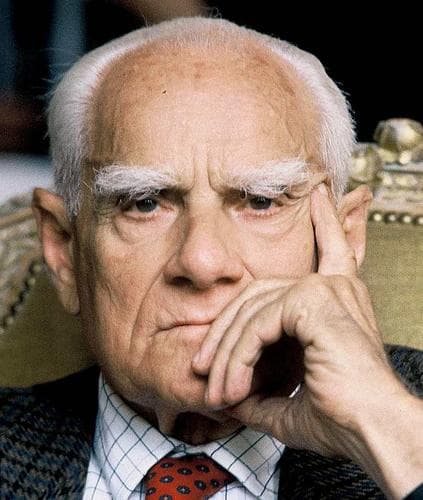
Alberto Moravia was an Italian novelist and journalist. His novels explored matters of modern sexuality, social alienation and existentialism. Moravia is best known for his debut novel Gli indifferenti and for the anti-fascist novel Il Conformista, the basis for the film The Conformist (1970) directed by Bernardo Bertolucci. Other novels of his adapted for the cinema are Agostino, filmed with the same title by Mauro Bolognini in 1962; Il disprezzo, filmed by Jean-Luc Godard as Le Mépris ; La Noia (Boredom), filmed with that title by Damiano Damiani in 1963 and released in the US as The Empty Canvas in 1964 and La ciociara, filmed by Vittorio De Sica as Two Women (1960). Cédric Kahn's L'Ennui (1998) is another version of La Noia.
Similar books
- Darkness at Noon
Arthur Koestler
4.0 (26k) average on GoodreadsPoliticsExplores the psychological impact of totalitarianism and the moral compromises of individuals within it.
- The Stranger
Albert Camus
4.1 (3k) average on GoodreadsFantasyFeatures a protagonist grappling with alienation and societal expectations, leading to a detached observation of life.
- Nausea
Jean-Paul Sartre
3.9 (86k) average on GoodreadsPhilosophyDelves into an individual's existential crisis and the search for meaning in a seemingly absurd world.
- The Old Man and the Sea
Ernest Hemingway
3.8 (831k) average on GoodreadsLiterary FictionA Cuban fisherman's long struggle with a giant marlin becomes a story of endurance and dignity, now retold for young adults with illustrations, phonetic guides, and writing prompts in Traditional Chinese.
- One Hundred Years of Solitude
Gabriel García Márquez
4.1 (753k) average on GoodreadsLiterary FictionThrough the multi-generational story of the Buendía family, a mythical town deals with the repeating patterns of time, love, and solitude, as the extraordinary mixes with the ordinary.
- The Goldfinch
Donna Tartt
3.9 (720k) average on GoodreadsLiterary FictionHaunted by a tragic explosion and clutching a stolen Dutch masterpiece, a young orphan navigates the opulent drawing rooms of New York and the gritty underbelly of the art world, desperately seeking connection and redemption amidst a life spiraling into crime and obsession.





Enjoyed the summary?
A summary gives you the shape of the book. The book itself has the detail, the examples and the voice.
Find The Conformist on AmazonAs an Amazon Associate, BookBrief earns from qualifying purchases. How we're funded