
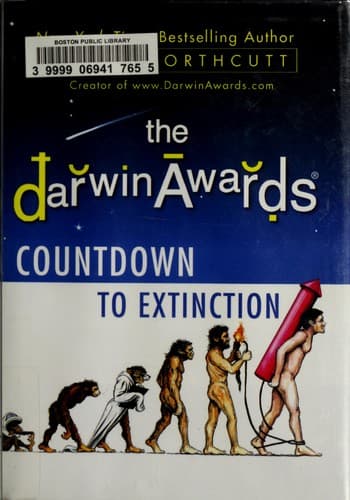
Core Idea
- Difficulty
- Easy
- Read it if
- You enjoy dark humor, are fascinated by human stupidity, appreciate real-world examples of natural selection, or want to understand the consequences of poor decision-making in a lighthearted yet impactful way. It's also great for those who like to ponder the interplay between technology, human behavior, and survival.
- Skip it if
- You are easily offended by stories of accidental death or injury, find humor in tragedy distasteful, or prefer serious academic discussions on evolution rather than anecdotal evidence. If you're looking for deep philosophical insights or a guide to improving your own decision-making, this book might not be for you.
Key Takeaways from The Darwin Awards Countdown to Extinction
Natural Selection in Action
The Darwin Awards highlight how extreme human folly can lead to the removal of individuals from the gene pool.
The core premise of the Darwin Awards is to illustrate natural selection in a modern, often darkly humorous, context. Individuals who exhibit an extraordinary lack of common sense, leading to their demise or incapacitation, effectively remove themselves from the reproductive pool. This aligns with Darwinian principles where traits detrimental to survival are weeded out over generations. The book serves as a compendium of these extreme examples, ranging from trying to jump between moving subway cars to attempting to sniff a live hand grenade, all demonstrating a failure to assess risk or understand basic physics and safety. These incidents, while tragic, underscore the evolutionary mechanism of eliminating maladaptive behaviors, albeit in a dramatic and immediate fashion.
“The Darwin Awards commemorate individuals who protect our gene pool by making the ultimate sacrifice of their own lives through incredibly idiotic mistakes.”
In the book: Numerous anecdotal accounts of self-inflicted injuries or fatalities due to gross negligence or stupidity, such as the man who used a lighter to check his car's gas tank.
Try this: Cultivate a habit of critical thinking and risk assessment in everyday situations. Before engaging in potentially dangerous activities, consider the worst-case scenarios and implement safety precautions.
Related ideas: natural-selection, risk-assessment, evolutionary-psychology
The Allure of Stupidity
Many Darwin Award winners are driven by a combination of thrill-seeking, ignorance, and overconfidence.
The book frequently reveals that a significant number of Darwin Award incidents stem from individuals making incredibly poor decisions under the influence of alcohol or drugs, coupled with an inflated sense of invincibility or a desire to impress others. This confluence of factors leads them to ignore obvious dangers, such as attempting to play 'chicken' with a train, trying to siphon gasoline with their mouth, or engaging in dangerous stunts for social media attention. The psychological drivers behind these behaviors often involve a failure to accurately perceive risk, an overestimation of personal abilities, and a lack of foresight regarding consequences. This highlights a critical flaw in human cognition that can override survival instincts.
“Human beings are often their own worst enemies, particularly when combined with alcohol, bravado, and a complete disregard for basic safety principles.”
In the book: Multiple cases involving alcohol consumption leading to fatal stunts, or individuals attempting dangerous feats to 'prove' something to friends.
Try this: Develop self-awareness regarding personal biases and cognitive distortions, especially in social settings. Prioritize safety over bravado or the desire for immediate gratification.
Related ideas: cognitive-bias, risk-perception, impulsivity
Unintended Consequences
Even seemingly innocuous actions can have fatal and unforeseen repercussions when combined with poor judgment.
A recurring theme in the book is how minor miscalculations or a lack of understanding of basic scientific principles can lead to catastrophic outcomes. For instance, a man attempting to hotwire a car by biting into live wires, or individuals using highly flammable substances as cleaning agents in poorly ventilated areas. These cases are not always about deliberate thrill-seeking but rather a profound ignorance of cause and effect. The book demonstrates that the world operates on predictable physical laws, and those who disregard them, whether intentionally or not, often face severe consequences. It's a stark reminder that ignorance of the law (of physics, in this case) is no excuse for avoiding its penalties.
“The universe has a peculiar way of punishing those who underestimate its power, particularly when they're armed with a bad idea and a lack of foresight.”
In the book: Examples like individuals attempting to dry clothes in a microwave, or using a vacuum cleaner to suck up flammable liquids, leading to explosions.
Try this: Cultivate a general knowledge of basic science and safety principles. Before attempting a task, consider potential hazards and consult reliable sources for best practices.
Related ideas: cause-and-effect, ignorance-is-not-bliss, safety-awareness
The Role of Technology
Modern technology, when misused or misunderstood, provides new avenues for self-inflicted harm.
The Darwin Awards are not confined to traditional forms of idiocy; many incidents involve the dangerous misuse of modern technology. This includes individuals attempting to 'hack' or modify devices without understanding the underlying dangers, such as tampering with live electrical circuits, or using industrial equipment in incredibly unsafe ways. The accessibility of powerful tools and complex machinery, combined with a lack of proper training or respect for their potential hazards, creates fertile ground for accidents. The book highlights how advancements, intended to make life easier, can become instruments of self-destruction when wielded by the uninformed or reckless. It's a cautionary tale about the importance of understanding the tools we use.
“As technology advances, so too do the creative, and often deadly, ways in which humans manage to misuse it.”
In the book: Cases involving individuals attempting to repair high-voltage electronics without unplugging them, or using power tools for tasks they were never designed for, resulting in injury or death.
Try this: Always read instruction manuals and follow safety guidelines for electronic devices and machinery. Seek professional help for repairs or modifications to complex systems.
Related ideas: technological-literacy, digital-safety, human-factors
Bystander Effect and Peer Pressure
The presence of others can sometimes exacerbate dangerous situations rather than mitigate them.
While not every Darwin Award involves an audience, many cases are influenced by peer pressure or the desire to perform for others. The book illustrates how individuals, egged on by friends or seeking validation, engage in stunts they might otherwise avoid. This phenomenon, related to the bystander effect, can lead to a collective failure to intervene or a heightened sense of bravado. Instead of acting as a deterrent, the group dynamic can amplify risky behavior, with tragic consequences. It underscores the powerful social forces that can influence individual decision-making, sometimes to a fatal degree, demonstrating how the human need for acceptance can override self-preservation.
“The desire to impress, or simply the presence of an audience, can override an individual's better judgment, leading to tragic outcomes.”
In the book: Stories of individuals daring each other to perform dangerous stunts, or groups failing to stop a friend from engaging in clearly suicidal acts.
Try this: Be aware of social pressures and develop the confidence to say 'no' to dangerous dares. Be an active bystander and intervene when others are putting themselves at risk.
Related ideas: peer-pressure, bystander-effect, social-influence
The 'Hold My Beer' Mentality
A significant portion of Darwin Award winners exhibit a reckless disregard for consequences, often fueled by bravado.
This colloquial phrase perfectly encapsulates a common thread among the awardees: a moment of impulsive, often alcohol-fueled, decision-making driven by a desire to prove something or simply for a laugh, without considering the potential for severe injury or death. This 'hold my beer' mentality is evident in stories where individuals attempt incredibly dangerous stunts, like trying to surf on the roof of a moving car, or attempting to jump over a wide chasm. It's characterized by a complete absence of foresight and an overestimation of personal capabilities, leading to predictable and often fatal outcomes. The book highlights how this specific brand of reckless bravado is a consistent pathway to self-destruction.
“There's a fine line between bravery and outright stupidity, and many Darwin Award winners leap over that line with gusto.”
In the book: Numerous anecdotes where individuals utter phrases like 'watch this!' or similar before engaging in fatal acts of recklessness.
Try this: Pause and reflect before acting on impulsive urges, especially when influenced by substances or social pressure. Prioritize safety and rational thought over momentary thrills or showing off.
Related ideas: impulse-control, recklessness, consequence-assessment
Lessons in Prevention
By studying these extreme examples of human error, we can learn to avoid similar pitfalls in our own lives.
Despite the humorous tone, the underlying purpose of the Darwin Awards, and the book, is to serve as a cautionary tale. Each story, no matter how outlandish, offers a lesson in what not to do. By dissecting the fatal flaws in judgment, the poor risk assessments, and the sheer lack of common sense, readers can gain a better understanding of how to prevent similar accidents in their own lives. It encourages a heightened sense of situational awareness, critical thinking, and a respect for the laws of physics and safety regulations. The book implicitly advocates for proactive safety measures and a thoughtful approach to daily activities, turning morbid entertainment into practical life lessons.
“While the stories are often darkly humorous, their underlying message is a serious one: pay attention, think twice, and value your life.”
In the book: The compilation of diverse scenarios, each offering a clear example of a preventable error, such as mistaking gasoline for water or attempting to defuse explosives without expertise.
Try this: Actively seek out safety information for new activities or equipment. Develop a habit of mentally rehearsing potential dangers before undertaking tasks. Learn from the mistakes of others.
Related ideas: accident-prevention, situational-awareness, critical-thinking
The Universality of Folly
The Darwin Awards transcend geographical and cultural boundaries, demonstrating that stupidity is a universal human trait.
The book features incidents from around the globe, highlighting that extreme human folly is not confined to any particular culture, nationality, or demographic. From individuals in rural settings to those in highly urbanized environments, the propensity for making fatally bad decisions appears to be a universal aspect of the human condition. This underscores that while societal norms and educational levels vary, the capacity for profound and self-destructive errors in judgment remains constant across humanity. It's a humbling reminder that intelligence in one area does not guarantee common sense in another, and that the fundamental mechanisms of human error are deeply ingrained.
“Stupidity knows no borders, no gender, and no age limit, as the global collection of Darwin Award winners clearly demonstrates.”
In the book: Stories from various countries and continents, showcasing similar types of fatal mistakes regardless of cultural context.
Try this: Recognize that everyone, including oneself, is susceptible to making poor judgments. Foster empathy and understanding while still advocating for common sense and safety.
Related ideas: human-condition, cross-cultural-studies, universal-traits
The Darwin Awards Countdown to Extinction Quotes
“The Darwin Awards honor those who improve our gene pool by removing themselves from it.”
“Natural selection is not a theory. It is a fact, proven daily by the magnificent efforts of Darwin Award candidates.”
“It takes a special kind of genius to accidentally self-extinguish in a truly memorable way.”
“Brave, yes. Smart, no. A recurring theme.”
“The gene pool is a better place for their absence.”
“Some people are just too helpful for their own good... or anyone else's.”
“The world is full of warning labels for a reason. Ignoring them can be fatal.”
“You can't fix stupid, but stupid can fix the gene pool.”
“Evolution sometimes needs a nudge, and these individuals provide it.”
“The pursuit of a thrill can sometimes lead to a very permanent stillness.”
“Common sense isn't always common, especially when fireworks are involved.”
“Gravity: it's not just a good idea, it's the law.”
“Ignorance is bliss, until it's fatal.”
Quiz
10 questions on the main ideas. Each answer comes with a short explanation.
Question 1
Which of the following best describes the core concept behind the Darwin Awards?
- Honoring individuals who make significant contributions to scientific research.
- Recognizing individuals who improve the gene pool by removing themselves from it in an extraordinarily idiotic manner.
- Celebrating acts of extreme bravery and self-sacrifice.
- Awarding prizes for the most innovative inventions of the year.
Show answer
B. Recognizing individuals who improve the gene pool by removing themselves from it in an extraordinarily idiotic manner. The Darwin Awards are given to individuals who ostensibly improve the human gene pool by accidentally removing themselves from it (or rendering themselves sterile) through acts of extreme foolishness.
Question 2
According to the book, what is a common theme among many Darwin Award recipients?
- A profound understanding of physics and engineering.
- An overestimation of their own intelligence or abilities.
- A selfless desire to help others.
- A cautious approach to dangerous situations.
Show answer
B. An overestimation of their own intelligence or abilities. Many Darwin Award winners often exhibit a severe overestimation of their own capabilities or a profound underestimation of danger.
Question 3
What is one of the key criteria for a Darwin Award nomination, as implied by the book?
- The act must be performed with malicious intent.
- The individual must be a minor.
- The individual must be dead or rendered sterile by their own actions.
- The act must benefit society in some way.
Show answer
C. The individual must be dead or rendered sterile by their own actions. A core criterion for a Darwin Award is that the nominee must have removed themselves from the gene pool, either by death or incapacitation (sterilization), due to their own folly.
Question 4
The book often features stories involving which common element that contributes to fatal mistakes?
- Advanced technological failure.
- Misunderstanding of basic physical laws or common sense.
- Acts of nature beyond human control.
- Deliberate acts of self-harm.
Show answer
B. Misunderstanding of basic physical laws or common sense. Many Darwin Award incidents stem from a fundamental misunderstanding or disregard for basic physics, safety, or common sense.
Question 5
What role does humor play in 'The Darwin Awards Countdown to Extinction'?
- It is completely absent; the book is a serious scientific study.
- It is used to mock the victims and discourage empathy.
- It is a central element, making light of tragic but incredibly foolish incidents.
- It's only present in the introduction and conclusion.
Show answer
C. It is a central element, making light of tragic but incredibly foolish incidents. The book uses dark humor to present and comment on the often absurd and tragic circumstances of the award recipients.
Question 6
Which of the following types of 'experiments' is most likely to be featured in the book?
- Controlled laboratory trials with safety protocols.
- Spontaneous, ill-conceived stunts performed without regard for consequences.
- Carefully planned public demonstrations of scientific principles.
- Medical research trials.
Show answer
B. Spontaneous, ill-conceived stunts performed without regard for consequences. The book is filled with accounts of individuals undertaking spontaneous, often alcohol-fueled or adrenaline-driven stunts with no foresight or safety considerations.
Question 7
The book's title, 'Countdown to Extinction,' implies a commentary on what?
- The extinction of animal species due to human activity.
- The idea that humanity is slowly improving its collective intelligence.
- The continuous removal of individuals from the gene pool through their own folly.
- The declining population of the world.
Show answer
C. The continuous removal of individuals from the gene pool through their own folly. The 'Countdown to Extinction' refers to the ongoing, self-inflicted removal of individuals from the human gene pool, as celebrated (tongue-in-cheek) by the Darwin Awards.
Question 8
What is typically NOT a characteristic of a Darwin Award winner's actions?
- Public recognition for their intelligence.
- A clear lack of foresight.
- Actions that lead to their own demise or sterilization.
- An element of sheer stupidity.
Show answer
A. Public recognition for their intelligence. Darwin Award winners are recognized for their profound lack of intelligence leading to their demise, not for any intellectual achievement.
Question 9
The book implicitly suggests a connection between the awards and which scientific theory?
- The Big Bang theory.
- The theory of relativity.
- Darwin's theory of natural selection.
- The theory of plate tectonics.
Show answer
C. Darwin's theory of natural selection. The awards are named after Charles Darwin and playfully link the self-removal of foolish individuals from the gene pool to a form of 'natural selection' (or rather, unnatural selection due to stupidity).
Question 10
Which of the following would be an unlikely scenario to find in 'The Darwin Awards Countdown to Extinction'?
- A man attempting to jump over a moving train.
- Someone trying to siphon gasoline with their mouth.
- A person dying from a well-researched and unavoidable accident.
- An individual using a lawnmower to trim hedges while standing on a ladder.
Show answer
C. A person dying from a well-researched and unavoidable accident. The Darwin Awards focus on deaths or incapacitations that are self-inflicted due to extreme folly or negligence, not unavoidable accidents.
The Darwin Awards Countdown to Extinction FAQ
What is 'The Darwin Awards Countdown to Extinction' about?
This book is a collection of true stories detailing individuals who have (inadvertently) improved the human gene pool by eliminating themselves from it in an extraordinarily idiotic manner. It celebrates those who make the ultimate sacrifice for the advancement of humanity, one foolish act at a time.
Who is Wendy Northcutt, and what is her role in the Darwin Awards?
Wendy Northcutt is the founder and curator of the Darwin Awards, a popular website and series of books. She compiles, verifies, and publishes these accounts of 'natural selection in action,' bringing humor and a touch of dark irony to the concept of evolutionary fitness.
Are the stories in 'The Darwin Awards Countdown to Extinction' true?
Yes, Wendy Northcutt and her team go to great lengths to verify the authenticity of each story before it is published. While some details might be embellished for narrative effect, the core events described are generally confirmed to be true incidents.
What kind of 'awards' are given out in the Darwin Awards?
The 'awards' are not physical accolades but rather a recognition of individuals who have removed themselves from the gene pool through their own gross negligence or incredibly foolish acts. It's a humorous commentary on human stupidity and the ultimate price some pay for it.
Is this book suitable for all ages?
Due to the nature of the content, which involves accidental deaths and injuries resulting from poor judgment, this book is generally recommended for mature audiences. While presented humorously, the underlying themes can be dark and are not suitable for young children.
How does this book relate to the concept of natural selection?
The book humorously illustrates natural selection by showcasing individuals who, through their own preventable actions, remove themselves from the reproductive population. It's a tongue-in-cheek look at the idea that those with less 'common sense' are less likely to pass on their genes.
Are there any moral or ethical considerations when reading the Darwin Awards?
While the book is intended as dark humor, some readers might find the celebration of accidental deaths ethically questionable. It encourages a discussion about the line between humor and tragedy, and how we perceive human folly and its consequences.
Is 'Countdown to Extinction' part of a series, or can it be read as a standalone?
It is part of a larger series of Darwin Awards books, but each volume typically features a new collection of stories and can be enjoyed independently. While previous books share the same theme, there isn't a continuous narrative to follow across the series.
Similar books
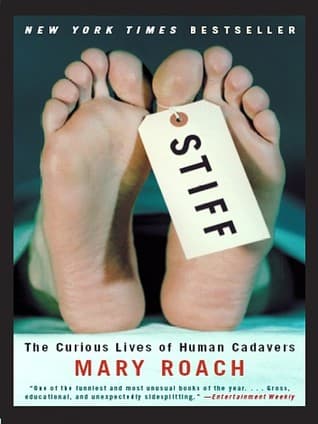
- Stiff: The Curious Lives of Human Cadavers
Mary Roach
4.1 (172k) average on GoodreadsHistoryBoth books explore morbid topics with a blend of humor, scientific curiosity, and engaging anecdotes, making the macabre accessible and entertaining.
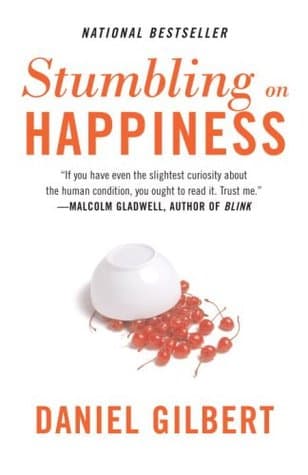
- Stumbling on Happiness
Daniel Todd Gilbert
3.8 (53k) average on GoodreadsBusinessWhile Northcutt focuses on individuals making fatal errors, Gilbert's "Stumbling on Happiness" explores the broader human tendency for misprediction and cognitive biases that lead to less severe, but still significant, errors in judgment about what will make us happy. Both authors use accessible language to dissect human irrationality, but Gilbert draws more directly on experimental psychology to explain why we err, whereas Northcutt presents the results of extreme error. Gilbert's work is more academically grounded, providing theoretical frameworks for the kind of flawed thinking that underpins many Darwin Award scenarios.
- The Diary of a Young Girl
Anne Frank
4.2 (2.7M) average on GoodreadsBiographyDuring the Nazi occupation, a teenage girl's diary, written from a secret annex, shares observations on humanity, hope, and the wait for freedom.
- Twisted 1. Twisted love
Ana Huang
3.7 (1.7M) average on GoodreadsA quiet billionaire with a difficult past finds his guarded heart opening to the woman he must protect, but their growing passion uncovers dangerous secrets and a shared, traumatic history.
- Eat, Pray, Love
Elizabeth Gilbert
3.6 (1.5M) average on GoodreadsLifestyleA heartbroken writer leaves her conventional life for a year-long global search for pleasure in Italy, spiritual devotion in India, and unexpected love and balance in Bali.
- Night
Elie Wiesel
4.3 (970k) average on GoodreadsBiographyIn the darkness of Auschwitz and Buchenwald, a teenage Elie Wiesel faces the extermination of his family, the loss of his faith, and the lasting scars of humanity's deepest cruelty.




Enjoyed the summary?
A summary gives you the shape of the book. The book itself has the detail, the examples and the voice.
Find The Darwin Awards Countdown to Extinction on AmazonAs an Amazon Associate, BookBrief earns from qualifying purchases. How we're funded