
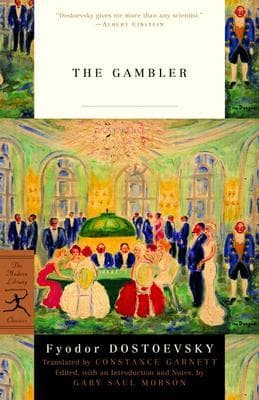
Synopsis
Covers the whole plot, including the ending.
- Difficulty
- Medium
- Pacing
- Moderate
- Mood
- Dark, Obsessive, Intense, Dramatic
- Read it if
- You enjoy deep psychological dives into obsession and addiction, particularly within a historical European setting, and appreciate complex, morally ambiguous characters.
- Skip it if
- You prefer lighthearted stories with clear moral protagonists or dislike narratives focused on self-destructive behavior and unrequited love.
The Gambler Plot Summary
Covers the whole plot, including the ending.
Arrival in Roulettenburg and the General's Precarious Position
Alexey Ivanovitch, a young, poor tutor, arrives in Roulettenburg, a German spa town. He lives in the household of the General Zagoryansky, who is old and financially ruined. The General is deeply in debt, having mortgaged his Russian estates and borrowed a lot from Monsieur de Grieux, a rich Frenchman. His only hope is the coming death of his very wealthy, old aunt, Antonida Vasilevna Tarasevicheva, called 'Grandmother.' He expects a large inheritance from her. Everyone in the household, including the General's stepdaughter Polina Alexandrovna and de Grieux, waits for news from Moscow about Grandmother's health. Her death would solve their money problems and let the General marry Mademoiselle Blanche de Cominges, a young Frenchwoman he likes.
Polina's Enigmatic Hold and Alexey's Obsession
Alexey is deeply, even masochistically, in love with Polina Alexandrovna, the General's stepdaughter. Polina, a proud and mysterious woman, treats Alexey with disdain and unexpected closeness. She often uses him for her own needs. She challenges him, tests his devotion, and even tells him to do humiliating things, which he does because of his intense love. Early in the novel, Polina tells Alexey to go to the casino and gamble for her, giving him a small amount of money. She is interested in gambling, perhaps to escape her own desperate situation, which includes owing money to de Grieux. Alexey's first tries at the roulette table involve some beginner's luck and a growing interest in the game, even as he loses the money she gave him.
The Arrival of Grandmother and the Household's Despair
To the shock of everyone in the household, the very wealthy and supposedly dying Grandmother arrives in Roulettenburg. She is not dead, but very much alive and full of energy, with her own group of people. Her unexpected arrival ruins the General's and Blanche's plans, as the expected inheritance is no longer coming soon. Grandmother, a smart and independent woman, immediately sees through the General's money schemes and Blanche's desire for money. She dislikes their greed and the General's overly polite behavior. Her arrival creates chaos in the household and makes their money worries worse, as she immediately starts to show her authority and criticize their way of life.
Grandmother's Gambling Spree and Devastating Losses
The General's household is further amazed and scared when Grandmother, despite her first dislike of gambling, feels drawn to the roulette table. She starts to gamble, at first winning a lot, which makes her new addiction stronger. She then loses huge amounts of money, day after day, in a reckless way, ignoring all pleas and warnings from her relatives and advisors. Her vast fortune quickly shrinks, and she eventually has to return to Russia, having lost much of her wealth, though still having enough to live comfortably. Her gambling spree completely destroys the General's hopes of an inheritance and leaves him in an even worse financial state.
Polina's Debt and Alexey's Desperate Act
After Grandmother leaves and the General's financial hopes are gone, Polina tells Alexey how desperate her situation is: she owes a lot of money to Monsieur de Grieux, who holds her promissory notes. Feeling trapped and shamed, she tells Alexey to win money for her at the roulette table, giving him a small amount to start. Driven by his obsessive love for her and a wish to prove himself, Alexey goes to the casino. In a feverish state, he has an amazing run of luck, winning a huge sum of money – 200,000 francs – through a mix of intuition and risky bets. He returns to Polina, putting the money at her feet.
Polina's Rejection and Alexey's Downward Spiral
Despite Alexey's win, Polina reacts with unexpected coldness and disgust. She throws the money back at him, saying he sees her as an object to be bought and showing her contempt for his gambling. She admits her love for de Grieux, who has since left her. Ashamed and heartbroken, Alexey is left with the large sum of money. In despair, he falls into the hands of Mademoiselle Blanche de Cominges. She now realizes Alexey is rich and seduces him. Alexey spends a lavish three weeks with Blanche, traveling to Paris and spending most of his money on luxury and gifts, letting himself be used. He knows Blanche cares only for money but is too lost to care.
Blanche's Betrayal and Alexey's Penniless Return
Blanche, having taken most of Alexey's winnings, eventually tires of him and his shrinking money. She plans a final betrayal by marrying the General, who, despite his earlier financial ruin, has secured a small inheritance or settlement. This makes him a more stable, though still poor, option than Alexey. Alexey is left almost penniless and abandoned by Blanche. The short, pleasure-seeking time ends, leaving him alone, without purpose, and with only a few florins. This experience pushes him into the life of a professional gambler, without his earlier romantic hopes.
Encounter with Mr. Astley and Reflection on His Fate
Months later, Alexey, now a poor professional gambler, meets Mr. Astley, a quiet and honorable Englishman who had observed him in Roulettenburg. Astley, who always showed a quiet understanding of Alexey's situation and concern for Polina, gives Alexey some money and tries to offer advice. Alexey admits he is completely absorbed in gambling, saying it is his only purpose and passion, a state where all other desires and feelings have disappeared. He thinks about his ruined life, his lost love for Polina, and how completely the roulette table controls him. He knows he has fallen but also feels a strange freedom in his addiction.
Polina's Fate and Astley's Revelation
Mr. Astley tells Alexey that Polina is in Paris, living in poverty and illness, abandoned by de Grieux. She is in a desperate state, physically and emotionally broken. Astley also suggests that Polina, despite her earlier rejection, still cares for Alexey and perhaps loves him. He says her first coldness and rejection of his money were due to her pride and her inability to accept help from someone she felt she had wronged or who had seen her at her lowest. This news brings a flicker of hope and renewed love in Alexey, briefly pulling him out of his gambling state.
A Glimmer of Hope and the Inevitable Return to the Table
Inspired by Astley's words and the thought of Polina, Alexey feels a brief return of his old self, imagining a way to improve his life and a future with her. He dreams of escaping gambling and becoming a 'man' again. However, this hope is short-lived. Despite his new resolve, the strong pull of the roulette table is too much. He finds himself drawn back to the casino, unable to resist the game. The novel ends with Alexey still caught in the gambling cycle, holding onto the idea that 'tomorrow, tomorrow everything will be over,' even as he continues to lose, always chasing the elusive big win.
Principal Figures
Alexey Ivanovitch
Protagonist
An impoverished tutor consumed by gambling addiction and obsessive love.
Alexey is the first-person narrator, a young, intelligent but deeply flawed Russian tutor. He is characterized by his intense, almost masochistic, love for Polina Alexandrovna, which borders on obsession. He is proud yet prone to humiliation, and possesses a sharp, cynical intellect that he often turns on himself and others. His defining trait is his rapid descent into gambling addiction, which he initially approaches with a mix of intellectual curiosity and desperation, but which quickly becomes an all-consuming passion, overriding all other aspects of his life, including his love and self-respect. He is a keen observer of human nature, particularly its darker aspects, and offers a psychological portrait of addiction.
Relationships: Polina Alexandrovna (Obsessive, unrequited love; master-servant dynamic); The General (Employer-employee; Alexey often mocks and despises him); Mademoiselle Blanche de Cominges (Brief, transactional, and exploitative affair); Mr. Astley (Confidant; a source of moral observation and quiet support)
Polina Alexandrovna
Supporting
The General's proud and enigmatic stepdaughter, the object of Alexey's obsessive love.
Polina is a complex and enigmatic character, proud, intelligent, and often cruel, yet also vulnerable and desperate. She holds a strange power over Alexey, subjecting him to humiliations and demanding his obedience, which he readily gives due to his intense love. She is deeply indebted to Monsieur de Grieux and is trapped by her financial circumstances and social pride. Her relationship with Alexey is one of manipulation and emotional torment, though she may harbor some genuine affection for him, expressed through her later despair. She represents a form of unattainable desire for Alexey and a catalyst for his gambling.
Relationships: Alexey Ivanovitch (Object of his obsessive love; her tormentor and confidante); The General (Stepdaughter; often at odds with his schemes); Monsieur de Grieux (Lover and creditor; later abandons her)
The General Zagoryansky
Supporting
An aging, debt-ridden Russian general, obsessed with wealth and social standing.
The General is a pathetic figure, a once-proud but now financially ruined Russian aristocrat. He is deeply in debt, having squandered his wealth and mortgaged his estates. His primary motivation is to secure an inheritance from his wealthy aunt, Grandmother, and marry Mademoiselle Blanche de Cominges to restore his social standing and finances. He is vain, pompous, and easily manipulated, particularly by Blanche. His desperation and lack of self-awareness make him a figure of ridicule and pity, embodying the decaying Russian aristocracy and its attempts to maintain appearances.
Relationships: Alexey Ivanovitch (Employer; Alexey views him with contempt); Polina Alexandrovna (Stepdaughter; often ignores her needs); Grandmother (Aunt; his source of hoped-for inheritance); Mademoiselle Blanche de Cominges (Object of his infatuation; his eventual wife)
Antonida Vasilevna Tarasevicheva ('Grandmother')
Supporting
The General's formidable, wealthy, and unexpectedly lively aunt.
Grandmother is a powerful and eccentric figure, a wealthy and independent Russian matriarch. Despite being old and supposedly near death, she arrives in Roulettenburg full of vitality and shrewdness, immediately seeing through the mercenary motives of the General and Blanche. She is proud of her Russian heritage and disdainful of European decadence. In a shocking turn, she succumbs to the allure of roulette, losing a significant portion of her fortune with reckless abandon. Her character provides both comic relief and a stark illustration of the universal susceptibility to gambling addiction, regardless of status or age.
Relationships: The General (Nephew; she despises his greed and weakness); Alexey Ivanovitch (Initially views him as an intelligent Russian)
Mademoiselle Blanche de Cominges
Supporting
A beautiful, calculating French adventuress and fortune-hunter.
Blanche is a beautiful, young Frenchwoman who is purely mercenary in her motivations. She attaches herself to the General in hopes of securing his anticipated inheritance. She is charming, manipulative, and entirely self-serving. When Alexey unexpectedly wins a fortune, she quickly shifts her attention to him, exploiting his despair and infatuation to extract his money. She represents the superficiality and moral decay of the European society Alexey observes. Her actions highlight the transactional nature of relationships driven by greed and social climbing.
Relationships: The General (Fiancée; later wife, for his money); Alexey Ivanovitch (Brief, exploitative mistress)
Monsieur de Grieux
Supporting
A wealthy, manipulative French nobleman and creditor.
Monsieur de Grieux is a wealthy and seemingly refined Frenchman, but beneath his polished exterior lies a calculating and somewhat sinister character. He is the General's primary creditor and holds Polina's promissory notes, giving him significant power over both. He is a rival for Polina's affections, and though she claims to love him, he ultimately abandons her when her financial situation deteriorates. He embodies the manipulative and self-interested aspects of the European upper class, contrasted with the more chaotic and passionate nature of the Russians in the novel.
Relationships: Polina Alexandrovna (Lover and creditor; later abandons her); The General (Creditor)
Mr. Astley
Supporting
A quiet, observant Englishman who offers Alexey a moral compass.
Mr. Astley is a reserved and honorable Englishman who quietly observes the chaotic events in Roulettenburg. He seems to be genuinely concerned for Polina and Alexey, acting as a moral counterpoint to the other characters' greed and desperation. He is a voice of reason and practicality, and later provides Alexey with assistance and news of Polina. His character represents a sense of stability and integrity amidst the moral degradation and recklessness of the other characters, particularly the Russians and the French.
Relationships: Alexey Ivanovitch (Confidant; offers advice and assistance); Polina Alexandrovna (Quietly concerned for her well-being)
The Baron and Baroness Wurmerhelm
Mentioned
Minor German aristocrats who serve as a symbol of the rigid European social order.
The Baron and Baroness Wurmerhelm are minor characters who represent the rigid, class-conscious German aristocracy. Alexey's deliberate insult to the Baroness by bumping into her is an act of rebellion against the perceived arrogance and social hierarchy he despises. They symbolize the established order and the social constraints that Alexey, in his rebellious nature, seeks to defy, albeit often in self-destructive ways.
Themes & Insights
Addiction and Self-Destruction
The main theme is Alexey's all-consuming gambling addiction. It changes him from a passionate person into a dehumanized machine. The novel shows how gambling controls the mind, replacing love, ambition, and self-respect. Alexey’s first interest in the game, his exciting moments, and his certain losses show the destructive cycle of addiction. Even Grandmother, a strong character, falls to its appeal, showing its power. The addiction becomes a way to destroy himself, as Alexey chooses the roulette table over any chance of improving his life or being happy with Polina. This shows a deep spiritual and moral decline.
“What is roulette? A game of chance, that's all. And what does it mean to me? My whole life!”
Love, Obsession, and Humiliation
Alexey's love for Polina is not just romantic; it is an intense obsession mixed with a desire for humiliation. He enjoys her power over him and her cruel demands, finding a strange pleasure in his own degradation. This unhealthy dynamic shows a deeper psychological need in Alexey, perhaps a wish to escape his own responsibility or to feel intense emotion. Polina, in turn, uses her power over him, but also struggles with her own pride and vulnerability. Their relationship is a study of power dynamics, unrequited desire, and the destructive side of obsessive love.
“I loved her to distraction, but I could not help hating her at times. She knew it all, and perhaps that was why she loved me.”
National Identity and Class Conflict
The novel explores the differences between Russian and European (especially French and German) national traits and class systems. Alexey, though often critical of other Russians, also feels a strong, though confused, Russian pride. He compares it to the perceived greed and superficiality of the French (de Grieux, Blanche) and the strict, overly formal nature of the Germans (the Baron and Baroness Wurmerhelm). The General's desperate attempts to keep up a European appearance while being financially ruined, and Grandmother's first dislike of European customs before she starts gambling, show these tensions. Alexey's gambling itself can be seen as a chaotic, passionate Russian reaction to the orderly, calculating European world.
“The German is a miser, but a miser in his own way, a right and proper way. He saves up for a rainy day, he builds up his fortune by his own labor, he's a good father and a good citizen. We Russians, on the other hand, just want everything all at once, in a moment, without any labor.”
The Illusion of Free Will and Fate
Throughout Alexey's gambling, there is a constant connection between his belief in luck, intuition, and fate, and the brief times he feels he can control his future. He often credits his wins and losses to an almost mystical 'system' or to pure chance, rather than to logical choices. This brings up a deeper philosophical question about free will versus predetermined fate. His repeated returns to the table, even though he knows the bad outcome, suggest he lacks true control, as if he is forced by an outside power or an inner need he cannot overcome. The novel questions how much control people truly have over their lives, especially when consumed by passion or addiction.
“Why, I asked myself, should I not try my luck? What if it is my turn now? Why should I not begin to win?”
Money and Morality
Money is a constant force in 'The Gambler,' driving almost every character's actions and relationships. The General's entire life is about getting an inheritance, Blanche's affections are purely for money, and Polina is trapped by her debts. The search for wealth often leads to moral compromises and degradation, as characters scheme, manipulate, and betray each other for money. Alexey's first desire for money is connected to winning Polina's love, but as his addiction grows, money becomes an abstract score, a way to keep gambling, separate from its real value. The novel clearly shows how an obsession with money can corrupt human relationships and values.
“Money, money, money! Money is everything, and without money, no one is anything.”
Plot Devices & Literary Techniques
First-Person Narration (Unreliable Narrator)
Alexey's subjective and often self-deceptive account of events.
The story is told entirely from Alexey Ivanovitch's perspective, providing intimate access to his thoughts, emotions, and rationalizations. However, Alexey is an unreliable narrator, deeply immersed in his gambling addiction and obsessive love. His perceptions are colored by his passions, self-pity, and occasional grandiosity. This device allows Dostoevsky to explore the psychological depths of addiction and obsession, showing the reader the internal justifications and distorted reality of a gambler, while also hinting at truths that Alexey himself might not fully acknowledge, such as his masochism or the true nature of his relationships.
The Roulette Table as a Metaphor
Symbol of fate, chance, and the human condition.
The roulette table is more than just a setting; it functions as a powerful metaphor for life itself, for fate, and for the human desire to control the uncontrollable. It represents the ultimate test of character, where individuals confront their greed, fear, hope, and despair. For Alexey, it becomes a world unto itself, a microcosm where all other realities fade. The spinning wheel and the ball symbolize the unpredictable nature of existence, while the players' reactions to wins and losses expose their deepest psychological flaws and moral weaknesses. It is the crucible where characters' true natures are revealed and often destroyed.
The 'Roulettenburg' Setting
A fictional spa town embodying moral decay and international tensions.
The fictional German spa town of Roulettenburg serves as a concentrated, almost theatrical, setting for the novel's conflicts. It is a place where people from different nationalities and classes converge, stripped of their usual social constraints, all drawn by the lure of gambling and quick money. The town, with its casinos and hotels, becomes a hotbed of moral decay, financial desperation, and social hypocrisy. It allows Dostoevsky to bring together diverse characters and highlight their national characteristics and class struggles in a confined, intense environment, away from their home countries where their actions might be more restrained.
Sudden Reversals of Fortune (Peripeteia)
Unexpected plot twists that drive the narrative and reveal character.
The novel is punctuated by dramatic and often ironic reversals of fortune. The most significant is Grandmother's unexpected arrival, shattering the General's hopes for an inheritance, followed by her own shocking descent into gambling and massive losses. Alexey's own sudden winning of a fortune, only to lose it quickly, is another key reversal. These peripeteia not only propel the plot forward but also serve to expose the true character of the individuals involved, highlighting their greed, desperation, and the fickle nature of luck and fate. They underscore the precariousness of their existence and the illusions they cling to.
The Gambler Quotes
“The main thing is to keep on playing.”
“Roulette is simply made for Russians.”
“If you want to ruin yourself, do it in a first-class way.”
“I am a gambler; I have felt that passion since my childhood.”
“Money is secondary; the main thing is the game itself.”
“A man will sometimes be drawn to ruin as if by some mysterious force.”
“Love is a game too, and a dangerous one.”
“The greatest pleasure is not in winning but in playing.”
“I lost everything, but I felt free.”
“In gambling, the only certainty is uncertainty.”
“Passion consumes reason, and we are left with nothing but the thrill.”
“To gamble is to court disaster with a smile.”
“We are all slaves to our desires, some more than others.”
“The wheel turns, and with it, our fortunes and our souls.”
Quiz
10 questions on the plot and the characters. Each answer comes with a short explanation.
Question 1
What is Alexey Ivanovitch's occupation at the beginning of the novel?
- A professional gambler
- A tutor in the general's household
- A Russian army officer
- A wealthy landowner
Show answer
B. A tutor in the general's household Alexey starts as a tutor working for the Russian general, which places him in a subordinate position that fuels his desire to break through social barriers, ultimately leading to his gambling addiction.
Question 2
Who is Polina in relation to the general?
- His daughter
- His wife
- His niece
- His sister
Show answer
C. His niece Polina is the general's niece, described as cruel yet seductive, and her affair with Alexey intensifies his psychological turmoil and gambling spiral.
Question 3
What does Alexey initially try to break through in Russian society?
- The legal system
- The wall of the established order
- The gambling laws
- The military hierarchy
Show answer
B. The wall of the established order Alexey aims to overcome the rigid social hierarchy ('the wall of the established order'), but this ambition leads him into gambling as a misguided means of achieving freedom and status.
Question 4
How does Dostoevsky characterize Alexey's gambling addiction?
- As a temporary distraction
- As an endless downward spiral
- As a profitable venture
- As a controlled hobby
Show answer
B. As an endless downward spiral The addiction is depicted as an 'endless downward spiral,' emphasizing its destructive and inescapable nature, which traps Alexey psychologically and financially.
Question 5
What role does Polina play in Alexey's descent into gambling?
- She discourages him from gambling
- She provides financial support for his bets
- Her affair with him accentuates his addiction
- She introduces him to gambling
Show answer
C. Her affair with him accentuates his addiction Polina's cruel and seductive nature, combined with their affair, deepens Alexey's emotional instability, making gambling a compulsive outlet for his passions and frustrations.
Question 6
Which term best describes the general's demeanor towards Alexey?
- Friendly and supportive
- Indifferent and aloof
- Imperious and domineering
- Mentoring and kind
Show answer
C. Imperious and domineering The general is described as 'imperious,' highlighting his authoritative and overbearing attitude, which contributes to the oppressive social environment Alexey rebels against.
Question 7
What is a key psychological aspect Dostoevsky explores through Alexey's character?
- The joy of winning at gambling
- The struggle with addiction and self-destruction
- The benefits of social climbing
- The simplicity of rural life
Show answer
B. The struggle with addiction and self-destruction Dostoevsky creates a 'stunning psychological portrait' of Alexey, focusing on his internal battle with addiction, obsession, and the self-destructive impulses that drive his gambling.
Question 8
In what way does the setting of the general's household influence the plot?
- It provides a peaceful escape from gambling
- It symbolizes the rigid social order Alexey tries to break
- It is where Alexey learns to gamble professionally
- It serves as a gambling den for the characters
Show answer
B. It symbolizes the rigid social order Alexey tries to break The household represents the established Russian social hierarchy ('the wall of the established order'), creating the oppressive context that motivates Alexey's rebellious and ultimately destructive actions.
Question 9
How does Dostoevsky use the romance between Alexey and Polina to enhance the drama?
- By making it a source of financial stability for Alexey
- By depicting it as a healthy relationship that curbs his addiction
- By intertwining it with Alexey's gambling to heighten emotional stakes
- By using it to criticize Russian marriage customs
Show answer
C. By intertwining it with Alexey's gambling to heighten emotional stakes The intense and tumultuous affair with Polina is closely linked to Alexey's gambling, adding layers of passion, manipulation, and despair that drive the novel's dramatic tension and psychological depth.
Question 10
What broader social critique is implied through Alexey's story?
- The efficiency of the Russian military
- The dangers of rural isolation
- The corrupting influence of the established social order
- The benefits of gambling for economic mobility
Show answer
C. The corrupting influence of the established social order Alexey's attempt to break through the rigid social structure leads to his downfall, suggesting that the oppressive 'established order' in Russia fosters destructive behaviors like addiction, as individuals seek escape or advancement.
The Gambler FAQ
What is 'The Gambler' by Fyodor Dostoyevsky about?
'The Gambler' follows Alexey Ivanovitch, a young tutor in the household of a Russian general, who attempts to challenge the rigid social order but becomes ensnared in a destructive gambling addiction. His descent is intensified by a tumultuous affair with Polina, the general's cruel yet captivating niece, leading to a psychological exploration of obsession and ruin.
Why should I read 'The Gambler'?
You should read 'The Gambler' for its intense psychological depth, as Dostoyevsky masterfully portrays addiction and social desperation through Alexey's spiral. The novel's dark romance with Polina and its critique of Russian aristocracy offer a compelling, dramatic narrative that remains relevant to themes of compulsion and human frailty.
What is the background/setting of 'The Gambler'?
The novel is set in the mid-19th century, primarily in the fictional German spa town of Roulettenburg, where the Russian general's household resides. This setting reflects the opulence and moral decay of the Russian aristocracy abroad, with casinos serving as the backdrop for Alexey's gambling obsession and social struggles.
What are the most memorable quotes from 'The Gambler'?
Memorable quotes include Alexey's declaration, 'I am a gambler; I have been a gambler all my life,' highlighting his fatalistic addiction, and his reflection on Polina, 'She is my ruin, but I cannot live without her,' capturing the destructive allure of their relationship. These lines underscore the novel's themes of compulsion and emotional entanglement.
What writing style does Dostoyevsky use in 'The Gambler'?
Dostoyevsky employs a fast-paced, first-person narrative through Alexey's perspective, using stream-of-consciousness techniques to convey his psychological turmoil. The style is dramatic and intense, with sharp dialogue and vivid descriptions of gambling scenes, immersing readers in the protagonist's addictive mindset and the novel's tense atmosphere.
What minor details add significant meaning in 'The Gambler'?
Minor details like the general's constant financial dependence on his wealthy aunt and the repetitive descriptions of roulette wheels symbolize the cyclical nature of debt and addiction. Alexey's meticulous tracking of bets and losses mirrors his obsessive personality, subtly reinforcing the novel's critique of chance and control.
What are some subtle foreshadowing moments in 'The Gambler'?
Early scenes where Alexey describes gambling as 'a fever' and Polina's manipulative behavior hint at his impending downfall. The general's anxiety over his aunt's health foreshadows the financial crises that drive Alexey to risk everything, subtly setting the stage for the novel's climax of loss and desperation.
What unexpected character connections exist in 'The Gambler'?
Unexpected connections include the general's reliance on Alexey for tutoring while simultaneously undermining him, and Polina's dual role as both a romantic interest and a catalyst for Alexey's ruin. These intertwined relationships highlight the power dynamics and mutual dependencies that fuel the novel's conflicts.
What are unspoken character motivations in 'The Gambler'?
Alexey's unspoken motivation is a desire for social mobility and escape from his tutor status, which drives his gambling as a misguided means to wealth. Polina's cruelty masks a deeper need for control and validation, stemming from her precarious position in the general's household, influencing her manipulative actions.
What psychological complexities do characters exhibit in 'The Gambler'?
Alexey exhibits a split self, torn between rational awareness of his addiction and compulsive behavior, while Polina displays a mix of vulnerability and cruelty, using her allure to dominate others. The general's pride and financial desperation reveal the psychological toll of maintaining aristocratic appearances in decline.
What are the major emotional turning points in 'The Gambler'?
Major turning points include Alexey's first major gambling win, which fuels his addiction, and his confrontation with Polina after she rejects him, deepening his despair. The death of the general's aunt and the subsequent financial collapse serve as a climax, pushing Alexey into a final, ruinous gambling spree.
How do relationship dynamics evolve in 'The Gambler'?
Alexey and Polina's relationship evolves from a seductive affair to a toxic dependency, with Polina's cruelty escalating as Alexey's gambling worsens. The general's authority diminishes as his financial troubles mount, shifting power dynamics within the household and highlighting the instability of social hierarchies.
Which parts of 'The Gambler' remain ambiguous or open-ended?
The ending is ambiguous, as Alexey's fate after his final losses is left unclear, leaving readers to ponder whether he finds redemption or further ruin. Polina's ultimate motivations and future are also unresolved, adding to the novel's exploration of uncertain human destinies and the lingering effects of addiction.
What are controversial scenes or decisions in 'The Gambler'?
Controversial scenes include Alexey's reckless gambling with money meant for the general's debts, risking others' livelihoods for his addiction. Polina's cruel treatment of Alexey, such as demanding he humiliate himself, sparks debate over whether she is a victim or perpetrator in their destructive relationship.
'The Gambler' ending explained: how it ends & what it means
The novel ends with Alexey losing everything in a final gambling binge, left in a state of despair and isolation. This conclusion symbolizes the inescapable cycle of addiction and the futility of seeking freedom through chance, suggesting that true liberation requires confronting one's inner demons rather than external risks.
About the author

Fyodor Mikhailovich Dostoevsky, sometimes transliterated as Dostoyevsky, was a Russian novelist, short story writer, essayist and journalist. Numerous literary critics regard him as one of the greatest novelists in all of world literature, as many of his works are considered highly influential masterpieces.
Similar books
- Notes from Underground
Fyodor Dostoevsky
4.2 (84k) average on GoodreadsPsychologyExplores psychological torment and alienation with an unreliable narrator.
- The Master And Margarita
Mikhail Bulgakov
4.3 (243k) average on GoodreadsFantasyOffers a satirical look at society with elements of the absurd and morally complex characters, though with a different tone.
- Dubliners
James Joyce
3.9 (123k) average on GoodreadsLiterary FictionWhile distinct in style and setting, Joyce's 'Dubliners' offers a compelling comparison in its focus on psychological realism and the portrayal of characters trapped by their circumstances and internal weaknesses. Both works use a series of vignettes (or, in 'The Gambler's' case, a focused narrative) to expose the 'paralysis' of their protagonists. However, Dostoevsky's work delves more deeply into the active self-destruction and frenzied obsession, whereas Joyce often depicts a more passive, albeit profound, spiritual and emotional stagnation. 'The Gambler' is a more direct plunge into the mind of an addict, while 'Dubliners' presents a broader, more melancholic societal portrait.
- To Kill a Mockingbird
Harper Lee
4.3 (4.5M) average on GoodreadsHistorical FictionIn the 1930s Jim Crow South, Harper Lee writes about racial injustice, moral growth, and the quiet courage of a lawyer father, Atticus Finch, as seen through his young daughter's eyes.
- The Great Gatsby
F. Scott Fitzgerald
3.9 (3.8M) average on GoodreadsHistorical FictionIn the opulent Roaring Twenties, a mysterious millionaire's lavish parties hide his desperate, tragic pursuit of a lost love, exposing the emptiness within the American Dream.
- Pride and Prejudice
Jane Austen
4.3 (3M) average on GoodreadsHistorical FictionIn a society focused on status and money, Elizabeth Bennet navigates love and pride, challenging Mr. Darcy and social expectations to find true affection.





Enjoyed the summary?
A summary gives you the shape of the book. The book itself has the detail, the examples and the voice.
Find The Gambler on AmazonAs an Amazon Associate, BookBrief earns from qualifying purchases. How we're funded