
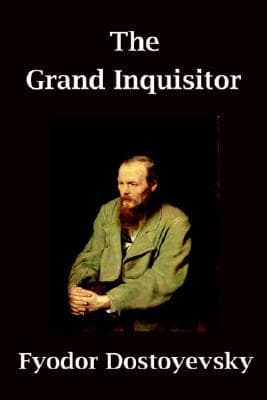
Synopsis
Covers the whole plot, including the ending.
- Difficulty
- Hard
- Pacing
- Slow
- Mood
- Thought-provoking, intense, contemplative, challenging
- Read it if
- You enjoy deep philosophical discussions on free will, faith, authority, and human nature. You appreciate allegorical narratives and are interested in exploring complex moral dilemmas. You're looking for a concise but profound work that challenges conventional spiritual thought.
- Skip it if
- You prefer fast-paced plots with clear action and resolution. You dislike long monologues and abstract philosophical debates. You are not interested in religious or spiritual themes, or find them challenging.
The Grand Inquisitor Plot Summary
Covers the whole plot, including the ending.
The Setting: Seville in the 16th Century
The story begins in Seville, Spain, during the height of the Inquisition, specifically during a 'terrible auto-da-fé' where many heretics were burned. In this time of religious fervor and fear, Jesus Christ quietly returns among the people. They immediately recognize Him and are drawn to Him, seeking healing and comfort. He performs miracles, healing a blind man and raising a child from the dead, just as in the Bible. His presence brings instant peace and joy to the suffering crowds, who understand who He is despite His silence. However, the Church authorities quickly notice this divine return.
The Arrest of Jesus
As Jesus walks through the cathedral square, performing miracles and silently blessing the crowd, the ninety-year-old Grand Inquisitor watches. He is a tall, gaunt man with 'deep-sunken eyes.' He observes the people's adoration and Jesus's actions with a stern face. Without speaking, he points at Jesus, and the Inquisition guards immediately arrest Him. The crowd, despite their earlier reverence, is too afraid of the Inquisitor to resist. Jesus is taken to a dark, solitary prison cell, His arrest a swift and silent display of the Church's power against the very figure it claims to serve.
The Midnight Confrontation
Later that night, the Grand Inquisitor enters Jesus's cell alone. He locks the door behind him, leaving them in near darkness, lit only by a small, flickering lamp. The Inquisitor begins a long, passionate speech, addressing Jesus directly but receiving no reply. Jesus remains silent throughout, listening to the Inquisitor's accusations and justifications. Jesus's silent presence intensifies the Inquisitor's verbal attack, making their one-sided conversation a deep philosophical debate about freedom, faith, and human nature. The Inquisitor's arguments defend the Church's actions and criticize Christ's original message.
The Three Temptations Revisited
The Inquisitor's main argument centers on the three temptations in the wilderness, which he sees as a turning point for humanity. He accuses Jesus of rejecting the three things that could have ensured human happiness: bread, miracles, and authority. By refusing to turn stones into bread, Jesus denied people material security. By refusing to jump from the temple and be saved by angels, He denied them a clear display of faith. By refusing earthly kingdoms, He denied them unified, absolute authority. The Inquisitor claims these rejections left humanity with an unbearable burden of freedom, leading to suffering and moral disorder, which the Church has since 'corrected' for their own good.
The Burden of Freedom
The Grand Inquisitor argues that Christ's gift of absolute freedom of choice in faith was too heavy for weak, suffering humanity. He states that people want certainty, authority, and someone to worship, rather than the difficult responsibility of individual moral decisions. According to the Inquisitor, humans are naturally weak and would rather give up their freedom for security and happiness provided by a powerful, kind (though deceptive) authority. He believes the Church, by removing this freedom and offering miracles, mystery, and authority, has served humanity's needs better than Christ's original, demanding path.
The Church's 'Correction' of Christ's Work
The Inquisitor boldly states that the Church has 'corrected' Christ's work, taking on the task of easing human suffering by removing the burden of freedom. He reveals that the Church, especially the Roman Catholic Church, secretly allied itself with the 'wise and dread spirit' (the devil) after the third temptation, accepting the earthly power Christ rejected. This alliance, he claims, allowed the Church to establish a universal kingdom based on 'miracle, mystery, and authority' – the very things Christ refused. The Church, in his view, provides the happiness and unity humanity truly wants, even if it means sacrificing truth and individual liberty. He sees the Church as a kind deceiver, guiding humanity toward happy ignorance.
The Future of Humanity Under the Church
The Grand Inquisitor imagines a future where the Church's authority brings universal peace and contentment. He describes humanity as a flock of 'weak, depraved, and rebellious' children who need constant guidance and control. Under the Church's system, they will be happy, fed, and forgiven, living without the pain of free choice. The Inquisitor believes that a select few, the 'hundred thousand' chosen ones, will bear the immense burden of knowing the truth and the deception, sacrificing their own freedom and conscience for the happiness of the masses. These leaders will suffer in silence, while the majority live in happy ignorance, accepting the 'bread' and 'miracles' offered by the Church.
The Justification for Burning Heretics
The Inquisitor connects his philosophy directly to the Inquisition's brutal practices. He justifies burning heretics, including those at the auto-da-fé that day, as necessary to maintain order and prevent the return of the 'dangerous' freedom Christ represents. He argues that by eliminating those who challenge the Church's authority or try to reintroduce individual conscience, they protect the fragile happiness and unity of the masses. The Inquisitor sees himself and his fellow 'chosen ones' as martyrs who accept the 'curse' of deception and cruelty for humanity's greater good, ensuring stability and preventing the anarchy that true freedom would unleash.
The Inquisitor's Personal Burden
Throughout his speech, the Grand Inquisitor reveals his immense personal burden and suffering in upholding this system. He sees himself not as a villain, but as a tragic figure who chose a path of 'correction' out of deep love and pity for humanity's weakness. He acknowledges the terrible deception at the heart of the Church's power but believes it is a necessary evil. He and others like him 'bear the curse' of knowing the truth while actively spreading a comforting lie. This self-awareness makes his character more complex, suggesting a man deeply convinced of his mission, even if it means sacrificing his own soul for what he sees as mankind's good.
Jesus's Silent Response
After the Inquisitor finishes his long, passionate speech, he pauses, expecting Jesus to respond. He even challenges Jesus to speak, to 'reply nothing, only go on suffering in silence.' Jesus, who has been completely silent throughout the confrontation, finally responds not with words, but with a gentle gesture. He approaches the old Inquisitor and softly kisses his 'bloodless, ninety-year-old lips.' This silent act of love and forgiveness is Jesus's only reply to the Inquisitor's complex arguments, a powerful symbol of grace and unconditional love that goes beyond all logical debate.
The Inquisitor's Reaction and Release
The kiss deeply affects the old Inquisitor. He trembles, and a 'new light' briefly appears in his eyes. Despite his initial plan to burn Jesus, this silent, loving act seems to touch his firm beliefs, at least for a moment. He then opens the prison door and tells Jesus, 'Go, and come no more… come not at all, never, never!' With that, he releases Jesus into the 'dark alleys of the city.' The Inquisitor remains alone in the cell, and the impact of the kiss and his decision is left for the reader to consider, suggesting a moment of deep internal conflict and perhaps a flicker of doubt in his long-held, cynical view.
Ivan's Conclusion and Alyosha's Reaction
Ivan Karamazov concludes his 'poem,' which he has been telling his younger brother, Alyosha. He emphasizes that the 'poem' is his own creation, reflecting his personal philosophical struggles rather than a literal historical event. Alyosha, deeply disturbed and moved by Ivan's tale, listens carefully. The story leaves him troubled, especially by the Inquisitor's arguments and their implications for faith and humanity. Alyosha, a devout novice monk, struggles to reconcile the Inquisitor's cynical practicality with his own strong belief in Christ's message of freedom and love. The 'poem' presents a central ideological conflict within 'The Brothers Karamazov.'
Principal Figures
The Grand Inquisitor
Antagonist
The ninety-year-old leader of the Spanish Inquisition.
A gaunt, ninety-year-old cardinal of the Spanish Inquisition, he is the central figure of Ivan's 'poem.' He is presented as a man of immense intellect, profound conviction, and cynical pragmatism. He believes that Christ's gift of absolute freedom was too great a burden for humanity, leading to suffering and chaos. To remedy this, he and the Church have 'corrected' Christ's work by establishing a system based on 'miracle, mystery, and authority,' offering humanity security and happiness in exchange for their freedom. He sees himself as a benevolent deceiver, bearing the curse of knowing the truth while sacrificing his own conscience for the masses' perceived good.
Relationships: Jesus Christ (Ideological opponent and prisoner); Humanity (Self-proclaimed protector and controller); The Church (Roman Catholic) (Loyal, albeit critical, servant and leader)
Jesus Christ
Protagonist
The silent, returning figure of divine love.
Jesus reappears in Seville during the Inquisition, performing miracles and silently embracing the suffering populace. His role in the 'poem' is primarily one of silent presence and symbolic action. He embodies absolute freedom, love, and spiritual truth, which stand in stark contrast to the Inquisitor's arguments for authority, control, and material security. His complete silence throughout the Inquisitor's monologue underscores the idea that divine truth transcends human logic and debate. His only direct action is the kiss, a powerful gesture of unconditional love and forgiveness that challenges the Inquisitor's cynical worldview.
Relationships: The Grand Inquisitor (Prisoner and silent recipient of accusations); Humanity (Savior and giver of spiritual freedom)
Ivan Karamazov
Narrator/Philosopher
The intellectual brother who recounts the 'poem.'
Ivan is the creator and narrator of 'The Grand Inquisitor' within 'The Brothers Karamazov.' He is a highly intelligent, tormented atheist who grapples with profound philosophical questions concerning faith, suffering, freedom, and morality. The 'poem' serves as a vehicle for him to express his own internal struggles and doubts about God's justice and the nature of humanity. He uses the Inquisitor's voice to articulate a powerful argument against Christ's vision of freedom, reflecting his own intellectual rebellion against traditional faith and his despair over human weakness and suffering.
Relationships: Alyosha Karamazov (Brother and audience for his philosophical ideas)
Alyosha Karamazov
Supporting
The devout brother who listens to Ivan's 'poem.'
Alyosha is Ivan's younger brother and a devout novice monk. He serves as the primary audience for Ivan's 'poem' and represents the perspective of pure, unshakeable faith and spiritual love. He is deeply affected and disturbed by the Inquisitor's arguments, struggling to reconcile the cynical pragmatism presented with his own understanding of Christ's message. His reactions and occasional interjections highlight the profound ideological conflict at the heart of the narrative. He embodies the simple, direct faith that the Inquisitor believes humanity is too weak to sustain.
Relationships: Ivan Karamazov (Brother and recipient of philosophical challenges)
The People of Seville
Supporting
The suffering masses who crave miracles and authority.
The common people of Seville represent the 'weak and suffering' humanity that the Grand Inquisitor claims to protect. They are depicted as initially overjoyed by Jesus's return and miracles, eagerly seeking His blessing. However, their fear of the Inquisition's power quickly overrides their devotion, as they remain passive when Jesus is arrested. They embody the Inquisitor's belief that humanity prioritizes material security, comfort, and external authority over the demanding burden of spiritual freedom. They are the 'flock' that the Inquisitor believes needs to be guided and controlled for their own happiness.
Relationships: Jesus Christ (Object of initial adoration); The Grand Inquisitor (Feared authority figure)
Themes & Insights
Freedom vs. Happiness/Security
This is the main conflict. The Inquisitor argues that humanity cannot handle the spiritual freedom Christ offers, as it causes suffering, moral disorder, and despair. He claims people would rather give up their freedom for the certainty, security, and material happiness provided by a strong, unifying authority (the Church). Christ, through His silence and actions, represents the difficult path of individual conscience and responsibility. The Inquisitor supports a system that prioritizes group contentment through control and kind deception.
“For nothing has ever been more insupportable for a man and a human society than freedom.”
The Nature of Faith and Miracles
The story explores whether faith should come from free conviction or be forced by miracles, mystery, and authority. The Inquisitor criticizes Christ for rejecting the three temptations, arguing that in doing so, He denied humanity the 'miracle, mystery, and authority' it desires. The Inquisitor believes that for the masses, true faith can only be maintained through public spectacle and unquestionable power, not inner spiritual freedom. Christ's silent presence and the simple, profound act of the kiss suggest that genuine faith comes from love and grace, not force or proof.
“Thou didst not come down from the cross when they shouted to Thee, 'Come down from the cross and we will believe in Thee.' Thou didst not come down because, again, Thou wouldst not enslave man by a miracle...”
Authority and Deception
The Inquisitor admits that the Church, in its goal to create a universal kingdom and ensure human happiness, has embraced deception and allied itself with the 'wise and dread spirit.' He argues that this deception is necessary because humanity is too weak to handle the truth of its freedom. The Church, under his leadership, takes on the burden of lying to the masses, giving them comforting myths and unquestionable authority. This theme questions whether a kind lie can be justified for the greater good, and what cost such a deception extracts from those who perpetuate it.
“We shall tell them that we are Thy servants and rule in Thy name. We shall deceive them again, for we will not let Thee come to us.”
Suffering and Compassion
Both Christ and the Inquisitor claim to act out of compassion for human suffering, but their methods are completely different. Christ offers a path that includes suffering as part of spiritual growth and freedom. The Inquisitor, however, tries to eliminate suffering by removing the burden of freedom, even if it means sacrificing truth and individual conscience. He sees himself as bearing great personal suffering by knowingly keeping a lie for the sake of human happiness. This theme explores the different forms compassion can take and the moral dilemmas in easing human pain.
“Thou didst choose what was difficult for man's sake, and therefore actedst as if Thou didst not love him at all, for Thou didst demand too much of him.”
Plot Devices & Literary Techniques
The Monologue
The Inquisitor's extended, one-sided speech.
The entire philosophical core of 'The Grand Inquisitor' is conveyed through the Inquisitor's lengthy, uninterrupted monologue. This device allows for a comprehensive and passionate articulation of his complex arguments against Christ's teachings and in defense of the Church's actions. The absence of dialogue from Jesus elevates the Inquisitor's voice, making his arguments stand alone in their intellectual force. It forces the reader to confront his reasoning directly, without immediate counter-argument, amplifying the moral and philosophical weight of his claims. The monologue is a direct challenge to the reader's own beliefs.
Silent Protagonist (Jesus)
Jesus's complete lack of verbal response.
Jesus's absolute silence throughout the Inquisitor's entire monologue is a profound plot device. It highlights the Inquisitor's arguments, forcing them to stand on their own merits without direct refutation. More importantly, it suggests that divine truth and love operate beyond the realm of human logic and verbal debate. His silence can be interpreted as an affirmation of the freedom he offers, allowing the Inquisitor (and the reader) to choose their response. His final, silent kiss becomes an even more powerful and symbolic act in the absence of any words, a gesture that transcends argument.
The Setting: Spanish Inquisition
A historical backdrop of extreme religious authority and persecution.
The choice of 16th-century Seville during the Spanish Inquisition is a crucial plot device. It provides a historical context of extreme religious zeal, unquestionable ecclesiastical authority, and brutal persecution for heresy. This setting immediately establishes the high stakes of the Inquisitor's power and the terrifying consequences of challenging the Church. It makes the Inquisitor's arguments about humanity's need for absolute authority and fear more plausible within the narrative, and starkly contrasts the Church's actions with the peaceful, loving nature of Christ's return, enhancing the ideological conflict.
Ivan's 'Poem' Framework
A story within a story, framing the philosophical debate.
The entire narrative of 'The Grand Inquisitor' is presented as a 'poem' invented and recounted by Ivan Karamazov to his brother Alyosha. This meta-narrative device allows Dostoyevsky to explore profound theological and philosophical questions without explicitly endorsing them as historical fact. It frames the Inquisitor's arguments as a product of Ivan's own intellectual struggles and despair, blurring the lines between fiction, philosophy, and personal anguish. It also provides an immediate reaction and interpretation of the 'poem' through Alyosha, allowing for a multifaceted engagement with the complex themes.
The Grand Inquisitor Quotes
“For nothing is more tempting to man than the freedom of his own conscience, and of his own chiefest good.”
“We have corrected thy work and have sent it to thee, and have asked thee not to keep thy new freedom a secret from us.”
“Dost thou not know that they will renounce God and their own souls, only to be allowed to crush those whom they should obey?”
“Three powers, three powers alone, were able to conquer at last the conscience of these weak rebels forever: miracle, mystery, and authority.”
“We have corrected thy work and have sent it to thee, and have asked thee not to keep thy new freedom a secret from us.”
“Man is a creature that is always looking for the object of its worship.”
“But if there is anything in the world which the man of today cannot stand, it is to have nobody to bow down to.”
“If Christ had not been the God, he would have lived and taken a wife and gone off to the East.”
“We have no right to give you freedom, for your own good, we have bound you and we have bound you for your own good.”
“Science will give them bread, and will again give them the responsibility for themselves, which is so terrible for them.”
“For the sake of the bread of men, they will come after you, because there is nothing more certain than bread; but whoever has bread, he will be his god.”
“But if you are to have freedom, you must have a free will. If you have a free will, you must have suffering.”
“And the more they are punished, the more they will suffer, and the more they will suffer, the more they will be punished.”
“The greatest mystery of the universe is the mystery of the human heart.”
Quiz
10 questions on the plot and the characters. Each answer comes with a short explanation.
Question 1
Who is the author of 'The Grand Inquisitor'?
- Leo Tolstoy
- Fyodor Dostoevsky
- Anton Chekhov
- Ivan Turgenev
Show answer
B. Fyodor Dostoevsky 'The Grand Inquisitor' is a part of Fyodor Dostoevsky's larger novel, 'The Brothers Karamazov'.
Question 2
In 'The Grand Inquisitor', who arrests Jesus?
- The Pope
- A Roman Emperor
- The Grand Inquisitor
- Pontius Pilate
Show answer
C. The Grand Inquisitor The central conflict of 'The Grand Inquisitor' is the arrest of Jesus by the titular Grand Inquisitor.
Question 3
What is the primary genre or field of study associated with 'The Grand Inquisitor'?
- Science Fiction
- Spirituality and Philosophy
- Historical Romance
- Political Thriller
Show answer
B. Spirituality and Philosophy 'The Grand Inquisitor' delves into profound questions about faith, freedom, and human nature, placing it firmly in the realms of spirituality and philosophy.
Question 4
The Grand Inquisitor is a section from which larger literary work?
- Crime and Punishment
- Notes from Underground
- The Brothers Karamazov
- The Idiot
Show answer
C. The Brothers Karamazov 'The Grand Inquisitor' is a famous chapter within Dostoevsky's monumental novel, 'The Brothers Karamazov'.
Question 5
What historical figure is mentioned as an example of a Grand Inquisitor who led an Inquisition?
- Martin Luther
- Tomas de Torquemada
- Galileo Galilei
- Christopher Columbus
Show answer
B. Tomas de Torquemada Tomas de Torquemada, a Dominican friar, is cited as a prominent example of a Grand Inquisitor who led the Spanish Inquisition.
Question 6
What is the primary theological and philosophical debate presented in 'The Grand Inquisitor'?
- The nature of scientific discovery
- The conflict between free will and determinism
- The tension between faith, freedom, and authority
- The ethics of political revolution
Show answer
C. The tension between faith, freedom, and authority The Inquisitor argues that humanity needs authority and miracles, not freedom, to be happy, contrasting this with Jesus's offer of free will and spiritual truth.
Question 7
The Grand Inquisitor criticizes Jesus for offering humanity something that ultimately leads to what?
- Universal happiness and peace
- Absolute knowledge and enlightenment
- Suffering and chaos
- Spiritual salvation for all
Show answer
C. Suffering and chaos The Inquisitor contends that Jesus's gift of freedom of choice, while noble, has led humanity to reject him and to embrace suffering and internal conflict.
Question 8
What does the Grand Inquisitor believe is the greatest burden for humanity?
- Poverty and hunger
- Ignorance and lack of education
- The burden of freedom and choice
- Persecution and injustice
Show answer
C. The burden of freedom and choice The Inquisitor argues that the freedom to choose, especially the freedom to reject faith, is too great a burden for most people, who crave certainty and guidance.
Question 9
According to the Grand Inquisitor's argument, what do people ultimately desire more than freedom?
- Truth and enlightenment
- Love and compassion
- Miracles, mystery, and authority
- Equality and justice
Show answer
C. Miracles, mystery, and authority The Inquisitor posits that humanity is weak and incapable of handling freedom, preferring to be led by tangible signs of power and mystery, which he believes the Church provides.
Question 10
The Grand Inquisitor's critique of Jesus's actions can be interpreted as a commentary on the historical development of which institution?
- The Roman Empire
- The Enlightenment
- The Catholic Church
- The Renaissance
Show answer
C. The Catholic Church The Inquisitor's actions and justifications are often seen as a critique of the institutionalization of religion, particularly the Catholic Church's role in wielding power and authority in the name of faith.
The Grand Inquisitor FAQ
What is 'The Grand Inquisitor' about?
'The Grand Inquisitor' is a poem within Fyodor Dostoevsky's novel 'The Brothers Karamazov'. It presents a dramatic dialogue where a Grand Inquisitor confronts Jesus, who has returned to Earth, questioning his teachings and actions.
Is 'The Grand Inquisitor' a standalone book?
No, 'The Grand Inquisitor' is not a standalone book. It is a famous chapter, often published as a separate novella for convenience, within Dostoevsky's larger novel, 'The Brothers Karamazov'.
Who is the Grand Inquisitor character?
The Grand Inquisitor is a Cardinal in Seville who represents a powerful, earthly authority. He has arrested Jesus and argues that humanity needs a strong hand to guide them, preferring security and happiness over freedom and faith.
What is the main philosophical argument in 'The Grand Inquisitor'?
The central philosophical argument revolves around the tension between freedom and happiness, faith and reason, and the nature of human will. The Inquisitor argues that Christ's gift of freedom was too burdensome for most people, who crave certainty and comfort.
What does the Grand Inquisitor criticize Jesus for?
The Grand Inquisitor criticizes Jesus for offering humanity freedom of choice, which he believes leads to suffering and sin. He argues that people desire miracles, mystery, and authority, which he and the Church provide, even at the cost of true faith.
What is the role of freedom in 'The Grand Inquisitor'?
Freedom is a pivotal theme. The Inquisitor views Christ's emphasis on free will as a cruel burden that humanity cannot bear, leading to despair. He believes providing security and happiness is a more effective form of governance, even if it means suppressing true freedom.
How does 'The Grand Inquisitor' relate to spirituality?
The work explores deep spiritual questions about the nature of faith, the role of miracles, and the relationship between divine authority and human institutions. It questions the effectiveness of Christ's message of love and freedom in the face of human weakness.
What is the significance of the Spanish Inquisition in relation to the poem?
The historical Spanish Inquisition, often associated with figures like Tomas de Torquemada, serves as a historical parallel and a symbol of the oppressive, authoritarian power that the Grand Inquisitor character embodies. It represents a human attempt to impose order and control in the name of religion.
What is the core conflict between Jesus and the Grand Inquisitor?
The core conflict is between Christ's ideal of spiritual freedom and the Inquisitor's pragmatic, albeit cynical, approach to managing humanity. Jesus represents unconditional love and faith, while the Inquisitor represents earthly power and the belief that people need to be controlled for their own good.
What are the main takeaways from reading 'The Grand Inquisitor'?
Key takeaways include reflections on the human need for certainty versus freedom, the potential dangers of unchecked religious authority, and the complex relationship between faith, reason, and human nature. It prompts readers to consider what truly makes people happy and free.
About the author

Fyodor Mikhailovich Dostoevsky, sometimes transliterated as Dostoyevsky, was a Russian novelist, short story writer, essayist and journalist. Numerous literary critics regard him as one of the greatest novelists in all of world literature, as many of his works are considered highly influential masterpieces.
Similar books
- Thus Spoke Zarathustra
Friedrich Nietzsche
4.0 (111k) average on GoodreadsPsychologyExplores complex philosophical ideas through an allegorical narrative and challenges traditional morality and religion.
- Notes from Underground
Fyodor Dostoevsky
4.2 (84k) average on GoodreadsPsychologyA deep dive into the mind of a single character, exploring themes of free will, rationality, and alienation through extensive internal monologue.
- Brave New World
Aldous Huxley
4.0 (1.4M) average on GoodreadsFantasyBoth "The Grand Inquisitor" and Brave New World explore dystopian visions where human happiness is engineered at the expense of freedom. However, Huxley's world achieves control through conditioning, drugs (soma), and technological advancements, leading to a state of blissful ignorance. Dostoevsky's Inquisitor, conversely, maintains control through spiritual authority, miracles, and the promise of collective certainty, actively acknowledging and manipulating humanity's fear of freedom and suffering. While Huxley's society is largely devoid of traditional religious struggle, Dostoevsky's directly confronts and redefines it.
- 1984
George Orwell
4.2 (3.1M) average on GoodreadsPoliticsWhile both works depict totalitarian systems, their methods and underlying philosophies differ significantly. Orwell's 1984 portrays a regime (Big Brother) that maintains power through constant surveillance, fear, torture, and the brutal suppression of thought, aiming for absolute physical and mental control. The Inquisitor, on the other hand, claims to act out of love and compassion for humanity, believing he is providing a necessary comfort and burden-free existence, even if it's based on a lie. Orwell's dystopia crushes the human spirit; Dostoevsky's Inquisitor claims to liberate it from the agony of choice, offering a 'happiness' that is arguably more insidious because it's willingly accepted.
- Eat, Pray, Love
Elizabeth Gilbert
3.6 (1.5M) average on GoodreadsLifestyleA heartbroken writer leaves her conventional life for a year-long global search for pleasure in Italy, spiritual devotion in India, and unexpected love and balance in Bali.
- Educated
Tara Westover
4.5 (796k) average on GoodreadsBiographyRaised in the Idaho mountains by fundamentalist survivalists, a young woman forges her own path to education, battling fierce family loyalty and personal demons to discover a world beyond her isolated upbringing.




Enjoyed the summary?
A summary gives you the shape of the book. The book itself has the detail, the examples and the voice.
Find The Grand Inquisitor on AmazonAs an Amazon Associate, BookBrief earns from qualifying purchases. How we're funded