
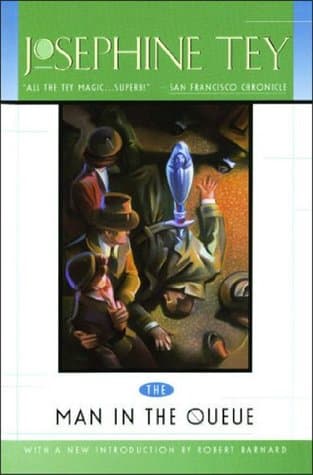
Synopsis
Covers the whole plot, including the ending.
- Difficulty
- Easy
- Pacing
- Moderate
- Mood
- Intriguing, Cerebral, Classic
- Read it if
- You enjoy classic British detective stories with a strong emphasis on puzzling clues and a clever, persistent inspector.
- Skip it if
- You prefer fast-paced thrillers or mysteries with graphic violence and modern forensic techniques.
The Man in the Queue Plot Summary
Covers the whole plot, including the ending.
The Woffington Theatre Murder
In London, a long queue waits outside the Woffington Theatre for a popular musical comedy. As the doors open and the crowd moves forward, a man named Robert Blair collapses, seemingly having fainted. A fellow queue-member, Mr. William Jenkins, tries to help him, only to find a small silver dagger in Blair's back. The immediate chaos is made worse because, despite the dense crowd, no one saw the stabbing or anyone suspicious flee. Inspector Alan Grant of Scotland Yard is called to the scene, facing a seemingly impossible crime with many potential witnesses who saw nothing.
Initial Investigation and Perplexing Clues
Inspector Grant begins his investigation, focusing on the murder weapon: a unique silver dagger with a fine design, suggesting it might be an antique or a souvenir. Robert Blair's identity is quickly confirmed by documents on him. Grant learns that Blair was an ordinary civil servant with no clear enemies or criminal ties. His landlady and colleagues offer little information about anyone who might want to harm him. The impossibility of the crime—a murder committed in daylight among a crowd without a single witness—becomes the main challenge for Grant and his team.
The Search for the Dagger's Origin
Because the dagger is unique, Grant's main inquiry focuses on its origin. He sends his officers to search antique shops, pawn brokers, and prop makers across London. This search eventually leads them to a theatrical prop maker who identifies the dagger as one of a set made for a historical play, 'The Rose and the Ring,' which had recently ended its run. This discovery provides a key link, suggesting the killer might have theatre connections or access to such props, narrowing the large group of potential suspects.
The Actor's Connection: Mr. Gilbert
Further investigation into the prop daggers shows that one was owned by an actor named Mr. Gilbert, who had a major role in 'The Rose and the Ring.' Inspector Grant interviews Gilbert, who confirms he had such a dagger for his stage performance. However, Gilbert has a solid alibi for the time of the murder, having been at a rehearsal across town. He also explains that his dagger was stolen from his dressing room several weeks prior, a theft he had not reported, thinking it a minor loss. This revelation complicates the case, indicating the killer likely got the weapon by theft.
Blair's Secret Life
While pursuing the dagger's origin, Grant's team continues to investigate Robert Blair's personal life. They find that despite his ordinary life, Blair had been secretly seeing a woman named Christine Clay, a chorus girl from the Woffington Theatre. This secret relationship introduces a potential motive that was previously missing. Grant learns that Blair and Christine had recently argued, hinting at trouble in their affair. This development shifts the investigation's focus toward the theatre's staff and Christine's acquaintances, opening a new line for suspects.
The Disappearance of Christine Clay
As Inspector Grant prepares to question Christine Clay more thoroughly about her relationship with Robert Blair and their recent argument, she mysteriously disappears. Her sudden disappearance immediately makes her a suspect, suggesting she might be the killer or deeply involved. Grant uses his resources to find her, believing she has important information. Her absence creates speculation among the theatre community and the press, adding pressure to Grant's investigation and creating a public perception that the 'chorus girl' is the main suspect, despite the lack of direct evidence.
The Search for Christine and the Railway Connection
Grant's persistent inquiries eventually reveal that Christine Clay bought a train ticket and left London shortly after Blair's murder. He carefully traces her movements, following a trail that suggests she was trying to avoid detection. This discovery confirms his suspicion that she is either the killer or is hiding something important. The pursuit now extends beyond London, requiring Grant to work with police forces in other areas, intensifying the search for the missing chorus girl and the truth behind Blair's death.
A New Suspect: The Jealous Lover
With Christine Clay now a fugitive, Grant considers the possibility that someone else, perhaps a jealous lover or a disgruntled ex-partner, might have killed Robert Blair out of jealousy over his relationship with Christine. He interviews other members of the Woffington Theatre company, especially those known to have romantic interests in Christine. This inquiry introduces several new potential suspects, none of whom have strong alibis or clear motives, complicating the already intricate case and making Grant consider the complex relationships within the theatre world.
The Interrogation of Christine Clay
After a relentless search, Christine Clay is finally found and brought in for questioning. During a tense interrogation with Inspector Grant, she strongly denies killing Robert Blair. She admits to their secret affair and their recent argument, but insists she had no part in his death. Under Grant's careful questioning, Christine eventually reveals a key detail: she saw a distinctive red scarf worn by a man near Blair in the queue just before the collapse. This detail, previously overlooked, gives Grant a new, tangible lead and shifts the focus away from Christine as the main suspect.
The Red Scarf and the Unseen Killer
With Christine's description of the red scarf, Inspector Grant re-examines witness statements and the theatre queue. He focuses on individuals standing near Blair, especially those who might have worn such an item. His investigation leads him to an ordinary man, Mr. William Jenkins, the same man who first tried to help Blair. Through careful reconstruction and psychological insight, Grant deduces that Jenkins, driven by a personal grievance against Blair, used the crowd's surge as cover. He timed the stabbing precisely, using the chaotic movement to prevent anyone from seeing his hand, then quickly disposed of the dagger, blending back into the crowd, appearing to be merely another concerned bystander. Jenkins held a long-standing grudge against Blair for a perceived wrong or betrayal, which he finally acted upon.
Principal Figures
Inspector Alan Grant
Protagonist
A sharp, intuitive Scotland Yard detective.
Inspector Alan Grant is a highly intelligent and observant detective from Scotland Yard. He possesses a keen analytical mind, a dry wit, and an almost uncanny ability to piece together seemingly disparate clues. Grant is characterized by his patience and his methodical approach to investigation, often focusing on the 'why' and 'how' rather than just the 'who.' He is not easily swayed by public opinion or initial assumptions, preferring to follow the evidence wherever it leads, even when it points to seemingly impossible scenarios.
Relationships: Robert Blair (Victim of his investigation); Christine Clay (Key witness and initial suspect); Mr. William Jenkins (The killer he ultimately apprehends)
Robert Blair
Victim
A seemingly ordinary civil servant murdered in a public queue.
Robert Blair is the victim of the murder at the Woffington Theatre. Initially presented as a nondescript civil servant with no obvious enemies, his death becomes the central mystery. As the investigation progresses, Grant uncovers a hidden aspect of Blair's life: a secret affair with a chorus girl, Christine Clay. This revelation complicates his character, moving him from a simple victim to a man with concealed romantic entanglements, providing a potential motive for his murder that was initially unseen by the police.
Relationships: Inspector Alan Grant (The detective investigating his murder); Christine Clay (His secret lover); Mr. William Jenkins (His killer)
Christine Clay
Supporting
A chorus girl and Robert Blair's secret lover, initially a prime suspect.
Christine Clay is a chorus girl at the Woffington Theatre and Robert Blair's secret mistress. Her clandestine relationship with Blair and her sudden disappearance after his murder immediately cast her under suspicion. She is portrayed as somewhat vulnerable but also resilient, caught in a difficult situation. While initially appearing to be a potential killer or accomplice, she ultimately provides a crucial piece of eyewitness information that helps Grant unravel the mystery. Her character highlights the hidden lives and relationships within the seemingly glamorous world of the theatre.
Relationships: Robert Blair (Her secret lover and the murder victim); Inspector Alan Grant (The detective who interrogates her); Mr. William Jenkins (The true killer, whom she briefly observed)
Mr. William Jenkins
Antagonist
The unassuming killer, whose motive stems from a past grievance.
Mr. William Jenkins is initially introduced as a helpful bystander who attempts to aid the collapsed Robert Blair. He is presented as an ordinary, respectable citizen, making his eventual reveal as the killer all the more shocking. His motive is rooted in a long-held, personal grievance against Blair, stemming from a past slight or betrayal that festered into a murderous intent. Jenkins meticulously planned the murder, using the chaotic theatre queue as a perfect cover, demonstrating a chilling cunning and a capacity for cold-blooded violence beneath his unassuming exterior.
Relationships: Robert Blair (His victim, against whom he held a long-standing grudge); Inspector Alan Grant (The detective who eventually unmasks him)
Mr. Gilbert
Supporting
An actor whose stolen prop dagger becomes the murder weapon.
Mr. Gilbert is an actor who performed in the play 'The Rose and the Ring,' for which the murder weapon (a silver dagger) was a prop. He confirms that his dagger was stolen from his dressing room, inadvertently linking him to the murder weapon's provenance. Gilbert provides an alibi for the time of the murder, effectively removing him as a suspect but highlighting the theatrical connection to the crime. His character serves to provide a crucial piece of the puzzle regarding the dagger's origin.
Relationships: Inspector Alan Grant (Interrogated by Grant about the dagger); Robert Blair (Unwittingly connected to Blair's murder through his stolen prop)
Superintendent Kent
Supporting
Grant's superior at Scotland Yard.
Superintendent Kent is Inspector Grant's direct superior at Scotland Yard. He represents the more conventional, by-the-book approach to police work, often providing a foil to Grant's more intuitive and unorthodox methods. Kent is generally supportive of Grant but also applies pressure for results, especially in high-profile cases. His character helps to contextualize Grant's position within the police hierarchy and provides someone for Grant to bounce ideas off of, even if Kent doesn't always fully grasp the subtle nuances of Grant's deductions.
Relationships: Inspector Alan Grant (Grant's superior officer)
Sergeant Williams
Supporting
Grant's diligent and loyal subordinate.
Sergeant Williams is one of Inspector Grant's dedicated subordinates. He is diligent, reliable, and carries out Grant's instructions meticulously, often handling the more routine but essential legwork of the investigation. Williams respects Grant's intelligence and methods, even if he doesn't always fully understand the Inspector's leaps of logic until the pieces come together. His character provides practical assistance and a grounded presence, helping to manage the vast amount of information and witness statements generated by the case.
Relationships: Inspector Alan Grant (Grant's subordinate and assistant)
Themes & Insights
The Elusiveness of Truth and Perception
This theme is central to the mystery, as a murder happens in daylight with many witnesses, yet no one sees anything. The novel explores how easily human perception can be misled, especially when people focus on their own goals (like getting into a theatre) or do not expect anything unusual. The 'man in the queue' scenario highlights the unreliability of eyewitness testimony and the difficulty of finding truth from many flawed perspectives. Grant must assemble fragments of observation and deduction to recreate an event that, by all accounts, should have been impossible to miss. Christine Clay's seemingly minor observation of a red scarf becomes the crucial detail that solves the 'unseen' murder.
“'How can a man be killed in a crowd like that and no one see it? It's impossible!'”
The Hidden Lives Beneath the Surface
The novel explores the idea that individuals often lead lives more complex and secretive than they show. Robert Blair, the victim, initially appears to be a mundane civil servant, but Grant uncovers his secret affair with Christine Clay, revealing a hidden romantic life. Similarly, the killer, Mr. Jenkins, is an unassuming man whose polite exterior hides a deep-seated grievance and a capacity for murder. The Woffington Theatre itself, with its glamorous facade, conceals personal dramas, jealousies, and secret relationships among its performers. This theme shows that appearances can be deceptive, and true motives and identities often lie beneath conventional layers.
“'Every man has a secret life, Inspector. Some just keep it better hidden than others.'”
The Nature of Justice and Retribution
The motive behind Robert Blair's murder is a long-held personal grievance, highlighting retribution and the individual's pursuit of their own justice. Mr. Jenkins's act is not driven by immediate passion but by a calculated desire to avenge a past wrong. The novel questions the effectiveness of societal justice when personal resentments simmer and lead to violence. Grant's role is to apply the formal justice system, but the crime's underlying motivation speaks to a more primal sense of righting a wrong, albeit through a terrible act. This theme explores the dark side of human nature when perceived injustices are allowed to fester.
“'He'd done me wrong, Inspector. A wrong that needed righting. And no one else would do it.'”
The Power of Deduction and Observation
Inspector Grant's character embodies the theme of meticulous deduction and keen observation over brute force or obvious clues. Faced with a crime where conventional evidence is almost nonexistent, Grant relies on his ability to observe human behavior, piece together fragmented accounts, and infer motives from subtle details. His success depends on his ability to think creatively, consider the crime's psychological aspects, and reconstruct the 'how' without an initial clear 'who' or 'why.' The novel celebrates the intellectual rigor needed to solve seemingly impossible puzzles, proving that careful thought can overcome even the most cunningly hidden crimes.
“'The facts are always there, Sergeant. It's merely a matter of seeing them in the right order.'”
Plot Devices & Literary Techniques
The Impossible Crime
A murder committed in plain sight with no witnesses.
This is the central conceit of the novel. The murder of Robert Blair occurs in a dense queue of people outside a theatre, yet not a single person claims to have seen the stabbing or the killer. This device creates immediate intrigue and challenges the detective's abilities, making the solution seem almost supernatural until Grant meticulously reconstructs the killer's method. It relies on the psychological effect of crowds and the limitations of human observation, setting up a seemingly unsolvable puzzle that drives the entire narrative.
The Red Herring
Christine Clay's disappearance misdirects the investigation.
The sudden vanishing of Christine Clay, Robert Blair's secret lover, serves as a significant red herring. Her flight from London immediately makes her the prime suspect, diverting Inspector Grant's attention and resources for a considerable portion of the investigation. This device plays on common crime novel tropes (the 'jealous lover' or 'guilty flight') to mislead both the characters and the reader, building suspense and delaying the discovery of the true killer until Christine is cleared and provides the crucial, overlooked detail.
The Unique Murder Weapon
A distinctive silver dagger with theatrical origins.
The murder weapon, a unique silver dagger, is not just a tool but a key plot device. Its distinctive appearance allows Inspector Grant to trace its origin to a theatrical prop maker and then to a specific play and actor. This provides a crucial initial lead when other clues are scarce. The fact that it was stolen further complicates the trail but ultimately narrows the pool of suspects, connecting the crime to a specific subculture (theatre) and providing a tangible link in an otherwise 'unseen' murder.
The Unreliable Witness
Multiple witnesses offer contradictory or incomplete accounts.
Despite the abundance of people present at the murder, their collective testimony is largely unreliable. Many witnesses provide vague descriptions, focus on irrelevant details, or simply saw nothing due to the crowd and the speed of the crime. This device emphasizes the subjective nature of perception and the difficulty of gathering accurate information from a chaotic event. Grant must sift through these unreliable accounts, finding the tiny kernels of truth (like Christine's observation of the red scarf) that ultimately lead to the killer, demonstrating the challenge of human memory and observation under stress.
The Man in the Queue Quotes
“It was impossible, he decided, to be bored while watching a queue.”
“The great thing about murder was its suddenness. It left no time for argument or appeal.”
“The English, he thought, were a race of people who loved to queue. It was in their blood.”
“One could not, after all, argue with a dead man.”
“Facts, like water, always found their own level in the end.”
“There was a curious intimacy in a queue, a shared anonymity.”
“The human mind was an intricate and often illogical machine.”
“It was not the spectacular lies that trapped you, but the small, quiet, persistent ones.”
“London had a way of absorbing its secrets, of holding them close.”
“He often wondered if people truly saw what was in front of them, or merely what they expected to see.”
“Justice, he thought, was a slow and often circuitous route, but it usually arrived eventually.”
“The past, like a shadow, followed one, no matter how fast one ran.”
“There was a vast difference between knowing something and proving it.”
“The theatre, even when empty, held the echoes of a thousand emotions.”
Quiz
10 questions on the plot and the characters. Each answer comes with a short explanation.
Question 1
What was the specific location where the murder took place?
- Inside the Woffington Theatre
- In the standing-room-only line outside the Woffington Theatre
- In the lobby of the Woffington Theatre
- On the street corner near the Woffington Theatre
Show answer
B. In the standing-room-only line outside the Woffington Theatre The murder occurred in the long line for the standing-room-only section outside the Woffington Theatre.
Question 2
What type of weapon was used to kill the man in the queue?
- A large kitchen knife
- A poisoned needle
- A small silver dagger
- A pistol
Show answer
C. A small silver dagger The man in the queue was found with a small silver dagger neatly plunged into his back.
Question 3
What was the initial assumption of the other theatergoers when the man first collapsed?
- They thought he was having a heart attack.
- They thought he had fainted.
- They thought he was drunk.
- They thought he was trying to cut the line.
Show answer
B. They thought he had fainted. Spectators initially thought the man had fainted when he sank to his knees and then keeled over.
Question 4
What is the central paradox Inspector Grant must solve regarding the murder?
- How the man was killed without any witnesses seeing the killer.
- Why the man was standing in line alone.
- How the killer managed to escape the theatre.
- The identity of the man in the queue.
Show answer
A. How the man was killed without any witnesses seeing the killer. The core mystery is 'just how a murder occurred among so many witnesses, none of whom saw a thing.'
Question 5
What play were people queuing to see at the Woffington Theatre?
- A Shakespearean tragedy
- A new experimental drama
- London’s favorite musical comedy of the past two years
- A classical opera
Show answer
C. London’s favorite musical comedy of the past two years The crowd was there to see 'London’s favorite musical comedy of the past two years' which was finishing its run.
Question 6
What characteristic of Inspector Grant is highlighted in the description?
- His physical strength and combat skills.
- His reliance on forensic science.
- His wit and guile.
- His moody and reclusive nature.
Show answer
C. His wit and guile. The text states, 'With the wit and guile that have made Inspector Grant a favorite of mystery fans, the inspector sets about discovering...' highlighting these traits.
Question 7
What was the status of the musical comedy's run at the Woffington Theatre at the time of the murder?
- It was just beginning its run.
- It was in the middle of its run.
- It was finishing its run at the end of the week.
- It had been extended due to popular demand.
Show answer
C. It was finishing its run at the end of the week. The musical comedy 'was finishing its run at the end of the week,' contributing to the large crowd.
Question 8
Why did the spectator recoil in horror after moving to help the fallen man?
- The man was covered in blood.
- The man's face was disfigured.
- He discovered a small silver dagger plunged into the man's back.
- The man suddenly woke up and attacked him.
Show answer
C. He discovered a small silver dagger plunged into the man's back. The spectator 'recoiled in horror from what lay before him: the man in the queue had a small silver dagger neatly plunged into his back.'
Question 9
What specific action of the line of people facilitated the murder going unnoticed?
- They were all looking at their watches.
- The line began to move, forming a wedge as people nudged forward.
- A sudden loud noise distracted everyone.
- It was dark, and visibility was poor.
Show answer
B. The line began to move, forming a wedge as people nudged forward. The text states, 'Suddenly, the line began to move, forming a wedge before the open doors as hopeful theatergoers nudged their way forward,' suggesting this movement and jostling could have obscured the killer.
Question 10
What is the primary challenge for Inspector Grant in this particular murder case?
- Lack of a clear motive for the murder.
- The absence of any witnesses who saw the killer or the act itself.
- The difficulty in identifying the victim.
- The killer having a perfect alibi.
Show answer
B. The absence of any witnesses who saw the killer or the act itself. The description emphasizes 'how a murder occurred among so many witnesses, none of whom saw a thing,' making the unseen nature of the crime the primary challenge.
The Man in the Queue FAQ
What is the central mystery Inspector Alan Grant investigates in 'The Man in the Queue'?
Inspector Grant investigates the murder of a man found dead with a silver dagger in his back while waiting in a crowded queue for the Woffington Theatre. The core puzzle is how the killer managed to stab the victim without being seen by any of the numerous witnesses in the tightly packed line, making it a seemingly impossible crime.
Who is the primary victim in the story, and what are the initial challenges in identifying him?
The primary victim is the man found dead in the queue, who is later identified as Arthur Penvale. Initially, identifying him is difficult because he carries no identifying papers, only a program from the Woffington Theatre, a watch, and a small amount of money, leaving Grant to painstakingly trace his movements and connections.
What is the setting of the murder, and why is it significant to the crime's unique nature?
The murder occurs in a long, crowded queue for the standing-room-only section of the Woffington Theatre in London, during the final week of a popular musical comedy. This setting is crucial because the sheer number of people and the jostling for position create both an opportunity for the killer to hide and a challenge for Grant, as no one saw the act itself.
Who is Inspector Alan Grant, and what are his key characteristics in this novel?
Inspector Alan Grant is a sharp, observant, and persistent detective from Scotland Yard. He is known for his logical deduction, his ability to read people, and his methodical approach to seemingly unsolvable cases, making him a formidable investigator even when faced with an impossible crime.
What is the role of the Woffington Theatre in the overall plot beyond being the murder location?
The Woffington Theatre is central not just as the murder location, but also because the victim, Arthur Penvale, had a significant connection to it through his past work and associates. Grant's investigation frequently returns to the theatre's staff, performers, and history to uncover motives and relationships that link back to Penvale.
How does the 'silver dagger' become a crucial piece of evidence, and what does it reveal?
The small silver dagger is the murder weapon, and its unique nature becomes a vital clue. It is not a common weapon, suggesting a specific origin or owner, and its presence points towards a meticulously planned rather than impulsive act. Grant eventually traces its type and possible origins, narrowing down the suspect pool.
What is the significance of the victim's past profession or connections in the theatre world?
Arthur Penvale's past as a theatre critic and his connections to various performers and producers are highly significant. These relationships reveal a history of grievances, rivalries, and unrequited affections, providing Grant with a rich tapestry of potential motives and suspects within the theatre community.
Are there any red herrings or misleading clues that Grant encounters during his investigation?
Yes, Grant encounters several red herrings, including initial suspicions about a specific disgruntled theatre employee and the complex web of romantic entanglements surrounding Penvale. These diversions force Grant to sift through numerous possibilities, testing his ability to discern genuine leads from deliberate misdirection or coincidences.
How does Grant piece together the method of the murder despite no one seeing the killer?
Grant painstakingly reconstructs the crowd dynamics, the victim's position, and the subtle movements within the queue. He deduces that the killer must have used the extreme crowding and the moment of the queue surging forward as a cover, possibly using a quick, concealed movement that blended into the general jostling, and then blended back into the crowd.
How does the psychological state of the killer contribute to the execution of the 'impossible' crime?
The killer's psychological state suggests a meticulous, calculating, and cold-blooded individual capable of planning and executing a murder in plain sight without faltering. Their ability to remain calm and blend in among hundreds of witnesses indicates a high degree of self-control and a profound detachment from the act, essential for such a unique crime.
What role does public perception and the 'crowd mentality' play in baffling the initial investigation?
The crowd mentality plays a significant role, as individual witnesses are often focused on their own goals (getting into the theatre) and are less observant of their surroundings. The collective anonymity and the 'every man for himself' attitude during the surge forward allowed the killer to operate unnoticed, making it difficult for initial witnesses to provide useful information.
How does Grant's own psychology, particularly his patience and analytical mind, aid him in solving the case?
Grant's patience allows him to meticulously gather and analyze every minute detail, even seemingly insignificant ones, without rushing to conclusions. His analytical mind enables him to create a logical framework for how the impossible crime could have occurred, systematically eliminating possibilities and focusing on the subtle human elements often overlooked by others.
To what extent does the novel explore themes of reputation and public image within the theatre world?
The novel heavily explores themes of reputation and public image, particularly through the victim Arthur Penvale, a theatre critic. His past critiques and personal relationships often impacted the careers and reputations of those in the theatre, creating a complex web of resentment and motive where public image was paramount and personal slights were deeply felt.
What is the ultimate motive revealed for Arthur Penvale's murder, and how does it connect to the killer?
The ultimate motive for Arthur Penvale's murder is deeply personal and rooted in past grievances and emotional betrayal. It is revealed to be a crime of revenge, where the killer felt Penvale had ruined their life or the life of someone they deeply cared about, leading to a long-simmering desire for retribution that culminated in the theatre queue.
How does 'The Man in the Queue' challenge traditional notions of detective work and evidence?
'The Man in the Queue' challenges traditional notions by presenting a crime with no apparent witnesses and minimal tangible evidence at the scene. It forces Grant to rely less on direct testimony and more on psychological profiling, reconstructing events, and understanding human nature and motive, pushing the boundaries of what constitutes 'evidence'.
Is there a moral or ethical dilemma that Grant faces during the investigation or after solving the case?
Grant faces an implicit ethical dilemma regarding the nature of justice, especially when the killer's motive is deeply personal and born from severe past suffering caused by the victim. While his duty is to bring the killer to justice, the circumstances might lead him to reflect on the complexities of human pain and retribution, although he ultimately upholds the law.
How does Josephine Tey use the London setting to enhance the atmosphere and plot of the mystery?
Josephine Tey uses the bustling, post-World War I London setting, with its crowded streets, theatre culture, and distinct social classes, to create a vivid and authentic backdrop. The anonymity of the city's crowds and the specific social dynamics of the theatre world are integral to both the crime's execution and Grant's investigation, adding layers of realism and intrigue.
What is the lasting impact or legacy of 'The Man in the Queue' within the mystery genre?
'The Man in the Queue' is celebrated for its ingenious 'impossible crime' premise and its early introduction of Inspector Alan Grant, who became a beloved recurring character. It solidified Josephine Tey's reputation for psychological depth and clever plotting, influencing subsequent mystery writers to explore more complex criminal methods and character motivations.
About the author
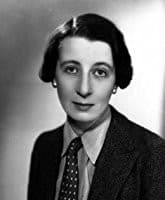
Josephine Tey was a British author known for her contributions to the mystery genre in the early to mid-20th century. Her notable works include "The Man in the Queue," a detective novel that introduces her recurring character, and "The Franchise Affair," which explores themes of justice and reputation. Tey's writing is characterized by its psychological depth and intricate plotting.
Similar books
- Gaudy Night
Dorothy L. Sayers
4.2 (23k) average on GoodreadsHistorical FictionFeatures a brilliant detective solving a complex, 'impossible' crime with a focus on character and atmosphere.
- The Moonstone
Wilkie Collins
3.9 (79k) average on GoodreadsHistorical FictionA foundational mystery novel with intricate plotting, multiple perspectives, and a focus on an elusive crime.
- THE MURDER OF ROGER ACKROYD
Agatha Christie
4.2 (153k) average on GoodreadsThrillerChristie's novel is renowned for its groundbreaking narrative twist and psychological manipulation, focusing on an intricate puzzle. Tey's 'The Man in the Queue' prioritizes a more external, methodical police procedural, with less emphasis on narrative trickery or deep psychological character studies of the murderer. Christie aims to surprise with structure; Tey with detailed investigation.
- To Kill a Mockingbird
Harper Lee
4.3 (4.5M) average on GoodreadsHistorical FictionIn the 1930s Jim Crow South, Harper Lee writes about racial injustice, moral growth, and the quiet courage of a lawyer father, Atticus Finch, as seen through his young daughter's eyes.
- The Great Gatsby
F. Scott Fitzgerald
3.9 (3.8M) average on GoodreadsHistorical FictionIn the opulent Roaring Twenties, a mysterious millionaire's lavish parties hide his desperate, tragic pursuit of a lost love, exposing the emptiness within the American Dream.
- Pride and Prejudice
Jane Austen
4.3 (3M) average on GoodreadsHistorical FictionIn a society focused on status and money, Elizabeth Bennet navigates love and pride, challenging Mr. Darcy and social expectations to find true affection.



Enjoyed the summary?
A summary gives you the shape of the book. The book itself has the detail, the examples and the voice.
Find The Man in the Queue on AmazonAs an Amazon Associate, BookBrief earns from qualifying purchases. How we're funded