
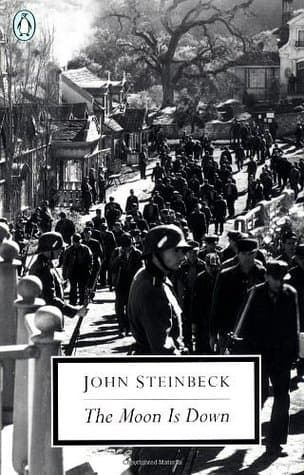
Synopsis
Covers the whole plot, including the ending.
- Difficulty
- Medium
- Pacing
- Slow
- Mood
- Somber, Resolute, Philosophical, Tense
- Read it if
- You appreciate allegorical tales about resistance against occupation and the enduring power of human spirit and democratic ideals.
- Skip it if
- You prefer fast-paced action or detailed character development over thematic exploration and a more philosophical narrative.
The Moon Is Down Plot Summary
Covers the whole plot, including the ending.
The Unforeseen Invasion
The story begins with the swift and unexpected occupation of a small, unnamed coastal town by an invading army, later understood to be German forces during WWII, though never explicitly stated. The town is important because of its port, which serves a coal mine. The invasion meets little organized resistance, surprising the townspeople. Colonel Lanser, the commander of the occupying battalion, sets up his headquarters in the home of Mayor Orden, the town's elected leader. Lanser and his staff try to keep things civil, despite the reality of military occupation.
The Weight of Occupation
As the initial shock fades, the townspeople deal with losing their freedom. The weather turns bleak, with early snow adding to the oppressive atmosphere. Colonel Lanser, a veteran who understands people, acknowledges that 'there are no peaceful people' when their liberty is taken. He tries to enforce rules and maintain a sense of normalcy, but the resentment among the 'simple, peaceful people' of the town becomes clear. This time marks the start of the psychological struggle between the occupiers and the occupied, as their new reality sets in.
The First Act of Defiance: Alexander Morden
The fragile peace breaks when Alexander Morden, a former alderman who values his freedom, is ordered to work in the coal mine. In defiance, Morden strikes Captain Loft with a pickaxe. Captain Bentick, intervening, is hit instead and dies. After a quick trial, Morden is executed by a firing squad. This brutal event acts as a catalyst for the town. It turns their anger and confusion into a 'slow, silent, waiting revenge,' changing their passive resistance into active, though covert, rebellion against the invaders.
The Slow, Silent Revenge
After Morden's execution, the townspeople begin their systematic, undeclared war against the occupiers. Sections of the railroad connecting the port to the coal mine are regularly damaged, machinery in the mine often breaks down, and the dynamo of the electricity generators is short-circuited. Also, individual soldiers who relax their guard, seek drink, or engage with women are found dead. This campaign of sabotage and targeted killings, though not coordinated in a traditional sense, shows the collective will of the people to resist. Mayor Orden, though outwardly compliant, supports his people, understanding their spirit.
Lanser's Growing Frustration
Colonel Lanser, despite his experience, becomes increasingly frustrated by the invisible enemy. He tries to reason with Mayor Orden, seeking to understand the source of the town's resilience. Orden explains to Lanser that his goal – 'to break man’s spirit permanently' – is impossible, as the idea of freedom lasts longer than any physical force. Lanser sees his own men growing weary, demoralized by the constant fear, the cold weather, and the futility of their position. He begins to realize that 'the flies have conquered the flypaper,' a metaphor for the occupiers being trapped by the very people they sought to control.
Desperation Among the Invaders
The relentless, silent resistance harms the occupying soldiers. The constant fear of ambush, the isolation, and the bleak, cold environment erode their morale. Many soldiers openly want the war to end so they can return home, seeing the futility of their presence in a town that refuses to be subdued. The officers also show signs of strain, with some, like Captain Loft, becoming more volatile and brutal, while others, like Lieutenant Tonder, fall into despair and loneliness, showing the psychological cost of the occupation on the invaders.
Seeking External Aid
Recognizing the need to do more, some members of the local resistance escape the occupied town and travel to England. There, they convey their situation and request explosives to increase their sabotage against the invaders. This marks a turning point, as the local resistance connects with outside support, signaling a broader conflict and the town's entry into the larger war effort. The request for dynamite shows a shift from passive disruption to more destructive, targeted actions.
Dynamite and Chocolates
In response to the resistance's plea, English planes drop small packages over the town. These packages contain dynamite sticks, meant to give the local resistance more destructive power, and chocolates, a gesture of solidarity and a morale booster for the suffering townspeople. The sight of these packages falling from the sky creates hope and renewed determination among the residents, while causing panic among the occupying army, who realize the outside world is now directly helping the resistance.
The Hostage Crisis
In a desperate attempt to stop the growing resistance and prevent the use of the new explosives, the invading army takes Mayor Orden and his friend, Dr. Winter, the town doctor and historian, hostage. Colonel Lanser makes it clear that any further acts of resistance from the townspeople will result in the immediate execution of both men. This act of coercion is a final gamble by the occupiers to regain control and break the town's spirit, putting the beloved mayor's life at risk.
Mayor Orden's Final Stand
Knowing his death is near, Mayor Orden remains firm. He tells his wife that while he can be killed, the 'idea of Mayor' – representing freedom, democracy, and the collective will of the people – is beyond the reach of any army. Before his execution, he shares a final conversation with Dr. Winter, reminding him of their high school play, where Orden played Socrates in 'The Apology.' He tells Winter to ensure 'the debt is repaid' to the army, a clear instruction for the resistance to continue, cementing his legacy as a martyr for freedom.
The Moon Is Down Characters
Mayor Orden
Protagonist
The democratically elected and beloved leader of the occupied town.
Mayor Orden is a wise, calm, and deeply respected leader. He embodies the spirit of his people – peaceful yet unyielding when faced with tyranny. He is pragmatic but holds an unwavering belief in freedom and the enduring power of ideas. Despite being under house arrest, he maintains a dignified composure and acts as a moral compass for both his people and, paradoxically, for Colonel Lanser. He understands human nature deeply and uses his conversations with Lanser to subtly undermine the invader's confidence.
Relationships: Colonel Lanser (Opposing leaders, engaged in a battle of wills and philosophies.); Dr. Winter (Close friend and confidant, sharing intellectual and historical perspectives.); His Wife (Supportive and loving partner, sharing his stoicism and understanding of his sacrifice.)
Colonel Lanser
Antagonist
The pragmatic and experienced commander of the invading army.
Colonel Lanser is a seasoned military officer, weary of war but committed to his duty. He is intelligent, attempts to operate under a veil of civility, and understands the complexities of human nature, acknowledging that 'there are no peaceful people' when freedom is lost. He tries to manage the occupation with a degree of order and minimal brutality, but his attempts are constantly thwarted by the town's resistance. He is a tragic figure, trapped by his orders and the futility of trying to conquer an idea.
Relationships: Mayor Orden (Philosophical adversary, engaged in a psychological battle for the town's spirit.); Captain Loft (Subordinate, whose brutality Lanser often disapproves of but tolerates for military expediency.); Lieutenant Tonder (Subordinate, whose deteriorating mental state reflects the toll of the occupation.)
Dr. Winter
Supporting
The town doctor and historian, a close friend and confidant of Mayor Orden.
Dr. Winter is a quiet, observant man, deeply knowledgeable about history and human behavior. He serves as Mayor Orden's most trusted confidant, offering a rational and historical perspective on the events unfolding. He is a witness to the occupation and the resistance, often reflecting on the broader implications of their struggle. His role is to absorb Orden's wisdom and ensure the continuation of the resistance, acting as a link to the past and a guardian of the future.
Relationships: Mayor Orden (Close friend and intellectual companion, sharing a deep understanding and trust.); The Townspeople (Trusted physician and respected community member.)
Alexander Morden
Supporting
An erstwhile alderman whose act of defiance sparks the town's organized resistance.
Alexander Morden is a proud and independent 'free man' who cannot tolerate being ordered around by an occupying force. His act of striking Captain Loft (leading to Captain Bentick's death) is not premeditated rebellion but an impulsive outburst against the violation of his dignity and freedom. His swift execution transforms him into the first martyr of the resistance, catalyzing the town's 'slow, silent, waiting revenge.' He represents the immediate, visceral reaction to oppression.
Relationships: Captain Loft (His direct oppressor, leading to Morden's violent outburst.); The Townspeople (A symbol of initial resistance and a martyr for their cause.)
Captain Loft
Supporting
A harsh and often brutal officer under Colonel Lanser's command.
Captain Loft is one of Colonel Lanser's officers, characterized by his harshness and short temper. He is often the enforcer of the occupation's more brutal aspects and is the target of Alexander Morden's pickaxe attack. Loft represents the more aggressive and less nuanced side of the invading force, often clashing with Lanser's attempts at civility. His frustration and cruelty grow as the resistance intensifies, reflecting the psychological strain of the occupation.
Relationships: Colonel Lanser (Subordinate, often at odds with Lanser's more measured approach.); Alexander Morden (His direct oppressor, leading to Morden's violent act.)
Lieutenant Tonder
Supporting
A young, sensitive officer who struggles with the psychological toll of the occupation.
Lieutenant Tonder is a more sensitive and introspective officer compared to his peers. He struggles deeply with the loneliness and isolation of the occupation, expressing a yearning for home and a normal life. His character highlights the human cost of war on the invaders, showing their vulnerability and despair. Tonder's gradual mental and emotional deterioration, culminating in his desperate search for connection and eventual demise, serves as a poignant counterpoint to the townspeople's resilience.
Relationships: Colonel Lanser (Subordinate, whose suffering Lanser observes with a degree of understanding.); Molly Morden (His unrequited romantic interest, a symbol of the unattainable peace and connection.)
Molly Morden
Supporting
Alexander Morden's wife, a symbol of quiet, enduring resistance and personal grief.
Molly Morden is the wife of Alexander Morden, and her character embodies the personal grief and quiet strength of the occupied populace. After her husband's execution, she becomes a symbol of the enduring spirit of resistance, even in the face of profound loss. She is courted by Lieutenant Tonder, but her loyalty and hatred for the invaders remain firm, highlighting the insurmountable chasm between the occupiers and the occupied. Her refusal to yield reflects the collective will of the town.
Relationships: Alexander Morden (Wife, deeply affected by his execution.); Lieutenant Tonder (Object of his unrequited affection, which she rejects due to his role as an occupier.)
The Moon Is Down Themes
The Indomitable Spirit of Freedom
This theme is central to the novel, stating that while bodies can be imprisoned or killed, the idea of freedom cannot be extinguished. Mayor Orden repeatedly tells this to Colonel Lanser, explaining that 'men cannot be killed, but the idea of man can be killed.' The townspeople's 'slow, silent, waiting revenge' shows this, as they continue to resist even after Alexander Morden's execution. The parachute drop of dynamite and chocolates symbolizes lasting hope and outside support for this spirit, showing that freedom is a universal desire.
“Free men cannot be conquered. The idea of freedom is stronger than any army.”
The Futility of Occupation
The novel explores the psychological and practical futility of military occupation when faced with a unified, determined populace. Colonel Lanser, despite his military skill, finds himself fighting an invisible enemy – the collective will of the town. His soldiers become demoralized, lonely, and fearful, realizing they are 'the flies' caught on 'the flypaper.' Constant sabotage, individual killings, and the general resentment make effective governance impossible, showing that brute force cannot control hearts and minds. The invaders' inability to 'break man's spirit permanently' leads to their own internal decay.
“The flies have conquered the flypaper. We are caught, and we cannot get out.”
The Nature of Good vs. Evil (or Ideas vs. Force)
Steinbeck frames the conflict not just as a battle between two armies, but as a clash between basic principles: democratic ideals of freedom and self-determination versus authoritarian force. Mayor Orden represents the lasting power of ideas, reason, and the collective human spirit, while Colonel Lanser, though not overtly evil, represents the instruments of force and control. The novel suggests that while force can temporarily subjugate, it can never truly conquer or destroy an idea. Orden's final conversation, referencing Socrates' Apology, elevates the struggle to a philosophical level, where truth and ideals ultimately win over physical power.
“The people don't like to be conquered, and they will not be conquered.”
The Psychological Toll of War
The novel details the psychological impact of war, not just on the occupied, but also on the occupiers. The townspeople endure fear, grief, and the loss of liberty, yet find strength in unity. Conversely, the invading soldiers, despite their initial military advantage, suffer from loneliness, paranoia, and demoralization. Lieutenant Tonder's despair and his longing for human connection are examples of this. Colonel Lanser, too, is a weary man, burdened by the moral ambiguities of his mission. The constant tension and the unseen enemy erode the invaders' will, showing that war damages everyone involved.
“This is a little war, but it is a long one. And it is a lonely one.”
Plot Devices & Literary Techniques
Symbolism of the Mayoralty
Mayor Orden as a symbol of the enduring idea of freedom and democratic rule.
Mayor Orden is more than just a character; he embodies the very 'idea' of democratic leadership and the spirit of his free people. His physical capture and impending execution are symbolic, as he articulates that while his body can be killed, the 'idea of Mayor' – representing freedom, self-governance, and resistance – is immortal and beyond the reach of any army. This device elevates the conflict from a mere military occupation to a philosophical struggle for enduring principles, making his sacrifice a powerful statement that inspires continued resistance.
The 'Flies and Flypaper' Metaphor
A recurring metaphor illustrating the unexpected entrapment of the invaders by the occupied.
The metaphor of 'the flies have conquered the flypaper' is a powerful plot device used by Colonel Lanser to express the ironic and desperate situation of his occupying forces. Initially, the invaders (flies) believed they could easily subdue the town (flypaper). However, the town's passive yet persistent resistance has effectively trapped the invaders, draining their morale and resources, making escape or true victory impossible. This metaphor underscores the futility of their mission and the unexpected strength of the seemingly weaker party, highlighting the psychological victory of the occupied over the occupiers.
Socratic Allusion
Mayor Orden's reference to Socrates in 'The Apology' as a parallel for his own sacrifice.
Mayor Orden's final conversation with Dr. Winter, where he reminds him of playing Socrates in 'The Apology,' serves as a profound classical allusion. Like Socrates, Orden is condemned to death for upholding truth and challenging authority (in this case, the authority of the invaders). Socrates chose death over abandoning his principles, and Orden does the same, emphasizing that ideas and moral principles are more important than physical life. This device elevates Orden's sacrifice to a universal, timeless act of martyrdom for freedom, ensuring his message and the resistance will live on.
Weather as a Reflection of Mood
The bleak and early onset of winter mirroring the oppressive atmosphere of the occupation.
The early and harsh onset of winter, with its cold and snow, serves as a powerful environmental motif that mirrors the oppressive, bleak, and demoralizing atmosphere of the occupation. The physical discomfort of the cold amplifies the psychological discomfort and fear experienced by both the townspeople and, notably, the invaders. It contributes to the soldiers' longing for home and their increasing despair, making the external environment a palpable extension of the internal state of the characters and the overall mood of the narrative.
The Moon Is Down Quotes
“Free men cannot be conquered.”
“The people don't like to be conquered, sir.”
“It is a rule that people are either slaves or free. If they are slaves they have a master. If they are free they have no master.”
“The debt is not to the past, but to the future.”
“The flies have conquered the flypaper.”
“You can kill people, but you can't kill ideas.”
“The conquerors are a little afraid of the conquered.”
“The one thing that is clear is that the people hate us.”
“A man is a man, and he has to be treated like a man.”
“The moon is down, and the night is dark, and the wind is cold. But the stars are still there.”
“They will win who can endure.”
“The little plans, the little victories, these are what make the big war.”
“It is not the killing of men that is the worst, but the killing of spirit.”
“The people will not be broken. They are not made that way.”
Quiz
10 questions on the plot and the characters. Each answer comes with a short explanation.
Question 1
Where does Colonel Lanser, the head of the invading battalion, establish his headquarters?
- The town's church
- The local inn
- Mayor Orden's house
- The coal mine office
Show answer
C. Mayor Orden's house Colonel Lanser and his staff establish their headquarters in the house of the democratically elected Mayor Orden.
Question 2
What is the initial event that catalyzes the townspeople into 'a slow, silent, waiting revenge'?
- The early onset of winter snows
- The execution of Alexander Morden
- Colonel Lanser's attempt to operate under a veil of civility
- Damage to the railroad linking the port with the mine
Show answer
B. The execution of Alexander Morden The execution of Alexander Morden after he strikes Captain Bentick with a pick axe is the incident that catalyzes the people of the town.
Question 3
What items do English planes parachute-drop into the town?
- Weapons and medical supplies
- Food rations and warm clothing
- Dynamite sticks and chocolates
- Propaganda leaflets and radios
Show answer
C. Dynamite sticks and chocolates English planes parachute-drop small packages containing dynamite sticks and chocolates all around the town.
Question 4
What is Colonel Lanser's internal realization about the occupied people, despite his attempt at civility?
- They are easily swayed by propaganda.
- They will eventually accept the new order.
- There are no peaceful people amongst those whose freedom has been taken away.
- Their resistance will quickly wane due to lack of resources.
Show answer
C. There are no peaceful people amongst those whose freedom has been taken away. Colonel Lanser, a veteran, knows in his heart that 'there are no peaceful people' amongst those whose freedom has been taken away by force.
Question 5
What does Mayor Orden tell his wife is beyond the reach of any army, even if he is killed?
- The town's physical infrastructure
- The idea of Mayor, freedom, and democracy
- The loyalty of his personal guards
- The town's supply of coal
Show answer
B. The idea of Mayor, freedom, and democracy Mayor Orden tells his wife that while he can be killed, the idea of Mayor (and freedom and democracy) is beyond the reach of any army.
Question 6
How do the townspeople primarily carry out their 'slow, silent, waiting revenge' after Morden's execution?
- Openly confronting soldiers in the streets
- Organizing large public protests
- Damaging infrastructure, sabotaging machinery, and killing isolated soldiers
- Refusing to work in the coal mine entirely
Show answer
C. Damaging infrastructure, sabotaging machinery, and killing isolated soldiers The resistance manifests as damaged railroad sections, frequent machinery breakdowns, short-circuited dynamos, and the killing of soldiers who relax their guard.
Question 7
What literary work does Mayor Orden reference to Dr. Winter before his execution, reminding him of a role he once played?
- Shakespeare's Hamlet
- The dialogues of Socrates in the Apology
- Plato's Republic
- An ancient Norse saga
Show answer
B. The dialogues of Socrates in the Apology Before his execution, Mayor Orden reminds Dr. Winter of the dialogues of Socrates in the Apology, a part he played in a high school play.
Question 8
What metaphorical phrase do the occupying forces use to describe their futile situation in the occupied town?
- The fox has entered the hen house.
- The wolves are at the door.
- The flies have conquered the flypaper.
- The cat is out of the bag.
Show answer
C. The flies have conquered the flypaper. The occupying force realizes the futility of the war and that 'the flies have conquered the flypaper,' indicating they are trapped by the very people they sought to control.
Question 9
What is the primary strategic importance of the small coastal town that makes it a target for invasion?
- It is a major agricultural hub.
- It has a large military base.
- It is a port that serves a large coal mine.
- It is a significant cultural and historical landmark.
Show answer
C. It is a port that serves a large coal mine. The town is important because it is a port that serves a large coal mine, making its resources vital for the invading army.
Question 10
What is the 'debt' that Mayor Orden tells Dr. Winter to make sure is repaid to the army?
- Financial compensation for damages incurred by the town.
- A formal apology for the resistance actions.
- The continuation of the resistance against the occupation.
- The return of all captured soldiers.
Show answer
C. The continuation of the resistance against the occupation. Mayor Orden tells Dr. Winter to make sure that the debt is repaid to the army, i.e., that the resistance is continued, as a form of ongoing defiance.
The Moon Is Down FAQ
What is the central conflict driving the narrative in 'The Moon Is Down'?
The central conflict arises from the occupation of a peaceful, democratic coastal town by an invading army. Colonel Lanser attempts to maintain civility and order, but the inherent human desire for freedom clashes with the imposed authoritarian rule, leading to a relentless, silent resistance from the townspeople against their occupiers.
Who are the key figures on the side of the occupied town, and what roles do they play?
Mayor Orden is the steadfast, democratically elected leader who symbolizes the town's spirit of freedom. Dr. Winter is the town doctor and historian, a close confidant to Orden, who helps to articulate the philosophical underpinnings of the resistance. Alexander Morden, an alderman, acts as the catalyst for the open resistance when he kills a soldier.
Who leads the invading forces, and what is his initial approach to the occupation?
Colonel Lanser commands the invading battalion. He is a veteran who initially tries to establish control under a 'veil of civility and law,' believing he can manage the townspeople through order and reason, despite his underlying understanding that conquered people are never truly peaceful.
How does the town's resistance evolve after the initial occupation and the execution of Alexander Morden?
Following Morden's execution, the townspeople shift from confusion to 'a slow, silent, waiting revenge.' Their resistance manifests as systematic sabotage—damaging railroads, breaking machinery, short-circuiting generators—and targeted killings of careless soldiers, indicating a deep-seated, organized defiance.
What role do the English play in supporting the resistance efforts in the occupied town?
After members of the resistance escape to England and request aid, English planes parachute-drop small packages containing dynamite sticks and chocolates. This external support provides the townspeople with the means to escalate their sabotage efforts against the occupying forces.
What is the significance of Mayor Orden's reference to Socrates and the Apology before his execution?
Mayor Orden's reference to Socrates in the Apology, a role he played in a high school play, signifies his acceptance of his impending death for his beliefs, much like Socrates. He instructs Dr. Winter to ensure the 'debt is repaid,' implying that the resistance must continue, drawing a parallel between his sacrifice and Socrates's philosophical stand.
How does the early arrival of snow and bleak weather contribute to the atmosphere and the psychological state of both the occupiers and the occupied?
The early, bleak snow and cold weather amplify the oppressive atmosphere. For the townspeople, it mirrors their internal cold anger and confusion. For the occupying soldiers, it exacerbates their discomfort, homesickness, and the psychological burden of constant fear, making them realize the futility of their situation.
What does the phrase 'the flies have conquered the flypaper' signify in the context of the invading army?
This phrase, used by the invading army, signifies their realization that despite their initial success, they are trapped. They are bogged down in a hostile environment, constantly under threat, and unable to achieve true control over the town's spirit, effectively being conquered by the very people they sought to subjugate.
How does Colonel Lanser's internal conflict between his duty and his understanding of human nature evolve throughout the occupation?
Lanser initially attempts to impose order with a facade of civility, but his deep-seated understanding that 'there are no peaceful people' whose freedom has been taken haunts him. As the resistance intensifies, he becomes increasingly aware of the futility of his mission, realizing that force cannot break the human spirit, leading to despair.
Analyze Mayor Orden's psychological resilience and his role as a symbol for the townspeople.
Mayor Orden embodies unwavering psychological resilience. Despite facing execution, he remains calm and focused on the continuity of the resistance. He understands that while he can be killed, the 'idea of Mayor' – representing freedom and democracy – is an indestructible concept, serving as an enduring symbol of hope and defiance for his people.
How does the psychological toll of occupation affect the invading soldiers, particularly in contrast to their initial expectations?
The invading soldiers initially expected a quick and easy conquest. However, the constant fear, the bleak weather, and the relentless, silent resistance wear heavily on them. They become homesick, demoralized, and realize the futility of their actions, leading to a profound psychological breakdown among many.
Discuss the symbolic importance of the coal mine and its connection to the town's strategic value and the resistance.
The coal mine is the primary reason for the town's strategic importance, providing resources for the war effort. For the townspeople, being forced to work in the mine under occupation is a direct assault on their freedom. Sabotage of the mine and its infrastructure becomes a potent symbol and practical means of resistance, disrupting the invaders' objectives.
How does the novel explore the theme of 'ideas cannot be killed by bullets' through Mayor Orden's character and fate?
The novel powerfully explores this theme through Mayor Orden's final moments. He acknowledges his impending death but confidently asserts that the 'idea of Mayor'—representing freedom, democracy, and the will of the people—is immortal and beyond the reach of any army. His execution, rather than suppressing the idea, solidifies it as a rallying cry for continued resistance.
What is the broader message about the nature of conquest and human freedom that Steinbeck conveys through the narrative?
Steinbeck conveys that true conquest is impossible when it involves subjugating the human spirit. He argues that while physical force can occupy territory and kill individuals, it cannot extinguish the inherent human desire for freedom and self-determination. The resistance, even in the face of overwhelming odds, demonstrates the enduring power of these ideals.
In what ways does 'The Moon Is Down' challenge conventional war narratives by focusing on the psychological impact rather than grand battles?
The novel subverts traditional war narratives by largely omitting large-scale battles. Instead, it meticulously details the psychological warfare between the occupiers and the occupied. It emphasizes the internal struggles, the slow burn of resistance, and the moral decay of the invaders, highlighting that the true impact of war lies in the human spirit's resilience and suffering.
About the author
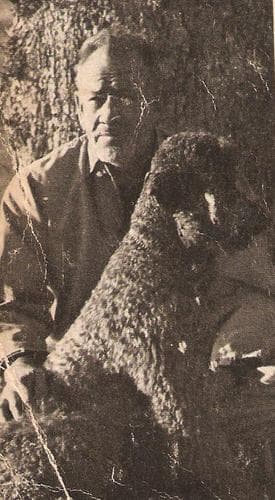
John Ernst Steinbeck was an American writer. He won the 1962 Nobel Prize in Literature "for his realistic and imaginative writings, combining as they do sympathetic humor and keen social perception". He has been called "a giant of American letters."
Similar books
- Darkness at Noon
Arthur Koestler
4.0 (26k) average on GoodreadsPoliticsExplores the psychological toll of totalitarianism and ideological conflict.
- The Plague
Albert Camus
4.0 (171k) average on GoodreadsLiterary FictionFeatures a community's struggle against an oppressive, external force and themes of collective resistance.
- The Diary of a Young Girl
Anne Frank
4.2 (2.7M) average on GoodreadsBiographyWhile both books deal with occupation during WWII, The Moon Is Down focuses on the macro-level psychological struggle and collective resistance of a town. The Diary of a Young Girl, in contrast, offers an intensely personal, micro-level perspective of hiding and survival, detailing the daily fears, hopes, and intellectual growth of one individual in an extremely confined space. Steinbeck's work is an externalized narrative of defiance; Frank's is an internalized account of endurance.
- Hiroshima
John Hersey
4.0 (61k) average on GoodreadsHistoryThe Moon Is Down is a work of fiction, albeit with propagandistic intent, exploring the unfolding drama of invasion and resistance. Hersey's Hiroshima, a work of literary journalism, provides a stark, factual account of the aftermath of the atomic bomb, focusing on the experiences of six survivors. While both depict the horrors of war, Steinbeck's work is about the struggle against an oppressor, offering a message of hope and eventual triumph. Hersey's is a chilling testament to the devastating consequences of modern warfare, with a more somber and reflective tone on human suffering.
- The Old Man and the Sea
Ernest Hemingway
3.8 (831k) average on GoodreadsLiterary FictionA Cuban fisherman's long struggle with a giant marlin becomes a story of endurance and dignity, now retold for young adults with illustrations, phonetic guides, and writing prompts in Traditional Chinese.
- One Hundred Years of Solitude
Gabriel García Márquez
4.1 (753k) average on GoodreadsLiterary FictionThrough the multi-generational story of the Buendía family, a mythical town deals with the repeating patterns of time, love, and solitude, as the extraordinary mixes with the ordinary.


Enjoyed the summary?
A summary gives you the shape of the book. The book itself has the detail, the examples and the voice.
Find The Moon Is Down on AmazonAs an Amazon Associate, BookBrief earns from qualifying purchases. How we're funded