
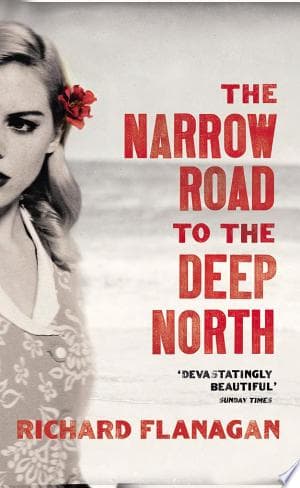
Synopsis
Covers the whole plot, including the ending.
- Difficulty
- Medium
- Pacing
- Moderate
- Mood
- Somber, Reflective, Poignant, Brutal, Philosophical
- Read it if
- You appreciate deep literary fiction, historical narratives about war's profound psychological impact, and explorations of love, memory, and trauma.
- Skip it if
- You prefer fast-paced plots, lighthearted stories, or avoid graphic depictions of war and human suffering.
The Narrow Road to the Deep North Plot Summary
Covers the whole plot, including the ending.
A Life Defined by the Railway
The novel begins with Dorrigo Evans, a respected Australian surgeon and national hero, at a dinner in his honor. Despite his public success, Dorrigo feels empty. His thoughts often return to his time as a prisoner of war on the Burma Railway (the 'Line') during World War II. He is haunted by the men he could not save, the brutality he saw, and the memory of Amy, his uncle's wife, with whom he had an affair before the war. The story frequently moves between his present, a series of public appearances and private struggles, and the past that shaped him, especially his time in the POW camps.
The Brutality of the Burma Railway
The story goes into Dorrigo's time as a POW, focusing on the terrible conditions on the Burma Railway. As a surgeon, Dorrigo constantly fights cholera, dysentery, starvation, and the brutal treatment from his Japanese captors. He performs many amputations and basic surgeries, often with poor tools and medicine, trying to save his men. The Japanese officers, Major Nakamura and Captain Ogawa, are shown as complex figures, capable of extreme cruelty and occasional, almost accidental, kindness. Dorrigo's leadership and medical skills are tested daily as he watches his fellow soldiers die slowly, forming a strong bond with the survivors.
The Affair with Amy
Mixed with the grim reality of the POW camp are clear flashbacks to Dorrigo's affair with Amy, his Uncle Jack's wife, in Tasmania before the war. Their relationship is passionate, forbidden, and changes Dorrigo deeply. They meet secretly, their stolen moments filled with intense emotional and physical connection that contrasts sharply with the desolation of the railway. Amy represents life, beauty, and a strong sense of being understood. This love story becomes the emotional center that supports Dorrigo through his darkest moments on the Line, a memory he holds onto for hope and meaning, even as he feels guilty for betraying his uncle.
A Letter from Home
In the POW camp, Dorrigo receives a smuggled letter from Amy. The letter is a lifeline, a real connection to the world he left behind and a confirmation of her continued love. However, it also brings great pain, showing the vast distance and uncertain future. The letter becomes a strong symbol of his past life and the love that drives his will to survive, even though he knows his chances of returning to that life, or to Amy, are small. This secret communication strengthens his inner world, setting him apart from the other prisoners in a way, as he carries this secret hope and burden.
The End of the War and Repatriation
The war ends, and the surviving Australian POWs are freed. Dorrigo, thin and traumatized, returns to Australia. The change back to civilian life is hard; he finds himself a hero, but feels disconnected from the 'normal' world. His experiences on the Line have left a lasting mark, making ordinary life seem unimportant. He struggles with the expectations placed on him as a survivor and hero, feeling guilty for surviving and carrying the weight of the men he could not save. The horrors he went through permanently change his view of time and reality.
A Marriage of Convenience and Loss
When he returns, Dorrigo learns of Amy's presumed death in a flood, a devastating blow that breaks his last link to his pre-war self. He marries Ella, Amy's sister, a woman who loves him deeply and tries to understand his trauma, but cannot fully reach him. Dorrigo becomes a celebrated surgeon, achieving professional success and public recognition. He has children and builds a comfortable life, but his inner world remains tied to the railway and Amy's memory. His marriage to Ella is one of quiet companionship and respect, but it lacks the passion and strong connection he shared with Amy, leaving him feeling adrift.
Amy's Survival and Unfulfilled Reunion
Years after the war, Dorrigo learns that Amy did not die in the flood; she survived and lived a quiet, solitary life. They arrange to meet, a moment of great anticipation and dread. Their reunion is brief and deeply unsatisfying. The years, the war, and their separate lives have created a gap between them that cannot be closed. The passionate lovers they once were no longer exist; they are replaced by two strangers burdened by memory and regret. This meeting shows that some losses cannot be reversed, and that even a strong love like theirs cannot fully escape the damage of time and experience.
The Lives of Others: Nakamura and Ogawa
The novel also shows the post-war lives of Major Nakamura and Captain Ogawa, Dorrigo's Japanese captors. Nakamura, who oversaw much of the brutality, becomes a respected businessman, struggling with his own memories and the impact of his wartime actions. Ogawa, a more conflicted character, faces his own challenges and thinks about war and humanity. These sections offer a complex view of the conflict, refusing to paint the Japanese soldiers as simple villains. Instead, they explore their humanity, cultural context, and their own post-war suffering and attempts at reconciliation or denial. Their stories mirror Dorrigo's own struggles.
The Slow Decline and Reflection
As Dorrigo gets older, his public life continues to thrive, but his private world becomes more isolated. His memory fails, a cruel irony for a man whose identity is so linked to his past. He continues to question his fame, feeling like a fraud whose achievements are built on others' suffering. His relationships with his children are distant, and his marriage to Ella, though long-lasting, remains emotionally unfulfilled. He thinks about love, loss, and the impossibility of truly escaping one's past, realizing that the railway defined him more than any other experience.
The Inevitable End
Dorrigo's life ends, a quiet conclusion to a life lived loudly but internally. In his final moments, his thoughts return to the men on the Line, to Amy, and to the strong, inescapable connection between love and death. He realizes that all his achievements are meaningless compared to the experiences of love and suffering he endured. The novel ends with a reflection on life's temporary nature, memory's lasting power, and the idea that true love, like true suffering, leaves a mark that shapes one's entire existence.
The Narrow Road to the Deep North Characters
Dorrigo Evans
Protagonist
A celebrated Australian surgeon haunted by his past as a POW on the Burma Railway and his love for Amy.
Dorrigo Evans is a complex and deeply conflicted character, presented as a war hero and brilliant surgeon, yet internally tormented. His experiences as a prisoner of war on the Burma Railway define his entire existence, leaving him with profound survivor's guilt and a sense of detachment from the world. He is driven by a strong sense of duty to his men, performing impossible surgeries in horrific conditions, but also by a longing for the intense love he shared with Amy. Despite his public success, he remains an isolated figure, unable to fully connect with others or escape the shadow of his past.
Relationships: Amy (intense, illicit, and transformative love affair); Ella (wife, Amy's sister, a stable but less passionate marriage); Jack Evans (uncle, betrayed by Dorrigo's affair with Amy); Major Nakamura (Japanese captor, a complex and brutal figure); Darky Gardiner (fellow POW, close friend, and patient)
Amy
Supporting
Dorrigo's uncle's wife, with whom he has a passionate and defining pre-war affair.
Amy is the object of Dorrigo's profound and enduring love, representing passion, beauty, and a connection to life that sustains him through the horrors of war. She is intelligent, sensual, and deeply perceptive, understanding Dorrigo in a way no one else does. Their affair is the emotional anchor of the novel, a stolen paradise contrasting sharply with the hell of the railway. Her supposed death and later reappearance profoundly impact Dorrigo, highlighting the irreversible changes wrought by time and war. She is the 'deep north' of Dorrigo's emotional landscape.
Relationships: Dorrigo Evans (intense, illicit love affair); Jack Evans (husband, Dorrigo's uncle); Ella (sister)
Ella
Supporting
Amy's sister and Dorrigo's eventual wife, a woman who provides stability but not full emotional connection.
Ella is Amy's sister and Dorrigo's wife after the war. She is a kind, empathetic, and resilient woman who genuinely loves Dorrigo and tries to understand the trauma he carries. She provides him with a stable home and family life, raising their children and supporting his career. However, she lives in the shadow of Amy and the railway, never fully able to penetrate Dorrigo's emotional guard or compete with the ghost of his past love. Her love for him is quiet and enduring, a stark contrast to the explosive passion he shared with Amy.
Relationships: Dorrigo Evans (wife, a marriage of quiet companionship); Amy (sister)
Major Nakamura
Antagonist/Supporting
A Japanese officer overseeing the POW camps, embodying the brutal efficiency of the Imperial Japanese Army.
Major Nakamura is one of the primary Japanese officers responsible for the cruelty and suffering inflicted upon the POWs. He is depicted as a man of duty and honor within his own cultural framework, but also capable of extreme brutality and indifference to human life. His post-war life is explored, revealing a man who, despite his past actions, seeks a form of redemption or at least a quiet existence, reflecting the novel's nuanced portrayal of the enemy. He struggles with his own memories and the changing face of Japan.
Relationships: Dorrigo Evans (captor-prisoner dynamic); Captain Ogawa (fellow officer, often in agreement on brutality)
Darky Gardiner
Supporting
A fellow Australian POW and close friend of Dorrigo, known for his resilience and eventual tragic fate.
Darky Gardiner is one of Dorrigo's closest comrades and patients on the Line. He is a symbol of the resilience, camaraderie, and ultimate vulnerability of the Australian POWs. Dorrigo performs a life-saving amputation on Darky, a moment that solidifies their bond and highlights Dorrigo's medical prowess under duress. Darky's eventual death, despite Dorrigo's efforts, profoundly impacts Dorrigo, embodying the arbitrary cruelty of the railway and the limits of his ability to save everyone.
Relationships: Dorrigo Evans (fellow POW, patient, and close friend)
Jimmy Bigelow
Supporting
A resilient and often irreverent Australian POW, a source of dark humor and a representation of the common soldier.
Jimmy Bigelow is another of Dorrigo's men, representing the spirit and dark humor of the Australian soldiers. He is a pragmatic and resourceful character, often making wry observations about their dire situation. His presence provides moments of levity and a grounding perspective amidst the horror. He is one of the survivors of the railway, carrying his own invisible wounds and adapting to a post-war life, often struggling with the legacy of his experiences.
Relationships: Dorrigo Evans (fellow POW, commander-soldier dynamic)
Captain Ogawa
Supporting
A Japanese officer, more complex and conflicted than Nakamura, who experiences his own post-war struggles.
Captain Ogawa is another Japanese officer, often seen alongside Nakamura. He is depicted with slightly more internal conflict and a capacity for reflection, particularly in his post-war life. While complicit in the brutality, his character offers a glimpse into the Japanese perspective on duty, honor, and the nature of war, further complicating the simple 'good vs. evil' dynamic. His post-war section explores his attempts to reconcile his past and understand the impact of his actions, albeit imperfectly.
Relationships: Dorrigo Evans (captor-prisoner dynamic); Major Nakamura (fellow officer)
Jack Evans
Supporting
Dorrigo's uncle and Amy's husband, a kind but ultimately betrayed figure.
Jack Evans is Dorrigo's uncle and Amy's husband, a seemingly decent and unassuming man. His kindness and trust are betrayed by Dorrigo's affair with Amy, though he remains largely unaware of the depth of their relationship. He represents the innocent party caught in the crosscurrents of passion and war. His presence highlights Dorrigo's guilt and the moral complexities of his pre-war life, contrasting with the starker moral choices of the war itself.
Relationships: Dorrigo Evans (uncle-nephew, betrayed by affair); Amy (husband)
The Old Man (Father O'Toole)
Mentioned
A fellow POW, whose wisdom and resilience offer spiritual guidance in the camps.
The Old Man, often referred to as Father O'Toole, is a figure of quiet wisdom and spiritual strength among the POWs. He provides a moral compass and a sense of enduring humanity amidst the depravity. His presence offers Dorrigo and the other men a different kind of resilience, one rooted in faith and inner peace, contrasting with Dorrigo's more pragmatic and often cynical approach to survival. He represents the enduring power of hope and dignity in the face of ultimate suffering.
Relationships: Dorrigo Evans (fellow POW, spiritual mentor)
The Narrow Road to the Deep North Themes
The Enduring Trauma of War
The novel shows the lasting psychological and physical scars of war, specifically the POW experience on the Burma Railway. Dorrigo's entire post-war life is overshadowed by the horrors he saw and lived through. He suffers from survivor's guilt, emotional distance, and difficulty finding meaning in 'normal' life. The constant flashbacks, the memories of the dead, and the physical decline of the men show how war changes people completely, making a true return impossible. Even the Japanese officers carry their own burdens, showing that trauma affects everyone.
“Forever after, there were for them only two sorts of men: the men who were on the Line, and the rest of humanity, who were not.”
Love and Loss
Love, in its different forms, is a main theme. The passionate affair between Dorrigo and Amy is a strong force, supporting Dorrigo through his darkest times on the Line. This love is contrasted with the quiet, lasting, but less passionate love he shares with Ella. The novel explores how love can bring hope and meaning, but also how it can be changed or lost by time, circumstances, and war trauma. The 'loss' includes not just Amy, but also the loss of innocence, comrades, and a former self.
“A man’s life was like a river, the father had said. When he was young, it flowed swiftly and in the right direction. But in middle age, the river broadened, and the current slowed. It was then that, unless a man was careful, he could lose his way.”
Memory and Time
Memory is shown as both a help and a burden. For Dorrigo, memories of Amy bring comfort, while memories of the railway are a constant torment. The novel often moves between past and present, blurring time, emphasizing that the past is never truly gone for those who have experienced deep trauma. Dorrigo's struggle with his aging memory, and how he filters or reinterprets events, shows that memory itself is subjective and unreliable. The story's structure reinforces this, showing how the present is always informed by the past.
“He understood then that a man's life was not a series of events at all, but a series of accidents. He understood that he was a man who had done many things, but had been nothing.”
The Nature of Heroism and Imposter Syndrome
Dorrigo is publicly known as a war hero, but he feels like an imposter. The novel questions common ideas of heroism, suggesting that real heroism might be in quiet acts of resilience and kindness, not in public praise. Dorrigo carries the burden of the men he could not save, feeling that his fame comes from their suffering. This theme explores the difference between public perception and private reality, and the weight of living up to an image that does not match one's inner self, especially when that self is broken by trauma.
“The great lie of war, of course, was that it was a test of a man's courage. It was not. It was a test of a man's luck.”
Humanity and Dehumanization
The novel clearly shows how war and captivity dehumanize both prisoners and captors. The POWs are reduced to basic survival instincts, losing dignity and individuality. Yet, within this, acts of humanity, friendship, and self-sacrifice appear. Conversely, the Japanese soldiers, though often brutal, are also shown to have their own complexities, fears, and cultural rules, challenging simple ideas of good and evil. The novel explores how circumstances can push people to extreme acts, but also how humanity can still exist.
“In the end, all that was left was hunger. A man could not be a man without food.”
Plot Devices & Literary Techniques
Non-linear Narrative Structure
Interweaving past and present to mirror Dorrigo's fragmented memory.
The novel jumps frequently between Dorrigo's present life as an acclaimed surgeon and his past experiences as a POW on the Burma Railway, as well as his pre-war affair with Amy. This non-linear structure mirrors Dorrigo's own fractured memory and the way his past constantly intrudes upon his present. It allows Flanagan to build suspense, reveal character depth gradually, and highlight the enduring impact of trauma, showing how certain memories are ever-present despite the passage of time. The shifts are often sudden, reflecting the intrusive nature of traumatic recall.
Symbolism of the Burma Railway (The Line)
Represents suffering, endurance, and the irreversible impact of war.
The Burma Railway, or 'the Line,' is more than just a setting; it is a powerful symbol. It represents the ultimate test of human endurance and the nadir of human suffering and cruelty. For Dorrigo and the other POWs, it becomes a metaphor for their lives – a brutal, inescapable path. It also symbolizes the indelible mark that trauma leaves, forever dividing humanity into 'those who were on the Line, and the rest.' The physical construction of the railway parallels the psychological construction and destruction of the men who built it.
The Love Letter
A tangible link to the past and a symbol of hope and ultimate loss.
The smuggled letter from Amy that Dorrigo receives in the POW camp is a potent symbol. It represents a fragile lifeline to his former life, a confirmation of love, and a source of hope that helps him endure. Yet, it also underscores the vast distance and the unlikelihood of a future together. When he later learns of Amy's presumed death, the letter becomes a relic of a lost world. Its physical presence and its emotional weight highlight the enduring power of human connection amidst utter desolation, but also the futility of holding onto a past that can never truly be reclaimed.
Third-Person Omniscient Perspective
Allows insight into multiple characters' inner lives and historical contexts.
The novel employs a third-person omniscient narrator, which grants the reader access not only to Dorrigo's complex inner world but also to the perspectives of other characters, including the Japanese officers Nakamura and Ogawa, and Amy. This narrative choice allows for a multifaceted exploration of the war, its aftermath, and the motivations of all involved. It enables Flanagan to provide historical context, cultural insights, and a broader understanding of the human condition, moving beyond a singular, subjective viewpoint to offer a more universal and empathetic portrayal of suffering and survival.
Intertextual References (Haiku, Zen Buddhism)
Enriches themes of transience, beauty, and the Japanese perspective.
Flanagan integrates elements of Japanese culture, particularly haiku poetry and references to Zen Buddhist philosophy, throughout the narrative. These elements serve multiple purposes: they offer glimpses into the cultural mindset of the Japanese captors, enriching their characterizations beyond simple villainy; they provide moments of stark beauty and contemplation amidst the horror, underscoring themes of transience and the search for meaning; and they subtly highlight the philosophical differences and clashes between the Western and Eastern perspectives on life, death, and honor. The haiku often punctuate moments of profound observation or despair.
The Narrow Road to the Deep North Quotes
“Sometimes you have to give up to find your way back.”
“War makes you an animal, but it doesn't make you any less human.”
“A good book, he had discovered, was an experience that was always a little sad.”
“We are all just a series of moments, some good, some bad, some forgotten.”
“To be a good doctor, you need to know when to give up, and when to keep fighting.”
“Love was not a feeling, he knew, but an act.”
“The greatest enemy of truth is often not the lie, but the myth.”
“What is it to be a man, but to be a story?”
“The past is never dead. It's not even past.”
“Hope, he had come to believe, was not a thing to be found, but a thing to be made.”
“Every life is a story, but not every story is a life.”
“He understood then that true courage was not the absence of fear, but the triumph over it.”
“The only way to keep the dead alive is to keep talking about them.”
“Sometimes the greatest love is the love you let go of.”
Quiz
10 questions on the plot and the characters. Each answer comes with a short explanation.
Question 1
What is the primary historical setting for Dorrigo Evans's experience during the war?
- The trenches of the Western Front
- A Japanese POW camp on the Burma Death Railway
- A prisoner-of-war camp in Nazi Germany
- A naval hospital ship in the Pacific
Show answer
B. A Japanese POW camp on the Burma Death Railway The book explicitly states that Dorrigo Evans is a surgeon in a Japanese POW camp on the Burma Death Railway, struggling to save men from the horrific conditions of its construction.
Question 2
Who is the woman that haunts Dorrigo Evans during his time as a POW?
- His childhood sweetheart, Amy
- His sister, Ella
- His uncle's young wife, Amy
- A nurse he met before the war, Anne
Show answer
C. His uncle's young wife, Amy The synopsis clearly states that Dorrigo is 'haunted by his love affair with his uncle’s young wife two years earlier.' Her name is Amy.
Question 3
What profession does Dorrigo Evans hold during his time in the POW camp?
- Infantry commander
- Engineer
- Surgeon
- Chaplain
Show answer
C. Surgeon Dorrigo Evans is explicitly identified as a 'surgeon' who struggles to save the men under his command from various ailments and abuses.
Question 4
What significant event changes Dorrigo Evans's life forever while he is a POW?
- He receives news of his impending release from the camp.
- He is promoted to a higher rank within the camp hierarchy.
- He receives a letter.
- He is severely injured during a work detail.
Show answer
C. He receives a letter. The synopsis mentions that while 'struggling to save the men under his command... he receives a letter that will change his life forever.' The content of this letter is a key plot point.
Question 5
The book's title, 'The Narrow Road to the Deep North,' is an allusion to what real-world literary work?
- Homer's 'The Odyssey'
- Bashō's 'Oku no Hosomichi' (The Narrow Road to the Interior)
- Joseph Conrad's 'Heart of Darkness'
- Sun Tzu's 'The Art of War'
Show answer
B. Bashō's 'Oku no Hosomichi' (The Narrow Road to the Interior) The title is a direct reference to the classic 17th-century Japanese travelogue by Matsuo Bashō, 'Oku no Hosomichi,' often translated as 'The Narrow Road to the Interior' or 'The Narrow Road to the Deep North.' This allusion highlights themes of journey, suffering, and reflection.
Question 6
Which theme is NOT explicitly mentioned in the book's description as central to the story?
- The many forms of love
- The many forms of death
- The pursuit of wealth and power
- War and truth
Show answer
C. The pursuit of wealth and power The description explicitly states the book is 'a story about the many forms of love and death, of war and truth.' The pursuit of wealth and power, while possibly present in a character's life, is not highlighted as a central theme in the provided summary.
Question 7
What is the enduring distinction that arises for the characters who experienced the Burma Death Railway?
- Those who were officers and those who were enlisted men.
- Those who were on the Line, and the rest of humanity.
- Those who survived the war, and those who perished.
- Those who were Australian and those of other nationalities.
Show answer
B. Those who were on the Line, and the rest of humanity. The opening line of the synopsis states: 'Forever after, there were for them only two sorts of men: the men who were on the Line, and the rest of humanity, who were not.' This highlights the profound and lasting impact of their shared experience.
Question 8
Which of the following conditions were the men under Dorrigo's command NOT explicitly mentioned as suffering from?
- Starvation
- Cholera
- Beatings
- Frostbite
Show answer
D. Frostbite The synopsis mentions Dorrigo 'struggling to save the men under his command from starvation, from cholera, from beatings.' Given the setting of the Burma Death Railway, frostbite is highly unlikely and not mentioned.
Question 9
How does Dorrigo Evans's life progress after the war, according to the description?
- He struggles with poverty and isolation.
- He comes of age, prospers, but discovers all that he has lost.
- He dedicates his life to political activism.
- He becomes a reclusive author.
Show answer
B. He comes of age, prospers, but discovers all that he has lost. The description states: 'as one man comes of age, prospers, only to discover all that he has lost.' This indicates a complex post-war life of success intertwined with profound personal loss.
Question 10
The novel explores the dichotomy between which two fundamental human experiences through Dorrigo's journey?
- Wealth and poverty
- Love and death
- Freedom and captivity
- Ignorance and enlightenment
Show answer
B. Love and death The description highlights this central theme: 'This is a story about the many forms of love and death, of war and truth...' The interplay of love and death is a core exploration.
The Narrow Road to the Deep North FAQ
What is "The Narrow Road to the Deep North" about?
"The Narrow Road to the Deep North" centers on Dorrigo Evans, an Australian surgeon and prisoner of war in a Japanese camp on the Burma Death Railway during World War II. Intertwined with his harrowing experiences of survival and leadership in the camp is the memory of his passionate love affair with Amy, his uncle's wife, before the war. The novel explores themes of love, loss, memory, and the enduring impact of war on a man's life.
Why should I read "The Narrow Road to the Deep North"?
You should read this novel for its profound exploration of human endurance, the complexities of love and memory, and its unflinching portrayal of the atrocities of war. Richard Flanagan's exquisite prose and deep character studies offer a moving and thought-provoking experience, making it a powerful testament to the resilience and fragility of the human spirit. It's a Man Booker Prize winner for a reason.
What is the background/setting of "The Narrow Road to the Deep North"?
The novel primarily shifts between two settings: the brutal Japanese POW camps on the Thailand-Burma Railway (the 'Death Railway') during World War II, where Australian soldiers, including Dorrigo Evans, are forced into slave labor; and pre-war Tasmania, depicting Dorrigo's life and his affair with Amy. Post-war Australia also features, showing Dorrigo's later life as a celebrated surgeon.
What are the most memorable quotes?
One memorable quote is, "Forever after, there were for them only two sorts of men: the men who were on the Line, and the rest of humanity, who were not," which encapsulates the profound, isolating experience of the POWs. Another is, "A good book is an impossible journey," reflecting the novel's own deep and challenging narrative.
What writing style does the author use?
Richard Flanagan employs a lyrical, evocative, and often poetic writing style, rich with vivid imagery and philosophical introspection. He uses a non-linear narrative, frequently shifting between past and present, and between different characters' perspectives, to build a complex tapestry of memory and experience. His prose is both beautiful and stark, capable of conveying immense suffering and profound beauty.
What minor details add significant meaning?
The recurring image of the 'wombat' in Dorrigo's memory, referring to Amy's scent, becomes a powerful symbol of his lost love and the sensory details that tie him to his past. The small, often mundane items the POWs cling to, like a single cigarette or a stolen piece of fruit, highlight their desperate fight for dignity and survival amidst unimaginable deprivation.
What are some subtle foreshadowing moments?
Early descriptions of Dorrigo's detached nature and his struggles with intimacy, even during his passionate affair with Amy, subtly foreshadow his inability to truly connect with others or find lasting happiness in his post-war life. The casual cruelty shown by some Japanese officers in seemingly minor interactions also hints at the escalating brutality of the POW camps.
What unexpected character connections exist?
Beyond Dorrigo and Amy, an unexpected connection is revealed between Dorrigo and Amy's husband, Frank. While never directly interacting as rivals, their shared love for Amy, and Frank's quiet understanding and eventual actions regarding her memory, create a poignant, unspoken bond that underscores the tragic dimensions of their lives.
What are unspoken character motivations?
Dorrigo's unspoken motivation for striving to save his men on the Line is not solely altruism, but also a desperate attempt to find meaning and absolution, perhaps for his guilt over Amy, and to exert some control in a world where he is otherwise powerless. His later pursuit of accolades and women also seems driven by an unspoken need to fill the void left by his true love.
What psychological complexities do characters exhibit?
Dorrigo exhibits survivor's guilt, a profound sense of detachment, and an inability to fully inhabit his post-war life, despite his success. Amy, on the other hand, grapples with societal expectations, infidelity, and a deep yearning for a love that transcends the ordinary, displaying both impulsiveness and a quiet strength in her choices.
What are the major emotional turning points?
A major emotional turning point is Dorrigo receiving Amy's letter in the POW camp, which shatters his carefully constructed emotional defenses and brings his pre-war life crashing into his present horrors. Another is his eventual discovery of Amy's fate, which forces him to confront the true cost of his past actions and the enduring power of his love for her.
How do relationship dynamics evolve?
Dorrigo and Amy's passionate, illicit affair evolves from intense desire into a profound, almost spiritual connection, despite its brevity. In contrast, Dorrigo's post-war marriages are marked by emotional distance and a lack of true intimacy, highlighting how his experiences on the Line and his lingering love for Amy have fundamentally altered his capacity for relationship.
Which parts remain ambiguous or open-ended?
The true depth of Amy's feelings and her ultimate motivations at certain points remain somewhat ambiguous, left for the reader to interpret through her actions and Dorrigo's memories. The novel also leaves open the question of whether any amount of post-war success or recognition can truly heal the deep wounds inflicted by trauma, suggesting that some losses are simply irreparable.
What are controversial scenes or decisions?
Dorrigo's decision to engage in an affair with his uncle's wife, Amy, is a central controversial decision, challenging societal norms and family loyalty. Within the POW camp, the ethical dilemmas faced by Dorrigo as a surgeon, having to choose which men to save and which to let die due to extreme scarcity, present deeply controversial and morally harrowing situations.
"The Narrow Road to the Deep North" ending explained: how it ends & what it means
The novel ends with an elderly Dorrigo, a celebrated national hero but a personally isolated man, reflecting on his life and the enduring ghost of Amy. He finally learns the full truth about Amy's death, which had been concealed from him. The ending signifies that despite his public achievements, Dorrigo never truly escaped the 'narrow road' of his past, and that the love and loss experienced during the war and with Amy were the most real parts of his existence, leaving him forever searching for what he had lost.
About the author

Richard Miller Flanagan is an Australian writer, who has also worked as a film director and screenwriter. He won the 2014 Man Booker Prize for his novel The Narrow Road to the Deep North.
Similar books
- The Nightingale
Kristin Hannah
4.6 (698k) average on GoodreadsHistorical FictionExplores human endurance and moral choices during WWII, with a focus on personal struggle amidst conflict.
- All the Light We Cannot See
Anthony Doerr
4.3 (1M) average on GoodreadsHistorical FictionFeatures intertwined stories set during WWII, exploring themes of survival, human connection, and the impact of war on individuals.
- The Railway Man
Eric Lomax
4.1 (6k) average on GoodreadsBiographyUnlike Lomax's memoir, which offers a first-hand, factual account of his own POW experience and later quest for reconciliation, Flanagan's novel is a fictionalized narrative that, while historically grounded, allows for greater imaginative exploration of the psychological and emotional landscape of its characters. Lomax's work is a direct testimony, while Flanagan's is an interpretation of collective trauma through a specific protagonist, offering a broader, more literary meditation on war's legacy.
- A Town Like Alice
Nevil Shute
4.1 (49k) average on GoodreadsHistorical FictionWhile Shute's novel also features a female protagonist's experiences as a POW in the Pacific theater, it focuses more on her post-war resilience and efforts to build a new life in Australia. Flanagan's work, in contrast, delves more deeply into the enduring psychological scars of the male POWs, the moral ambiguities of survival, and the persistent haunting of past love and loss, offering a more introspective and less outwardly optimistic view of recovery from wartime trauma. Shute's narrative has a more traditional romantic arc, whereas Flanagan's is starker and more melancholic.
- The Old Man and the Sea
Ernest Hemingway
3.8 (831k) average on GoodreadsLiterary FictionA Cuban fisherman's long struggle with a giant marlin becomes a story of endurance and dignity, now retold for young adults with illustrations, phonetic guides, and writing prompts in Traditional Chinese.
- One Hundred Years of Solitude
Gabriel García Márquez
4.1 (753k) average on GoodreadsLiterary FictionThrough the multi-generational story of the Buendía family, a mythical town deals with the repeating patterns of time, love, and solitude, as the extraordinary mixes with the ordinary.



Enjoyed the summary?
A summary gives you the shape of the book. The book itself has the detail, the examples and the voice.
Find The Narrow Road to the Deep North on AmazonAs an Amazon Associate, BookBrief earns from qualifying purchases. How we're funded