
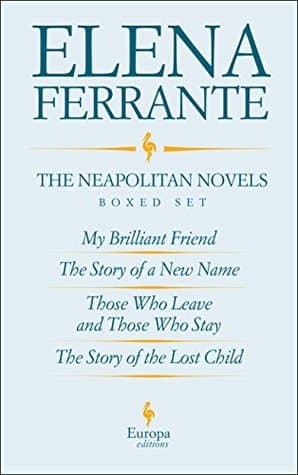
Synopsis
Covers the whole plot, including the ending.
- Difficulty
- Medium
- Pacing
- Variable
- Mood
- Introspective, Intense, Realistic, Melancholy, Evocative
- Read it if
- You love deep, psychological character studies, epic sagas of friendship, and rich historical fiction set in post-war Italy with a strong focus on class, gender, and intellectualism.
- Skip it if
- You prefer fast-paced plots, clear-cut resolutions, or stories with universally likable characters. The raw, often uncomfortable depiction of violence and complex relationships might be challenging.
The Neapolitan Novels Plot Summary
Covers the whole plot, including the ending.
The Disappearance of Lila Cerullo and Early Childhood
The story begins with the elderly Elena Greco getting a call from Lila Cerullo's son, Rino. He tells her Lila has vanished. Elena, knowing Lila always wanted to disappear, decides to write their story. She starts by describing their childhood in a poor, rough neighborhood in Naples in the 1950s. Elena, or Lenù, is a hard-working, studious girl. Raffaella Cerullo, or Lila, is very smart, rebellious, and captivating. Their friendship starts because they both love books and want to escape their difficult surroundings. An early memory is their bold trip up dark stairs to the apartment of Don Achille, the feared loan shark, to get their lost dolls back. This act strengthens their bond and hints at Lila's brave nature.
Adolescence and Diverging Paths
As they become teenagers, their lives start to differ. Even though Lila is very intelligent, her parents, Fernando and Nunzia Cerullo, do not let her go past elementary school. She has to work in her father's shoemaking shop. This unfairness affects Lenù, who can continue her education thanks to her teacher, Maestra Oliviero, and her parents. But Lila secretly reads many books and teaches herself Latin and Greek, showing her strong intellect and ambition even without formal schooling. She designs a new shoe with her brother Rino, hoping to help her family escape poverty. Meanwhile, Lenù struggles with feeling less capable and jealous, always comparing herself to Lila's natural intelligence and charm.
Lila's Marriage and Lenù's Academic Struggles
Lila, now a beautiful young woman, gets attention from several young men, including the wealthy Marcello Solara and the ambitious Stefano Carracci, son of the late Don Achille. After some hesitation, Lila agrees to marry Stefano, who promises to invest in her shoe designs. Their wedding is a big event, a temporary win for Lila and her family. However, the celebration goes wrong when Marcello Solara shows up wearing the shoes Lila designed, a gift from Stefano. This betrays Lila's trust and ruins her hopes for the 'Cerullo' brand. Meanwhile, Lenù continues high school, dealing with insecurity and often feeling overshadowed by Lila's dramatic life, even from a distance. Lenù's academic success becomes her main way to escape, but she often wants to impress Lila.
Lenù's University Life and Early Success
Lenù gets a scholarship and moves to Pisa for university, a big step away from the neighborhood. There, she meets Pietro Airota, a smart and kind academic from a respected family. Their relationship grows, and Lenù finds a new intellectual and social setting, though she sometimes still feels like an outsider. During this time, Lenù writes her first novel, a raw story about female desire and her Neapolitan upbringing. The novel is published to good reviews, bringing her some fame and confirming her intellectual pursuits. This success finally gives Lenù a sense of achievement separate from Lila, though she still wants Lila's approval and understanding of her work. She marries Pietro, starting a seemingly stable and respectable life.
Lila's Entanglement with the Solaras and Marital Strife
Back in Naples, Lila's life with Stefano gets worse. Stefano's connection with the Solara family, especially Michele Solara, a powerful and dangerous person, deepens. Lila starts a passionate and destructive affair with Nino Sarratore, Lenù's childhood crush. This leads to the end of her marriage to Stefano. She eventually leaves Stefano, taking her son Rino, and lives with Nino for a while, having a short period of intense happiness and intellectual stimulation. However, Nino turns out to be unreliable and leaves her, putting Lila in a difficult situation. She finds herself alone, struggling financially, and more involved with the Solaras, who offer her work at their sausage factory. This time marks a big decline for Lila, from the early promise of her marriage to a life of hardship and danger.
Lenù's Family Life and Return to Naples
Lenù's life with Pietro in Florence includes the birth of their two daughters, Dede and Elsa. While she has a comfortable, intellectual life, she feels increasingly unhappy with her marriage and daily routine. Her writing career continues, and she becomes a respected intellectual. However, her connection to her Neapolitan roots and, specifically, to Lila, remains a strong part of her life. She often returns to Naples, drawn by family duties or Lila's dramatic life. During these visits, she sees Lila's struggles, her strength, and her continued intelligence, which often makes Lenù question her own choices and achievements, feeding her ongoing feelings of not being good enough despite her success.
Lila's Political Awakening and Factory Work
After Nino leaves her and she faces money problems, Lila takes a hard job at the Solara family's sausage factory. Here, she sees and experiences worker exploitation, dangerous conditions, and widespread corruption. This experience sparks a strong political awareness in her. She gets involved in union work and socialist movements, using her sharp mind and brave nature to fight for other workers' rights. Her activism puts her against the powerful Solara brothers and the local crime organization, making her life even more dangerous. This time shows Lila's strong commitment to fairness and her ability to change, even when facing great difficulty.
Lenù's Affair and Divorce
Despite her seemingly stable life, Lenù feels a growing unhappiness and a desire for something more intense. During a book tour, she reconnects with Nino Sarratore, now a successful academic. Their renewed connection, fueled by shared history and intellectual understanding, quickly turns into a passionate affair. Lenù eventually leaves Pietro and her daughters to be with Nino, believing she has found true love and intellectual partnership. This choice significantly changes her life, mirroring Lila's own chaotic romantic decisions. However, Nino eventually proves to be as unreliable and self-centered as before, leaving Lenù again heartbroken and disappointed. She has to face how her desires repeat and how her past still influences her.
Lila's Descent into the Camorra's Shadow
After her factory activism and more personal troubles, Lila gets more involved with the local crime organization. She develops a complex and dangerous relationship with Pasquale Peluso, a childhood friend now deeply involved in crime. Lila uses her intelligence, strategic thinking, and knowledge of the neighborhood's power structures to deal with this dangerous world. She takes on various roles, often involving illegal activities, mainly to keep her son, Rino, safe. During this time, Lila operates on the edges of legality. Her actions are often morally unclear, but always driven by a strong will to survive and protect those she cares about. This shows her ability to be both ruthless and very loyal.
Lenù's Return to Naples and Literary Success
After her painful breakup with Nino, Lenù decides to move back to Naples with her daughters. This return to her roots is both a retreat and a new start. She buys an apartment in the same building as Lila, bringing their lives close again. Lenù continues to write, achieving more literary success and becoming a known intellectual. She watches Lila's life closely, seeing her friend's deeper involvement with crime and her increasingly mysterious presence in the neighborhood. Lenù's writing often uses her observations of Lila and the complexities of their city, making their intertwined lives the core of her literary work, even as Lila tries to erase herself.
The Disappearance of Tina and Lila's Final Erasure
The final, terrible event for Lila is the disappearance of her young daughter, Tina. This tragedy is never fully explained but is suggested to be linked to the neighborhood's criminal elements. This loss breaks Lila, pushing her to her final, extreme act: completely erasing herself. Over the years, Lila systematically removes herself from all records, photos, and memories, cutting ties with everyone, including her family. She carefully plans her disappearance, leaving no trace. This last, profound act of self-erasure is the end of her lifelong wish to escape her identity and the oppressive forces around her. It leaves Lenù to deal with her friend's ultimate, defiant freedom and the legacy of their intense, lifelong bond.
Principal Figures
Elena Greco (Lenù/Lenuccia)
Protagonist
The diligent, intellectual narrator and writer, constantly seeking to define herself against Lila.
Lenù is the primary narrator and protagonist, a studious and ambitious woman who uses education and writing as her means of escape from the poverty and violence of her Neapolitan neighborhood. She is often plagued by insecurity, constantly comparing herself to Lila and feeling that her achievements are somehow lesser. Despite her academic and literary success, she struggles with feelings of inadequacy, a conventional marriage, and the complexities of motherhood. Her driving force is a desire for self-definition and intellectual validation, often expressed through her intense observations of Lila and her own experiences.
Relationships: Lila Cerullo (lifelong, intense, complex friendship fueled by admiration, rivalry, and love); Pietro Airota (husband, intellectual but emotionally distant); Nino Sarratore (childhood crush, later lover, intellectual but unreliable); Dede and Elsa Airota (daughters, whom she struggles to balance with her career); Maestra Oliviero (influential elementary school teacher)
Raffaella Cerullo (Lila)
Co-Protagonist/Antagonist (in Lenù's perception)
Brilliantly intelligent, rebellious, and fiercely independent, who defies societal expectations.
Lila is the magnetic, enigmatic, and fiercely intelligent co-protagonist whose life unfolds in dramatic contrast to Lenù's. Denied formal education, she possesses a natural brilliance and an indomitable spirit that allows her to self-educate and navigate the treacherous social and criminal landscapes of Naples. She is impulsive, volatile, and capable of both profound love and shocking ruthlessness. Lila's driving force is a deep-seated rejection of societal constraints and a desire for radical freedom, even if it means self-destruction or invisibility. Her life is a series of intense experiences, from early marriage to Stefano, an affair with Nino, factory work, and eventual entanglement with the Camorra.
Relationships: Elena Greco (lifelong, intense, complex friendship fueled by admiration, rivalry, and love); Stefano Carracci (first husband, initially a source of hope, later a betrayer); Nino Sarratore (lover, intellectual connection, ultimately abandons her); Rino Cerullo (older brother, shares a bond over the shoe business and neighborhood struggles); Fernando and Nunzia Cerullo (parents, who deny her education); Michele and Marcello Solara (powerful neighborhood brothers, with whom she has a complex, dangerous relationship)
Stefano Carracci
Supporting
Lila's first husband, a successful butcher who initially offers a path to prosperity.
Stefano Carracci is the son of Don Achille and a successful butcher. He is initially presented as a charming and ambitious young man who genuinely loves Lila and promises to invest in her shoemaking designs. His marriage to Lila offers a brief glimmer of hope for her escape from poverty. However, Stefano's true character is revealed through his volatile temper, his betrayal of Lila's trust by aligning with the Solara family, and his increasing possessiveness and violence. He represents the seductive yet ultimately oppressive forces of the neighborhood, trapping Lila even in marriage.
Relationships: Lila Cerullo (husband, initially loving, later abusive and controlling); Fernando and Nunzia Cerullo (Lila's parents, his in-laws); Michele and Marcello Solara (business associates, later powerful allies against Lila)
Nino Sarratore
Supporting
Lenù's childhood crush and later lover, a brilliant intellectual but ultimately unreliable.
Nino Sarratore is the son of Donato and Lidia Sarratore, a family initially seen as educated and refined. He is Lenù's first crush and later becomes her lover. Nino is highly intelligent, articulate, and charismatic, attracting both Lenù and Lila with his intellectual prowess and rebellious spirit. He represents the allure of intellectual escape and a more sophisticated world beyond the neighborhood. However, he is also deeply flawed, demonstrating a pattern of selfishness, unreliability, and emotional detachment, ultimately abandoning both Lila and Lenù after intense affairs, leaving a trail of heartbreak and disillusionment.
Relationships: Elena Greco (childhood crush, later lover, intellectual connection); Lila Cerullo (lover, intense affair); Donato Sarratore (father, with whom he has a complex and often strained relationship); Lidia Sarratore (mother)
Pietro Airota
Supporting
Lenù's husband, a kind and intellectual academic from a prominent Florentine family.
Pietro Airota is Lenù's husband, a university professor from a distinguished Florentine family. He is intelligent, gentle, and provides Lenù with a stable, respectable life away from Naples. His family offers Lenù entry into an elite intellectual circle, validating her academic achievements. However, Pietro is often portrayed as emotionally distant and somewhat oblivious to Lenù's deeper emotional needs and struggles, particularly her ongoing obsession with Lila and her Neapolitan past. Their marriage ultimately falters due to a lack of profound connection and Lenù's own dissatisfaction.
Relationships: Elena Greco (husband, intellectual companion, later estranged); Dede and Elsa Airota (daughters); Adele Airota (mother-in-law, a supportive figure for Lenù's writing)
Michele Solara
Supporting
The powerful and dangerous older Solara brother, deeply involved in the Camorra.
Michele Solara is the older and more dangerous of the two Solara brothers, who wield significant power in the neighborhood through their bar, pastry shop, and deep ties to the local Camorra. He is ruthless, calculating, and manipulative, exerting a pervasive influence over the lives of many characters, including Stefano Carracci and, eventually, Lila herself. Michele is attracted to Lila and seeks to control her, offering her work but also trapping her in his orbit. He represents the omnipresent threat of organized crime and the oppressive forces that keep the neighborhood in its grip.
Relationships: Lila Cerullo (obsessed with her, employer, dangerous associate); Marcello Solara (younger brother, partner in crime); Stefano Carracci (business associate, later ally)
Marcello Solara
Supporting
The younger Solara brother, initially a persistent suitor for Lila, later a dangerous associate.
Marcello Solara is Michele's younger brother, equally dangerous but initially more overtly charming. He is one of Lila's earliest and most persistent suitors, obsessed with her beauty and defiant spirit. Marcello embodies the raw, aggressive masculinity of the neighborhood and the sense of entitlement that comes with the Solara family's power. His actions, such as wearing Lila's designed shoes to her wedding to Stefano, are acts of deliberate provocation and assertion of dominance. He remains a menacing presence throughout the narrative, representing the forces that seek to control and exploit Lila.
Relationships: Lila Cerullo (obsessed suitor, later dangerous associate); Michele Solara (older brother, partner in crime)
Maestra Oliviero
Supporting
The influential elementary school teacher who recognizes and champions Lenù's intelligence.
Maestra Oliviero is the girls' demanding but supportive elementary school teacher. She is one of the first adults to recognize the exceptional intelligence of both Lenù and Lila, and she actively encourages their academic pursuits. She plays a crucial role in convincing Lenù's parents to allow her to continue her studies, seeing education as the primary path to escape the neighborhood's limitations. Although she eventually disapproves of Lila's choices, Maestra Oliviero remains a symbol of the transformative power of education and a key figure in shaping Lenù's future.
Relationships: Elena Greco (teacher, mentor, advocate); Lila Cerullo (teacher, recognizes her brilliance but cannot save her from her family's decisions)
Rino Cerullo
Supporting
Lila's older brother, involved in the family shoemaking business and later the Camorra.
Rino Cerullo is Lila's older brother and her partner in the early shoemaking ventures. He shares Lila's ambition to elevate their family through their shoe designs but lacks her intellectual depth and strategic mind. Rino is impulsive and prone to violence, often acting as Lila's protector in the rough neighborhood. He becomes increasingly entangled with the Camorra and struggles with his own demons, including drug addiction. His life mirrors the tragic trajectory of many young men in their neighborhood, caught between aspirations and the pervasive influence of organized crime.
Relationships: Lila Cerullo (brother, partner in shoemaking, protective but often problematic); Fernando Cerullo (father)
Pasquale Peluso
Supporting
A childhood friend who becomes deeply involved in the Camorra.
Pasquale Peluso is a childhood friend of both Lenù and Lila, the son of Alfredo Peluso, a carpenter who is later wrongly imprisoned. Pasquale is a working-class youth who becomes increasingly involved with the local Camorra. He is a complex character, capable of both loyalty and violence, and represents the limited choices available to young men in their neighborhood. His relationship with Lila evolves over time, becoming more significant as she also finds herself entangled in the criminal underworld, relying on his connections and protection.
Relationships: Lila Cerullo (childhood friend, later complex associate in the Camorra); Elena Greco (childhood acquaintance)
Themes & Insights
Friendship, Rivalry, and Love
The main theme is the intense, close, and often damaging friendship between Lenù and Lila. Their bond is a mix of love, admiration, strong rivalry, and deep jealousy. They constantly compare themselves, both inspiring and hindering each other's growth. Lila's presence always pushes Lenù's ambition, while Lenù's successes often make Lila resentful or lead her to more extreme actions. Their relationship shows how female friendships can bring great strength and lasting pain, shaping their identities and life choices more than any other connection.
“'We were one person, a two-headed monster, and this was our strength, our great resource, but also our great misery. Because one head could not exist without the other.”
Identity and Self-Discovery
Both Lenù and Lila work to form their identities despite the limiting social and economic conditions of post-war Naples. Lenù tries to define herself through education and writing, always trying to escape her background and Lila's intelligence. Lila, without traditional schooling, creates a radical identity through defiance, intellect, and change, often trying to erase herself and her past. Their struggle for identity is tied to their efforts to escape, or sometimes to embody, their violent neighborhood. The story explores how much of one's self is natural and how much is shaped by surroundings and relationships.
“'It was as if, after so many years, the old question that had always accompanied us had returned: who am I without her?'”
Social Class and Economic Struggle
The novels clearly show the great poverty and limited chances in a working-class Neapolitan neighborhood. The characters' lives are deeply affected by their social class, which controls access to education, work, and safety. The constant need for money drives many of their choices, from Lila's early marriage to Stefano for perceived security to Lenù's constant pursuit of academic success to improve her life. The presence of the local crime organization further highlights the unfair systems and the desperate actions people take to survive or succeed in a corrupt system, showing how class determines destiny.
“'Our lives were not our own, they were the lives of the neighborhood, the lives of the city, the lives of Italy.'”
Violence and Oppression
Violence, both at home and in society, is always present in the novels. It appears in the brutal fights among neighborhood boys, physical abuse in marriages (like Stefano's toward Lila), and the constant threat of the local crime organization. This oppressive atmosphere shapes the characters' views, their ways of coping, and their hopes. The violence is not just physical; it also comes from limited opportunities, societal expectations, and the mental toll of living where power is often used through fear. It shows how difficult true escape or change can be.
“'The neighborhood was a place where it was easy to get lost, easy to get hurt, easy to disappear.'”
Intellectualism and Education
Education and intellectual pursuits are shown as both a way to escape and a source of great satisfaction, especially for Lenù. Her academic journey, from elementary school to university and a successful writing career, is her main way to rise above her background. For Lila, who did not go to school, intelligence shows in her self-teaching, sharp insights, and ability to understand complex ideas. The theme explores the different values placed on formal versus informal education and the mind's power to question and understand the world, even when limited by circumstances.
“'Books were the only way out, the only way to leave the neighborhood, to see the world.'”
Plot Devices & Literary Techniques
First-Person Retrospective Narration
Elena Greco recounts the entire story from old age, shaping the reader's perception.
The entire 'Neapolitan Novels' series is told from the first-person perspective of Elena Greco (Lenù) as an elderly woman, looking back on her life and her lifelong friendship with Lila. This narrative choice allows for deep introspection, subjective interpretation, and a constant revisiting of memories and emotions. Lenù's voice is highly self-aware, often questioning her own motives and perceptions, especially regarding Lila. The retrospective nature means that events are filtered through Lenù's mature understanding, giving the narrative a reflective and analytical tone, yet also highlighting the unreliability and bias inherent in memory and personal narrative. Her decision to write the story is a direct response to Lila's disappearance, making the act of narration itself a central plot device.
The Disappearance of Lila Cerullo
The framing device that sets the entire narrative in motion and fuels Elena's quest for understanding.
Lila's disappearance at the very beginning of the first novel serves as the primary framing device for the entire series. It is the catalyst that prompts Elena to write their intertwined story, an act of defiance against Lila's desire to erase herself completely. This device creates a constant sense of mystery and urgency, as the reader, like Elena, is driven to understand the 'why' and 'how' of Lila's radical act. It also underscores the profound impact Lila has had on Elena's life, as Elena's narrative becomes an attempt to reconstruct and preserve Lila's existence, even as Lila tries to dismantle it.
The Neighborhood as a Character
The impoverished, violent Neapolitan district that profoundly shapes the characters' lives.
The specific Neapolitan neighborhood where Lenù and Lila grow up functions almost as a character itself. It is not merely a setting but a living, breathing entity that exerts immense influence over the characters' destinies. Its poverty, violence, rigid social hierarchies, and the pervasive presence of the Camorra dictate opportunities, limit choices, and instill a deep sense of belonging mixed with a desperate desire for escape. The neighborhood represents both the roots that ground the characters and the chains that bind them. Its oppressive atmosphere fuels their ambition and shapes their relationships, making their struggles for identity and self-determination inextricably linked to their environment.
Symbolism of Shoes
Represents ambition, creativity, social status, and betrayal.
Shoes carry significant symbolic weight throughout the series. Initially, Lila's design of the revolutionary 'Cerullo' shoes symbolizes her raw talent, ambition, and the hope for economic upliftment for her family. When Stefano Carracci betrays her by presenting the shoes as a gift to Marcello Solara at their wedding, it symbolizes the crushing of Lila's dreams and the pervasive influence of the Camorra. Later, the shoes Lenù wears, or the lack thereof, can reflect her social standing or her attempts to fit into different worlds. The creation, sale, and destruction of shoes mirror the characters' aspirations, their struggles, and the compromises they are forced to make.
The Neapolitan Novels Quotes
“I am not afraid of anything, I am not afraid of anyone, and I am not afraid of anything.”
“We were twelve years old, but we walked along the hot streets of the neighborhood, amid the dust and flies that the occasional old trucks stirred up as they passed, like two old ladies taking the measure of lives of disappointment, fenced in by domestic duties.”
“I was not capable of making up stories, I was only good at studying.”
“She wanted to become, right away, the person she was supposed to become.”
“The beauty of the neighborhood was that everything was always the same, so we could believe that nothing ever changed.”
“I was the shadow of her light.”
“She was trying to say that it was all a game, but for her it was not a game.”
“We were a single thing, and that thing was called Lila and Lenù.”
“The only thing that could not be forgiven was to be born a woman.”
“I felt that I had to become, at all costs, the girl who had been to school.”
“She was like a whirlwind, and I was the calm at the center.”
“The neighborhood was our universe, and we were its prisoners.”
“I wanted to become, through her, what I could not become alone.”
“We were two parts of the same person, and we hated each other for it.”
Quiz
10 questions on the plot and the characters. Each answer comes with a short explanation.
Question 1
What is the name of the fictional neighborhood in Naples where Elena and Lila grow up?
- Rione Sanità
- Rione Luzzatti
- Rione Terra
- Rione
Show answer
D. Rione The Rione is the impoverished neighborhood in Naples where Elena Greco and Lila Cerullo spend their childhood and much of their lives, serving as a central setting that shapes their experiences and relationships.
Question 2
What significant event occurs at the end of 'My Brilliant Friend' that marks a turning point in Elena and Lila's friendship?
- Lila gets married to Stefano Carracci
- Elena moves to Pisa for university
- Lila publishes her first novel
- Elena wins a literary prize
Show answer
A. Lila gets married to Stefano Carracci At the end of the first novel, Lila's marriage to Stefano Carracci symbolizes her entrapment in the traditional, oppressive structures of their neighborhood, contrasting with Elena's pursuit of education and foreshadowing the divergent paths of their friendship.
Question 3
Which character is known for his involvement with the Solaras, the local crime family, and becomes a significant figure in Lila's life?
- Enzo Scanno
- Nino Sarratore
- Michele Solara
- Alfonso Carracci
Show answer
C. Michele Solara Michele Solara, part of the powerful Solara family, becomes obsessed with Lila and plays a key role in her life, representing the dangerous allure and control of organized crime in Naples.
Question 4
In 'The Story of a New Name', what does Lila do with the notebooks containing her writings and thoughts?
- She publishes them under a pseudonym
- She gives them to Elena for safekeeping
- She throws them into the Arno River in Florence
- She throws them into a furnace in the neighborhood
Show answer
D. She throws them into a furnace in the neighborhood Lila burns her notebooks in a furnace, symbolizing her rejection of her intellectual aspirations and the constraints of her life, an act that deeply affects Elena and highlights themes of erasure and self-destruction.
Question 5
What is the primary reason Elena decides to write the story of her friendship with Lila?
- To win a literary award and gain fame
- To process her grief after Lila's death
- To understand Lila's disappearance and preserve their history
- To expose the crimes of the Solaras
Show answer
C. To understand Lila's disappearance and preserve their history Elena begins writing the novels after Lila disappears, aiming to make sense of their complex relationship and ensure that Lila's brilliance and their shared past are not forgotten, reflecting themes of memory and identity.
Question 6
Which historical event serves as a backdrop in 'Those Who Leave and Those Who Stay', influencing the characters' political and social awareness?
- World War II
- The Italian economic miracle of the 1950s
- The Years of Lead and political turmoil in the 1970s
- The fall of the Berlin Wall
Show answer
C. The Years of Lead and political turmoil in the 1970s The Years of Lead, a period of social conflict and terrorism in Italy during the 1970s, shapes the novel's setting, affecting Elena's involvement in feminist movements and the characters' evolving ideologies.
Question 7
How does Lila's character challenge traditional gender roles in the Neapolitan community?
- By becoming a successful businesswoman in the shoe factory
- By moving abroad and cutting ties with her family
- By writing feminist manifestos that gain national attention
- By marrying multiple times to gain independence
Show answer
A. By becoming a successful businesswoman in the shoe factory Lila defies expectations by working in and later managing the shoe factory, demonstrating entrepreneurial skill in a male-dominated environment, which contrasts with the limited roles available to women in their neighborhood.
Question 8
What symbolic object, created in childhood, represents the enduring bond and rivalry between Elena and Lila?
- A doll named Tina
- A secret diary they shared
- A pair of shoes designed by Lila
- A locket exchanged as teenagers
Show answer
A. A doll named Tina The doll Tina, thrown into a cellar by Lila and retrieved by Elena as children, recurs throughout the series as a metaphor for their lost innocence, mutual dependence, and the unresolved tensions in their friendship.
Question 9
In 'The Story of the Lost Child', what tragic event involving Lila's daughter leads to a major crisis in her life?
- Her daughter Tina is kidnapped and never found
- Her daughter Immacolata dies in an accident
- Her daughter runs away to join a political group
- Her daughter is diagnosed with a serious illness
Show answer
A. Her daughter Tina is kidnapped and never found The disappearance of Lila's daughter Tina, named after the childhood doll, causes Lila to unravel emotionally, symbolizing the pervasive loss and violence in their world and deepening the themes of motherhood and trauma.
Question 10
How does Elena's perception of her own success as a writer evolve in relation to Lila's unfulfilled potential?
- She believes her success is entirely due to Lila's inspiration and feels guilty
- She sees it as proof of her superiority and distances herself from Lila
- She attributes it to luck and avoids comparing herself to Lila
- She uses it to financially support Lila and alleviate her own doubts
Show answer
A. She believes her success is entirely due to Lila's inspiration and feels guilty Elena often feels that her literary achievements are derivative of Lila's innate brilliance and ideas, leading to lifelong insecurity and a complex dynamic where her success is intertwined with Lila's shadow, highlighting themes of envy and identity.
The Neapolitan Novels FAQ
What is 'The Neapolitan Novels' about?
The series chronicles the lifelong friendship between Elena Greco and Lila Cerullo, two girls from a poor Naples neighborhood, following their lives from childhood in the 1950s through old age. It explores their complex bond, personal ambitions, struggles with class and gender constraints, and how their relationship evolves against the backdrop of a changing Italy.
Why should I read 'The Neapolitan Novels'?
Ferrante's work offers an unflinching, psychologically rich portrayal of female friendship, capturing its intensity, rivalry, and enduring connection. It provides a vivid social history of post-war Italy while exploring universal themes of identity, ambition, love, and the lasting impact of childhood.
What is the background/setting of 'The Neapolitan Novels'?
The story is set primarily in Naples, Italy, spanning from the 1950s to the early 2000s. It begins in the impoverished, violent neighborhood of Rione Luzzatti, reflecting the post-war struggles, political turmoil, and social transformations of Italy during this period.
What are the most memorable quotes?
Key quotes include Lila's childhood declaration, 'I'm not afraid of anything,' which defines her rebellious spirit, and Elena's reflection, 'We'll see who wins this time,' capturing their lifelong competition. Another is Elena's realization about their friendship: 'She was my brilliant friend, and I was nothing without her.'
What writing style does the author use?
Elena Ferrante employs a raw, intimate first-person narrative from Elena's perspective, blending detailed realism with emotional intensity. The prose is direct and unadorned, often focusing on the inner lives of characters, with a confessional tone that enhances the authenticity of the story.
What minor details add significant meaning?
The recurring motif of Lila's lost doll, Tina, symbolizes vanished childhood innocence and the fragility of memory. The neighborhood's changing landscape, like the construction of new buildings, mirrors the characters' internal transformations and the erosion of their past.
What are some subtle foreshadowing moments?
Early scenes of Lila's violent outbursts and her fascination with boundaries hint at her later struggles with mental instability. Elena's childhood envy of Lila's intelligence foreshadows their lifelong competitive dynamic, where success and failure are constantly reevaluated.
What unexpected character connections exist?
Nino Sarratore, initially a childhood crush for Elena, becomes a pivotal figure who intimately connects with both Elena and Lila, revealing hidden layers of betrayal and desire. The Solara brothers' persistent presence ties the neighborhood's violence to the characters' personal lives across decades.
What are unspoken character motivations?
Elena's academic pursuits are driven not just by intellectual curiosity but by a deep-seated need to escape poverty and prove herself equal to Lila. Lila's rebellious acts often mask a fear of being trapped and a desire for autonomy, which she rarely articulates directly.
What psychological complexities do characters exhibit?
Lila embodies a contradiction of fierce independence and vulnerability, often self-destructing under pressure. Elena grapples with impostor syndrome, feeling her achievements are hollow compared to Lila's innate brilliance, leading to cycles of self-doubt and validation-seeking.
What are the major emotional turning points?
Key moments include Lila's decision to marry Stefano at sixteen, which fractures their friendship; Elena's publication of her first novel, shifting their power dynamic; and the disappearance of Lila's daughter, Tina, which becomes a traumatic turning point in their later lives.
How do relationship dynamics evolve?
The friendship evolves from childhood solidarity to adolescent rivalry, then to adult interdependence marked by resentment and loyalty. In old age, it becomes a reflective, sometimes distant connection, haunted by memories and unresolved tensions.
Which parts remain ambiguous or open-ended?
The fate of Lila's daughter, Tina, is never resolved, leaving a haunting mystery. Lila's final disappearance and whether she intentionally erases herself from existence are left open to interpretation, emphasizing themes of identity and oblivion.
What are controversial scenes or decisions?
Lila's choice to marry the abusive Stefano for financial security sparks debate about agency versus oppression. Elena's affair with Nino, despite his history with Lila, raises questions about betrayal and the limits of friendship.
'The Neapolitan Novels' ending explained: how it ends & what it means
The series ends with Elena receiving Lila's childhood dolls, symbolizing the return of their shared past, after Lila disappears without a trace. This suggests Lila has chosen self-erasure, while Elena is left to preserve their story, reflecting on memory, loss, and the indelible mark of their friendship.
Similar books
- My Brilliant Friend
Elena Ferrante
4.0 (201k) average on GoodreadsLiterary FictionFirst book in the series, essential for context and character introduction.
- A Little Life
Hanya Yanagihara
4.3 (212k) average on GoodreadsLiterary FictionExplores a decades-long, intense, and often painful friendship with deep psychological insight.
- One Hundred Years of Solitude
Gabriel García Márquez
4.1 (753k) average on GoodreadsLiterary FictionAn epic, multi-generational saga set in a specific cultural backdrop, exploring destiny and intertwined lives.
- Pachinko
Min Jin Lee
4.3 (208k) average on GoodreadsLiterary Fiction"The Neapolitan Novels" and "Pachinko" are both multi-generational sagas that meticulously trace the lives of families and individuals against a backdrop of significant historical change and class struggle. Lee's novel focuses on Korean immigrants in Japan, exploring themes of identity, discrimination, and resilience through a more sprawling, family-centric narrative. Ferrante, in contrast, maintains a tight focus on the intense, often co-dependent, friendship between two women, using their bond as the primary lens through which to view societal transformations and personal development within a specific Neapolitan working-class environment. While both excel at historical detail and character development, Ferrante's scope is narrower and more psychologically intense in its exploration of a single relationship.
- The Old Man and the Sea
Ernest Hemingway
3.8 (831k) average on GoodreadsLiterary FictionA Cuban fisherman's long struggle with a giant marlin becomes a story of endurance and dignity, now retold for young adults with illustrations, phonetic guides, and writing prompts in Traditional Chinese.
- The Goldfinch
Donna Tartt
3.9 (720k) average on GoodreadsLiterary FictionHaunted by a tragic explosion and clutching a stolen Dutch masterpiece, a young orphan navigates the opulent drawing rooms of New York and the gritty underbelly of the art world, desperately seeking connection and redemption amidst a life spiraling into crime and obsession.





Enjoyed the summary?
A summary gives you the shape of the book. The book itself has the detail, the examples and the voice.
Find The Neapolitan Novels on AmazonAs an Amazon Associate, BookBrief earns from qualifying purchases. How we're funded