

Core Idea
- Difficulty
- Hard
- Read it if
- You want a foundational, comprehensive, and philosophical understanding of how totalitarian regimes like Nazi Germany and Stalinist Russia came into being, focusing on their unique political structures, psychological underpinnings, and ideological mechanisms.
- Skip it if
- You are looking for a light introduction to 20th-century history, a quick overview of totalitarianism, or a book that offers straightforward solutions to political problems. This book is dense, demanding, and requires significant intellectual engagement.
Key Takeaways from The Origins of Totalitarianism
Loneliness as a Precondition for Total Domination
Totalitarianism exploits the atomized individual, not the isolated one.
Arendt clearly separates isolation and loneliness. Isolation is political; it means being cut off from political action and public life, but still able to have private relationships and creative pursuits. Loneliness, however, is much deeper: it is a state where one feels abandoned by all human company, unable to connect, and stripped of the ability to experience. This extreme aloneness, a 'desert' of human connection, is where totalitarian movements grow. When people become mere parts of an ideological machine, their unique experiences and views become meaningless, making them open to the single-minded 'logic' of totalitarian thought. This deep disconnection stops real disagreement or group resistance from forming, as individuals lose faith in shared reality and their own ability to judge independently.
“Loneliness, the common ground for terror, the essence of totalitarian government, and for the ideological thinking or rather logical reasoning which prepares individuals for it, is one of the most acute and most desperate experiences of man.”
In the book: Arendt meticulously traces how the breakdown of class structures and traditional social bonds in pre-totalitarian societies led to the emergence of 'masses' – undifferentiated, atomized individuals. These masses, devoid of shared interests or meaningful group affiliations, were particularly vulnerable to totalitarian propaganda and the promise of belonging, however illusory.
Try this: Cultivate genuine social connections and participate in community life. Resist narratives that seek to isolate individuals or groups by undermining trust and shared reality. Actively engage in public discourse, even in small ways, to counter the atomizing effects of modern society.
Related ideas: isolation, mass-society, propaganda
Ideology's Totalitarian Logic
Totalitarian ideologies impose a 'super-sense' that annihilates reality.
For Arendt, totalitarian ideologies are not just systems of ideas but 'super-senses' that claim to explain all past, present, and future events through one all-encompassing logical deduction. Whether it is the 'law of nature' for Nazism (racial struggle) or the 'law of history' for Stalinism (class struggle), these ideologies provide a consistent, unquestionable story that claims to reveal the hidden truth behind everything. This 'logic' is so absolute that it overrides common sense, experience, and facts. When reality goes against the ideology, reality is considered false or temporary, to be forcibly changed. This creates an internally consistent, closed system of thought that is terrifyingly immune to outside criticism or evidence, eventually destroying the idea of objective truth.
“Totalitarian ideologies are characterized by their claim to possess either the key to history, or the solution to the riddles of the universe, or the masterplan for the organization of life itself.”
In the book: Arendt highlights how both Nazi racial theory and Bolshevik historical materialism were presented as infallible scientific truths, predicting inevitable outcomes. The purging of 'enemies of the people' in Stalinist Russia, for instance, wasn't about individual guilt but about fulfilling a historical necessity dictated by the ideology, regardless of actual facts.
Try this: Be deeply skeptical of any singular, all-encompassing explanation for complex societal problems. Actively question narratives that dismiss factual evidence or lived experience in favor of an abstract, 'logical' inevitability. Value and defend the messy, contradictory nature of reality over neat, totalizing explanations.
Related ideas: ideology, totalitarianism, super-sense
Terror as the Essence of Totalitarian Rule
Totalitarian terror is not a means to an end, but the very principle of government.
Arendt argues that totalitarian terror is fundamentally different from tyrannical violence. Tyrannical violence aims to eliminate political opposition and secure power. Totalitarian terror, in contrast, is not just a tool for stopping dissent but the permanent, all-encompassing rule of government itself. Its purpose is to enforce the 'law' of the ideology (racial purity or historical necessity) and ensure that humanity conforms to its demands. This means terror is directed not just at enemies, but at everyone, creating an atmosphere of constant fear and unpredictability. It breaks down society, preventing any spontaneous action, thought, or dissent, thus making individuals interchangeable and expendable. Terror dissolves all private and public spaces, leaving no refuge from the state's ever-present power, and thus ensures the 'unhindered' movement of the ideological 'law'.
“Terror is the realization of the law of movement; its chief aim is to make it possible for the force of nature or the force of history to race through mankind, unhindered by any spontaneous human action.”
In the book: The concentration camps and Gulags are not merely punitive institutions but the 'laboratories' where totalitarian terror is perfected, demonstrating that human beings are entirely superfluous and can be created or destroyed according to ideological necessity. The arbitrary arrests and purges under Stalin, often targeting loyal party members, illustrate terror's indiscriminate nature, designed to keep everyone in a state of fear and obedience to the 'law of history.'
Try this: Recognize that the normalization of fear and arbitrary punishment, even in seemingly minor instances, can erode the foundations of a free society. Defend due process, the rule of law, and the right to dissent as bulwarks against terror. Support institutions that protect individuals from arbitrary state power.
Related ideas: terror, totalitarianism, rule-of-law
The Banality of Evil
Totalitarianism thrives on thoughtlessness, not necessarily malice.
While Arendt's 'banality of evil' concept is more developed in Eichmann in Jerusalem, its beginnings are visible in Origins. She suggests that totalitarian systems do not necessarily need deeply evil people to work. Instead, they thrive on a lack of critical thinking, an unquestioning acceptance of orders, and a failure to consider the moral implications of one's actions. When people become mere parts of a large administrative machine, they stop thinking for themselves, becoming detached from the reality and consequences of their deeds. This thoughtlessness, rather than active malice, allows horrific acts to be committed on a large scale, as individuals give up personal responsibility and moral judgment to the 'system' or the 'ideology.' It shows the dangerous human ability to simply follow orders without reflection.
“The sad truth is that most evil is done by people who never make up their minds to be either good or bad.”
In the book: The vast bureaucratic apparatus of the Nazi regime, where countless individuals performed their 'duties' without necessarily harboring intense personal hatred for Jews, but simply followed established procedures and regulations. Arendt observes how the sheer scale and administrative nature of totalitarian atrocities dehumanized both victims and perpetrators, making the latter see their actions as mere tasks within a larger, impersonal system.
Try this: Cultivate critical thinking and moral imagination. Question authority, especially when it demands actions that violate fundamental human dignity. Take personal responsibility for your choices, even within a larger organizational structure. Resist the temptation to become a 'cog' in any system without reflecting on its ethical implications.
Related ideas: banality-of-evil, thoughtlessness, obedience
From Classes to Masses
The collapse of traditional class structures paved the way for totalitarian movements.
Arendt argues that totalitarian movements were built not on the revolutionary passion of specific classes, but on the isolated 'masses' that came from the breakdown of traditional class societies in Europe. The old class system, despite its flaws, gave individuals a sense of belonging, shared interests, and a structured place in society. When these structures collapsed due to economic problems, war, and political instability, millions of people were left without social or political representation, feeling unnecessary and disconnected. These 'masses' were marked by their indifference to public affairs, their lack of shared interests, and their deep loneliness. They were not driven by specific class complaints but by a general feeling of meaninglessness and a desire for belonging, making them very open to the all-encompassing promises of ideological movements.
“The chief characteristic of the mass man is not brutality and backwardness, but his isolation and lack of normal social relationships.”
In the book: The post-World War I era in Germany and the economic instability leading up to the Russian Revolution created vast populations of disillusioned, unemployed, and politically unrepresented individuals who felt abandoned by existing political parties and institutions. These were the 'masses' who swelled the ranks of the Nazi and Bolshevik parties, drawn by the promise of a new, all-encompassing identity.
Try this: Support and participate in diverse community organizations, civic groups, and political parties that foster shared identity and collective action. Be wary of political rhetoric that seeks to dissolve existing social structures or demonize entire groups, as this can lead to atomization. Recognize the importance of mediating institutions between the individual and the state.
Related ideas: mass-society, class-structure, atomization
Imperialism's Precedent for Total Domination
European colonial practices laid the groundwork for totalitarian methods at home.
Arendt argues that European imperialism, especially in Africa, was a testing ground for methods later used by totalitarian regimes in Europe. Practices like racial ideology, bureaucratic terror, the idea of 'superfluous' populations, and the arbitrary imposition of rule were developed and normalized in the colonies. The justification for colonial expansion often relied on dehumanizing racial theories and the idea that some populations were expendable or needed to be 'managed' through violence. This experience desensitized European agents to the value of human life and introduced the idea that 'laws of nature' (race) could override human laws and morality. The return of these brutalized agents and the normalization of these practices within European political thought contributed to the intellectual and psychological atmosphere ready for totalitarianism.
“The 'white man's burden' was a heavy one indeed, but not because it consisted of civilizing savages, but because it meant transforming men into natives and natives into mere specimens.”
In the book: Arendt points to figures like Cecil Rhodes and the British colonial administration in South Africa, where racial laws and administrative violence against indigenous populations foreshadowed later totalitarian practices. The use of concentration camps during the Boer War, and the general disregard for human rights in colonial territories, provided a blueprint for the dehumanization and administrative extermination seen in Nazi Germany.
Try this: Critically examine historical narratives of colonialism and recognize how past injustices can have profound and lasting impacts on political culture. Understand that the dehumanization of 'others,' wherever it occurs, creates dangerous precedents that can be turned against anyone. Advocate for human rights universally, without distinction of race or origin.
Related ideas: imperialism, racism, dehumanization
The Origins of Totalitarianism Quotes
“The most radical revolutionary will become a conservative the day after the revolution.”
“Totalitarianism, in power, invariably replaces all first-rate talents, regardless of their sympathies, with those crackpots and fools whose lack of intelligence and creativity is still the best guarantee of their loyalty.”
“The ideal subject of totalitarian rule is not the convinced Nazi or the convinced Communist, but people for whom the distinction between fact and fiction (i.e., the reality of experience) and the distinction between true and false (i.e., the standards of thought) no longer exist.”
“Loneliness, the common ground for terror, is at the same time the most common and the most terrible experience of man.”
“Terror is the essence of totalitarian domination.”
“The moment we no longer have a free press, anything can happen. What is at stake is not the truth, but the right to ascertain the truth.”
“What makes it so plausible to assume that hypocrisy is the vice of vices is that integrity can stand in its way only if it is not itself a form of hypocrisy.”
“The aim of totalitarian education has never been to instill convictions but to destroy the capacity to form any.”
“Violence can destroy power; it is utterly incapable of creating it.”
“Evil in the Third Reich had lost the quality by which most people recognize it—the quality of temptation. Many things were done that were not tempting at all, but only obligatory.”
“The trouble with modern revolutions is that they are all, without exception, in the hands of the professional revolutionaries.”
“Every end in history necessarily contains a new beginning.”
“The end of action, unlike the end of manufacture, can never be reliably predicted.”
“A life without speech and without action, that is, without the world and without one's fellow men, is, literally, a dead life.”
Quiz
10 questions on the main ideas. Each answer comes with a short explanation.
Question 1
According to Arendt, which two historical phenomena are examined as precursors to the rise of totalitarianism in the first two parts of 'The Origins of Totalitarianism'?
- The Enlightenment and the French Revolution
- The rise of anti-Semitism and European colonial imperialism
- The Industrial Revolution and the rise of nationalism
- World War I and the Russian Revolution
Show answer
B. The rise of anti-Semitism and European colonial imperialism Arendt explicitly begins her analysis with the rise of anti-Semitism in the 1800s and then examines European colonial imperialism from 1884 to World War I as foundational elements leading to totalitarianism.
Question 2
Arendt argues that Nazi Germany and Stalinist Russia were fundamentally:
- Opposing philosophies of Right and Left
- Distinct forms of authoritarianism
- Two sides of the same coin, sharing core totalitarian features
- Responses to the economic crises of the interwar period
Show answer
C. Two sides of the same coin, sharing core totalitarian features A central argument of Arendt's work is that despite their ideological differences, Nazi Germany and Stalinist Russia were both genuine forms of totalitarian government, sharing fundamental characteristics, which she describes as 'two sides of the same coin.'
Question 3
What does Arendt identify as a crucial precondition for total domination by totalitarian regimes?
- Economic prosperity and widespread literacy
- A strong tradition of democratic institutions
- Isolation and loneliness
- Religious fervor and communal solidarity
Show answer
C. Isolation and loneliness Arendt specifically discusses 'the nature of isolation and loneliness as preconditions for total domination,' highlighting how the atomization of society makes individuals susceptible to totalitarian control.
Question 4
How does Arendt characterize the transition from 'classes' to 'masses' in the context of totalitarianism?
- A natural evolution of industrial society leading to greater social cohesion.
- The disintegration of traditional class structures, leading to atomized, unorganized individuals susceptible to manipulation.
- The strengthening of class consciousness and political organization among the working class.
- A demographic shift caused by rapid urbanization and population growth.
Show answer
B. The disintegration of traditional class structures, leading to atomized, unorganized individuals susceptible to manipulation. Arendt argues that totalitarian movements exploit the breakdown of traditional class structures, transforming organized classes into undifferentiated, atomized masses who lack common interests and are thus more easily controlled.
Question 5
In Arendt's view, what is the primary function of propaganda in the context of a totalitarian regime's relationship with the 'nontotalitarian world'?
- To genuinely persuade foreign powers of the regime's ideology.
- To maintain a facade of normalcy and ideological consistency for external consumption, while terror operates internally.
- To incite revolution in other countries.
- To provide accurate information about the regime's policies and goals.
Show answer
B. To maintain a facade of normalcy and ideological consistency for external consumption, while terror operates internally. Arendt distinguishes the role of propaganda for external audiences from the role of terror internally. Propaganda aims to create a believable, consistent image for the outside world, often masking the true nature of the regime's internal operations, which are governed by terror.
Question 6
Arendt's analysis of totalitarianism suggests that terror is not merely a means to an end, but rather:
- A temporary measure to suppress immediate opposition.
- An inherent and continuous principle of totalitarian rule, essential for maintaining total domination.
- A tool used exclusively against political opponents.
- A sign of the regime's weakness and instability.
Show answer
B. An inherent and continuous principle of totalitarian rule, essential for maintaining total domination. For Arendt, terror is not just a police tool but a fundamental and ongoing mechanism of totalitarian government. It is used not only against enemies but also against loyal citizens to maintain a state of permanent instability and obedience, ensuring total domination.
Question 7
Which of the following best describes Arendt's argument regarding the 'banality of evil' (a concept she further developed in 'Eichmann in Jerusalem' but whose seeds are present in her understanding of totalitarian functionaries)?
- Evil acts are typically perpetrated by inherently monstrous individuals driven by deep ideological conviction.
- The greatest evils are often committed by ordinary people who fail to think, exercising thoughtlessness rather than malice.
- Evil is a mystical force that transcends human understanding.
- Only those who are mentally ill are capable of extreme evil.
Show answer
B. The greatest evils are often committed by ordinary people who fail to think, exercising thoughtlessness rather than malice. While 'banality of evil' is explicitly coined later, Arendt's analysis of totalitarian systems in 'The Origins' already lays groundwork for understanding how individuals within such systems can become cogs in an apparatus of terror and destruction without necessarily being 'demonic,' but rather through conformity, lack of critical thought, and adherence to bureaucratic logic. The question specifically asks about the 'seeds' of this concept.
Question 8
Arendt critically distinguishes totalitarianism from mere tyranny or authoritarianism by emphasizing its unique ambition to:
- Control only the political sphere of society.
- Eliminate all existing institutions and social structures to establish a completely new, 'fabricated' reality, controlling not just actions but also thought and human nature itself.
- Restore traditional values and social hierarchies.
- Achieve economic efficiency and national prosperity above all else.
Show answer
B. Eliminate all existing institutions and social structures to establish a completely new, 'fabricated' reality, controlling not just actions but also thought and human nature itself. Arendt argues that totalitarianism goes beyond mere suppression of dissent or political control. Its ultimate goal is total domination, which involves destroying all spontaneous human activity, transforming human nature, and creating a 'fabricated' reality where ideology dictates all aspects of life, eliminating plurality and unpredictability.
Question 9
In her examination of European colonial imperialism, Arendt highlights how the experiences in overseas territories, particularly the practices of racial superiority and administrative arbitrariness, contributed to:
- The development of robust democratic institutions in Europe.
- The strengthening of international law and human rights.
- The erosion of traditional moral and political safeguards, paving the way for totalitarian methods to be imported back into Europe.
- The widespread acceptance of multiculturalism and diversity.
Show answer
C. The erosion of traditional moral and political safeguards, paving the way for totalitarian methods to be imported back into Europe. Arendt argues that the dehumanizing practices, racial ideologies, and administrative terror developed in colonial contexts (e.g., South Africa) served as a 'dress rehearsal' for totalitarianism, eroding moral and political norms that might otherwise have resisted totalitarian movements in Europe itself.
Question 10
Arendt contends that the 'loneliness' she identifies as a precondition for totalitarian domination is distinct from 'solitude' because loneliness implies:
- A deliberate choice to withdraw from society for contemplation.
- Being without human companionship, but still connected to the world through thought and self-dialogue.
- Being abandoned by all human companionship and unable to engage in self-dialogue, thus losing one's connection to the world and reality.
- A transient emotional state that can be easily overcome by social interaction.
Show answer
C. Being abandoned by all human companionship and unable to engage in self-dialogue, thus losing one's connection to the world and reality. Arendt makes a crucial distinction: solitude is being alone with oneself (a state conducive to thought), whereas loneliness is being utterly abandoned by all human companionship, losing the ability for self-dialogue, and thus becoming disconnected from the world and reality. This radical isolation makes individuals susceptible to ideological manipulation.
The Origins of Totalitarianism FAQ
What is the main argument of Hannah Arendt's The Origins of Totalitarianism?
Arendt argues that totalitarianism, exemplified by Nazi Germany and Stalinist Russia, is a novel form of government distinct from traditional tyranny or authoritarianism. She traces its origins through anti-Semitism and imperialism, highlighting how these historical forces created the conditions for total domination.
Does Arendt consider Nazism and Stalinism to be the same?
Arendt famously asserts that Nazi Germany and Stalinist Russia were 'two sides of the same coin' rather than opposing philosophies. She analyzes their shared institutional structures and operational methods, such as the use of terror and propaganda, despite their differing ideological pretexts.
What role does anti-Semitism play in the origins of totalitarianism according to Arendt?
Arendt dedicates the first volume to the rise of anti-Semitism in 19th-century Europe, viewing it not as the sole cause but as a crucial precursor. She explains how it helped dismantle traditional class structures and fostered a climate of statelessness and rootlessness, contributing to the formation of atomized masses susceptible to totalitarian movements.
What is the significance of imperialism in Arendt's analysis?
European colonial imperialism, particularly from 1884 to WWI, is explored in the second volume. Arendt argues that the administrative practices and racial ideologies developed during colonial rule provided a blueprint for later totalitarian regimes, demonstrating how domination over 'superfluous' populations became normalized.
How does Arendt define 'total domination'?
Total domination, for Arendt, is the ultimate goal of totalitarian regimes, characterized by the eradication of human spontaneity and plurality. It relies on the systematic use of terror to eliminate all opposition, both real and potential, and to enforce a consistent, ideologically driven reality, ultimately isolating individuals.
What is the role of propaganda in totalitarian regimes?
Arendt posits that propaganda in totalitarian states is primarily directed at the nontotalitarian world and the initial stages of a movement. Internally, once power is consolidated, terror replaces overt persuasion, as the regime aims to enforce its ideology through fear and the systematic destruction of objective reality.
How different is Arendt's view of totalitarianism from other political theories of her time?
Arendt distinguishes her theory by emphasizing the unprecedented nature of totalitarianism, arguing it's not merely an extreme form of tyranny or a traditional dictatorship. She focuses on its unique structural elements, such as the ideological drive towards total domination and the creation of 'superfluous' people, rather than solely on economic or class-based explanations.
Does 'The Origins of Totalitarianism' offer solutions to prevent totalitarianism?
While the book is primarily an analytical and historical work, not a prescriptive guide, it implicitly suggests that understanding the preconditions and mechanisms of totalitarianism is essential for its prevention. Arendt highlights the importance of political freedom, plurality, and resistance to ideological thought as safeguards against total domination.
What does Arendt mean by the 'loneliness' and 'isolation' as preconditions for totalitarianism?
Arendt argues that loneliness and isolation, distinct from solitude, are crucial preconditions. Loneliness is the experience of being abandoned by the world, while isolation is the inability to act in concert with others. These states make individuals susceptible to the ideological fictions of totalitarian movements, which promise a false sense of belonging and purpose.
About the author
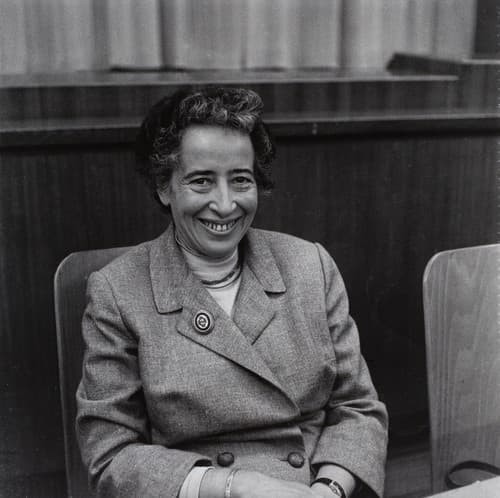
Hannah Arendt was a political theorist and philosopher known for her work on totalitarianism, authority, and the nature of power. Her notable book, "The Origins of Totalitarianism," explores the rise of totalitarian regimes in the 20th century and their impact on society. Arendt's writings have significantly influenced contemporary political thought and discussions on human rights and democracy.
Similar books
- 1984
George Orwell
4.2 (3.1M) average on GoodreadsPoliticsExplores the psychological impact of totalitarian control and surveillance on the individual, complementing Arendt's theoretical analysis.
- Brave New World
Aldous Huxley
4.0 (1.4M) average on GoodreadsFantasyOffers a dystopian vision of social control, albeit through different means (conditioning and pleasure) than Arendt's terror-based totalitarianism.
- Animal Farm
George Orwell
4.0 (2.7M) average on GoodreadsPoliticsA farm animals' rebellion against humans turns into a pig-led dictatorship, showing how power corrupts and revolutionary ideals are betrayed.
- Freakonomics: A Rogue Economist Explores the Hidden Side of Everything
Steven D. Levitt
4.0 (709k) average on GoodreadsBusinessThis book uses economic principles to reveal the surprising incentives behind everything from drug dealing and real estate to cheating teachers and the decline of crime.
- I Am Malala: The Story of the Girl Who Stood Up for Education and Was Shot by the Taliban
Malala Yousafzai
4.1 (419k) average on GoodreadsPoliticsA teenage girl from a Taliban-controlled valley refuses to give up her books, becoming a global voice for education even after an assassination attempt.
- Atlas Shrugged
Ayn Rand
3.7 (354k) average on GoodreadsPoliticsIn a dystopian America where innovators vanish, a brilliant heiress races to uncover the truth behind the disappearing industrialists and the enigmatic John Galt, who vows to stop the world's progress.






Enjoyed the summary?
A summary gives you the shape of the book. The book itself has the detail, the examples and the voice.
Find The Origins of Totalitarianism on AmazonAs an Amazon Associate, BookBrief earns from qualifying purchases. How we're funded