
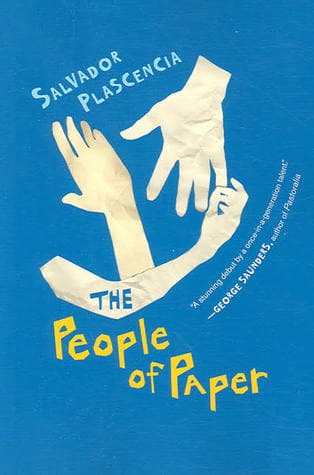
Synopsis
Covers the whole plot, including the ending.
- Difficulty
- Hard
- Pacing
- Variable
- Mood
- Experimental, Surreal, Philosophical, Melancholy
- Read it if
- You enjoy experimental literary fiction that plays with meta-narrative, unique formatting, and philosophical questions about authorship and free will.
- Skip it if
- You prefer traditional linear narratives, character-driven plots without meta-commentary, or find unconventional typography distracting.
The People of Paper Plot Summary
Covers the whole plot, including the ending.
The Introduction of Saturn and the Scissor-Wielding Author
The story begins with Saturn, a former boxer, living in a world where people are made of paper. Saturn falls in love with Merced de Papel. Their romance is passionate, but one day, Merced disappears. Saturn is heartbroken and searches for her. He soon learns that his life, including Merced's disappearance, is controlled by a reclusive author. This author, known as the 'Scissor-Man,' uses scissors to cut characters from his story for his own amusement.
Federico de la Fe and the Virgin of the Paper
We meet Federico de la Fe, a sad and religious man whose life changed after his wife died. In his grief, Federico finds comfort in a paper Virgin Mary. He becomes her guardian and carries the delicate paper icon with him. Federico believes the Virgin of the Paper has spiritual power and can offer protection and guidance in their fragile, paper world. His faith and the Virgin's influence become central to his life, drawing others to him and opposing the author's destructive actions.
The Founding of the City of Ampersand
To escape the Scissor-Man's edits and deletions, a group of marginalized characters bands together. This group includes the 'faceless' – characters whose features the author removed – and the 'erased' – those partially or fully cut from the story. They create a hidden city called Ampersand, a sanctuary built on resistance and self-determination. Ampersand becomes a symbol of hope and defiance, a place where characters can exist outside the author's direct control, trying to create their own destinies and protect themselves. This city represents a rebellion against the oppressive narrative.
Saturn's Quest for Merced and the Author's Intervention
Driven by love, Saturn's search for Merced grows. His journey is dangerous, with the author subtly — and sometimes openly — interfering. The Scissor-Man, watching Saturn's struggle, takes an interest in his suffering, often adding obstacles or changing the landscape. Saturn starts to understand the author's power, realizing that even his memories and perceptions can be manipulated. This realization fuels his desperation and his anger towards his unseen creator, pushing him to seek radical solutions to regain control and find his lost love.
The Faceless and Their Quest for Identity
Among Ampersand's inhabitants are the 'faceless,' characters whose facial features the author cut away. They wander with blank faces, struggling with loss and anonymity. Their goal is to regain their faces, and with them, their identities and ability to express themselves. They believe that by resisting the author's deletions, they can reclaim their personhood. Their struggle highlights the theme of identity and the importance of self-definition in a world where external forces threaten to diminish one's existence. They are a symbol of rebellion against narrative control.
Federico's Pilgrimage and the Virgin's Influence
Federico de la Fe continues his pilgrimage, carrying his paper Virgin Mary. His devotion and the Virgin's perceived miracles attract a following. People, desperate for hope and protection, are drawn to Federico and his icon, believing she can offer comfort from the author's unpredictable will. This growing following around the Virgin of the Paper does not go unnoticed by the Scissor-Man. The author, watching his creations, becomes intrigued by Federico's faith and the Virgin's influence, seeing it as a challenge to his authority.
The Author's Growing Frustration and Experiments
As his characters, especially those in Ampersand, show more resistance and self-determination, the Scissor-Man becomes agitated. Their attempts to write their own stories and escape his control anger him. In response, he increases his destructive actions, making more drastic and cruel edits. He cuts out limbs, deletes memories, and adds chaotic elements to the story, all to reassert his power. These experiments are not just malicious; they also reflect his artistic frustrations and a desperate need to maintain control over his paper world, even if it means tearing it apart.
Saturn Discovers the Author's Sanctuary
Through determination, Saturn breaks through the narrative barriers and finds the author's hidden sanctuary. This is a key moment, as a character directly confronts their creator, going beyond the limits of their fictional reality. Saturn's journey takes him to a place where the paper world and the author's 'real' world meet, a space where creation and destruction are clear. This discovery is both terrifying and empowering, offering Saturn a direct path to confront the source of his suffering and possibly reclaim what was taken from him.
The Confrontation and the Virgin's Sacrifice
The story builds to a confrontation between Saturn and the Scissor-Man. Saturn, driven by love and anger, challenges his creator. At the same time, Federico de la Fe and his followers arrive, bringing the Virgin of the Paper. In an act of defiance, the Virgin of the Paper makes a sacrifice, allowing herself to be cut or altered in a way that weakens the author's power. This act is a personal and symbolic sacrifice, reducing the author's control over the paper world and offering hope for freedom.
The Aftermath and the Re-writing of Reality
After the confrontation and the Virgin's sacrifice, the Scissor-Man's power is diminished. He can no longer arbitrarily cut and delete characters. While he still exists, his authority is challenged. The characters, especially those from Ampersand, use this chance to begin rewriting their own reality. They mend their torn pages, reclaim their erased features, and start to build a world where their destinies are their own. However, the scars of the author's actions remain, reminding them of their fragile existence and the ongoing struggle for self-determination. Merced's fate, while still unclear, is now potentially within Saturn's grasp to define.
Principal Figures
Saturn
Protagonist
A former boxer searching for his lost love, Merced, and challenging his creator.
Saturn is a man of immense passion and resilience, a former boxer whose life takes a tragic turn with the disappearance of his beloved Merced de Papel. His love for Merced drives his every action, transforming him from a heartbroken lover into a defiant rebel. He possesses a stubborn refusal to accept the reality imposed upon him, leading him on a perilous quest to confront the author who controls his world. Saturn represents the individual's fight for agency and the enduring power of love against seemingly insurmountable odds.
Relationships: Merced de Papel (Lost love and primary motivation); The Scissor-Man (Antagonistic creator)
Merced de Papel
Catalyst/Lost Love
Saturn's beloved, whose disappearance triggers his journey and exposes the author's control.
Merced de Papel is the enigmatic and beautiful woman whose sudden disappearance plunges Saturn into despair and sets the entire narrative in motion. She is the embodiment of Saturn's joy and the painful void left in her absence. Though largely absent for much of the story, her memory and the hope of her return are powerful forces. She represents the fragility of happiness and the profound impact of loss in a world where existence itself is precarious. Her status as a 'cut' character highlights the author's arbitrary power and the devastating consequences of his interventions.
Relationships: Saturn (Beloved partner)
The Scissor-Man (The Author)
Antagonist
The unseen, omnipotent author who manipulates and cuts his paper characters.
The Scissor-Man is the malevolent and capricious author who literally controls the lives of the paper people. He is an unseen force, yet his presence is felt throughout the narrative through his arbitrary edits, deletions, and creative interventions. He represents unchecked power, artistic hubris, and the existential dread of being a creation at the mercy of a creator. His motivations are complex, ranging from a desire for narrative control to a perverse enjoyment of his characters' suffering. He is the ultimate antagonist, embodying the forces that threaten the characters' free will and existence.
Relationships: Saturn (Creator and antagonistic subject); Federico de la Fe (Observer and manipulator); The Faceless/Erased (Victims of his edits)
Federico de la Fe
Supporting/Spiritual Leader
A devout man who becomes the guardian of the miraculous Virgin of the Paper.
Federico de la Fe is a man consumed by grief after the death of his wife, finding solace and a new purpose in his devotion to the Virgin of the Paper. He is deeply spiritual and becomes a beacon of hope for many in the fragile paper world. His unwavering faith provides a stark contrast to the author's destructive nature, suggesting that belief can offer protection and meaning even in the face of arbitrary power. Federico's journey is one of spiritual conviction and the search for miracles in a world that often seems devoid of them, drawing a following that challenges the author's narrative.
Relationships: The Virgin of the Paper (Devoted guardian); His deceased wife (Source of his initial grief and devotion)
The Virgin of the Paper
Symbolic/Supporting
A miraculous paper icon believed to offer protection and challenge the author's power.
The Virgin of the Paper is a powerful symbolic figure, a delicate paper icon discovered and protected by Federico de la Fe. She represents hope, faith, and the potential for a higher power or meaning beyond the author's control. Her perceived miracles and the devotion she inspires provide a counter-narrative to the author's destructive tendencies. She is not a sentient character in the traditional sense, but her presence and the belief in her power drive significant plot developments and contribute to the collective resistance against the Scissor-Man. Her ultimate sacrifice is a pivotal moment in the narrative.
Relationships: Federico de la Fe (Devoted guardian); The People of Paper (Symbol of hope and protection)
The Faceless
Supporting/Collective
Characters whose faces have been cut away by the author, seeking to reclaim their identities.
The Faceless are a collective of characters who have been literally stripped of their facial features by the Scissor-Man. They are a poignant representation of the author's cruelty and the loss of individual identity under oppressive control. Their struggle is deeply existential, as they seek to regain their faces and, with them, their ability to express themselves and be recognized as unique individuals. They are among the first to form the city of Ampersand, symbolizing the collective resistance against the author's power and the fight for self-definition in a world where their very being is subject to external manipulation.
Relationships: The Scissor-Man (Oppressor); The People of Ampersand (Fellow resistors)
The Erased
Supporting/Collective
Characters partially or entirely cut from the narrative, striving for existence.
The Erased are another group of characters who have suffered at the hands of the Scissor-Man, having been partially or entirely cut from the narrative. They represent the ultimate vulnerability of the paper people and the constant threat of non-existence. Their struggle is to simply *be*, to maintain their presence in the story despite the author's attempts to delete them. They join the Faceless in forming Ampersand, seeking refuge and a collective strength to resist further erasure. Their existence highlights the meta-fictional aspect of the novel, emphasizing the fragility of narrative and the power of authorship.
Relationships: The Scissor-Man (Oppressor); The People of Ampersand (Fellow resistors)
Themes & Insights
The Nature of Authorship and Control
This theme explores the power between creator and creation, with the Scissor-Man as the author who shapes and destroys his characters. The novel questions the ethics of such power, showing the suffering caused by arbitrary decisions. The characters' rebellion, especially Ampersand's creation and Saturn's confrontation, represents a fight for freedom against narrative control. It makes readers consider the responsibility of creation and the fragility of fictional worlds when controlled by a whimsical hand.
“He held the scissors, and with them, he held their very breath.”
The Search for Identity and Self-Determination
A main theme is the characters' search to define themselves outside the author's rules. The 'faceless' characters, stripped of identity, embody this struggle, as do the 'erased' who fight for their existence. Ampersand's creation is a collective act of self-determination, a place where characters try to write their own stories. Saturn's pursuit of Merced is also a fight for his personal story, refusing the author's version of his fate. This theme highlights the human desire for individuality and freedom, even in a world where existence is dictated by an external force.
“To not have a face was to not have a story, to be a blank page waiting for someone else's cruel hand.”
The Enduring Power of Love and Faith
Despite the harsh realities from the Scissor-Man, love and faith are strong forces of resistance and hope. Saturn's love for Merced drives his journey, giving him strength to challenge his creator. Federico de la Fe's faith in the Virgin of the Paper provides comfort and inspires a community, offering a spiritual alternative to the author's control. These themes suggest that emotional and spiritual connections can overcome physical manipulation and narrative erasure, providing meaning and purpose in a chaotic world. They are anchors in a world constantly being rewritten.
“Love was the only story they truly owned, the one the Scissor-Man could never fully cut away.”
Metafiction and the Deconstruction of Narrative
The novel is metafictional, constantly drawing attention to its own construction as a story. The author as a character in the narrative, literally cutting and pasting, breaks down the illusion of fiction. It blurs the lines between author, reader, and character, inviting the audience to consider how storytelling works. The fragility of the paper world and its inhabitants is a metaphor for the precariousness of any narrative, subject to its creator's whims. This theme encourages a critical look at how stories are made and their power.
“He sharpened his scissors, ready to snip away another inconvenient subplot.”
Plot Devices & Literary Techniques
The Scissor-Man (The Author)
The literal embodiment of the author as a character within the narrative.
This device is a highly metafictional element, making the author a direct, active participant and antagonist in the story. The Scissor-Man's physical actions—cutting, pasting, and editing—directly translate to events within the paper world. This blurs the line between the 'real' world of the author and the 'fictional' world of the characters, allowing for a direct exploration of authorship, narrative control, and the ethics of creation. He serves as a constant reminder of the constructed nature of the story, inviting readers to question the omnipotence of any author.
Paper World and Paper People
The literal material composition of the characters and their environment.
The concept of characters and their world being made of paper is a powerful metaphorical device. It immediately conveys fragility, vulnerability, and the ease with which they can be manipulated, torn, or erased. This physical reality directly supports the theme of authorship and control, as the Scissor-Man's tools (scissors, glue) have a literal impact. It also allows for unique visual and sensory descriptions, emphasizing the precariousness of existence and making the characters' struggles for survival and self-preservation more visceral and immediate. Their paper nature is both their greatest weakness and a symbol of their potential for transformation and re-writing.
Ampersand
A hidden city founded by marginalized characters as a sanctuary from the author's control.
Ampersand functions as a symbolic and literal plot device for rebellion and self-determination. It is a physical manifestation of the characters' collective desire for autonomy, a place where they can attempt to exist outside the direct influence of the Scissor-Man. Its very name, representing connection and addition, stands in opposition to the author's acts of cutting and deletion. The city provides a focal point for the resistance, a community that nurtures the 'faceless' and 'erased,' and a source of hope that challenges the author's absolute authority, demonstrating that collective action can create new narratives.
The Virgin of the Paper
A miraculous paper icon that embodies faith and offers a counter-force to the author's power.
The Virgin of the Paper serves as a powerful symbol and a key plot device for introducing elements of faith and the miraculous into a world dictated by a cynical author. She represents an alternative source of power and meaning, one that is not controlled by the Scissor-Man. Her perceived miracles inspire hope and gather a following, directly challenging the author's monopoly on reality. Her ultimate sacrifice is a pivotal moment, as it directly impacts the author's power, suggesting that belief and spiritual devotion can have tangible effects even in a metafictional world, providing a spiritual counterpoint to the author's material manipulation.
The People of Paper Quotes
“It was a place where stories, once told, became real, and where the boundaries between author and character, creator and creation, were constantly blurring.”
“To write was to kill, to give life was to take it away, for every character born required the sacrifice of the author's own breath.”
“The tattoo was a map, not of a place, but of a life, each line a road taken, each shade a memory.”
“They were paper people, fragile and easily torn, yet capable of enduring more than flesh and blood.”
“Love, he realized, was not a fixed point but a constantly shifting landscape, always requiring new maps.”
“The past, like a shadow, followed them, sometimes long and distorted, sometimes short and sharp, but always there.”
“Every page turned was a step closer to an ending, and every ending was a new beginning, if one only knew where to look.”
“He carried his loneliness like a heavy cloak, visible to all, yet understood by none.”
“The sun, in Oaxaca, did not merely shine; it burned, it bleached, it revealed every hidden crease and flaw.”
“To be forgotten, he thought, was a fate worse than death, for it erased not just a life, but the very possibility of having lived.”
“The world was a book, and they were merely words, arranged and rearranged by an unseen hand.”
“Silence, in that place, was not an absence of sound but a presence, a heavy, listening thing.”
“The tears, when they came, were not of sorrow but of recognition, of seeing oneself reflected in the shattered pieces of another.”
“He knew then that true magic lay not in changing the world, but in changing how one saw it.”
Quiz
10 questions on the plot and the characters. Each answer comes with a short explanation.
Question 1
What is the primary physical characteristic that distinguishes the 'People of Paper' from the 'People of Plastic'?
- The People of Paper have no shadows, while the People of Plastic do.
- The People of Paper are made of paper, while the People of Plastic are made of plastic.
- The People of Paper can fly, and the People of Plastic cannot.
- The People of Paper have vibrant colors, while the People of Plastic are monochromatic.
Show answer
B. The People of Paper are made of paper, while the People of Plastic are made of plastic. The most fundamental distinction between the two groups is their material composition: one is literally made of paper, the other of plastic.
Question 2
What is the name of the organization that seeks to eradicate the People of Paper?
- The Anti-Paper League
- The Plastic Supremacy Front
- The Sanitation Department
- The Eraser Collective
Show answer
C. The Sanitation Department The 'Sanitation Department' is the bureaucratic entity responsible for 'eradicating' the People of Paper, framing their existence as a form of waste or impurity.
Question 3
What unique power or ability do the People of Paper possess related to their material form?
- They can absorb and remember everything written on them.
- They can spontaneously generate new pages from their bodies.
- They can transform into any written document they desire.
- They can project their thoughts onto blank pages.
Show answer
A. They can absorb and remember everything written on them. A key aspect of their existence is that any writing or marking on their paper bodies becomes a part of them, influencing their memories and identities.
Question 4
What is the primary motivation behind the People of Plastic's desire to eliminate the People of Paper?
- Fear that the People of Paper will deplete their natural resources.
- A belief that the People of Paper are inherently 'dirty' or 'wasteful' and threaten their ordered existence.
- Religious prophecies foretelling the destruction of the People of Plastic by the People of Paper.
- Competition for the same living spaces and territories.
Show answer
B. A belief that the People of Paper are inherently 'dirty' or 'wasteful' and threaten their ordered existence. The People of Plastic view the People of Paper as an anomaly, a source of chaos and dirtiness that must be 'sanitized' to maintain their sterile, ordered world.
Question 5
Who is the 'Creator' figure often referenced by the People of Paper?
- A mythical god from ancient folklore.
- The author, Salvador Plascencia, who writes their existence.
- The leader of the People of Paper's resistance movement.
- A scientist who genetically engineered them.
Show answer
B. The author, Salvador Plascencia, who writes their existence. The novel frequently breaks the fourth wall, and the characters often refer to their author, Salvador Plascencia, as their 'Creator,' directly acknowledging their fictional nature.
Question 6
What is the significance of the 'sun' in the world of 'The People of Paper'?
- It is a source of energy that allows the People of Paper to reproduce.
- It is a powerful eraser that threatens the existence and memories of the People of Paper.
- It symbolizes hope and renewal for both the People of Paper and Plastic.
- It is a giant spotlight controlled by the Sanitation Department.
Show answer
B. It is a powerful eraser that threatens the existence and memories of the People of Paper. The sun is depicted as a dangerous entity for the People of Paper, capable of erasing their writing and thus their memories and identities, functioning like a cosmic eraser.
Question 7
What does the character Saturn, the astrologer, often do to the People of Paper he encounters?
- He tries to teach them how to resist the Sanitation Department.
- He writes on their bodies, often predicting their futures or altering their pasts.
- He attempts to convert them into People of Plastic.
- He provides them with safe houses and shelter.
Show answer
B. He writes on their bodies, often predicting their futures or altering their pasts. Saturn is a key character who directly interacts with the paper bodies of the People of Paper by writing on them, thereby influencing their very being and destiny.
Question 8
The novel frequently uses footnotes. What is their primary function in 'The People of Paper'?
- To provide historical context for the fictional world.
- To offer alternative narratives, character backstories, and meta-commentary on the act of writing and reading.
- To translate foreign language phrases used by the characters.
- To list the bibliography of sources the author consulted.
Show answer
B. To offer alternative narratives, character backstories, and meta-commentary on the act of writing and reading. The extensive footnotes are a crucial structural and thematic element, often diverging into separate stories, character histories, or philosophical musings that expand and complicate the main narrative.
Question 9
What does the term 'papelón' refer to in the context of the novel?
- A type of sweet pastry consumed by the People of Paper.
- A derogatory term used by the People of Plastic for the People of Paper.
- A state of profound sadness or existential despair experienced by the People of Paper.
- A sacred ritual performed to honor the Creator.
Show answer
C. A state of profound sadness or existential despair experienced by the People of Paper. 'Papelón' is a unique term in the novel describing a deep, almost spiritual melancholy or despair that afflicts the People of Paper, often linked to their fragile existence and the threat of erasure.
Question 10
What is the underlying thematic connection between the People of Paper's existence and the act of writing/storytelling?
- Their existence is a metaphor for the impermanence of all artistic creations.
- Their bodies are literally the stories, and their lives are intrinsically linked to being written and read, reflecting on the nature of narrative and authorship.
- They represent the lost art of calligraphy in a digital age.
- They are a cautionary tale about the dangers of excessive documentation.
Show answer
B. Their bodies are literally the stories, and their lives are intrinsically linked to being written and read, reflecting on the nature of narrative and authorship. The novel is highly meta-fictional; the People of Paper are not just characters in a story, but their very being is made of paper and defined by the words written on them, making them embodiments of narrative itself.
The People of Paper FAQ
What is the core premise of 'The People of Paper'?
'The People of Paper' centers on a secret society of sadomasochists, the S&M, who are led by a mysterious figure known as the 'General'. Their existence is disrupted when the 'General' decides to remove the letter 'S' from the alphabet, an act that has profound and surreal consequences, including a war between the S&M and the 'Lords of the Letter S'. The narrative also involves a parallel story about a love triangle among characters who realize they are literary creations.
Who are the key factions or groups in the book?
The primary factions are the S&M, a powerful sadomasochistic organization led by the General, and the 'Lords of the Letter S', who fiercely defend the integrity of the alphabet. There are also the 'People of Paper' themselves, characters within the narrative who become aware of their fictional nature, and a group of 'Paper-Cutters' who are tasked with literally removing the letter 'S' from the world.
What is the significance of the General's decision to remove the letter 'S'?
The General's decision to remove the letter 'S' is a central catalyst, symbolizing a radical attempt to reshape reality, language, and power dynamics. This act literally alters the world, causing objects and concepts containing 'S' to disappear or change, leading to a war and forcing characters to confront the constructed nature of their existence and the arbitrary rules governing their reality.
Who is the character Merced de Papel and what is her role?
Merced de Papel is a central character who is a 'paper person,' meaning she becomes aware of her own fictionality. She is involved in a complex love triangle with two other characters, Federico de la Fe and Carmelo Castaneda, and her journey explores themes of love, identity, and the struggle for agency within a predetermined narrative. Her realization of being a literary construct is key to the meta-narrative.
What is the 'leper colony' and how does it function within the narrative?
The 'leper colony' is a metaphorical and literal space where those afflicted by the removal of the letter 'S' (or those who otherwise don't fit into the General's new order) are sent. It represents a place of exile and marginalization, where characters grapple with their altered identities and the loss of their former selves, highlighting the destructive power of linguistic and societal control.
How does the book explore the concept of meta-fiction?
The book deeply explores meta-fiction through characters like Merced de Papel, Federico de la Fe, and Carmelo Castaneda, who become aware they are literary creations. They discuss their author, their plotlines, and even their own dialogue, blurring the lines between story and reality. This self-awareness allows the novel to comment on the nature of storytelling and the power of authorship.
Are there any specific historical or literary allusions woven into the text?
The novel is rich with allusions, particularly to Mexican culture, history, and literature, though it often deconstructs them. Plascencia frequently references figures like Octavio Paz and aspects of Mexican identity, but filters them through a postmodern, often grotesque lens. The structure itself, with its multiple narratives and footnotes, echoes experimental literary traditions.
What is the significance of the footnotes and their often contradictory nature?
The footnotes are not merely supplementary; they are integral to the narrative, often providing alternative perspectives, contradicting the main text, or offering absurd explanations. This technique underscores the novel's meta-fictionality, suggesting that even 'authoritative' information is unreliable and that multiple interpretations of reality can coexist, or conflict, within a single text.
How does the 'General' embody the psychological archetype of the authoritarian leader?
The 'General' embodies the authoritarian leader through his absolute control, his arbitrary and destructive decrees (like removing 'S'), and his cult of personality within the S&M. He seeks to impose a singular vision on reality, demonstrating the psychological drive to control and reshape the world, often at the expense of individual freedom and established order, reflecting a megalomaniacal desire for power.
What psychological impact does the awareness of being a fictional character have on Merced de Papel?
Merced de Papel's awareness of her fictionality leads to an existential crisis, a profound sense of determinism, and a struggle for agency. She grapples with the idea that her emotions, choices, and even her love are predetermined by an author, leading to feelings of despair, rebellion, and a desperate search for genuine experience outside her narrative constraints.
How does sadomasochism function as a psychological metaphor in the book?
Sadomasochism functions as a pervasive psychological metaphor for power dynamics, control, submission, and the construction of identity through pain and pleasure. It symbolizes the author-character relationship, where the author inflicts 'pain' (plot twists, suffering) and characters 'submit,' but also find meaning or even pleasure in their roles, reflecting the human condition of seeking meaning within imposed structures.
What is the psychological significance of the 'Paper-Cutters' and their literal act of removing letters?
The 'Paper-Cutters' represent agents of censorship, destruction, and the literal erasure of identity and history. Psychologically, their actions reflect the human capacity for blind obedience to authority and the willingness to participate in the dismantling of established order, even when the consequences are absurd or devastating, highlighting a collective psychosis under authoritarian rule.
Is 'The People of Paper' ultimately a critique of authoritarianism, or something more nuanced?
While the novel clearly critiques authoritarianism through the General's actions and the suffering it causes, its critique is more nuanced. It also interrogates the nature of authorship and control, suggesting that even within a 'free' narrative, characters (and people) are subject to forces beyond their control. It's a critique of any system that seeks absolute power, whether political or literary.
How can the ending of the novel be interpreted, given its surreal nature?
The ending of the novel is open to multiple interpretations, often emphasizing the cyclical nature of storytelling, the persistence of language, or the ultimate futility of escaping one's narrative. It doesn't offer a definitive resolution but rather reinforces the book's themes of meta-fiction and the ongoing struggle for identity and meaning within a constructed reality, leaving readers to ponder the true nature of 'freedom'.
What is the deeper meaning behind the 'war' between the S&M and the Lords of the Letter S?
The war between the S&M and the Lords of the Letter S can be interpreted as a symbolic conflict between chaos and order, destruction and preservation, or even the avant-garde and tradition. It represents the struggle over the fundamental building blocks of reality—language itself—and questions who has the authority to define and control meaning, highlighting the political power inherent in linguistic structures.
Does the novel offer any hope for its characters, or is it purely nihilistic?
While the novel delves into nihilistic themes regarding predetermined fate and the absurdity of existence, it isn't purely nihilistic. Characters like Merced de Papel, despite their awareness of being fictional, continue to love, strive, and seek meaning, suggesting a resilient human spirit. The act of writing the novel itself, by Plascencia, implies a value in exploring these profound questions, even without easy answers.
How does the novel's fragmented structure contribute to its overall message?
The novel's fragmented structure, with its multiple narratives, shifting perspectives, and non-linear timeline, mirrors the fractured reality it depicts. It suggests that reality itself is not a monolithic whole but a collection of subjective experiences and contested truths. This fragmentation forces the reader to actively participate in constructing meaning, reflecting the characters' own struggle to make sense of their disjointed world.
What is the significance of the recurring imagery of paper and writing?
The recurring imagery of paper and writing is central to the novel's meta-fictional core. Paper represents the material of existence for the 'People of Paper,' and writing is the act of creation and control. It highlights the fragility of their reality, the power of the author (the 'Writer'), and the idea that all reality, even our own, might be a text waiting to be written or erased, underscoring themes of destiny and free will.
Similar books
- House of Leaves
Mark Z. Danielewski
4.1 (131k) average on GoodreadsThrillerBoth books utilize unconventional typography and page layouts to enhance the narrative and create a unique reading experience.
- One Hundred Years of Solitude
Gabriel García Márquez
4.1 (753k) average on GoodreadsLiterary FictionFeatures magical realism and a sprawling, intricate narrative that blurs the line between reality and the fantastical.
- Ficciones
Jorge Luis Borges
4.4 (49k) average on GoodreadsFantasyBorges's short stories, particularly those like 'Tlon, Uqbar, Orbis Tertius,' share Plascencia's fascination with creating intricate, self-contained fictional worlds that challenge perceptions of reality and authorship. Both authors utilize elements of fantasy to explore philosophical concepts. However, Plascencia's novel offers a more sustained, singular narrative arc, whereas Borges typically explores these themes through concise, episodic tales. Plascencia's characters also demonstrate a more acute awareness of their fictionality than many of Borges's protagonists.
- The Old Man and the Sea
Ernest Hemingway
3.8 (831k) average on GoodreadsLiterary FictionA Cuban fisherman's long struggle with a giant marlin becomes a story of endurance and dignity, now retold for young adults with illustrations, phonetic guides, and writing prompts in Traditional Chinese.
- The Goldfinch
Donna Tartt
3.9 (720k) average on GoodreadsLiterary FictionHaunted by a tragic explosion and clutching a stolen Dutch masterpiece, a young orphan navigates the opulent drawing rooms of New York and the gritty underbelly of the art world, desperately seeking connection and redemption amidst a life spiraling into crime and obsession.
- Little Fires Everywhere
Celeste Ng
4.1 (713k) average on GoodreadsLiterary FictionIn Shaker Heights, an artist and her daughter move in, and their free-spirited lives clash with a rule-bound matriarch, revealing hidden conflicts beneath a perfect surface.




Enjoyed the summary?
A summary gives you the shape of the book. The book itself has the detail, the examples and the voice.
Find The People of Paper on AmazonAs an Amazon Associate, BookBrief earns from qualifying purchases. How we're funded