

Core Idea
- Difficulty
- Medium
- Read it if
- You appreciate literary memoir that uses scientific concepts as a deep metaphorical and philosophical tool to explore identity, trauma, and the human condition, especially if you're interested in Holocaust narratives from a unique, intellectual perspective.
- Skip it if
- You are looking for a straightforward historical account or a purely scientific text, or if you dislike memoirs that blend personal narrative with extensive philosophical or scientific musings.
Key Takeaways from The Periodic Table
The Alchemy of Identity
Elements are not just chemicals; they are allegories for human experience.
Levi skillfully uses each chemical element as a metaphor to explore his own life, the lives of others, and the human condition. This is more than a clever literary device; it is a profound philosophical statement. By connecting an element with each chapter, Levi turns the properties of matter into allegories for resilience, fragility, purity, and contamination. For example, 'Argon' represents the isolated world of his Piedmontese Jewish ancestors, while 'Iron' shows the strength and work ethic of his early career. This method lets him examine complex themes like memory, trauma, and survival with the precision of a chemical analysis, revealing the basic parts of his identity and the world he lived in.
“The noblest elements are those that are most difficult to obtain, most resistant to change, and most distinct from their surroundings.”
In the book: The entire structure of the book, with each chapter titled after a chemical element and its narrative reflecting the element's properties or historical significance. For example, 'Argon' describes the insular, unreactive nature of his ancestors.
Try this: When reflecting on personal history or complex experiences, consider using a symbolic framework (e.g., natural elements, seasons, architectural styles) to structure your thoughts and uncover deeper connections.
Related ideas: metaphor, allegory, identity, memoir
Chemistry as a Moral Compass
Science offers a rigorous framework for understanding truth and resisting dogma.
For Levi, chemistry was more than a job; it was a way to seek truth, a defense against the irrationality and propaganda of the Fascist era. Science's precise, verifiable nature contrasted sharply with the vague, often contradictory political rhetoric. His chemistry training gave him a critical mind, a demand for evidence, and respect for the observable world. This scientific rigor became a moral requirement, helping him tell truth from lies, even in extreme situations. It gave him a stable intellectual base when the social and political world around him collapsed, offering a way to understand and navigate reality.
“To make a mistake is human, to persist in it is diabolical.”
In the book: Levi's detailed descriptions of his laboratory work and experiments, even early in his career, and his consistent application of scientific logic to non-scientific problems throughout the book. His disdain for imprecise language and 'empty words' is also evident.
Try this: Cultivate a 'scientific' approach to information consumption: question assumptions, seek evidence, and be wary of claims that lack verifiable data, especially in emotionally charged contexts.
Related ideas: truth, science, dogma, critical-thinking
The Resilience of the Human Spirit
Even in the face of unimaginable horror, the capacity for connection and meaning persists.
While "The Periodic Table" is not only about the Holocaust, Levi's experiences in Auschwitz deeply influence its themes. The book shows the extraordinary resilience of the human spirit. Despite the dehumanization and suffering he faced, Levi consistently looked for connection, beauty, and intellectual engagement. His ability to find meaning in his work, in friendships, and in simple observation, even after trauma, shows an enduring inner life. He demonstrates that even when everything is taken away, the drive to understand, create, and connect remains a powerful force against despair.
“Perhaps the most important thing is to retain one's human dignity, to not let oneself be reduced to an animal.”
In the book: The chapter 'Vanadium,' which directly addresses his encounter with the German chemist Dr. Müller after the war, showcasing his attempt to understand and reconcile. Also, the various anecdotes of camaraderie and shared intellectual pursuits among his peers.
Try this: In times of adversity, actively seek out and cultivate sources of meaning, connection, and intellectual stimulation. These acts of self-preservation are vital for maintaining dignity and hope.
Related ideas: resilience, trauma, dignity, humanity
The Burden of Memory and Witness
Bearing witness is a moral imperative, but also a heavy personal cost.
Levi understood that surviving the Holocaust brought a huge moral responsibility: to bear witness. His careful, almost scientific, account of events and observations is an important historical document. However, this act of remembrance takes a personal toll. The constant engagement with traumatic memories, the struggle to express the inexpressible, and the burden of ensuring such atrocities are never forgotten weigh heavily on him. He balances conveying the horror truthfully with avoiding its corrosive effects, showing that while memory is vital for justice and prevention, it is also a constant source of pain for the survivor.
“The memory of the offense burns, but it is also a duty to remember.”
In the book: Levi's later works and his public speaking engagements, which often focused on his experiences, underscore his commitment to bearing witness. In this book, the undercurrent of the Holocaust, even in chapters not directly about it, highlights its pervasive influence on his memory.
Try this: Engage with historical accounts of injustice, not just for knowledge, but to understand the human cost and the ongoing responsibility of collective memory. Support initiatives that preserve and share survivor testimonies.
Related ideas: memory, witness, trauma, history
The Impermanence of Purity
Nothing in life, or chemistry, remains truly pure; contamination is inevitable.
Through various elemental stories, Levi explores purity and its inevitable corruption. In chemistry, absolute purity is often hard to achieve, and 'impurities' can greatly change a substance's properties. Metaphorically, this applies to human character, society, and even science. His early struggles to find pure reagents or deal with contaminated samples reflect the moral compromises and political contaminations he saw in society. This theme suggests a nuanced understanding: while purity might be a goal, existence involves constant interaction and unavoidable 'contamination,' which can also lead to new, unexpected formations and complexities.
“The world is full of impurities, and that is what makes it interesting.”
In the book: The chapter 'Zinc,' where he recounts his first successful experiment involving the purification of zinc, contrasting it with the 'impure' political climate. Also, his reflections on the 'contamination' of scientific ethics under Fascism.
Try this: Embrace the complexities and 'impurities' in life and relationships rather than striving for an unattainable perfection. Recognize that mixed motives and imperfect solutions are often the reality, and learn to navigate them.
Related ideas: purity, contamination, complexity, ethics
The Dignity of Work
Meaningful labor provides purpose and preserves humanity, even under duress.
Levi consistently highlights the importance of work, not just for survival, but as a source of identity, dignity, and intellectual engagement. From his early days as a chemist, finding joy and challenge in experiments, to his forced labor during the war, where any chance to use his skills, however small, offered a glimmer of purpose, work is presented as essential to the human spirit. It grounds people in reality, demands problem-solving, and offers tangible results, providing a sense of accomplishment and self-worth even in the most degrading circumstances. His ability to perform tasks, even simple ones, connected him to his professional identity and provided a mental escape.
“Work is a primary human need, and its absence is a slow death.”
In the book: The chapter 'Nickel,' where he details his work in a nickel mine and the satisfaction of solving practical problems, even while imprisoned. Also, his detailed descriptions of early professional projects and the satisfaction derived from them.
Try this: Actively seek out work (paid or unpaid) that challenges you intellectually and allows you to apply your skills. Recognize the intrinsic value of labor beyond its financial compensation.
Related ideas: work, dignity, purpose, labor
The Power of Observation
A keen eye for detail reveals the hidden truths of the world and human nature.
Levi's chemistry background trained him to be a very keen observer, a trait seen throughout his writing. He meticulously details elements' properties, chemical reactions, and the specific characteristics of people and places he encounters. This attention to detail allows him to find deep insights in seemingly ordinary situations, whether it is an element's behavior or subtle human interactions. His observational skill is not just a scientific tool; it is a fundamental part of his humanity, helping him record, understand, and bear witness to life's complexities and suffering with unwavering precision.
“A good chemist must be a good observer, for the smallest detail can reveal the greatest secret.”
In the book: The vivid descriptions of the Piedmontese countryside, the precise details of his chemical experiments, and the memorable portraits of various characters, from his eccentric Uncle to his fellow chemists.
Try this: Practice mindful observation in your daily life. Pay attention to small details in your environment, in conversations, and in your own reactions. This can deepen understanding and appreciation.
Related ideas: observation, detail, perception, mindfulness
The Fragility of Freedom
Liberty is not a given; it is a precious state easily eroded by indifference and malice.
Throughout the memoir, Levi subtly shows how fragile freedom is. His early life in Italy, marked by growing Fascist oppression, reminds us how quickly individual liberties and social norms can break down. The shift from a relatively free academic and professional life to forced labor and imprisonment highlights the rapid loss of autonomy. He implicitly warns against complacency, showing that losing freedom often starts with small compromises or a collective turning away from injustice. His story is a powerful reminder of liberty's value and the constant watchfulness needed to preserve it against both clear tyranny and subtle erosion.
“Freedom is a fragile thing, easily broken, and its pieces are hard to reassemble.”
In the book: The historical context of his early chapters, showing the gradual tightening grip of Fascism in Italy, leading to discriminatory laws and eventually his arrest. The stark contrast between his pre-war life and his experiences during the war.
Try this: Be actively engaged in civic life, defend democratic institutions, and speak out against infringements on human rights and civil liberties, recognizing that vigilance is key to preserving freedom.
Related ideas: freedom, tyranny, liberty, vigilance
The Interconnectedness of All Things
From atoms to human lives, everything is part of a larger, intricate system.
Levi's scientific perspective naturally leads to an understanding of interconnectedness. In chemistry, elements react, compounds form, and substances transform, showing constant interplay. This scientific principle extends metaphorically to human relationships, historical events, and society. His personal story is linked to his community's history, the rise of Fascism, and global conflict. He shows how individual lives are shaped by broader forces, and how individual actions can have ripple effects. This theme emphasizes that nothing exists in isolation; every element, person, and event is part of a complex, dynamic system.
“All substances are connected, and no one exists in isolation.”
In the book: The way each elemental chapter, while distinct, seamlessly flows into the next, building a larger narrative of his life and the historical context. His reflections on the chain reactions and transformations in chemical processes, linking them to human destiny.
Try this: Recognize and appreciate the interdependence in your own life and in society. Consider the ripple effects of your actions and decisions on others and the environment.
Related ideas: interconnectedness, system-thinking, causality, ecology
The Enduring Value of Craftsmanship
Skill, precision, and dedication in any craft offer profound satisfaction and meaning.
Levi, as a chemist, was a craftsman of the material world. He took great pride in his experiments' precision, his reagents' purity, and his work's careful execution. This dedication to craftsmanship goes beyond the lab; it is a value he observes and respects in various professions and activities throughout his life. Whether it is a carpenter's skill, a writer's artistry, or a scientist's meticulousness, doing something well, with care and expertise, brings deep fulfillment and purpose. It shows human ingenuity and the desire to create quality, a stark contrast to the destructive forces he also witnessed.
“There is a profound satisfaction in making things well, with your own hands and mind.”
In the book: His detailed descriptions of chemical procedures and the joy he derives from successful syntheses or purifications. The respect he shows for skilled workers and artisans he encounters, even in difficult circumstances.
Try this: Approach your own work, hobbies, and daily tasks with a sense of craftsmanship. Focus on quality, attention to detail, and continuous improvement, finding satisfaction in the process itself.
Related ideas: craftsmanship, skill, precision, mastery
The Periodic Table Quotes
“The noblest human trait is the capacity to transform suffering into knowledge.”
“It is the duty of men to be men, that is, not to be afraid of the unknown, but to explore it.”
“Carbon, in fact, is a peculiar element: it is the only element that at ordinary temperatures can bind to itself in long stable chains without the intervention of other atoms.”
“Mankind is a single species, and no one has the right to kill it.”
“I had become a chemist, and I never regretted it, because chemistry, for me, was a never-ending adventure.”
“The work of man does not consist in creating, but in transforming.”
“To extract meaning from the material world, to impose order on its chaos, is the chemist's trade.”
“The past cannot be altered, but it can be understood.”
“We are all, in a sense, made of these elements, and they are all around us, in the air we breathe, the food we eat, the ground we walk on.”
“Every element has its own story, its own personality, its own history.”
“The memory of an offense is not extinguished by forgiveness, but by time.”
“The greater the obstacle, the more glory in overcoming it.”
“To make a mistake is human, to persist in it is diabolical.”
“Words are stones, and silence is golden.”
Quiz
10 questions on the main ideas. Each answer comes with a short explanation.
Question 1
Which chemical element does Primo Levi use to describe his own early, uncertain attempts at writing, feeling that it was a 'difficult, ambiguous, and fascinating element'?
- Iron
- Nickel
- Argon
- Carbon
Show answer
C. Argon In the chapter 'Argon', Levi describes his Piedmontese ancestors and his own early, somewhat inert and noble, attempts at writing, associating them with the properties of Argon.
Question 2
What profession did Primo Levi pursue before and after his time in Auschwitz, a profession that heavily influences the structure and themes of 'The Periodic Table'?
- Physicist
- Historian
- Chemist
- Biologist
Show answer
C. Chemist Levi was a chemist, and each chapter of 'The Periodic Table' is named after a chemical element, using its properties as a metaphor for his life experiences.
Question 3
In the chapter 'Zinc', what significant event occurs that marks Levi's growing awareness of the dangers facing Jews in Italy?
- He graduates from university with honors.
- He and his Jewish friend Sandro are barred from working in a specific laboratory due to racial laws.
- He has his first romantic relationship.
- He successfully synthesizes a new compound.
Show answer
B. He and his Jewish friend Sandro are barred from working in a specific laboratory due to racial laws. The 'Zinc' chapter recounts Levi's early professional experiences and the increasingly oppressive racial laws that began to affect his ability to work and live freely as a Jew.
Question 4
Which element does Levi use to symbolize the fundamental, irreducible nature of life and the continuity of existence, tracing its path from the atmosphere into living beings and back?
- Oxygen
- Nitrogen
- Carbon
- Hydrogen
Show answer
C. Carbon The final chapter, 'Carbon', follows a single carbon atom through various transformations, illustrating the cyclical nature of matter and life, and Levi's enduring hope.
Question 5
What specific job did Levi hold in the concentration camp, which he attributes to saving his life?
- Bookkeeper
- Musician
- Chemist in the Buna factory laboratory
- Translator for the SS
Show answer
C. Chemist in the Buna factory laboratory Levi's skills as a chemist led to him being assigned to the Buna factory laboratory, which offered slightly better conditions and protection from the harshest labor, thereby increasing his chances of survival.
Question 6
In the chapter 'Iron', Levi recounts his friendship with Sandro, a fellow student and mountaineer. What does Sandro represent for Levi?
- A rival in scientific research.
- An embodiment of physical strength and a love for nature, contrasting with Levi's more intellectual pursuits.
- A mentor who guided Levi's early career.
- A political agitator who encouraged Levi's anti-fascist activities.
Show answer
B. An embodiment of physical strength and a love for nature, contrasting with Levi's more intellectual pursuits. Sandro, described in 'Iron', is presented as a robust, vital friend who loved the outdoors and physical challenges, offering a counterpoint to Levi's more cerebral nature and highlighting the richness of pre-war life.
Question 7
The chapter 'Chromium' details Levi's experience with a batch of faulty paint. What larger theme does this seemingly minor professional problem illuminate?
- The challenges of post-war economic recovery.
- The enduring nature of human error and the need for meticulousness, even after the war.
- The corruption within Italian industry.
- The superiority of German chemical engineering.
Show answer
B. The enduring nature of human error and the need for meticulousness, even after the war. In 'Chromium', Levi meticulously investigates the cause of a paint defect, demonstrating his commitment to truth and precision, and implicitly contrasting this rational approach with the irrationality he faced during the war.
Question 8
Which element does Levi use to describe his experience of being a partisan and his capture, emphasizing its volatile and dangerous nature?
- Potassium
- Gold
- Vanadium
- Cerium
Show answer
D. Cerium In the chapter 'Cerium', Levi recounts his brief, ill-fated time as a partisan, associating the element's pyrophoric and reactive nature with the dangerous and ultimately unsuccessful resistance he participated in.
Question 9
What does Levi's recurring use of chemical elements as metaphors throughout the book primarily achieve?
- It serves as a purely academic exercise to demonstrate his scientific knowledge.
- It creates a structured framework for his memories, linking the material world to human experience and providing a rational lens through which to view irrational events.
- It allows him to avoid directly addressing the emotional trauma of the Holocaust.
- It is a stylistic choice with no deeper symbolic meaning.
Show answer
B. It creates a structured framework for his memories, linking the material world to human experience and providing a rational lens through which to view irrational events. The elemental structure is central to Levi's project, allowing him to explore complex personal and historical themes through the objective, yet deeply symbolic, language of chemistry.
Question 10
What is the primary purpose of 'The Periodic Table' as a memoir, according to the book description?
- To provide a detailed scientific explanation of the chemical elements.
- To serve as a prologue to his Holocaust experience and celebrate love, friendship, and the search for meaning in the face of tyranny.
- To document the history of the Piedmontese Jewish community.
- To offer a critique of fascism from a scientific perspective.
Show answer
B. To serve as a prologue to his Holocaust experience and celebrate love, friendship, and the search for meaning in the face of tyranny. The description highlights that the book, far from being just a prologue, is Levi's 'most impassioned response' celebrating human resilience and the search for meaning.
The Periodic Table FAQ
What is 'The Periodic Table' by Primo Levi about?
'The Periodic Table' is a unique memoir that blends autobiography with scientific exploration. Primo Levi uses the elements of the periodic table as metaphors to recount his experiences as a Jewish-Italian chemist, his life before and after Auschwitz, and his reflections on humanity and the material world.
Is 'The Periodic Table' a science textbook?
No, while it delves into chemistry and scientific concepts, 'The Periodic Table' is not a textbook. It's a literary work that uses science as a lens through which Levi explores personal memories, historical events, and philosophical questions, making it accessible even to readers without a strong science background.
Does 'The Periodic Table' directly detail Levi's experiences in Auschwitz?
While Levi's time in Auschwitz profoundly shapes the book's themes and his perspective, 'The Periodic Table' does not explicitly detail his experiences in the concentration camp. Instead, it serves as a prequel and a powerful response to those events, focusing on his life leading up to and after, with the Holocaust as an ever-present shadow.
What is the significance of the periodic table elements in Levi's book?
Each chapter in the book is named after a different chemical element, which then serves as a thematic anchor or metaphor for the stories and reflections within that chapter. Levi masterfully weaves scientific properties of the elements into narratives about his life, work, friendships, and the human condition.
How does 'The Periodic Table' differ from other Holocaust memoirs?
Unlike many direct Holocaust memoirs, Levi's 'The Periodic Table' approaches the subject indirectly through the lens of science and personal history. It's less a chronological account of suffering and more an intellectual and emotional exploration of resilience, memory, and the search for meaning, rooted in his identity as a chemist.
Who would enjoy reading 'The Periodic Table'?
Readers interested in memoirs, history (especially WWII and the Holocaust), science writing, and philosophical reflections will find this book engaging. It appeals to those who appreciate elegant prose and a unique blend of personal narrative with intellectual depth.
Does 'The Periodic Table' require prior knowledge of chemistry?
No, prior knowledge of chemistry is not required. Levi explains the scientific concepts clearly and concisely, making them understandable to a general audience. The focus is on the metaphorical and narrative power of the elements, rather than detailed scientific instruction.
What themes are explored in 'The Periodic Table'?
The book explores themes of identity, memory, the power of science, the resilience of the human spirit, the nature of good and evil, friendship, love, and the search for meaning in a world scarred by war and persecution.
Is 'The Periodic Table' considered a classic of literature?
Yes, 'The Periodic Table' is widely regarded as a modern classic and a masterpiece of 20th-century literature. It is celebrated for its unique structure, beautiful prose, intellectual depth, and its profound insights into the human experience.
About the author

Primo Michele Levi was an Italian chemist, partisan, writer, and Jewish Holocaust survivor. He was the author of several books, collections of short stories, essays, poems and one novel. His best-known works include If This Is a Man, his account of the year he spent as a prisoner in the Auschwitz concentration camp in Nazi-occupied Poland; and The Periodic Table (1975), linked to qualities of the elements, which the Royal Institution named the best science book ever written.
Similar books
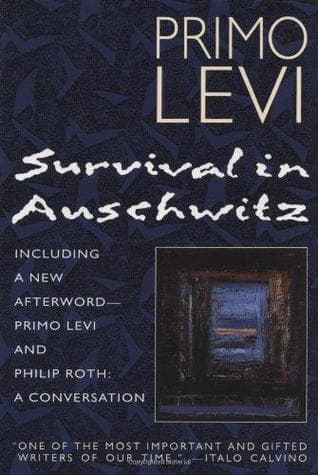
- Survival in Auschwitz
Primo Levi
4.3 (48k) average on GoodreadsBiographyDirectly related work by the same author, focusing on his Holocaust experiences.
- Sapiens: A Brief History of Humankind
Yuval Noah Harari
4.4 (502k) average on GoodreadsPsychologyBroad historical and philosophical scope, connecting diverse fields of knowledge.
- Night
Elie Wiesel
4.3 (970k) average on GoodreadsBiographyWhile Wiesel's Night offers a stark, unadorned account of Holocaust survival, focusing on immediate trauma and spiritual questioning, Levi's The Periodic Table provides a broader, post-war reflection, integrating intellectual and professional life before and after the camps. Levi's work is more reflective and incorporates scientific metaphors, offering a different lens on trauma and resilience.
- Man's Search for Meaning
Viktor E. Frankl
4.4 (401k) average on GoodreadsBiographyFrankl's work explores psychological resilience and the search for purpose in extreme suffering through a direct philosophical lens. Levi, however, grounds his philosophical inquiries in the tangible world of chemistry and specific lived experiences, making his insights on human nature and work emerge organically from his narrative rather than as prescriptive lessons.
- The Diary of a Young Girl
Anne Frank
4.2 (2.7M) average on GoodreadsBiographyDuring the Nazi occupation, a teenage girl's diary, written from a secret annex, shares observations on humanity, hope, and the wait for freedom.
- Eat, Pray, Love
Elizabeth Gilbert
3.6 (1.5M) average on GoodreadsLifestyleA heartbroken writer leaves her conventional life for a year-long global search for pleasure in Italy, spiritual devotion in India, and unexpected love and balance in Bali.





Enjoyed the summary?
A summary gives you the shape of the book. The book itself has the detail, the examples and the voice.
Find The Periodic Table on AmazonAs an Amazon Associate, BookBrief earns from qualifying purchases. How we're funded