
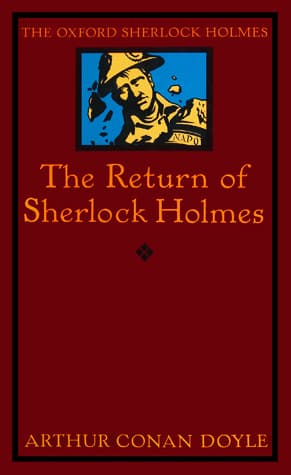
Synopsis
Covers the whole plot, including the ending.
- Difficulty
- Easy
- Pacing
- Moderate
- Mood
- Intriguing, Analytical, Classic
- Read it if
- You love classic detective stories with a brilliant, eccentric protagonist and intricate puzzles, or if you're a fan of Sherlock Holmes and want to dive into his return to action.
- Skip it if
- You prefer modern, fast-paced thrillers or find Victorian-era prose and episodic case structures less engaging.
The Return of Sherlock Holmes Plot Summary
Covers the whole plot, including the ending.
The Empty House: Holmes's Miraculous Return
Three years after his presumed death at Reichenbach Falls, Dr. Watson is called to investigate the murder of the Honourable Ronald Adair. While contemplating the case, an old bookseller visits Watson, who reveals himself to be Sherlock Holmes in disguise. Holmes explains how he faked his death to evade Professor Moriarty's network and spent the intervening years traveling and studying. He reveals that Moriarty's chief lieutenant, Colonel Sebastian Moran, is the murderer of Adair, having shot him with an air rifle because Adair discovered Moran cheating at cards. Holmes and Watson stake out an empty house opposite 221B Baker Street, where Moran attempts to assassinate Holmes. Holmes, using a wax bust as a decoy, outwits Moran, leading to his capture and the official re-establishment of Holmes's practice.
The Norwood Builder: A Case of False Accusation
John Hector McFarlane, a young lawyer, is accused of murdering Jonas Oldacre, a builder who had recently made McFarlane his sole heir. McFarlane visited Oldacre's house the night before the alleged murder, and evidence points strongly against him. Holmes investigates and finds inconsistencies: the house is partially burned, a body is found, but the details don't add up. He discovers that Oldacre, a vindictive man, faked his own death and staged the fire to frame McFarlane, whose mother had jilted Oldacre years ago. Oldacre is found hiding in a secret compartment, and the case is resolved, clearing McFarlane's name and exposing Oldacre's elaborate revenge scheme.
The Dancing Men: Deciphering a Cryptic Message
Hilton Cubitt, a Norfolk squire, seeks Holmes's help regarding strange stick-figure drawings, or 'dancing men,' that appear around his estate, terrifying his American wife, Elsie. Elsie refuses to explain their origin, only saying they relate to her past. Holmes deduces the drawings are a cipher and painstakingly decodes them, realizing they are messages from an American gangster named Abe Slaney, whom Elsie knew in her past. Holmes races to Norfolk, but arrives too late to prevent tragedy: Cubitt is found dead, and Elsie is gravely wounded. Holmes deduces Slaney shot Cubitt, and Elsie, in a struggle, wounded herself. Slaney is apprehended and confesses to the murder, revealing Elsie's attempt to escape her criminal past.
The Solitary Cyclist: Protecting a Young Heiress
Violet Smith, a young music teacher, consults Holmes about a strange man who consistently follows her on a bicycle during her weekend commutes. She also describes unusual behavior from her new employers, Mr. Carruthers and Mr. Woodley, who offered her a lucrative position after her uncle's death. Holmes investigates and discovers that Violet's uncle, Robert Smith, was actually her guardian, holding a large inheritance for her. Carruthers and Woodley are associates of her uncle's former partner, a villain named Williamson, who seeks to force Violet into marriage with Woodley to gain control of her fortune. Holmes intervenes, preventing the forced marriage, and Williamson and his accomplices are brought to justice, with Carruthers, who had genuinely grown fond of Violet, helping the police.
The Priory School: The Disappearance of a Duke's Son
Dr. Thorneycroft Huxtable, the headmaster of the Priory School, enlists Holmes's aid in finding the Duke of Holdernesse's ten-year-old son, Lord Saltire, who has vanished along with a German master, Heidegger. Holmes and Watson travel to the school and discover a bicycle, a local inn, and a complex trail. Holmes eventually deduces that the Duke himself orchestrated the kidnapping to prevent his son from inheriting, favoring another child. It's revealed the Duke's estranged wife, the boy's mother, had another son with her first husband, and the Duke, in a fit of misguided loyalty and jealousy, tried to remove Lord Saltire from the line of succession. Heidegger was killed trying to protect the boy. The Duke is forced to confess, and Lord Saltire is safely returned.
Black Peter: The Harpoon Murder
Inspector Hopkins seeks Holmes's assistance in solving the gruesome murder of Peter Carey, known as 'Black Peter,' a retired whaling captain found harpooned to the wall of his cabin. The cabin, a separate hut on his property, was locked from the inside. Holmes examines the scene and discovers a tobacco pouch, a notebook, and a hidden compartment. He uses a ruse to attract a suspect, a young man named John Hopley Neligan, whose father disappeared years ago with valuable American railway bonds. Holmes deduces that Neligan, believing Carey knew of his father's fate and the bonds' location, confronted Carey. In a struggle, Neligan accidentally killed Carey with his own harpoon. Neligan confesses, revealing Carey's theft of the bonds and his father's subsequent ruin.
Charles Augustus Milverton: The King of Blackmailers
Holmes is hired by Lady Eva Blackwell to retrieve compromising letters from Charles Augustus Milverton, a blackmailer. Milverton demands an exorbitant sum, threatening to expose Lady Eva's past and ruin her upcoming marriage. Holmes, unable to reason with Milverton, resorts to breaking into his house with Watson. While hiding, they witness a woman, one of Milverton's previous victims, confronting and then shooting him dead. Holmes and Watson escape with Lady Eva's letters and burn Milverton's entire collection of compromising documents, ending his reign of terror. Holmes allows the police to pursue the unknown female assassin, maintaining his ethical stance against blackmail.
The Six Napoleons: A Curious Case of Broken Busts
Inspector Lestrade brings Holmes a peculiar case: several plaster busts of Napoleon Bonaparte have been smashed across London. The first two were at a shop and a doctor's house, the third at a journalist's home, where the owner was also murdered. Holmes deduces that the perpetrator is not a maniac but is searching for something specific hidden within the busts. He links the busts to a common origin and traces them. He discovers that a valuable black pearl, the Borgia Pearl, was hidden inside one of the busts by an Italian criminal named Beppo, who had recently escaped prison. Beppo, trying to retrieve his hidden jewel, was smashing the busts. Holmes sets a trap, and Beppo is caught, confessing to the murder and the theft.
The Three Students: Academic Espionage
Mr. Hilton Soames, a tutor and lecturer at a university, consults Holmes after discovering that someone has broken into his office and copied parts of an examination paper for a Greek scholarship. The incident occurred shortly before the exam, and Soames suspects one of three students living on the same floor. Holmes investigates the room, finding clues like pencil shavings, clay, and a scratch on the desk. Through careful observation and deduction, he identifies the culprit as Daulat Ras, an Indian student, who was desperate to win the scholarship and had bribed a servant for access. Holmes confronts Ras, who confesses, and the scandal is contained, saving Soames's reputation and ensuring academic fairness.
The Golden Pince-Nez: A German Professor's Secret
Stanley Hopkins calls upon Holmes to investigate the murder of Willoughby Smith, Professor Coram's young secretary, who was found dead in the study with a golden pince-nez clutched in his hand. The study was locked from the inside. Holmes examines the scene, finding a lady's pince-nez, a hidden compartment, and other subtle clues. He deduces that the murder weapon was a knife and that the perpetrator was a woman. He identifies the woman as Anna, Professor Coram's estranged wife, a former Russian nihilist who had come to retrieve a compromising document hidden by her late brother, who was also a nihilist. Smith stumbled upon her, and she killed him in a panic. Anna is apprehended, and the dark secrets of her past are revealed.
The Missing Three-Quarter: A Rugby Player's Disappearance
Mr. Cyril Overton, a Cambridge rugby team captain, seeks Holmes's help in finding Godfrey Staunton, their star player, who has vanished just days before an important match. Staunton was last seen meeting a mysterious, shabbily dressed man. Holmes and Watson follow a trail from Cambridge to London, encountering strange characters and false leads. Holmes eventually deduces that Staunton was visiting a secluded cottage where his fiancée, who was terminally ill, was being cared for by a reclusive doctor. Staunton had kept their engagement secret due to his family's disapproval of her humble origins. The fiancée dies, and Staunton, grief-stricken, returns to the university, his secret revealed but his reputation intact.
The Abbey Grange: A Baronet's Violent End
Holmes and Watson are called to Abbey Grange, where Sir Eustace Brackenstall has been found murdered, apparently by burglars who also tied up his wife, Lady Brackenstall, and a maid. Holmes quickly finds inconsistencies in Lady Brackenstall's account, particularly regarding the knots used to bind her. He deduces that the 'burglary' was staged and that Lady Brackenstall's lover, Captain Croker, a former sea captain, was responsible for Sir Eustace's death. Sir Eustace was a brutal alcoholic who regularly abused his wife. Croker, enraged by the abuse, confronted and killed Sir Eustace. Holmes, sympathetic to Lady Brackenstall's plight, allows Croker to escape justice, arranging a scenario where the official report aligns with the staged burglary.
The Second Stain: Protecting National Secrets
Lord Bellinger, the Prime Minister, and the Right Honourable Trelawney Hope, Secretary for European Affairs, consult Holmes regarding the theft of a crucial letter from Hope's dispatch box, which, if made public, could lead to war. The letter was stolen from a locked room, with Hope's wife, Lady Hilda Hope, being the only other person with access. Holmes suspects Lady Hilda is involved but struggles to find proof. He discovers that Lady Hilda had given the letter to a foreign agent, Eduardo Lucas, who was subsequently murdered. Holmes retrieves the letter from Lady Hilda, who confesses she took it to prevent an old indiscretion from being revealed by Lucas. Holmes, understanding the gravity, helps her restore the letter, averting a diplomatic crisis and war.
The Return of Sherlock Holmes Characters
Sherlock Holmes
Protagonist
The brilliant consulting detective, resurrected from his presumed death.
Sherlock Holmes is a master of observation, deduction, and disguise, driven by an insatiable desire to solve mysteries and bring criminals to justice. His return, after faking his death at Reichenbach Falls, revitalizes the London criminal underworld's nemesis. He possesses an encyclopedic knowledge across various fields, a keen eye for detail, and a logical mind that can connect seemingly disparate facts. Holmes often employs unconventional methods, including breaking the law himself (as seen in 'Charles Augustus Milverton'), to achieve what he considers a greater good. He is intensely focused on his work, often neglecting social niceties, but demonstrates a deep, if often unexpressed, loyalty to Watson.
Relationships: Dr. John H. Watson (Best friend, chronicler, and loyal assistant); Colonel Sebastian Moran (Arch-nemesis and Moriarty's successor); Inspector Lestrade (Police colleague, often outwitted but respected); Mrs. Hudson (Landlady and caregiver)
Dr. John H. Watson
Supporting
Holmes's loyal companion, chronicler, and the narrator of his adventures.
Dr. Watson is Holmes's steadfast friend, flatmate, and the primary chronicler of his cases. Though less intellectually brilliant than Holmes, Watson provides a vital human element to the narratives, serving as the reader's entry point into Holmes's world. He is a man of courage, a former army surgeon, and possesses a strong moral compass. Watson's unwavering belief in Holmes and his practical support, whether assisting in investigations or simply providing companionship, are crucial. His surprise and joy at Holmes's return in 'The Empty House' underscore their deep bond.
Relationships: Sherlock Holmes (Best friend, flatmate, and professional partner); Mrs. Hudson (Shared landlady)
Colonel Sebastian Moran
Antagonist
Moriarty's right-hand man and a dangerous assassin, targeting Holmes.
Colonel Sebastian Moran is introduced as 'the second most dangerous man in London' after Professor Moriarty. A former military man, he is a big-game hunter and a ruthless killer, known for his proficiency with an air-gun. Moran's motive in 'The Empty House' is to eliminate Holmes, who he knows was responsible for Moriarty's death. He is cunning and patient, setting a trap for Holmes, but ultimately outwitted by the detective's superior intellect and foresight. His capture marks a significant victory for Holmes upon his return, demonstrating that the criminal underworld still faces a formidable opponent.
Relationships: Sherlock Holmes (Arch-nemesis); Professor Moriarty (Former employer and mentor)
Inspector Lestrade
Supporting
A Scotland Yard detective who frequently relies on Holmes's expertise.
Inspector Lestrade is one of Scotland Yard's most persistent detectives, though often lacking Holmes's imaginative flair and deductive brilliance. He frequently calls upon Holmes for assistance in particularly perplexing cases, such as 'The Six Napoleons' and 'The Second Stain.' Lestrade respects Holmes's abilities, even if he doesn't always fully understand them, and his presence often highlights Holmes's superior methods. He is hardworking and dedicated, representing the conventional law enforcement against which Holmes's unique genius shines.
Relationships: Sherlock Holmes (Professional colleague and consultant); Dr. John H. Watson (Acquaintance)
Jonas Oldacre
Antagonist
A vindictive builder who fakes his own death for revenge.
Jonas Oldacre is the central figure in 'The Norwood Builder.' He is a wealthy but deeply malicious builder who harbors a decades-old grudge against a woman who rejected him. Oldacre orchestrates an elaborate plot to fake his own murder and frame her son, John Hector McFarlane, for the crime. His meticulous planning and hidden compartments reveal a cunning, if twisted, mind. His ultimate goal is not profit, but cruel psychological revenge, demonstrating a chilling capacity for malevolence and deception.
Relationships: John Hector McFarlane (Victim of his framing plot); Mrs. McFarlane (Object of his decades-old grudge)
Elsie Cubitt (Patrick)
Supporting
An American woman haunted by her criminal past, leading to tragic consequences.
Elsie Cubitt, née Patrick, is the wife of Hilton Cubitt in 'The Dancing Men.' She is an American woman with a dark secret: a past association with a gang of criminals, including Abe Slaney, in the United States. Despite her efforts to escape this past and build a new life, the 'dancing men' messages from Slaney terrorize her. Her refusal to confide in her husband, driven by fear and shame, ultimately leads to tragedy. She is a sympathetic character, caught between her desire for a fresh start and the inescapable shadow of her former life.
Relationships: Hilton Cubitt (Husband); Abe Slaney (Figure from her criminal past, former suitor)
Charles Augustus Milverton
Antagonist
A notorious blackmailer, 'the king of blackmailers,' who profits from others' secrets.
Charles Augustus Milverton is a cold, calculating, and utterly ruthless blackmailer. He thrives on the misery and social ruin of his victims, collecting incriminating letters and demanding exorbitant sums to keep secrets. His polite demeanor masks a cruel and avaricious nature. Milverton represents a different kind of criminal, one who wields social power rather than physical force. His demise, at the hands of one of his many victims, is a rare instance where Holmes allows a criminal to be killed, recognizing the profound evil Milverton embodied.
Relationships: Lady Eva Blackwell (One of his victims); Sherlock Holmes (Opponent in his blackmail scheme)
Beppo
Antagonist
An Italian criminal seeking a hidden jewel, leading to a series of bizarre crimes.
Beppo is the antagonist in 'The Six Napoleons.' An Italian immigrant and former stone-cutter, he is a cunning and desperate criminal. He hid the valuable Borgia Pearl inside a plaster bust of Napoleon Bonaparte to evade capture after committing a prior murder. Upon his release from prison, he systematically tracks down and smashes all copies of the bust, desperate to retrieve his hidden jewel. His actions, initially appearing as random vandalism, reveal a focused determination and a willingness to commit further violence, including murder, to achieve his goal.
Relationships: Sherlock Holmes (Antagonist and pursuer)
Lady Hilda Hope
Supporting
The wife of a government minister, entangled in a blackmail plot involving a sensitive state document.
Lady Hilda Hope is a central figure in 'The Second Stain.' She is the beautiful and well-connected wife of Trelawney Hope, the Secretary for European Affairs. Desperate to protect a secret from her past – an indiscretion committed before her marriage – she falls prey to the blackmailer Eduardo Lucas. To retrieve compromising letters, she steals a vital state document from her husband's dispatch box, inadvertently risking war. Her actions, born of fear and a desire to preserve her reputation and marriage, highlight the personal cost of political intrigue and blackmail.
Relationships: Trelawney Hope (Husband); Eduardo Lucas (Blackmailer)
Captain Croker
Supporting
A sea captain who takes justice into his own hands to protect a woman he loves.
Captain Croker appears in 'The Abbey Grange.' He is a brave and devoted sea captain who is deeply in love with Lady Brackenstall. Witnessing the brutal abuse she suffers at the hands of her husband, Sir Eustace, Croker takes matters into his own hands, confronting and ultimately killing the baronet. He then helps Lady Brackenstall stage a burglary to cover up the true circumstances of Sir Eustace's death. Holmes, recognizing the extreme provocation and Lady Brackenstall's suffering, allows Croker to escape justice, acknowledging the moral complexities of the situation.
Relationships: Lady Brackenstall (Lover); Sir Eustace Brackenstall (Victim of his intervention)
The Return of Sherlock Holmes Themes
Justice vs. Legality
This collection explores the tension between legal and moral right. In 'The Abbey Grange,' Holmes allows Captain Croker to escape punishment for murder, considering it justifiable given Sir Eustace Brackenstall's abuse of his wife. Similarly, in 'Charles Augustus Milverton,' Holmes condones the blackmailer's murder and helps destroy his records, prioritizing the victims' protection over strict adherence to the law. This theme shows Holmes's personal ethics, which sometimes go beyond conventional legal boundaries.
“'I am not the law, and I am not here to administer justice in the ordinary sense. I am here to prevent a greater injustice.”
The Persistence of the Past
Many stories in 'The Return of Sherlock Holmes' show how past actions, secrets, and relationships eventually affect individuals. Elsie Cubitt in 'The Dancing Men' tries to escape her criminal past, but the 'dancing men' messages from Abe Slaney bring it back, leading to tragedy. Jonas Oldacre in 'The Norwood Builder' plans an elaborate revenge plot based on a decades-old romantic slight. Even the sensitive 'Second Stain' involves Lady Hilda Hope's past indiscretion being used for blackmail. These narratives show that one's history, no matter how buried, can influence their present and future.
“The past is like a pebble in a shoe. It may be small, but it can make the whole journey painful.”
The Deceptive Nature of Appearances
A recurring theme is that things are rarely as they seem; appearances can be misleading. In 'The Empty House,' Holmes's disguise as an old bookseller completely fools Watson, showing the power of outward presentation. 'The Norwood Builder' is built on a staged murder and a hidden perpetrator, where obvious evidence points to an innocent man. Even the seemingly random smashing of Napoleon busts in 'The Six Napoleons' hides a specific and valuable motive. Holmes's genius is seeing beyond the superficial to uncover the truth, often revealing that mundane or bizarre details hold the key to a deeper deception.
“Data! Data! Data! I can't make bricks without clay.”
The Power of Deduction and Observation
This collection shows Holmes's deductive abilities and meticulous observation, which are central to his method. His ability to piece together insignificant details – a specific type of tobacco, an unusual knot, a scratch on a desk – into a coherent narrative of events is key to every case. In 'The Dancing Men,' Holmes deciphers a complex cipher, and in 'The Priory School,' he tracks a missing boy through subtle clues. This theme celebrates the triumph of intellect and rational thought over confusion and criminal cunning.
“You see, but you do not observe.”
Revenge and Retribution
Motives of revenge and retribution drive several plots. Jonas Oldacre's scheme in 'The Norwood Builder' is a direct act of revenge for a past slight. Colonel Moran's pursuit of Holmes in 'The Empty House' is fueled by a desire to avenge Moriarty. In 'Black Peter,' the discovery of the captain's killer reveals a desperate act born from a desire for retribution and answers about a father's ruin. These stories show how deep-seated grievances can lead to violent and complex criminal acts, often requiring Holmes to unravel layers of personal history to understand the true motive.
“Revenge is a dish best served cold, and Oldacre had kept his simmering for many years.”
Plot Devices & Literary Techniques
The 'Locked Room' Mystery
A crime committed in circumstances that appear impossible, often with the room sealed from within.
Several stories in 'The Return of Sherlock Holmes' feature variations of the 'locked room' mystery. In 'The Empty House,' Ronald Adair is shot in a room with a closed window, seemingly without anyone entering or leaving, until Holmes reveals the air rifle. 'Black Peter' presents a cabin locked from the inside with the victim harpooned. 'The Golden Pince-Nez' also features a secretary murdered in a locked study. These scenarios allow Doyle to showcase Holmes's unique ability to find the logical, albeit often unexpected, explanation for seemingly impossible crimes, reinforcing his intellectual prowess.
Disguise and Impersonation
Holmes's use of various guises to gather information or outwit criminals.
Disguise is a hallmark of Sherlock Holmes's methodology, and it is prominently featured in this collection. Most notably, Holmes's return in 'The Empty House' is marked by his elaborate disguise as an elderly bookseller, completely fooling Dr. Watson. He also uses disguise when investigating Charles Augustus Milverton. This device allows Holmes to move unnoticed in different social strata, gather intelligence directly, and confront criminals without revealing his true identity until the opportune moment, adding an element of theatricality and surprise to his investigations.
The Unreliable Narrator (of events)
Characters provide accounts of events that are later revealed to be incomplete or deliberately false.
While Watson remains the reliable narrator of the overall story, many of the clients and witnesses Holmes encounters provide unreliable accounts of the events, either through omission, fear, or outright deception. Lady Brackenstall's staged account of the burglary in 'The Abbey Grange' is a prime example. Elsie Cubitt's withholding of information about her past in 'The Dancing Men' also drives the plot. This device creates layers of mystery that Holmes must peel back, highlighting the challenge of discerning truth from human testimony and demonstrating his skill in identifying inconsistencies.
Ciphers and Codes
Cryptographic messages used as a central puzzle for Holmes to solve.
The most prominent use of ciphers in this collection is in 'The Dancing Men.' The seemingly childish stick-figure drawings form a complex substitution cipher that Holmes must painstakingly decode. This device highlights Holmes's intellectual breadth beyond mere criminal investigation, showcasing his proficiency in linguistics and cryptography. The deciphering of the code is not just a plot point but the central mechanism through which the story's tragic backstory and present danger are revealed, demonstrating the power of hidden messages.
The 'Great Game' Echo
References to international espionage and political intrigue.
While not as central as in other Holmes stories, the 'Great Game' — the strategic rivalry between the British Empire and the Russian Empire for supremacy in Central Asia — subtly influences some narratives. 'The Second Stain' is a direct engagement with international espionage, where the theft of a crucial letter threatens to ignite a European war. 'The Golden Pince-Nez' also touches upon Russian nihilism and political secrets. These elements add a broader geopolitical context to some cases, reminding the reader that Holmes's work sometimes extends beyond domestic crime to matters of national and international security.
The Return of Sherlock Holmes Quotes
“When you have eliminated the impossible, whatever remains, however improbable, must be the truth.”
“I am the last and highest court of appeal in detection.”
“The game is afoot.”
“It is a capital mistake to theorize before one has data. Insensibly one begins to twist facts to suit theories, instead of theories to suit facts.”
“The world is full of obvious things which nobody by any chance ever observes.”
“I have a turn both for observation and for deduction.”
“There is nothing more deceptive than an obvious fact.”
“My mind rebels at stagnation. Give me problems, give me work, give me the most abstruse cryptogram, or the most intricate analysis, and I am in my own proper atmosphere.”
“The little things are infinitely the most important.”
“I am a brain, Watson. The rest of me is a mere appendix.”
“Education never ends, Watson. It is a series of lessons, with the greatest for the last.”
“You know my methods, Watson. Apply them.”
“The most difficult crime to track is the one which is purposeless.”
“I have frequently gained my first real insight into the character of parents by studying their children.”
Quiz
10 questions on the plot and the characters. Each answer comes with a short explanation.
Question 1
In 'The Adventure of the Empty House,' how does Sherlock Holmes explain his survival after the Reichenbach Fall?
- He was rescued by a passing mountaineer
- He used a secret tunnel system beneath the falls
- He climbed the cliff wall to a narrow ledge and escaped
- He faked his death with a body double
Show answer
C. He climbed the cliff wall to a narrow ledge and escaped Holmes reveals to Watson that he survived by climbing the cliff to a narrow ledge, avoiding the deadly fall, which allowed him to disappear for three years to dismantle Moriarty's network.
Question 2
In 'The Adventure of the Dancing Men,' what do the stick-figure drawings represent?
- A secret treasure map
- A coded message using a substitution cipher
- A children's game with no real meaning
- A warning about a criminal gang
Show answer
B. A coded message using a substitution cipher The dancing men are a simple substitution cipher created by Abe Slaney to communicate with Elsie Cubitt, which Holmes deciphers to solve the case.
Question 3
What is the primary weapon used by the villain Colonel Sebastian Moran in 'The Adventure of the Empty House'?
- A poisoned dart
- An air gun
- A sword cane
- A garrote wire
Show answer
B. An air gun Colonel Moran, a dangerous marksman, uses an air gun with specially designed bullets to commit murders without making noise, as described in the book's introduction and the story.
Question 4
In 'The Adventure of the Six Napoleons,' why does the criminal break busts of Napoleon?
- He is a political anarchist targeting symbols of tyranny
- He is searching for a hidden black pearl inside one of them
- He has a personal vendetta against the sculptor
- He is trying to frame someone else for the crimes
Show answer
B. He is searching for a hidden black pearl inside one of them The criminal, Beppo, breaks the busts to find the Borgia Pearl, which he had hidden inside one after stealing it, leading Holmes to deduce the motive through the pattern of destruction.
Question 5
What theme is highlighted by Holmes's return after being presumed dead for three years?
- The inevitability of death in detective work
- The triumph of intellect and perseverance over adversity
- The decline of traditional methods in modern crime-solving
- The importance of wealth in solving mysteries
Show answer
B. The triumph of intellect and perseverance over adversity Holmes's survival and return demonstrate his cleverness and determination, reinforcing themes of intellectual mastery and resilience central to the series.
Question 6
In 'The Adventure of the Norwood Builder,' what key evidence proves Jonas Oldacre faked his own death?
- A hidden diary detailing his plan
- Footprints leading away from the burnt building
- A thumbprint in dried paint on a wall
- A witness who saw him escape
Show answer
C. A thumbprint in dried paint on a wall Holmes discovers Oldacre's thumbprint in paint on a wall, proving he was alive after the supposed murder, as the paint had dried after the incident.
Question 7
How does Dr. Watson initially react upon seeing Holmes alive in 'The Adventure of the Empty House'?
- He faints from shock
- He angrily accuses Holmes of betrayal
- He cries out in disbelief and joy, as quoted in the book
- He calmly accepts it without surprise
Show answer
C. He cries out in disbelief and joy, as quoted in the book Watson's emotional exclamation, 'Holmes, is it really you? Can it indeed be that you are alive?' shows his shock and happiness, highlighting their deep friendship.
Question 8
What method does Holmes use to catch Colonel Moran in 'The Adventure of the Empty House'?
- A trap set with a wax dummy of Holmes in a window
- A chase through the streets of London
- A coded message luring him to a meeting
- An undercover operation with police assistance
Show answer
A. A trap set with a wax dummy of Holmes in a window Holmes places a wax dummy of himself in the window of 221B Baker Street to draw out Moran, who attempts to shoot it with his air gun, allowing Holmes and Watson to apprehend him.
Question 9
In the context of the book, what does the 'return' in the title symbolize beyond Holmes's physical reappearance?
- The resurgence of logical deduction in an age of superstition
- The comeback of Victorian fashion trends
- The revival of Watson's medical career
- The return of Moriarty from the dead
Show answer
A. The resurgence of logical deduction in an age of superstition The title signifies the restoration of Holmes's methodical, rational approach to crime-solving, which London desperately needs, as emphasized in the stories.
Question 10
Which story involves Holmes deciphering a message to prevent a murder, leading to the capture of an American criminal?
- The Adventure of the Norwood Builder
- The Adventure of the Six Napoleons
- The Adventure of the Dancing Men
- The Adventure of the Empty House
Show answer
C. The Adventure of the Dancing Men In 'The Adventure of the Dancing Men,' Holmes decodes the cipher messages to uncover Abe Slaney's threats, ultimately preventing further harm and solving the case.
The Return of Sherlock Holmes FAQ
What is 'The Return of Sherlock Holmes' about?
The book follows Sherlock Holmes' dramatic return after being presumed dead for three years following his confrontation with Professor Moriarty at Reichenbach Falls. He reunites with Dr. Watson and resumes solving complex cases in London, including tracking a murderer with an air gun, investigating the Norwood Builder mystery, deciphering the Dancing Men code, and solving the Six Napoleons case.
Why should I read 'The Return of Sherlock Holmes'?
This collection marks Holmes' triumphant return after Conan Doyle famously killed him off, featuring thirteen classic detective stories that showcase Holmes' deductive genius at its peak. Readers get to experience the emotional reunion with Watson, clever mysteries like the Dancing Men cipher, and Holmes' evolution as a character after his hiatus.
What is the background/setting of 'The Return of Sherlock Holmes'?
Set in late Victorian London (circa 1894), the stories unfold in Holmes' Baker Street rooms, London's foggy streets, and various English country estates. The backdrop reflects the era's social tensions, technological changes, and the persistent threat of crime that Holmes' analytical mind is uniquely equipped to combat.
What are the most memorable quotes from the book?
Key quotes include Watson's emotional exclamation, 'Holmes, is it really you? Can it indeed be that you are alive?' and Holmes' characteristic lines about deduction like 'You see, but you do not observe.' The stories also feature Holmes' dry wit about his theatrical death and return.
What writing style does Arthur Conan Doyle use?
Conan Doyle employs Watson's first-person narrative, creating an intimate, documentary-like tone that blends detailed observation with emotional resonance. The prose combines logical deduction sequences with atmospheric Victorian descriptions, maintaining suspense while developing the Holmes-Watson dynamic.
What minor details add significant meaning in these stories?
In 'The Adventure of the Empty House,' the bust of Napoleon used as target practice reveals Holmes' understanding of criminal psychology. In 'The Dancing Men,' the stick-figure cipher's variations show Holmes' linguistic deduction. Watson's unchanged sitting room arrangement upon Holmes' return symbolizes their enduring partnership.
What are some subtle foreshadowing moments?
Holmes' mention of 'Eastern knowledge' during his absence foreshadows his disguise methods in 'The Empty House.' In 'The Norwood Builder,' the builder's unusual will preparation hints at the eventual solution. The air gun murderer's first appearance subtly connects to Holmes' own survival methods.
What unexpected character connections exist?
Colonel Sebastian Moran, introduced as Moriarty's chief lieutenant, becomes Holmes' primary adversary in 'The Empty House.' In 'The Six Napoleons,' the criminal's obsession connects seemingly unrelated burglaries. The Norwood Builder case reveals hidden family relationships driving the crime.
What are unspoken character motivations?
Holmes' extended absence involves unstated personal transformation and strategic planning against remaining Moriarty network members. Watson's suppressed grief manifests as cautious joy upon Holmes' return. Villains like Moran are driven by professional pride and financial desperation rather than pure malice.
What psychological complexities do characters exhibit?
Holmes shows increased emotional awareness post-return, particularly regarding Watson's loyalty. Watson grapples with betrayal feelings mixed with relief. Criminals display obsessive traits, like the Napoleon bust destroyer's fixation or the Dancing Men creator's coded communication compulsion.
What are the major emotional turning points?
The climactic reunion scene where Watson faints upon seeing Holmes alive marks their relationship's restoration. Holmes' explanation of his disappearance in 'The Empty House' resolves Watson's lingering hurt. Each case's resolution provides emotional closure for victims while reinforcing Holmes' purpose.
How do relationship dynamics evolve between Holmes and Watson?
Their partnership deepens through shared trauma of Holmes' 'death' and joyful reunion. Watson transitions from grieving friend to validated chronicler, while Holmes demonstrates uncharacteristic appreciation for Watson's steadfastness. Their collaboration becomes more mutually respectful and emotionally open.
Which parts remain ambiguous or open-ended?
Holmes' exact activities during his three-year absence are only partially explained, leaving room for speculation. Some criminals' ultimate fates after capture are unresolved. The emotional aftermath of Holmes' deception on secondary characters like Mrs. Hudson is never fully addressed.
What are controversial scenes or decisions?
Holmes' decision to fake his death without informing Watson causes ongoing debate about whether this was necessary or cruel. His methods in 'The Norwood Builder' involving apparent police manipulation raise ethical questions. The violent conclusion of 'The Empty House' showcases Holmes' willingness to use lethal force.
'The Return of Sherlock Holmes' ending explained: how it ends & what it means
The collection ends with Holmes and Watson continuing their partnership, having reestablished their dynamic through solved cases. This signifies Holmes' permanent return to public life and Conan Doyle's commitment to the character. The final stories reinforce that Holmes' deductive brilliance remains essential to Victorian London's moral order.
How does Holmes' character develop after his return?
Post-hiatus Holmes demonstrates greater strategic patience and emotional intelligence, while maintaining his brilliant deductive skills. He shows more awareness of Watson's importance and occasionally reveals vulnerability about his isolation during absence. His methods incorporate lessons learned from Moriarty confrontation.
What makes the mysteries in this collection particularly clever?
Cases like 'The Dancing Men' feature ingenious ciphers requiring linguistic deduction, while 'The Six Napoleons' involves pattern recognition across seemingly random crimes. 'The Norwood Builder' presents an apparent impossible crime that Holmes solves through architectural understanding. Each mystery showcases different facets of Holmes' analytical mind.
How does Conan Doyle handle Holmes' resurrection believably?
Through Watson's gradual acceptance and Holmes' detailed explanation of climbing the Reichenbach Falls wall, hiding from Moriarty's men, and traveling incognito. The author provides plausible survival methods while maintaining the emotional impact of the return, making the resurrection integral to the character's development.
About the author
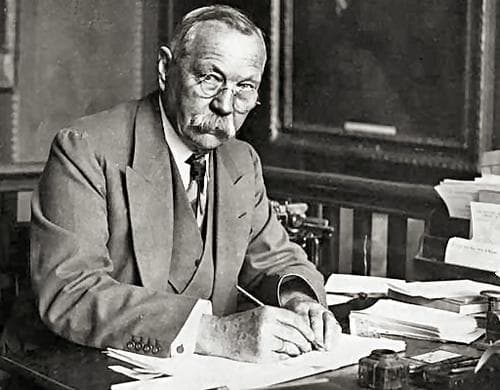
Sir Arthur Ignatius Conan Doyle was a British writer and physician. He created the character Sherlock Holmes in 1887 for A Study in Scarlet, the first of four novels and fifty-six short stories about Holmes and Dr. Watson. The Sherlock Holmes stories are milestones in the field of crime fiction.
Similar books
- The Adventures of Sherlock Holmes
Arthur Conan Doyle
4.3 (243k) average on GoodreadsMysteryAnother collection of classic Holmes short stories, showcasing his deductive brilliance.
- A Study in Scarlet
Arthur Conan Doyle
4.2 (324k) average on GoodreadsHistorical FictionThe very first Sherlock Holmes novel, introducing the iconic duo and their methods.
- To Kill a Mockingbird
Harper Lee
4.3 (4.5M) average on GoodreadsHistorical FictionIn the 1930s Jim Crow South, Harper Lee writes about racial injustice, moral growth, and the quiet courage of a lawyer father, Atticus Finch, as seen through his young daughter's eyes.
- The Great Gatsby
F. Scott Fitzgerald
3.9 (3.8M) average on GoodreadsHistorical FictionIn the opulent Roaring Twenties, a mysterious millionaire's lavish parties hide his desperate, tragic pursuit of a lost love, exposing the emptiness within the American Dream.
- Pride and Prejudice
Jane Austen
4.3 (3M) average on GoodreadsHistorical FictionIn a society focused on status and money, Elizabeth Bennet navigates love and pride, challenging Mr. Darcy and social expectations to find true affection.
- Angels & Demons
Dan Brown
3.9 (2.7M) average on GoodreadsThrillerA Harvard symbologist races through Rome's ancient sites, deciphering cryptic clues to unmask the Illuminati and stop a vengeful plot to destroy the Vatican with a stolen antimatter weapon.






Enjoyed the summary?
A summary gives you the shape of the book. The book itself has the detail, the examples and the voice.
Find The Return of Sherlock Holmes on AmazonAs an Amazon Associate, BookBrief earns from qualifying purchases. How we're funded