
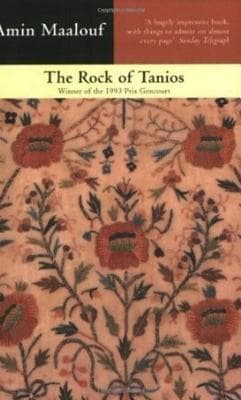
Synopsis
Covers the whole plot, including the ending.
- Difficulty
- Medium
- Pacing
- Moderate
- Mood
- Atmospheric, Intriguing, Historical, Reflective
- Read it if
- You enjoy historical fiction set in complex geopolitical landscapes, featuring intricate plots and legendary figures.
- Skip it if
- You prefer fast-paced action or straightforward narratives without political complexity.
The Rock of Tanios Plot Summary
Covers the whole plot, including the ending.
The Legend and the Rock
The novel opens with the narrator, a descendant of Kfaryabda, telling the local legend of Tanios and the rock where he was last seen. Tanios vanished in 1840, leaving behind intrigue and speculation. The narrator wants to understand the truth behind the myth and begins to piece together fragmented stories, oral traditions, and historical records. He emphasizes Tanios's impact on the village and how his story became intertwined with the turbulent politics of 19th-century Mount Lebanon, a region caught between Ottoman, Egyptian, British, and French ambitions. This opening sets up the story as a quest to reconstruct a lost history.
The Birth of Tanios and the Sheik's Curse
The story details the circumstances of Tanios's birth. His mother, Lamia, is the beautiful wife of Gerios, the sacristan of Kfaryabda. However, Tanios is widely believed to be the illegitimate son of Sheik Francis, the powerful ruler of the village. This suspicion comes from Lamia's beauty, Gerios's submissive nature, and Sheik Francis's known behavior. The Sheik, despite his position, is a man of unpredictable temper and unchecked desires, often causing chaos. Tanios's parentage becomes an open secret, a source of shame and a peculiar privilege, setting him apart and foreshadowing his complex life.
The Sheik's Tyranny and the Patriarch's Death
Sheik Francis's tyrannical rule and cruelty are clear. He regularly abuses his power, extorting villagers and punishing dissenters without mercy. A key event occurs when Sheik Francis, in a rage, publicly humiliates and beats Patriarch Boutros, a revered religious leader. The elderly Patriarch, unable to recover from the assault, dies. This act of sacrilege and violence causes widespread outrage among the villagers and attracts the attention of higher authorities, including the regional Ottoman governor and European consuls, further destabilizing the already fragile political climate.
Gerios's Revenge and the Murder of Sheik Francis
Consumed by grief and a desire for revenge for the Patriarch's death, Gerios, Tanios's presumed father, plans his retribution. He sees Sheik Francis as the Patriarch's murderer and the man who shamed his wife and fathered Tanios. Gerios ambushes and kills Sheik Francis. The assassination plunges Kfaryabda into chaos and fear. Knowing he cannot remain in the village, Gerios immediately flees, taking Tanios with him. This sudden flight marks a turning point in Tanios's life, thrusting him from his village into a dangerous world of exile and political intrigue.
Exile in the Monasteries and the British Consul
Gerios and Tanios embark on a perilous journey, seeking refuge in monasteries and hidden mountain retreats to evade authorities and the Sheik's vengeful family. During their exile, they meet people sympathetic to their plight or opposed to the Sheik's family. Through these connections, they eventually meet Lord Bentinck, the British Consul in Beirut. Bentinck, a shrewd and influential diplomat, sees an opportunity in Gerios and Tanios. He offers them protection and resources, but in exchange, he expects their loyalty and involvement in his broader political plans against the Ottoman and Egyptian powers vying for control of the region. This alliance draws Tanios into international espionage.
Tanios as an Emissary and Spy
Under Lord Bentinck's guidance and protection, Tanios quickly develops into a resourceful and intelligent young man. His knowledge of the local terrain, languages, and customs makes him valuable. Bentinck uses Tanios as an emissary, sending him on secret missions to deliver messages, gather intelligence, and form alliances with various Christian and Druze leaders who are unhappy with the current rule. Tanios finds himself caught between the British Empire's ambitions, the fading power of the Ottomans, and the rising influence of the Egyptian Pasha Ibrahim. He learns to navigate the world of diplomacy and espionage, where loyalty is fluid and betrayal is a constant threat.
The French Counter-Intrigue and the Pasha's Agents
As Tanios's influence grows, he meets agents of other European powers, particularly the French, who also want influence in the region. The French, led by their own consul, try to undermine British interests and recruit local allies. At the same time, agents of Ibrahim Pasha, the Egyptian ruler, work to consolidate their power and suppress dissent. Tanios is caught in a dangerous web of competing loyalties and ideologies. He must constantly assess who to trust and how to protect himself and Gerios, while fulfilling his duties to Lord Bentinck. His missions become increasingly risky, exposing him to the brutal realities of political power struggles.
The Return to Kfaryabda and the Reconciliation
After years of exile and a successful campaign by European powers against Ibrahim Pasha, Mount Lebanon becomes more stable. Tanios, protected by his European patrons, cautiously returns to Kfaryabda. He finds his village changed by time and the shadows of past conflicts. He tries to reconcile with his mother, Lamia, and confronts the legacy of Sheik Francis. While his return is a bittersweet homecoming, Tanios can no longer fully belong to the simple life he once knew. His experiences have changed him, making him a figure of admiration and suspicion.
The Looming Threat and the Prophecy
Even with some conflicts resolved, the political landscape of Mount Lebanon remains volatile. New factions emerge, old feuds resurface, and European powers continue to manipulate local leaders. Tanios, despite trying to live a settled life, remains a marked man due to his past associations and perceived power. Whispers of a prophecy or curse surrounding his fate begin to circulate, adding to the sense of foreboding. The narrator emphasizes that Tanios, despite his intelligence and resourcefulness, is ultimately a pawn in larger geopolitical games, and his destiny is not entirely his own. The stage is set for his final, mysterious disappearance.
The Disappearance of Tanios
The story ends with Tanios's enigmatic disappearance. One day, he is seen sitting on the rock, gazing at the mountains, a place he often visited for contemplation. He is never seen again. No body is found, no definitive explanation emerges. The villagers speculate: some believe he was abducted by enemies, others that he simply walked away to escape his tumultuous life, and some even suggest a supernatural intervention. The narrator presents these theories, acknowledging that the truth remains elusive. Tanios's disappearance solidifies his legend, transforming him from a historical figure into a timeless myth, forever linked to the rock and the unresolved questions of his fate.
The Rock of Tanios Characters
Tanios
Protagonist
The intelligent, resourceful, and enigmatic son of Kfaryabda, caught between worlds.
Tanios is the central figure of the novel, a young man of exceptional intelligence, charisma, and adaptability. Believed to be the illegitimate son of Sheik Francis and Lamia, he carries the weight of his uncertain parentage and the expectations placed upon him. He possesses a keen mind, a talent for languages, and a deep understanding of human nature, which makes him invaluable as an emissary. Despite his involvement in high-stakes espionage, he retains a strong connection to his homeland and its traditions, often feeling torn between his village roots and the sophisticated world of European diplomacy. He is a keen observer, often internalizing the complex dynamics around him.
Relationships: Lamia (Biological mother, complex and strained relationship due to his origins.); Gerios (Adoptive father, close bond forged through shared exile and revenge.); Sheik Francis (Biological father (presumed), tyrannical figure whose death shapes Tanios's destiny.); Lord Bentinck (Mentor and patron, a complex relationship of trust and manipulation.)
Gerios
Supporting
Tanios's adoptive father, a humble sacristan turned avenger.
Gerios is a seemingly meek and submissive sacristan of Kfaryabda, deeply devoted to his wife, Lamia, and the church. However, beneath his quiet exterior lies a fierce sense of justice and a capacity for profound vengeance. His initial passivity gives way to a resolute determination after the murder of Patriarch Boutros and the perceived dishonor to his family. He is the catalyst for Tanios's exile, bringing him into contact with the wider world. Gerios is a man of simple convictions but immense courage, driven by a desire to rectify wrongs and protect his adopted son, even if it means sacrificing his own peace.
Relationships: Lamia (Wife, deep but complicated by Tanios's parentage.); Tanios (Adoptive son, fiercely protective bond.); Sheik Francis (Murderer of the Patriarch and his personal enemy.)
Lamia
Supporting
Tanios's beautiful and enigmatic mother, a source of scandal.
Lamia is renowned for her striking beauty, which becomes both a blessing and a curse in the patriarchal society of Kfaryabda. She is Tanios's biological mother, and her perceived affair with Sheik Francis makes her a figure of scandal and gossip. Despite the public scrutiny, she maintains a quiet dignity. Her motivations are often shrouded in mystery, leaving the reader to wonder about her true feelings and the extent of her involvement with Sheik Francis. She represents the constraints placed upon women in her era and the lasting impact of societal judgment, yet she also embodies resilience and a quiet strength.
Relationships: Gerios (Husband, a complex marriage marked by Tanios's parentage.); Tanios (Son, a distant but loving bond, strained by his exile.)
Sheik Francis
Antagonist
The tyrannical and dissolute ruler of Kfaryabda, Tanios's presumed biological father.
Sheik Francis is the epitome of unchecked power and moral decay. As the Sheik of Kfaryabda, he rules with an iron fist, indulging his whims and inflicting cruelty upon his villagers. He is known for his profligacy, his quick temper, and his disregard for traditional and religious authority. His actions, particularly the beating of Patriarch Boutros and his rumored affair with Lamia, are the catalysts for much of the novel's conflict. He represents the oppressive local power structures that existed in Mount Lebanon, and his assassination sets in motion Tanios's journey into the wider world. He is a figure of fear and resentment.
Relationships: Lamia (Rumored lover, contributing to Tanios's scandalous birth.); Gerios (His murderer, driven by vengeance.); Tanios (Presumed biological father, a shadow over Tanios's identity.)
Lord Bentinck
Supporting
The shrewd and influential British Consul, Tanios's patron and manipulator.
Lord Bentinck is a master of political maneuvering and espionage, representing British interests in the Levant. He is intelligent, pragmatic, and utterly ruthless in his pursuit of geopolitical advantage against the Ottomans and the French. He recognizes Tanios's potential and takes him under his wing, transforming him into a valuable asset. While he offers Tanios protection and education, his patronage is always driven by self-interest. Bentinck embodies the complex and often exploitative nature of European colonialism and diplomacy in the 19th century, using local figures as pawns in a larger game. He is a complex character, capable of both kindness and manipulation.
Relationships: Tanios (Mentor and employer, a relationship based on mutual utility and a degree of paternalism.)
Patriarch Boutros
Supporting
A revered religious leader whose death ignites the village's outrage.
Patriarch Boutros is a figure of moral authority and spiritual guidance in Kfaryabda. He is an elderly and respected religious leader, embodying the traditional values and spiritual strength of the community. His public humiliation and subsequent death at the hands of Sheik Francis are not just personal tragedies but symbolic acts that galvanize the villagers and provoke Gerios's vengeful actions. His death serves as a catalyst for the main plot, highlighting the tyranny of Sheik Francis and the profound impact of his actions on the collective conscience of the community. He is a martyr figure, whose memory fuels the desire for justice.
Relationships: Sheik Francis (His tormentor and murderer.); Gerios (His devoted sacristan, who avenges his death.)
The Narrator
Supporting
A descendant of Kfaryabda, piecing together the legend of Tanios.
The unnamed narrator is a modern-day historian or storyteller, a descendant of the people of Kfaryabda, who undertakes the arduous task of reconstructing Tanios's story. He is driven by a profound curiosity and a desire to unearth the truth behind the local legend. His role is crucial as he frames the narrative, weaving together historical facts, oral traditions, and his own interpretations. He often reflects on the nature of history, memory, and storytelling, acknowledging the inherent biases and gaps in any historical account. He is the bridge between the past and the present, ensuring Tanios's legacy endures.
Relationships: Tanios (The subject of his historical and literary investigation.)
The Rock of Tanios Themes
The Nature of Identity and Belonging
Tanios's unclear parentage (son of Gerios or Sheik Francis?) and his exile force him to constantly question who he is and where he belongs. He is an outsider in his own village and later an intermediary in European diplomacy. His identity is shaped by the shifting loyalties and cultural divides of 19th-century Mount Lebanon. This theme is clear when Tanios returns to Kfaryabda (Plot Summary, Section 8), finding that he no longer fits into the simple village life. He has been changed by his experiences abroad. He is a man of two worlds, belonging fully to neither.
“He was a rock, an island, and the waves of the world beat against him, trying to wear him down, but he stood firm, always himself, and always alone.”
The Power of Legend and Storytelling
The novel itself shows the lasting power of legend. The narrator's quest is to find historical truth beneath layers of myth, yet he acknowledges that Tanios's legend has a life of its own, shaping Kfaryabda's collective memory. Tanios's mysterious disappearance (Plot Summary, Section 10) turns him from a historical figure into an almost mythical one, discussed and reinterpreted through generations. The story highlights how communities preserve their past through oral traditions, even when facts blur with embellishment. Legends often convey deeper truths than mere historical records.
“A legend, once born, takes on a life of its own. It breathes, it grows, it changes, sometimes eclipsing the very facts that gave it birth.”
Colonialism and Geopolitical Manipulation
The novel portrays Mount Lebanon as a chessboard for competing European powers—Britain and France—vying for influence against the fading Ottoman Empire and the rising Egyptian Pasha. Tanios, as an emissary for Lord Bentinck (Plot Summary, Section 6), becomes a pawn in these larger geopolitical games. European consuls manipulate local leaders, exploit tensions, and offer protection in exchange for loyalty, shaping the region's destiny for their own strategic gains. This theme highlights the impact of external interference on local communities and the moral ambiguities of such power dynamics.
“We were but pawns, moving across a chessboard whose rules were dictated by distant kings and queens.”
Justice, Revenge, and Morality
The plot's initial catalyst is Gerios's revenge for Patriarch Boutros's murder (Plot Summary, Section 4). This raises questions about justice in a lawless land and the moral implications of taking the law into one's own hands. While Gerios's act is presented as a righteous response to tyranny, it also forces Tanios into exile and danger. The theme explores whether true justice can be achieved through violent means, or if such acts merely perpetuate cycles of vengeance, leading to further instability and moral compromise for those involved.
“There are acts of justice that burn with the fire of revenge, and it is hard to tell where one ends and the other begins.”
Plot Devices & Literary Techniques
Frame Narrative
The story of Tanios is told through the lens of a modern-day narrator investigating a historical legend.
The novel employs a frame narrative, with an unnamed narrator (a descendant of Kfaryabda) embarking on a quest to uncover the truth behind the local legend of Tanios. This device allows the author to explore the nature of history, memory, and storytelling itself. The narrator acts as a guide, piecing together fragmented accounts, oral traditions, and historical documents, acknowledging the subjectivity and gaps inherent in historical reconstruction. This structure adds depth, inviting the reader to question the reliability of historical accounts and appreciate the enduring power of myth.
The Enigmatic Disappearance
Tanios's vanishing act serves as the central mystery and enduring legacy.
Tanios's disappearance from the rock (Plot Summary, Section 10) is not just the climax but also the enduring mystery that drives the entire narrative. By leaving his fate ambiguous, the author elevates Tanios from a mere historical figure to a legendary one. This device fuels speculation, allows for multiple interpretations (abduction, escape, supernatural event), and ensures Tanios's story remains alive in the collective memory of the village. It symbolizes the unresolved conflicts and the elusive nature of truth in a turbulent historical period, making Tanios's absence more powerful than any definitive ending.
Ambiguous Paternity
Tanios's uncertain parentage fuels scandal and shapes his identity.
The question of Tanios's true father – Gerios or Sheik Francis – is a core plot device that introduces scandal, shapes Tanios's identity, and drives much of the initial conflict. This ambiguity (Plot Summary, Section 2) creates a sense of otherness for Tanios, setting him apart from his peers and influencing how others perceive him. It also highlights themes of honor, shame, and societal judgment in a traditional community. The unresolved nature of his parentage mirrors the broader uncertainties and shifting allegiances within the political landscape of the novel, reflecting a world where origins are often contested and truths are elusive.
The Rock of Tanios Quotes
“Each man carries within himself a world of dreams, of sorrows, and of hopes, and the history of a land is but the sum of these individual histories.”
“The past is never truly dead. It lives on in our memories, in our stories, and in the very stones of our homes.”
“To be born in these mountains is to be born with a certain stubbornness, a refusal to be entirely tamed.”
“There are some truths that can only be spoken through legend, and some lives that can only be understood through myth.”
“A man's worth is not measured by the size of his lands or the number of his servants, but by the integrity of his heart and the wisdom of his words.”
“Every secret has its own weight, and some are heavy enough to crush a man.”
“The sea, like history, has its tides, its calm and its storms, and sometimes it throws up unexpected treasures.”
“It is often in the quietest moments, and in the most ordinary places, that destiny truly takes its course.”
“Sometimes, the greatest loyalty is shown not by what one says, but by what one chooses to remain silent about.”
“The world is full of echoes, and every action, however small, reverberates through time.”
“Love, like a mountain spring, can find its way through the hardest rock, carving its own path.”
“There are wounds that time can never truly heal, only cover with a thin skin of forgetfulness.”
“A man who forgets his ancestors is like a tree without roots, easily toppled by the slightest wind.”
“In the end, all that remains of us are the stories we tell, and the stories that are told about us.”
Quiz
10 questions on the plot and the characters. Each answer comes with a short explanation.
Question 1
Which major political powers were struggling for domination in the region during Tanios's time, as mentioned in the book description?
- Persians and Russians
- Egyptian Pashas and Ottoman Empire
- Mamluks and Byzantines
- Mongols and Crusaders
Show answer
B. Egyptian Pashas and Ottoman Empire The book description explicitly states that 'the Egyptian Pashas were struggling against Ottoman domination' during Tanios's era.
Question 2
What is the central mystery or legend that 'The Rock of Tanios' weaves together?
- The discovery of a hidden treasure
- The legend of his disappearance
- The secret of his true parentage
- The location of a lost ancient city
Show answer
B. The legend of his disappearance The book description states the novel 'weaves together the strands of the fascinating legend of his disappearance,' specifically mentioning the rock where he was last seen.
Question 3
What role did Tanios eventually take on when he became entangled with international powers?
- A military general
- A religious leader
- An intermediary between dueling European and Middle Eastern powers
- A renowned scholar
Show answer
C. An intermediary between dueling European and Middle Eastern powers The description clearly states, 'Tanios soon took on the roll of intermediary between dueling European and Middle Eastern powers.'
Question 4
Tanios's biological father is described in what way, leading to chaos in the village?
- A benevolent but weak leader
- A powerful Sheik whose every action brought chaos
- A quiet and reclusive scholar
- A foreign merchant with no local influence
Show answer
B. A powerful Sheik whose every action brought chaos The summary states Tanios 'was the illegitimate son of a powerful Sheik whose every action brought chaos into his village.'
Question 5
What specific event directly led to Tanios and his adopted father fleeing their homeland?
- Tanios's biological father being overthrown
- A natural disaster destroying their village
- Tanios's adopted father causing the death of a powerful political rival
- An invasion by a neighboring army
Show answer
C. Tanios's adopted father causing the death of a powerful political rival The text states, 'When Tanios's adopted father caused the death of a powerful political rival, he and his son together fled their homeland.'
Question 6
Beyond the Egyptian-Ottoman struggle, which other European powers were involved in plotting and intrigue during this period?
- Spanish and Portuguese
- German and Italian
- British and French
- Russian and Austrian
Show answer
C. British and French The description notes, 'the British and French plotted with and against each other' in the region.
Question 7
What is the primary setting for the beginning of Tanios's story?
- The bustling streets of Cairo
- The coastal cities of the Mediterranean
- The mountains of Lebanon
- The deserts of the Arabian Peninsula
Show answer
C. The mountains of Lebanon The first line states, 'Tanios was a child of the mountains of Lebanon in the 1880s.'
Question 8
How does the novel, 'The Rock of Tanios,' primarily begin its narrative, according to the description?
- With Tanios's birth and early childhood
- With a detailed account of the political landscape
- With a recollection of the rock on which Tanios was last seen sitting
- With a prophecy about Tanios's future
Show answer
C. With a recollection of the rock on which Tanios was last seen sitting The summary states, 'Amin Maalouf's novel, The Rock of Tanios, begins with a recollection of the rock on which Tanios was last seen sitting.'
Question 9
The description highlights a contrast between Tanios's biological father and Tanios himself. What is a key difference in their immediate impact on their surroundings?
- One was a farmer, the other a warrior.
- One caused chaos, while the other became an intermediary.
- One was local, the other traveled little.
- One was religious, the other secular.
Show answer
B. One caused chaos, while the other became an intermediary. Tanios's biological father's 'every action brought chaos into his village,' while Tanios 'soon took on the roll of intermediary between dueling European and Middle Eastern powers,' suggesting a role of mediation rather than disruption.
Question 10
What is the primary genre of 'The Rock of Tanios' as described?
- Science Fiction
- Romance
- Historical Fiction
- Fantasy
Show answer
C. Historical Fiction The genre is explicitly stated at the beginning of the provided text: 'Historical Fiction.'
The Rock of Tanios FAQ
What is the central mystery driving the narrative of 'The Rock of Tanios'?
The novel opens with the legend of Tanios's disappearance and the rock where he was last seen, immediately establishing a central mystery. The entire story then unfolds as an attempt to reconstruct the events leading up to that final moment, leaving the reader to ponder his ultimate fate and the truth behind the local legend.
Who are the key figures in Tanios's immediate family and how do their relationships shape his early life?
Tanios is the illegitimate son of Sheikh Francis, a powerful local leader, and his mother is the beautiful Lamia. He is raised by his mother and her husband, the humble but respected mason, Gerios. This complex parentage, particularly the shadow of Sheikh Francis, defines Tanios's identity and places him at the center of village intrigue and scandal from a young age.
How does the political climate of 19th-century Mount Lebanon influence the plot?
The novel is set during a turbulent period where Egyptian Pashas vied with Ottoman rule, and European powers like Britain and France manipulated local factions. This geopolitical struggle provides the backdrop for the various power plays, conspiracies, and betrayals that Tanios and his family become entangled in, ultimately forcing them into exile and international espionage.
What is the significance of the 'rock' in the title and throughout the story?
The 'rock' refers to the specific geological formation where Tanios was last seen, becoming a symbol of his enigmatic disappearance and the enduring legend. It represents both a physical place and a metaphorical marker of his final, unresolved moment, serving as a constant reminder of the mystery that frames the entire narrative.
What event forces Tanios and his adopted father, Gerios, to flee their homeland?
Gerios, Tanios's adopted father, commits an act that leads to the death of Sheikh Francis, Tanios's biological father and a powerful political rival. This murder, whether accidental or intentional, makes them outlaws in their own land and forces them to seek refuge, initiating their journey into the wider world of international intrigue.
What clues does Maalouf provide about the true identity of Tanios's biological father, Sheikh Francis, and his motivations?
Maalouf subtly portrays Sheikh Francis as a man driven by ambition and a desire for control, often acting impulsively and causing chaos. His obsession with Lamia, Tanios's mother, reveals a possessive nature. While initially a figure of scandal, his death at Gerios's hands becomes a pivotal plot point, hinting at the deep-seated rivalries and passionate conflicts that defined his life.
Are there any subtle indications of Tanios's unique abilities or destiny even before he becomes an intermediary?
From a young age, Tanios is depicted as unusually intelligent, observant, and possessing a captivating presence. His ability to navigate complex social situations and earn the trust of various individuals, even amidst the chaos of his birth, subtly foreshadows his later role as a diplomatic intermediary between clashing powers.
How does the recurring motif of storytelling and legend-making contribute to the narrative's structure?
The novel itself is presented as a reconstruction of a legend, with the narrator often commenting on the different versions of events and the fallibility of memory. This meta-narrative technique highlights how history is shaped by perception and oral tradition, making the reader question the 'truth' even as they are drawn into the story.
What role does the character of Lamia, Tanios's mother, play beyond her beauty and tragic circumstances?
Lamia, while beautiful and a catalyst for much of the initial conflict, also represents resilience and quiet strength. Her enduring love for Gerios and her efforts to protect Tanios, despite the scandalous circumstances of his birth, underscore themes of maternal devotion and the enduring power of personal relationships amidst political turmoil.
How does Tanios's illegitimacy affect his sense of identity and belonging throughout the novel?
Tanios's illegitimacy is a constant shadow over his life, marking him as 'different' and placing him at the heart of village gossip and scandal. This uncertain parentage likely fuels his quest for self-discovery and his ability to adapt to various roles, as he grapples with who he is in relation to both his biological and adopted fathers.
Analyze the psychological impact of exile on Tanios and Gerios.
Exile profoundly transforms both Tanios and Gerios. For Gerios, it means a loss of status and familiarity, forcing him into a world he doesn't fully understand. For Tanios, it's a crucible that hones his skills, exposing him to new cultures and challenges, ultimately shaping him into a sophisticated intermediary, but also perhaps deepening his sense of being an outsider.
How does the novel explore the theme of fate versus free will through Tanios's journey?
Tanios's life is initially dictated by the circumstances of his birth and the actions of others, suggesting a strong element of fate. However, his choices to embrace his role as an intermediary and navigate the treacherous world of espionage demonstrate his agency. The novel subtly balances these forces, leaving the reader to ponder how much of his destiny was predetermined versus self-chosen.
What is the psychological toll of being a 'man between worlds' for Tanios, caught between Eastern and Western powers?
Being an intermediary between dueling European and Middle Eastern powers places immense psychological strain on Tanios. He must constantly adapt his identity, language, and loyalties, leading to a potential fracturing of self. This role likely cultivates a profound sense of isolation, as he truly belongs to neither world but is essential to both.
Does the novel ultimately offer a definitive answer to Tanios's disappearance, or does it lean into ambiguity?
The novel deliberately leans into ambiguity regarding Tanios's ultimate fate. While it recounts the events leading to his last known sighting on the rock, it leaves his final moments unresolved, allowing the legend to persist. This choice reinforces the narrative's exploration of storytelling, myth, and the elusive nature of absolute truth.
How does Maalouf use the historical setting to comment on broader themes of identity and cultural clash?
Maalouf uses the specific historical context of 19th-century Lebanon, a crossroads of empires and cultures, to explore universal themes of identity, belonging, and the clash between East and West. Tanios's personal journey mirrors the broader struggles of his homeland, grappling with external influences while trying to maintain its own unique character.
What is the significance of the blend of historical fact and legendary elements in the narrative?
The blend of historical fact and legendary elements serves to blur the lines between reality and myth, inviting the reader to consider how stories are constructed and remembered. This approach enhances the novel's thematic depth, suggesting that legends often capture a deeper truth about human experience, even if the literal facts are elusive.
Could Tanios's disappearance be interpreted as a symbolic act, rather than a literal one?
Tanios's disappearance can certainly be interpreted symbolically. Given his role as a 'man between worlds,' his vanishing might represent the impossibility of truly belonging to any single culture or the ultimate fate of those who try to bridge unbridgeable divides. It could signify his transcendence from a historical figure into an enduring legend.
How does the narrator's voice contribute to the overall tone and reliability of the story?
The narrator's voice is often reflective and slightly detached, presenting the story as a meticulously researched account of a local legend. This lends an air of authority, yet the narrator frequently acknowledges the gaps in information and the differing versions of events, subtly questioning the absolute reliability of any single narrative and inviting the reader's critical engagement.
About the author

Amin Maalouf is a Lebanese-French author known for his historical novels that explore cultural identity and the intersection of civilizations. His notable works include 'The Gardens of Light,' 'Leo Africanus,' and 'The Crusades Through Arab Eyes,' which offer profound insights into historical events and diverse perspectives. Maalouf's writing is celebrated for its lyrical prose and deep engagement with complex themes.
Similar books
- The Prophet
Kahlil Gibran
4.2 (235k) average on GoodreadsSpiritualityOffers a deep dive into Lebanese culture and philosophical themes, though less plot-driven.
- Palace Walk
Naguib Mahfouz
4.2 (15k) average on GoodreadsHistorical FictionDepicts a family's life against a backdrop of significant historical and political change in the Middle East.
- My Name Is Red
Orhan Pamuk
3.9 (45k) average on GoodreadsHistorical Fiction"The Rock of Tanios" shares with Pamuk's novel a blend of historical detail, philosophical inquiry, and a sense of mystery. However, Maalouf's focus is more on the local Lebanese political scene and the impact of European intervention, whereas Pamuk delves into Ottoman court life and the clash of artistic traditions in Istanbul.
- To Kill a Mockingbird
Harper Lee
4.3 (4.5M) average on GoodreadsHistorical FictionIn the 1930s Jim Crow South, Harper Lee writes about racial injustice, moral growth, and the quiet courage of a lawyer father, Atticus Finch, as seen through his young daughter's eyes.
- The Great Gatsby
F. Scott Fitzgerald
3.9 (3.8M) average on GoodreadsHistorical FictionIn the opulent Roaring Twenties, a mysterious millionaire's lavish parties hide his desperate, tragic pursuit of a lost love, exposing the emptiness within the American Dream.
- Pride and Prejudice
Jane Austen
4.3 (3M) average on GoodreadsHistorical FictionIn a society focused on status and money, Elizabeth Bennet navigates love and pride, challenging Mr. Darcy and social expectations to find true affection.



Enjoyed the summary?
A summary gives you the shape of the book. The book itself has the detail, the examples and the voice.
Find The Rock of Tanios on AmazonAs an Amazon Associate, BookBrief earns from qualifying purchases. How we're funded