
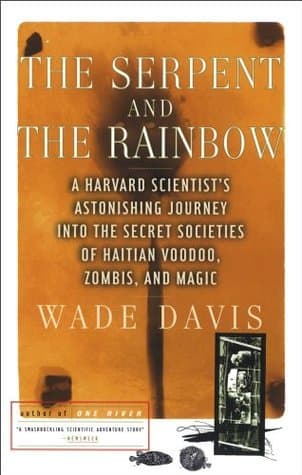
Core Idea
- Difficulty
- Medium
- Read it if
- You are fascinated by the intersection of anthropology, ethnobotany, and cultural practices, and want to understand the scientific and social realities behind the myth of zombies in Haiti.
- Skip it if
- You are looking for a horror story about the undead or prefer light, fictional reads over dense, fact-based anthropological investigations.
Key Takeaways from The Serpent and the Rainbow
Zombification: A Social Sanction, Not Supernatural
The 'zombi' phenomenon is a culturally specific form of social control and punishment, not a magical resurrection.
Davis breaks down the common Western idea of zombies as mindless, reanimated corpses. He shows zombification as a powerful, extreme form of social justice in rural Haitian Vodoun society. It is a punishment for those who commit serious offenses against their community, especially violating social rules or stealing land. The process involves a neurotoxin, mainly tetrodotoxin (found in pufferfish), which causes a death-like state, followed by a period of enslavement. This mix of pharmacology and cultural belief helps maintain order and enforce the community's will, showing Vodoun's deep power as a governing force in the countryside.
“The zombi is not the product of a supernatural event, but rather a victim of a complex pharmacological assault and a profound social ostracism.”
In the book: Davis's primary evidence comes from his scientific analysis of the 'zombi poison' samples, which identified tetrodotoxin and other psychoactive compounds. He also cites the specific cases of Clairvius Narcisse and Ti-Femme, individuals who were medically declared dead, buried, and later reappeared as zombis, recounting their experiences of being 'brought back' and enslaved.
Try this: When encountering unexplained cultural phenomena, resist immediate supernatural interpretations. Seek to understand the underlying social, political, and pharmacological mechanisms that might be at play. Recognize that what appears 'magical' often has a rational, albeit culturally specific, explanation.
Related ideas: tetrodotoxin, social-control, ethnobotany
Vodoun: The Living Soul of Haiti
Vodoun is not merely a religion, but the comprehensive social, political, and cultural framework of rural Haiti.
Davis argues that Western views have misunderstood and misrepresented Vodoun, often reducing it to sensational 'black magic.' He reveals it as a complex, strong, and deeply spiritual belief system that came from slavery, uniting enslaved Africans from different traditions. Beyond ritual and belief, Vodoun provides the moral code, legal system, healthcare, and even the political structure for most Haitians, especially in rural areas where government presence is minimal. It holds history, creates social cohesion, and is the foundation of Haitian resistance and identity.
“To understand Vodoun is to understand Haiti, for it is not simply a religion, but the very essence of Haitian identity, history, and social organization.”
In the book: Davis details the intricate pantheon of Lwa (spirits), the complex rituals, and the communal gatherings that form the backbone of Vodoun. He describes how disputes are settled by Houngans (priests) and Mambos (priestesses), how justice is administered, and how community welfare is maintained through Vodoun organizations. The successful Haitian Revolution itself is presented as a testament to Vodoun's unifying power.
Try this: Challenge ethnocentric biases when encountering unfamiliar cultures. Seek to understand belief systems from an emic (insider) perspective, recognizing their inherent logic and functionality within their specific context, rather than imposing external judgments or stereotypes.
Related ideas: haitian-culture, vodoun-religion, cultural-misunderstanding
The Pharmacological Underpinning of Ritual
Many spiritual experiences and cultural practices are rooted in the precise application of natural psychoactive substances.
A key idea from Davis's work is the role of ethnobotanical knowledge in traditional societies. He shows that the 'magic' of Vodoun, and many other indigenous spiritual practices, often relies on a sophisticated understanding and use of natural pharmacology. The zombie poison is the most dramatic example, but Davis also discusses other plants used for healing, divination, and inducing trance states. This shows that traditional healers and shamans are often skilled botanists and pharmacologists. Their rituals are designed to use the power of specific plants to create desired physiological and psychological effects, influencing spiritual experience and social behavior.
“The line between magic and medicine, between the sacred and the profane, often blurs when one considers the precise and intentional use of botanical agents in traditional cultures.”
In the book: The detailed chemical analysis of the zombi powder is central, identifying tetrodotoxin. Davis also alludes to other plants used in Vodoun rituals, though less explicitly detailed than the zombi poison. He emphasizes the meticulous preparation and specific knowledge required to handle such potent substances, demonstrating a deep, empirical understanding of their effects.
Try this: Recognize the scientific validity inherent in traditional ecological knowledge. Instead of dismissing indigenous practices as 'superstition,' investigate the empirical observations and pharmacological insights that often inform them. This can lead to discoveries in medicine and a deeper appreciation for human ingenuity.
Related ideas: ethnobotany, psychoactive-plants, traditional-medicine
Colonial Legacy and Cultural Resilience
Haitian Vodoun is a testament to cultural survival and resistance against centuries of oppression and misrepresentation.
Davis places Vodoun within Haiti's difficult history, arguing that its lasting strength is a direct response to the legacy of slavery and colonialism. Enslaved Africans, stripped of their individual cultures, combined their spiritual traditions into Vodoun to keep their identity, build community, and resist their oppressors. It provided a secret language, a moral guide, and the spiritual drive for the Haitian Revolution, the only successful slave revolt to create an independent nation. Even after independence, external forces and internal elites demonized Vodoun, yet it remained the heart of the Haitian people, a symbol of their strength and defiance.
“Vodoun was forged in the crucible of slavery, a tool of resistance and a sanctuary for identity against the brutal forces of colonialism.”
In the book: The historical narrative of the Haitian Revolution, particularly the Bois Caïman ceremony, is presented as a pivotal moment where Vodoun served as a catalyst for collective action. Davis details the ongoing demonization of Vodoun by missionaries and Western media, contrasting it with its profound importance to the majority of Haitians.
Try this: Understand that cultural practices often carry profound historical weight and serve as mechanisms for survival and resistance against oppression. Be critical of narratives that demonize indigenous cultures, recognizing that such narratives often stem from colonial biases or attempts to exert control.
Related ideas: haitian-revolution, colonialism, cultural-resilience
The Ethnographer's Dilemma: Immersion vs. Objectivity
Conducting deep ethnobotanical research requires profound cultural immersion, challenging the traditional bounds of scientific objectivity.
Davis's story is about his personal journey as much as his scientific findings. He deals with the tension in ethnographic research: the need for deep immersion to gain trust and understanding versus the scientific need for objective observation. His willingness to take part in Vodoun ceremonies, endure physical hardships, and navigate dangerous social situations shows the sacrifices and risks involved in truly understanding a foreign culture. This immersive approach, while possibly affecting traditional scientific 'distance,' allowed him to uncover the complex facts behind zombification, arguing that true understanding requires empathy and a willingness to move beyond one's own cultural framework.
“To truly understand, one must not merely observe, but participate, to shed the skin of the outsider and embrace the worldview of the other.”
In the book: Davis vividly recounts his experiences participating in Vodoun rituals, meeting with secret societies, and facing threats to his life. His descriptions of the sensory overload, the emotional intensity, and the gradual building of trust with key informants like Marcel Pierre and Ti-Nicholas illustrate his deep immersion.
Try this: When engaging in cross-cultural work or research, recognize the importance of cultural humility and the necessity of building genuine relationships. Be prepared to step outside your comfort zone and challenge your own preconceived notions to achieve deeper understanding.
Related ideas: ethnography, cultural-immersion, scientific-objectivity
Secret Societies: Guardians of Order and Knowledge
Secret societies within Vodoun play a crucial, often misunderstood, role in maintaining social order and preserving traditional knowledge.
Davis reveals the existence and function of various secret societies, such as the Bizango and the Sanpwel, within the Vodoun system. These societies are not evil, as often portrayed, but act as powerful, often feared, tools of social control and justice in areas where formal government structures are weak or absent. They are responsible for administering punishments, including zombification, and for preserving knowledge, particularly about the pharmacology of the zombie poison. Their secrecy allows them to operate effectively outside state control, ensuring that the community's will is enforced and traditional practices are maintained.
“Beyond the public face of Vodoun lie the secret societies, the true arbiters of justice and the keepers of profound, often dangerous, knowledge.”
In the book: Davis's encounters with members of these societies, his descriptions of their rituals, and his understanding of their role in the zombification process (e.g., the 'master of the poison' and the 'maître zombi') illustrate their power and function. The fear they inspire in the general populace also serves as evidence of their authority.
Try this: Avoid simplistic interpretations of 'secret societies' as inherently evil or conspiratorial. Instead, analyze their function within their specific cultural and historical context, recognizing that they may serve vital roles in governance, justice, or cultural preservation, particularly in stateless or marginalized communities.
Related ideas: secret-societies, social-justice, esoteric-knowledge
The Power of Belief and Suggestion
Beyond pharmacology, the psychological impact of cultural belief and suggestion is critical to the zombi phenomenon.
While Davis scientifically explains the effects of the zombie poison, he also stresses the role of psychological and cultural factors. Victims of zombification are not just drugged; they are culturally 'dead.' The belief in Vodoun's power, the fear of secret societies, and social ostracism create a psychological state of extreme vulnerability and suggestibility. This mental state is essential for the subsequent 'enslavement' and compliance of the zombie, showing that the mind's interpretation of reality, shaped by cultural narratives, can be as powerful as any chemical agent in determining human experience and behavior.
“The poison lays the body low, but it is the power of belief, the absolute conviction of one's fate, that truly creates the zombi.”
In the book: The accounts of Clairvius Narcisse, who described himself as being 'dead' and then 'awakened' into a new, subservient existence, highlight the profound psychological impact. The societal belief that zombis are soulless entities, and the victims' own internalization of this belief, reinforces their compliant state.
Try this: Recognize the immense power of belief systems and cultural narratives in shaping individual perception and behavior. When analyzing human phenomena, consider not only physical causes but also the psychological and social contexts that give them meaning and efficacy.
Related ideas: psychological-impact, cultural-belief, placebo-effect
Haiti: A Nation Forged in Freedom, Besieged by Poverty
Haiti's unique history of self-liberation is tragically intertwined with ongoing economic struggle and external exploitation.
Davis paints a picture of Haiti as a nation that gained freedom against great odds, only to be punished and exploited by global powers. Its successful slave revolt set a dangerous precedent, leading to international isolation, crippling debts, and repeated interventions. This history helps understand Haiti's current poverty and instability. Vodoun, in this view, is not just a cultural cornerstone but also a coping mechanism and a source of strength for a people who have faced constant hardship. The book implicitly criticizes the Western world's role in Haiti's struggles, showing the hypocrisy of celebrating freedom while undermining a nation that achieved it on its own.
“Haiti's independence, born of unparalleled courage, has been a burden as much as a blessing, constantly undermined by external forces and internal strife.”
In the book: Davis recounts the massive indemnity Haiti was forced to pay to France, its long period of international ostracism, and the subsequent political instability and foreign interventions. He connects these historical factors directly to the pervasive poverty and the reliance on Vodoun as a parallel governance structure.
Try this: When evaluating the challenges faced by developing nations, always consider the historical context, particularly the lingering effects of colonialism, exploitation, and international policies. Avoid blaming the victims and instead analyze systemic factors.
Related ideas: haitian-history, post-colonialism, economic-exploitation
Ethnobotany: Bridging Science and Tradition
Ethnobotany offers a vital bridge between indigenous knowledge systems and modern scientific inquiry, revealing hidden wisdom.
Davis's work shows the power of ethnobotany, a field that studies the relationship between people and plants. By working with traditional healers and knowledge-keepers in Haiti, he uncovered the specific plant components of the zombie poison, demonstrating that indigenous cultures have sophisticated, empirically derived knowledge about the natural world. This approach validates traditional wisdom and has potential for modern medicine and science. It highlights the need to preserve indigenous cultures and their knowledge, as they hold vast, untapped information about biodiversity and its uses.
“The knowledge held within indigenous cultures, often dismissed as primitive, frequently contains empirical truths that modern science is only beginning to rediscover.”
In the book: The entire investigative process, from identifying the specific plants (e.g., pufferfish, toads, taro) used in the zombi powder to analyzing their chemical constituents, is a testament to ethnobotanical methodology. Davis's reliance on informants like the 'Houngan' and 'Bokor' highlights the collaborative nature of this field.
Try this: Support initiatives that aim to document and preserve indigenous knowledge. Foster interdisciplinary approaches that integrate traditional wisdom with modern scientific methods to address global challenges in health, environment, and sustainable development.
Related ideas: ethnobotany, indigenous-knowledge, biodiversity-preservation
The Serpent and the Rainbow Quotes
“The zombie is not a figure of fantasy but a social reality, a person whose soul has been captured and whose body has been turned into a slave.”
“In Haiti, the dead are not dead; they are simply living in another world.”
“The poison that creates a zombie is a complex pharmacological cocktail, not mere superstition.”
“Vodou is not black magic; it is a sophisticated religion that structures the entire social and spiritual life of Haiti.”
“To understand the zombie, one must first understand the history of slavery in Haiti.”
“The botanist's role is not just to identify plants but to decode the cultural logic behind their use.”
“In the Vodou universe, every action has a spiritual consequence, and every illness has a supernatural cause.”
“The zombie represents the ultimate fear of the Haitian peasant: loss of autonomy and forced labor.”
“Science and spirituality are not opposites here; they are two sides of the same coin.”
“The serpent and the rainbow—the symbols of death and regeneration—are at the heart of Vodou cosmology.”
“To dismiss these practices as mere folklore is to ignore centuries of accumulated wisdom.”
“In Haiti, the line between the living and the dead is porous, negotiated daily through ritual and remembrance.”
“The zombie powder is a testament to the pharmacological ingenuity of the Haitian bokor.”
“Vodou is a religion of resistance, born from the struggle against slavery and colonialism.”
“The real horror is not the zombie but the social conditions that make such a belief necessary.”
Quiz
10 questions on the main ideas. Each answer comes with a short explanation.
Question 1
What was Wade Davis's primary academic role when he investigated zombis in Haiti?
- A medical doctor studying tropical diseases
- A Harvard ethnobotanist
- A cultural anthropologist from Yale
- A forensic pathologist
Show answer
B. A Harvard ethnobotanist Davis was an ethnobotanist affiliated with Harvard University, which positioned him uniquely to investigate the botanical and cultural aspects of zombification in Haiti.
Question 2
What year did Wade Davis arrive in Haiti to begin his investigation?
- 1978
- 1980
- 1982
- 1985
Show answer
C. 1982 Davis arrived in April 1982 to investigate documented cases of zombis, marking the start of his fieldwork detailed in the book.
Question 3
According to Davis, what is the relationship between vodoun culture and Haitian history?
- Vodoun is a minor folk tradition with little historical significance
- Vodoun is primarily a tourist attraction developed in the 20th century
- The story of vodoun is essentially the history of Haiti
- Vodoun was imported from Europe during colonial times
Show answer
C. The story of vodoun is essentially the history of Haiti Davis argues that vodoun culture encapsulates Haiti's history, from African origins through the independence movement to its contemporary role in rural governance.
Question 4
What key botanical discovery did Davis make regarding the zombification process?
- A hallucinogenic mushroom used in rituals
- A poison derived from puffer fish (tetrodotoxin)
- A rare orchid with sedative properties
- A caffeine-like stimulant from local plants
Show answer
B. A poison derived from puffer fish (tetrodotoxin) Davis identified tetrodotoxin from puffer fish as a key component in the poison used to induce a death-like state in zombification, blending science with cultural practice.
Question 5
How does Davis describe the role of vodoun in Haiti's countryside?
- As a declining practice replaced by modern medicine
- As the de facto government and social framework
- As a secret society with limited influence
- As a purely religious institution separate from politics
Show answer
B. As the de facto government and social framework Davis observes that vodoun culture functions as the effective government in rural Haiti, organizing social, political, and spiritual life.
Question 6
What was the primary goal of Davis's investigation in Haiti?
- To debunk vodoun as superstition
- To study Haitian agriculture and botany
- To investigate documented cases of zombis
- To write a travelogue about Haitian festivals
Show answer
C. To investigate documented cases of zombis Davis aimed to scientifically examine real cases of zombis—people who reappeared after being declared dead—to understand the phenomenon within its cultural context.
Question 7
Which aspect of Haitian culture does Davis emphasize as crucial for understanding zombification?
- Its economic systems and trade routes
- Its colonial architecture and urban planning
- Its vodoun rituals and social control mechanisms
- Its modern healthcare infrastructure
Show answer
C. Its vodoun rituals and social control mechanisms Davis argues that zombification must be understood within the framework of vodoun rituals, which serve as tools for social regulation and cultural cohesion in Haiti.
Question 8
What does Davis suggest is the broader significance of his findings for Western science?
- They prove that zombis are purely fictional constructs
- They demonstrate the limitations of Western medical models in non-Western contexts
- They show that Haitian botany has no practical applications
- They validate European colonial views on Haitian culture
Show answer
B. They demonstrate the limitations of Western medical models in non-Western contexts Davis's work highlights how Western science often fails to account for cultural and spiritual dimensions, urging a more integrative approach to phenomena like zombification.
Question 9
In Davis's analysis, how is zombification linked to Haiti's history of slavery and resistance?
- It is a random cultural artifact with no historical ties
- It originated as a form of entertainment for slave owners
- It reflects African spiritual traditions adapted under oppression and used in the independence struggle
- It was imported by French colonists to control the population
Show answer
C. It reflects African spiritual traditions adapted under oppression and used in the independence struggle Davis traces zombification to African roots, showing how it evolved as a means of social control and resistance during slavery, later becoming embedded in vodoun culture post-independence.
Question 10
What methodological approach does Davis primarily use in 'The Serpent and the Rainbow'?
- A purely quantitative analysis of zombi cases
- An experimental laboratory study on tetrodotoxin
- A combination of anthropological fieldwork and personal narrative
- A historical documentary based solely on archives
Show answer
C. A combination of anthropological fieldwork and personal narrative Davis blends rigorous anthropological investigation with a first-person adventure story, making the book both a scientific study and a compelling personal journey into Haitian culture.
The Serpent and the Rainbow FAQ
What is 'The Serpent and the Rainbow' about?
The book is a scientific investigation and personal adventure story by Harvard ethnobotanist Wade Davis, exploring zombis and vodoun (voodoo) culture in Haiti. It documents Davis's 1982 journey to study documented cases of zombification, placing the phenomenon within its cultural, historical, and botanical contexts.
Does zombification really work according to the book?
Yes, Davis presents scientific evidence that zombification is a real pharmacological process involving tetrodotoxin from puffer fish and other neurotoxins, which can induce a death-like state. However, he emphasizes it's deeply embedded in vodoun cultural and social control systems, not just a chemical phenomenon.
What is vodoun (voodoo) culture as explained in the book?
Vodoun is presented as a complex Afro-Haitian spiritual system that blends West African religions with Catholicism. Davis shows it's not just superstition but a coherent worldview that has shaped Haiti's history, social structure, and resistance movements, effectively governing rural Haiti.
How different is this from fictional zombie stories?
Unlike Hollywood zombies, Haitian zombis are not reanimated corpses but living people in a pharmacologically-induced trance state. Davis emphasizes zombification serves specific social functions within vodoun culture, such as punishment for community violations, rather than random horror.
What scientific evidence does Wade Davis provide?
Davis collected and analyzed 'zombie powder' samples, identifying tetrodotoxin and other compounds that can mimic death. He also documented case studies, pharmacological effects, and cultural contexts, presenting zombification as an intersection of ethnobotany, toxicology, and anthropology.
How does the book connect vodoun to Haitian history?
Davis argues vodoun was central to Haiti's independence movement and continues to structure rural society. The book traces how African spiritual traditions evolved during slavery, fueled the 1791 revolution, and became a system of resistance and governance against colonial and post-colonial oppression.
Is 'The Serpent and the Rainbow' a horror story?
While it deals with eerie subjects, it's primarily a scientific and anthropological work. Davis approaches zombification with academic rigor, though his personal adventures and encounters with vodoun rituals add narrative tension and cultural immersion.
What is the significance of the title?
The 'serpent' represents vodoun's Damballah Wedo (the serpent spirit) and healing/poison duality, while the 'rainbow' symbolizes hope and transformation. Together, they reflect the book's theme of bridging scientific inquiry with spiritual understanding in Haitian culture.
How does Davis's approach differ from traditional anthropology?
Davis combines rigorous scientific methods with first-person narrative adventure. Unlike detached observers, he immerses himself in vodoun ceremonies, earning trust through participation while maintaining objective analysis of botanical and cultural evidence.
What practical insights does the book offer about Haitian culture?
It reveals how vodoun provides social cohesion, historical continuity, and psychological resilience in Haiti. Davis shows that understanding zombification requires examining land rights, family structures, and political history, not just isolated supernatural beliefs.
Similar books
- Ishmael
Daniel Quinn
3.9 (2k) average on GoodreadsFantasyExplores philosophical and anthropological themes of culture, society, and humanity's place in the world through a narrative lens.
- Eat, Pray, Love
Elizabeth Gilbert
3.6 (1.5M) average on GoodreadsLifestyleA heartbroken writer leaves her conventional life for a year-long global search for pleasure in Italy, spiritual devotion in India, and unexpected love and balance in Bali.
- Wild: From Lost to Found on the Pacific Crest Trail
Cheryl Strayed
4.0 (615k) average on GoodreadsLifestyleAfter losing her mother and her marriage, a young woman impulsively hikes over a thousand miles of the Pacific Crest Trail alone, finding strength and healing in the unforgiving wilderness.
- Into Thin Air: A Personal Account of the Mount Everest Disaster
Jon Krakauer
4.2 (395k) average on GoodreadsLifestyleOn May 10, 1996, ambition and a sudden, violent storm turned Mount Everest into a deadly trap, leaving Jon Krakauer to tell the harrowing story of a disaster that took lives and shattered climbers' dreams.
- On The Road
Jack Kerouac
3.6 (349k) average on GoodreadsLifestyleDean Moriarty and Sal Paradise go on a wild, cross-country trip with jazz, drugs, and a desperate search for meaning on America's post-war roads.
- A Walk in the Woods: Rediscovering America on the Appalachian Trail
Bill Bryson
4.1 (346k) average on GoodreadsLifestyleBill Bryson humorously describes his ill-prepared yet insightful attempt to hike the Appalachian Trail, meeting unique characters and the raw beauty of the wilderness.





Enjoyed the summary?
A summary gives you the shape of the book. The book itself has the detail, the examples and the voice.
Find The Serpent and the Rainbow on AmazonAs an Amazon Associate, BookBrief earns from qualifying purchases. How we're funded