
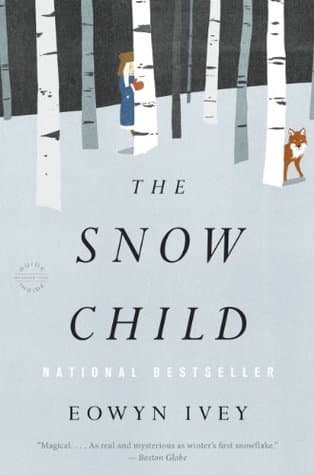
Synopsis
Covers the whole plot, including the ending.
- Difficulty
- Medium
- Pacing
- Moderate
- Mood
- Atmospheric, Melancholy, Magical, Hopeful, Resilient
- Read it if
- You love lyrical prose, magical realism, and stories about the Alaskan wilderness, longing, and the unconventional forms family can take.
- Skip it if
- You prefer fast-paced plots, clear-cut fantasy explanations, or stories without significant melancholy.
The Snow Child Plot Summary
Covers the whole plot, including the ending.
A Desolate Homestead and a Snow Child's Birth
In 1920, Jack and Mabel, a childless couple in their late thirties, move to the remote Alaskan wilderness. They seek a new life after the stillbirth of their only child. They homestead near the fictional town of Palmer, enduring harsh conditions and the hard physical work of clearing land and building a cabin. Mabel struggles deeply with loneliness and depression, made worse by the isolation and her desire for a child. Jack, though tough, is often emotionally distant, focused on survival. During the first snowfall of winter, in a rare moment of shared happiness, they build a snow child in their yard, with a scarf, mittens, and berries for eyes. Mabel even names it Faina. The act gives them a brief sense of connection and hope.
The Disappearance and the Wild Girl
The next morning, Jack and Mabel wake to find the snow child gone, its accessories neatly piled where it stood. Later that day, while hunting, Jack sees a young, blonde-haired girl running through the trees with a red fox. She wears animal skins and seems wild, disappearing quickly. Mabel, at first doubtful, sees the girl herself a few days later, leaving a small animal on their doorstep. The couple is captivated and puzzled. They begin to leave food out for her, hoping to draw her closer. They learn her name is Faina, the same name Mabel gave the snow child, and she seems to have an otherworldly connection to the wilderness, surviving the brutal Alaskan winter easily.
Faina's Gradual Integration
Faina gradually begins to interact with Jack and Mabel, but always with a wildness and some detachment. She speaks little, preferring to communicate through actions and her connection to nature. She helps Jack with trapping, showing an unusual knowledge of the woods and its creatures. Mabel, at first cautious of Faina's wild nature, grows to love her deeply, finding in her the daughter she always wanted. Faina's presence fills the emptiness in their lives, bringing laughter and purpose back to their lonely homestead. However, her unusual habits, like her discomfort with warmth and her preference for sleeping outdoors, remain a constant source of wonder and concern for Jack and Mabel, confirming her mysterious origins.
The Neighbors' Suspicion and Faina's Secret
The Bensons, Jack and Mabel's nearest neighbors and friends, learn of Faina's presence. Esther Benson, practical and motherly, worries about Faina's upbringing, while Garrett Benson, a trapper, finds her hunting skill interesting. Other settlers in Palmer whisper about the strange, wild girl. Mabel, while protective of Faina, also notices unsettling details: Faina never seems to age, she avoids direct sunlight and warmth, and she dislikes being touched. One day, Mabel finds a small, faded photograph among Faina's things — a picture of a young woman who looks a lot like Faina, hinting at a past before her arrival.
A Life with Faina and the Call of the Wild
Years pass, and Faina becomes an important part of Jack and Mabel's lives. She grows into a young woman, though her youthful appearance largely stays the same. She continues to show her unique traits: her red fox, now an old companion, is always nearby; she thrives in the cold and snow but becomes tired and sick in the summer heat; she communicates more freely but keeps a spiritual connection to the wilderness. Jack teaches her to read and write, and she learns quickly, yet her heart remains tied to the wild. Jack and Mabel, despite their lasting love, are always aware of the delicate balance of her presence, knowing she is not entirely of their world.
Faina's Courtship and the Approaching Change
As Faina gets older, she attracts the attention of a young homesteader named Allan. They fall in love, and Allan, accepting of Faina's unusual ways, proposes marriage. Jack and Mabel are happy but also worried, understanding what it means for Faina to enter a more conventional life. They worry about her ability to adapt, especially her weakness to warmth and her natural wildness. Faina, though she loves Allan, expresses her own fears about losing her connection to the snow and the wild. Her physical condition seems to worsen as summer approaches and the idea of a settled life, suggesting a difficult choice.
The Wedding and the Summer's Toll
Faina and Allan marry in a simple ceremony. However, as the Alaskan summer continues, Faina's health gets much worse. She becomes increasingly frail, weak, and has a constant fever. Her skin feels cold, and she struggles to breathe in the heat. Mabel tirelessly cares for her, seeing the link between Faina's illness and her dislike of warmth. Jack, too, is very concerned, remembering folk tales of snow maidens. The joy of the wedding is overshadowed by the growing fear that Faina cannot survive the summer, her life force draining with the melting snow and the prolonged warmth.
Faina's Retreat to the Wilderness
Realizing she is dying, Faina makes a desperate choice. One hot summer night, she slips away from Allan and her parents, heading into the deepest parts of the wilderness. She is weak but determined, driven by an instinct to return to her true element. Jack and Mabel, along with Allan, are distraught. They search for her for days, their hearts heavy with dread. They know, deep down, that Faina is returning to where she came from, a place where she might find peace, even if it means leaving them forever. Her departure confirms her magical, temporary nature.
The Revelation and Acceptance
Driven by an unexplained urge, Mabel continues searching even after others stop. She eventually finds a secluded, abandoned cabin in a remote part of the woods. Inside, she finds a very old, frail woman, nearly skeletal, who says her name is Galina. Galina reveals she is Faina's mother, explaining that Faina was indeed a snow child, brought to life from snow and ice, just as the fairy tales say. She had built her own snow child years ago, who vanished and reappeared as Faina. Galina explains the conditions of Faina's existence: her need for cold, her weakness to warmth, and her eventual return to the snow. This revelation confirms Jack and Mabel's deepest suspicions and fears about Faina's true nature.
Faina's Final Transformation
Mabel brings Galina back to their homestead, where she lives out her final days, sharing more of Faina's history. Eventually, Galina dies peacefully. As the first snows of winter begin to fall, Jack and Mabel find Faina, transformed back into a snow child, lying peacefully in a clearing, the red fox curled beside her. Her body is pure snow, beautiful and calm. They understand that she has returned to her original form, completing her cycle. While heartbroken, they also feel a deep sense of peace and thanks for the years they had with her. Faina's memory forever connects them, their love for her showing the magic and mystery of the Alaskan wilderness.
Principal Figures
Mabel
Protagonist
A lonely homesteader who finds joy and purpose in raising a mysterious snow child.
Mabel is a sensitive and introspective woman, deeply affected by the stillbirth of her child and the harsh realities of homesteading in 1920s Alaska. She struggles with profound loneliness and depression, often feeling isolated and unfulfilled. Her longing for a child is a central driving force. When Faina appears, Mabel embraces her with fierce maternal love, finding renewed purpose and happiness. She is intuitive and open to the magic of the world, gradually accepting Faina's unusual nature. Her journey is one of healing, acceptance, and learning to love unconditionally, even when faced with the inexplicable.
Relationships: Jack (Husband, initially distant but grows closer through shared experience); Faina (Adopted daughter, object of her deep maternal love and wonder); Esther Benson (Friend and confidante)
Jack
Protagonist
A resilient homesteader, initially pragmatic, who slowly opens his heart to the magic of Faina.
Jack is a hardworking, practical man, driven by the desire to make a life for himself and Mabel in the Alaskan wilderness. He is less outwardly emotional than Mabel, often internalizing his feelings and focusing on the physical demands of homesteading. He is a skilled hunter and trapper, deeply connected to the land in a practical sense. While initially skeptical of Faina's origins, he comes to love her as his own daughter, teaching her practical skills and protecting her. His arc involves softening his pragmatic exterior and embracing a more open, accepting view of the world's mysteries, particularly through his love for Faina.
Relationships: Mabel (Wife, partner in homesteading and parenthood); Faina (Adopted daughter, whom he teaches and protects); Garrett Benson (Friend and fellow trapper)
Faina
Central Figure
A mysterious girl, born of snow, who brings joy and wonder to Jack and Mabel's lives.
Faina is the enigmatic 'snow child,' a wild girl who appears after Jack and Mabel build a snow effigy. She possesses an otherworldly connection to the Alaskan wilderness, thriving in the cold, moving silently, and accompanied by a red fox. She is initially feral, speaking little, but gradually integrates into Jack and Mabel's lives, learning to read and write. Despite her growing connection to humanity, she retains her wild essence, sensitive to warmth and the pull of nature. She embodies both innocence and ancient magic, her existence a living fairy tale. Her true nature is revealed to be a snow maiden, destined to return to the snow.
Relationships: Jack (Adoptive father, teacher of practical skills); Mabel (Adoptive mother, recipient of deep maternal love); Allan (Husband and love interest); Galina (Biological mother, a previous snow child creator)
Esther Benson
Supporting
A kind and practical neighbor, a source of comfort and friendship for Mabel.
Esther is Jack and Mabel's nearest neighbor and a vital source of companionship and practical advice for Mabel. She is a warm, maternal woman who has raised her own children in the harsh Alaskan environment. Esther represents the grounded, practical reality of homesteading life. She is initially cautious and concerned about Faina's wildness and lack of conventional upbringing but eventually comes to accept her, offering kindness and support. She provides a sense of community and normalcy amidst the isolation, acting as a sounding board and friend for Mabel.
Relationships: Mabel (Close friend and confidante); Garrett Benson (Husband)
Garrett Benson
Supporting
A seasoned trapper and neighbor, a practical and observant friend to Jack.
Garrett is Esther's husband and a experienced trapper in the Alaskan wilderness. He is a pragmatic and observant man, knowledgeable about the land and its creatures. He befriends Jack, sharing his trapping expertise and providing a male companionship that Jack often lacks. Garrett is intrigued by Faina's uncanny abilities in the woods, often marveling at her skill. While less emotionally expressive than Esther, he is a loyal friend and offers a grounded perspective on the challenges of their environment. He represents the resilience and resourcefulness required for Alaskan life.
Relationships: Jack (Friend and fellow trapper); Esther Benson (Wife)
Allan
Supporting
A young homesteader who falls in love with and marries Faina.
Allan is a kind, gentle, and earnest young homesteader who comes to live near Jack and Mabel. He is drawn to Faina's unique beauty and spirit, falling deeply in love with her. Allan is accepting of Faina's unusual ways, demonstrating patience and understanding. He represents the possibility of a more conventional life for Faina, offering her a future rooted in human connection and domesticity. His love for Faina is genuine, but he ultimately faces the heartbreak of her true nature. He is a symbol of the human world's attempt to integrate with the wild.
Relationships: Faina (Husband and love interest); Jack (Future father-in-law); Mabel (Future mother-in-law)
Galina
Supporting
Faina's biological mother, a reclusive old woman who reveals the truth of snow children.
Galina is a very old, reclusive woman discovered by Mabel in a remote cabin. She reveals herself to be Faina's biological mother, having also created a snow child years ago who then came to life. Galina is the keeper of the ancient knowledge of snow children, explaining their origins, their need for cold, and their inevitable return to the snow. Her appearance provides the crucial explanation for Faina's mysterious existence, connecting her story to a deeper folklore. She is a figure of wisdom and sorrow, having lived through the same bittersweet experience as Jack and Mabel.
Relationships: Faina (Biological mother); Mabel (Confidante and recipient of her life story)
The Red Fox
Supporting
Faina's loyal animal companion, a symbol of her wildness and connection to nature.
The red fox is Faina's constant companion from the moment she first appears. It moves with her, hunts with her, and stays by her side throughout her life with Jack and Mabel. The fox is more than just a pet; it is an extension of Faina's wild spirit, a tangible link to her origins in the wilderness. Its presence reinforces her mysterious nature and her deep, intuitive connection to the animal world. The fox symbolizes loyalty, wildness, and the untamed beauty of Alaska, always present as a silent witness to Faina's journey.
Relationships: Faina (Loyal companion and spiritual kin)
Themes & Insights
Loss, Grief, and Healing
The novel begins with Jack and Mabel dealing with the deep sadness of losing their child. Mabel's depression and loneliness are key to her character. Faina's arrival, though mysterious, helps them heal, filling the emptiness left by their loss. The story explores how love, even for a magical being, can mend broken hearts. Ultimately, Faina's departure brings a new kind of loss, but one softened by understanding and the lasting love she brought, allowing Jack and Mabel to find some peace and acceptance.
“Perhaps it was the way of life, she thought, to make small gains and losses, to move and change, and to love what could not be held.”
Nature vs. Civilization
The harsh, beautiful Alaskan wilderness is a strong force in the novel, always challenging the human desire for control. Faina embodies the wild, thriving in the cold and resisting the limits of home life. Her struggle to adapt to human warmth and societal expectations shows the conflict between untamed nature and settled life. Jack and Mabel's homesteading efforts show their attempt to make a life in the wild, while Faina's existence reminds them of the wilderness's lasting power and mystery, showing that some things cannot be controlled.
“The wilderness was a great, indifferent beast, and it devoured both the weak and the strong.”
Magic, Folklore, and Reality
The novel smoothly combines the tough realities of historical homesteading with elements of a fairy tale. Faina's origin as a snow child comes directly from Russian folklore, challenging what characters and readers think is possible. The story explores the power of belief and imagination in a world that demands practical thinking. Jack and Mabel's slow acceptance of Faina's magical nature changes their lives, suggesting there is wonder and mystery beyond rational explanation, and that sometimes, the deepest truths are found in stories and legends.
“Perhaps the world was not a place for logic, but for magic. Perhaps a child could be born of snow.”
Parental Love and Acceptance
A main theme is the deep and unconditional love Jack and Mabel develop for Faina, despite her mysterious origins and unusual nature. They accept her wildness, her unique needs, and her eventual fate, loving her as their own daughter. Their journey shows the power of parental love, which goes beyond normal limits and expectations. They learn to care for, protect, and eventually let go, embracing the bittersweet reality of loving a child not entirely of their world, finding joy and meaning in the time they have together.
“To love her was to accept what she was, to accept the wildness in her, and to know that she would always belong to the snow.”
Isolation and Community
The extreme isolation of the Alaskan wilderness greatly affects Jack and Mabel, especially Mabel, leading her into depression. The novel shows the human need for connection. The gradual formation of a small community with the Bensons and later Allan, provides important support, friendship, and a sense of belonging. These relationships contrast with the deep solitude Jack and Mabel first face, showing how community, even in a harsh environment, can support people and help them handle life's challenges, though Faina's ultimate fate reminds them of the unique isolation of her own existence.
“The silence was a presence, sometimes a comfort, sometimes an enemy.”
Plot Devices & Literary Techniques
Fairy Tale Archetype (The Snow Maiden)
Faina's character is directly inspired by Russian folklore.
The entire premise of 'The Snow Child' is built upon the Russian folk tale of Snegurochka, or the Snow Maiden. Faina embodies this archetype: she is born of snow, thrives in cold, and weakens with warmth, eventually returning to her elemental state. This device establishes a magical realism framework for the narrative, allowing the reader to accept the fantastical elements within a historical setting. It also foreshadows Faina's fate, creating a sense of bittersweet inevitability throughout the story. The explicit mention of the 'snow child' tale by Galina at the end directly confirms this literary device.
Setting as a Character
The Alaskan wilderness shapes the characters and drives the plot.
The Alaskan wilderness in the 1920s is far more than just a backdrop; it is a powerful, active force that dictates the lives of Jack and Mabel. Its harshness leads to their isolation and struggle, while its beauty and mystery allow for Faina's existence. The cycles of winter and summer directly impact Faina's health and ultimately her fate. The wilderness provides sustenance, challenges, and a sense of awe, deeply influencing the characters' resilience, their relationship with each other, and their understanding of the world. It is the crucible in which their lives are forged and transformed.
Symbolism of the Red Fox
Faina's animal companion symbolizes her wildness and connection to nature.
The red fox that accompanies Faina from her first appearance serves as a potent symbol. It represents Faina's untamed nature, her deep connection to the animal world, and her origins in the wilderness. The fox is a silent, constant presence, mirroring Faina's own elusive and mysterious qualities. It never fully integrates into domestic life, just as Faina never fully sheds her wildness. Its loyalty to Faina underscores her unique bond with nature and reinforces the magical, primal essence of her character, acting as a visual manifestation of her true spirit.
Foreshadowing through Seasonal Cycles
The changing seasons subtly hint at Faina's vulnerability and eventual fate.
The progression of seasons, particularly the contrast between the brutal Alaskan winter and the brief, warm summer, serves as a significant foreshadowing device. Faina thrives in winter, embodying its spirit, but visibly weakens and becomes ill as summer approaches and the temperatures rise. This cyclical pattern subtly but consistently hints at her elemental nature and her eventual demise if exposed to prolonged warmth. The dread of summer's arrival becomes a growing concern for Jack and Mabel, signaling the inevitable conflict between Faina's snow-bound existence and the natural world's changing temperatures.
The Snow Child Quotes
“She was a girl who could walk a trapline, skin a fox, and shoot a rifle with the best of them, but she also knew how to make a sourdough starter sing.”
“The wilderness had its own way of measuring time, not in hours or days, but in seasons, in the rise and fall of rivers, the migration of animals.”
“Sometimes, when a person is too much alone, they make a friend of their own heart.”
“It was a wild, strange land, and it demanded a wild, strange heart to live in it.”
“The line between what was real and what was imagined often blurred in the vast, silent stretches of the territory.”
“Love was not a thing to be found, but a thing to be made, and remade, and made again, each day, with the person you chose.”
“A person could starve from loneliness as easily as from hunger.”
“The snow child was a whisper of hope in a land that could be brutally unforgiving.”
“There was a kind of peace in giving up, a quiet acceptance of what was, instead of fighting for what might be.”
“Winter was not just a season; it was a way of life, a test of endurance, a canvas for the soul.”
“Stories were not just entertainment; they were the way people made sense of the world, the way they kept the past alive.”
“The greatest sorrow was the one you carried alone, the one you had no words for.”
“Nature didn't care about human plans; it had its own rhythms, its own merciless beauty.”
“Perhaps the world was not a place of facts, but a place of possibilities, and a person had to choose which ones to believe.”
Quiz
10 questions on the plot and the characters. Each answer comes with a short explanation.
Question 1
What prompts Jack and Mabel to build the snow child?
- They were celebrating Christmas and wanted a festive decoration.
- They were feeling playful during the season's first snowfall and a moment of levity.
- Their neighbors suggested it as a way to cope with their loneliness.
- Mabel had a dream about a snow child and convinced Jack to build it.
Show answer
B. They were feeling playful during the season's first snowfall and a moment of levity. The book states that in a moment of levity during the season's first snowfall, they built a child out of snow, indicating a spontaneous act of joy amidst their hardships.
Question 2
What animal is often seen accompanying Faina?
- A wolf
- A bear cub
- A red fox
- An owl
Show answer
C. A red fox Faina is described as hunting with a red fox at her side, emphasizing her connection to the wild.
Question 3
What is the primary emotional state Mabel is experiencing before Faina's appearance?
- Excitement for homesteading life
- Contentment and peace
- Loneliness and despair
- Anger at Jack's lack of effort
Show answer
C. Loneliness and despair The book explicitly states Mabel is 'crumbling from loneliness and despair,' highlighting her emotional struggle prior to Faina's arrival.
Question 4
How do Jack and Mabel initially react to Faina's sudden appearance?
- They immediately call for help, fearing she is lost.
- They are confused and struggle to understand this child who seems to have appeared from a fairy tale.
- They are suspicious and believe she is a runaway.
- They are overjoyed and instantly accept her without question.
Show answer
B. They are confused and struggle to understand this child who seems to have appeared from a fairy tale. The text states, 'As Jack and Mabel struggle to understand this child who could have stepped from the pages of a fairy tale,' indicating their initial confusion and wonder.
Question 5
What does Faina's ability to survive alone in the Alaskan wilderness suggest about her character?
- She is a runaway from a nearby settlement.
- She possesses an unusual, almost supernatural, connection to nature.
- She was abandoned by her parents and learned to fend for herself.
- She is a figment of Jack and Mabel's imagination.
Show answer
B. She possesses an unusual, almost supernatural, connection to nature. Faina's survival skills, described as 'somehow survives alone in the Alaskan wilderness,' combined with her mysterious origins, hint at her magical or mythical nature, aligning with the fairy tale elements of the story.
Question 6
The setting of Alaska in the 1920s contributes to the story primarily by:
- Providing a backdrop for a bustling, modern lifestyle.
- Highlighting the ease of communication and travel.
- Emphasizing isolation, harshness, and the struggle for survival.
- Creating opportunities for widespread community interaction.
Show answer
C. Emphasizing isolation, harshness, and the struggle for survival. The description 'Alaska, 1920: a brutal place to homestead' directly emphasizes the challenging and isolating nature of the setting, which is central to the characters' struggles.
Question 7
What overarching theme is suggested by the phrase 'in this beautiful, violent place things are rarely as they appear'?
- The importance of trusting first impressions.
- The deceptive nature of appearances and the hidden realities of life and nature.
- The triumph of human will over natural forces.
- The simplicity of life in the wilderness.
Show answer
B. The deceptive nature of appearances and the hidden realities of life and nature. This phrase directly foreshadows that Faina's true nature will be complex and perhaps not what Jack and Mabel initially perceive, highlighting themes of illusion versus reality and the mysterious aspects of the setting.
Question 8
The transformation mentioned at the end of the synopsis ('what they eventually learn about Faina will transform all of them') most likely refers to:
- Their physical relocation to a different homestead.
- A profound change in their understanding of family, love, and the natural world.
- Their decision to adopt more children.
- Faina convincing them to abandon their farm.
Show answer
B. A profound change in their understanding of family, love, and the natural world. Given the literary and fantasy elements, 'transform' implies a deep, internal change in character and perspective, particularly concerning their childlessness, their relationship, and Faina's magical nature.
Question 9
How does Jack's experience of homesteading differ from Mabel's, as described in the synopsis?
- Jack is thriving, while Mabel is struggling with the work.
- Jack is breaking under the weight of the farm work, while Mabel is crumbling from loneliness and despair.
- Both are equally happy with their new life.
- Jack finds joy in the physical labor, and Mabel enjoys the quiet solitude.
Show answer
B. Jack is breaking under the weight of the farm work, while Mabel is crumbling from loneliness and despair. The synopsis clearly differentiates their struggles: 'he breaking under the weight of the work of the farm; she crumbling from loneliness and despair,' showing distinct but equally severe challenges.
Question 10
The genre blend of Literary Fiction, Fantasy, and Historical Fiction suggests that the story will likely explore:
- A straightforward historical account of Alaskan homesteading with no imaginative elements.
- Realistic character development and social commentary intertwined with magical or mythical elements within a specific historical context.
- A purely fantastical world with no grounding in reality or historical events.
- A fast-paced adventure novel focused solely on survival in the wilderness.
Show answer
B. Realistic character development and social commentary intertwined with magical or mythical elements within a specific historical context. Literary Fiction implies deep character and thematic exploration; Fantasy points to magical realism or mythical elements (like Faina); and Historical Fiction grounds it in a specific time and place (Alaska, 1920s). The combination suggests a rich, nuanced narrative.
The Snow Child FAQ
What is "The Snow Child" about?
"The Snow Child" is about Jack and Mabel, a childless homesteader couple in 1920s Alaska, who are struggling with loneliness and the harsh wilderness. In a whimsical moment during the first snowfall, they build a snow child, only for it to disappear and be replaced by a mysterious, wild young girl named Faina, who they come to love as their own daughter. The story explores the challenges of frontier life, the power of belief, and the blurred lines between reality and folklore.
Why should I read "The Snow Child"?
You should read "The Snow Child" for its enchanting blend of historical fiction and magical realism, set against the breathtaking yet brutal backdrop of 1920s Alaska. It offers a poignant exploration of grief, hope, and the human need for connection, all while weaving in elements of a beloved Russian fairy tale. The novel's evocative prose and compelling characters make for a deeply immersive and emotionally resonant reading experience.
What is the background/setting of "The Snow Child"?
The story is set in the rugged, isolated Alaskan wilderness during the 1920s, a period of challenging homesteading. Jack and Mabel are recent arrivals, grappling with the extreme weather, demanding physical labor, and profound solitude of their new life. The unforgiving landscape and the close-knit, self-reliant community of other homesteaders form a crucial backdrop to their personal struggles and the emergence of Faina.
What are the most memorable quotes?
One memorable quote is, "She was a wild thing, a child of the woods, and no one could tame her." Another impactful line is, "Perhaps there were no such things as happy endings, only places where stories stopped." These quotes encapsulate the wild spirit of Faina and the often bittersweet nature of life in the Alaskan frontier.
What writing style does the author use?
Eowyn Ivey employs a lyrical and atmospheric writing style that beautifully balances the harsh realities of homesteading with the magical elements of a fairy tale. Her prose is rich with sensory details, vividly describing the Alaskan landscape and the characters' internal states. The narrative flows with a gentle, deliberate pace, drawing readers into the characters' experiences and the unfolding mystery of Faina.
What minor details add significant meaning?
The recurring motif of the red fox, which often accompanies Faina, subtly reinforces her wild, untamed nature and her deep connection to the wilderness. Also, the specific details of Mabel's longing for a child, like her knitting tiny garments, heighten the emotional impact of Faina's arrival and the couple's attachment to her, making her a symbol of their deepest desires.
What are some subtle foreshadowing moments?
Subtle foreshadowing appears in the early descriptions of Faina's unusual resilience to cold and her ability to move silently through the snow, hinting that she is not an ordinary child. Additionally, the local gossip and old wives' tales shared by homesteaders about spirits of the woods and children born of snow gently prepare the reader for the magical aspects of Faina's existence and her eventual fate.
What unexpected character connections exist?
Beyond Jack and Mabel's direct connection to Faina, there's an unexpected bond between Faina and the older, more experienced homesteader, Garrett. He develops a protective, almost paternal affection for her, often bringing her gifts and watching out for her, which offers a different perspective on her integration into the community and her unique nature.
What are unspoken character motivations?
Mabel's unspoken motivation is a profound, almost desperate desire for motherhood, which drives her to embrace Faina despite the child's mysterious origins and wildness. Jack, while initially more skeptical, is motivated by his love for Mabel and his own deep-seated need for family and purpose, leading him to accept Faina and build a life around her, even if it defies logic.
What psychological complexities do characters exhibit?
Mabel exhibits deep psychological complexities related to grief and hope, swinging between despair over her childlessness and fervent belief in Faina's existence, blurring the lines of her own sanity. Jack struggles with the psychological burden of providing for his family in a harsh environment, and his pragmatism often clashes with his growing acceptance of the fantastical, challenging his worldview.
What are the major emotional turning points?
A major emotional turning point is when Jack and Mabel first glimpse the blonde-haired girl after the snow child disappears, igniting a fragile hope within them. Another critical moment is Faina's first winter with them, where her growing attachment to the couple and her vulnerability to the human world deepen their love and commitment, fundamentally changing their isolated lives.
How do relationship dynamics evolve?
Jack and Mabel's relationship evolves from one strained by unspoken grief and isolation into a partnership strengthened by shared love for Faina and the challenges they face together. Initially drifting apart, their joint commitment to understanding and raising Faina rekindles their intimacy and mutual support. Faina's presence also transforms their relationships with the wider homesteading community, making them more connected.
Which parts remain ambiguous or open-ended?
The true nature of Faina remains largely ambiguous. The novel never explicitly states whether she is a magical snow child come to life, a wild human girl who survived the elements, or a manifestation of Jack and Mabel's longing. Her origins and certain extraordinary abilities are left to the reader's interpretation, blending reality with the realm of fairy tales.
What are controversial scenes or decisions?
One potentially controversial aspect is Mabel's deep, almost obsessive belief in Faina's magical origins, which some might view as a descent into delusion rather than hopeful acceptance. Also, the decision of Jack and Mabel to allow Faina to live so much of her life in the wild, without formal schooling or constant supervision, could be debated in terms of parental responsibility versus respecting her unique nature.
"The Snow Child" ending explained: how it ends & what it means
The novel ends with Faina, now a young woman, disappearing into the wilderness after giving birth to her own child, a baby girl. This mirrors her mysterious arrival and completes a cyclical narrative, suggesting that the magic and wildness she embodies continue through generations. Her departure leaves Jack and Mabel with a grandchild, a tangible legacy of their love for Faina, and a profound understanding of the interconnectedness of life, death, and the natural world, reinforcing the idea that some things transcend human explanation.
Similar books
- Circe
Madeline Miller
4.3 (343k) average on GoodreadsFantasyBoth feature mythical figures navigating human worlds with lyrical prose and deep emotional resonance.
- Where the Crawdads Sing
Delia Owens
4.5 (975k) average on GoodreadsHistorical FictionExplores a wild girl's survival and integration into society amidst a stunning natural backdrop.
- A Gentleman in Moscow
Amor Towles
4.3 (293k) average on GoodreadsLiterary FictionFocuses on character development and the quiet beauty of life unfolding in a specific, contained setting.
- The Old Man and the Sea
Ernest Hemingway
3.8 (831k) average on GoodreadsLiterary FictionA Cuban fisherman's long struggle with a giant marlin becomes a story of endurance and dignity, now retold for young adults with illustrations, phonetic guides, and writing prompts in Traditional Chinese.
- One Hundred Years of Solitude
Gabriel García Márquez
4.1 (753k) average on GoodreadsLiterary FictionThrough the multi-generational story of the Buendía family, a mythical town deals with the repeating patterns of time, love, and solitude, as the extraordinary mixes with the ordinary.
- The Goldfinch
Donna Tartt
3.9 (720k) average on GoodreadsLiterary FictionHaunted by a tragic explosion and clutching a stolen Dutch masterpiece, a young orphan navigates the opulent drawing rooms of New York and the gritty underbelly of the art world, desperately seeking connection and redemption amidst a life spiraling into crime and obsession.





Enjoyed the summary?
A summary gives you the shape of the book. The book itself has the detail, the examples and the voice.
Find The Snow Child on AmazonAs an Amazon Associate, BookBrief earns from qualifying purchases. How we're funded