
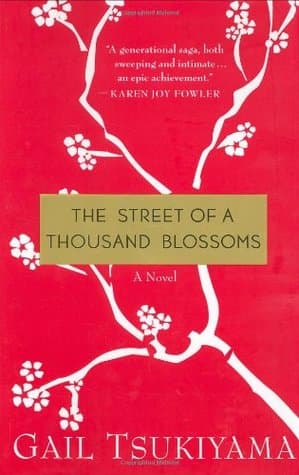
Synopsis
Covers the whole plot, including the ending.
- Difficulty
- Medium
- Pacing
- Moderate
- Mood
- Historical, Reflective, Emotional, Resilient, Cultural
- Read it if
- You enjoy sweeping historical sagas set in Japan, focusing on family, tradition, and resilience through adversity.
- Skip it if
- You prefer fast-paced plots or stories with a singular, intense conflict.
The Street of a Thousand Blossoms Plot Summary
Covers the whole plot, including the ending.
Early Life on the Street of a Thousand Blossoms
In Tokyo, 1939, brothers Hiroshi and Kenji live with their grandparents, Yoshio and Michiko, on the Street of a Thousand Blossoms. Their parents died in the Great Kanto Earthquake. Hiroshi, the older brother, is drawn to sumo wrestling, showing natural strength. Kenji, more artistic, is fascinated by Noh mask carving. Their grandparents provide a loving and stable home, teaching them traditional Japanese values and encouraging their talents. Yoshio, a former fisherman, often shares wisdom, while Michiko manages the household. The boys' childhood is shaped by their neighborhood and the growing anticipation of their futures.
Aki and Haru's Childhood
Meanwhile, across Tokyo, sisters Aki and Haru live with their parents, the renowned sumo master Sho Tanaka and his wife. Aki is the elder sister, sensitive and often lost in thought. Haru, in contrast, is independent, practical, and more assertive. Their father, Tanaka, is a respected figure in sumo, and their home reflects the sport's discipline and tradition. The girls have a comfortable upbringing, but their personalities lead them on different paths; Aki seeks beauty, while Haru is more grounded and focused on her sister.
Apprenticeships Begin
As the boys grow, their paths meet the Tanaka family. Hiroshi's talent for sumo wrestling is recognized, leading to an invitation to train under Sho Tanaka. This is a great honor and a step toward his dream of becoming a professional rikishi. At the same time, Kenji's interest in Noh mask carving grows. He begins an informal apprenticeship with the respected mask-maker, Genjiro, known for his craftsmanship. Both brothers start their chosen vocations, filled with hope for their futures, unaware of the coming global conflict.
The Shadow of War
The peaceful aspirations of both families end with the attack on Pearl Harbor, marking Japan's entry into World War II. The war affects daily life in Tokyo, bringing rationing, air raid drills, and uncertainty. Hiroshi's sumo training is interrupted as resources become scarce and national priorities shift. Kenji finds his mask-making supplies dwindling, and demand for traditional art lessens under the shadow of conflict. The war forces everyone to put dreams on hold, as survival and national duty come first. The once lively Street of a Thousand Blossoms becomes quieter, reflecting the nation's somber mood.
Wartime Hardships and Separation
As the war continues, life in Tokyo becomes harder. Food is rationed, and bombing raids are a constant threat. Hiroshi is conscripted into the Japanese army, separating him from his family and sumo career. This changes his life path. Kenji, due to an eye condition, avoids military service but struggles to find work and continue his mask carving amid scarcity. The Tanaka family also faces challenges, with their sumo stable affected by the war. The war's brutality begins to take a toll on both families, testing their endurance.
Post-War Devastation and Reunion
The war ends with devastating firebombing raids on Tokyo, leaving much of the city in ruins, including the Street of a Thousand Blossoms. Kenji and his grandparents survive, but their home and neighborhood are destroyed. Hiroshi returns from the war, scarred physically and emotionally. The Tanaka family also endures loss, though they survive. The immediate post-war period is a struggle for survival, marked by scarcity, the smell of ash, and the task of rebuilding. The families reunite, but the Japan they knew is gone, replaced by rubble and grief.
Rebuilding Lives and Rekindling Dreams
In the years after the war, Hiroshi and Kenji slowly rebuild their lives. Hiroshi, though injured, tries to return to sumo, facing physical and mental challenges to regain his strength. It is a long and hard path. Kenji, with his grandparents' encouragement, works to revive his mask carving, finding comfort and purpose in his art. He seeks out his old master, Genjiro, to continue his apprenticeship, hoping to help preserve traditional Japanese culture. Resilience guides them as they navigate a changed world, holding onto their pre-war dreams.
Love and New Beginnings
As years pass, the lives of the two families become more deeply connected. Kenji and Aki, both sensitive and artistic, find understanding and affection for each other. Their shared appreciation for beauty draws them together in a world still recovering. Hiroshi, initially reserved and dealing with war trauma, connects with Haru, whose practical nature and strong spirit offer him stability. These relationships, formed from shared hardship and mutual respect, provide hope and happiness amid the challenges of post-war Japan, offering a sense of normalcy.
Challenges and Triumphs
Hiroshi's return to sumo shows his determination. Despite war injuries, he pushes himself, regaining his form and confidence, eventually achieving recognition in the sumo world, though with setbacks. Kenji dedicates himself to mask carving, mastering techniques under Genjiro's guidance. His work gains acclaim, and he becomes a respected mask maker, helping revive Noh theater. Both brothers, through perseverance, achieve their dreams, showing the power of passion and resilience in a world that tried to break them.
Generational Wisdom and Legacy
Throughout their lives, Yoshio and Michiko's wisdom and love guide Hiroshi and Kenji. Their grandparents' emphasis on tradition, perseverance, and purpose stays with the brothers as they navigate adulthood. They see their grandsons achieve their dreams and build families, ensuring that the legacy of love, art, and sport continues. The Street of a Thousand Blossoms, though physically changed, lives on in the spirit of its people, embodying the lasting strength of family and culture in a changing Japan. The cycle of life continues, enriched by their experiences.
The Street of a Thousand Blossoms Characters
Hiroshi
Protagonist
The older brother, a gifted sumo wrestler whose dreams are interrupted by war.
Hiroshi is the older of the two orphaned brothers, raised by his grandparents. From a young age, he displays remarkable strength and a natural aptitude for sumo wrestling, driven by a quiet determination to excel. He is initially ambitious and focused on his athletic career. The war forces him into military service, leaving him physically and emotionally scarred. He struggles with trauma and the challenge of returning to his passion, embodying resilience and the quiet strength to rebuild. He is a man of few words but deep convictions.
Relationships: Kenji (Younger brother, close bond, shared upbringing); Yoshio (Grandfather, mentor figure); Michiko (Grandmother, loving caregiver); Haru (Wife, source of stability and strength); Sho Tanaka (Sumo master, mentor)
Kenji
Protagonist
The younger brother, an artistic and introspective Noh mask carver.
Kenji is the younger, more artistic and sensitive brother. Fascinated by the intricate beauty of Noh masks, he pursues an apprenticeship with a master carver. He is intelligent, observant, and deeply connected to traditional Japanese art and culture. Unlike Hiroshi, he is spared military service due to an eye condition, which leaves him to witness the war's devastation from home. He finds solace and purpose in his art, which becomes a means of preserving beauty and tradition in a broken world. He is driven by a quiet passion and a desire for creative expression.
Relationships: Hiroshi (Older brother, close bond, shared upbringing); Yoshio (Grandfather, mentor figure); Michiko (Grandmother, loving caregiver); Aki (Wife, kindred artistic spirit); Genjiro (Mask carving master, mentor)
Aki
Supporting
The delicate and artistic elder daughter of the sumo master, who marries Kenji.
Aki is the elder daughter of Sho Tanaka, the sumo master. She is portrayed as delicate, introspective, and prone to daydreaming, with a sensitive and artistic soul. She is often lost in her own thoughts and appreciates beauty and quiet contemplation. The war deeply affects her, and she, like Kenji, finds solace in the arts and in introspection. Her gentle nature complements Kenji's artistic temperament, and they form a deep, understanding bond, representing the quieter, more aesthetic aspects of Japanese culture.
Relationships: Haru (Younger sister, close bond); Sho Tanaka (Father, sumo master); Kenji (Husband, kindred spirit)
Haru
Supporting
The independent and practical younger daughter of the sumo master, who marries Hiroshi.
Haru is the younger daughter of Sho Tanaka. In contrast to her sister Aki, Haru is independent, practical, and more assertive. She possesses a strong will and a grounded perspective, often taking charge and facing challenges directly. She is resilient and unwavering, providing stability and strength to those around her, particularly to Hiroshi after his return from the war. Her pragmatic nature and unwavering support help Hiroshi navigate his trauma and rebuild his life. She represents strength, determination, and a forward-looking spirit.
Relationships: Aki (Older sister, close bond); Sho Tanaka (Father, sumo master); Hiroshi (Husband, source of stability and encouragement)
Yoshio
Supporting
The boys' wise and loving grandfather, a former fisherman.
Yoshio is the patriarchal figure who, along with his wife Michiko, raises Hiroshi and Kenji after their parents' death. A former fisherman, he imparts wisdom to his grandsons through quiet guidance and life lessons, emphasizing perseverance, purpose, and the importance of knowing what one fights for. He embodies traditional Japanese values and provides a stable, loving foundation for the boys' upbringing. His presence is a constant source of quiet strength and moral guidance throughout their lives, even as the world around them changes drastically.
Relationships: Michiko (Wife, loving partner); Hiroshi (Grandson, provides guidance and wisdom); Kenji (Grandson, provides guidance and wisdom)
Michiko
Supporting
The boys' loving and gentle grandmother.
Michiko is the gentle and nurturing grandmother who helps raise Hiroshi and Kenji. She maintains the household with quiet grace and provides unconditional love and comfort to her grandsons. Her presence creates a warm and stable home environment, offering a sense of normalcy and tradition even during times of immense hardship. She represents the quiet strength and enduring love of family, holding the family together through her care and devotion. Her gentle nature is a balm amidst the harsh realities of war and its aftermath.
Relationships: Yoshio (Husband, loving partner); Hiroshi (Grandson, caregiver); Kenji (Grandson, caregiver)
Sho Tanaka
Supporting
A renowned sumo master and father to Aki and Haru, who mentors Hiroshi.
Sho Tanaka is a highly respected and renowned sumo master, and the father of Aki and Haru. He embodies the discipline, tradition, and dedication required in the world of sumo. He takes Hiroshi under his wing as an apprentice, recognizing his talent and potential. Tanaka represents the established order and the strict adherence to tradition, but also the resilience of Japanese culture. His family's experiences parallel those of Hiroshi and Kenji, highlighting the widespread impact of the war on all aspects of society.
Relationships: Aki (Daughter); Haru (Daughter); Hiroshi (Sumo apprentice, mentee)
Genjiro
Supporting
An eccentric but highly skilled master Noh mask carver who apprentices Kenji.
Genjiro is the master Noh mask carver who takes Kenji as his apprentice. He is depicted as eccentric and deeply devoted to his craft, representing the highest standards of traditional Japanese artistry. He guides Kenji in the intricate art of mask making, passing down not just techniques but also a philosophy of beauty, patience, and dedication. Genjiro's unwavering commitment to his art, even during times of war and scarcity, inspires Kenji and symbolizes the enduring power of cultural heritage.
Relationships: Kenji (Apprentice, mentee)
The Street of a Thousand Blossoms Themes
The Enduring Power of Family and Tradition
Throughout the novel, family bonds and Japanese tradition offer comfort and guidance amid social change. Yoshio and Michiko's loving upbringing of Hiroshi and Kenji, instilling values of perseverance, forms the basis of their resilience. Even after war destroys their home, the family's spirit lasts. Kenji's dedication to Noh mask carving and Hiroshi's commitment to sumo wrestling represent the continuation of cultural heritage, showing how tradition can provide stability and identity in a changing world. The intertwined lives of the brothers and the Tanaka sisters highlight how family connections heal and rebuild.
“Just remember," Yoshio said quietly to his grandsons. "Every day of your lives, you must always be sure what you're fighting for.”
Resilience and the Human Spirit
The novel explores human resilience in the face of hardship. The characters endure WWII's horrors, including the firebombing of Tokyo, loss, and trauma. Hiroshi's struggle to return to sumo after war injuries, and Kenji's determination to continue mask carving amid scarcity, exemplify this theme. Their ability to rebuild lives, pursue passions, and find love after such devastation shows lasting spirit. The community's effort to reconstruct Tokyo reflects collective resilience, showing that even after great loss, hope and the will to live can prevail.
“Even in the ruins, life found a way to bloom, just as a single blossom could push through cracked pavement.”
The Impact of War on Individual Lives and Culture
The war is a central, transformative force in the novel, disrupting dreams, causing suffering, and changing Japan's landscape. Hiroshi's conscription and trauma, Kenji's struggle with his art, and the destruction of the Street of a Thousand Blossoms show the war's direct impact on lives and communities. Beyond physical devastation, the war also threatens traditional Japanese arts like sumo and Noh mask carving. The characters' efforts to revive these traditions after the war highlight the cultural struggle to recover and preserve identity in a world forever changed by conflict.
“The war had taken so much, not just lives and homes, but the very texture of their days, the quiet rhythm of their dreams.”
The Pursuit of Passion and Purpose
A main theme is pursuing one's passion and finding purpose, even when facing great obstacles. Hiroshi's drive to become a sumo wrestler and Kenji's fascination with Noh mask carving are central to their identities. Despite the war forcing them to temporarily abandon their dreams, they both return to their chosen paths with renewed determination. Their dedication to their crafts brings them personal fulfillment and contributes to the cultural fabric of a recovering Japan. Their journeys show that true purpose can sustain individuals through the darkest times.
“He knew, with a certainty that transcended the rubble of their city, that his hands were meant for carving.”
Plot Devices & Literary Techniques
Parallel Journeys
The story follows the converging and diverging paths of two sets of siblings.
The novel employs parallel journeys by following the lives of Hiroshi and Kenji, and separately, Aki and Haru. Initially, their stories unfold in distinct settings, highlighting their unique interests and family dynamics. The war acts as a catalyst, bringing their paths closer through shared hardship and eventually intertwining their destinies through marriage. This device allows the author to present a broader view of Japanese society during a tumultuous period, showcasing how different individuals and families experienced the same historical events while also exploring the universal themes of love, loss, and resilience through varied perspectives.
Symbolism of Sumo and Noh Masks
Sumo wrestling and Noh mask carving symbolize tradition, discipline, and the preservation of culture.
Sumo wrestling and Noh mask carving serve as powerful symbols throughout the narrative. Sumo, embodied by Hiroshi and Sho Tanaka, represents physical strength, discipline, and a deep connection to ancient Japanese traditions and ritual. It signifies the enduring spirit and honor of Japan. Noh masks, crafted by Kenji and Genjiro, symbolize artistic expression, spiritual depth, and the preservation of cultural heritage. They embody the beauty and intricate craftsmanship of traditional Japan, acting as a metaphor for the face of a nation, both revealed and concealed, through times of change and devastation. Both arts represent a commitment to mastery and a link to the past.
The Street of a Thousand Blossoms
The physical street serves as a metaphor for the enduring spirit of a community.
The 'Street of a Thousand Blossoms' is more than just a setting; it functions as a central metaphor for the community, its traditions, and its resilience. Initially, it represents a vibrant, peaceful neighborhood steeped in tradition, a place of growth and dreams. Its destruction during the war symbolizes the immense loss and devastation inflicted upon Japan. However, the eventual rebuilding and the continued lives of the characters signify that while the physical street may change, the spirit and essence of the community—its ability to 'blossom' again after hardship—endures. It embodies memory, loss, and the cyclical nature of life.
The Street of a Thousand Blossoms Quotes
“The past is like a string of pearls, each one a memory, and you can hold them in your hand, but they don't weigh anything.”
“Sometimes the most beautiful things are the ones we can't quite grasp, like the scent of cherry blossoms carried on the wind.”
“A woman's heart is a garden, and sometimes it needs rain, even if the sky is clear.”
“The greatest strength is not in never falling, but in rising every time we fall.”
“We carry our ancestors within us, their hopes and their sorrows, like the very blood in our veins.”
“Silence can be a language all its own, speaking volumes when words fail.”
“To truly see someone, you must look beyond their surface, into the stories they carry.”
“Love is not a single blossom, but a thousand tiny petals, each one a moment, a touch, a shared breath.”
“War takes more than just lives; it takes the colors from the world, leaving only shades of gray.”
“The present moment is a gift, and sometimes we are too busy unwrapping the past or anticipating the future to truly appreciate it.”
“Even in the darkest times, there is always a flicker of light, if you only know where to look for it.”
“The scent of rice cooking, the sound of laughter, these are the small anchors that hold us to life.”
“Regret is a heavy burden, but forgiveness, especially of oneself, can lighten the load.”
“Art is not just what we create, but how we see the world, how we choose to interpret its beauty and its pain.”
Quiz
10 questions on the plot and the characters. Each answer comes with a short explanation.
Question 1
In what year does 'The Street of a Thousand Blossoms' begin?
- 1935
- 1939
- 1941
- 1945
Show answer
B. 1939 The book explicitly states that the story begins in Tokyo in 1939, before the events of Pearl Harbor.
Question 2
What traditional Japanese art form does the older brother, Hiroshi, show unusual skill in?
- Noh theater mask-making
- Sumo wrestling
- Calligraphy
- Kabuki acting
Show answer
B. Sumo wrestling Hiroshi is noted for his skill in sumo wrestling, which leads to his invitation to train with Sho Tanaka.
Question 3
What is the name of the renowned sumo master who lives across town from the brothers?
- Yoshio
- Kenji
- Sho Tanaka
- Hiroshi
Show answer
C. Sho Tanaka Sho Tanaka is introduced as the renowned sumo master with whom Hiroshi is invited to train.
Question 4
What event is described as changing everything for both families, causing them to put their dreams on hold?
- The Great Kanto Earthquake
- The bombing of Hiroshima
- The attack on Pearl Harbor
- The death of their grandparents
Show answer
C. The attack on Pearl Harbor The narrative explicitly states, 'But then Pearl Harbor changes everything,' indicating the onset of World War II's direct impact on their lives.
Question 5
What is Kenji's artistic passion and intended apprenticeship?
- Sumo wrestling
- Creating hard-carved masks for Noh theater
- Traditional Japanese pottery
- Painting ukiyo-e woodblock prints
Show answer
B. Creating hard-carved masks for Noh theater Kenji is fascinated by and begins an informal apprenticeship in the art of creating hard-carved masks for Noh theater.
Question 6
Who are Sho Tanaka's two young daughters?
- Aki and Haru
- Yoshio and Kenji
- Hiroshi and Haru
- Aki and Yoshio
Show answer
A. Aki and Haru Sho Tanaka's daughters are named as Aki, 'the delicate, daydreaming,' and Haru, 'her independent sister.'
Question 7
What is the core message Yoshio quietly imparts to his grandsons at the beginning of the story?
- Always prioritize family above all else.
- Tradition is the most important aspect of life.
- You must always be sure what you're fighting for.
- Dreams are meant to be pursued relentlessly.
Show answer
C. You must always be sure what you're fighting for. Yoshio's direct quote is, 'Every day of your lives, you must always be sure what you're fighting for.' This sets a thematic tone for the brothers' journeys.
Question 8
How long does the story of 'The Street of a Thousand Blossoms' span?
- Approximately ten years
- Almost thirty years
- Just over a decade
- A lifetime, over sixty years
Show answer
B. Almost thirty years The summary states, 'In an exquisitely moving story that spans almost thirty years,' indicating the significant duration of the narrative.
Question 9
Beyond the impact of war, what overarching themes are highlighted in the novel's description?
- Political intrigue and rebellion
- The pursuit of individual fame and fortune
- Tradition and change, heartbreaking loss and surprising hope, love and family
- Technological advancement and industrialization
Show answer
C. Tradition and change, heartbreaking loss and surprising hope, love and family The description explicitly mentions 'a world of tradition and change, of heartbreaking loss and surprising hope, and of the impact of events beyond their control... Above all, The Street of a Thousand Blossoms is a masterpiece about love and family.'
Question 10
What term is used to describe the brothers' grandparents in relation to their future dreams?
- Strict disciplinarians
- Distant and uninvolved
- Loving and inspiring, rooting dreams in tradition
- Ambivalent about their artistic pursuits
Show answer
C. Loving and inspiring, rooting dreams in tradition The text states they are 'loving grandparents, who inspire them to dream of a future firmly rooted in tradition.'
The Street of a Thousand Blossoms FAQ
What is the central premise of 'The Street of a Thousand Blossoms'?
The novel follows two orphaned brothers, Hiroshi and Kenji, growing up in Tokyo from 1939. Hiroshi pursues sumo wrestling, while Kenji becomes a Noh mask maker. Their lives, along with those of the Tanaka family, are deeply impacted by World War II and its aftermath, forcing them to navigate tradition, loss, and rebuilding over nearly thirty years.
Who are the main characters and what are their primary ambitions at the story's beginning?
The main characters are the brothers Hiroshi, who dreams of becoming a great sumo wrestler, and Kenji, who aspires to be a master Noh mask maker. Across town, the Tanaka family includes Sho Tanaka, a sumo master, and his daughters Aki, a delicate dreamer, and Haru, who is more independent. These characters' paths intertwine through their shared aspirations and the unfolding historical events.
How does World War II specifically affect Hiroshi's sumo career and Kenji's mask-making?
World War II forces Hiroshi to put his sumo training on hold, as he is conscripted into the military. Kenji's mask-making also suffers as materials become scarce, and the demand for traditional arts diminishes during wartime. The war fundamentally disrupts their individual artistic and athletic pursuits, forcing them into different roles for survival.
What role do the grandparents play in the brothers' lives?
Yoshio and his wife provide a loving and stable home for Hiroshi and Kenji, instilling in them a strong sense of tradition, discipline, and the importance of knowing what they are fighting for. Yoshio's quiet wisdom guides them, and their home on the Street of a Thousand Blossoms serves as a foundational sanctuary for the boys.
Which specific historical events beyond Pearl Harbor shape the characters' lives?
Beyond Pearl Harbor, the firebombing of Tokyo, the subsequent occupation of Japan, and the post-war rebuilding efforts are crucial. These events lead to widespread destruction, societal shifts, and personal losses that force the characters to adapt to a vastly changed Japan, impacting their livelihoods and relationships.
What is the significance of the 'Street of a Thousand Blossoms' beyond being a physical location?
The 'Street of a Thousand Blossoms' symbolizes tradition, beauty, and the enduring spirit of Japanese culture despite adversity. It represents the roots from which Hiroshi and Kenji grow, a place of memory and stability that contrasts with the destruction and change happening elsewhere in Tokyo.
How does the author use the arts of sumo and Noh mask-making to symbolize broader themes?
Sumo symbolizes discipline, strength, and the public face of tradition, while Noh mask-making represents introspection, hidden emotions, and the profound, often unchanging aspects of identity. Together, they reflect the tension between outward performance and inner truth, and the resilience of Japanese cultural heritage.
Are there any subtle connections or parallels between the Tanaka family and the brothers' family before their direct interactions?
Before Hiroshi's apprenticeship with Sho Tanaka, both families are rooted in traditional Japanese arts and values, albeit in different social strata. The Tanaka family, through Sho, represents the pinnacle of sumo, a path Hiroshi is destined to join, subtly linking their aspirations even before their personal encounter.
How does the loss experienced by the characters, particularly during the war, shape their identities and relationships?
The devastating losses, including homes, loved ones, and a sense of normalcy, force characters like Hiroshi and Kenji to mature rapidly and re-evaluate their priorities. This shared trauma deepens their bonds but also leaves lasting emotional scars, influencing their choices in love and their commitment to their crafts.
Analyze the psychological impact of choosing between personal ambition and family duty for characters like Hiroshi.
Hiroshi grapples with the psychological tension between his passion for sumo and his duty to his family, especially during wartime. This conflict creates internal struggle, as he must sacrifice his dreams for survival and protection, leading to moments of frustration but ultimately reinforcing his deep loyalty and sense of responsibility.
How do Aki and Haru represent different coping mechanisms or responses to hardship?
Aki, with her delicate nature and daydreaming, might represent a more internal, perhaps fragile, response to hardship, seeking solace in inner worlds. Haru, being independent, likely embodies a more pragmatic and resilient approach, actively seeking solutions and taking charge in the face of adversity.
What psychological journey does Kenji undertake as he develops as a mask maker?
Kenji's journey as a mask maker is a deeply psychological one, as he learns not just the craft but also to understand the complex emotions and stories behind each face. He must internalize the suffering and beauty of the human condition, particularly after the war, allowing his art to become a conduit for expressing his own grief and hope.
Is the ending of the novel ultimately hopeful or melancholic, given the decades of hardship?
The ending is arguably a poignant blend of hope and melancholy. While characters find new purpose, love, and continue their traditions, the scars of war and loss remain. The resilience and continuation of life's beauty suggest hope, but the underlying sense of what was lost prevents a purely joyful conclusion, offering a realistic view of post-war recovery.
How does the novel explore the theme of 'tradition versus change'?
The novel explores 'tradition versus change' through the characters' struggles to maintain their cultural heritage (sumo, Noh) in a rapidly modernizing and war-torn Japan. While some traditions are lost or adapted, the core values of family, discipline, and artistic pursuit endure, demonstrating the resilience of culture while acknowledging the inevitability of change.
What is the overarching message about the impact of external events on ordinary lives?
The overarching message is that even ordinary, decent individuals are profoundly shaped by monumental external events like war, often beyond their control. Their dreams are shattered, their lives irrevocably altered, yet their inherent humanity, capacity for love, and will to rebuild persist. It highlights both the fragility and resilience of the human spirit.
Does the novel suggest that artistic pursuits like sumo and mask-making are luxuries or necessities for the human spirit?
The novel strongly suggests that artistic pursuits are necessities for the human spirit, not luxuries. Even amidst the devastation of war, characters cling to their art forms as ways to express identity, maintain cultural connection, and find meaning. Kenji's masks and Hiroshi's sumo provide solace, purpose, and a link to their heritage, proving essential for their psychological well-being.
How does the novel portray the role of women in a changing Japanese society?
The novel portrays women like Aki and Haru navigating evolving roles in a society undergoing immense change. While initially constrained by traditional expectations, the war and its aftermath force them into more independent and resilient positions, taking on responsibilities, pursuing their own paths, and contributing significantly to the rebuilding of their families and communities.
What is the significance of Yoshio's advice, 'Every day of your lives, you must always be sure what you're fighting for,' in the context of the entire story?
Yoshio's advice is a foundational theme, guiding the brothers through immense hardship. It compels Hiroshi to fight for his family's survival and later his sumo dream, and Kenji to fight for the preservation of his art and the memories it embodies. It underscores the importance of purpose and conviction in navigating life's challenges, especially when faced with overwhelming external forces.
Similar books
- Memoirs of a Geisha
Arthur Golden
4.1 (1.7M) average on GoodreadsHistorical FictionExplores Japanese culture and history through the lens of individual lives facing societal change and hardship.
- Pachinko
Min Jin Lee
4.3 (208k) average on GoodreadsLiterary FictionA multi-generational saga of a Korean family in Japan, dealing with war, prejudice, and the struggle for identity.
- Snow Flower and the Secret Fan
Lisa See
4.1 (339k) average on GoodreadsHistorical FictionSee's novel also explores female friendship in historical East Asia but features a more intricate plot driven by specific cultural customs (nu shu) and stricter societal constraints. See's characters often navigate betrayals and more explicit dramatic consequences, whereas Tsukiyama's sisters maintain a more consistent bond and focus on personal growth within their chosen paths, with a more meditative tone.
- To Kill a Mockingbird
Harper Lee
4.3 (4.5M) average on GoodreadsHistorical FictionIn the 1930s Jim Crow South, Harper Lee writes about racial injustice, moral growth, and the quiet courage of a lawyer father, Atticus Finch, as seen through his young daughter's eyes.
- The Great Gatsby
F. Scott Fitzgerald
3.9 (3.8M) average on GoodreadsHistorical FictionIn the opulent Roaring Twenties, a mysterious millionaire's lavish parties hide his desperate, tragic pursuit of a lost love, exposing the emptiness within the American Dream.
- Pride and Prejudice
Jane Austen
4.3 (3M) average on GoodreadsHistorical FictionIn a society focused on status and money, Elizabeth Bennet navigates love and pride, challenging Mr. Darcy and social expectations to find true affection.




Enjoyed the summary?
A summary gives you the shape of the book. The book itself has the detail, the examples and the voice.
Find The Street of a Thousand Blossoms on AmazonAs an Amazon Associate, BookBrief earns from qualifying purchases. How we're funded