
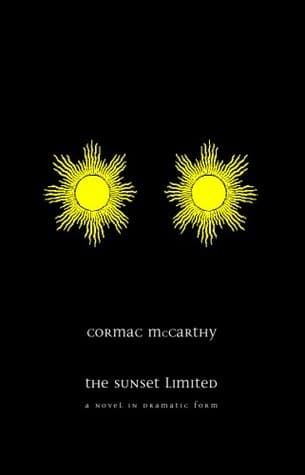
Synopsis
Covers the whole plot, including the ending.
- Difficulty
- Hard
- Read it if
- You are intrigued by intense philosophical debates on faith vs. atheism, the nature of suffering, and the meaning of life, presented through a raw, dialogue-driven narrative.
- Skip it if
- You prefer plot-driven narratives, shy away from dense philosophical discussions, or are looking for a book with clear answers rather than challenging questions.
The Sunset Limited Quotes
“Every man has a god. And if he has not a god of his own choosing, then he has a god of another man's choosing.”
“You want to know what the world is? It's a conspiracy. A conspiracy of the living against the dead.”
“The world is run by those who can bear to be bored.”
“If you believe in God, you're a fool. If you don't believe in God, you're a fool.”
“There are two kinds of people in the world. Those who want to die and those who are afraid to die.”
“The worst thing about the world is not that it's bad, but that it's meaningless.”
“You got to carry the fire. And if you dont, who will?”
“The world is perfect. It's just perfectly awful.”
“Every man has a right to his own death.”
“You dont have to believe in God to be a good man. But you got to believe in something.”
“What if there is no light? What if there's only darkness?”
“The word of God is a fire. It burns. It cleanses.”
“There's no such thing as an atheist. Just a man who hasnt found God yet.”
“I'm not trying to save you. I'm trying to save myself.”
Quiz
10 questions on the plot and the characters. Each answer comes with a short explanation.
Question 1
What is the primary motivation for White's presence in the tenement apartment?
- He was invited by Black to discuss theological concepts.
- He attempted suicide by jumping in front of a train and was saved by Black.
- He was seeking shelter from a storm and Black offered him a place to stay.
- He is a social worker investigating Black's living conditions.
Show answer
B. He attempted suicide by jumping in front of a train and was saved by Black. The play opens with Black having prevented White from committing suicide by jumping in front of the Sunset Limited train, hence White's reluctant presence in Black's apartment.
Question 2
What is Black's former profession or background before his spiritual transformation?
- A university professor of philosophy.
- A successful businessman.
- An ex-con and former addict.
- A musician.
Show answer
C. An ex-con and former addict. The description explicitly states Black is an 'ex-con and ex-addict,' which informs his unique perspective on hope and faith.
Question 3
What is the central philosophical conflict explored between Black and White?
- The merits of capitalism versus socialism.
- The existence of God versus atheism, and the meaning (or lack thereof) of life.
- The importance of art versus science.
- The benefits of urban versus rural living.
Show answer
B. The existence of God versus atheism, and the meaning (or lack thereof) of life. The core of their conversation revolves around 'the meaning of life,' with Black arguing for faith and White for nihilism, directly addressing the existence of God and the purpose of human existence.
Question 4
White describes his life as a professor as having left him in 'despair' despite its 'relative ease.' What does this suggest about his worldview?
- He believes material comfort is directly proportional to happiness.
- He finds academic pursuits inherently meaningless and unfulfilling.
- He experiences an existential crisis where external success does not alleviate internal emptiness.
- He secretly desires a more challenging and difficult life.
Show answer
C. He experiences an existential crisis where external success does not alleviate internal emptiness. White's despair despite 'relative ease' points to an existential understanding that external conditions do not necessarily provide internal meaning or happiness, a core tenet of his nihilistic perspective.
Question 5
Black often uses analogies and personal anecdotes to support his arguments. What is the primary purpose of this communication style?
- To confuse White and distract him from the core issues.
- To demonstrate the practical, lived experience of faith and hope, contrasting with White's abstract intellectualism.
- To avoid engaging with White's more complex philosophical arguments directly.
- To showcase his storytelling abilities and entertain White.
Show answer
B. To demonstrate the practical, lived experience of faith and hope, contrasting with White's abstract intellectualism. Black's background and communication style emphasize the practical, visceral experience of faith and redemption, aiming to connect with White on a different level than pure intellectual debate.
Question 6
White argues that the only true 'freedom' is to acknowledge and embrace the ultimate meaninglessness of existence. How does Black typically counter this argument?
- By agreeing with White but asserting that meaninglessness is still preferable to suffering.
- By suggesting that faith, even if unprovable, provides a necessary framework for hope and overcoming despair.
- By attempting to prove the existence of God through logical deduction.
- By changing the subject to a more practical concern, like food or shelter.
Show answer
B. By suggesting that faith, even if unprovable, provides a necessary framework for hope and overcoming despair. Black's core argument is that faith, irrespective of empirical proof, offers a pathway out of the despair that meaninglessness brings, providing purpose and hope.
Question 7
The title 'The Sunset Limited' refers to the train White attempted to jump in front of. What symbolic significance does this train hold within the play's themes?
- It symbolizes the fast-paced, modern world that White wishes to escape.
- It represents a final, irreversible journey into oblivion or the end of hope, aligning with White's despair.
- It signifies the boundless opportunities and journeys available in life.
- It is a metaphor for the limited time both men have to resolve their philosophical differences.
Show answer
B. It represents a final, irreversible journey into oblivion or the end of hope, aligning with White's despair. The 'Sunset Limited' is the specific train White attempts suicide with, making it a powerful symbol of his desire for a definitive end, a final journey into nothingness, reflecting his profound despair.
Question 8
White claims that if there were a God, such a deity would be 'a monster' for allowing the suffering in the world. What philosophical problem is White invoking here?
- The problem of free will.
- The problem of evil (theodicy).
- The problem of induction.
- The problem of solipsism.
Show answer
B. The problem of evil (theodicy). White's argument directly addresses the classical 'problem of evil' or theodicy, which questions how a benevolent, omnipotent, and omniscient God can coexist with the existence of suffering and evil in the world.
Question 9
Despite Black's fervent arguments for faith and hope, White remains unconvinced at the play's conclusion. What does this narrative choice suggest about McCarthy's intent?
- That Black's arguments are ultimately flawed and unpersuasive.
- That profound philosophical differences are often irreconcilable, and the play prioritizes exploring the conflict over providing answers.
- That White is simply too stubborn to accept the truth.
- That the play advocates for a universal embrace of nihilism.
Show answer
B. That profound philosophical differences are often irreconcilable, and the play prioritizes exploring the conflict over providing answers. McCarthy doesn't offer easy answers. The unresolved nature of their debate highlights the profound, often irreconcilable, differences in human worldview, emphasizing the exploration of the conflict itself rather than a definitive resolution.
Question 10
The play is set entirely in Black's sparsely furnished tenement apartment. How does this confined setting contribute to the play's overall impact?
- It emphasizes the characters' financial struggles and social status.
- It creates a claustrophobic atmosphere that forces an intense, inescapable confrontation between the two opposing philosophies.
- It symbolizes the limited options available to both characters in their lives.
- It serves as a neutral ground where neither man has an advantage.
Show answer
B. It creates a claustrophobic atmosphere that forces an intense, inescapable confrontation between the two opposing philosophies. The single, confined setting intensifies the philosophical debate, making the confrontation inescapable and focusing all attention on the dialogue and the profound implications of their opposing worldviews.
The Sunset Limited FAQ
What is the central theme of Cormac McCarthy's The Sunset Limited?
The Sunset Limited explores the fundamental clash between faith and nihilism, and the search for meaning in human existence. It delves into the despair of intellectualism versus the resilience found in belief, all through a single, intense conversation.
Does The Sunset Limited have a traditional plot or narrative arc?
No, The Sunset Limited is structured more as a philosophical dialogue than a traditional narrative. The 'action' is primarily the verbal exchange between the two characters, Black and White, as they debate profound existential questions.
What is the significance of the characters being named Black and White?
The names 'Black' and 'White' symbolize the starkly opposing worldviews and philosophies each character embodies: Black representing faith, hope, and an embrace of life despite hardship, and White representing despair, nihilism, and the rejection of inherent meaning.
Does faith, as presented by Black, actually 'work' to resolve White's despair?
The play does not offer a definitive, easy answer to whether faith 'works' in resolving White's despair. Instead, it presents the unyielding arguments from both sides, leaving the audience to grapple with the efficacy and validity of each perspective for themselves.
How does The Sunset Limited differ from McCarthy's other novels like No Country for Old Men?
The Sunset Limited differs significantly by being a play, almost entirely dialogue-driven, and confined to a single setting, unlike the expansive, often violent, and descriptive prose of his novels. It's a direct philosophical debate rather than an epic narrative.
Is The Sunset Limited a religious text?
While religion and faith are central topics, The Sunset Limited is not a religious text in itself. It is a work of philosophical fiction that uses religious arguments as part of a broader exploration of human meaning, despair, and the search for purpose.
What is 'nihilism' as discussed in The Sunset Limited?
Nihilism in The Sunset Limited refers to White's belief that life is without objective meaning, purpose, or intrinsic value. It's the conviction that all moral values are baseless and that existence ultimately leads to nothingness, contributing to his profound despair.
What is the 'meaning of life' that Black and White are trying to discover?
They are attempting to discover whether life possesses an inherent, divinely ordained meaning, or if it is a meaningless, random occurrence. Their conversation grapples with the philosophical underpinnings that give human existence purpose, or deny it.
Can The Sunset Limited be enjoyed by readers unfamiliar with philosophy or theology?
Yes, absolutely. While it tackles deep philosophical and theological questions, McCarthy's accessible dialogue and the raw human emotion make it engaging even for those new to these subjects. The intensity of the debate itself is captivating.
About the author
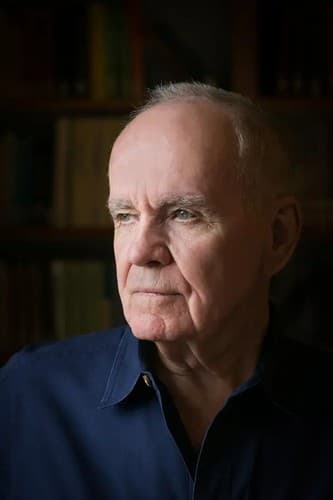
Cormac McCarthy was an American writer who authored twelve novels, two plays, five screenplays, and three short stories, spanning the Western and postapocalyptic genres. He was known for his graphic depictions of violence and his unique writing style, recognizable by a sparse use of punctuation and attribution. McCarthy is widely regarded as one of the greatest American novelists.
Similar books
- Notes from Underground
Fyodor Dostoevsky
4.2 (84k) average on GoodreadsPsychologyExplores existential despair and the struggle with reason and belief through intense internal monologue.
- Waiting for Godot
Samuel Beckett
3.8 (160k) average on GoodreadsPhilosophyTwo characters engage in a profound, circular dialogue about meaning, waiting, and the absurdity of existence.
- The Road
Cormac McCarthy
4.0 (716k) average on GoodreadsScience FictionShares McCarthy's stark prose and explores human endurance, hope, and despair in extreme circumstances, though less dialogue-focused.
- The Myth of Sisyphus
Albert Camus
4.2 (25k) average on GoodreadsPhilosophyCamus's work, like McCarthy's, confronts the absurd and the search for meaning in a godless universe. However, The Sunset Limited grounds these abstract ideas in a more immediate, personal, and dramatic confrontation between two individuals, rather than a philosophical essay. McCarthy's play makes the existential struggle a palpable, real-time debate, contrasting with Camus's more introspective and analytical approach.
- Eat, Pray, Love
Elizabeth Gilbert
3.6 (1.5M) average on GoodreadsLifestyleA heartbroken writer leaves her conventional life for a year-long global search for pleasure in Italy, spiritual devotion in India, and unexpected love and balance in Bali.
- Educated
Tara Westover
4.5 (796k) average on GoodreadsBiographyRaised in the Idaho mountains by fundamentalist survivalists, a young woman forges her own path to education, battling fierce family loyalty and personal demons to discover a world beyond her isolated upbringing.



Enjoyed the summary?
A summary gives you the shape of the book. The book itself has the detail, the examples and the voice.
Find The Sunset Limited on AmazonAs an Amazon Associate, BookBrief earns from qualifying purchases. How we're funded