
Synopsis
Covers the whole plot, including the ending.
- Difficulty
- Medium
- Pacing
- Variable
- Mood
- Witty, Melancholy, Reflective, Eccentric, Atmospheric
- Read it if
- You enjoy dry wit, philosophical musings on love and loss, and a journey through an exotic landscape with quirky characters.
- Skip it if
- You prefer fast-paced plots, straightforward narratives, or dislike melancholic undertones in your humor.
The Towers of Trebizond Plot Summary
Covers the whole plot, including the ending.
The Start of the Journey and Aunt Dot's Eccentricity
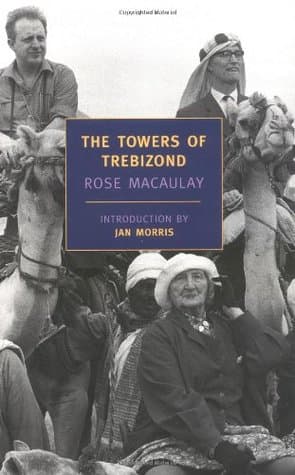
The novel begins with Aunt Dot's iconic line, "Take my camel, dear," after High Mass, immediately setting an eccentric tone. Laurie narrates her journey with her aunt and Father Hugh Chantry-Pigg, an Anglican priest, on a mission to Trebizond. Their stated goal is to study women's roles in Turkey and promote Anglo-Catholicism, but their true motives are often hidden. Laurie, troubled by a past love, observes her companions' habits: Aunt Dot's unpredictable statements and Father Hugh's earnest, if sometimes naive, religious passion. They navigate the first parts of their journey, dealing with logistics, cultural differences, and the underlying tension of their individual quests, which are not simple academic pursuits.
Arrival in Istanbul and the Initial Encounters
In Istanbul, the group immediately faces travel challenges. Laurie, Aunt Dot, and Father Hugh try to navigate the busy city, its mix of ancient history and modern life, and the practicalities of their mission. They encounter bureaucracy and cultural misunderstandings, often leading to funny situations, especially through Aunt Dot's unique interactions. During this time, Laurie thinks about her past and the deep sense of loss that fills her thoughts, quietly contrasting her inner turmoil with the outer absurdity of their trip. Their first experiences in Istanbul show the blend of comedy and sadness that defines the novel, as the characters' surface goals start to clash with their deeper, unacknowledged motivations.
The Journey Eastward and the Camel
As the group travels east from Istanbul, the journey becomes more unusual. Aunt Dot's insistence on buying a camel, named Horace, adds another layer of absurdity, making their progress slow and often unpredictable. They cross different landscapes, from modern roads to more remote, old paths, meeting various people: local villagers, other travelers, and even a group of American evangelists led by Billy Graham. These encounters offer both humor and reflection, as the characters' different views clash. Laurie continues to observe the world through her personal grief, while Aunt Dot and Father Hugh stick to their unique ideas of their mission, sometimes unaware of the realities around them.
Encounters with Sorcerers and Policemen
The journey includes several small crises and unusual meetings. The group deals with stubborn police, who are often puzzled by their goals and methods, causing delays and funny interrogations. More mysteriously, they meet people who seem to be sorcerers or practitioners of local magic, offering potions and predictions. These interactions add a touch of fantasy to the otherwise grounded, though eccentric, travel story. Laurie, often distant, watches these events with a sharp, analytical eye, noting the conflict between the rational and the superstitious. These episodes show the novel's exploration of different belief systems and the human need to find meaning in both the ordinary and the extraordinary.
Billy Graham and the Evangelists
A memorable episode is the group's chance meeting with Billy Graham and a bus of Southern American evangelists on tour. This meeting creates a fascinating and humorous clash of religious cultures and ideas. Father Hugh, with his Anglican views, finds himself in a lively, if sometimes awkward, discussion with the fervent Protestants. Aunt Dot, always irreverent, watches the scene with amusement and detached curiosity. Laurie, while noting the differences, also thinks about the shared human desire for faith and spiritual searching, even as her own faith is tied to her personal sorrow. The interaction highlights the novel's look at religious diversity and the sometimes funny, sometimes deep ways people express their beliefs.
Arrival in Trebizond and Historical Reflections
After their difficult and eventful journey, the group finally arrives in Trebizond. The city, with its ancient walls and history as a former Byzantine empire, deeply affects Laurie. She is struck by the echoes of past civilizations and the strong sense of continuity and decay. This arrival changes the narrative's tone, becoming more thoughtful and sad. Laurie thinks about the rise and fall of empires, the fleeting nature of human efforts, and history's lasting power to shape the present. Her observations about Trebizond mix with her personal thoughts on loss and memory, as the ancient ruins seem to mirror the ruins of her own heart. The city becomes a strong symbol of both lasting beauty and unavoidable decline.
The Mission's Peculiarities and Father Hugh's Efforts
In Trebizond, Father Hugh Chantry-Pigg works earnestly, though sometimes misguidedly, on his mission to promote Anglo-Catholicism and study women's roles. He tries to engage with local religious figures and communities, often meeting polite confusion or resistance. His efforts, though well-intentioned, are often hampered by his lack of understanding of Turkish culture and religious practices, leading to funny misunderstandings. Aunt Dot, meanwhile, continues her eccentric observations, offering her unique, often cynical, comments on the events. Laurie, seeing Father Hugh's sincere but ultimately futile efforts, thinks more about faith, cultural exchange, and the human desire to impose one's beliefs on others, even as she deals with her own spiritual doubts.
Laurie's Internal Struggle and Memories of Vere
Throughout the journey, and especially in Trebizond, Laurie's inner world is dominated by her grief for Vere, her married lover who died. Her memories of their secret affair, their deep connection, and the pain of his loss are woven through the story, providing a sad contrast to the outer comedic events. She constantly revisits their past, analyzing their relationship, her guilt and love, and the deep emptiness left by his absence. These inner thoughts show the depth of her sorrow and her struggle to connect her past with her present. Trebizond, with its ancient echoes of loss and lasting beauty, serves as a strong background for her thoughts, making her personal tragedy feel both intimate and universal.
Aunt Dot's Secret Agenda and the Women's Movement
While supposedly studying women's roles, Aunt Dot's true agenda is more radical than Father Hugh's. She is very interested in promoting women's liberation, often in ways that shock or amuse those around her. Her methods are unconventional, involving direct and often blunt questions about women's lives, and she challenges traditional norms without fear. Her observations and actions highlight the complexities of gender roles and societal expectations, especially in a cross-cultural setting. Laurie observes her aunt's spirited, though sometimes naive, activism, which adds another layer to the novel's exploration of social change and individual action, contrasting with Father Hugh's more conservative religious goals.
The Unraveling of the Mission and the Return Journey
As their time in Trebizond ends, the group's various, often conflicting, missions begin to fall apart. Father Hugh's Anglo-Catholic efforts have had limited success, Aunt Dot's women's liberation work has met with curiosity and resistance, and Laurie's inner search for peace remains unsolved. The practicalities of their return trip, including Horace the camel's fate, become new challenges. The characters, though perhaps not achieving their initial goals, have changed from their experiences. The journey back is marked by reflection and a subtle shift in their views, as the external adventures have mixed with their internal lives, leaving them with a deeper, if more complicated, understanding of themselves and the world.
The Climax of Laurie's Grief and Spiritual Crisis
As the journey continues, Laurie's internal struggle reaches a peak. Her constant grief for Vere, combined with the religious and historical thoughts from Trebizond, forces her to confront her sorrow's depth and her faith's fragility. She grapples with questions of sin, redemption, and the meaning of love and loss in a world that often seems uncaring. Her spiritual crisis is deeply personal, different from Father Hugh's theological pursuits or Aunt Dot's social activism. This period of intense thought includes moments of despair and a longing for comfort, highlighting the novel's exploration of human suffering and the search for meaning in tragedy. The lively, often absurd, outer world contrasts sharply with her inner desolation.
The Aftermath and Lingering Sorrow
The travelers eventually return, but the journey's end does not neatly resolve Laurie's pain. While the outer adventures finish, her inner struggle with grief and loss continues. The novel suggests that some sorrows are not easily overcome but become a permanent part of one's identity. Laurie returns to her ordinary life, but it is now filled with memories of Vere and the experiences of Trebizond. Her thoughts on love, death, and faith are left somewhat open, emphasizing the complexity of the human condition. Her companions' humor and eccentricity contrast sadly with her lasting melancholy, showing the novel's main idea of finding beauty and meaning amidst deep sadness.
The Towers of Trebizond Characters
Laurie
Protagonist
A young woman haunted by a lost love, navigating an eccentric journey.
Laurie is the novel's narrator, a young woman in her twenties, intelligent and deeply introspective. She is haunted by the recent death of her married lover, Vere, and much of her inner monologue revolves around her grief, guilt, and the complexities of their affair. She is an astute observer of her eccentric companions, Aunt Dot and Father Hugh, and the world around her, often providing a cynical or melancholic commentary on their adventures. While outwardly passive, her internal world is rich and tumultuous, grappling with questions of love, loss, faith, and the meaning of life.
Relationships: Aunt Dot (Niece, companion, observer of her aunt's eccentricities); Father Hugh Chantry-Pigg (Travel companion, intellectual foil, object of observation); Vere (Deceased lover, the source of her profound grief and introspection)
Aunt Dot
Supporting
Laurie's eccentric and outspoken aunt, a catalyst for much of the novel's humor.
Aunt Dot is Laurie's formidable and utterly unconventional great-aunt. She is the driving force behind the expedition to Trebizond, ostensibly to study the position of women, but often pursuing her own whimsical and radical agenda. She is a woman of strong opinions, often expressed with shocking bluntness, and possesses a unique blend of intellectual curiosity and profound eccentricity. Her pronouncements and actions provide much of the novel's comedic relief, as she navigates cultural differences with a complete disregard for convention, frequently leading to amusing misunderstandings and unexpected situations.
Relationships: Laurie (Aunt, companion, source of both amusement and exasperation for Laurie); Father Hugh Chantry-Pigg (Travel companion, often a source of bewildered disagreement)
Father Hugh Chantry-Pigg
Supporting
A High Anglican priest on a mission to promote Anglo-Catholicism in Turkey.
Father Hugh is a High Anglican priest, earnest and devout, accompanying Aunt Dot and Laurie to Trebizond. His primary mission is to promote Anglo-Catholicism and to observe the religious landscape of Turkey. He is sincere in his faith and intentions but often naive and culturally insensitive, leading to humorous misunderstandings and a struggle to connect with local populations. He represents a more traditional, institutional approach to faith, contrasting sharply with Laurie's personal spiritual crisis and Aunt Dot's secular radicalism. His earnestness, combined with his sometimes-pedantic nature, makes him a frequently comic figure.
Relationships: Laurie (Travel companion, subject of Laurie's observations); Aunt Dot (Travel companion, often baffled by Aunt Dot's antics)
Vere
Mentioned
Laurie's deceased married lover, the central figure of her sorrow.
Vere is not a physically present character but is central to Laurie's internal world. He was Laurie's married lover, and his recent death is the source of her profound and pervasive grief. Through Laurie's memories and reflections, Vere is depicted as a complex, beloved figure who brought both immense joy and moral complication into her life. His absence shapes Laurie's entire narrative, driving her introspection on love, loss, sin, and the nature of happiness. He represents the ideal of lost love and the enduring pain of remembrance.
Relationships: Laurie (Deceased lover, the profound connection that fuels Laurie's internal journey)
Horace
Supporting
The camel acquired by Aunt Dot, a symbol of the journey's eccentricity.
Horace is the camel acquired by Aunt Dot for the journey eastward. He is a largely passive character, but his presence is significant. Horace embodies the sheer absurdity and unconventional nature of the expedition. His acquisition, maintenance, and occasional recalcitrance contribute to many of the comedic situations and logistical challenges faced by the group. He serves as a tangible symbol of Aunt Dot's eccentricities and the novel's humorous tone, contrasting sharply with the profound internal struggles of Laurie.
Relationships: Aunt Dot (Owner, subject of her affection and occasional frustration); Laurie (Travel companion, object of observation and occasional logistical burden)
Billy Graham
Mentioned
The famous American evangelist encountered by the group in Turkey.
Billy Graham appears briefly in the novel as a real-life figure encountered by the travelers. He is depicted leading a busload of American evangelists, offering a stark contrast to Father Hugh's High Anglicanism and the local Turkish religious practices. His presence highlights the diversity of religious belief systems and provides a platform for humorous and insightful observations on faith, conversion, and cultural differences. The encounter serves as a moment of cultural collision and theological debate, further enriching the novel's exploration of religion.
Relationships: Father Hugh Chantry-Pigg (Brief theological interlocutor); Aunt Dot (Object of her amused observation)
The Turkish Policemen
Supporting
Local authorities who create bureaucratic hurdles and comedic situations.
Various Turkish policemen are encountered throughout the journey, often creating bureaucratic obstacles or attempting to understand the bizarre intentions of Aunt Dot and her companions. They represent the practical, often frustrating, realities of travel in a foreign land and serve as foils for the group's eccentricities. Their interactions with the travelers, often marked by confusion and cultural misunderstanding, contribute significantly to the novel's comedic tone, highlighting the clash between local authority and foreign unconventionality.
Relationships: Aunt Dot (Often the source of their bewilderment); Laurie (Observed and sometimes interacted with by Laurie)
The Sorcerers/Local Mystics
Supporting
Mysterious figures offering potions and prophecies, adding a touch of the fantastical.
These unnamed figures represent the mystical and superstitious elements of the local culture. They offer potions, prophecies, and enigmatic advice, blurring the lines between the rational and the magical. Their presence adds a layer of exoticism and minor peril to the journey, challenging the characters' preconceived notions and highlighting the diversity of belief systems in the region. For Laurie, they offer a glimpse into alternative ways of understanding the world, contrasting with her own internal, more intellectual struggles.
Relationships: Aunt Dot (Approached by Aunt Dot with a mix of skepticism and curiosity); Laurie (Observed by Laurie as part of the cultural tapestry)
The Towers of Trebizond Themes
Grief and Loss
The main theme is Laurie's deep and lasting grief for Vere, her deceased married lover. Her inner thoughts are always filled with memories of him, their complex affair, and the pain of his absence. This theme is explored through her reflections on love, sin, and the difficulty of finding meaning after such a loss. The lively, often absurd, external journey contrasts sadly with her inner desolation, showing how personal sorrow can color one's view of the world. For example, Trebizond's ancient ruins often reflect the 'ruins' of her own heart.
“One does not get over things, one carries them with one. One lives with them, they are part of one. And one must go on living.”
The Search for Meaning and Faith
The novel explores various kinds of spiritual and existential searches. Father Hugh represents traditional, institutional faith (Anglo-Catholicism), earnestly, though somewhat naively, trying to spread his beliefs. Aunt Dot, though secular, has her own 'mission' of women's liberation, driven by a different kind of conviction. Laurie, however, deals with a more personal spiritual crisis, questioning God's existence, sin's nature, and the possibility of comfort in suffering. The meeting with Billy Graham's evangelists and local mystics broadens the range of belief systems, showing the diverse ways humans seek meaning in a complex world.
“What was faith? A leap in the dark, a surrender, a passionate affirmation? Or just a habit of mind, a comfortable adherence?”
Eccentricity and the Absurdity of Life
The novel is full of eccentricity, mainly through Aunt Dot and her unusual way of traveling and living. From buying a camel to her blunt statements, her actions fill the story with humor and a sense of the absurd. The oddness of their mission—Anglo-Catholicism and women's rights in rural Turkey—further highlights this theme. This lighthearted absurdity often contrasts sharply with Laurie's deep sorrow, creating a bittersweet tone. The funny situations show the inherent strangeness of human behavior and the often comical clashes that happen when different cultures and personalities meet.
“Take my camel, dear,' said my aunt Dot, as she climbed down from this animal on her return from High Mass.”
Cultural Clash and Understanding
The journey through Turkey provides a rich setting for exploring cultural differences and the challenges of cross-cultural understanding. The characters, especially Father Hugh and Aunt Dot, often misunderstand local customs and beliefs, leading to humorous but also insightful moments. The meeting with Billy Graham's American evangelists adds another layer, showing diversity within Western cultures. Laurie, as the observer, often thinks about the difficulty of truly knowing another culture, and how one's own background shapes perceptions. The novel quietly questions the effectiveness of imposing one's values on others.
“It was difficult, she thought, to know what was in the minds of these people, so polite, so remote, so entirely other.”
The Past and Its Lingering Presence
The weight of history, both personal and societal, is a key theme. Laurie constantly relives her past with Vere, and her memories are a living presence. Similarly, the ancient ruins and historical importance of places like Trebizond bring thoughts of past empires, conflicts, and the passage of time. The novel suggests that the past is never truly gone but continues to shape the present, both for individuals and for civilizations. The mix of ancient ruins with modern life shows this continuity, highlighting how echoes of what once was still resonate.
“The past, she reflected, was not a country one left behind, but a country one carried within, its landscapes altering with every step.”
Plot Devices & Literary Techniques
First-Person Narration (Unreliable)
The story is told through Laurie's subjective and grief-stricken perspective.
The entire novel is narrated in the first person by Laurie. This device allows for deep access to her internal world, her profound grief for Vere, and her introspective reflections on faith and loss. However, her perspective is often colored by her sorrow and detachment, making her a somewhat unreliable narrator regarding the objective reality of events, particularly compared to the more outwardly focused observations of her companions. This subjective lens emphasizes the emotional core of the story and allows the reader to experience the world through her unique, melancholic filter, highlighting the contrast between external absurdity and internal pain.
Juxtaposition of Comedy and Tragedy
The novel constantly places humorous, absurd events alongside profound personal sorrow.
This device is central to the novel's unique tone. The external plot is often filled with farcical situations, eccentric characters (Aunt Dot, Father Hugh), and comedic misunderstandings. These lighthearted elements are constantly juxtaposed with Laurie's deep, internal grief and existential questioning. This contrast creates a bittersweet and poignant effect, preventing the novel from becoming either purely humorous or overly sentimental. It reflects the complexity of life, where joy and sorrow often coexist, and allows for a deeper exploration of human resilience and the search for meaning amidst suffering.
The Journey as Metaphor
The physical journey to Trebizond mirrors Laurie's internal journey of grief and self-discovery.
The physical expedition from Istanbul to Trebizond is more than just a travelogue; it serves as a powerful metaphor for Laurie's internal journey. As she traverses diverse landscapes and encounters various cultures, she simultaneously navigates the landscapes of her own grief, memory, and spiritual questioning. The challenges and discoveries of the external trip parallel her internal struggles and insights. The destination of Trebizond, with its ancient history and echoes of lost empires, symbolically reflects the 'ruins' of her own heart and the enduring presence of the past, making the physical journey a vehicle for profound psychological exploration.
Symbolism of Trebizond
The ancient city represents the persistence of history, loss, and the beauty of decay.
Trebizond is not merely a destination but a potent symbol. As a historical city that was once a powerful Byzantine empire, it embodies the rise and fall of civilizations, the transience of human endeavors, and the enduring presence of history. For Laurie, its ancient ruins and layered past resonate deeply with her personal sense of loss and the 'ruins' of her own heart after Vere's death. It symbolizes the bittersweet beauty of decay, the way that even in decline, there is a profound sense of continuity and meaning. The city acts as a mirror for her internal state, making her personal tragedy feel universal.
The Towers of Trebizond Quotes
“There are no new jokes, only new audiences. And new ways of telling them.”
“It is always a mistake to suppose that because a thing is old, it is therefore out of date.”
“Life is a journey, not a destination. But it is always nice to have a destination, even if you never reach it.”
“Love, like religion, is a mystery, and should not be too closely examined.”
“The past is a foreign country; they do things differently there.”
“It is a peculiar thing, the way that some people can be so certain of what they believe, and others so uncertain.”
“The greatest adventures are not always those that take us to the furthest places, but those that take us to the furthest reaches of ourselves.”
“Trebizond, a name that hums with history, a place where East meets West, and past meets present.”
“One travels not to escape life, but for life not to escape us.”
“There is a kind of freedom in not knowing what comes next, a thrilling uncertainty.”
“The world is full of ghosts, some visible, some not, but all of them leaving their traces.”
“Religion, like everything else, is a matter of taste. Some prefer it plain, some highly spiced.”
“To be truly alive, one must risk being truly lost.”
“The greatest truths are often found in the strangest places, whispered by the most unlikely voices.”
Quiz
10 questions on the plot and the characters. Each answer comes with a short explanation.
Question 1
Which unusual animal does Aunt Dot offer at the very beginning of the novel?
- A horse
- A camel
- A donkey
- An elephant
Show answer
B. A camel The novel famously begins with Aunt Dot offering her camel, a quirky detail that sets the tone for the eccentricities to follow.
Question 2
What is the primary mode of travel for the group from Istanbul to Trebizond?
- By train
- By boat
- By car and other overland means
- Primarily on foot
Show answer
C. By car and other overland means The journey involves various overland methods, including cars and sometimes more unusual transport, as they traverse the backlands of Turkey.
Question 3
Which historical figure makes an unexpected appearance, traveling with Southern evangelists?
- T.E. Lawrence
- Billy Graham
- Winston Churchill
- Mother Teresa
Show answer
B. Billy Graham The group encounters Billy Graham, the famous evangelist, on tour with a busload of Southern evangelists, adding to the novel's quirky charm.
Question 4
What is the narrator's name?
- Aunt Dot
- Laurence
- Laurie
- Rose
Show answer
C. Laurie The narrator of the story is Laurie, a young woman traveling with her eccentric aunt and a clergyman.
Question 5
What is one of the underlying emotional tones that shadows the humorous narrative?
- Overwhelming joy and optimism
- A sense of impending danger and espionage
- Heartbreak and painful memories of lost love
- Frustration with modern technology
Show answer
C. Heartbreak and painful memories of lost love Despite its humorous surface, the novel is deeply tinged with heartbreak, as the narrator grapples with the 'specters of ancient empires, religious turmoil, and painful memories of lost love.'
Question 6
Besides Aunt Dot and the narrator, who is another key member of their traveling party?
- A Turkish guide named Mehmet
- A young American tourist
- A clergyman, Father Hugh Chantry-Pigg
- A British diplomat
Show answer
C. A clergyman, Father Hugh Chantry-Pigg Father Hugh Chantry-Pigg, an Anglican clergyman, is a central figure in the traveling party, often providing theological and sometimes exasperating commentary.
Question 7
What is the primary goal of Aunt Dot's mission in Trebizond?
- To establish a new archaeological dig
- To convert the local population to Anglicanism
- To open a new British embassy
- To find a rare historical artifact
Show answer
B. To convert the local population to Anglicanism Aunt Dot is driven by a fervent, if somewhat misguided, desire to establish an Anglican mission and convert the local population in Trebizond.
Question 8
The novel explores the narrator's complex feelings about which two aspects of the past?
- Colonial expansion and technological progress
- Ancient empires and religious turmoil
- Agricultural reform and industrialization
- Modern art movements and political revolutions
Show answer
B. Ancient empires and religious turmoil The description explicitly states that the narrator confronts 'the specters of ancient empires, religious turmoil, and painful memories of lost love,' highlighting these as key themes.
Question 9
Which type of unusual encounter is mentioned as part of the group's journey through Turkey?
- Meetings with famous Hollywood actors
- Negotiations with international arms dealers
- Encounters with potion-dealing sorcerers and recalcitrant policemen
- Discussions with leading Turkish politicians
Show answer
C. Encounters with potion-dealing sorcerers and recalcitrant policemen The synopsis specifically mentions 'encountering potion-dealing sorcerers, recalcitrant policemen, and Billy Graham,' emphasizing the fantastical and bureaucratic challenges faced.
Question 10
What is the narrator's relationship with the deceased man, Laurie's lover, who often appears in her thoughts and memories?
- He was her estranged husband.
- He was a casual acquaintance.
- He was her cousin and lover, with whom she had an incestuous relationship.
- He was a historical figure she admired.
Show answer
C. He was her cousin and lover, with whom she had an incestuous relationship. A central, often unspoken, heartbreak for Laurie is her past incestuous relationship with her cousin, who is now deceased, and whose memory haunts her throughout the journey.
The Towers of Trebizond FAQ
What is the central premise of 'The Towers of Trebizond'?
'The Towers of Trebizond' follows Laurie, the narrator, on a journey through Turkey with her eccentric aunt Dot, a missionary, and Father Hugh Chantry-Pigg, an Anglican priest. Their ostensible mission is to research the position of women in Turkey and establish a Christian mission, but the trip quickly devolves into a series of humorous and poignant adventures, all while Laurie grapples with personal grief.
Who are the main characters accompanying Laurie on her journey?
Laurie is accompanied by her formidable Aunt Dot, a dedicated and somewhat overbearing Anglican missionary with a penchant for camels, and Father Hugh Chantry-Pigg, a scholarly but often impractical Anglican priest. Later, their group expands to include Laurie's lover, Vere, adding a complex emotional layer to the travel narrative.
What role does the setting of Turkey play in the novel?
Turkey, particularly the historical region leading to Trebizond, serves as a rich backdrop, blending ancient history, diverse cultures, and religious complexities. The landscape and encounters with locals, from sorcerers to policemen, highlight the clash of tradition and modernity, mirroring Laurie's internal conflicts and the characters' varying responses to the exotic.
How does humor manifest in the narrative, despite the underlying sadness?
Humor arises from the characters' eccentricities, particularly Aunt Dot's steadfast adherence to her missionary ideals and her camel, and Father Hugh's academic detachment in absurd situations. The juxtaposition of their earnest, often misplaced, endeavors with the realities of their Turkish surroundings, including an encounter with Billy Graham, creates many comedic moments.
What is the significance of the opening line, 'Take my camel, dear,' said my aunt Dot, as she climbed down from this animal on her return from High Mass.'?
This iconic opening immediately establishes the novel's unique blend of the mundane and the absurd, the religious and the practical. It introduces Aunt Dot's eccentric character and her unusual mode of transport, setting a tone of whimsical adventure and hinting at the unconventional journey to follow.
What is the nature of Laurie's relationship with Vere, and why is it significant?
Laurie and Vere are lovers, and their relationship is a central, deeply personal element of the novel, marked by both passion and profound sadness. Vere's presence, and later his tragic death, is the hidden heartbreak that shadows Laurie's journey, making her observations and experiences intensely poignant and reflective of her grief.
How does the novel subtly explore the theme of colonialism or Western perspectives on the East?
The novel subtly explores Western perspectives through Aunt Dot's missionary zeal and Father Hugh's scholarly interest, both of whom approach Turkey with preconceived notions and a desire to impose their own cultural or religious frameworks. Laurie, however, offers a more nuanced, less judgmental observation of the local culture, though still from a Western viewpoint.
Are there any anachronisms or deliberate historical inaccuracies in the novel, and if so, what is their purpose?
While generally set in a contemporary (for its time) Turkey, the novel sometimes blurs the lines between historical periods and myth, particularly in Laurie's internal monologues about ancient empires. These aren't strict inaccuracies but rather a deliberate weaving of historical consciousness into the present, emphasizing the timeless nature of human experience and sorrow.
What is the symbolic meaning of Trebizond itself in the narrative?
Trebizond, a historical city with a rich and complex past, symbolizes a destination that is both real and idealized, a place of historical grandeur and lost glory. For Laurie, it represents a culmination of her journey, a place where past and present converge, and where she confronts the weight of history and her personal grief.
How does Laurie's grief over Vere's death influence her perception of the world around her?
Laurie's unspoken grief over Vere's death profoundly colors her perceptions, making her acutely aware of beauty, loss, and the ephemeral nature of life. The landscapes, ancient ruins, and even trivial encounters are filtered through her sorrow, giving her observations a melancholic depth and a sense of existential reflection.
What psychological coping mechanisms do Aunt Dot and Father Hugh employ in their adventures?
Aunt Dot copes by rigidly adhering to her missionary purpose and Christian faith, using it as a framework to interpret and manage unfamiliar situations. Father Hugh often retreats into academic contemplation and historical facts, using intellectual detachment as a way to process the chaos and absurdity around him.
How does the novel explore the psychology of faith and doubt through its characters?
The novel explores faith through Aunt Dot's unwavering, almost militant, Anglicanism and Father Hugh's more scholarly, contemplative belief. Laurie, however, grapples with doubt and a more personal, less institutionalized spiritual quest, especially in the wake of her loss, questioning the comfort and purpose that faith might offer.
What is the psychological impact of constant travel and displacement on Laurie?
Constant travel and displacement amplify Laurie's sense of rootlessness and internal turmoil. The ever-changing scenery mirrors her unsettled emotional state, making her journey both a physical escape and an internal confrontation with her grief and search for meaning in a world that feels increasingly transient.
Is 'The Towers of Trebizond' ultimately a tragic or hopeful novel?
The novel is often debated on this point. While deeply shadowed by tragedy and loss, particularly Vere's death, it also contains moments of profound beauty, humor, and a resilient spirit. Laurie's continued observations and her journey, despite her grief, suggest a form of enduring hope or at least a graceful acceptance of life's complexities.
How does Rose Macaulay blend elements of travelogue, autobiography, and fiction in the book?
Macaulay masterfully blends these elements by drawing on her own experiences and travels in Turkey, infusing the narrative with authentic detail and a personal voice reminiscent of a travelogue. The fictional plot and characters, particularly Laurie's personal tragedy, elevate it beyond mere reportage into a deeply introspective novel, blurring the lines between the author's observations and the narrator's experiences.
What is the significance of the recurring motif of ancient empires and lost civilizations?
The recurring motif of ancient empires and lost civilizations serves as a powerful metaphor for personal loss and the transience of human endeavors. For Laurie, these ruins resonate with her own sense of what has been lost, placing her individual grief within a larger, historical context of rise and fall, making her sorrow both unique and universal.
How does the novel engage with and critique different forms of spirituality or religion?
The novel critiques rigid, dogmatic forms of religion through Aunt Dot's sometimes comically zealous missionary work and the encounter with the Southern evangelists, highlighting their insensitivity to local culture. It contrasts these with a more contemplative, personal spirituality sought by Laurie and Father Hugh's academic approach, suggesting a spectrum of religious experience and questioning the efficacy of proselytization.
To what extent is Laurie a reliable narrator, given her emotional state?
Laurie is a largely reliable narrator in terms of recounting events, but her emotional state, particularly her grief, undoubtedly colors her interpretations and focus. Her subjective lens makes the narrative richer and more introspective, revealing the emotional truths of her experience rather than strictly objective facts, inviting readers to engage with her perspective.
What is the lasting legacy or impact of 'The Towers of Trebizond' in literature?
'The Towers of Trebizond' is celebrated for its unique blend of humor and pathos, its distinctive narrative voice, and its profound exploration of grief, faith, and travel. It stands as a testament to Rose Macaulay's literary genius, admired for its witty prose, complex characterizations, and its ability to intertwine personal tragedy with broader historical and cultural themes, securing its place as a modern classic.
About the author

Rose Macaulay was a British author known for her novels and essays, primarily active in the early to mid-20th century. Her notable work, The Towers of Trebizond, explores themes of faith and travel, reflecting her keen observations of society and culture. Macaulay's writing often blends wit with social commentary, making her a distinctive voice in English literature.
Similar books
- A Handful of Dust
Evelyn Waugh
3.9 (23k) average on GoodreadsLiterary FictionShares a similar blend of dark humor, social satire, and underlying tragedy.
- Travels with My Aunt
Graham Greene
3.8 (11k) average on GoodreadsLiterary FictionFeatures an eccentric aunt and an unwilling protagonist on an unusual journey.
- Orlando
Virginia Woolf
3.9 (61k) average on GoodreadsFantasyOffers a rich, reflective narrative voice and a journey through historical and personal landscapes.
- Eat, Pray, Love
Elizabeth Gilbert
3.6 (1.5M) average on GoodreadsLifestyleA heartbroken writer leaves her conventional life for a year-long global search for pleasure in Italy, spiritual devotion in India, and unexpected love and balance in Bali.
- Wild: From Lost to Found on the Pacific Crest Trail
Cheryl Strayed
4.0 (615k) average on GoodreadsLifestyleAfter losing her mother and her marriage, a young woman impulsively hikes over a thousand miles of the Pacific Crest Trail alone, finding strength and healing in the unforgiving wilderness.
- Into Thin Air: A Personal Account of the Mount Everest Disaster
Jon Krakauer
4.2 (395k) average on GoodreadsLifestyleOn May 10, 1996, ambition and a sudden, violent storm turned Mount Everest into a deadly trap, leaving Jon Krakauer to tell the harrowing story of a disaster that took lives and shattered climbers' dreams.





Enjoyed the summary?
A summary gives you the shape of the book. The book itself has the detail, the examples and the voice.
Find The Towers of Trebizond on AmazonAs an Amazon Associate, BookBrief earns from qualifying purchases. How we're funded