
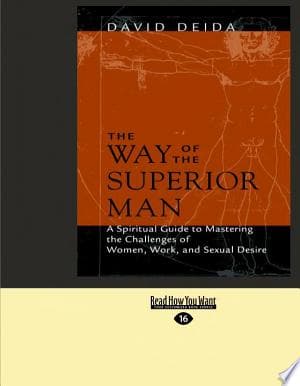
Core Idea
- Difficulty
- Medium
- Read it if
- You are a man seeking to deepen your understanding of masculine purpose, improve your relationships through conscious polarity, and cultivate a more authentic and embodied way of living.
- Skip it if
- You prefer traditional self-help approaches focused on external achievements, are not open to exploring spiritual or energetic dimensions of relationships, or are uncomfortable with direct, sometimes provocative language regarding gender roles.
Key Takeaways from The Way of the Superior Man
Uncover Your Deepest Purpose
Your life's direction emerges from your deepest truth, not external validation.
Deida states that a man's main responsibility is to find and live his deepest purpose. This is not a career goal or social expectation, but an inherent, often unspoken drive that gives his existence meaning. This purpose acts as his steady guide, directing his decisions and actions. Without aligning with this core purpose, a man will feel unfulfilled, regardless of external achievements. It requires deep self-reflection and the courage to shed societal conditioning and personal fears to discover what truly resonates within him. Living in line with this purpose is the source of his authentic power and appeal.
“Your mission is your life. And if your mission is to find the deepest truth, then your life will be a constant unfolding into that truth.”
In the book: Deida consistently emphasizes that a man's purpose is his 'gift' to the world, and that deviating from it leads to a sense of 'deadness' or 'unfulfillment,' even if he achieves material success. He illustrates this with scenarios of men who are successful by societal standards but feel empty inside because they haven't aligned with their true calling.
Try this: Regularly engage in self-reflection and meditation to identify what truly energizes you and what feels like a 'calling' beyond mere obligation. Make small, consistent choices that align with this deeper purpose, even if they seem counter-intuitive to external pressures. Prioritize your purpose over comfort or fleeting desires.
Related ideas: masculine-purpose, authentic-living, inner-compass
Polarity Fuels Passion
Sexual attraction thrives on the dynamic interplay of masculine and feminine energies.
Deida argues that lasting sexual passion in relationships comes not from sameness, but from the dynamic tension created by the interaction of distinct masculine and feminine energies. He defines masculine energy as direction, purpose, consciousness, and penetration; feminine energy as flow, emotion, embodiment, and openness. When partners embody their core essences, a strong energetic polarity forms, leading to intense attraction and a strong sexual dynamic. Conversely, when partners become too similar or 'neutralized' in their energetic expression, passion fades. This describes energetic expressions, not rigid gender roles, and these energies can exist in any individual.
“The greater the polarity, the greater the passion. The more a man is rooted in his masculine essence and a woman in her feminine essence, the more powerful the sexual attraction.”
In the book: Deida frequently uses analogies of magnets and electrical currents to explain polarity. He describes scenarios where couples lose passion because they both try to be 'neutral' or 'balanced' in their energetic expression, rather than allowing their core essences to differentiate and create a dynamic pull.
Try this: Identify your primary energetic essence (masculine or feminine) and consciously cultivate its expression. If you're masculine-polarized, practice being more present, purposeful, and unwavering. If you're feminine-polarized, practice being more open, flowing, and emotionally expressive. Encourage your partner to embody their own essence without judgment.
Related ideas: masculine-energy, feminine-energy, sexual-polarity, relationship-dynamics
Master Your Inner Shadow
True strength comes from integrating your fears and flaws, not suppressing them.
Deida redefines strength not as stoicism or invulnerability, but as radical honesty with oneself, embracing fears, insecurities, and perceived weaknesses. He argues that suppressing these 'shadow' aspects weakens a man, making him fragile and reactive. True mastery involves acknowledging and integrating these parts, understanding that they are facets of a complete self. By facing and feeling uncomfortable truths, a man expands his capacity for love, presence, and authentic power, becoming more resilient and less prone to self-deception.
“A man's worth is not measured by how much he achieves, but by how much he is willing to open and yield to the truth, even when it is painful.”
In the book: Deida describes the common male tendency to 'armor up' against vulnerability, which ultimately leads to emotional shutdown and distance in relationships. He uses examples of men who are outwardly successful but inwardly tormented by unacknowledged fears or unresolved issues, leading to destructive patterns.
Try this: Practice radical self-honesty. When uncomfortable emotions arise (fear, jealousy, anger), instead of immediately acting on them or suppressing them, pause and feel them fully in your body. Explore their source without judgment. Consider journaling or discussing these feelings with a trusted friend or therapist.
Related ideas: shadow-work, vulnerability, emotional-intelligence, self-acceptance
The Gift of Presence
Your unwavering presence is the ultimate gift you can offer a woman.
For Deida, a man's most profound offering to a woman (and to any relationship or endeavor) is his full, undivided presence. This means being completely available in the moment, without distraction, mental wandering, or emotional reservation. It involves grounding oneself in the present, feeling what is happening, and offering steady, conscious awareness. This presence creates a sense of safety and trust, allowing a woman to relax into her feminine essence and feel deeply seen and valued. A lack of presence, conversely, is seen as a form of abandonment, even if physically nearby.
“A woman doesn't want your money, your power, or your status. She wants your full, undivided presence.”
In the book: Deida often recounts scenarios where women complain about men being physically present but mentally absent, preoccupied with work, worries, or other distractions. He highlights that this mental absence is far more damaging to intimacy than physical distance.
Try this: When interacting with others, especially your partner, practice putting away distractions (phone, TV). Make eye contact and actively listen without planning your response. Take deep breaths to anchor yourself in the present moment. Consciously bring your awareness back whenever your mind wanders.
Related ideas: mindfulness, intimacy, conscious-relationship, attentive-listening
Embrace Your Edge
Growth occurs at the boundary of your comfort zone and beyond your perceived limits.
Deida encourages men to constantly seek and embrace their 'edge' – that uncomfortable boundary where growth happens. This means willingly stepping into challenges, facing fears, and pushing past self-imposed limits in all areas of life: physical, emotional, spiritual, and relational. Stagnation occurs when a man retreats into comfort and avoids discomfort. By consistently leaning into what feels difficult or unknown, a man improves his abilities, expands his capacity, and builds resilience. This is about conscious, deliberate expansion of one's competence and courage, not reckless behavior.
“Every moment of your life is either a test or a celebration. The superior man lives his life as a constant series of tests, always seeking to expand his edge.”
In the book: Deida uses the metaphor of a warrior always training, always seeking the next challenge to refine his skill and character. He contrasts this with the 'couch potato' mentality, where comfort leads to decay and a lack of aliveness.
Try this: Identify one area in your life where you've been playing it safe. Choose a small, actionable step that pushes you slightly beyond your comfort zone (e.g., initiating a difficult conversation, learning a new skill, trying a challenging workout). Consistently seek out these 'edges' rather than avoiding them.
Related ideas: personal-growth, courage, resilience, challenge-seeking
Don't Hesitate, Decide
Indecision is a betrayal of your purpose; clear decisions provide direction.
A key aspect of masculine energy, according to Deida, is the ability to make clear, decisive choices. Indecision is seen as a damaging force that drains energy, creates uncertainty, and ultimately betrays a man's purpose. While he advocates for conscious decision-making, he stresses that the act of choosing, even if imperfect, is better than paralysis. A decision, once made, provides direction and allows for progress, even if adjustments are needed later. This decisiveness provides security and trust for those around him, especially a feminine partner who thrives on clear direction.
“Hesitation is the death of your purpose. Decide, even if it's the wrong decision, and learn from it. But do not hesitate.”
In the book: Deida often describes scenarios where a man's indecisiveness leaves a woman feeling insecure and frustrated, as if she lacks a clear leader or direction. He contrasts this with the sense of relief and surrender a woman feels when a man makes a clear, confident decision, even if she might not have chosen the same path.
Try this: When faced with a choice, set a time limit for gathering information, then make a decision and commit to it. Avoid 'analysis paralysis.' Practice making smaller decisions quickly to build momentum. If a decision turns out to be suboptimal, learn from it and adjust, but don't dwell on the 'what ifs.'
Related ideas: decisiveness, leadership, action-orientation, commitment
The Art of Surrender
True intimacy requires both partners to surrender to love, even when it's uncomfortable.
Deida suggests that the deepest levels of intimacy are accessed not through control or manipulation, but through mutual surrender to the flow of love and emotion. For the masculine-polarized man, this often means letting go of his need to control outcomes or 'fix' his partner's emotions, instead maintaining a steady presence through her emotional shifts. For the feminine-polarized woman, it means surrendering to the man's direction and purpose. This is not about weakness, but about a conscious choice to open fully, allowing authentic connection and vulnerability to flourish. It requires great trust and a willingness to be affected by the other.
“The superior man does not try to control his woman. He trusts her, and he trusts himself to handle whatever she brings.”
In the book: Deida describes how men often try to 'problem-solve' a woman's emotions, which feels dismissive to her. He advocates for simply 'holding space' and allowing her to express herself, rather than trying to change her state. He also discusses the feminine desire to 'relax and open' when she feels truly safe and held by a man's unwavering presence.
Try this: Practice letting go of the need to control or predict outcomes in your relationships. When your partner expresses emotions, resist the urge to 'fix' them; instead, listen with an open heart and simply be present. For your own fears, surrender to feeling them fully rather than resisting.
Related ideas: vulnerability, trust, emotional-intimacy, relational-flow
Your Woman's Mood is a Gift
Her emotional landscape is a reflection and a catalyst for your own growth.
Deida offers a different perspective on a woman's emotional volatility: rather than something to fear, it is a powerful catalyst for a man's spiritual and emotional growth. He suggests that a woman's changing moods, her 'oceanic' nature, can push a man to deepen his own presence, expand his capacity for love, and maintain his center amidst chaos. By learning to stay steady and love her through her emotional expressions, without being pulled off his own purpose or becoming reactive, a man refines his consciousness and strengthens his masculine core. Her emotions, therefore, are not a problem to be solved, but a dynamic force to be embraced.
“Your woman's mood is a gift, even when it is difficult. It is a portal for you to open more deeply, to love more fully, and to grow in consciousness.”
In the book: Deida frequently uses the analogy of a woman as a 'storm' or 'ocean' and the man as the 'mountain' or 'shoreline' – unwavering and present. He details how men often fail by either getting swept away by her emotions or by trying to shut them down, missing the opportunity for growth.
Try this: When your partner is experiencing strong emotions, resist the urge to shut down, argue, or 'fix' her. Instead, practice maintaining your inner center, breathing deeply, and simply being present with her. Acknowledge her feelings without judgment. See her emotional expression as an opportunity to deepen your own capacity for love and presence.
Related ideas: emotional-intelligence, relationship-challenges, conscious-love, masculine-presence
Live as if Your Life is Ending
Embrace your finite existence to live with urgency and without compromise.
Deida urges men to confront their own mortality as a strong motivation for living a life of purpose and authenticity. By acknowledging that existence is finite, a man is compelled to let go of complacency, abandon trivial pursuits, and fully commit to his deepest calling. This awareness creates an urgency to live without compromise, to express love fully, to pursue his mission relentlessly, and to constantly expand his consciousness. It is a call to live each day as if it were his last chance to fully embody his truth, rather than postponing his true desires for an imagined future.
“If you knew you had one day left to live, would you still be doing what you are doing? Your answer is your truth.”
In the book: Deida challenges readers with direct questions about their daily choices, asking if they would make the same choices if they knew their life was ending soon. He implies that most men would radically shift their priorities, highlighting the disconnect between how they live and how they truly wish to live.
Try this: Regularly ask yourself: 'If this were my last week/month/year, what would I change?' Use this as a compass to re-evaluate your priorities, relationships, and daily activities. Take decisive action to eliminate anything that doesn't align with your deepest truth and purpose.
Related ideas: mortality-awareness, urgency-of-life, authentic-living, purpose-driven
Serve a Greater Love
Your ultimate fulfillment comes from offering your gifts in service of something beyond yourself.
Ultimately, Deida guides the superior man toward a life of selfless service rooted in a 'greater love' or divine consciousness. He suggests that true fulfillment is not found in personal gain or ego-driven achievements, but in offering one's unique gifts and deepest purpose for the benefit of all. This spiritual dimension elevates a man's actions beyond mere ambition, giving them profound meaning. By aligning his life with this greater love, he transcends his individual self, becoming a channel for positive change and experiencing a deep, lasting sense of peace and connection. His purpose is not just for himself, but an offering to the world.
“Your truest purpose is to serve the divine, to offer your unique gifts and love to the world.”
In the book: Deida often speaks of 'divine love' or 'ultimate truth' as the source of all purpose. He encourages men to see their relationships and work as opportunities to express this higher love, rather than as means to an end for personal gratification. He implies that without this greater orientation, even a man living his purpose can still feel a subtle emptiness.
Try this: Reflect on how your unique talents and passions can serve a purpose greater than your own immediate gratification. Seek opportunities to contribute to your community, a cause, or simply to uplift those around you through your work and relationships. Regularly connect with a sense of universal love or spirit.
Related ideas: spiritual-purpose, selfless-service, divine-love, transcendence
The Way of the Superior Man Quotes
“Your mission is your highest priority. It is the most important thing to you. It is more important than your mother, your children, your wife, your friends, your lovers, and any pleasure. If you are a man, your mission is the most important thing in your life. Period.”
“The feminine thrives on praise and adoration. The masculine thrives on challenge and purpose.”
“Stop hoping for a inspired life. Strive for it. The only way to live an inspired life is to take action consistent with your deepest desire.”
“Your greatest fear is not that you are inadequate, but that you are powerful beyond measure.”
“A man must choose his path, and then live it with all his heart. He must give his gift to the world, and not hold back.”
“The feminine wants to be ravished by the masculine, not talked into it.”
“You are only as free as you are willing to be uncomfortable.”
“The superior man is not just looking for a woman to complete him. He is looking for a woman to challenge him, to inspire him, to push him to his edge.”
“Every moment of your life is either a test or a celebration. The more you embrace the tests, the more you will have to celebrate.”
“Give your gift fully. Don't die with your music still in you.”
“If you don't know your purpose, your purpose is to find your purpose.”
“The masculine grows by moving into the unknown. The feminine grows by deepening into the known.”
“Don't postpone joy. Don't postpone your true calling. Don't postpone living the life you were meant to live.”
“Your heart knows the way. Run in that direction.”
Quiz
10 questions on the main ideas. Each answer comes with a short explanation.
Question 1
According to Deida, what is the primary distinction between masculine and feminine essence, particularly in their deepest desires?
- Masculine seeks security, feminine seeks adventure.
- Masculine seeks purpose and freedom, feminine seeks love and connection.
- Masculine seeks power, feminine seeks submission.
- Masculine seeks knowledge, feminine seeks beauty.
Show answer
B. Masculine seeks purpose and freedom, feminine seeks love and connection. Deida posits that the masculine essence primarily seeks its deepest purpose and the freedom to express it, while the feminine essence primarily seeks love and an experience of being fully cherished and penetrated by love.
Question 2
Deida introduces the concept of a man's 'edge.' What does he mean by this?
- The sharp wit a man uses in conversation.
- The point of growth and challenge beyond a man's comfort zone, where he must lean into his fear.
- The competitive advantage a man holds in business.
- The boundary a man sets in his relationships.
Show answer
B. The point of growth and challenge beyond a man's comfort zone, where he must lean into his fear. A man's 'edge' refers to the place where he feels a legitimate fear or resistance, and where his growth lies in consciously moving beyond that fear to fulfill his purpose. It's about living at the edge of his comfort zone.
Question 3
What is one of the key 'gifts' a superior man offers a woman, according to Deida?
- Financial stability and material possessions.
- Constant emotional reassurance and validation.
- His unswerving presence, direction, and purpose.
- Always agreeing with her decisions.
Show answer
C. His unswerving presence, direction, and purpose. Deida emphasizes that a superior man's greatest gift to a woman is his unwavering presence, his clear direction, and his commitment to his deeper purpose, which provides a container for her to relax and flow.
Question 4
Deida often speaks about a man's 'mission.' How does he characterize its importance?
- It's a hobby to fill free time.
- It's secondary to family life.
- It's the ultimate priority from which all other aspects of his life derive meaning and energy.
- It's solely about career advancement.
Show answer
C. It's the ultimate priority from which all other aspects of his life derive meaning and energy. For Deida, a man's mission or purpose is paramount; it is the driving force of his life, and his relationships, family, and personal well-being are meant to be aligned with and supported by it, not replace it.
Question 5
Which of the following best describes Deida's view on a man's relationship with fear?
- Fear is a sign to retreat and avoid conflict.
- Fear is an illusion that must be completely eradicated.
- Fear is a signal pointing to where a man needs to expand and grow, to be moved through.
- Fear is a feminine trait that superior men overcome instantly.
Show answer
C. Fear is a signal pointing to where a man needs to expand and grow, to be moved through. Deida teaches that fear is not to be avoided but embraced as an indicator of where a man's growth lies. He should acknowledge fear and consciously choose to move through it in pursuit of his purpose.
Question 6
Deida advises men to 'live as if your father were dead.' What is the core message behind this provocative statement?
- To literally cut off all ties with one's father.
- To stop seeking approval or validation from any paternal figure and fully embrace one's own authority.
- To mourn the past and focus on the future.
- To take over the family business immediately.
Show answer
B. To stop seeking approval or validation from any paternal figure and fully embrace one's own authority. This statement encourages men to shed the need for parental approval or guidance and step fully into their own masculine authority, making decisions and living their purpose from their own center, not from a place of seeking external validation.
Question 7
What does Deida suggest is the masculine response to a woman's emotional 'chaos' or 'storms'?
- To try and fix her emotions with logical solutions.
- To withdraw and give her space until she calms down.
- To remain unreactive, present, and hold a steady, loving consciousness, allowing her to feel fully.
- To mirror her emotions back to her.
Show answer
C. To remain unreactive, present, and hold a steady, loving consciousness, allowing her to feel fully. A superior man, according to Deida, does not try to fix or judge a woman's emotional fluctuations. Instead, he holds a steady, unreactive presence, providing a 'masculine container' for her to fully express and release her emotions, without losing his own center.
Question 8
Deida frequently uses the analogy of 'facing the ocean.' What does this represent for a man?
- The importance of spending time in nature.
- Confronting the vastness and unpredictability of life's challenges with an open heart and unwavering purpose.
- A specific meditation technique involving water.
- The desire for travel and exploration.
Show answer
B. Confronting the vastness and unpredictability of life's challenges with an open heart and unwavering purpose. Facing the ocean symbolizes a man's willingness to confront the unknown, the vastness, and the potential chaos of life and his own being, without flinching, maintaining his core direction and purpose.
Question 9
What does Deida mean by a man's 'sexual integrity'?
- Being faithful in all sexual relationships.
- Having a clear, conscious understanding and expression of his deepest sexual desires, aligned with his purpose.
- Only engaging in sex within a committed marriage.
- Being physically fit for sexual activity.
Show answer
B. Having a clear, conscious understanding and expression of his deepest sexual desires, aligned with his purpose. Sexual integrity, in Deida's view, means a man is deeply aligned with his authentic sexual desires and expresses them truthfully and consciously, without shame or compromise, as an extension of his life's purpose.
Question 10
According to Deida, what is the 'ultimate purpose' of a man's life?
- To achieve financial success and security.
- To find a perfect partner and build a family.
- To fully live and express his unique, deepest purpose and consciousness, without holding back.
- To gain power and influence over others.
Show answer
C. To fully live and express his unique, deepest purpose and consciousness, without holding back. Deida consistently emphasizes that a man's ultimate purpose is to fully embody and express his unique core essence and deepest purpose in the world, living without compromise or holding back his gift.
The Way of the Superior Man FAQ
What is the core message of 'The Way of the Superior Man'?
The core message is about living a life of masculine integrity, authenticity, and freedom by understanding and embodying your deepest purpose. It guides men through challenges in career, relationships, intimacy, and spirituality to achieve fulfillment.
Does 'The Way of the Superior Man' offer practical advice or is it purely theoretical?
Yes, the book offers very practical advice, empowering skills, and body practices. It's designed as a guidebook to help men immediately apply its principles to their lives without compromise.
What is meant by 'masculine purpose' in the context of this book?
Masculine purpose, as defined by Deida, refers to a man's deepest truth and drive, often external to himself, that he is compelled to manifest in the world. It's the unique direction and contribution that gives his life meaning and fulfillment.
How does 'The Way of the Superior Man' address relationships and intimacy?
The book delves into the dynamics of masculine and feminine energies in relationships, offering insights into what women truly desire and what makes a man a good lover. It provides guidance on fostering deep intimacy and navigating sexual spirituality.
Is this book only for men, or can women also benefit from reading it?
While primarily written for men, women can also greatly benefit from reading it. Understanding the principles of masculine and feminine energy, as described by Deida, can lead to deeper insights into their male partners and improve relationship dynamics.
How is 'The Way of the Superior Man' different from other self-help books for men?
It distinguishes itself by focusing heavily on sexual spirituality and the polarity of masculine and feminine energies, offering a radical and authentic approach to self-development that goes beyond conventional advice on career and relationships.
Does 'The Way of the Superior Man' advocate for traditional gender roles?
The book explores the concept of essential masculine and feminine energies rather than rigid social roles. It encourages individuals to understand and embody their authentic energetic expression, which may align with or diverge from traditional roles.
What kind of 'body practices' are mentioned in the book?
The book includes various body practices designed to help men cultivate and direct their masculine energy, enhance their presence, and deepen their capacity for love and intimacy. These practices often involve breathwork, awareness, and physical exercises.
About the author

David Deida is a contemporary spiritual teacher and author, best known for his influential book, "The Way of the Superior Man." His work explores the nature of consciousness, sexuality, and the masculine and feminine principles. Deida's writings offer practical guidance for navigating relationships and personal growth.
Similar books
- The 7 Habits of Highly Effective People: Powerful Lessons in Personal Change
Stephen R. Covey
4.1 (524k) average on GoodreadsBusinessCovey focuses on universal, principle-centered effectiveness, independence, and interdependence applicable to all individuals, regardless of gender. Deida, in contrast, specifically addresses masculine identity and purpose within a framework of gender polarity. Covey's approach is more structured and broadly applicable, while Deida's is more spiritual and gender-specific.
- The Perks of Being a Wallflower
Stephen Chbosky
4.2 (1.3M) average on GoodreadsPsychologyThrough letters, a shy high school freshman learns to navigate first love, trauma, and self-discovery, stepping off the sidelines and into life.
- Eleanor Oliphant Is Completely Fine
Gail Honeyman
4.3 (708k) average on GoodreadsLiterary FictionA lonely woman's structured life changes when an IT guy and an elderly man help her learn to open her heart.
- One Flew Over the Cuckoo's Nest
Ken Kesey
4.2 (631k) average on GoodreadsPsychologyIn a mind-bending asylum, the boisterous Randle McMurphy wages a defiant war against the tyrannical Nurse Ratched, inspiring his fellow inmates, including the seemingly catatonic Chief Bromden, to reclaim their lost humanity.
- The Bell Jar
Sylvia Plath
4.0 (591k) average on GoodreadsPsychologyIn the suffocating grip of 1950s expectations, a brilliant young woman's descent into mental illness is painted with such vivid, internal clarity that her 'insanity' feels terrifyingly rational and inevitable.
- The Subtle Art of Not Giving a F*ck: A Counterintuitive Approach to Living a Good Life
Mark Manson
3.9 (530k) average on GoodreadsBusinessEmbrace your flaws and stomach life's lemons, because true happiness isn't about relentless positivity, but about choosing what truly matters to give a f*ck about.






Enjoyed the summary?
A summary gives you the shape of the book. The book itself has the detail, the examples and the voice.
Find The Way of the Superior Man on AmazonAs an Amazon Associate, BookBrief earns from qualifying purchases. How we're funded