
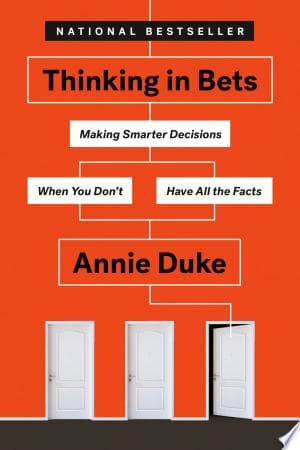
Core Idea
- Difficulty
- Medium
- Read it if
- You want to improve your decision-making skills by understanding how to navigate uncertainty and separate the quality of your choices from their eventual outcomes. You are interested in applying principles from poker and probabilistic thinking to everyday life and business decisions.
- Skip it if
- You are looking for a prescriptive, step-by-step guide with guaranteed outcomes or prefer books that avoid discussing probability and cognitive biases in depth. You are not open to the idea that 'good' decisions can lead to 'bad' results, and vice versa.
Key Takeaways from Thinking in Bets
Separate Decision Quality from Outcome Quality
A good decision can lead to a bad outcome, and vice versa.
One of the most important ideas from 'Thinking in Bets' is the need to separate the quality of a decision from the quality of its outcome. We tend to judge our choices by how things turned out, but this 'resulting' bias stops us from learning and improving. A decision made with good reasoning, good information, and a clear understanding of probabilities can still lead to a bad result because of randomness or 'luck.' On the other hand, a poor decision can, by chance, lead to a good outcome. Real progress comes from evaluating the process and information used in our decisions, not just their often unpredictable results. This separation allows for objective analysis and helps us grow, stopping us from repeating bad strategies just because they once got lucky.
“Results are a terrible teacher.”
In the book: Duke frequently uses poker analogies, where a player can make the statistically correct move (e.g., going all-in with a strong hand) but still lose to an improbable 'river card.' She also cites real-world examples, such as NFL coaches making statistically sound fourth-down decisions that backfire due to unforeseen circumstances, leading to public outcry despite the analytical validity of the choice.
Try this: After any significant decision, conduct a 'pre-mortem' (before the outcome is known, if possible) or a 'post-mortem' focusing on the decision-making process itself: What information was available? What were the probabilities? What alternatives were considered? Avoid the temptation to retroactively justify or condemn a decision solely based on its outcome.
Related ideas: resulting-bias, outcome-bias, decision-making-process
Embrace Uncertainty with Probabilistic Thinking
Shift from 'right or wrong' to 'how likely?'
Life is uncertain, yet our language and biases often push us towards simple 'right or wrong' thinking. Duke suggests adopting a probabilistic mindset, seeing decisions not as certainties but as bets on future outcomes with different chances. This means expressing beliefs and predictions using percentages or ranges (e.g., 'I'm 70% sure this will happen,' or 'There's a 30% chance of failure'). This approach makes us quantify our confidence, acknowledge luck, and become more comfortable with unclear situations. It also makes us more open to new information and less likely to be overconfident, as we are always considering other possibilities.
“Thinking in bets starts with recognizing that there are exactly two things that determine how our lives turn out: the quality of our decisions and luck.”
In the book: Duke recounts her own poker experiences, where every decision is a calculation of odds and expected value. She also references research by Philip Tetlock on 'superforecasters,' who consistently outperform others by expressing their predictions in precise probabilities and continually updating their beliefs.
Try this: When evaluating options or making predictions, explicitly state your confidence level as a percentage. Practice saying 'I'm not sure' or 'I believe there's an X% chance' instead of definitive statements. This trains your brain to think in terms of likelihoods rather than absolutes, making your mental models more accurate.
Related ideas: probabilistic-thinking, uncertainty-management, forecasting
The Power of the 'Betting Mindset'
Every decision is a wager on future outcomes.
Seeing every decision as a 'bet' changes how we make choices. It shows that we are always risking something (time, money, reputation, opportunity) for a possible future reward, and that uncertainty is always present. This mindset encourages us to clearly consider the 'pot odds' – the possible gain versus the possible loss – and the 'implied odds' – what other opportunities or costs might arise. It also makes us state our beliefs and the reasons behind them, making our assumptions clear. By taking this view, we move away from impulsive choices and towards a more disciplined, analytical way of thinking, similar to how professional poker players approach each hand.
“A bet is a decision about an uncertain future.”
In the book: Duke elaborates on how top poker players don't just 'play the hand' but 'play the player' and the 'situation,' constantly estimating probabilities of opponents' cards and future actions. This is a continuous betting process. She also applies this to business decisions, where investments are essentially bets on market trends or product success.
Try this: Before making a significant decision, explicitly ask yourself: 'What am I betting on here? What are the potential upsides and downsides? What are the odds of each outcome?' Write down your reasoning and the 'terms' of your bet. This structured thinking clarifies your assumptions and potential risks.
Related ideas: expected-value, decision-framing, risk-assessment
Avoid Hindsight Bias and Resulting
Don't let outcomes rewrite your past reasoning.
Hindsight bias, often linked with 'resulting,' is the tendency to believe, after an event, that one would have predicted the outcome. This distorts our memory of our original predictions and decision processes, making it harder to learn from mistakes or credit good decisions that just got unlucky. When we 'result,' we unfairly judge a decision's quality based only on its outcome, ignoring the information available when the choice was made. This stops real learning, as we either dismiss good strategies that failed due to luck or reinforce bad ones that succeeded by chance. Actively fighting these biases is important for building a strong decision-making system.
“The greatest enemy of good decision making is resulting.”
In the book: Duke provides compelling examples from sports, like a football coach's play call being deemed 'brilliant' or 'idiotic' purely based on whether it resulted in a touchdown or a turnover, irrespective of the strategic soundness. She also cites research showing how people consistently overestimate their ability to have predicted past events.
Try this: Before an outcome is known, write down your decision, your reasons, your expected probabilities, and alternative possibilities. After the outcome, compare it to your original notes. This creates an objective record, making it harder for hindsight bias to creep in and allowing for genuine learning about your predictive accuracy and decision process.
Related ideas: hindsight-bias, cognitive-bias, learning-from-mistakes
The Value of 'Truthseeking' Groups
Leverage diverse perspectives to challenge assumptions.
Our individual views are limited and prone to bias. To make better decisions, Duke supports forming 'truthseeking' groups – diverse teams or people dedicated to open discussion, questioning assumptions, and helping each other see blind spots. These groups are not echo chambers; they thrive on constructive disagreement and a shared goal of accuracy over agreement. By sharing our thoughts and letting others with different views examine them, we can find faulty reasoning, spot missing information, and improve our probability estimates. This group intelligence approach is more effective than thinking alone.
“The only way to improve our decision making is to get outside our own heads.”
In the book: Duke frequently refers to 'decision pods' or 'truthseeking groups' that she and other poker players formed to review hands, discuss strategy, and critique each other's play without ego. She also alludes to the benefits seen in intelligence agencies or scientific communities where peer review and diverse expert opinions are crucial.
Try this: Form a small, trusted group of colleagues or friends who are committed to honest feedback. Regularly discuss significant decisions, explaining your reasoning and asking them to identify flaws, missing information, or alternative perspectives. Emphasize a culture of curiosity and intellectual humility, not just agreement.
Related ideas: cognitive-diversity, peer-review, group-decision-making
Recognize and Mitigate Cognitive Biases
Understand your brain's shortcuts to make better choices.
Duke points out that our brains have many cognitive biases – mental shortcuts that, while often efficient, can lead to regular errors in judgment. Confirmation bias, availability heuristic, and the illusion of control are examples that can badly affect decision-making. By understanding these flaws, we can develop ways to counter them. This is not about removing biases completely, which is likely impossible, but about creating pauses in our thinking to question and apply more deliberate, rational thought. Awareness is the first step; building habits to lessen their impact is the next.
“We are all prone to a host of cognitive biases that make us less rational than we think we are.”
In the book: Duke discusses how confirmation bias leads us to seek out information that supports our existing beliefs, and how the availability heuristic makes us overemphasize recent or vivid events. She uses examples from the financial world where investors fall prey to these biases, leading to poor portfolio decisions.
Try this: Actively seek out information that contradicts your initial hypothesis. When making a decision, list three reasons why your chosen path might fail. This 'devil's advocate' approach helps counteract confirmation bias. Also, pause before making snap judgments based on easily recalled, but potentially unrepresentative, information.
Related ideas: confirmation-bias, availability-heuristic, illusion-of-control
The Power of 'Failing Well'
Learn from mistakes without self-flagellation.
Failure is a natural part of learning, especially in an uncertain world. 'Failing well' means seeing setbacks not as personal flaws but as valuable data. It involves being willing to admit mistakes, objectively analyzing what went wrong (separating bad decisions from bad luck), and adjusting future strategies without shame or fear. This needs intellectual humility and resilience, understanding that every 'failure' offers a chance to improve our mental models and decision-making. Without this ability to learn from failure, we are likely to repeat errors or become too afraid to take risks.
“Failing well means learning from our mistakes without letting them paralyze us.”
In the book: Duke highlights how poker players constantly review their hands, not just the wins, to understand where they might have made a better play, even if they won the pot. She also references stories of entrepreneurs who iterated through multiple 'failures' before achieving success, attributing their eventual triumph to their ability to learn and adapt.
Try this: After any negative outcome, instead of dwelling on regret, conduct a 'failure analysis.' What was the decision? What was the outcome? What was the information available? What was the luck component? What could be done differently next time? Focus on process improvement, not self-blame.
Related ideas: growth-mindset, resilience, error-analysis
The Importance of 'Quitting Well'
Knowing when to cut your losses and move on.
As important as making good initial decisions is knowing when to 'quit well.' This means recognizing when a 'bet' is no longer good, or when new information changes the probabilities, even if it means abandoning a project or path you have already invested heavily in (sunk cost fallacy). Many people struggle with this, holding onto losing situations out of stubbornness, ego, or not wanting to admit defeat. Duke argues that 'quitting well' is a skill developed through probabilistic thinking, allowing us to objectively assess the expected value of continuing versus stopping, freeing up resources for better opportunities. It is about improving future outcomes, not justifying past investments.
“The best way to get better at decision making is to realize that you're always making a bet.”
In the book: Duke draws parallels to poker, where folding a hand, even if you've put chips in, is often the correct decision when the odds turn against you. She also cites examples of companies or individuals who persisted with failing projects for too long, incurring massive losses due to the sunk cost fallacy, contrasting them with those who pivoted successfully by 'quitting well.'
Try this: Periodically re-evaluate ongoing projects or commitments as if you were starting them today. Would you still make the same 'bet' with the current information? Set 'kill criteria' or exit strategies upfront for major decisions, defining the conditions under which you will abandon a course of action.
Related ideas: sunk-cost-fallacy, opportunity-cost, strategic-pivot
Develop a 'Future-Self' Perspective
Make decisions for your future well-being, not just immediate gratification.
Many poor decisions come from a gap between our present selves and our future selves. We prioritize immediate rewards or avoid short-term discomfort, often at the cost of long-term well-being. Duke encourages taking a 'future-self' perspective, where we consider how our current choices will affect the person we want to be or the situation we want to reach later on. This involves imagining ourselves in the future to experience the results of our current actions. This perspective helps in making more disciplined choices, resisting impulsive behaviors, and aligning daily decisions with overall goals, much like an investor thinks about long-term returns.
“Thinking in bets is a tool to help us make better decisions for our future selves.”
In the book: While not explicitly named 'future-self perspective,' Duke's emphasis on long-term success over short-term outcomes, and making decisions that are robust over time, implicitly supports this. She might reference financial planning, career development, or health choices where immediate sacrifices lead to significant future gains.
Try this: Before a significant decision, imagine yourself one year, five years, or even ten years from now. How would your future self view this decision? What advice would they give? Write a letter from your future self to your present self about the decision you're facing. This can provide valuable perspective.
Related ideas: long-term-thinking, delayed-gratification, self-control
Cultivate Intellectual Humility
Acknowledge the limits of your knowledge.
A main idea of thinking in bets is intellectual humility – understanding that our knowledge is always incomplete and our view of the world is imperfect. Overconfidence, the opposite of humility, is a dangerous bias that leads to bad risk assessment and an unwillingness to update beliefs. By embracing humility, we become more open to new information, more willing to admit when we are wrong, and more receptive to different viewpoints. This is not about self-doubt, but about a realistic assessment of our mental limits, which ultimately leads to more solid and adaptable decision-making. It is the basis for continuous learning and improvement.
“The world is an uncertain place, and we are all operating with incomplete information.”
In the book: Duke often points out how even the most skilled poker players, or any experts, acknowledge the role of luck and the limits of their predictive power. She contrasts this with individuals who cling to their beliefs despite contradictory evidence, often leading to catastrophic outcomes (e.g., in investing or politics).
Try this: Regularly ask yourself, 'What might I be wrong about here?' Actively seek out dissenting opinions and genuinely listen to arguments against your position. Practice expressing your confidence levels as probabilities rather than certainties, implicitly acknowledging room for error.
Related ideas: overconfidence-bias, growth-mindset, epistemology
Thinking in Bets Quotes
“Life is a lot like poker, not like chess. We are making decisions without knowing all the cards.”
“Resulting is the tendency to judge the quality of a decision by its outcome.”
“When we think in bets, we are expressing a degree of certainty (or uncertainty) about a particular belief.”
“We tend to seek out information that confirms our existing beliefs and ignore information that contradicts them.”
“The quality of a decision can't be solely judged by its outcome, especially when luck plays a significant role.”
“To improve our decision-making, we need to separate the quality of the decision from the quality of the outcome.”
“Hindsight bias makes us believe that past events were more predictable than they actually were.”
“We don't know what we don't know.”
“The goal is not to be right every time, but to make good decisions consistently over time.”
“Expressing our beliefs as probabilities helps us to be more accurate and less dogmatic.”
“A decision journal is a powerful tool for improving our decision-making process.”
“When we lose, we tend to externalize the cause. When we win, we internalize it.”
“The future is uncertain, and our decisions are made in the face of that uncertainty.”
“We need to get comfortable with being wrong to truly learn and grow.”
Quiz
10 questions on the main ideas. Each answer comes with a short explanation.
Question 1
According to Annie Duke, what is the key to long-term success and reducing worry when making decisions?
- Always ensuring the best decision leads to the best outcome.
- Eliminating all elements of luck from decision-making processes.
- Thinking in bets by assessing probabilities and potential outcomes.
- Seeking absolute certainty in all information before deciding.
Show answer
C. Thinking in bets by assessing probabilities and potential outcomes. The book emphasizes that because luck and hidden information are always present, the key is to 'think in bets'—assessing how sure you are, potential outcomes, and the odds of success.
Question 2
What common societal value does Annie Duke argue makes it difficult for most people to adopt a 'thinking in bets' mindset?
- The value of quick decision-making.
- The value of appearing certain and confident.
- The value of always being right.
- The value of avoiding risk at all costs.
Show answer
B. The value of appearing certain and confident. The text states, 'For most people, it's difficult to say "I'm not sure" in a world that values and, even, rewards the appearance of certainty.'
Question 3
According to Duke, what is a key distinction professional poker players understand about decisions and outcomes that most people struggle with?
- That all bad decisions lead to bad outcomes.
- That great decisions don't always lead to great outcomes, and bad decisions don't always lead to bad outcomes.
- That outcomes are entirely within their control if the decision is optimal.
- That luck is irrelevant in the long run.
Show answer
B. That great decisions don't always lead to great outcomes, and bad decisions don't always lead to bad outcomes. The book highlights that 'professional poker players are comfortable with the fact that great decisions don't always lead to great outcomes, and bad decisions don't always lead to bad outcomes.'
Question 4
When 'thinking in bets,' what question does Annie Duke suggest asking to evaluate if a successful outcome was due to skill or chance?
- Did I feel confident when I made the decision?
- Did I land in the unlucky 10% on the strategy that works 90% of the time? Or is my success attributable to dumb luck rather than great decision making?
- How many alternative decisions could I have made?
- Was my initial gut feeling correct?
Show answer
B. Did I land in the unlucky 10% on the strategy that works 90% of the time? Or is my success attributable to dumb luck rather than great decision making? The text explicitly states this question as a core component of thinking in bets: 'Did I land in the unlucky 10% on the strategy that works 90% of the time? Or is my success attributable to dumb luck rather than great decision making?'
Question 5
What is one of the negative consequences of a need for certainty in decision-making, as described by Duke?
- Increased confidence and calmness.
- Greater compassion in decision-making.
- Vulnerability to reactive emotions, knee-jerk biases, and destructive habits.
- A more successful long-term track record.
Show answer
C. Vulnerability to reactive emotions, knee-jerk biases, and destructive habits. The book states that shifting away from a need for certainty makes you 'less vulnerable to reactive emotions, knee-jerk biases, and destructive habits in your decision making.'
Question 6
Annie Duke draws on examples from which of the following fields to illustrate her decision-making tools?
- Only poker and sports.
- Business, sports, politics, and poker.
- Only business and finance.
- Medicine and law.
Show answer
B. Business, sports, politics, and poker. The text explicitly mentions Duke 'draws on examples from business, sports, politics, and (of course) poker to share tools anyone can use.'
Question 7
How does 'thinking in bets' help individuals in situations where there's 'information hidden from view'?
- It magically reveals the hidden information.
- It eliminates the need for any hidden information.
- It encourages acknowledging uncertainty and making decisions based on probabilities despite incomplete information.
- It suggests delaying all decisions until all information is available.
Show answer
C. It encourages acknowledging uncertainty and making decisions based on probabilities despite incomplete information. The core of thinking in bets is to 'get comfortable with uncertainty' and 'accurately assessing what you know and what you don't,' implying that decisions are made with the understanding of hidden information and the probabilistic nature of outcomes.
Question 8
What is the ultimate goal of shifting one's thinking from a need for certainty to accurately assessing what is known and unknown?
- To guarantee every decision yields the best possible outcome.
- To become more confident, calm, compassionate, and successful in the long run.
- To never make a mistake again.
- To eliminate the element of luck entirely.
Show answer
B. To become more confident, calm, compassionate, and successful in the long run. The final sentence of the provided text states this explicitly: 'You'll become more confident, calm, compassionate, and successful in the long run.'
Question 9
When Annie Duke asks, 'What decision has the highest odds of success?', what specific aspect of decision-making is she prompting individuals to consider?
- The emotional satisfaction derived from the decision.
- The subjective preference for one option over others.
- A probabilistic assessment of the likelihood of favorable outcomes for each choice.
- The speed at which the decision can be executed.
Show answer
C. A probabilistic assessment of the likelihood of favorable outcomes for each choice. This question is a direct application of thinking in bets, which involves 'accurately assessing what you know and what you don't' and considering 'What decision has the highest odds of success?'—a probabilistic approach.
Question 10
Why does Annie Duke, a former World Series of Poker champion, specifically use poker as a primary example in her work on decision-making?
- Because poker is the only game where luck plays a significant role.
- Because poker players are inherently risk-averse, making their decisions unique.
- Because poker inherently involves making decisions under uncertainty, with incomplete information, and where outcomes are a mix of skill and luck, mirroring real-world challenges.
- Because poker strategies are directly transferable to all business decisions without modification.
Show answer
C. Because poker inherently involves making decisions under uncertainty, with incomplete information, and where outcomes are a mix of skill and luck, mirroring real-world challenges. Poker serves as a perfect metaphor because it embodies the core challenges of decision-making under uncertainty, with hidden information (opponent's cards), and where good decisions don't always guarantee good outcomes due to luck, just like in business or life.
Thinking in Bets FAQ
What is 'thinking in bets'?
'Thinking in bets' is a framework for decision-making that acknowledges the role of uncertainty and luck in outcomes. It involves assessing probabilities, understanding the range of possible results, and evaluating decisions based on their long-term expected value rather than individual outcomes.
Does 'thinking in bets' guarantee better outcomes every time?
No, 'thinking in bets' does not guarantee a good outcome every single time. It's about making the best possible decision given available information and probabilities, which increases the likelihood of long-term success, even if some individual outcomes are unlucky.
How is 'Thinking in Bets' different from traditional decision-making books?
While many decision-making books focus on eliminating risk or finding certainty, 'Thinking in Bets' emphasizes embracing uncertainty and separating the quality of a decision from the luck of its outcome. It encourages probabilistic thinking rather than seeking definitive answers.
What is 'resulting' and why is it a problem?
'Resulting' is the tendency to judge the quality of a decision based solely on its outcome. It's a problem because good decisions can have bad outcomes due to luck, and bad decisions can have good outcomes, leading to flawed learning and future choices.
How can I apply 'thinking in bets' to my daily life or business decisions?
You can apply it by consciously considering probabilities, identifying hidden information, and framing choices as bets. This involves asking 'How sure am I?' and 'What are the possible outcomes?' to make more informed and less emotionally driven decisions.
Does 'Thinking in Bets' help with managing anxiety about uncertainty?
Yes, by understanding that uncertainty is inherent and separating decisions from outcomes, the book helps reduce anxiety. It teaches you to evaluate your process rather than just the results, leading to a calmer and more confident approach.
What role does poker play in Annie Duke's philosophy?
Poker serves as a powerful metaphor and training ground for 'thinking in bets.' In poker, players constantly make decisions with incomplete information and significant uncertainty, forcing them to weigh probabilities and manage risk effectively, regardless of the immediate outcome.
What is the 'truth-seeking' approach mentioned in the book?
The 'truth-seeking' approach involves actively trying to get to the most accurate understanding of reality, including acknowledging what you don't know and being open to changing your mind. It's about reducing bias and improving the accuracy of your beliefs.
How can I avoid common decision-making biases using this framework?
By adopting a 'thinking in bets' mindset, you become more aware of biases like hindsight bias and confirmation bias. The framework encourages you to explicitly consider alternative outcomes and probabilities, making you less vulnerable to knee-jerk reactions and emotional decision-making.
About the author
Annie Duke is a former professional poker player and author known for her work in decision-making and strategic thinking. Her notable books, including 'Thinking in Bets' and 'Quit,' explore the intersection of luck, skill, and cognitive biases. Duke applies her extensive experience in high-stakes poker to provide practical frameworks for making better choices in both personal and professional life.
Similar books
- The Perks of Being a Wallflower
Stephen Chbosky
4.2 (1.3M) average on GoodreadsPsychologyThrough letters, a shy high school freshman learns to navigate first love, trauma, and self-discovery, stepping off the sidelines and into life.
- Eleanor Oliphant Is Completely Fine
Gail Honeyman
4.3 (708k) average on GoodreadsLiterary FictionA lonely woman's structured life changes when an IT guy and an elderly man help her learn to open her heart.
- One Flew Over the Cuckoo's Nest
Ken Kesey
4.2 (631k) average on GoodreadsPsychologyIn a mind-bending asylum, the boisterous Randle McMurphy wages a defiant war against the tyrannical Nurse Ratched, inspiring his fellow inmates, including the seemingly catatonic Chief Bromden, to reclaim their lost humanity.
- The Bell Jar
Sylvia Plath
4.0 (591k) average on GoodreadsPsychologyIn the suffocating grip of 1950s expectations, a brilliant young woman's descent into mental illness is painted with such vivid, internal clarity that her 'insanity' feels terrifyingly rational and inevitable.
- The Subtle Art of Not Giving a F*ck: A Counterintuitive Approach to Living a Good Life
Mark Manson
3.9 (530k) average on GoodreadsBusinessEmbrace your flaws and stomach life's lemons, because true happiness isn't about relentless positivity, but about choosing what truly matters to give a f*ck about.
- Sapiens: A Brief History of Humankind
Yuval Noah Harari
4.4 (502k) average on GoodreadsPsychologySapiens tells the story of Homo sapiens, showing how our ability to create shared fictions helped us go from an ordinary ape to the planet's main species, changing Earth and our future.






Enjoyed the summary?
A summary gives you the shape of the book. The book itself has the detail, the examples and the voice.
Find Thinking in Bets on AmazonAs an Amazon Associate, BookBrief earns from qualifying purchases. How we're funded