
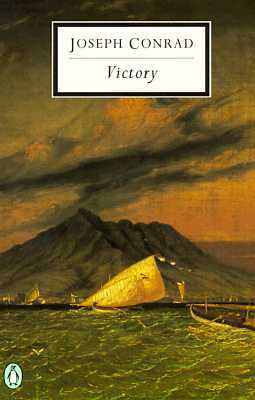
Synopsis
Covers the whole plot, including the ending.
- Difficulty
- Hard
- Pacing
- Moderate
- Mood
- Atmospheric, Melancholy, Suspenseful, Philosophical
- Read it if
- You enjoy psychological depth, moral dilemmas, and the exploration of human isolation against an exotic backdrop.
- Skip it if
- You prefer fast-paced action without much introspection or a clear, happy resolution.
Victory Plot Summary
Covers the whole plot, including the ending.
The Enigma of Heyst
Axel Heyst, a Swedish baron, lives a solitary and detached life in the Malay Archipelago, guided by his father's philosophy of non-involvement. He first settles on Samburan as a partner in the Tropical Belt Coal Company, which ultimately fails. After the company's collapse, Heyst retreats to a desolate bungalow on a remote island, keeping only a distant connection with the outside world through the settlement of Surabaya. His deliberate isolation and enigmatic past lead to rumors and a reputation as a mysterious figure among the European trading community, especially the resentful innkeeper Schomberg, who despises Heyst's aloofness and perceived moral superiority.
A Glimpse of Lena's Plight
On a rare visit to Surabaya, Heyst meets Lena, a young English woman playing in Zangiacomo's Ladies' Orchestra at Schomberg's hotel. Lena is vulnerable, exploited by Zangiacomo and harassed by the lecherous Schomberg, who is infatuated with her. She feels trapped and desperate. Heyst, observing her quiet suffering and the predatory behavior around her, feels an uncharacteristic stir of compassion, a crack in his carefully built wall of detachment, though he struggles with this feeling and his long-held principles.
Heyst's Intervention and Escape
Heyst, moved by Lena's situation and Schomberg's aggressive advances, makes a sudden, uncharacteristic decision. He offers Lena an escape, inviting her to his isolated island. Lena, seeing this as her only chance for freedom, accepts. Their departure is hasty and secret, further fueling Schomberg's rage and resentment, as he believes Heyst has stolen 'his' woman. This rescue is a significant departure from Heyst's philosophy of non-involvement, marking the start of his reluctant re-engagement with humanity.
Life on the Island
Heyst brings Lena to his remote island, where they live in the abandoned bungalow of the Tropical Belt Coal Company. Lena is initially overwhelmed by the solitude and Heyst's emotional reserve. Despite their physical intimacy, Heyst struggles to fully connect with Lena, maintaining a mental and emotional distance rooted in his father's teachings. Lena, grateful for her rescue, senses Heyst's inner conflict and yearns for a deeper emotional bond, feeling the weight of his detachment and the unspoken past that haunts him. She tries to break through his defenses, sensing his vulnerability beneath his indifferent exterior.
Schomberg's Vengeance
Back in Surabaya, Schomberg's obsession with Lena and his hatred for Heyst turn into a dangerous plot. He meets a trio of disreputable characters: Mr. Jones, a gentlemanly but sinister nihilist; Ricardo, Jones's brutal and animalistic secretary; and Pedro, a silent, ape-like servant. Schomberg, believing Heyst is wealthy, invents stories of Heyst's supposed fortune hidden on his island and Lena's forced imprisonment. He cunningly convinces the criminals that Heyst is an easy target, manipulating their greed to raid Heyst's island, intending for them to exact his revenge and steal Heyst's supposed riches.
The Arrival of the Invaders
The criminal trio, guided by Schomberg's malicious directions, arrives at Heyst's secluded island. Their sudden appearance shatters the fragile peace Heyst and Lena had established. Heyst, initially believing them to be shipwrecked mariners, offers cautious hospitality, giving them shelter in the abandoned company buildings. However, he quickly sees their true, sinister intentions. The dynamic on the island changes dramatically, as Heyst is forced to confront the direct consequences of his past actions and his attempt to escape human entanglement, while Lena's instincts immediately alert her to the danger.
The Confrontation and Lena's Resolve
Heyst finds himself paralyzed by his ingrained philosophy of non-involvement, struggling to take decisive action against the invaders. He tries to reason with Jones, believing intellectual discussion can resolve the situation, but Jones's nihilistic worldview makes him impervious. Lena, however, is driven by a strong instinct for self-preservation and a growing love for Heyst. She recognizes the immediate and brutal threat posed by Ricardo, who is dangerously attracted to her. Lena resolves to protect Heyst, even if it means sacrificing herself, understanding that Heyst's detachment makes him vulnerable to such ruthless men.
Ricardo's Obsession and Lena's Scheme
Ricardo, the most physically dangerous of the invaders, becomes intensely fixated on Lena, making advances that she skillfully deflects while subtly encouraging his interest. She realizes that her only chance to save Heyst is to disarm Ricardo, literally and figuratively. Lena engages in a dangerous game of manipulation, using her allure to get close to Ricardo, planning to steal his knife, his main weapon and symbol of his brutal power. This act is risky, but Lena's determination to protect Heyst overcomes her fear, showing her courage and resourcefulness.
The Failed Plan and Tragic Climax
Lena successfully takes Ricardo's knife, hiding it, but her plan takes an unforeseen turn. Ricardo, enraged by the loss of his weapon and Lena's perceived betrayal, confronts her. Meanwhile, Jones, who despises women, discovers Ricardo's interest in Lena, which further fuels his contempt. In a chaotic sequence, Jones, believing Ricardo has betrayed him for a woman, shoots Ricardo. Heyst, witnessing the unfolding tragedy and the direct result of his inaction, finally breaks from his detachment. However, in the ensuing confusion, Lena, trying to protect Heyst from a perceived threat from Jones, is accidentally shot by Jones, who mistakes her for a man in the dim light.
Heyst's Despair and Final Act
Lena dies in Heyst's arms, her last words expressing her love for him and her triumph in having saved him from his isolation. Her death shatters Heyst's remaining detachment, revealing the depth of his love for her and his profound regret for his inability to fully embrace life and love. Overwhelmed by grief, guilt, and the realization of his philosophy's destructive consequences, Heyst carries Lena's body into the bungalow. In a final, desperate act of self-annihilation, he sets the building ablaze, perishing with her in the flames, a tragic end to his life of deliberate non-involvement.
Victory Characters
Axel Heyst
Protagonist
A reclusive Swedish baron haunted by his father's philosophy of non-involvement.
Heyst is a man defined by his intellectual detachment and a deeply ingrained philosophy of non-involvement, inherited from his cynical father. He believes that by avoiding emotional connections and worldly entanglements, he can escape suffering. This leads him to a life of isolation and observation rather than participation. Despite his outward calm and gentlemanly demeanor, he carries a profound loneliness and a fear of human intimacy. His rescue of Lena is an impulsive act that challenges his core beliefs, forcing him to confront the very human connection he has so assiduously avoided.
Relationships: Lena (Rescued lover, his emotional catalyst and ultimate sacrifice.); Schomberg (Antagonist, a resentful innkeeper who despises Heyst and plots his downfall.); Mr. Jones (Antagonist, a nihilistic and predatory gentleman-thief.); Ricardo (Antagonist, Jones's brutal and animalistic secretary.)
Lena
Protagonist/Love Interest
A young, vulnerable musician rescued by Heyst, who ultimately saves him from his isolation.
Lena is a young English woman, initially a member of Zangiacomo's Ladies' Orchestra, exploited and harassed by men like Schomberg. She possesses an innate strength, resourcefulness, and a deep capacity for love and loyalty, despite her vulnerable circumstances. Her journey with Heyst is one of awakening and self-discovery, as she strives to understand and break through Heyst's emotional barriers. She represents warmth, life, and the very human connection Heyst fears, ultimately becoming the active force that confronts the threats to their existence.
Relationships: Axel Heyst (Her rescuer and lover, for whom she develops profound love and loyalty.); Schomberg (Her tormentor and antagonist, from whom Heyst rescues her.); Ricardo (Her primary threat, whom she attempts to outwit and disarm.)
Schomberg
Antagonist
A lecherous and vengeful innkeeper who orchestrates Heyst's downfall.
Schomberg is the German proprietor of the hotel in Surabaya, a coarse, resentful, and deeply prejudiced man. He is infatuated with Lena and harbors a profound hatred for Heyst, whom he views as an arrogant, privileged outsider who stole 'his' woman and embodies everything he despises. His malice and petty vindictiveness drive the central conflict of the novel, as he manipulates and incites the criminal trio to seek revenge on Heyst. Schomberg embodies the destructive power of jealousy and unfulfilled desire.
Relationships: Axel Heyst (His nemesis, the object of his intense hatred and jealousy.); Lena (The object of his lust and obsession, whom he believes Heyst stole.); Mr. Jones (His unwitting accomplice, whom he manipulates to attack Heyst.); Ricardo (His unwitting accomplice, whom he manipulates to attack Heyst.)
Mr. Jones
Antagonist
A gentlemanly but nihilistic and predatory criminal mastermind.
Mr. Jones is the leader of the criminal trio, a gaunt, aristocratic-looking man with a chillingly detached and nihilistic worldview. He is a 'gentleman-thief' who preys on others, driven by a profound misanthropy and a particular hatred for women, whom he views as the source of all evil and corruption. His refined manners mask a cold, predatory nature and an utter lack of empathy. He is the intellectual force behind the criminal enterprise, seeing himself as a superior being above the moral constraints of society.
Relationships: Axel Heyst (His intended victim, whom he sees as another weak human to exploit.); Ricardo (His loyal, though eventually disobedient, secretary and enforcer.); Pedro (His brutish and silent servant.)
Ricardo
Antagonist
Mr. Jones's brutal, animalistic, and highly skilled secretary and enforcer.
Ricardo is the physical embodiment of danger and primal instinct. He is Mr. Jones's secretary and chief enforcer, characterized by his animalistic grace, predatory cunning, and an almost artistic skill with a knife. He is intensely loyal to Jones but is also susceptible to carnal desires, particularly his dangerous attraction to Lena. Ricardo represents the raw, untamed forces of human nature that Heyst's philosophy attempts to deny. His violent impulses and lack of moral restraint make him a formidable and terrifying threat.
Relationships: Mr. Jones (His master and companion in crime, to whom he is fiercely loyal.); Lena (The object of his dangerous desire, whom he attempts to possess.); Axel Heyst (His intended victim, whom he intends to rob and perhaps kill.)
Pedro
Supporting/Mentioned
The silent, ape-like servant of Mr. Jones and Ricardo.
Pedro is the third member of the criminal trio, a silent, almost subhuman figure who serves Jones and Ricardo. He is often described with animalistic imagery, reflecting his primitive nature and lack of speech. He acts as a brute force, following orders without question, and embodies the most basic, unthinking aspects of human depravity. His presence emphasizes the uncivilized and dangerous element that invades Heyst's isolated world.
Relationships: Mr. Jones (His master.); Ricardo (His fellow criminal.)
Heyst's Father
Mentioned
A cynical philosopher whose teachings profoundly shaped Axel Heyst's life.
Heyst's deceased father is a pervasive, though unseen, character whose philosophical writings and cynical advice profoundly influence Axel Heyst's life. His father preached a doctrine of detachment and non-involvement, warning against the dangers of human connection and the futility of action. This philosophy becomes Axel's guiding principle, shaping his reclusive lifestyle and his emotional distance from others. The father's influence represents the intellectual and emotional shackles that Heyst struggles to break free from throughout the novel.
Relationships: Axel Heyst (His son, who lives by his philosophical precepts.)
Zangiacomo
Mentioned
The proprietor of the Ladies' Orchestra, who exploits Lena.
Zangiacomo is the leader of the Ladies' Orchestra in Surabaya, a minor character who primarily serves to establish Lena's initial miserable circumstances. He is depicted as an exploitative figure who profits from the vulnerability of the young women under his charge, particularly Lena. His role highlights the oppressive environment from which Heyst rescues Lena, making Heyst's intervention seem all the more significant.
Relationships: Lena (Her exploitative employer.)
Victory Themes
Isolation vs. Connection
This is the central theme of 'Victory.' Heyst deliberately chooses a life of isolation, believing it offers protection from suffering and disillusionment, a philosophy inherited from his father. However, his encounter with Lena forces him to confront the limits and futility of such a life. His inability to fully embrace connection, even with Lena, leaves him vulnerable to the predatory forces of the world. Lena, in contrast, actively seeks connection and finds strength in it, ultimately sacrificing herself to save Heyst from his self-imposed detachment. The novel argues that true 'victory' is not avoiding life, but engaging with it, despite the inherent risks of pain and loss, as seen when Heyst's final, desperate act results from his failure to fully connect and act decisively.
“'Look on--make no sound.' A man should just look on, and say nothing.”
The Destructive Nature of Evil and Malice
The novel vividly portrays the insidious and destructive power of human malice, shown mainly by Schomberg, Mr. Jones, and Ricardo. Schomberg's petty jealousy and vindictiveness, fueled by a personal slight, start the entire tragic chain of events. Mr. Jones represents a more intellectual and nihilistic evil, driven by misanthropy and a desire to prey on others. Ricardo embodies brutal, animalistic evil, motivated by greed and lust. These characters are not redeemed or reasoned with; their malevolence is a force that Heyst, with his detached philosophy, is ill-equipped to handle. Their actions ultimately lead to the violent destruction of Heyst's world and Lena's life, showing that evil, however it appears, inevitably brings suffering.
“There are depths of horror in a man's heart that can't be plumbed.”
The Power of Love and Sacrifice
Despite the tragic ending, the novel highlights the transformative and redemptive power of love, particularly through Lena's character. Lena, initially a victim, finds purpose and immense courage through her growing love for Heyst. She actively fights for their survival, using her wits and ultimately sacrificing her life to protect him from the invaders. Her love forces Heyst to confront his own emotional barrenness and ultimately breaks through his detachment, even if it is too late. Her sacrifice is a 'victory' in its own right, as it allows Heyst to experience genuine human connection and emotion, albeit tragically. It suggests that love, even in the face of overwhelming evil, can provide meaning and purpose.
“I was saving you, Heyst, saving you.”
Illusion vs. Reality
Many characters in 'Victory' operate under various illusions. Heyst lives under the illusion that isolation can shield him from life's pain, only to find that it leaves him vulnerable to greater suffering. Schomberg holds the illusion that Lena belongs to him and that Heyst is a wealthy man, leading him to orchestrate a futile revenge. Mr. Jones lives under the illusion of his own intellectual superiority and invulnerability. The novel consistently exposes these illusions, revealing the harsh realities of human nature and the unpredictable forces of the world. The stark contrast between Heyst's intellectual detachment and the brutal reality of the invaders' intentions shows the danger of living in a self-constructed fantasy.
“Heyst was a man whom no one knew; a man who had never been heard of before and was not likely to be heard of again.”
Colonialism and Exploitation
While not the main focus, the colonial setting of the Malay Archipelago provides a backdrop of moral decay and exploitation. The failed Tropical Belt Coal Company, the transient and often questionable European residents, and the casual disregard for local populations (implied by the setting and characters' interactions) reflect the darker aspects of colonial enterprise. Characters like Schomberg and the criminal trio exploit the remote and unregulated nature of the region for their own nefarious purposes. Lena herself is a victim of exploitation within this environment, first by Zangiacomo and then by Schomberg. The island's desolation after the company's failure symbolizes the empty promises and destructive consequences of such ventures.
“The world of affairs, in which he had been so reluctantly involved, had been nothing but a vast, appalling joke.”
Plot Devices & Literary Techniques
The Isolated Island Setting
A remote, abandoned island serving as a physical and symbolic refuge and trap.
Heyst's island retreat is more than just a location; it's a powerful symbol of his chosen isolation. Initially, it represents a sanctuary from the complexities and dangers of human society, a place where he can enact his philosophy of non-involvement. However, it gradually transforms into a trap, a confined space where the external evils Heyst sought to escape finally converge. The island's desolation, once a comfort, becomes a stark reminder of his emotional barrenness and ultimately, the site of his and Lena's tragic demise, demonstrating that no physical barrier can fully protect one from human nature.
The Philosophy of Non-Involvement
Heyst's guiding principle, inherited from his father, which dictates emotional and social detachment.
This philosophical doctrine, 'Look on—make no sound,' is Heyst's primary motivation and, ultimately, his tragic flaw. It dictates his every action (or inaction) and shapes his character. The device functions to create the central conflict, as Heyst's adherence to this principle prevents him from fully connecting with Lena or decisively confronting the threats from Schomberg's gang. It highlights the intellectual's struggle with the demands of the real world and serves as a constant internal barrier that Heyst must overcome, or succumb to, throughout the narrative. Its failure is central to the novel's tragic message.
Dramatic Irony
The discrepancy between what characters know or believe and what the audience knows to be true.
Dramatic irony is prevalent, particularly concerning Schomberg's perception of Heyst and the criminals' motives. Schomberg believes Heyst is a wealthy man, a belief that drives the criminals to the island, whereas the audience knows Heyst is impoverished and has no hidden treasure. This creates a tension where the audience is aware of the impending doom based on false pretenses. Similarly, Heyst's initial belief that he can intellectually resolve the conflict with Jones, while the audience understands the true, brutal nature of the invaders, underscores his tragic naiveté and the limitations of his philosophy.
Symbolism of Names
Character names carrying symbolic weight that reflects their nature or role.
Conrad uses character names to subtly hint at their personalities or functions. 'Heyst,' for instance, can be interpreted as 'hoist' or 'haze,' suggesting someone lifted above or obscured from human affairs. 'Lena' (derived from Helen) evokes a sense of beauty and a woman who causes conflict or is fought over. 'Ricardo' sounds like 'rich-heart' but is ironically a brutal, 'animalistic' character. 'Mr. Jones' is a common name, making his villainy more chillingly universal. These names add layers of meaning, reinforcing the characters' roles and the novel's themes of isolation, malice, and human connection.
Victory Quotes
“He who looks too long into an abyss, the abyss also looks into him.”
“A man's most splendid actions are those of which he is unconscious.”
“Life is a dream—a horrible, fascinating dream.”
“The world is a bad dog and will bite you if you don't keep it on a chain.”
“No man is ever a stranger to the sea.”
“It is not good for a man to be too much alone.”
“There are no perfectly safe things in this world.”
“Woe to the man whose heart has not learned while young to hope, to love—and to put its trust in life!”
“The greatest joy in life is to be loved.”
“Action is the last refuge of the unfortunate.”
“All roads lead to the same grave.”
“The very air of this place seems to be heavy with dead hopes.”
“There is no escape from the world, my friend.”
“One must not only be silent, but also be clever at it.”
Quiz
10 questions on the plot and the characters. Each answer comes with a short explanation.
Question 1
What is the primary reason Axel Heyst initially isolates himself from others?
- He is a misanthrope who actively dislikes human company.
- He believes he can avoid suffering by cutting himself off from others.
- He is wanted by the law and must remain hidden.
- He is conducting secret scientific research that requires solitude.
Show answer
B. He believes he can avoid suffering by cutting himself off from others. Heyst's initial motivation for isolation stems from a philosophical belief that detachment will protect him from the pains of human existence.
Question 2
From what establishment does Axel Heyst rescue Lena?
- A bustling market in Surabaya
- Zangiacomo's Ladies' Orchestra
- A remote missionary outpost
- A struggling theatrical troupe
Show answer
B. Zangiacomo's Ladies' Orchestra Heyst encounters Lena as a member of Zangiacomo's Ladies' Orchestra, where she is performing under the oppressive eye of Schomberg.
Question 3
Who is the 'evil innkeeper' from whom Heyst rescues Lena?
- Mr. Jones
- Ricardo
- Schomberg
- Pedro
Show answer
C. Schomberg Schomberg, the innkeeper, is depicted as a malicious character who harbors an unhealthy obsession with Lena and instigates the pursuit of Heyst.
Question 4
What business venture does Heyst become involved in on a remote island before his encounter with Lena?
- A pearl diving operation
- A rubber plantation
- A coal company
- A shipping enterprise
Show answer
C. A coal company Heyst attempts to manage a coal company on a remote island, an endeavor that ultimately fails and reinforces his tendency towards isolation.
Question 5
What is the central struggle Lena faces in her relationship with Heyst?
- To convince Heyst to return to European society.
- To save Heyst from his emotional detachment and isolation.
- To escape the island and find her own freedom.
- To understand Heyst's mysterious past and hidden secrets.
Show answer
B. To save Heyst from his emotional detachment and isolation. Lena's primary role in the relationship is to try and break through Heyst's profound emotional detachment, which he has cultivated as a defense mechanism.
Question 6
Which of the following best describes the overall tone and conclusion of 'Victory'?
- A triumphant journey of self-discovery and lasting happiness.
- A humorous satire of colonial life.
- A violent and tragic conclusion.
- A philosophical debate on the nature of good and evil.
Show answer
C. A violent and tragic conclusion. The summary explicitly states that the novel is 'marked by a violent and tragic conclusion,' highlighting its somber resolution.
Question 7
What is the name of the general region where Heyst's island retreat is located?
- The Caribbean Sea
- The Mediterranean Basin
- The Malay Archipelago
- The South Pacific Ocean
Show answer
C. The Malay Archipelago The description specifies that the coal company operation and subsequently Heyst's island retreat are situated in the Malay Archipelago.
Question 8
Heyst's philosophy of avoiding suffering by cutting himself off from others is ultimately presented as:
- A successful strategy for achieving inner peace.
- A flawed and ultimately destructive approach to life.
- A necessary evil in a corrupt world.
- A temporary phase that Heyst quickly outgrows.
Show answer
B. A flawed and ultimately destructive approach to life. The narrative suggests that Heyst's detachment, while intended to prevent suffering, actually leads him into greater peril and prevents him from fully experiencing life and love.
Question 9
How does the relationship between Heyst and Lena evolve from its initial stage?
- It remains static, with Heyst maintaining his detachment throughout.
- It shifts as Lena actively works to challenge Heyst's isolation.
- It devolves into mutual distrust and resentment.
- It becomes a platonic friendship, devoid of romantic feelings.
Show answer
B. It shifts as Lena actively works to challenge Heyst's isolation. The summary notes that 'the relationship shifts as Lena struggles to save Heyst from the detachment and isolation,' indicating a dynamic and evolving interaction.
Question 10
The novel is described as both a tale of rescue and adventure and what other primary focus?
- A critique of colonialism and its impact on native populations.
- A historical account of trade in the Malay Archipelago.
- A perceptive study of a complex relationship and of the power of love.
- An exploration of the supernatural elements in remote islands.
Show answer
C. A perceptive study of a complex relationship and of the power of love. The final sentence of the summary explicitly states it is also 'a perceptive study of a complex relationship and of the power of love,' highlighting its thematic depth.
Victory FAQ
What is the central conflict Axel Heyst faces throughout the novel?
Axel Heyst's central conflict stems from his father's nihilistic philosophy, which taught him to avoid involvement and suffering by detaching himself from humanity. This philosophy clashes with his innate human need for connection and love, particularly as Lena enters his life, forcing him to confront the limitations and dangers of his isolation.
Who is Lena and what is her background before meeting Heyst?
Lena is a young English girl working as a violinist in Zangiacomo's Ladies' Orchestra, a traveling musical troupe in the Dutch East Indies. She is exploited and vulnerable, having fled a difficult past in England, and is particularly targeted by the predatory innkeeper Schomberg, who desires her.
How does Schomberg instigate the tragic events on Samburan?
Schomberg, fueled by his unrequited obsession with Lena and a deep resentment towards Heyst for 'stealing' her, manipulates the criminals Mr. Jones, Ricardo, and Pedro. He feeds them false information about Heyst hoarding treasure on Samburan, intending for them to rob and possibly kill Heyst, thereby allowing him to reclaim Lena.
What is the significance of the failed 'Tropical Belt Coal Company' in Heyst's life?
The Tropical Belt Coal Company represents Heyst's brief, ill-fated attempt to engage with the world and overcome his detachment, initiated by his friendship with Morrison. Its subsequent failure, and the ensuing scandal, reinforces his cynical view of human enterprise and pushes him further into self-imposed exile on Samburan, solidifying his belief that involvement leads only to disappointment.
What is the ultimate fate of Axel Heyst and Lena?
Lena is fatally wounded by Mr. Jones, who mistakes her for Heyst in the darkness, sacrificing herself to save Heyst from the villain. Devastated by her death and recognizing the profound impact she had on his isolated existence, Heyst commits suicide by setting fire to his bungalow with himself inside, unable to live without her.
What is the symbolic meaning of the 'victory' in the novel's title?
The 'victory' is complex and ironic. It can refer to Lena's triumph in breaking through Heyst's isolation and eliciting true love from him, even if fleetingly. It also alludes to her 'victory' over Ricardo, disarming him and asserting her agency, though this ultimately leads to her death. For Heyst, it is a victory over his own cynical philosophy, but one that comes at the cost of his life.
How does the character of Ricardo embody a particular aspect of human nature?
Ricardo represents primal, animalistic instinct and predatory desire. He is a 'cat-like' figure, driven by his senses and an almost pathological loyalty to Mr. Jones, yet also capable of intense, violent passion, particularly towards Lena. He embodies the dangerous, untamed aspects of human nature that Heyst tries to avoid.
What is the significance of Mr. Jones's misogyny?
Mr. Jones's extreme misogyny is a central part of his character, viewing women as inherently corrupt and dangerous. This hatred drives his actions, particularly his murderous intent towards Lena, and provides a stark contrast to Heyst's evolving appreciation for her. It also serves as a potent symbol of the destructive, warped masculinity present in the novel.
How does Lena's journey reflect a form of self-discovery?
Lena's journey is one of profound self-discovery, moving from a vulnerable, exploited girl to a woman who understands and acts upon her own agency. She learns to love, to strategize, and ultimately to sacrifice herself for the man she cares for, transcending her past victimhood and finding a sense of purpose and strength she previously lacked.
What role does the setting of the Malay Archipelago play in the novel's themes?
The remote, tropical setting of the Malay Archipelago, particularly the isolated island of Samburan, amplifies themes of isolation, primal instincts, and the fragility of civilization. It creates an environment where conventional societal rules are absent, allowing the characters' true natures and darkest desires to emerge unchecked, mirroring Heyst's retreat from the world.
How does Heyst's relationship with his father influence his worldview?
Heyst's father, a cynical philosopher, instilled in him a philosophy of complete detachment and non-involvement, warning him against the 'taint' of human connection. This paternal influence profoundly shapes Heyst's early life, leading him to believe that avoiding suffering means avoiding all human interaction, a belief Lena challenges and ultimately overturns.
Is Heyst a hero or an anti-hero?
Heyst is best described as an anti-hero. While he performs heroic acts, such as rescuing Lena, his initial motivations are often driven by detachment rather than altruism, and his passivity frequently puts himself and others in danger. His journey is one of overcoming his own flaws to find a form of heroism, but it's a flawed and tragic one.
What is the significance of the recurrent motif of darkness and light in the novel?
The motif of darkness and light underscores the novel's themes of morality, knowledge, and hidden truths. Darkness often symbolizes ignorance, danger, and the unknown, particularly during the climatic confrontation. Light, conversely, represents revelation, understanding, and the possibility of connection, which Heyst slowly embraces through Lena, only for it to be extinguished.
How does Conrad use narrative structure and point of view to enhance the story?
Conrad employs a complex narrative structure, beginning with a third-person omniscient narrator who often relies on secondary characters' gossip and speculation (like Schomberg's) to introduce Heyst. This creates an air of mystery and unreliable information, reflecting Heyst's enigmatic nature and the difficulty of truly knowing another person, before shifting to a more focused perspective on Heyst and Lena.
Could Lena have survived if Heyst had acted differently?
This is debatable, but it's strongly implied that Heyst's ingrained passivity and indecisiveness contributed to the tragic outcome. His inability to fully arm himself or act decisively against the intruders, coupled with his philosophical struggle, meant that Lena was forced to take on a dangerous role that ultimately led to her death. His active engagement earlier might have altered their fate.
What is the symbolic role of the character Pedro?
Pedro, the ape-like henchman of Mr. Jones and Ricardo, symbolizes the brute, unthinking force of nature and the lowest common denominator of humanity. He is driven by instinct and hunger, representing the base desires and unrefined violence that lurk beneath the surface of civilization, contrasting sharply with Heyst's intellectualism.
How does Heyst's emotional transformation manifest throughout the story?
Initially, Heyst is emotionally detached, viewing human interaction with cynical indifference. Through his relationship with Lena, he gradually opens up, experiencing genuine affection, concern, and eventually, profound love and despair. His transformation culminates in his final act of self-destruction, demonstrating the depth of his newfound emotional capacity.
What is the nature of the relationship between Mr. Jones and Ricardo?
The relationship between Mr. Jones and Ricardo is one of master and servant, characterized by Jones's intellectual dominance and Ricardo's animalistic loyalty and subservience. Ricardo is utterly devoted to Jones, admiring his cunning and intellect, while Jones views Ricardo as a useful, if somewhat brutish, tool, reflecting a twisted, symbiotic dependency.
About the author
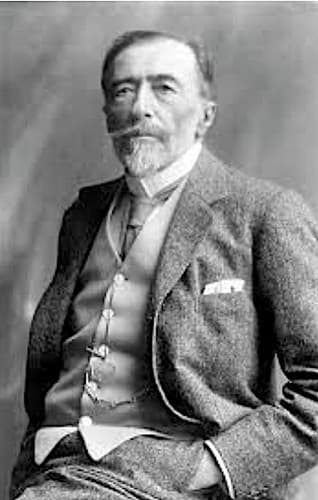
Joseph Conrad was a Polish-British novelist and short story writer. He is regarded as one of the greatest writers in the English language; though he did not speak English fluently until his twenties, he came to be regarded a master prose stylist who brought a non-English sensibility into English literature. He wrote novels and stories, many in nautical settings, that depict crises of human individuality in the midst of what he saw as an indifferent, inscrutable and amoral world.
Similar books
- Heart of Darkness
Joseph Conrad
3.4 (415k) average on GoodreadsHistorical FictionFeatures a journey into a remote, dangerous setting and a descent into moral ambiguity.
- The Stranger
Albert Camus
4.1 (3k) average on GoodreadsFantasyDelves into themes of existentialism and the emotional detachment of its protagonist.
- A Passage to India
E.M. Forster
3.7 (70k) average on GoodreadsHistorical FictionForster's novel also explores cultural clashes and human interaction in a colonial setting, but Victory focuses more intensely on individual psychological states and existential crises, rather than broader societal or political critiques. Forster often uses a more direct narrative style, while Conrad's narrative in Victory is more fragmented and psychologically nuanced.
- The Old Man and the Sea
Ernest Hemingway
3.8 (831k) average on GoodreadsLiterary FictionA Cuban fisherman's long struggle with a giant marlin becomes a story of endurance and dignity, now retold for young adults with illustrations, phonetic guides, and writing prompts in Traditional Chinese.
- One Hundred Years of Solitude
Gabriel García Márquez
4.1 (753k) average on GoodreadsLiterary FictionThrough the multi-generational story of the Buendía family, a mythical town deals with the repeating patterns of time, love, and solitude, as the extraordinary mixes with the ordinary.
- The Goldfinch
Donna Tartt
3.9 (720k) average on GoodreadsLiterary FictionHaunted by a tragic explosion and clutching a stolen Dutch masterpiece, a young orphan navigates the opulent drawing rooms of New York and the gritty underbelly of the art world, desperately seeking connection and redemption amidst a life spiraling into crime and obsession.





Enjoyed the summary?
A summary gives you the shape of the book. The book itself has the detail, the examples and the voice.
Find Victory on AmazonAs an Amazon Associate, BookBrief earns from qualifying purchases. How we're funded