

Synopsis
Covers the whole plot, including the ending.
- Difficulty
- Medium
- Pacing
- Moderate
- Mood
- Introspective, Pain-wracked, Philosophical, Reflective
- Read it if
- You appreciate introspective, character-driven dramas that explore themes of guilt, responsibility, and the human condition, with a focus on psychological depth and moral ambiguity.
- Skip it if
- You prefer fast-paced plots with clear-cut heroes and villains, or find extensive internal monologue and fragmented narratives difficult to engage with.
After the Fall Plot Summary
Covers the whole plot, including the ending.
Quentin's Confession and the 'Tower of Skulls'
The play starts with Quentin, a middle-aged lawyer, talking to an unseen listener, thinking about his life's journey and failures. He deals with a deep sense of guilt and the human capacity for destruction, shown by his recurring image of a 'tower of skulls' from a concentration camp, a place he has never visited but feels connected to. He says he plans to marry Holga, a German woman who survived the camps, and uses this moment of thought to examine his past relationships and his own part in the suffering around him. His monologue sets up a non-linear exploration of his memories, as people from his past appear on stage, acting out scenes from his story.
The Decline of His Parents and Early Disillusionment
Quentin remembers his childhood, especially when his father, a successful businessman, lost everything in the Great Depression. This financial collapse deeply affected his parents' relationship and his mother's health. He remembers his mother's anger and her later decline, ending in her death. This early experience of loss and the breaking of his family's security left a lasting mark on Quentin, reducing his youthful idealism and showing him the harsh realities of vulnerability and human error. He sees his father's attempts to save his business as a useless fight against an unavoidable fall, like his own later struggles.
Louise: The First Marriage and the Struggle for Individuality
Quentin recalls his first marriage to Louise, an intellectual woman who resented being seen only as his wife. He describes their early attempts at connection, his initial respect for her intelligence, and their later struggles as she tried to create her own separate identity and career. Their marriage had a growing emotional distance, intellectual arguments, and a feeling of unfulfilled longing for both of them. Quentin admits his own role in their disconnect, acknowledging his desire to control and his inability to truly understand her need for independence, which led to their divorce.
Maggie: The Vulnerable Singer and the Burden of Love
The story moves to Maggie, a beautiful and vulnerable singer who becomes Quentin's second wife. He is drawn to her innocence and fragility, seeing her as someone he can protect. However, as Maggie's career grows, she becomes more insecure, dependent, and prone to self-destructive behavior, including alcoholism and drug abuse. Quentin, burdened by his desire to 'save' her, becomes more involved in her emotional problems. Their relationship is a downward spiral, with public scandals, private despair, and Quentin's growing realization that his love, far from saving her, might be adding to her destruction.
The McCarthy Era and Political Betrayal
Mixed with his personal life is Quentin's experience during the McCarthy era. He remembers the pressure to 'name names' and the moral compromises made by many, including his friend Mickey, who was involved in communist activities. Quentin deals with his own inaction and the guilt of not speaking out more strongly or standing by his principles. He sees careers and lives destroyed because of political paranoia and betrayal. This time forces him to face humanity's capacity for cruelty and how easily people can be forced to abandon their ideals, further adding to his sense of universal guilt.
Maggie's Decline and Suicide
Maggie's mental and physical health gets worse quickly. Her addiction takes over, and she becomes more paranoid and manipulative. Quentin, tired and feeling trapped, struggles to handle her increasing demands and erratic behavior. He admits thinking about leaving her and even wishing for her death, a confession that deeply troubles him. The end of this part is Maggie's suicide by overdose, a moment that leaves Quentin shattered and filled with guilt, questioning his own role in her death and the limits of his capacity for love and responsibility. He sees his own ambition and desire to control as contributing factors.
Reunion with Louise and Unresolved Issues
After Maggie's death, Quentin meets Louise by chance. Their interaction is full of the unsaid history of their failed marriage. He tries to confess his perceived failures and seek some understanding from her. However, Louise remains somewhat guarded, showing her earlier struggles for independence. This reunion shows the lasting impact of his past relationships on his current state of mind. It highlights his ongoing search for self-understanding and his realization that he cannot simply erase the results of his actions or escape the patterns of his past.
Holga's Perspective and the Weight of Survival
Holga, a German woman who survived the Nazi concentration camps, shows Quentin a possible way to heal. Her experiences have given her a deep understanding of human suffering and resilience. She does not offer easy answers or forgiveness but a clear-eyed acceptance of the human condition, including its capacity for both good and evil. Holga's practical view on survival and her refusal to make victimhood romantic challenge Quentin's own self-pity and his abstract guilt. She helps him see that 'survival can be hard to bear' but also that connection and meaning are possible even after great loss.
The Realization of Shared Guilt and the Human Connection
Through his thoughts and his upcoming marriage to Holga, Quentin understands something important. He sees that his personal failures and humanity's larger atrocities are connected. The 'tower of skulls' is not just a symbol of distant evil, but a representation of the destructive potential in every person, including himself. He recognizes that his own ambition, fear, and self-deception contributed to the pain he caused and experienced. This acceptance of shared guilt, instead of isolating him, connects him to all humanity, offering a fragile hope for real connection and a future built on honesty and responsibility.
Embracing the Present and a Hopeful Future
In the play's end, Quentin, having faced his past and his own involvement in suffering, is ready to embrace his future with Holga. He understands that the 'fall' is a continuous process, part of the human condition, and that true innocence is not possible. However, he also recognizes that love and connection, though risky and painful, are essential for living. He accepts the burden of his past and the fragility of the future, choosing to move forward with Holga, not with naive optimism, but with a mature acceptance of life's complexities and the ongoing struggle for meaning and connection.
Principal Figures
Quentin
Protagonist
A middle-aged lawyer grappling with guilt, memory, and the meaning of his life.
Quentin is the central figure of the play, a highly introspective and articulate lawyer. He is intelligent, self-aware, and tormented by his past relationships and his perceived failings. He struggles with a deep sense of guilt, both personal and universal, and is constantly seeking to understand the origins of human destructiveness and his own complicity. His journey is one of profound self-analysis, as he dissects his motivations, his ambitions, and the ways in which he has both loved and failed those around him. He is driven by a desire for truth and a need to reconcile his personal history with the larger historical tragedies of the 20th century.
Relationships: Louise (First wife; intellectual, independent, ultimately estranged); Maggie (Second wife; vulnerable singer, tragic, dependent, self-destructive); Holga (Fiancée; German survivor of concentration camps, pragmatic, understanding); Father (Parent; businessman who lost everything, source of early disillusionment); Mother (Parent; emotionally fragile, affected by financial ruin, source of early trauma)
Maggie
Supporting
Quentin's second wife, a famous but deeply insecure and self-destructive singer.
Maggie is a beautiful, charismatic, and immensely talented singer who captures Quentin's heart. However, beneath her public persona lies profound insecurity, a yearning for validation, and a crippling dependency. She is fragile, prone to self-doubt, and ultimately succumbs to alcoholism and drug addiction. Her tragic trajectory is largely driven by her inability to cope with fame, her past traumas, and her desperate need for Quentin's unwavering love and protection. She represents the destructive power of unaddressed psychological wounds and the complex, often tragic, dynamics of a 'savior' relationship.
Relationships: Quentin (Second husband; her 'savior' and ultimately a witness to her demise); Mickey (Friend and lawyer; tries to help her, but ultimately unable to prevent her fall)
Louise
Supporting
Quentin's first wife, an intellectual woman who sought independence and self-definition.
Louise is Quentin's first wife, an intelligent and independent woman who struggled against the societal expectations of a wife in the mid-20th century. She is a serious academic, striving for her own career and identity distinct from Quentin's. Her relationship with Quentin is marked by intellectual sparring, a lack of deep emotional intimacy, and a mutual inability to fully understand each other's needs. She represents the challenge of maintaining individuality within a relationship and the difficulty of truly connecting when fundamental needs and desires are misaligned. She eventually divorces Quentin, asserting her autonomy.
Relationships: Quentin (First husband; intellectual companion, but emotionally distant)
Holga
Supporting
A German concentration camp survivor and Quentin's fiancée, offering a path to acceptance.
Holga is a German woman who survived the horrors of the concentration camps. She is pragmatic, resilient, and possesses a profound, unsentimental understanding of human nature and suffering. She does not seek pity or offer easy comfort but instead provides Quentin with a clear-eyed perspective on survival and the human capacity for both good and evil. Her presence in Quentin's life represents a potential for healing and a future built on honesty and acceptance, rather than illusion or self-deception. She embodies the idea that one can move forward after immense trauma, acknowledging the past without being consumed by it.
Relationships: Quentin (Fiancée; a source of hope and a catalyst for his final understanding)
Father
Supporting
Quentin's father, a businessman whose financial ruin shaped Quentin's early life.
Quentin's father is a once-successful businessman who loses everything during the Great Depression. His financial collapse and subsequent struggle to reclaim his standing deeply affect Quentin's childhood, shattering his youthful illusions of security and introducing him to the harsh realities of vulnerability and failure. He represents the fall from grace and the devastating impact of external forces on personal lives. Quentin's complex feelings towards his father—a mixture of love, pity, and a sense of disillusionment—are a significant part of his introspective journey.
Relationships: Quentin (Son; object of Quentin's early admiration and later disillusionment); Mother (Wife; their relationship is strained by financial hardship)
Mother
Supporting
Quentin's mother, whose emotional fragility and death leave a lasting impact.
Quentin's mother is portrayed as an emotionally fragile woman, deeply affected by her husband's financial ruin. Her fury, her subsequent decline, and her eventual death leave a profound and traumatic impression on young Quentin. She represents the vulnerability of individuals to external circumstances and the lasting impact of parental suffering on a child's psyche. Her memory contributes to Quentin's pervasive sense of guilt and his early understanding of human fragility and the inevitability of loss.
Relationships: Quentin (Son; source of early emotional trauma and guilt); Father (Husband; their relationship is strained by hardship)
Mickey
Supporting
Quentin's friend and lawyer, caught in the McCarthy era's political purges.
Mickey is Quentin's friend and a fellow lawyer who becomes entangled in the McCarthy-era communist witch hunts. His experiences with the political pressures to 'name names' highlight the moral compromises and betrayals of that period. He represents the ordinary individual caught in extraordinary political circumstances, forced to make difficult choices with devastating consequences. His plight underscores Quentin's broader reflections on universal guilt and the human capacity for both principled resistance and damaging acquiescence.
Relationships: Quentin (Friend and colleague; their relationship is tested by political pressures); Maggie (Lawyer and friend; tries to help her with her legal troubles)
Felice
Mentioned
A young, awkward girl whom Quentin helped gain confidence.
Felice is a minor character from Quentin's past, a young, awkward girl whom he helped to feel proud of herself. Her memory serves as a brief counterpoint to Quentin's more destructive relationships, reminding him of his capacity for positive influence and genuine connection. She represents a moment of unburdened, altruistic interaction in his otherwise complicated emotional landscape, offering a glimpse of the 'better' parts of his character.
Relationships: Quentin (Mentor/friend; he helped her gain self-esteem)
Themes & Insights
Guilt and Complicity
Guilt, both personal and universal, runs through Quentin's story. He struggles with his direct responsibility for the suffering of those he loved, especially Maggie, and his indirect involvement in broader historical atrocities, shown by the 'tower of skulls.' He questions whether his inaction during the McCarthy era or his desire to control others makes him morally like those who commit greater evils. This theme makes the audience consider their own possible involvement in the suffering of others, blurring the lines between victim and perpetrator.
“And the fact that I am not a killer, that I am not a Hitler, that I am not a Stalin, that I am not a man who has ordered the death of millions—that doesn't mean I am not guilty. Because what is guilt? It is the knowing that one could have done otherwise.”
The Nature of Love and Responsibility
Quentin's relationships with Louise and Maggie explore the complexities of love, attachment, and responsibility. With Louise, love struggles against the need for individual identity. With Maggie, Quentin's desire to 'save' her becomes a destructive force, showing the dangers of dependency, the limits of love, and the line between care and control. The play asks if love is truly selfless or always tied to personal needs and expectations, suggesting that true love requires a painful acceptance of another's independence and vulnerability, even to self-destruction.
“And the truth is, I loved her more than I loved myself. And that was the lie.”
Identity and Self-Deception
Quentin's journey is a constant search for self-knowledge, removing layers of self-deception. He faces his own ambition, his need for approval, and his capacity for cruelty, often hidden as good intentions. His thoughts on his past marriages show how he put his own needs onto his wives, failing to see them as separate individuals. The play suggests that true identity comes from an honest look at one's flaws and the painful acceptance of one's own mistakes, rather than holding onto an ideal self-image.
“I think the world is moving toward a time when we will be forced to face ourselves, our true selves, without the consolations of a God or a Party or a Cause.”
The Weight of History and Memory
The play mixes personal memory with historical events, especially the Holocaust and the McCarthy era. Quentin's image of the 'tower of skulls' represents humanity's collective capacity for destruction, making personal guilt connect with historical atrocities. His non-linear story structure shows how the past always shapes the present, and how individuals are both products and participants in history. The play suggests that facing historical trauma, both collective and individual, is necessary for healing and moving forward.
“Is the tower of skulls only what happened to others, or is it a part of me?”
The Illusion of Innocence
A main theme is that true innocence is not possible after humanity's 'fall' from grace, both religiously and historically. Quentin's journey leads him to accept that no one is entirely blameless, and that the capacity for evil is in everyone. His initial desire to be 'innocent' or to 'save' others fails because it denies human nature's flaws. The play argues for a mature acceptance of human error and shared guilt as a necessary step towards real connection and a more responsible way of living.
“I looked into her face, and I knew that innocence, if it ever existed, was not for us.”
Plot Devices & Literary Techniques
Stream of Consciousness/Interior Monologue
Quentin's continuous, non-linear narration, directly addressing the audience as an unseen listener.
The play is primarily structured as Quentin's extended interior monologue, a stream of consciousness where his thoughts, memories, and reflections unfold in a non-linear fashion. He directly addresses an unseen 'listener,' creating an intimate, confessional tone. This device allows for deep psychological exploration, revealing Quentin's complex inner world, his self-doubt, and his relentless quest for understanding. It blurs the lines between past and present, as memories are triggered and acted out on stage, giving the audience direct access to his thought process and emotional turmoil.
Non-Linear Narrative / Flashbacks
Scenes from Quentin's past are performed as memories, interrupting his present-day monologue.
Instead of a chronological plot, the play employs a non-linear narrative structure. Quentin's monologue is frequently interrupted by vivid flashbacks, where characters from his past appear and act out scenes from his memories. These scenes are not always presented in strict order but rather as they arise in Quentin's mind, creating a mosaic of his life. This device effectively conveys the fragmented and associative nature of memory, emphasizing how past events continue to haunt and inform Quentin's present state of mind, and how he constantly re-evaluates his history.
The 'Tower of Skulls' Symbol
A recurring symbolic image representing universal human guilt and the capacity for destruction.
The 'tower of skulls' is a powerful, recurring symbol throughout the play, representing the horrors of the Holocaust and the collective human capacity for destruction and evil. Quentin, despite never having seen a concentration camp, feels deeply connected to this image, using it as a metaphor for the universal guilt he grapples with. It serves to link his personal failures and betrayals to larger historical atrocities, suggesting that the destructive potential is inherent in humanity. This symbol underscores the play's theme of shared guilt and the illusion of individual innocence.
The Unseen Listener
An implied, silent character that Quentin addresses, allowing for direct audience engagement.
Quentin's direct address to an 'unseen listener' is a crucial plot device. While this listener is never explicitly identified, it functions as a stand-in for the audience, drawing them directly into Quentin's confession and making them complicit in his introspection. This creates a sense of intimacy and urgency, as Quentin lays bare his soul and challenges the listener (and thus the audience) to confront their own moral complexities. It allows for a deeply personal and philosophical exploration without the need for traditional dialogue-driven exposition.
The Set Design (Minimalist and Evocative)
A sparse, abstract set that allows for fluid movement between different times and places.
The play's set is typically described as minimalist and abstract, often featuring a raised platform or a suggestion of a 'ruin' or a 'mindscape.' This design serves as a flexible space where Quentin's memories can be enacted without literal scene changes. It allows for fluidity between different times and locations, emphasizing that the action takes place primarily within Quentin's mind. The sparse nature of the set highlights the internal landscape of the protagonist and the symbolic nature of the events, rather than focusing on realistic depiction.
After the Fall Quotes
“The world is an oyster, but you don't crack it open with a fork.”
“We are all in it together. It's a question of whether you want to live or not.”
“The only thing is, how do you get rid of the guilt?”
“I think the world is full of people who are trying to tell you what to do, and very few who are trying to help you understand.”
“Is the knowing all? Is there no forgiveness?”
“I saw myself, in the world, as a kind of moral accountant.”
“The world has become too dangerous to live in without love.”
“No man need ever be a stranger to another.”
“I think that a man who can't forgive himself is a man who can't forgive life.”
“We are members of one another, and we betray each other at our peril.”
“And the fact is, I am not innocent.”
“There are no innocent great men.”
“The world is not a courtroom. It is a house.”
“What is the end of it, this constant accusation?”
Quiz
10 questions on the plot and the characters. Each answer comes with a short explanation.
Question 1
At the beginning of 'After the Fall,' where does Quentin position himself to begin his narrative?
- In a psychiatrist's office
- On the edge of the stage
- At a cafe table
- In a courtroom witness stand
Show answer
B. On the edge of the stage Howard Taubman explicitly states that 'Quentin emerges, moves forward and seats himself on the edge of the stage and begins to talk, like a man confiding in a friend.' This physical positioning is key to the play's intimate, confessional style.
Question 2
Which of the following is NOT described as a significant figure or memory that 'crisscrosses' through Quentin's narrative?
- His mother's death and fury with his father
- An awkward young girl he made proud of herself
- His estranged son who became a successful artist
- Memories of inquisition when men were asked to name names
Show answer
C. His estranged son who became a successful artist The provided summary mentions his mother's death and fury, an awkward young girl, and the McCarthy-era 'inquisition.' There is no mention of an estranged son who became a successful artist.
Question 3
What primary feeling or state of being is 'After the Fall' described as by Howard Taubman?
- A joyous celebration of life
- A lighthearted romantic comedy
- A pain-wracked drama
- An intellectual philosophical debate
Show answer
C. A pain-wracked drama Taubman explicitly characterizes the play as 'a pain-wracked drama,' emphasizing its emotional intensity and the struggle inherent in Quentin's search.
Question 4
How does Quentin's first wife differentiate herself, according to the summary?
- She wanted to be a famous actress.
- She wanted to be a separate person.
- She sought financial independence.
- She desired a large family.
Show answer
B. She wanted to be a separate person. The summary states that Quentin's 'first wife who wanted to be a separate person,' highlighting a theme of individuality and perhaps marital conflict in their relationship.
Question 5
The 'inquisition' mentioned in the play refers to a historical period when men were asked to 'name names.' What political movement did these men mistakenly associate with a better future?
- Fascism
- Anarchism
- Communism
- Socialism
Show answer
C. Communism The summary states, 'They bring back the memories of inquisition when men were asked to name names of those who had joined with them in a communism that they mistook for a better future.' This directly references the McCarthy era and the Red Scare.
Question 6
What is the defining characteristic of Quentin's second wife, as described in the summary?
- She drove him into a separateness.
- She encouraged his career ambitions.
- She sought to reconcile him with his family.
- She was a source of unwavering comfort.
Show answer
A. She drove him into a separateness. The summary contrasts the wives, stating the 'second who drove him into a separateness,' suggesting a more isolating or conflict-ridden dynamic compared to his first wife's desire for separateness.
Question 7
According to the summary, what significant event led to Quentin's father losing 'all'?
- A catastrophic stock market crash
- A failed political campaign
- Trying to save a floundering business
- A legal dispute with a business partner
Show answer
C. Trying to save a floundering business The summary notes, 'another [memory] of his mother's fury with his father, who lost all in trying to save a floundering business,' indicating a past financial hardship that deeply affected the family.
Question 8
The possible third woman in Quentin's life is described with a specific background that informs her perspective. What is it?
- She was a war correspondent who witnessed many atrocities.
- She was a German raised in a furnace of concentration camps.
- She was an immigrant who fled political persecution.
- She was a survivor of a devastating natural disaster.
Show answer
B. She was a German raised in a furnace of concentration camps. The summary provides a very specific detail: 'a possible third who knew, as a German raised in a furnace of concentration camps, that 'survival can be hard to bear.'' This background gives her a unique and profound perspective on suffering and endurance.
Question 9
What overarching theme does the phrase 'survival can be hard to bear,' attributed to the possible third woman, most strongly suggest in the context of the play?
- The resilience of the human spirit against all odds.
- The lasting psychological burden and moral compromises of surviving trauma.
- The importance of forgetting past suffering to move forward.
- The inherent unfairness of life's struggles.
Show answer
B. The lasting psychological burden and moral compromises of surviving trauma. Given her background of concentration camps, 'survival can be hard to bear' points to the idea that merely existing after immense trauma doesn't equate to peace or happiness. It implies a lasting psychological and moral weight, reflecting the 'pain-wracked drama' of the play and its deep search for meaning amidst past failures and betrayals.
Question 10
Howard Taubman describes 'After the Fall' as Mr. Miller's 'maturest' work. What aspect of the play's experience does he use to support this claim, indicating its depth?
- Its elaborate stage design and theatrical innovations.
- Its focus on a search that 'cuts to the bone' in an 'adult world.'
- Its popular appeal and commercial success.
- Its use of humor to lighten difficult subject matter.
Show answer
B. Its focus on a search that 'cuts to the bone' in an 'adult world.' Taubman concludes by saying, 'AFTER THE FALL is a pain-wracked drama; it is also Mr. Miller's maturest For to sit in Mr. Miller's theater is to be in an adult world concerned with a search that cuts to the bone.' This emphasizes the profound, uncompromising nature of the play's exploration of human experience.
After the Fall FAQ
What is 'After the Fall' about?
'After the Fall' is a deeply introspective play by Arthur Miller, presented as a stream of consciousness from the perspective of Quentin, a lawyer in his 50s. He grapples with his past relationships, particularly his two failed marriages (one with Louise, another with Maggie, a Marilyn Monroe-like character), his family history, and his complicity in the McCarthy era's political purges. The play is a profound exploration of guilt, personal responsibility, and the human capacity for destruction and survival 'after the fall' from innocence.
Why should I read 'After the Fall'?
You should read 'After the Fall' for its raw, unflinching examination of personal responsibility, the nature of love, and the impact of historical events on individual lives. Miller's semi-autobiographical work offers a profound psychological journey through Quentin's mind, challenging readers to confront their own complicity and the inherent destructiveness within humanity, while also searching for hope and connection amidst the wreckage of past failures. It's a mature and complex work that provokes deep self-reflection.
What is the background/setting of 'After the Fall'?
The play is set entirely within Quentin's mind, represented by a 'set of levels, platforms, and a ramp,' suggesting the landscape of memory. While there are no traditional scene changes, the narrative constantly shifts between present reflections and past events, including his childhood, his marriages to Louise and Maggie, and the backdrop of the McCarthy era's 'inquisition' where men were pressured to 'name names.' The 'setting' is psychological, spanning decades of Quentin's life and the socio-political climate of mid-20th century America.
What are the most memorable quotes?
One memorable quote is Quentin's realization, 'My brothers, my sisters, we are all of us in this place, we are all of us in this time.' This encapsulates his growing understanding of shared human fallibility. Another is Holga's observation that 'survival can be hard to bear,' echoing the profound trauma she experienced in concentration camps and highlighting the psychological scars that persist even after escaping physical danger.
What writing style does the author use?
Arthur Miller employs a stream-of-consciousness narrative, where Quentin directly addresses the audience, often blurring the lines between monologue and dramatic scene. The style is highly introspective and non-linear, with characters from Quentin's past appearing and disappearing 'in the background' as he recounts his memories. This gives the play a confessional, almost therapeutic tone, allowing for deep psychological probing and thematic exploration without strict adherence to chronological order.
What minor details add significant meaning?
The recurring image of the concentration camp tower, which Holga survived, serves as a powerful symbol of humanity's capacity for destruction and Quentin's own complicity in smaller, personal 'inquisitions.' This detail elevates Quentin's personal struggles to a universal human condition, suggesting that the same destructive impulses exist in varying degrees everywhere, not just in extreme historical events.
What are some subtle foreshadowing moments?
Early in the play, Quentin's reflections on his mother's 'fury' and his father's business failures hint at the deep-seated family dysfunctions and the theme of betrayal that will later manifest in his own relationships. His initial idealization of Maggie, despite her evident fragility, subtly foreshadows the tragic and destructive nature of their marriage, as he overlooks her vulnerabilities in pursuit of his own emotional needs.
What unexpected character connections exist?
While not a direct connection, the parallel drawn between Quentin's personal 'betrayals' and the broader societal betrayals of the McCarthy era is a key, unexpected connection. Quentin's self-examination of how he might have 'named names' if pressured links his private moral failures to the public moral failures of his time, suggesting a universal human weakness for self-preservation at the cost of others.
What are unspoken character motivations?
Maggie's unspoken motivation, beneath her desire for fame and love, seems to be a desperate search for validation and stability, stemming from a profound sense of insecurity and a traumatic past. Her erratic behavior and substance abuse are often symptoms of this deeper need for acceptance, which Quentin, despite his love, ultimately fails to fully provide or understand.
What psychological complexities do characters exhibit?
Quentin exhibits immense psychological complexity, wrestling with his 'innocence' and the realization of his own destructive impulses. He struggles with self-deception, guilt, and a desperate need to find meaning and connection, often projecting his own needs onto others. Maggie, on the other hand, embodies the complexities of a highly sensitive and vulnerable individual trapped by her public image and battling severe mental health issues, constantly seeking love but often sabotaging it.
What are the major emotional turning points?
A major emotional turning point for Quentin is his realization that 'the world is not a courtroom,' and that he must accept his own complicity and the inherent destructiveness within humanity, rather than constantly seeking to blame others or absolve himself. Another is his final, painful acceptance of Maggie's death and his role in their tragic relationship, which allows him to move towards a more authentic connection with Holga.
How do relationship dynamics evolve?
Quentin's relationship dynamics evolve from an initial idealization and projection in his marriage to Louise, where he seeks a 'separate person' but ultimately feels confined, to a passionate but ultimately destructive entanglement with Maggie, where his attempts to 'save' her only exacerbate their mutual pain. By the end, his potential relationship with Holga represents a more mature, realistic connection based on shared understanding of human fallibility and a mutual acceptance of 'the fall,' rather than an idealized fantasy.
Which parts remain ambiguous or open-ended?
The play's ending remains somewhat open-ended regarding Quentin's future with Holga. While he has achieved a significant breakthrough in self-awareness, the audience is left to ponder whether this newfound understanding will truly enable him to sustain a healthy relationship. The play suggests hope for a more authentic connection, but doesn't explicitly guarantee a 'happy' resolution, acknowledging that 'survival can be hard to bear' and growth is an ongoing process.
What are controversial scenes or decisions?
The portrayal of Maggie, widely interpreted as a thinly veiled depiction of Marilyn Monroe, was highly controversial. Miller's decision to dramatize her struggles with such raw detail and link them so closely to Quentin's own failings sparked debate about the ethics of using a real person's tragic life for dramatic purposes, particularly given their personal history. Some critics viewed it as exploitative, while others saw it as a courageous and honest self-examination.
'After the Fall' ending explained: how it ends & what it means
The play ends with Quentin, having confronted his past and accepted his own complicity in the destruction around him, reaching out to Holga. He has come to terms with the idea that humanity is inherently flawed and that 'innocence' is an illusion. His final realization is that 'we are all of us in this place,' sharing the burden of human imperfection. This ending signifies a move from self-deception and blame towards a more mature acceptance of responsibility and the possibility of genuine connection based on shared vulnerability, rather than an idealized love. It means finding hope 'after the fall' by embracing the reality of human nature.
About the author
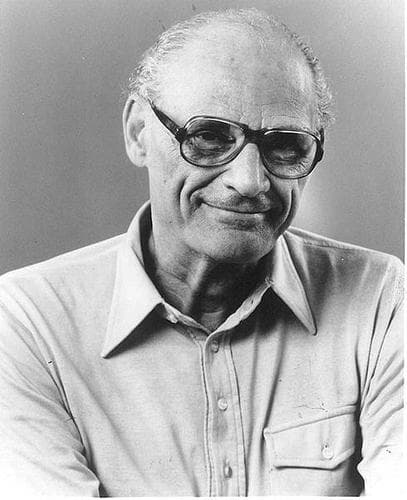
Arthur Asher Miller was an American playwright, essayist and screenwriter in the 20th-century American theater. Among his most popular plays are All My Sons (1947), Death of a Salesman (1949), The Crucible (1953), and A View from the Bridge (1955). He wrote several screenplays and was most noted for his work on The Misfits (1961). The drama Death of a Salesman is considered one of the best American plays of the 20th century.
Similar books
- Death of a Salesman
Arthur Miller
3.5 (186k) average on GoodreadsFictionExplores themes of disillusionment, the American Dream, and the weight of the past through the lens of a troubled male protagonist.
- A Streetcar Named Desire
Tennessee Williams
4.0 (261k) average on GoodreadsFictionFeatures a vulnerable female character's decline and explores complex relationships and psychological turmoil.
- The Glass Menagerie
Tennessee Williams
3.7 (112k) average on GoodreadsFictionA memory play that delves into a character's past relationships and the impact of family dynamics.
- The Old Man and the Sea
Ernest Hemingway
3.8 (831k) average on GoodreadsLiterary FictionA Cuban fisherman's long struggle with a giant marlin becomes a story of endurance and dignity, now retold for young adults with illustrations, phonetic guides, and writing prompts in Traditional Chinese.
- One Hundred Years of Solitude
Gabriel García Márquez
4.1 (753k) average on GoodreadsLiterary FictionThrough the multi-generational story of the Buendía family, a mythical town deals with the repeating patterns of time, love, and solitude, as the extraordinary mixes with the ordinary.
- The Goldfinch
Donna Tartt
3.9 (720k) average on GoodreadsLiterary FictionHaunted by a tragic explosion and clutching a stolen Dutch masterpiece, a young orphan navigates the opulent drawing rooms of New York and the gritty underbelly of the art world, desperately seeking connection and redemption amidst a life spiraling into crime and obsession.





Enjoyed the summary?
A summary gives you the shape of the book. The book itself has the detail, the examples and the voice.
Find After the Fall on AmazonAs an Amazon Associate, BookBrief earns from qualifying purchases. How we're funded