
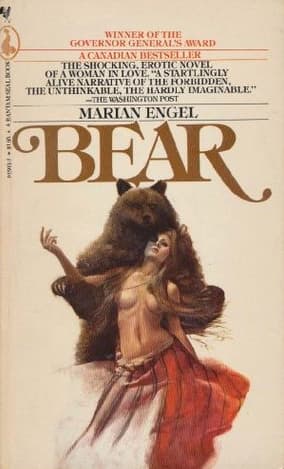
Synopsis
Covers the whole plot, including the ending.
- Difficulty
- Medium
- Pacing
- Slow
- Mood
- Erotic, Introspective, Solitary, Provocative
- Read it if
- You're looking for a short, intense, and deeply introspective novel about unconventional relationships, nature, and female self-discovery.
- Skip it if
- You are uncomfortable with bestiality as a central theme or prefer fast-paced, plot-driven narratives.
Bear Plot Summary
Covers the whole plot, including the ending.
A Release from the Archives
Lou, an archivist at the Historical Institute, feels stagnant and detached. She lives a reclusive life, with little social interaction. Her boss, Colonel Cary, offers her a unique assignment: to travel to a remote island in northern Ontario and catalog the large, unorganized library of a deceased colonel named Jocelyn, housed in an octagonal stone house. Lou accepts the task, seeing it as a chance for a new experience. She packs her things and travels north, leaving the city for the wilderness.
Arrival on the Island
Lou arrives at the remote island by boat, guided by a local named Homer. The island is wild and beautiful, different from her urban life. She notices the octagonal stone house, which feels grand and abandoned. Inside, the library is a jumble of books, maps, and personal items, showing Colonel Jocelyn's eccentric life. Lou begins the work of organizing, cataloging, and cleaning the collection, finding comfort in the methodical task. She observes the lake and forests, slowly getting used to the solitude and island life.
The First Encounter
As Lou settles into her routine, she becomes aware of another presence on the island. She finds signs of an animal—droppings, flattened grass, and once, a large footprint. She dismisses it as a wild dog or a deer. However, one evening, while exploring near the house, she meets a large, old male bear. The encounter is startling but not threatening. The bear seems as surprised as she is; they watch each other before the bear walks away. This discovery both frightens and fascinates Lou, adding something new to her isolated life and changing her idea of being alone.
Observing and Coexisting
Lou's fear of the bear slowly turns into curiosity. She begins to watch the bear from a distance, learning its habits. She leaves food out for it, and the bear seems to get used to her presence. Their interactions are cautious and silent, an agreement of coexistence on the small island. Lou finds herself spending less time on books and more time thinking about the bear and the wildness it represents. This change marks a turning point in her engagement with nature and her inner life, as she starts to let go of her urban detachment.
Bridging the Gap
The relationship between Lou and the bear grows deeper. She starts to approach the bear more closely, speaking to it softly. She offers it berries and fish, which the bear accepts. Gradually, the physical barrier between them begins to disappear. Lou tentatively touches the bear, stroking its fur, and the bear responds with a rumbling sound, not of aggression, but of acceptance. These physical interactions are tentative and experimental, pushing the limits of what Lou thought possible. She feels a primal connection, a sense of touch and being touched that has been absent in her sterile life, and she begins to feel more alive.
Intimacy and Transformation
The physical relationship between Lou and the bear becomes more intimate. She bathes with the bear in the lake, experiencing a raw connection with nature and the animal. The bear licks her, grooms her, and they have a unique physical affection that goes beyond typical human relationships. This intimacy is not sexual in a human way, but deeply sensual and changes Lou, waking up her dormant senses and desires. She feels a sense of belonging and freedom, letting go of her inhibitions and embracing a primal part of herself she had suppressed. Her idea of herself and her body changes.
The Climax of Connection
The relationship ends in a powerful union. Lou and the bear engage in a form of physical love that is animalistic and spiritual. The bear licks her clitoris, and Lou has an orgasm, a release that is physical and symbolic. This act is not about human sexuality but about a complete surrender to nature, instinct, and a primal connection that defies social norms. It is a moment of total integration, where Lou goes beyond her human limits and fully embraces her wild, natural self. This experience leaves her feeling transformed and reborn, shedding the last parts of her former, detached existence.
A Painful Reminder
After their most intense intimacy, the bear, perhaps playing, accidentally nips Lou's neck, drawing blood. The injury is minor but important. It is a painful reminder of the difference between human and animal, and the dangers of their unconventional bond. The bear's action, though unintentional, breaks the spell of their perfect union, making Lou face the reality of her situation and her companion's wildness. This moment of pain and realization marks the beginning of the end of their intense physical relationship.
The Departure and Reflection
As summer ends and her cataloging work is done, Lou prepares to leave the island. The bear, sensing her departure, becomes more distant. Lou feels sadness but also peace. Her time on the island and her relationship with the bear have changed her. She leaves with Homer, leaving the octagonal house and the bear behind. On the boat ride back, Lou thinks about her experiences, recognizing her personal growth and the awakening of her senses and spirit. She is no longer the same detached archivist who arrived months earlier.
Returning to the World
Lou returns to her job at the Historical Institute, back to her old routine and colleagues, who notice a change in her. She is more present and has a quiet strength. The scar on her neck is a private reminder of her summer. While she returns to society, she knows that the wilderness, the bear, and the connection she experienced will always be part of her. She has found a new understanding of herself and her place in the world, having embraced her wildness and awakened her capacity for deep, unconventional love and self-discovery.
Principal Figures
Lou
Protagonist
A reclusive archivist who undergoes a profound transformation through her encounter with a bear.
Lou is a quiet, unassuming archivist in her late twenties or early thirties, characterized by her detached nature and a life spent in the sterile environment of the Historical Institute. Before her assignment, she is emotionally stagnant, living a life of routine and intellectual pursuits, devoid of genuine human connection or sensual experience. She sees herself as 'dead' or 'asleep.' Her journey to the island and her subsequent relationship with the bear awaken her senses, her sexuality, and her understanding of her own wildness. She is intelligent and methodical, but also deeply repressed, seeking something she doesn't quite understand until she finds it in the most unexpected place.
Relationships: Colonel Cary (Boss, employer); Homer (Boatman, connection to the local community); The Bear (Lover, spiritual guide, catalyst for transformation)
The Bear
Central Figure/Catalyst
An old, male bear, representing wildness, instinct, and primal connection.
The bear is a large, old male, a solitary inhabitant of the remote island. He is a creature of instinct, powerful and ancient, embodying the untamed essence of nature. He is not anthropomorphized in the traditional sense, but rather acts as a mirror and a guide for Lou's journey of self-discovery. His presence is initially intimidating, then comforting, and finally, deeply intimate. He is patient, gentle, and utterly wild, challenging Lou's preconceived notions of relationships and existence. His actions are driven by instinct and a form of animal affection, leading to both profound connection and an accidental injury that reminds Lou of their fundamental differences.
Relationships: Lou (Lover, companion, object of her transformation)
Colonel Cary
Supporting
Lou's distant boss, who provides her with the island assignment.
Colonel Cary is Lou's employer at the Historical Institute. He is a somewhat detached, formal figure who represents the structured, intellectual world Lou inhabits. He is the one who offers Lou the assignment to catalogue Colonel Jocelyn's library, inadvertently setting her on her transformative journey. While he plays a pivotal role in initiating the plot, his direct involvement in Lou's personal narrative is minimal. He serves as a symbol of the 'civilized' world that Lou temporarily escapes and to which she eventually returns, subtly changed.
Relationships: Lou (Boss-employee)
Homer
Supporting
The local boatman who ferries Lou to and from the island.
Homer is a gruff but reliable local boatman who provides Lou's only direct human contact during her isolation on the island. He represents the practical, grounded aspect of the wilderness community. He is aware of the island's history and its unique inhabitant (the bear), but he doesn't interfere. He is a silent observer, a conduit between Lou and the outside world, and his presence marks both her arrival and her departure. He is a man of few words, embodying the stoic nature often associated with northern Ontario residents.
Relationships: Lou (Service provider, brief acquaintance)
Colonel Jocelyn
Mentioned
The deceased original owner of the island and the eccentric library.
Colonel Jocelyn is a character known only through his legacy: the octagonal house and the vast, disorganized library on the island. He was an eccentric and reclusive figure, a collector of books and artifacts, whose life is slowly pieced together by Lou through the process of cataloguing his possessions. He serves as a historical backdrop, providing the setting and the initial purpose for Lou's presence on the island. His unconventional life hints at the possibilities of living outside societal norms, foreshadowing Lou's own path.
Themes & Insights
Identity and Self-Discovery
The main theme is Lou's journey of self-discovery. Her initial identity comes from her job and emotional detachment. The island's isolation and her meeting with the bear make her shed social expectations and face her primal self. She learns about her own sensuality, her capacity for unconventional love, and her connection to nature, finding a more authentic identity. This shows in her letting go of inhibitions and her physical change.
“She was a woman of twenty-eight, and she felt as if she had been asleep for twenty of them. She had lived in a world of books and papers, and now she was in a world of flesh and fur.”
Nature vs. Civilization
The novel contrasts the sterile, intellectual world of the Historical Institute with the wild beauty of the northern Ontario island. Lou's initial detachment comes from her civilized life, while the bear embodies pure nature. Her time in the wilderness, eating berries, bathing in the lake, and bonding with the bear, blurs the lines between these two worlds. The book suggests that true fulfillment comes from combining the wild, instinctual self with the civilized mind, acknowledging the limits of human ideas.
“She had always thought of herself as a creature of intellect, but here, with the bear, she was nothing but a body, and it was glorious.”
Sensuality and the Body
A theme is the awakening of Lou's sensuality and her relationship with her own body. Before the island, Lou's physical existence is ignored; she is 'buried' in her work. The bear's presence, and their intimate physical interactions, make her confront and embrace her body, its desires, and its capacity for pleasure. The unique connection with the bear is not about human sexuality but about a primal experience of touch, warmth, and release, leading to a re-evaluation of her physical self.
“She felt the rough wetness of his tongue, and then a strange, piercing pleasure that was not human, but utterly, entirely hers.”
The Unconventional and Taboo
The novel explores the boundaries of acceptable relationships and human experience through Lou's bond with the bear. The interspecies relationship questions social taboos about sexuality, intimacy, and the difference between human and animal. It makes readers question ideas of love and connection. Engel presents this relationship not as abnormal, but as a path to spiritual and personal freedom for Lou, showing the restrictive nature of social norms and the potential for meaning outside them.
“She had fallen in love with a bear. And it was not a joke, or a fantasy, but the most real thing that had ever happened to her.”
Plot Devices & Literary Techniques
The Octagonal House
A symbolic setting representing uniqueness, enclosure, and a break from linear thought.
The octagonal stone house is more than just a setting; it's a symbolic space. Its eight sides suggest a departure from conventional four-sided structures, mirroring the unconventional events that unfold within. It is a self-contained world, a sanctuary where Lou can shed her old self without external judgment. The house, with its vast and chaotic library, also represents the accumulated knowledge and eccentricities of the past, which Lou must systematically order before she can fully embrace the wild present embodied by the bear. It encloses her in a space for transformation.
The Bear as a Totem Animal/Spirit Guide
The bear functions as a primal force guiding Lou's spiritual and sensual awakening.
The bear in the novel transcends a mere animal; it acts as a totem or spirit guide for Lou. It represents the untamed wilderness, instinct, and a deeper, more ancient form of wisdom. Its presence forces Lou to reconnect with her own primal instincts and sensuality, which have been suppressed by her civilized life. The bear does not speak, but communicates through its presence, its actions, and its physical interactions, leading Lou through a transformative journey of self-discovery and connection to the natural world. It is a catalyst for her spiritual rebirth.
Isolation
The physical and emotional isolation of the island facilitates Lou's internal transformation.
The profound isolation of the remote northern Ontario island is a crucial plot device. It removes Lou from the distractions, judgments, and societal expectations of her urban life, creating a vacuum in which her internal transformation can occur unimpeded. This physical isolation mirrors her initial emotional isolation. Without other human beings to interact with, Lou is forced to confront herself, her desires, and her relationship with the natural world and the bear. The lack of external influence allows for the development of her unconventional bond and her subsequent self-discovery.
The Catalogue/Archiving
Lou's methodical work provides a structural and metaphorical framework for her personal journey.
Lou's task of cataloguing the chaotic library serves as both a literal plot driver and a powerful metaphor for her internal process. Just as she systematically orders the books and papers, she is also, subconsciously, cataloguing and organizing her own life, emotions, and identity. The act of bringing order to chaos in the external world parallels her journey towards understanding and integrating the chaotic, wild aspects of her own self. The completion of the catalogue signifies the end of her initial mission and the readiness for her departure, having also completed her personal 'cataloguing' of self.
Bear Quotes
“She had thought she was beyond feeling. Now she knew she was not.”
“He was the oldest, most perfect animal she had ever seen. He was utterly male.”
“The island was an ark, an island of refuge. It was also a prison.”
“She felt herself dissolving, melting, becoming liquid, becoming part of the forest, part of the bear.”
“He was not a man, he was a bear. And she was not a woman, she was a human being.”
“The world was not a place for neat categories.”
“She had come to the island to find something, and she had found it. Or it had found her.”
“The past was not a burden, but a root.”
“She was learning to listen to the silence.”
“There was no going back to what she had been.”
“The bear was a teacher, a lover, a god, a beast. He was everything.”
“She was no longer afraid of her own wildness.”
“The forest breathed with her, and she with it.”
Quiz
10 questions on the plot and the characters. Each answer comes with a short explanation.
Question 1
What is Lou's profession before she is sent to the island?
- A librarian in a public library
- An archivist at an historical institute
- A university professor specializing in history
- A museum curator
Show answer
B. An archivist at an historical institute Lou has been working 'buried like a mole amid the decaying maps and manuscripts of an historical institute' for five years, indicating her role as an archivist or researcher there.
Question 2
Where is the remote island located that Lou is sent to?
- Off the coast of British Columbia
- In the Maritimes, near Nova Scotia
- In northern Ontario
- On one of the Great Lakes in the US
Show answer
C. In northern Ontario The book explicitly states the island is 'on a remote island in northern Ontario,' making this a direct plot detail.
Question 3
What is the primary task Lou is assigned to do on the island?
- Write a historical novel about the island's past
- Restore the octagonal house to its original condition
- Catalogue a nineteenth-century library
- Conduct an archaeological dig
Show answer
C. Catalogue a nineteenth-century library Lou's 'welcome field assignment' is specifically 'to catalogue a nineteenth-century library' found on the island.
Question 4
How long had Lou been working at the historical institute before her assignment?
- Two years
- Three years
- Five years
- Ten years
Show answer
C. Five years The text states Lou had been 'After five years buried like a mole amid the decaying maps and manuscripts of an historical institute'.
Question 5
What is the unusual architectural feature of the house on the island?
- It is built entirely of glass
- It is an octagonal house
- It is a floating house on the water
- It has no windows
Show answer
B. It is an octagonal house The house is described as an 'octagonal house', making its shape a distinctive and 'improbably located' feature.
Question 6
What is Lou eager to do regarding the estate's history?
- Sell off its valuable antique collection
- Reconstruct its curious history
- Modernize its facilities for future use
- Turn it into a bed and breakfast
Show answer
B. Reconstruct its curious history Lou is 'Eager to reconstruct the estate's curious history', indicating her intellectual curiosity and professional interest.
Question 7
What is the unexpected 'other inhabitant' Lou discovers on the island?
- A reclusive old man
- A family of wolves
- A bear
- A ghost
Show answer
C. A bear The synopsis clearly states Lou 'is unprepared for her discovery that the island has one other inhabitant: a bear.'
Question 8
The description suggests Lou's previous work environment was:
- Social and stimulating
- Dull and isolating
- Physically demanding and outdoorsy
- High-pressure and competitive
Show answer
B. Dull and isolating The phrase 'buried like a mole amid the decaying maps and manuscripts' for five years implies a monotonous, isolated, and somewhat lifeless existence, making 'dull and isolating' the best fit.
Question 9
What literary genre elements are highlighted in the book's description?
- Science Fiction, Thriller, Historical Fiction
- Literary Fiction, Fantasy, Romance
- Mystery, Horror, Young Adult
- Biography, Self-Help, Satire
Show answer
B. Literary Fiction, Fantasy, Romance The provided book information explicitly lists 'Literary Fiction, Fantasy, Romance' as the genres.
Question 10
The fact that Lou is 'unprepared' for the bear suggests a clash between:
- Her academic expectations and the realities of manual labor
- Her structured, intellectual life and untamed nature
- Her desire for solitude and the presence of other humans
- Her hope for a promotion and her current assignment
Show answer
B. Her structured, intellectual life and untamed nature Lou's previous life was 'buried like a mole' with 'decaying maps and manuscripts' – a highly intellectual and controlled environment. Her encounter with a wild bear represents a stark contrast to this, symbolizing a clash with untamed nature and a departure from her structured existence.
Bear FAQ
What is 'Bear' by Marian Engel about?
'Bear' tells the story of Lou, a lonely and unfulfilled archivist who, after years of monotonous work, is sent to a remote island in northern Ontario to catalogue a historical library. There, she discovers and forms an increasingly intimate and unconventional relationship with a bear, leading her on a journey of self-discovery and awakening.
Why should I read 'Bear'?
You should read 'Bear' for its daring exploration of human loneliness, nature, and unconventional sexuality, presented through beautiful, evocative prose. It's a profound character study that challenges societal norms and delves into the primal aspects of existence and desire, offering a unique and thought-provoking experience.
What is the background/setting of 'Bear'?
The story is primarily set on a remote, sparsely populated island in northern Ontario, home to an old octagonal house containing a historical library. This isolated, natural environment, far from urban civilization, acts as a crucible for Lou's transformation, emphasizing her detachment from societal expectations and her connection to the wilderness.
What are the most memorable quotes?
Memorable quotes often highlight Lou's introspection and her connection to the bear, such as her reflections on her own 'animal' nature or descriptions of the bear's presence. The novel's strength lies more in its sustained atmosphere and the quiet intensity of its narrative than in easily extractable one-liners, focusing on the sensory and emotional experience.
What writing style does the author use?
Marian Engel employs a precise, lyrical, and often sensual writing style, rich in natural imagery and psychological insight. Her prose is understated yet deeply evocative, conveying Lou's internal world and the raw beauty of the Canadian wilderness with clarity and emotional depth, making the unconventional narrative feel grounded.
What minor details add significant meaning?
The decaying state of the historical documents Lou catalogues at the institute mirrors her own stagnant life before the island. The octagonal shape of the house, a symbol of balance and enclosure, subtly reflects Lou's initial desire for order and her eventual breaking out of conventional structures.
What are some subtle foreshadowing moments?
Early descriptions of Lou's feeling 'buried like a mole' and her yearning for something 'unclean' subtly foreshadow her eventual embrace of a primal, unconventional existence. The initial descriptions of the island as an untamed, ancient place also hint at the profound, non-human encounter awaiting her.
What unexpected character connections exist?
The most unexpected 'connection' is Lou's relationship with the bear itself, blurring the lines between human and animal, companionship and romance. There are no other significant human characters on the island to form connections with, emphasizing Lou's isolation and her unique bond with the animal.
What are unspoken character motivations?
Lou's unspoken motivation is a deep-seated craving for authenticity, touch, and release from her sterile, intellectual existence. She seeks a connection that transcends societal expectations and intellectual pursuits, a primal fulfillment that her previous life lacked, driving her towards the bear.
What psychological complexities do characters exhibit?
Lou exhibits complex psychological shifts, moving from extreme introversion and emotional repression to a state of raw, uninhibited sensuality and self-acceptance. Her journey reflects a struggle with identity, societal conditioning, and the liberation found in embracing her animalistic self, challenging conventional notions of sanity and desire.
What are the major emotional turning points?
Key emotional turning points include Lou's initial fear and curiosity towards the bear, her first tentative physical contact, and the escalating intimacy that culminates in a profound sexual and emotional bond. Her acceptance of this relationship marks a radical shift from her previous emotional detachment to a state of profound connection and self-discovery.
How do relationship dynamics evolve?
The central relationship dynamic between Lou and the bear evolves from initial apprehension and observation to one of mutual trust, affection, and ultimately, a deeply intimate and sexual bond. It's a dynamic that defies human categorization, becoming a partnership based on instinct, presence, and a unique form of understanding.
Which parts remain ambiguous or open-ended?
The novel leaves the long-term future of Lou's relationship with the bear, and her place in the world, ambiguous. It doesn't offer a definitive 'return to normal' or a clear path forward, suggesting that her transformation is ongoing and that her new understanding of self may not fit into conventional societal structures.
What are controversial scenes or decisions?
The most controversial aspect of 'Bear' is undoubtedly the explicit sexual relationship between Lou and the bear. This central element challenges taboos surrounding bestiality, species boundaries, and conventional sexuality, making it a highly debated and often shocking narrative choice for readers.
'Bear' ending explained: how it ends & what it means
The novel ends with Lou having fully embraced her relationship with the bear and her own primal nature. She is no longer the repressed archivist but a woman awakened to her desires and a deeper connection with the natural world. The ending signifies her profound personal transformation and liberation, leaving her future open but irrevocably changed by her experience.
Similar books
- Lullabies for Little Criminals
Heather O'Neill
4.0 (20k) average on GoodreadsLiterary FictionFeatures a young woman navigating complex and often transgressive relationships in a raw, intimate style.
- Surfacing
Margaret Atwood
3.5 (22k) average on GoodreadsLiterary FictionBear and Surfacing both feature female protagonists retreating to remote natural settings to confront personal crises and identity. However, Bear distinguishes itself with a literal, physical human-animal relationship, while Atwood's novel explores a more psychological blurring of human and animal boundaries and a search for ancestral roots.
- The Old Man and the Sea
Ernest Hemingway
3.8 (831k) average on GoodreadsLiterary FictionA Cuban fisherman's long struggle with a giant marlin becomes a story of endurance and dignity, now retold for young adults with illustrations, phonetic guides, and writing prompts in Traditional Chinese.
- One Hundred Years of Solitude
Gabriel García Márquez
4.1 (753k) average on GoodreadsLiterary FictionThrough the multi-generational story of the Buendía family, a mythical town deals with the repeating patterns of time, love, and solitude, as the extraordinary mixes with the ordinary.
- The Goldfinch
Donna Tartt
3.9 (720k) average on GoodreadsLiterary FictionHaunted by a tragic explosion and clutching a stolen Dutch masterpiece, a young orphan navigates the opulent drawing rooms of New York and the gritty underbelly of the art world, desperately seeking connection and redemption amidst a life spiraling into crime and obsession.
- Little Fires Everywhere
Celeste Ng
4.1 (713k) average on GoodreadsLiterary FictionIn Shaker Heights, an artist and her daughter move in, and their free-spirited lives clash with a rule-bound matriarch, revealing hidden conflicts beneath a perfect surface.





Enjoyed the summary?
A summary gives you the shape of the book. The book itself has the detail, the examples and the voice.
Find Bear on AmazonAs an Amazon Associate, BookBrief earns from qualifying purchases. How we're funded