

Synopsis
Covers the whole plot, including the ending.
- Difficulty
- Hard
- Pacing
- Moderate
- Mood
- Bleak, Violent, Philosophical, Stark, Disturbing
- Read it if
- You are seeking a challenging, unflinching exploration of violence, morality, and the dark side of human nature, presented with unparalleled literary prose. Ideal for fans of historical fiction that subverts genre conventions and delves into philosophical themes.
- Skip it if
- You are sensitive to graphic violence, find morally ambiguous or nihilistic narratives difficult, or prefer stories with clear heroic arcs and hopeful resolutions. This book is exceptionally bleak and brutal.
Blood Meridian, or the Evening Redness in the West Plot Summary
Covers the whole plot, including the ending.
The Kid's Early Wanderings and Introduction to Violence
The novel opens with 'the kid,' a fourteen-year-old runaway from Tennessee, leaving his abusive home. He travels through the South, doing small crimes and fighting, eventually reaching Texas. He sees and takes part in casual violence. In Nacogdoches, he meets Judge Holden, a large, hairless, mysterious man who is very smart and has disturbing ideas. The Judge quickly shows his powerful presence. The kid later joins an expedition led by Captain White, aiming to take over Sonora, Mexico. This poorly organized group goes into the Chihuahua desert, where Comanche warriors ambush and kill most of them. The kid is one of the few survivors, left alone and without possessions in the harsh wilderness.
Joining Glanton's Gang
After the Comanche attack, the Kid wanders, near death, into Chihuahua. Mexican authorities imprison him, mistaking him for an American invader. In prison, he meets members of a scalp-hunting gang led by John Joel Glanton, a historical figure. This group, hired by the Mexican government to kill Apaches, includes Judge Holden, who is an important intellectual and strategic force in the group. The Kid, seeing no other way to survive, joins Glanton's gang, starting a journey of violence and moral decline. His joining the gang marks a deeper entry into the brutal frontier.
The Campaign of Atrocities
Glanton's gang, first hired to kill Apaches, quickly starts killing without distinction. They kill Apaches, peaceful Coahuiltecans, and eventually, any Mexican villagers or travelers they meet, scalping everyone for bounty regardless of their tribal group or innocence. The bounties for Indian scalps are high, and the gang's greed and bloodlust become endless. The Judge, with his wide knowledge and chilling statements on war and human nature, often guides their decisions and justifies their crimes. The Kid, though involved, often watches with detached horror, a silent witness to the growing cruelty around him. Their path through Sonora and Chihuahua is marked by death and destruction.
Betrayal and Pursuit
The growing brutality and random killings by Glanton's gang eventually cause widespread anger among the Mexican people and authorities. The governor of Chihuahua cancels their contract and sends soldiers to arrest them. Glanton's group, now hunted, flees north toward the United States border. During their escape, they commit more violence, including killing a group of Mexican soldiers sent to stop them. The pursuit is constant, forcing the gang to give up their original goal and focus only on survival, making them outlaws in both Mexico and the United States.
Massacre at a Ferry Crossing
The rest of Glanton's gang, now smaller and more paranoid, arrive at a ferry crossing on the Gila River, run by a Yuma Indian named Caballo en Pelo. They decide to take over the ferry, seizing control from the Yumas and using it for money, robbing and killing many travelers who try to cross. This act of aggression leads to their downfall. The Yuma Indians, at first tolerant, become more hostile and plan an attack to take back their ferry and get revenge. The Kid and Tobin, a former priest who joined the gang, see the growing tension.
The Yuma Massacre and the Gang's End
The Yuma Indians launch a surprise attack on Glanton's camp at the ferry crossing. The massacre is quick and brutal. Many of Glanton's men, including Glanton himself, are killed at the start. The Kid, Tobin, and a few others manage to escape the immediate slaughter, but they are wounded and chased by the angry Yumas. This event ends Glanton's scalp-hunting group, bringing a violent finish to their bloody campaign. The Kid and Tobin, badly injured, must now travel the hostile desert alone, their former allies dead or scattered.
Flight and Separation
Wounded and chased by the Yumas, the Kid and Tobin flee across the harsh desert. Tobin, with a bullet in his neck, suffers greatly, and the Kid, despite his own injuries, helps him. They meet other survivors of the massacre, but these meetings often end in more violence or betrayal. Their bond is tested by the extreme conditions and their shared trauma. Eventually, after a difficult journey and facing starvation and thirst, they are separated. The Kid continues his solitary journey, now completely alone and bearing the physical and mental scars of his experiences with Glanton's gang.
The Kid's Later Years and Encounters
Years pass. The Kid, now an adult, works as a buffalo hunter in the American West. He meets various people, some reminding him of his past, others new. He crosses paths with Glanton's former lieutenant, David Brown, who also survived. These meetings are often short and filled with lingering dread and the unspoken weight of their shared, violent history. The Kid carries the mark of his experiences, a quiet, watchful figure in a world still defined by violence. He remains a wanderer, unable to settle, always on the edge of society.
The Final Confrontation
The Kid eventually arrives in a small frontier town, entering a saloon. There, he again meets Judge Holden, many years after the Yuma massacre. The Judge, seemingly unchanged, is dancing and talking about philosophy, representing an eternal, evil force. The reunion has an unspoken history and a sense of what is bound to happen. The Judge, recognizing the Kid, starts a chilling, one-sided conversation about war, dance, and the lasting presence of violence, hinting that the Kid cannot escape his past or the Judge's influence.
The Kid's Demise
After their meeting in the saloon, the Kid goes to an outhouse. The Judge follows him. Inside, the Judge brutally kills the Kid, sexually assaulting him before his death. The exact details of the murder are somewhat unclear but suggested by the Judge's later actions and the discovery of the body. This final, horrifying act confirms the Judge's triumph and the futility of the Kid's attempts to escape the pervasive violence and evil he witnessed and took part in. The Judge then reappears, dancing among the revelers, a monstrous, eternal figure of destruction, his power undiminished.
Blood Meridian, or the Evening Redness in the West Characters
The Kid
Protagonist
A runaway youth who becomes a witness and participant in extreme violence.
The Kid is the novel's central, though often passive, protagonist. He is introduced as a fourteen-year-old runaway from Tennessee, escaping a life of poverty and abuse. He is largely silent and observational, a tabula rasa upon which the horrors of the frontier are etched. While he participates in the gang's violence, he rarely initiates it and often seems to be merely surviving, driven by instinct rather than malice. He represents humanity's vulnerability to extreme environments and the loss of innocence. His arc is a descent into a world where moral distinctions blur, and his attempts at retaining some semblance of self are ultimately futile against the overwhelming force of the Judge and the violence of the West.
Relationships: Judge Holden (antagonist, a malevolent force he cannot escape); John Joel Glanton (leader of the gang he joins); Tobin (fellow gang member, a reluctant companion and survivor)
Judge Holden
Antagonist
A massive, hairless, polymathic, and profoundly evil figure.
Judge Holden is the novel's primary antagonist and perhaps its most iconic and terrifying character. He is a physically immense, hairless man of vast intellect, speaking multiple languages, skilled in science, art, and philosophy, yet utterly devoid of human empathy or morality. He embodies pure, transcendent evil, often delivering chilling monologues on war, fate, and the nature of man. The Judge views violence as a form of divine dance and war as the ultimate expression of human will. He is seemingly ageless, appearing unchanged over decades, representing an eternal, demonic force that presides over and revels in destruction. He is the philosophical and intellectual architect of the gang's atrocities.
Relationships: The Kid (predator/prey; a malevolent observer and eventual killer); John Joel Glanton (strategic advisor and intellectual partner in crime); Tobin (philosophical opponent and survivor of his influence)
John Joel Glanton
Supporting
The historical leader of the scalp-hunting gang.
John Joel Glanton is the real-life historical figure who leads the infamous scalp-hunting gang. In the novel, he is depicted as a ruthless and charismatic leader, driven by a combination of avarice and a deep-seated love for violence. While he is the nominal leader, he often defers to the Judge's counsel, especially in matters of strategy and survival. Glanton's brutality sets the tone for the company, and his descent into indiscriminate slaughter is a central element of the plot. He represents the tangible, human face of the frontier's depravity, a man who finds his true calling in organized murder. He is ultimately undone by his own unchecked aggression.
Relationships: The Kid (employer/subordinate); Judge Holden (lieutenant and intellectual collaborator); Tobin (fellow gang member)
Tobin
Supporting
A former priest turned gang member, a reluctant witness to the violence.
Tobin is a former novitiate priest who has joined Glanton's gang. He is one of the more reflective and articulate members, often engaging in philosophical discussions with the Judge, though he is ultimately outmatched by Holden's intellect. Tobin serves as a foil to the Judge's absolute nihilism, occasionally expressing glimpses of a former moral compass, even while participating in the gang's atrocities. He forms a reluctant bond with the Kid, particularly after the Yuma massacre, and his survival instincts are strong. He represents the lingering echoes of conventional morality in a world that has abandoned it, and the struggle to retain humanity in inhuman conditions.
Relationships: The Kid (companion in survival); Judge Holden (philosophical adversary); John Joel Glanton (fellow gang member)
Toadvine
Supporting
A scarred and violent drifter, one of the Kid's earliest companions.
Toadvine is a heavily scarred and violent drifter whom the Kid first encounters in Nacogdoches. He has a distinctive scar that runs from his hairline to his jaw. Toadvine is a brutal, impulsive character, prone to brawling and lawlessness. He eventually joins Glanton's gang alongside the Kid, becoming a reliable, albeit savage, member. He embodies the raw, animalistic violence of the frontier, driven by instinct and a disregard for human life. He serves as an early example of the kind of men the Kid will be surrounded by, and his presence underscores the pervasive nature of brutality in this world.
Relationships: The Kid (fellow drifter and gang member); Judge Holden (fellow gang member)
Captain White
Supporting
The delusional leader of the first filibustering expedition.
Captain White is the idealistic but utterly incompetent leader of the filibustering expedition the Kid initially joins. He dreams of conquering Sonora for America, but his plans are poorly conceived and his leadership is weak. He represents the naive, romanticized view of westward expansion that is brutally shattered by the realities of the frontier. His expedition serves as the Kid's initial exposure to large-scale, organized violence and its devastating consequences. His quick demise at the hands of the Comanches highlights the stark difference between his romantic ideals and the harsh realities of the desert.
Relationships: The Kid (temporary commander)
David Brown
Supporting
A prominent member and lieutenant in Glanton's gang.
David Brown is another historical figure who serves as a significant member of Glanton's gang. He is depicted as a hardened, ruthless individual, often seen as a lieutenant to Glanton. Brown participates in the gang's atrocities with little apparent compunction. He is one of the few named members of the gang, besides the Kid and Tobin, who briefly survives the Yuma massacre, highlighting the arbitrary nature of survival. His later encounters with the Kid serve as a reminder of their shared, violent past, and the difficulty of truly escaping it.
Relationships: The Kid (fellow gang member); John Joel Glanton (fellow gang member)
Elias
Mentioned
A character who questions the gang's indiscriminate violence.
Elias is a character who briefly appears and serves as a voice, however weak, of protest against the gang's indiscriminate slaughter of Mexicans. He questions the morality of their actions and argues that they are betraying their contract. His concerns are quickly dismissed by Glanton and the Judge, who see no distinction between targets. Elias's presence highlights the moral void that the gang operates within and the futility of appealing to conscience in such an environment. He is a minor character but significant for being one of the few to voice dissent.
Relationships: John Joel Glanton (fellow gang member, whom he questions)
Blood Meridian, or the Evening Redness in the West Themes
The Nature of Violence and Evil
The main idea in *Blood Meridian* is the constant and inherent nature of violence. McCarthy shows violence not as an error, but as a basic, primal part of human existence, especially on the frontier. The Judge represents this idea, saying that war is the highest form of human expression and that violence is a dance, a sacred act. The gang's random killing, the Comanche raids, and the constant threat of death all contribute to a world where violence is the main way people interact and survive. The novel suggests that evil is not just the absence of good, but an active, intelligent, and eternal force.
“War is the ultimate game because war is at last a forcing of the unity of existence. War is god.”
Fate vs. Free Will
The question of choice is important in the novel. The Kid often seems carried along by events, a passive watcher rather than an active participant, suggesting that his fate is determined. The Judge, with his statements on the inevitability of certain actions and the cyclical nature of violence, supports this idea. Characters seem driven by forces beyond their control, whether it is the land, their own brutality, or the Judge's manipulation. The frontier itself acts as a test, removing individual choice and reducing men to their most basic, violent instincts. This implies their destiny is set by their environment and their own dark nature.
“The truth about the world, he said, is that anything is possible. Ideologies of chance, he said, are the refuge of the ignorant.”
The American West and Myth-Making
*Blood Meridian* thoroughly rethinks the romanticized myth of the American West. Instead of heroic cowboys and noble pioneers, McCarthy shows a landscape of brutal opportunism, genocide, and moral decay. The novel removes any idea of heroism, showing westward expansion as a bloody conquest fueled by greed, racism, and uncontrolled violence. The historical Glanton gang, often ignored in popular stories, is brought to the forefront to expose the dark side of frontier history. This idea challenges readers to face the true, savage cost of Manifest Destiny, replacing celebratory stories with a stark, unflinching account of historical horror.
“He'd hear the voice of the judge and know it to be right. That whatever in creation exists without my knowledge exists without my consent.”
Loss of Innocence and the Corrupting Influence of Power
The Kid's journey explores the loss of innocence. Starting as a fourteen-year-old runaway, he is quickly exposed to, and then immersed in, extreme brutality. The novel tracks his gradual desensitization and his change from a boy into a hardened, silent man who is involved in atrocities. The corrupting effect of power, especially the power to take life without consequence, is clear in Glanton's gang. As they gain power over life and death, their actions become more depraved, showing how uncontrolled authority and the absence of moral limits can lead to complete corruption, consuming even those who first resist.
“He saw that the judge was right. That there was no such thing as a good man or a bad man. That there was only the will to do.”
Plot Devices & Literary Techniques
Unreliable Narration / Ambiguity
A detached, omniscient narrator often withholds crucial information or moral judgment.
The novel employs a highly stylized, detached omniscient narrator who often describes horrific events with an almost biblical solemnity, but without explicit moral condemnation. This narrative voice rarely delves into the characters' inner thoughts, particularly the Kid's, leaving their motivations and feelings ambiguous. This ambiguity forces the reader to confront the events directly and form their own interpretations of the violence and its meaning. The lack of clear moral guidance from the narrator mirrors the moral void of the world depicted, making the reader a silent, often uncomfortable, witness to the unfolding atrocities and enhancing the sense of existential dread.
Biblical Allusion and Language
Language and imagery evocative of Old Testament wrath and apocalypse.
McCarthy's prose is highly stylized, often employing archaic language, long sentences, and a rhythmic, almost prophetic tone reminiscent of the Old Testament. The landscape descriptions often evoke a sense of desolate grandeur, akin to a biblical wasteland. Characters like the Judge, with his seemingly supernatural qualities and pronouncements, take on a demonic, almost divine, aura. This device elevates the narrative beyond a simple historical account, imbuing the violence with a sense of mythological or archetypal significance, suggesting that the events unfold within a timeless, cosmic struggle between good and evil, or simply the eternal reign of evil.
The Judge as a Symbolic Figure
An embodiment of eternal evil, war, and destructive intellect.
Judge Holden transcends a mere character to become a powerful symbolic figure. He represents pure, unadulterated evil, a force of nature rather than a man. His agelessness, immense knowledge, and philosophical pronouncements on violence, war, and the human will suggest he is an archetypal figure, perhaps even a demonic entity. He is the intellectual architect of the gang's depravity, giving voice to the darkest impulses of humanity. His presence symbolizes the pervasive, eternal nature of violence and the idea that some forms of evil are not merely human but transcendent, an inherent part of the cosmos that presides over and thrives on destruction. He is a constant, terrifying presence that the Kid can never truly escape.
Landscape as Character
The harsh, indifferent desert reflecting and influencing the human condition.
The vast, desolate, and indifferent landscape of the American Southwest and Northern Mexico is not merely a setting but an active force in *Blood Meridian*. McCarthy describes the desert with meticulous detail, emphasizing its harshness, its beauty, and its capacity for cruelty. The landscape acts as a crucible, stripping away human artifice and exposing primal instincts. It mirrors the moral desolation of the characters and contributes to their brutality, forcing them into a constant struggle for survival that justifies, in their minds, extreme violence. The land is unforgiving, reflecting the unforgiving nature of the men who traverse it, and often seems to mock their human endeavors.
Blood Meridian, or the Evening Redness in the West Quotes
“Whatever in creation exists without my knowledge exists without my consent.”
“War is god.”
“He never sleeps, the judge. He is dancing, dancing. He says that he will never die.”
“The way of the world is to bloom and to flower and die but in the affairs of men there is no waning and the noon of his expression signals the onset of night.”
“Your heart's desire is to be told some mystery. The mystery is that there is no mystery.”
“Only that man who has offered up himself entire to the blood of war, who has been to the floor of the pit and seen horror in the round and learned at last that it speaks to his inmost heart, only that man can dance.”
“The truth about the world, he said, is that anything is possible. Had you not seen it all from birth and thereby bled it of its strangeness it would appear to you for what it is, a hat trick in a medicine show, a fevered dream, a trance bepopulate with chimeras having neither analogue nor precedent, an itinerant carnival, a migratory tentshow whose ultimate destination after many a pitch in many a mudded field is unspeakable and calamitous beyond reckoning.”
“Men are born for games. Nothing else. Every child knows that play is nobler than work.”
“The freedom of birds is an insult to me. I'd have them all in zoos.”
“It makes no difference what men think of war, said the judge. War endures. As well ask men what they think of stone. War was always here. Before man was, war waited for him.”
“The universe is no narrow thing and the order within it is not constrained by any latitude in its conception to repeat what exists in one part in any other part.”
“They rode on and the sun in the east flushed pale streaks of light and then a deeper run of color like blood seeping up in sudden reaches flaring planewise and where the earth drained up into the sky at the edge of creation the top of the sun rose out of nothing like the head of a great red phallus until it cleared the unseen rim and sat squat and pulsing and malevolent behind them.”
“He says that he will never die.”
“The mother dead these fourteen years did incubate in her own bosom the creature who would carry her off. The father never speaks her name, the child does not know it.”
Quiz
10 questions on the plot and the characters. Each answer comes with a short explanation.
Question 1
What is the Kid's age when he first appears in the novel?
- 16 years old
- 14 years old
- 12 years old
- 18 years old
Show answer
B. 14 years old The novel opens with the Kid as a fourteen-year-old Tennesseean who runs away from home and begins his journey into the violent world of the American Southwest.
Question 2
What historical event serves as the basis for the Glanton gang's activities in the novel?
- The California Gold Rush
- The Mexican-American War
- The scalping of Native Americans for bounties
- The building of the transcontinental railroad
Show answer
C. The scalping of Native Americans for bounties The novel is based on historical events from the 1850s where groups like the Glanton gang were hired to collect scalps of Native Americans for bounties, reflecting the brutal reality of westward expansion.
Question 3
Who is the enigmatic, hairless, and highly educated figure that serves as the gang's philosophical and violent leader?
- Judge Holden
- Captain White
- John Joel Glanton
- Tobin
Show answer
A. Judge Holden Judge Holden is a towering, hairless, and intellectually formidable character who espouses a philosophy of war and violence, becoming the gang's dominant force and the Kid's ultimate antagonist.
Question 4
What is the primary commodity that the Glanton gang trades in, driving much of the novel's violence?
- Gold nuggets
- Horses
- Scalps
- Guns
Show answer
C. Scalps The gang is primarily engaged in collecting scalps from Native Americans to sell for bounties, a brutal practice that fuels the cycle of violence depicted throughout the novel.
Question 5
How does the novel end for the Kid, who is now referred to as 'the man' in later years?
- He settles down as a farmer in Texas
- He is killed by Judge Holden in an outhouse
- He escapes to live peacefully in Mexico
- He becomes a lawman in a frontier town
Show answer
B. He is killed by Judge Holden in an outhouse In the novel's climactic ending, the Kid (now an older man) encounters Judge Holden in an outhouse, where the Judge murders him, symbolizing the inescapable nature of violence and fate.
Question 6
Which of the following best describes a central theme of 'Blood Meridian'?
- The romantic adventure of the American frontier
- The inherent goodness of human nature in harsh conditions
- The inescapable and cyclical nature of violence
- The triumph of civilization over wilderness
Show answer
C. The inescapable and cyclical nature of violence The novel subverts traditional Western tropes by portraying violence not as a means to an end but as an eternal, cyclical force that defines human existence, particularly in the context of westward expansion.
Question 7
What role does the character Tobin, the ex-priest, primarily serve in the narrative?
- He is the gang's primary scout and tracker
- He provides moral guidance and religious solace to the Kid
- He acts as a storyteller and witness to the gang's atrocities
- He leads the gang after Glanton's death
Show answer
C. He acts as a storyteller and witness to the gang's atrocities Tobin often recounts tales and observations, serving as a narrative voice that highlights the gang's brutality and the philosophical underpinnings of their actions, particularly in relation to Judge Holden.
Question 8
In one of the novel's most infamous scenes, what does Judge Holden claim to never sleep and to never die?
- War
- Evil
- The desert
- Human greed
Show answer
A. War Judge Holden delivers a monologue asserting that 'war is god,' claiming it never sleeps and never dies, which encapsulates his philosophy that violence is a fundamental, eternal aspect of existence.
Question 9
What symbolic object does Judge Holden often carry and use to document his observations?
- A revolver engraved with biblical verses
- A ledger book where he records everything
- A compass that points to true north
- A scalping knife with a bone handle
Show answer
B. A ledger book where he records everything Judge Holden carries a ledger book in which he meticulously records plants, animals, and other phenomena, symbolizing his desire to catalog and control all aspects of existence, aligning with his role as an embodiment of destructive knowledge.
Question 10
How does the novel's portrayal of Native Americans differ from traditional Western narratives?
- It depicts them as noble savages in harmony with nature
- It romanticizes their resistance to American expansion
- It shows them as equally brutal victims and perpetrators in a cycle of violence
- It ignores their presence to focus on white settlers
Show answer
C. It shows them as equally brutal victims and perpetrators in a cycle of violence Unlike many Westerns, 'Blood Meridian' presents Native Americans not as simplistic villains or heroes but as complex participants in the violent frontier, often victims of scalp-hunting but also engaging in their own brutal acts, reflecting the novel's theme of universal violence.
Blood Meridian, or the Evening Redness in the West FAQ
What is 'Blood Meridian' about?
The novel follows the Kid, a fourteen-year-old from Tennessee who joins the Glanton Gang, a group of scalp hunters operating on the Texas-Mexico border in the 1850s. It chronicles their brutal campaign of violence against Native Americans and Mexicans, exploring the depravity of America's westward expansion through the lens of historical events like the Glanton Gang's atrocities.
Why should I read 'Blood Meridian'?
It's a profound and unflinching examination of human violence, challenging the romanticized myths of the Wild West with its stark, poetic prose. McCarthy's masterful subversion of Western conventions and exploration of philosophical themes like nihilism and evil make it a landmark in American literature, though its graphic content requires strong reader fortitude.
What is the background/setting of 'Blood Meridian'?
Set in the 1850s along the Texas-Mexico border, the novel draws from historical events like the Glanton Gang's scalp-hunting expeditions during the Mexican-American War era. The harsh, desolate landscapes of the American Southwest and northern Mexico serve as a backdrop to the relentless violence, mirroring the moral emptiness of the characters.
What are the most memorable quotes?
Key quotes include Judge Holden's chilling 'Whatever in creation exists without my knowledge exists without my consent,' highlighting his godlike nihilism, and the opening line 'See the child,' which introduces the Kid's innocence before corruption. The judge's assertion 'War is god' encapsulates the novel's theme of violence as a primal, divine force.
What writing style does the author use?
McCarthy employs a dense, biblical prose with minimal punctuation, long descriptive passages of the landscape, and archaic language that evokes epic poetry. This style contrasts sharply with the brutal subject matter, creating a haunting, mythic tone that elevates the violence to a philosophical meditation.
What minor details add significant meaning?
The repeated imagery of dancing, such as the judge's eerie dance at the end, symbolizes his embodiment of eternal war and chaos. The kid's lack of a given name underscores his lost identity in the violence, while the gang's collection of artifacts, like the judge's ledger book, represents their futile attempt to order a meaningless world.
What are some subtle foreshadowing moments?
Early scenes, like the kid's encounter with the hermit who warns of evil, hint at the coming descent into brutality. The judge's first appearance, calmly documenting a revival meeting, foreshadows his role as an archivist of violence who will dominate the narrative. The kid's survival of a bear attack as a child prefigures his resilience in the gang's horrors.
What unexpected character connections exist?
The judge and the kid share a twisted mentor-student dynamic, with the judge seeing the kid as a potential disciple of his nihilistic philosophy. Tobin, the ex-priest, serves as a foil to the judge, offering glimpses of morality amidst the chaos, yet he remains complicit in the gang's violence, blurring lines between good and evil.
What are unspoken character motivations?
The kid is driven by a deep-seated need for survival and belonging, leading him to embrace the gang's violence despite occasional moral qualms. Judge Holden's motivation is to assert dominance over all existence, viewing violence as a means to prove his philosophy that war is the ultimate truth, with no explicit emotional drive beyond this intellectual pursuit.
What psychological complexities do characters exhibit?
The kid grapples with a conflict between innate humanity and desensitization to brutality, shown in moments like sparing the wounded Shelby. Judge Holden embodies pure psychopathy, combining intellectual grandeur with utter amorality, while characters like Tobin display cognitive dissonance, rationalizing violence through religious or pragmatic justifications.
What are the major emotional turning points?
The kid's decision to spare the wounded Shelby marks a brief flicker of empathy amidst the carnage. The massacre at the ferry crossing deepens the gang's descent into unchecked savagery, and the kid's final confrontation with the judge in the jakes represents a climactic rejection of the judge's worldview, though it leads to his ambiguous demise.
How do relationship dynamics evolve?
The kid's relationship with the judge shifts from initial wariness to a tense rivalry, as the kid resists the judge's influence while others succumb. Within the gang, alliances are fluid and based on survival, with loyalty crumbling under stress, such as during the Yuma attack, highlighting the fragility of human bonds in extreme violence.
Which parts remain ambiguous or open-ended?
The novel's ending is highly ambiguous: it's unclear if the kid is murdered by the judge or succumbs to other means, and the judge's survival and eternal nature are left open to interpretation. The kid's moral fate—whether he achieves redemption or is damned—is never resolved, inviting debate on the possibility of goodness in such a world.
What are controversial scenes or decisions?
The graphic depiction of violence, such as the massacre of Native American villages and the gang's scalping sprees, is controversial for its unflinching brutality. The kid's sporadic acts of mercy, like sparing Shelby, are debated as either moral triumphs or futile gestures in a world dominated by the judge's nihilistic philosophy.
'Blood Meridian' ending explained: how it ends & what it means
The novel ends with the kid, now an adult, encountering the judge in a jakes, where the judge implies he will kill him, and the epilogue shows a mysterious figure digging holes and setting fence posts, possibly symbolizing ongoing violence. This suggests the judge's philosophy of eternal war prevails, with the kid's resistance ultimately futile in a cosmos ruled by brutality.
About the author
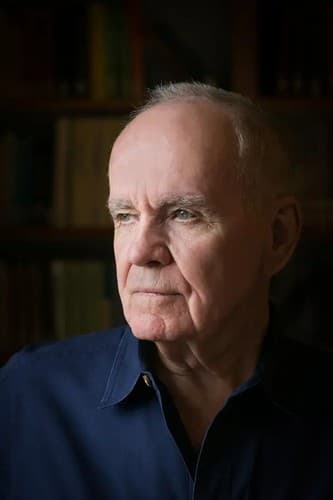
Cormac McCarthy was an American writer who authored twelve novels, two plays, five screenplays, and three short stories, spanning the Western and postapocalyptic genres. He was known for his graphic depictions of violence and his unique writing style, recognizable by a sparse use of punctuation and attribution. McCarthy is widely regarded as one of the greatest American novelists.
Similar books
- The Road
Cormac McCarthy
4.0 (716k) average on GoodreadsScience FictionShares McCarthy's distinctive prose, bleak post-apocalyptic setting, and focus on survival and human nature under extreme duress.
- Lonesome Dove
Larry McMurtry
4.5 (149k) average on GoodreadsHistorical FictionAnother epic Western, though vastly different in tone, it explores the harsh realities of the frontier with deep character development.
- The Old Man and the Sea
Ernest Hemingway
3.8 (831k) average on GoodreadsLiterary FictionA Cuban fisherman's long struggle with a giant marlin becomes a story of endurance and dignity, now retold for young adults with illustrations, phonetic guides, and writing prompts in Traditional Chinese.
- One Hundred Years of Solitude
Gabriel García Márquez
4.1 (753k) average on GoodreadsLiterary FictionThrough the multi-generational story of the Buendía family, a mythical town deals with the repeating patterns of time, love, and solitude, as the extraordinary mixes with the ordinary.
- The Goldfinch
Donna Tartt
3.9 (720k) average on GoodreadsLiterary FictionHaunted by a tragic explosion and clutching a stolen Dutch masterpiece, a young orphan navigates the opulent drawing rooms of New York and the gritty underbelly of the art world, desperately seeking connection and redemption amidst a life spiraling into crime and obsession.
- Little Fires Everywhere
Celeste Ng
4.1 (713k) average on GoodreadsLiterary FictionIn Shaker Heights, an artist and her daughter move in, and their free-spirited lives clash with a rule-bound matriarch, revealing hidden conflicts beneath a perfect surface.






Enjoyed the summary?
A summary gives you the shape of the book. The book itself has the detail, the examples and the voice.
Find Blood Meridian, or the Evening Redness in the West on AmazonAs an Amazon Associate, BookBrief earns from qualifying purchases. How we're funded