
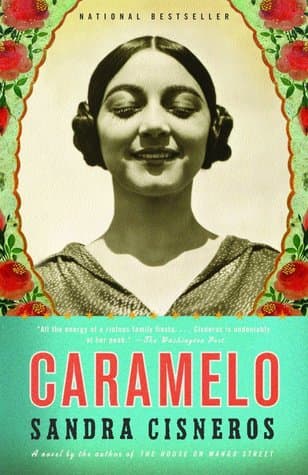
Synopsis
Covers the whole plot, including the ending.
- Difficulty
- Medium
- Pacing
- Variable
- Mood
- Vibrant, Reflective, Humorous, Melancholy, Poignant
- Read it if
- You enjoy rich, multigenerational family sagas with a strong focus on cultural identity, the immigrant experience, and the craft of storytelling itself, with a vibrant, lyrical narrative voice.
- Skip it if
- You prefer fast-paced plots with clear, linear narratives and minimal digressions, or if you dislike books that blur the lines between truth and fiction.
Caramelo Plot Summary
Covers the whole plot, including the ending.
The Annual Migration to Mexico
Every summer, the large Reyes family, including Lala, her six older brothers, her parents, and many aunts and uncles, travels from Chicago to Mexico City. They go to the home of the 'Little Grandfather' and the 'Awful Grandmother' (Soledad). Lala, the youngest and only girl, often feels overlooked among her brothers and the adults' arguments. During these long drives, she starts to notice and absorb the family's stories, especially those about her grandmother Soledad, whom Lala sees as harsh. The trip itself is full of American roadside stops, car problems, and a clear cultural change as they cross into Mexico, setting the scene for Lala's growth and her exploration of her heritage.
Life at the Awful Grandmother's House
When they arrive in Mexico City, the Reyes family settles into the busy, multi-generational home of Little Grandfather and Awful Grandmother Soledad. Lala is curious about the family's history and their complex relationships, especially the tense one between her parents and Soledad. She notices the Awful Grandmother's strict rules and what she sees as favoritism towards other grandchildren, making Lala feel like an outsider. During these summers, Lala starts to put together bits of family lore, listening closely to adult conversations and gossip. She forms a close bond with her Tía Light, who, despite her own difficulties, gives Lala a different view of the family's past and their Mexican heritage, encouraging Lala's growing interest in storytelling.
The Caramelo Rebozo
Lala's connection to her heritage is clear in the caramelo rebozo, a striped shawl passed down through Reyes women. This rebozo, first belonging to her great-grandmother, is a physical link to the past, holding the scent and history of the women who wore it. Lala is fascinated by its story and its importance in her family. When she eventually gets the rebozo, it becomes a strong symbol of her identity, her connection to her ancestors, and her role as a keeper of family stories. The rebozo's journey, from its making in a small village to its passing through different hands, mirrors Lala's own exploration of her complex identity and the ties that bind her to her family's story.
Unraveling Soledad's Past
Wanting to understand why her Awful Grandmother Soledad acts the way she does, Lala begins to uncover Soledad's past. She listens to bits of conversations, looks at old photos, and quietly asks family members questions. Lala learns that Soledad was once a beautiful and lively young woman, deeply in love with her husband, Little Grandfather. However, life's difficulties, including the Mexican Revolution, poverty, and losing children, made her tough. Lala discovers that Soledad's 'awfulness' is a protective facade, a response to a life of struggle. This discovery starts to change Lala's view of her grandmother, moving from simple judgment to a deeper understanding based on empathy.
The Storytelling and Its Repercussions
As Lala starts to weave together her family's stories, especially Soledad's, her Awful Grandmother accuses her of 'exaggerating' and 'telling lies.' Soledad, protective of her own story and perhaps uncomfortable with the raw truth, dismisses Lala's interpretations. This conflict shows the main idea of storytelling itself: how memory is subjective, how fact and fiction blend, and who has the power to tell a story. Lala grapples with these accusations, understanding that her version of events, while perhaps embellished for effect, is an attempt to make sense of her family's history and to voice untold experiences. This tension drives Lala's exploration of truth and the art of storytelling.
The Mexican Revolution and Family Trauma
Lala looks into her grandparents' traumatic past, learning about the devastating effects of the Mexican Revolution on their lives. She finds that Little Grandfather and Awful Grandmother Soledad suffered greatly, including displacement, poverty, and constant threats of violence. Soledad, in particular, experienced significant loss and hardship, which shaped her stoic and sometimes bitter nature. Lala learns how the revolution broke families apart, forced difficult choices, and left lasting emotional scars. This historical background helps explain her grandparents' personalities and their deep resilience, helping Lala connect their personal struggles to the larger historical forces that shaped their world and her family's path.
The American Dream and Cultural Clash
Lala notices the clear difference between her family's life in Chicago and their summers in Mexico City. Her parents, especially her father, work hard for the American Dream, embracing some American culture, yet they stay deeply connected to their Mexican heritage. This dual identity creates constant cultural tension in the family. Lala's brothers show a more American identity, while Lala feels pulled between both worlds. The yearly trips highlight these differences, as they deal with language barriers, different social customs, and the expectations of their Mexican relatives versus their American lives. Lala struggles with her sense of belonging, feeling like an 'other' in both countries at different times.
The Betrayal and Its Legacy
Lala uncovers a painful family secret about a betrayal that greatly affected her Awful Grandmother Soledad. She learns that Soledad was betrayed by a close relative, possibly involving land or inheritance, which contributed to her hardened personality and her distrust of others. This betrayal, though not fully detailed, is presented as a key moment that shaped Soledad's life choices and her relationships with her children, including Lala's father. The discovery of this old grievance helps Lala understand the source of some of the family's long-standing feuds and the bitterness that runs through their interactions, further complicating her view of her grandmother.
Lala's Coming-of-Age and Identity
Throughout the story, Lala goes through a significant journey of growing up. She changes from a quiet observer to an active part of her family's story, finding her voice as a storyteller. As she learns more about her family's past and her heritage, she deals with the complexities of her Mexican-American identity. Lala learns to navigate her family's expectations, the cultural differences between Mexico and the United States, and her own growing desires. Her experiences, especially with her grandmother and the caramelo rebozo, shape her understanding of herself and her place in the world, solidifying her role as the family historian and interpreter of their complex past.
The Power of Storytelling and Reclaiming Narratives
By the end of the story, Lala fully accepts her role as a storyteller, recognizing its power. She understands that stories are not just facts but living things that can be shaped and reimagined to make sense of the past and to voice unspoken things. Despite her grandmother's accusations of 'lying,' Lala realizes that her 'exaggerations' add emotion and meaning to facts, making history resonate. She sees herself as a weaver of tales, like the weaver of the caramelo rebozo, creating a rich tapestry of her family's experiences, reclaiming stories, and finding healing and understanding through telling them.
The Legacy of the Reyes Women
Through her journey, Lala comes to appreciate the strength and resilience of the Reyes women, especially her great-grandmother, her grandmother Soledad, and her mother. She sees how they faced great hardship, cultural expectations, and personal struggles with quiet determination. The caramelo rebozo becomes a strong symbol of this legacy, representing the connections, tradition, and female endurance that link them across generations. Lala recognizes that she is a product of these women, inheriting not just their stories but also their spirit. This understanding empowers her to carry forward their legacy, by remembering their past and continuing to tell their stories.
Reconciliation and Acceptance
Though a full reconciliation with Awful Grandmother Soledad is not explicit, Lala reaches a deep understanding and acceptance. By uncovering Soledad's traumatic past and the reasons for her tough exterior, Lala moves beyond simple judgment to empathy. She understands that Soledad's 'awfulness' was a shield, a result of a life filled with loss and betrayal. This deeper insight allows Lala to forgive, if not the actions, then the circumstances that shaped her grandmother. Telling Soledad's story, even with its 'exaggerations,' becomes a way of honoring her, allowing Lala to connect with her grandmother on a deeper, though complex, level.
Principal Figures
Ceyala "Lala" Reyes
Protagonist
The youngest Reyes child and an aspiring storyteller who grapples with her bicultural identity.
Lala is the observant and imaginative narrator, the only girl among six older brothers. She feels both overlooked and burdened by her unique position within the boisterous Reyes family. Throughout the novel, she develops a keen eye for detail and a talent for storytelling, using her observations to piece together her family's complex history. She is driven by a desire to understand her heritage, particularly the enigmatic Awful Grandmother, and to find her own voice amidst the cacophony of her family. Lala is curious, sensitive, and deeply reflective, often using her imagination to fill in the gaps of family lore.
Relationships: Awful Grandmother Soledad (Strained and complicated; Lala seeks to understand and humanize her.); Little Grandfather (Affectionate but distant; Lala sees him as a contrast to Soledad.); Inocencio Reyes (Father) (Affectionate but often overwhelmed; Lala seeks his approval and stories.); Zoila Reyes (Mother) (Caring but sometimes strict; Lala observes her struggles with Soledad.); Tía Light (Confidante and source of family history, offering Lala different perspectives.)
Awful Grandmother Soledad
Antagonist/Supporting
Lala's stern, enigmatic Mexican grandmother, whose past holds many family secrets.
Soledad is initially perceived by Lala as 'Awful Grandmother' due to her strictness, perceived coldness, and favoritism. She is a woman hardened by a lifetime of hardship, including the Mexican Revolution, poverty, and personal betrayals. Soledad is fiercely proud, traditional, and deeply protective of her own narrative, often dismissing Lala's attempts to uncover the past as 'lies.' Beneath her tough exterior lies a history of love, loss, and resilience. She represents the unyielding matriarchal figure, a guardian of tradition and a repository of unspoken family trauma, whose complex character is slowly unraveled by Lala's curiosity.
Relationships: Ceyala "Lala" Reyes (Antagonistic yet deeply connected; Soledad challenges Lala's storytelling.); Little Grandfather (Deep and enduring love, shaped by shared hardship and secrets.); Inocencio Reyes (Son) (Complex and often strained; mother-son dynamics influenced by past events.)
Inocencio Reyes
Supporting
Lala's father, a hardworking Mexican immigrant who balances the American dream with his heritage.
Inocencio is Lala's father, a kind but often overwhelmed man who strives to provide for his large family in Chicago. He is deeply devoted to his wife, Zoila, and his children, but also remains strongly tied to his Mexican roots and his parents in Mexico City. He carries the burden of his family's expectations and the challenges of being an immigrant. Inocencio is often caught between the demands of his American life and the traditions of his Mexican heritage, embodying the bicultural struggle. He is a source of affection and stories for Lala, though sometimes reticent about the more painful aspects of the family's past.
Relationships: Ceyala "Lala" Reyes (Loving father-daughter bond; Lala seeks his stories and approval.); Zoila Reyes (Wife) (Deeply loving and supportive marital relationship.); Awful Grandmother Soledad (Mother) (Strained and respectful, marked by past family tensions.)
Zoila Reyes
Supporting
Lala's mother, a resilient woman who navigates family dynamics and her husband's large family.
Zoila is Lala's mother, a strong and practical woman who manages the chaos of her household and her seven children. She is devoted to her family but often finds herself caught in the crossfire of her husband's sprawling, opinionated relatives, particularly her mother-in-law, Soledad. Zoila represents a more grounded, Americanized perspective within the family, often trying to bring order to the Mexican traditions. She is a loving mother who sometimes struggles to understand Lala's imaginative nature but ultimately supports her children. Her relationship with Soledad is a source of quiet tension and a reflection of generational and cultural differences.
Relationships: Ceyala "Lala" Reyes (Loving mother-daughter bond; Zoila tries to guide Lala.); Inocencio Reyes (Husband) (Deeply loving and supportive marital relationship.); Awful Grandmother Soledad (Mother-in-law) (Strained and respectful, marked by cultural and personal differences.)
Little Grandfather
Supporting
Lala's gentle Mexican grandfather, a quiet presence in contrast to his wife, Soledad.
The Little Grandfather is Soledad's husband and Lala's paternal grandfather. He is a quieter, more gentle figure compared to his formidable wife. He carries his own history of hardship and resilience, having lived through the Mexican Revolution alongside Soledad. While he doesn't dominate the narrative, his presence is a calming force, and he is deeply beloved by his family. Lala sees him as a contrast to her grandmother, a softer presence who offers a different kind of warmth and connection to her Mexican heritage. His love for Soledad is an enduring testament to their shared history.
Relationships: Ceyala "Lala" Reyes (Affectionate grandfather-granddaughter bond.); Awful Grandmother Soledad (Wife) (Deep and enduring love, shaped by shared hardship and secrets.)
Tía Light
Supporting
Lala's aunt, a source of family stories and a confidante for Lala.
Tía Light is Lala's aunt and a significant figure in her development as a storyteller. She is one of the more open and sympathetic adult relatives, often sharing snippets of family history and gossip with Lala, albeit sometimes with her own biases. Tía Light offers Lala a different perspective on the family's past, particularly regarding Soledad, and encourages Lala's imaginative spirit. She has her own struggles and insecurities, which make her relatable to Lala. Tía Light serves as a bridge between the adults' complex world and Lala's quest for understanding.
Relationships: Ceyala "Lala" Reyes (Confidante and mentor in storytelling.); Awful Grandmother Soledad (Complex family relationship, often marked by past slights.)
The Six Brothers
Supporting
Lala's boisterous older brothers, who often overshadow her but also provide protection.
Lala's six older brothers are a collective force of chaos, noise, and masculine energy within the family. They represent a more assimilated, Americanized youth, often more concerned with typical boyhood pursuits than their Mexican heritage. While they frequently overshadow Lala and contribute to her feeling of being overlooked, they also offer her a sense of protection and belonging. Their presence highlights Lala's unique position as the only girl and influences her observations of gender dynamics within the family. They are a constant, rowdy backdrop to Lala's internal journey.
Relationships: Ceyala "Lala" Reyes (Sibling rivalry and occasional protective affection.); Inocencio Reyes (Father) (Father-son dynamics, often involving discipline and expectations.)
Auntie Ninfa
Mentioned
A family member whose story intertwines with the caramelo rebozo's history.
Auntie Ninfa is a character whose connection to the caramelo rebozo is significant. She is part of the lineage of women who owned the shawl before it came to Lala, and her story adds another layer to the rebozo's rich history. While not a central figure in the immediate plot, her presence in the rebozo's narrative emphasizes the interconnectedness of the Reyes women across generations and the way objects carry the weight of personal histories. She represents another thread in the intricate tapestry of family lore that Lala works to unravel.
Relationships: Ceyala "Lala" Reyes (An ancestor whose story Lala uncovers through the rebozo.)
Themes & Insights
The Power of Storytelling and Memory
A main part of 'Caramelo' is how stories are told, remembered, and changed. Lala, as the narrator, constantly grapples with how memory is subjective, how fact and fiction blur, and who has the power to tell a family's history. Her grandmother's accusations of 'lying' show this tension, suggesting that 'truth' often depends on perspective. Lala learns that 'exaggeration' can add emotional truth to stories and make them resonate, giving voice to experiences that might otherwise be forgotten. The novel itself shows that storytelling is not just about recounting events but about creating meaning and understanding across generations. For example, Lala's detailed, imaginative account of her grandmother's past, even if not strictly factual, helps her understand Soledad's 'awfulness.'
“A lie is a story that has been told so many times it's as good as truth.”
Identity and Biculturalism
The novel explores what it means to be Mexican-American. Lala and her family constantly navigate life between their American lives in Chicago and their Mexican heritage in Mexico City. This dual identity appears in their language, customs, values, and possessions. Lala struggles to find her place, feeling like an 'other' in both worlds at different times. The yearly trip to Mexico physically shows this cultural movement, making characters face their dual loyalties. Lala's journey is about integrating these two parts of her identity, understanding that her biculturalism is a source of richness, not division. Her connection to the caramelo rebozo symbolizes her embrace of this intertwined heritage, a physical object that bridges generations and cultures.
“I am a story. I am a letter. I am a song. I am a dance.”
Family Secrets and Intergenerational Trauma
The Reyes family has many secrets, betrayals, and unspoken traumas that affect generations. Lala's search to understand her Awful Grandmother leads her to uncover the deep impact of events like the Mexican Revolution, as well as personal betrayals and losses, on her family. These past wounds appear in the present as strained relationships, unspoken resentments, and the tough exterior of characters like Soledad. The novel suggests that understanding these secrets and the trauma they caused is essential for healing and breaking cycles of pain. Lala's act of bringing these stories to light, even if met with initial resistance, is a key step in acknowledging this intergenerational legacy. The story of the rebozo itself carries the 'vibrations' of these past experiences.
“The past is a rebozo, a shawl, of threads that unravel and tangle, and sometimes tear.”
The Role of Women and Matriarchal Power
The novel shows the often quiet power of women in the Reyes family. From the Awful Grandmother Soledad to the resilient Zoila and the insightful Tía Light, women keep traditions, bear children, and often quietly drive family dynamics. The caramelo rebozo, passed down through generations of women, symbolizes this lasting female line and the strength, resilience, and stories they carry. Lala's journey is deeply connected to understanding these women, their struggles, and their successes, and finding her own place within this powerful matriarchal line. Even in their struggles, the women show great strength in navigating societal expectations.
“A woman's life is a rebozo, a beautiful thing, but also a burden.”
Love and Loss
Beneath the family arguments and historical trauma, 'Caramelo' includes themes of love and loss. The lasting love between Little Grandfather and Awful Grandmother, despite their hardships, is a foundation of the family. Lala observes her parents' protective love, the complex affection among siblings, and the deep love that binds the large family together, even during conflict. However, this love often comes with significant loss—loss of land, loss of children, loss of innocence during the revolution, and the emotional toll of betrayal. The novel explores how love continues and adapts in the face of these losses, shaping characters' resilience and their capacity for both joy and sorrow.
“Love is a thing that changes, like a river, like a dream, like a memory.”
Plot Devices & Literary Techniques
The Caramelo Rebozo
A multi-striped shawl that symbolizes family history, identity, and the art of storytelling.
The caramelo rebozo is the central symbolic object in the novel. Passed down through generations of Reyes women, its striped pattern is said to hold the stories and 'vibrations' of those who wore it. It functions as a tangible link to the past, embodying the family's Mexican heritage, the resilience of its women, and the interconnectedness of their lives. For Lala, the rebozo is a source of fascination and a catalyst for her storytelling, representing the threads of history she attempts to weave together. Its unraveling and re-weaving metaphorically mirror Lala's process of uncovering and reinterpreting her family's narrative, blurring the lines between fact and fiction.
Non-linear Narrative / Flashbacks
The story jumps back and forth in time, interweaving Lala's present with her family's past.
The novel employs a non-linear narrative structure, frequently shifting between Lala's childhood experiences in the present (the annual trips to Mexico) and extensive flashbacks that delve into the history of her grandparents and earlier generations. This fragmented approach mirrors the nature of memory and oral storytelling, where stories are not always told chronologically but emerge in bits and pieces. This device allows Cisneros to gradually reveal the complex layers of family history, secrets, and trauma, building a more complete picture of the characters and their motivations, particularly the Awful Grandmother, as Lala uncovers more information.
Metafiction / Self-referential Narrative
Lala, as the narrator, frequently comments on the act of storytelling itself, questioning truth and fiction.
Lala frequently breaks the fourth wall, directly addressing the reader and commenting on her own narrative process. She questions the reliability of her memories, acknowledges her 'exaggerations,' and debates the nature of 'truth' in storytelling, especially when challenged by her grandmother. This metafictional element highlights the novel's central theme of storytelling's power and subjectivity. It reminds the reader that the narrative is a constructed reality, shaped by the narrator's perspective, desires, and imagination, blurring the lines between author, narrator, and character, and inviting the reader to engage critically with the 'facts' presented.
The 'Awful Grandmother' Archetype
A character archetype that initially presents as harsh but reveals deeper complexities and trauma.
The 'Awful Grandmother' is an archetype used to represent a seemingly difficult or unsympathetic elder whose true nature and past are gradually revealed to be far more complex and sympathetic. Soledad initially embodies this archetype for Lala, appearing cold, critical, and distant. However, as Lala delves into her history, the 'awfulness' is recontextualized as a protective facade, a consequence of immense suffering, loss, and betrayal experienced during the Mexican Revolution and subsequent hardships. This device allows for a profound character transformation (in the reader's perception) and underscores the novel's exploration of empathy, understanding, and the power of uncovering hidden truths.
Caramelo Quotes
“The worst part of it all was that I got to be the one who had to tell the story.”
“A dress can save your life.”
“We are a family of storytellers, and we have been telling stories for generations.”
“It’s not enough to be Mexican; you have to be something else too.”
“The past is a rebozo, a shawl, a caramelo, a sweet, a story, a lie.”
“Home is a foreign place.”
“What do you do when the story you’ve been told all your life turns out to be a lie?”
“We are all made of stories.”
“There are some things you carry with you, no matter how far you travel.”
“A good story is like a good rebozo, it covers you up and keeps you warm.”
“Every family has a caramelo, a sweet, a secret, a lie.”
“My grandmother, she was a woman of many stories, some true, some not so true.”
“You can’t choose your family, but you can choose how you tell their story.”
“To be a woman is to be a story.”
Quiz
10 questions on the plot and the characters. Each answer comes with a short explanation.
Question 1
Which city do Ceyala 'Lala' Reyes's family drive from at the beginning of the summer?
- Los Angeles
- Chicago
- San Antonio
- New York City
Show answer
B. Chicago The Reyes family's annual summer trip begins in Chicago, from where they drive to Mexico City.
Question 2
What is the relationship between 'Lala' Reyes and the 'Awful Grandmother'?
- Lala is the Awful Grandmother's sister.
- Lala is the Awful Grandmother's granddaughter.
- Lala is the Awful Grandmother's niece.
- Lala is the Awful Grandmother's daughter-in-law.
Show answer
B. Lala is the Awful Grandmother's granddaughter. Lala is the granddaughter who observes and tries to understand her Awful Grandmother.
Question 3
What specific item is passed down through generations of Reyes women and is mentioned as being 'alive with the vibrations of history, family, and love'?
- A golden locket
- A set of antique dishes
- A cherished rebozo, or shawl
- A family recipe book
Show answer
C. A cherished rebozo, or shawl The rebozo, a traditional Mexican shawl, is a central symbol of heritage and connection for the Reyes women.
Question 4
What does Lala primarily struggle with among her family, specifically concerning her brothers?
- Financial dependence on them
- Finding her own voice above their 'boom'
- Their constant teasing about her academic performance
- Convincing them to participate in family traditions
Show answer
B. Finding her own voice above their 'boom' Lala struggles to assert her individuality and find her voice amidst her six older brothers' presence.
Question 5
What happens when Lala begins to tell the Awful Grandmother's life story?
- The Grandmother praises her storytelling abilities.
- The Grandmother becomes emotional and shares more details.
- The Grandmother accuses Lala of exaggerating.
- The Grandmother forbids her from continuing the story.
Show answer
C. The Grandmother accuses Lala of exaggerating. The Awful Grandmother's accusation of exaggeration highlights the theme of truth and embellishment in storytelling.
Question 6
How many cars does the Reyes family pack up for their annual summer drive to Mexico City?
- Two cars
- Three cars
- Four cars
- Five cars
Show answer
B. Three cars The family's large size necessitates packing three cars for their journey, emphasizing the scale of their family gatherings.
Question 7
What central theme does the 'multigenerational family narrative turn into a whirlwind exploration of' as Lala tells stories?
- The challenges of modern technology
- The importance of financial stability
- Storytelling, lies, and life
- The impact of political events on daily life
Show answer
C. Storytelling, lies, and life The novel delves into how family stories are constructed, embellished, and passed down, blurring the lines between truth and fiction.
Question 8
What does Lala seek clues about when she starts telling the Awful Grandmother's life story?
- How the Grandmother amassed her wealth.
- How the Grandmother got to be so awful.
- The Grandmother's secret past as a performer.
- The Grandmother's favorite childhood memories.
Show answer
B. How the Grandmother got to be so awful. Lala's curiosity about her grandmother's character drives her to explore her history, revealing a core motivation for her storytelling.
Question 9
The description states Lala struggles to understand her place 'on this side of the border and that.' What does 'this side' and 'that' implicitly refer to?
- Childhood and adulthood
- The past and the present
- The U.S. (Chicago) and Mexico (Mexico City)
- Urban life and rural life
Show answer
C. The U.S. (Chicago) and Mexico (Mexico City) This refers to Lala's bicultural identity, navigating her life in the United States and her heritage and experiences in Mexico.
Question 10
Beyond being a 'shrewd observer of family life,' what other role does Lala take on that defines the narrative of the novel?
- The family's primary peacekeeper
- The family's designated driver
- The family's storyteller and chronicler
- The family's financial manager
Show answer
C. The family's storyteller and chronicler Lala's role as a storyteller, particularly in recounting her grandmother's life, is central to the novel's exploration of narrative and family history.
Caramelo FAQ
What is the central conflict Lala faces as she grows up?
Lala struggles to find her own voice and identity amidst her large, boisterous family, particularly her six older brothers. She also grapples with understanding her bicultural heritage, feeling caught between her Mexican roots and her American upbringing, and trying to define her place in both worlds.
How does the 'caramelo' rebozo function as a symbol throughout the novel?
The caramelo rebozo symbolizes the intertwined history and legacy of the Reyes women, passed down through generations. Its unraveling threads and repairs mirror the family's fragmented memories and the way stories are pieced together, highlighting themes of heritage, truth, and the subjective nature of history.
Describe the annual journey from Chicago to Mexico City and its significance.
Every summer, the Reyes family embarks on a chaotic road trip from Chicago to Mexico City in three packed cars. This journey is a foundational ritual, symbolizing the family's deep connection to their Mexican heritage and serving as a crucial setting for Lala's observations, storytelling, and the unfolding of family dramas.
Who are the Little Grandfather and Awful Grandmother, and why are they important?
The Little Grandfather (Inocencio) and Awful Grandmother (Soledad) are Lala's paternal grandparents in Mexico City, whose house serves as the family's summer hub. The Awful Grandmother, Soledad, becomes a central figure as Lala attempts to unravel her life story, leading to accusations of exaggeration and driving the novel's exploration of truth and fiction.
How does Lala's role as a 'shrewd observer' evolve into her becoming a storyteller?
Lala begins as a quiet observer, soaking in the details of her family's lives and conversations, especially those of her Awful Grandmother. This keen observation naturally transitions into her desire to recount and interpret these stories, eventually leading her to actively shape and 'exaggerate' the narratives herself, questioning the very nature of truth.
What is the significance of the 'Awful Grandmother' accusing Lala of exaggerating?
This accusation is a pivotal moment, directly challenging Lala's narrative authority and prompting the novel's deep dive into the nature of storytelling. It highlights the tension between objective truth and subjective memory, revealing how family histories are constructed and contested, and underscoring that even 'truthful' accounts are shaped by the teller.
How do the 'Asides' or footnotes contribute to the novel's structure and themes?
The 'Asides' serve as Lala's direct commentary, offering historical context, personal reflections, and further 'exaggerations' or alternative versions of events. They break the fourth wall, reinforcing the novel's meta-narrative about storytelling itself, inviting the reader to question the reliability of the narrator and the construction of history.
What is the implied connection between the 'caramelo' rebozo and the 'caramelo' in the title?
The 'caramelo' rebozo is explicitly described as having the color of caramel, directly linking the title to this central heirloom. The word 'caramelo' also evokes sweetness, comfort, and perhaps a bittersweet nostalgia, reflecting the complex emotions tied to family, memory, and the stories that are both comforting and sometimes difficult to swallow.
How does Lala's relationship with Celaya, her 'perfect' cousin, reveal deeper family dynamics?
Lala's perceived rivalry or comparison with Celaya, who is often favored or seen as more traditionally beautiful and obedient, underscores Lala's struggle for individuality and recognition within her family. It highlights the pressures on young women in the Reyes family and Lala's resistance to conventional expectations, pushing her towards a more unconventional path.
How does Lala's bicultural identity contribute to her psychological development?
Lala's biculturalism creates an inherent tension, fostering her observational skills as she navigates two distinct cultural landscapes. It fuels her quest for self-understanding and belonging, leading her to question fixed identities and embrace a more fluid, narrative-based sense of self that can encompass both Mexican and American experiences.
Discuss the psychological impact of being the only girl among six brothers on Lala.
Being the only girl likely contributed to Lala's early development as a keen observer, often feeling overlooked or having to fight for attention and a voice. It also may have fostered a sense of resilience and independence, pushing her to carve out her own space and identity separate from the masculine energy that dominated her immediate family environment.
How does the act of storytelling serve as a coping mechanism or form of empowerment for Lala?
Storytelling allows Lala to process her experiences, make sense of her family's complex history, and assert her own perspective. It empowers her by giving her control over narratives that might otherwise overwhelm her, transforming her observations into agency and allowing her to define her own reality and identity within the family.
What psychological need does Lala fulfill by delving into the Awful Grandmother's past?
Lala's deep dive into Soledad's past is driven by a need to understand the origins of her grandmother's 'awfulness' and, by extension, to understand herself and her own heritage. It's a quest for psychological continuity and a desire to connect with the matriarchal line, seeking clues to her own identity and the complexities of womanhood within her family.
How does the novel challenge traditional notions of historical truth and memory?
The novel explicitly questions the idea of a single, objective historical truth by presenting multiple perspectives, 'exaggerations,' and the subjective nature of memory. Through Lala's storytelling and the Awful Grandmother's reactions, it suggests that history, especially family history, is always a constructed narrative, shaped by who is telling it and why.
What is the novel's stance on the relationship between lies, exaggeration, and truth in storytelling?
Caramelo suggests that 'lies' and 'exaggerations' are not necessarily antithetical to truth, but rather integral components of how human beings make sense of their lives and transmit their histories. It implies that emotional truth and the deeper meaning conveyed through embellishment can be more profound than a purely factual account, especially in family narratives.
In what ways does Cisneros use the rebozo as a metaphor for the novel itself?
The rebozo, with its intricate weave, unraveling threads, and repairs, serves as a powerful metaphor for the novel's structure and themes. Like the rebozo, the novel is a complex tapestry of stories, memories, and histories, constantly being re-woven and re-interpreted, reflecting the layered and sometimes fragmented nature of family narrative and identity.
How does the ending of the novel, particularly its open-ended nature, contribute to its overall message?
The open-ended nature of the novel's ending reinforces the idea that stories are never truly finished, much like life itself. It suggests that identity and family history are ongoing processes of creation and interpretation, inviting the reader to continue pondering the complexities of truth, memory, and the narratives we construct about ourselves and our origins.
What message does 'Caramelo' convey about the importance of oral tradition and family storytelling?
'Caramelo' powerfully argues for the enduring importance of oral tradition and family storytelling as vital means of preserving culture, identity, and connection across generations. It shows how these narratives, even with their embellishments, form the emotional and historical fabric that binds a family together, providing a sense of belonging and continuity.
About the author

Sandra Cisneros is a Mexican-American author known for her contributions to contemporary literature. Her notable works include "The House on Mango Street," a coming-of-age story that explores themes of identity and culture, and "Caramelo," which delves into family dynamics and heritage. Cisneros's writing often reflects her experiences as a Latina in the United States.
Similar books
- The House on Mango Street
Sandra Cisneros
3.6 (126k) average on GoodreadsYoung AdultExplores Mexican-American identity and coming-of-age through a series of vignettes with lyrical prose.
- One Hundred Years of Solitude
Gabriel García Márquez
4.1 (753k) average on GoodreadsLiterary FictionA sprawling, multigenerational family saga rich in magical realism and the intertwining of history and myth.
- Like Water for Chocolate
Laura Esquivel
4.0 (324k) average on GoodreadsFantasyFeatures a strong female protagonist and blends family history, culture, and a distinct narrative voice.
- The Old Man and the Sea
Ernest Hemingway
3.8 (831k) average on GoodreadsLiterary FictionA Cuban fisherman's long struggle with a giant marlin becomes a story of endurance and dignity, now retold for young adults with illustrations, phonetic guides, and writing prompts in Traditional Chinese.
- The Goldfinch
Donna Tartt
3.9 (720k) average on GoodreadsLiterary FictionHaunted by a tragic explosion and clutching a stolen Dutch masterpiece, a young orphan navigates the opulent drawing rooms of New York and the gritty underbelly of the art world, desperately seeking connection and redemption amidst a life spiraling into crime and obsession.
- Little Fires Everywhere
Celeste Ng
4.1 (713k) average on GoodreadsLiterary FictionIn Shaker Heights, an artist and her daughter move in, and their free-spirited lives clash with a rule-bound matriarch, revealing hidden conflicts beneath a perfect surface.




Enjoyed the summary?
A summary gives you the shape of the book. The book itself has the detail, the examples and the voice.
Find Caramelo on AmazonAs an Amazon Associate, BookBrief earns from qualifying purchases. How we're funded